Friday, March 28, 2025

Russia's Black Sea Deal Demands Raise Concerns


By RFE/RL staff - Mar 27, 2025


Russia has linked the Black Sea cease-fire deal to the lifting of Western sanctions on Russian banks and agricultural exports, conditions that are not explicitly stated in the White House version of the agreement.

Experts suggest that Russia's demands may be an attempt to test the Trump administration's desire for a deal and potentially shift blame to Europe if the agreement falls through.

The negotiations surrounding the Black Sea Initiative also involve discussions about restoring broader US-Russian relations, which have been strained for over a decade.


US and Russian statements laying out a framework for limiting military actions in the Black Sea were widely welcomed as a step to wider cease-fire in the Kremlin’s war on Ukraine: Both Moscow and Washington would “continue working toward a durable and lasting peace,” the Kremlin and the White House said.

But the Kremlin statement also had specific language absent from the White House’s.

Moscow would only abide by the agreement, the Kremlin said, after the West lifted sanctions on Russian banks that have been involved trading agriculture products, as well as on Russian ships. Rosselkhozbank, a major state-owned lender for Russian agrobusiness, was mentioned specifically, including connecting it and other Russian entities to the global SWIFT system of bank transfers.

So was lifting restrictions on fertilizer exports and insurance companies covering them.

That’s all potentially a major stumbling block, experts say: Rejoining the SWIFT system, for example, would require European consent -- at a time when US-European relations are spiraling downward.

Is it a “poison pill” aimed at torpedoing the entire deal? Is it Russia pushing maximalist negotiating positions, similar to what it’s done since before the start of the all-out invasion of Ukraine? Or is the Kremlin language merely more explicit in its wording?

“The Russian demands are completely unproportional to what Russia is offering,” Janis Kluge, deputy chief of Eastern Europe and Eurasia division at the German Institute for International and Security Affairs in Berlin, told RFE/RL.

“Moscow wants to test [the Trump administration] here. It wants to see how desperate he really is to get even a partial cease-fire done,” Kluge said. “But it is also important who will get blamed by Trump when there is no deal. Russia's conditions are meant to turn Trump's anger away from Moscow and toward Europe.”

'Root Causes'

Trump has made ending Russia’s three-year assault on Ukraine one of his top foreign policy priorities. In contrast to his predecessor, Joe Biden, who refused to engage with Moscow, Trump’s administration has done just that, holding at least two phone calls with President Vladimir Putin and dispatching top advisers, including Secretary of State Marco Rubio, to Saudi Arabia to open negotiations.


Talks have focused not only on resolving the war, but more broadly restoring US-Russian relations, which have nosedived since at least 2012, under then-President Barack Obama, and then plummeted after the February 2022 invasion. Putin has referred to the broader issues as the “root causes” of the standoff over Ukraine.

The agreement reached this week -- which included a parallel set of US talks with Ukrainian officials -- involved “technical experts” tasked with focusing on just one area: the Black Sea Initiative.

That’s a deal brokered by Turkey and the United Nations aimed at getting Ukrainian and Russian grain exports out of the Black Sea and into world markets, heading off fears of price inflation and famine.

It expired in July 2023 after Russia refused to renew its participation.

The sweeping Western sanctions aimed at punishing Russia for the invasion included cutting off Russian banks from SWIFT, a messaging system that helps banks conduct transfers and payments.

The sanctions did not, however, target Russian exports of food and fertilizer; Moscow remains a major supplier to global markets for agriculture-related goods. However, Russian officials have repeatedly complained that sanctions on things like insurance or shipping and logistics have hindered that trade.

The demands laid out in the Kremlin’s March 25 statement, Kluge said, are similar to what Russia wanted during the 2023 negotiations.


“Back then, Ukraine was in a desperate situation, a solution for grain exports was needed,” he said. “The EU was worried about too much grain coming to Europe, triggering protests by farmers. So the EU was willing to compromise, and ‘re-SWIFTING’ Rosselkhozbank was seen as an option to get it done.”

“We’ve seen this before. They’re basically copying and pasting their own language from the summer of 2023,” said Iulia-Sabina Joja, a senior fellow at the Middle East Institute in Washington, D.C., and former Romanian presidential adviser. “They weren’t as daring as now, with the SWIFT language, and particularly with fertilizer exports, which they’re making a lot of money off of.”

'A Negotiating Tactic’

A week before the Black Sea agreement was announced, the Kremlin and the White House sketched out the framework for a limited cease-fire that aimed to restrict targeting energy infrastructure -- things like power plants, transmission lines, and substations.

Still, Ukrainian and Russian forces have continued to pound one another with drones and missiles, including overnight on March 26.

Dmytro Lytvyn, an adviser to President Volodymyr Zelenskyy, told RFE/RL’s Ukrainian Service that Russia had targeted Ukrainian energy facilities at least eight times since March 18.

In comments to reporters, Kremlin spokesman Dmitry Peskov insisted that Putin's order for a moratorium on targeting Ukrainian energy infrastructure remained in place.

He also said, however, that the Black Sea initiative would be "activated after a number of conditions are met."

The White House’s March 25 statement broadly signaled that Washington would help restore Russia’s access to the market for agricultural and fertilizer exports, along with lowering maritime insurance costs and improving access to ports

In comments to reporters, Trump later signaled that his administration was looking at lifting additional sanctions.

“It’s a negotiating tactic, but it’s not something surprising or unusual,” Joja said of Russia’s position. “They don’t want a cease-fire, or to stop the war. They keep finding excuses not to, keep putting in conditions which are in pursuit of their national interest.”

Russia has made clear its ultimate goal is to have the Western sanctions lifted. But those sanctions remain a bargaining chip for the Trump administration, so it’s unlikely the White House would seek to lift them all at once, Ukrainian economist Borys Kushniruk said.

“It's not advantageous for Trump to lift all the sanctions against Russia. This is an instrument of influence, so why get rid of it?" Kushniruk told RFE/RL’s Ukrainian Service.

Mark Galeotti, a longtime expert on Russia’s security services, argued that Russian officials were setting a trap for the Europeans.

“Many of the concessions Moscow demands are not simply in Washington’s gift,” he said in an op-ed for The Spectator magazine. “Does Europe meekly go along with the American plan, heightening frustrations that it is not also at the negotiating table, or does it resist, again running the risk of further alienating an already Europhobic administration?”

By RFE/RL
Guyana is the World’s Newest Petro-State

By Matthew Smith - Mar 25, 2025

Guyana has become a major player in the global oil market due to substantial offshore oil discoveries, particularly within the Stabroek Block led by ExxonMobil.

The country is projected to become the world’s largest per capita oil producer, with production anticipated to exceed one million barrels per day by 2027.

The rapid development of Guyana’s oil industry has led to exponential economic growth, making it the world’s fastest-growing economy in 2024.


In a mere six years, one of South America’s poorest nations, Guyana, has emerged as the world’s newest petrostate. There is speculation that the tiny country of less than one million is on track to become the continent’s second-largest oil producer. Even neighboring Venezuela’s President Maduro’s never-ending saber rattling over the Essequibo is not distracting the national government, in the capital Georgetown, from promoting the world’s fastest-growing oil boom. Guyana is now a major contributor to the world petroleum supply and will become the largest per capita oil producer, with production anticipated to exceed one million barrels per day by the end of 2027.

After decades of poor exploration results, which led to industry insiders concluding Guyana had little to no hydrocarbon potential, global energy supermajor ExxonMobil in 2015 hit it big in offshore Guyana’s 6.6 million-acre Stabroek Block. The Liza-1 well was drilled to a depth of 17,825 feet (5,433 meters) and encountered 290 feet of oil-bearing reservoirs (90 meters). Production from Liza-1 began in 2019, only four years after the discovery was made in an industry where it can take a decade, even more, to develop major deepwater petroleum resources. Importantly, in a world where low-emission fuels are in increasing demand, the oil being produced is light and sweet with an API gravity of 31.9 degrees and 0.59% sulfur content.

The 6.6-million-acre Stabroek Block is a stunning success for Exxon. The super major, which is the operator controlling 45% of the offshore acreage along with partners Hess (30% ownership) and CNOOC (holding a 20% interest), is investing heavily to develop the block. Exxon’s exploration spending is paying handsome dividends, with it making 46 discoveries in the Stabroek Block since 2015, which are estimated to contain at least 12 billion barrels of oil resources. There are now three floating production, storage, and offloading (FPSO) vessels operating in the Stabroek Block: Liza, Unity Gold and Payara Gold. Eventually, there will be six FPSOs operating by 2027, with the capacity expected to exceed 1.3 million barrels per day.

During November 2024, the Stabroek Block hit the impressive 500-million-barrel production milestone with significant growth ahead as the Exxon-led consortium continues to invest heavily in developing the Stabroek Block. January 2025 data, from Guyana’s Ministry of Natural Resources, shows the country was pumping more than 658,000 barrels per day from the three FPSOs operating in the Stabroek Block. The consortium has completed three projects in the block, with a further three being sanctioned by Georgetown in various stages of development. Exxon is seeking approval for two additional operations: the 180,000 barrel per day Hammerhead project and the Longtail gas development, which will target up to 1.5 billion cubic feet of non-associated gas production and 290,000 barrels of condensate per day.

The 250,000 barrel per day Yellow Tail project will be the fourth facility to come online in the block, with operations slated to commence during 2025 with the ONEGUYANA FPSO. This will see Guyana lifting over 900,000 barrels per day once the Yellow Tail facility reaches capacity, making the former British colony the world’s largest per capita oil producer. Exxon is developing two more projects, Uaru and Whiptail, in the Stabroek Block, which will come online in 2026 and 2027, respectively.


The $12.7 billion Uaru project will have a nameplate capacity of 250,000 barrels per day and will commence production in 2026. Uaru will be composed of 10 drill centers and 44 production and injection wells targeting an oil resource estimated to contain more than 800 million barrels. Exxon’s sixth project is the Whiptail development with a budgeted cost of $12.7 billion and capacity of 250,000 barrels per day from 10 drill centers with 48 production and injection wells. Start-up of Whiptail, which will see a sixth FPSO installed and brought online, is targeted for 2027.

While analysts anticipate that the Exxon-led consortium will be pumping 1.3 million barrels per day from the Stabroek Block by the end of 2027, that number could be significantly higher. When operational, the Uaru and Whiptail projects will add a combined 500,000 barrels per day of production capacity to the Stabroek Block, which, with 900,000 barrels per day already being lifted, should see output rise to 1.4 million barrels daily.

The rapid development of the Stabroek Block and sheer volume of world-class discoveries in offshore Guyana, now exceeding 50 since 2015, underscores the considerable oil potential possessed by the country of less than one million. Those numbers highlight that the US Geological Survey (USGS) seriously underestimated the hydrocarbon potential of the Guyana-Suriname Basin. In a 2012 assessment, the USGS estimated the Guyana-Suriname Basin had recoverable undiscovered oil resources of 13 billion barrels. That number is only slightly higher than the 11.6 billion barrels discovered by Exxon in the Stabroek Block.

Indeed, there is a swathe of hydrocarbon discoveries in the Guyana-Suriname Basin outside of the Stabroek Block, emphasizing how severely the USGS underestimated the basin’s oil potential. Six oil discoveries were made in offshore Guyana outside of the Stabroek Block, which have yet to be formally appraised. Those include the Kawa-1 and Wei-1 wells in the Corentyne Block, which are the subject of a dispute between Georgetown and the majority owner Frontera Energy. There were also four non-commercial discoveries: three in the Canje Block and one in the Kaieteur Block.

There are 10 deep water discoveries in offshore Suriname to consider, particularly with it estimated they contain 2.5 billion barrels of recoverable oil resources. The five world-class discoveries in Block 58, which is contiguous to Stabroek Block, are the most important. TotalEnergies, the operator, and partner APA Corporation are developing a 750-million-barrel resource contained in the Sapakara and Krabdagu discoveries, called the GranMorgu project, which is expected to commence production in 2028. Malaysia’s national oil company, Petronas, the operator with a 100% working interest, made three discoveries in Block 52 offshore Suriname, which are believed to contain 500 million barrels of oil.

Those developments underscore the considerable petroleum potential waiting to be exploited in offshore Guyana, which will boost reserves and production with the former British colony on track to become a leading global oil exporter. The rapid growth of Guyana’s oil industry is responsible for skyrocketing national gross product (GDP). For 2024, the former British colony is experiencing real GDP growth of a whopping 43.8%, taking its value to nearly $63 billion, making Guyana the world’s fastest-growing economy that year. That strong growth will continue into 2025, with the economy forecast to expand by over 14% to see GDP exceed $70 billion. This bodes well for Guyana, which is expected to become South America’s wealthiest country on a GDP per capita basis

By Matthew Smith for Oilprice.com


India Set to Tap Vast Oil Reserves With Multi-Billion Dollar Investments


By Alex Kimani - Mar 24, 2025


Motilal Oswal sees U.S. tariff pressure as an opportunity for India to boost domestic production and reduce its trade reliance.

India imports 87% of its oil but holds an estimated 22 billion barrels of untapped reserves in underexplored basins like Mahanadi, Andaman, Bengal, and Kerala-Konkan.

With only 10% of India’s sedimentary basins currently under exploration, the government aims to ramp that up to 16% this year.


Amid concerns over U.S. President Donald Trump’s hard-hitting tariff policy, diversified Indian financial services company Motilal Oswal has suggested that India could strengthen its domestic industries and ramp up local production. Trump has a history of imposing heavy tariffs on India, including 25% on steel and 10% on aluminum imposed in 2018. The tariffs had an inimical effect on India’s trade with the U.S., with steel exports plunging 46% one year after the tariffs were announced.

Meanwhile, India’s heavy reliance on oil imports leads to huge capital outflows and a weaker rupee. India imports 87% of its oil, mainly from Russia, Iraq, Saudi Arabia, the United Arab Emirates and the U.S. India spent $132.4 billion on crude oil imports in the 12 months up to mid-2024, a 16% Y/Y drop thanks to lower oil prices. Luckily, India is well endowed with substantial oil reserves. Last year, S&P Global Commodity Insights reported that four largely unexplored sedimentary basins in India could hold up to 22 billion barrels of oil. In effect, lesser-known Category-II and III basins namely Mahanadi, Andaman Sea, Bengal, and Kerala-Konkan contain more oil than the Permian Basin which has already produced 14 billion of its 34 billion barrels of recoverable oil reserves.

Rahul Chauhan, an upstream analyst at Commodity Insights, has emphasized the potential of India’s unexplored Oil & Gas sector, "ONGC and Oil India hold acreages in the Andaman waters under the Open Acreage Licensing Program (OALP) and have planned a few significant projects. However, India still awaits the entry of an international oil company with deepwater and ultra-deepwater exploration expertise to participate in current and upcoming OALP bidding rounds and explore these frontier regions," he has declared.

Currently, only 10% of India’s 3.36 million sq km wide sedimentary basin is under exploration. However, Petroleum Minister Hardeep Singh Puri says that figure will jump to 16% in 2024 following the award of blocks under the Open Acreage Licensing Policy (OALP) rounds. So far, OALP has resulted in the award of 144 blocks covering about 244,007 sq km. Under OALP, India allows upstream exploration companies to carve out areas for oil and gas exploration and put in an expression of interest for any area throughout the year. The interests are accumulated thrice a year following which they are put on auction. According to Puri, India’s Exploration and Production (E&P) activities in the oil and gas sector offer investment opportunities worth $100 billion by 2030.

India boasts significant discoveries in the Krishna-Godavari, Barmer, and Assam basins, but exploration in other areas has been slower to develop. Of India's 3.14 million square kilometers of sedimentary basins, 1.3 million sq km are in deep waters. India had its first foray into deepwater exploration in the Bay of Bengal in 2024 in the Krishna-Godavari Basin, courtesy of India's state run Oil and Natural Gas Corporation (ONGC). ONGC said it was planning to spend over $10 billion developing multiple deepwater projects in its KG-DWN-98/2 block in that basin.

Meanwhile, state-owned upstream company Oil India Ltd is looking to start exploration activities in Nagaland

“We have a total of 30 blocks under the OALP. We have already drilled all wells under the awarded OALP blocks, except in Nagaland. We are pursuing the ministry and they have set up a high power committee involving OIL, ONGC, government officials, to discuss the issue with the Government of Nagaland and resume exploration,” the official said.

Unlike Pakistan, India is likely to have little trouble attracting the oil and gas majors. Indeed, British energy giant BP Plc (NYSE:BP) has been hunting for more opportunities in the country. BP has forged a joint venture with Indian multinational conglomerate Reliance Industries to operate 1,900 fuel retail stations across India and produces oil and gas from a deepwater block in the Krishna-Godavari basin. The JV has teamed up with ONGC to bid for exploration rights for an offshore block in India.

Analysts have predicted that India is set to become the key driver of global oil demand growth, overtaking China.


“China’s role as a global oil demand growth engine is fading fast,” Emma Richards, senior analyst at London-based Fitch Solutions Ltd, told The Times of India. According to the analyst, over the next decade, China’s share of emerging market oil demand growth will decline from nearly 50% to just 15% while India’s share will double to 24%.

A rapidly growing population, which has likely surpassed China’s, is expected to be the main driver of consumption trends in India. Meanwhile, the country’s transition from traditional gasoline and diesel-fueled transport is expected to lag other regions, in sharp contrast to China’s skyrocketing adoption of electric vehicles and clean energy in general.

By Alex Kimani for Oilprice.com


Saudi Oil Giant Aramco Eyes Investment in Indian Refineries


By Charles Kennedy - Mar 27, 2025, 

Saudi Aramco is discussing investments in two new Indian refineries to secure future crude sales.

The company is offering to supply crude volumes equivalent to three times its future stake in each project.

These discussions involve Bharat Petroleum Corporation Ltd (BPCL) and Oil and Natural Gas Corporation Limited (ONGC).


Saudi Aramco, the world’s top oil firm and single biggest crude exporter, is in discussions to invest in two planned refineries in India, sources in India told Reuters on Thursday.

State-owned Indian refiners plan to build several new crude processing plants to meet soaring fuel and petrochemicals demand in the world’s third-largest crude oil importer.

Saudi Arabia, for its part, looks to lock in future term sales for its crude in the top Asian markets, which are set to continue driving global demand growth in the coming years. India has even surpassed China as the single biggest driver of demand growth.

Aramco already has several deals with Chinese refiners and petrochemical producers as the Saudi oil giant has been pursuing deals in recent years to expand its international downstream presence, especially in demand centers such as Asia.

Now Saudi Aramco has set its sights on investment in the new Indian refineries expected to be built. The Saudi oil giant is offering to supply crude volumes equivalent to three times its future stake in each project, according to Reuters’ sources.

Saudi Aramco is discussing buying a stake in Bharat Petroleum Corporation Ltd (BPCL)’s $11 billion new refining and petrochemical complex in south India, and is in separate talks with Oil and Natural Gas Corporation Limited (ONGC) for a proposed refinery in the Gujarat state on India’s west coast, the sources told Reuters.

However, Indian refiners are continuously looking for cheaper crude and diversified supply, and the Saudi proposal to supply a large part of the oil for the new refineries may not work.

BPCL’s refinery project is at a more advanced stage and the state-owned refiner has already launched some preliminary work on the project, including land purchase.

For years Saudi Aramco has been trying to tap downstream opportunities in India. The oil giant has tried – and failed – to reach a deal with private refiner Reliance Industries.

By Charles Kennedy for Oilprice.com
U.S. Copper Import Tariffs May Arrive Sooner Than Expected

By ZeroHedge - Mar 27, 2025,


The US administration is considering implementing copper import tariffs sooner than initially expected, potentially by mid-May, which is significantly ahead of the original September-November timeline.

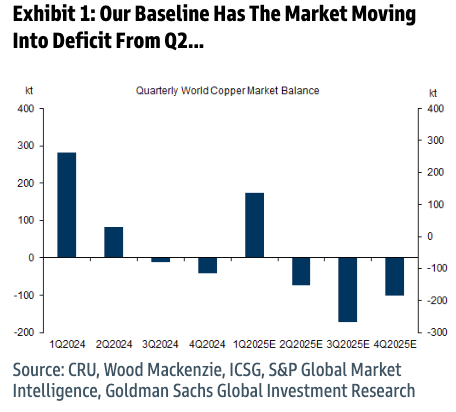
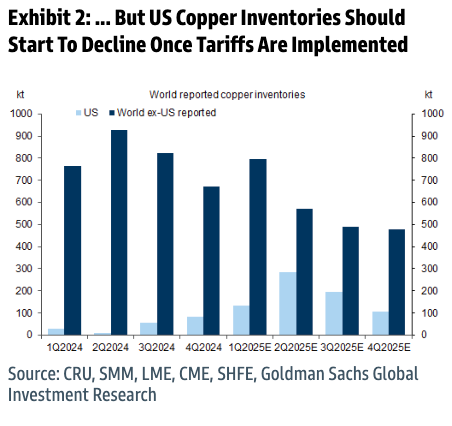
Goldman Sachs analysts predict that the expedited tariffs will lead to a temporary surge in US copper imports in April, followed by a decline in US stocks and a normalization by the third quarter of 2025.

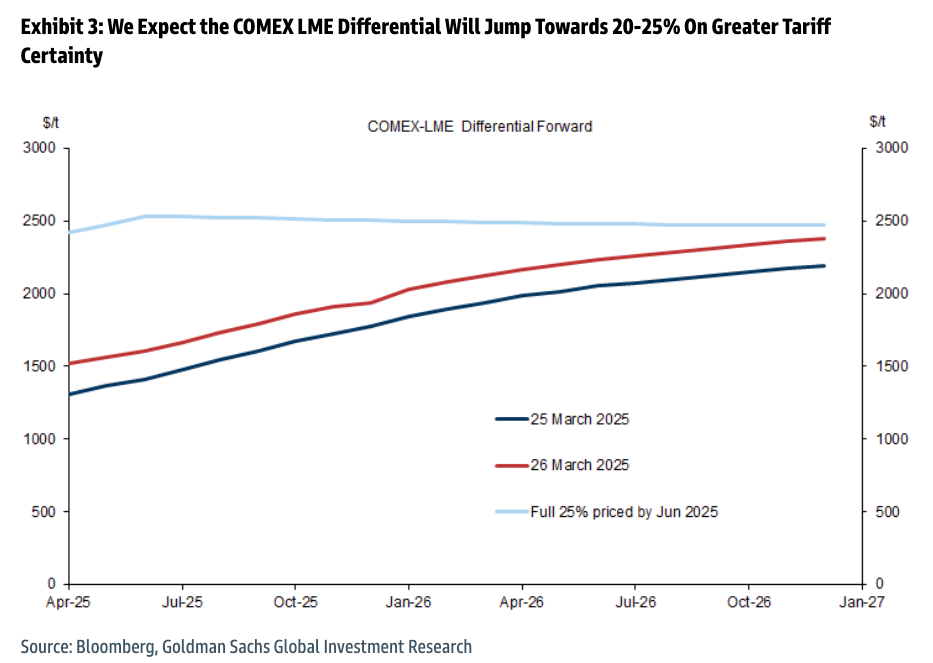
The anticipation of these tariffs has caused a significant widening of the price gap between COMEX and LME copper contracts, with COMEX prices rising to record highs.


President Trump's national security probe under Section 232 of the Trade Expansion Act of 1962, launched in February to review raw copper, refined copper, copper concentrates, copper alloys, scrap copper, and other copper derivatives imported into the U.S, directed the Commerce Department to deliver tariff recommendations to the White House within 270 days. That review process has likely been accelerated, as a new report suggests U.S. copper imports could be enacted in the near-term.

Sources told Bloomberg that the Trump administration is moving quickly with its review of copper import tariffs and will likely act well before the 270-day deadline, which was expected between September and November. The new timeline has now shifted to mid-May.

Commenting on the shortened timeline, Goldman's Eoin Dinsmore, Aurelia Waltham, and others provided clients with a critical Q&A addressing physical market flows and pricing across various exchanges:

What is the impact on physical market flows?

Greater certainty on copper tariffs means COMEX is likely to trade at a higher premium to LME, but there is less time to ship metal to the U.S. Assuming tariffs are implemented in May, we think shipments to the U.S. will likely be fast tracked, with net imports in April potentially jumping 200kt[1] above the standard 60-70kt/month, albeit with upside risk. However, with the possibility of earlier tariff implementation, we now expect U.S. stocks to decline by 30-40kt/month from mid-to-late Q2 onwards. Thus, we avoid a stock glut in the U.S. in Q3 2025, when we expect global copper market tightness to be most pronounced.


What is the impact on the LME price?

We see stranded stocks at the low-end of our range - a 200kt increase in U.S. stocks, and a possible 60kt loss of refined production from lower U.S. exports of copper concentrates and scrap. But by Q3, when we forecast the bulk of the 2025 annual global deficit will occur, U.S. stocks should have started to normalize. Thus, the expected H2 crunch should be less pronounced, which reduces upside risk to our LME price forecast. We hold to our 3/6/12 Month LME price forecasts of $9,600/t, $10,000/t and $10,700/t, and flag near-term downside risk from the trade policy update on April 2nd.

Will COMEX now price the full 25% tariff over the LME?

Factoring in uncertainty on the tariff level and high U.S. inventories, we think an implied tariff of 20% should be the cap in the near-term. This has also been a level regularly cited as a good exit point in numerous client meetings.

Will Sep-Dec 2025 spreads tighten?

We close the trade recommendation to go long Sep-Dec 2025 timespreads. Despite Q3 2025 being the key point for global copper market tightness, the spread will no longer need to rise to a level to halt exports to the U.S. Based on our Q3 ex-US reported inventories forecast, the likely backwardation would be only $0-60/t, close to current levels.

The analysts see global copper markets shifting into a deficit in 2Q25.


U.S. copper inventories should begin declining after tariffs are enacted.


Analysts expect the COMEX and LME spread to be capped soon.


The Bloomberg report sent copper prices on Comex up 3% to a record $5.37 per pound. Meanwhile, the benchmark price on the London Metal Exchange fell 2% to $9,893 per ton, widening the gap between the two contracts to about $1,700 per ton


"The news today is this story of Copper tariffs coming sooner than possibly expected... LME/CMX arb at $1750-1800 in July (+$300 to start today) or 18% Tarrff expected," Goldman analyst James McGeoch told clients earlier.


McGeoch offered some thoughts about today's news and copper trading:The durability of this move is significantly greater than 2024. Balances are tight, there is a fundamental driver and a technical ampifier (that technical is also fundamental in that the U.S. is short metal, fundamentally they want to change that).
As price traded back to $10k last night, the CMX premium now well above 15%, as it trades through record highs to 529 (+1.5%), traders (with vested interests) talk about price to $12k
Remember that whilst metal is being stacked in the U.S., we had last week the China SRB suggest it was also looking to build stocks of critical minerals: cobalt, copper, nickel, and lithium link. So Apparent demand (at either end, U.S. and China) is amplifying the effect of real demand (electrification, Chinese fiscal put, German infra plan), and tightening the balances further
Trading observation in discussion Monday - Positioning has not baked the above in. Regional contract differentiation leaves those with the global view on sideline (also too much idiosyncratic risk they lack edge to play). Point is the big rally lacks a big uptick in spec interest/positioning. The copper fwds have a lot to go, the incentives not in the curve and physical premiums doubled last week (first sign they are being impacted). The work now is dissecting physical location premiums and how the moves in inventory can impact near term demand. As we rally to $10k we may see some producing selling and as such spreads can remain bid.
CTA's are as long as I can recall, the GS model suggests close to $18bn (historical max 19.6bn). This is where all the length is. CFTC weekly data showed a fairly meh inc for managed money accts (CME +9 to 22k lots, LME +2 to 63k)

And we ask: What happens to global copper production with prices at record highs?


Now that tariffs are likely to be imposed sooner, importers will have significantly less time to rush copper shipments into the U.S.

By Zerohedge.com

Column: Green iron is a prize worth billions, winning is the trick

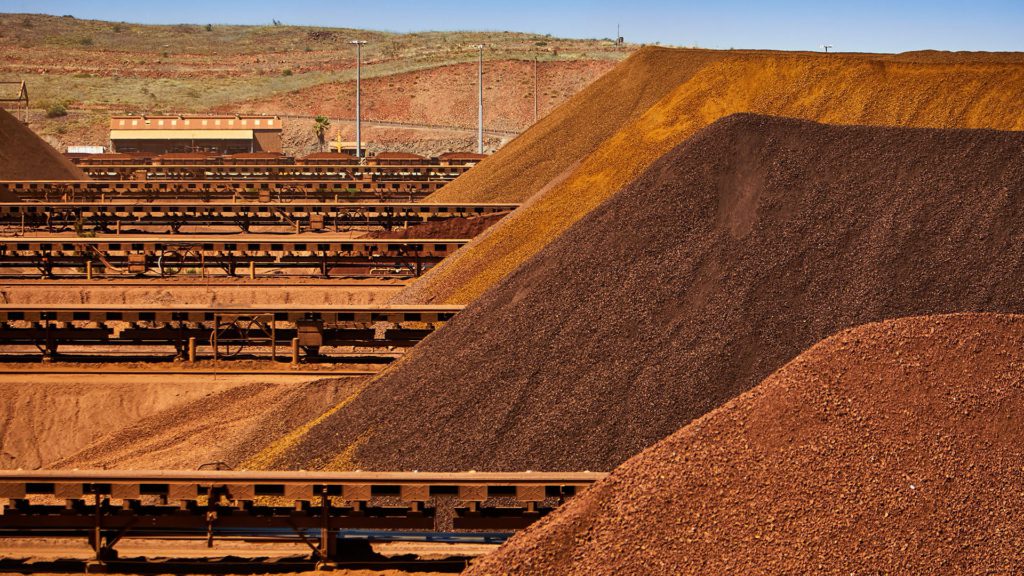
Piles of iron ore at Cape Lambert (Credit: Rio Tinto)

Decarbonizing the steel industry is one of the massive challenges in meeting climate goals, but could end up being extremely profitable for companies and governments prepared to take the risks.

The steel value chain accounts for 7% to 9% of global carbon emissions, the largest single industrial contributor and thus a prime target for the net-zero by 2050 goals of many countries and companies.

The problem is that about 80% of steel emissions come from a single step in the process, namely turning iron ore into pig, or crude, iron by removing oxygen and other impurities, a process that now involves using vast quantities of coal.

The good news is there are available technologies to take coal largely out of the mix, and while the eventual finished steel will not be emissions-free, it is possible to get the carbon intensity down to around 300 kg (661 lb) per ton of steel, about one-seventh of the current 2.2 tons of emissions.

The bad news is that adopting these technologies at the necessary scale requires not only huge capital investments, but massive amounts of cheap green energy and coordinated government regulations and incentives across all countries, from resource producers like Australia to steel makers like China and Japan.

Australia is the world’s largest producer of iron ore, exporting almost 1 billion metric tons a year, of which more than 80% goes to China, the world’s biggest importer and maker of half of global steel.

Iron ore is Australia’s biggest resource export, and metallurgical coal used to make steel is in the top five, meaning the country is extremely exposed to any sustained shift in global steel production to lower emissions.

At the Green Iron and Steel Forum held this week in Perth, the scale of the challenge and value of the potential shift to low-emission steel was front and centre.

Australia’s iron ore exports are worth about $85 billion a year and metallurgical coal a further $34 billion, but the potential increase in value by switching to producing green iron for export was put as high as $252 billion a year.

That assumes converting most of the current iron ore volumes to green iron through a process of using hydrogen made from renewable energies such as solar and wind.

A more realistic view of converting 40% of iron ore output to green iron by 2050 still yields an impressive value of around $110 billion per year, to which would be added the value of the other 60% of iron ore still being shipped.

But building the energy and processing infrastructure to achieve this will require massive amounts of capital, running into hundreds of billions of dollars.

It is likely that the cost of solar panels, wind turbines and battery storage will continue to decline, especially if the massive volumes being demanded result in increasing economies of scale in China.

But even so, before such huge amounts of capital are deployed, investors will need a fairly high degree of certainty.

Commitments needed

Steel mills in existing heavyweights like China, Japan and South Korea will need to commit to actually buying green iron.

This means they will have to commit capital to switching steel production from the coal-intensive basic oxygen furnace-blast furnace method to using electric arc furnaces, which can process green iron into steel without using coal for smelting.

Steel makers will also have to agree to invest in Australian green iron plants and share the up-front capital costs.

Miners are good at digging and shipping iron ore, so they will have to learn how to process the raw ore into pig iron using green hydrogen, which effectively means finding partners with expertise in building firmed renewable power plants and hydrogen production plants.

The problem is aligning all the various parties together in order to kick start what is effectively a new industry, albeit one using an existing raw material.

There is also probably a major role to be played by governments in Australia and across Asia.

Low-emissions steel is going to be more expensive to produce than the current high-emissions product.

Experience suggests consumers are unlikely to voluntarily pay more for a low-emissions product, meaning that the steel sector has to either be punished by carbon taxes or incentivized by subsidies in order to switch.

Some Asian countries are introducing carbon taxes and some have incentives for green projects, but there is no sign of a coordinated regional framework that would provide investor certainty and drive investment.

At the Perth conference it became apparent that the technology and the willingness to embark on the green iron journey exist in Australia.

It is likely that shifting from the dig-and-ship model of iron ore in Australia to adding in the additional step of beneficiating to green iron will be like a proverbial snowball.

Right now the green iron dream is like a small snowball at the top of a mountain. To start rolling downhill and gaining size and speed it needs some initial momentum.

Even once it starts rolling it will take some time to build speed and size, but if it can avoid hitting too many obstacles it can turn into an avalanche by the time it gets to the bottom of the mountain.

(The views expressed here are those of the author, Clyde Russell, a columnist for Reuters.)

(Editing by Clarence Fernandez)


INSIGHT: Myanmar rebels disrupt China rare earth trade, sparking regional scramble

Kachin Independence Army cadets in Laiza. Image by Paul Vrieze (VOA), October 2016, under public domain license, Wikipedia.

When armed rebels seized northern Myanmar’s rare-earths mining belt in October, they dealt a blow to the country’s embattled military junta – and wrested control of a key global resource.

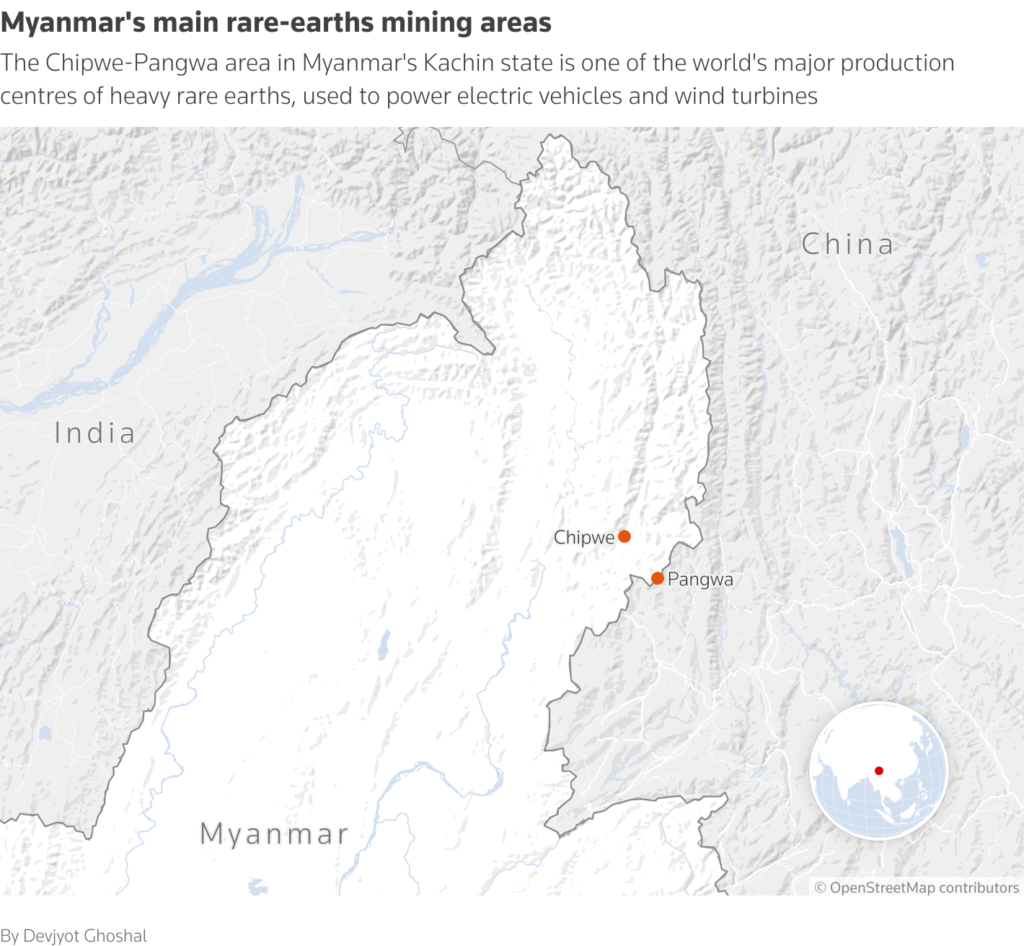
By capturing sites that produce roughly half of the world’s heavy rare earths, the Kachin Independence Army (KIA) rebels have been able to throttle the supply of minerals used in wind turbines and electric vehicles, sending prices of one key element skyward.

The KIA is seeking leverage against neighbouring China, which supports the junta and has invested heavily in rare earths mining in Myanmar’s Kachin state, according to two people familiar with the matter.


Chinese imports of rare earth oxides and compounds from Myanmar dropped to 311 metric tons in February, down 89% compared to the year-ago period, according to Chinese customs data that hasn’t been previously reported. Most of the fall came after October.

Reuters spoke to nine people with knowledge of Myanmar’s rare earths industry and its four-year civil war about turmoil in the mining belt.

One of them described the move by the KIA, which is part of a patchwork of armed groups fighting military rule, as an attempt to drive a wedge between the junta and China.

“They want to use rare earth reserves as a leverage in their negotiation with China,” said Dan Seng Lawn, executive director of the non-profit Kachinland Research Centre, which studies Kachin socio-political issues.

Three of the people also detailed previously unreported interest in the sector by India, China’s regional rival, which they said in late 2024 sent officials from a state-owned rare earths mining and refining firm to Kachin.

The KIA is one of the largest and oldest ethnic militias in Myanmar. It fights for the autonomy of the Kachin minority, a mostly Christian group who have long held grievances against the Bamar Buddhist majority.

The group has imposed a hefty tax on the mostly Chinese-operated rare-earth miners working around Panwa and Chipwe towns in Kachin, according Dan Seng Lawn, whose institute is based in the state, and a Chinese mining analyst.

China has been one of the staunchest international backers of Myanmar’s military since it deposed a civilian-led government in 2021 and ignited a bloody civil war. Beijing continues to see the junta as a guarantor of stability along its frontier, though the military has been ejected from most of the borderlands since a major rebel offensive in 2023.

A spokesperson for China’s Foreign Ministry said the department was not aware of the specifics of the situation in the mining belt but it continues to “actively promote peace talks and provide all possible support and assistance for the peace process in northern Myanmar.”

India’s external affairs ministry, the KIA and a junta spokesperson did not return requests for comment. Bawn Myang Co Ltd, which the US government previously identified as an operator of mines in the area, couldn’t be reached.

Price spike

Chinese spot prices of terbium oxide, whose supply is concentrated in Kachin, jumped 21.9% to 6,550 yuan per kg between late September and March 24, data from Shanghai Metals Market show.

Prices of dysprosium oxide, which is also largely mined in Kachin but was in lower demand over the last six months, eased 3.2% to 1,665 yuan per kg during the same period.

Most rare earths from Kachin are processed in China, so a protracted stalemate would have global implications.

“A prolonged shutdown would likely lead to higher, potentially more volatile rare earth prices in China, and a reshaping of market dynamics in the near term,” research firm Adamas Intelligence said in a February note.

Export plunge

Chinese miners started building up major operations in Kachin in the 2010s, after Beijing tightened regulations on domestic mines.

Kachin’s often unregulated mines steadily expanded after the 2021 coup with the tacit approval of the junta, according to the UK-based Global Witness non-profit.

But the growth came at a heavy cost, ravaging the environment and leaving Kachin’s hills pock-marked with leeching pools, according to witness accounts and satellite imagery.

Since the KIA’s takeover, a 20% tax imposed by the rebels has made it effectively impossible for local operators to run profitable mines.

The KIA wants China to stop pushing it to set down arms against the junta and to recognize the rebels’ de facto control of the border, said Dan Seng Lawn, adding that the parties had met at least twice in recent months.

The KIA has full control of the border in areas where it operates and anti-junta groups rule most of the rest of Myanmar’s frontier with China.

Beijing appeared reluctant to accept the KIA’s demands, though it risked its monopoly on Myanmar’s rare earth reserves if it doesn’t position itself pragmatically, Dan Seng Lawn said.

Reopening the minerals sector would be a major financial lifeline to the rebels: Myanmar’s heavy rare earths trade stood at around $1.4 billion in 2023, according to Global Witness.

The KIA has told miners in Kachin it will now allow shipments of existing rare earth inventories to China, Reuters reported Thursday.

But to resume operations at full capacity, the KIA needs an agreement with China, home to thousands of workers with the know-how, said Singapore-based rare-earths expert Thomas Kruemmer.

“Without them, this won’t work, full stop,” he said.

India alternative?

Amid the ongoing tussle, India has attempted to deepen its influence in Kachin, with which it also shares a border, according to Dan Seng Lawn and two people familiar with Indian official thinking.

India’s state-run mining and refining firm IREL in December sent a team to Kachin to study resources there, according to one of the Indian sources, who spoke on condition of anonymity due to the sensitivity of the matter.

Indian authorities have reservations about operating in an area with armed non-state actors, but the Kachin desire to diversify away from China and New Delhi’s need for resources have pushed the two parties to talk, the Indian source said.

IREL did not return requests for comment.

An Indian delegation that included IREL also held an online meeting with the Kachins in December to discuss their interest in reopening the rare-earths sector, said Dan Seng Lawn, who attended the discussion.

They were willing to pay higher prices than China, he said.

Any India deal faces multiple obstacles, said Kruemmer and Dan Seng Lawn.

There is only skeletal infrastructure along the mountainous and sparsely populated Kachin-India frontier, making it challenging for commodities to be moved from Myanmar to the neighbouring northeastern states of India. Those states are also far removed from India’s manufacturing belts in the south and west.

India also doesn’t have the ability to commercially process the heavy rare earths and transform them into magnets used by industry, according to Kruemmer and the Indian source.

Some 90% of the world’s rare earths magnets are produced in China, which has brought the sector under tighter state control, followed by Japan.

Nevertheless, if Beijing does not recognize the “changing power dynamics,” Dan Seng Lawn said, the KIA “will have to open alternative options.”

(By Devjyot Ghoshal, Poppy McPherson, Amy Lv, Neha Arora and Shoon Naing; Editing by Katerina Ang)


Myanmar: Arakan Army To Begin Conscription In West

Members of the Arakan Army. Photo Credit: Arakan Army

By 

One of Myanmar’s most powerful rebel armies will begin conscription for all residents over 18 years old, sources told Radio Free Asia on Thursday. 


The Arakan Army, or AA, which controls the vast majority of western Myanmar’s Rakhine State, is organizing administrative processes in the state that would make conscription a legal obligation, a source close to the AA told RFA, adding that details would be released soon. 

A resident from the state’s Mrauk-U township also confirmed that the AA was holding meetings in villages to discuss details about the conscription.

“Men between the ages of 18 and 45 will undergo two months of military training and be required to serve for two years,” the resident said, speaking on condition of anonymity for security reasons.

He added that women between the ages of 18 and 35 will also be required to serve.

No information has been released about what draftees will be required to do or whether they will serve in combat, raising concerns among civilians in the embattled region, which has witnessed brutal retaliation efforts from Myanmar’s junta.


The AA currently controls 14 of Rakhine state’s 17 townships.

RFA contacted AA spokesperson Khaing Thu Kha for more information, but he did not respond by the time of publication.

With a well-organized military structure and strong local support, the AA has established de facto governance in much of the region, collecting taxes and administering justice independently from the central government. 

The junta views the AA as a persistent threat, as its growing influence undermines military control and fuels aspirations for greater autonomy among other ethnic groups.

Facing serious setbacks from insurgent groups across the country, reduced foreign investment, and defections from its own troops, the junta enacted controversial conscription laws in February last year, mandating compulsory military service for men aged 18 to 35 and women aged 18 to 27.

​International human rights organizations have strongly criticized junta’s conscription law, arguing that it exacerbates the country’s existing humanitarian crisis and violates fundamental human rights. 

The United Nations Special Rapporteur on Myanmar, Tom Andrews, described the junta’s imposition of mandatory military service as a sign of its desperation and a further threat to civilians. 

The enforcement of this law has led to a significant exodus of young people seeking to evade conscription. Reports indicate that thousands have fled across borders, particularly into Thailand, to avoid mandatory military service.


Radio Free Asia’s mission is to provide accurate and timely news and information to Asian countries whose governments prohibit access to a free press. Content used with the permission of Radio Free Asia, 2025 M St. NW, Suite 300, Washington DC 20036.

 OUTLAW DEEP-SEA MINIJG

Deep-sea mining scars remain after 40 years, but life returning


TMC has carried out exploratory mining expeditions to the Clarion-Clipperton Zone (CCZ). (Image: TMC.)

A new study led by the UK’s National Oceanography Centre (NOC) has revealed that the effects of a deep-sea mining experiment in the Pacific Ocean more than four decades ago are still apparent, though early signs of biological recovery have emerged.

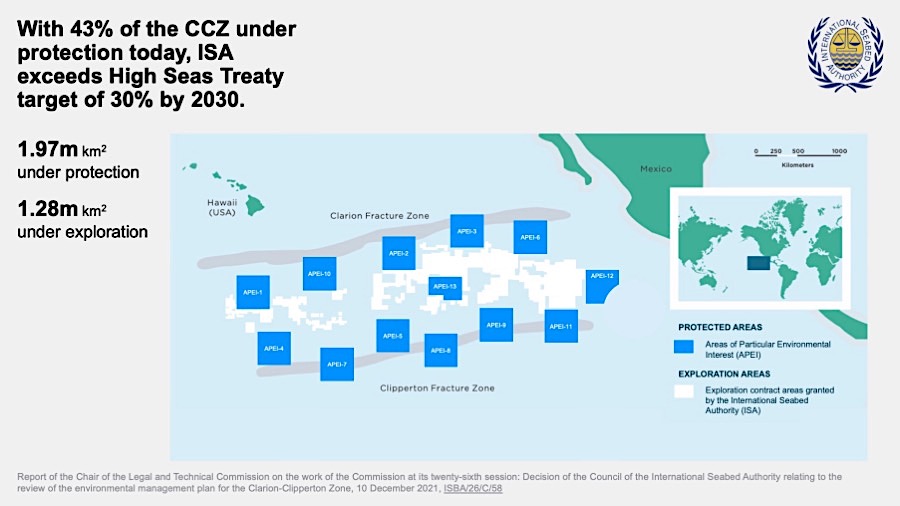
A 2023 expedition to the mineral-rich Clarion Clipperton Zone (CCZ) by a team of scientists led by Britain’s National Oceanography Centre found that the seafloor, a complex ecosystem hosting hundreds of species, still bears scars of a 1979 test mining operation.

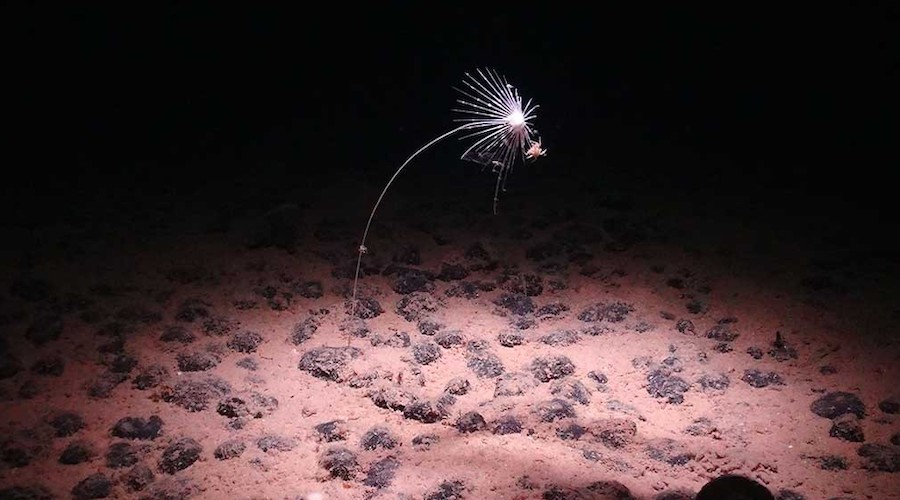
The collection of small polymetallic nodules, potato-shaped rocks rich in minerals and metals, from an eight-metre strip of the seabed caused long-term sediment changes and reduced the populations of many of the larger organisms living there, the study, published in Nature, shows.

The team of researchers also found encouraging signs of recovery, with smaller and more mobile creatures returning to the area.

Lead author and expedition leader, Professor Daniel Jones of the National Oceanography Centre said that to tackle the question of recovery from deep-sea mining, it is necessary to first look at available evidence and use old mining tests to help understand long-term impacts. 

“Forty-four years later, the mining tracks themselves look very similar to when they were first made, with a strip of seabed cleared of nodules and two large furrows in the seafloor where the machine passed,” Jones said.

Among the first creatures to recolonize the disturbed areas were large, amoeba-like xenophyophores, commonly found throughout the CCZ — a vast area between Hawaii and Mexico. “However, large-sized animals that are fixed to the seafloor are still very rare in the tracks, showing little signs of recovery,” he said.

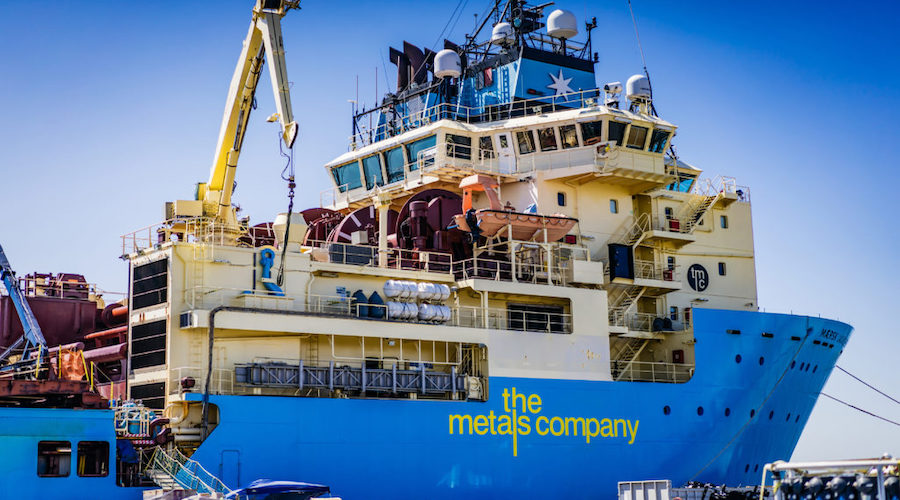
Courtesy of The Metals Company.

The study’s release coincides with a key meeting of the UN’s International Seabed Authority (ISA) in Kingston, Jamaica, where delegates from 36 countries are reviewing over hundreds of proposed amendments to a 256-page draft mining code that will rule commercial deep-sea mining. 

Environmental groups have called for a halt to such activities, a position supported by 32 governments and 63 major companies and financial institutions.

While few expect a final text to be completed by the time the latest round of talks ends on March 28, Canada’s The Metals Company (NASDAQ: TMC) plans to submit the first formal mining application in June.

TMC, which will hold fourth quarter and full year 2024 financial results calls after market close on Thursday, has long said that deep-sea mining has a smaller environmental footprint than terrestrial mining. 

Recovery not only possible, but likely

Chief executive officer Gerard Barron told MINING.COM that the new study supports this view. “For years, activists have pushed baseless claims that nodule-collecting robots will dig up the seafloor and devastate ecosystems. This new study proves otherwise — showing that even with outdated, far more disruptive technology, recovery is not only possible but likely within decades,” Barron said.

“Sessile megafauna such as sponges were scarce in track areas where nodules were removed, as expected, but were observed attached to nodules left behind by the 1979 collector. This suggests a potential mitigation strategy — leaving some nodules intact to support recolonization by reliant organisms,” he said.

Deep-sea mining scars remains after 40 years, but life returning
It was historically thought that the deep sea was fairly lifeless, but recent studies are challenging this perception. Image: ©National Oceanography Centre and The Trustees of the Natural History Museum, with acknowledgement to the SMARTEX project.

TMC has pledged to leave at least 30% of its contract areas untouched to facilitate recovery. “Our own nodule collector will disturb just the top 3 cm of sediment, not the 80 cm as seen in the 1970s trials,” Barron noted.

Opponents warn that the long-term consequences of deep-sea mining remain uncertain, advocating for further research before large-scale extraction begins. Supporters argue that the industry is vital for meeting growing mineral demand.

According to the International Energy Agency, demand for copper and rare earth metals is expected to rise by 40%, while the need for nickel, cobalt, and lithium from clean energy technologies alone could increase by 60%, 70%, and 90%, respectively.

The Metals Company to apply for deep sea exploration license under US legislation

TMC hopes to begin seafloor mining by late 2025. Credit: The Metals Company

Canadian miner The Metals Company said on Thursday it had formally initiated a process under the US Department of Commerce to apply for exploration licenses and permits to extract minerals from the ocean floor.

The company plans to apply under the Deep Seabed Hard Mineral Resources Act of 1980 (DSHMRA) instead of the International Seabed Authority (ISA), stating the latter had not yet adopted regulations around deep seabed exploitation.

It also added that it has requested a pre-application consultation with National Oceanic and Atmospheric Administration (NOAA).

TMC’s bid to become the first company to gain approval to develop deep sea minerals has been controversial. Environmental groups are calling for all activities to be banned, warning that industrial operations on the ocean floor could cause irreversible biodiversity loss.

This move comes at a time when delegations from 36 countries are attending a council meeting of the UN’s ISA in Kingston, Jamaica this week to decide if mining companies should be allowed to extract metals such as copper or cobalt from the ocean floor.

Few expect a final text for the mining code to be completed by the end of the latest round of talks on March 28, with delegates also planning to discuss potential actions if a mining application is submitted before the regulations are completed.

“We believe we have sufficient knowledge to get started and prove we can manage environmental risks. What we need is a regulator with a robust regulatory regime, and who is willing to give our application a fair hearing,” said Gerard Barron, CEO of The Metals Company.

Advocacy group Greenpeace said the move was “desperate”, accusing the company of “encouraging a breach of customary international law”, by attempting to mine the international seabed under US legislation.

(By Seher Dareen and Ernest Scheyder; Editing by Vijay Kishore)


Dutch Project to Design Liquid Hydrogen Powered Bulk Carrier
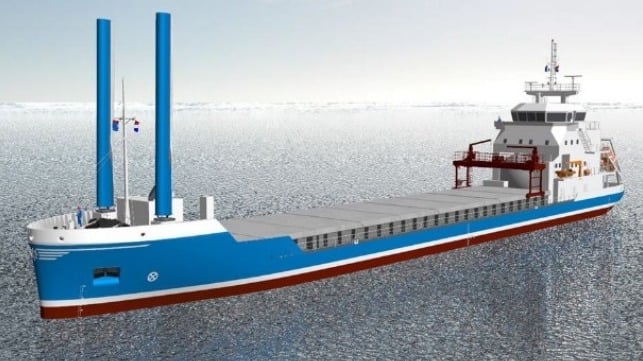
Concept for a liquid hydrogen powered bulker with added benefits from wind propulsion (H2ESTIA)

Published Mar 27, 2025 6:21 PM by The Maritime Executive

A new project launched by a consortium of Dutch companies and supported by the government is focusing on what they are calling the world’s first zero-emission general cargo ship powered by liquid hydrogen. According to the project organizers, this initiative is a key pillar of the Maritime Masterplan, setting a new standard for decarbonizing European maritime logistics.

The project which is being led by the Dutch Innovation Company (Nederlandse Innovatie Maatschappij or NIM) focuses on designing, constructing, and demonstrating a hydrogen-powered cargo vessel that will operate in the North Sea and beyond. Managed by Van Dam Shipping, the ship is designed to transport bulk goods, eliminating harmful emissions and redefining the future of sustainable shipping.

“By integrating hydrogen technology with digital innovation, we are proving that zero-emission shipping is not just a vision—it is an achievable reality,” says Sander Roosjen, CTO at NIM.

At the heart of the H2ESTIA Project is its integrated approach to hydrogen-powered propulsion. The vessel will be equipped with a newly designed cryogenic hydrogen storage and bunkering system, enabling safe handling and storage of liquid hydrogen at extremely low temperatures. A hydrogen fuel cell system together with batteries will provide primary propulsion, delivering clean power.

To further enhance energy efficiency, the ship will incorporate wind-assisted propulsion and waste heat recovery solutions, reducing hydrogen consumption. Digital twin technology will create a virtual model of the ship, allowing for real-time monitoring, operational optimization, and enhanced safety measures.

The project the organizers said is set to demonstrate technological readiness and economic viability, ensuring such vessels can be commercially deployed. It also addresses major challenges such as the certification of hydrogen systems, risk management, and crew training, paving the way for the safe integration of hydrogen technology into maritime operations.

The H2ESTIA Project is supported by a consortium of leading maritime and technology firms, TNO, MARIN, the University of Twente, Cryovat, EnginX, Encontech, classification society RINA, and the Dutch Ministry of Infrastructure and Water Management.