Monday, May 12, 2025


Improving typhoon intensity forecasting and enhancing climate change prediction accuracy


Associate Professor Iwano and team receive MEXT Award for Science and Technology


Okayama University of Science

Associate Professor Iwano and His Team Receive 2025 MEXT Award for Science and Technology 

image: 

Associate Professor Koji Iwano and his research team at Okayama University of Science received the 2025 MEXT Award for Science and Technology (Research Category). The award recognizes their pioneering work in measuring air-sea momentum, heat, and CO₂ transfers under typhoon conditions—contributing to improved accuracy in typhoon intensity forecasting and climate change prediction.

view more 

Credit: Okayama University of Science


On April 15, 2025, Associate Professor Koji Iwano from the Department of Mechanical Systems Engineering, Faculty of Engineering at Okayama University of Science, along with his research collaborators, received the 2025 MEXT Award for Science and Technology (Research Category), presented by Japan’s Ministry of Education, Culture, Sports, Science and Technology.

Their research enabled high-precision measurements of momentum (friction), heat, and CO₂ transfer across the air-see interface, which are closely linked to typhoon intensity and global warming. Notably, it marks the first successful modeling of how these transport phenomena correlate with wind speed and wave morphology under extreme wind conditions.

The study, titled "Investigation of Momentum, Heat, and CO₂ Transport Mechanisms at the Air-Sea Interface Under Typhoon Conditions," was conducted in collaboration with Professor Naohisa Takagaki of the Graduate School of Engineering at the University of Hyogo and Professor Emeritus Satoru Komori of Kyoto University.

According to Associate Professor Iwano, accurately predicting typhoon tracks and maximum wind speeds using global coupled atmosphere-ocean models is essential for developing effective disaster mitigation strategies. However, existing models have lacked clarity in representing air-sea momentum and heat exchange under extreme wind conditions. To bridge this gap, the research team designed and built Japan’s only large-scale indoor typhoon simulation tank, capable of simulating intense, wave-breaking ocean surfaces by generating airflow across the water surface at speeds equivalent to 70 m/s—comparable to a severe typhoon.

Using this facility, the team achieved unprecedented precision in measuring the transfer of momentum, heat, and CO₂ across the air-sea interface, effectively capturing interactions between the airflow and water flow under extreme conditions. Their findings revealed a regime shift at a threshold wind speed of 30 m/s: momentum transfer coefficients, which increase steadily at lower wind speeds and plateau at higher speeds; conversely, heat transfer coefficients, relatively stable at lower wind speeds, increase sharply under higher wind conditions.

These discoveries are expected to contribute to improving accuracy in typhoon intensity forecasts and the development of innovative typhoon control strategies, including potential methods involving artificial intervention to ocean surface conditions.

Commenting on the award, Associate Professor Iwano stated:

“It is a tremendous honor to receive this prestigious recognition. This award acknowledges the outcomes of our indoor experimental research using a large-scale simulation tank. All of us on the research team are sincerely grateful that the significance and value of this work have been recognized—especially at a time when large-scale experimental research is no longer mainstream. I also wish to express my heartfelt thanks to everyone who supported this project. Moving forward, we will continue to advance this research and use these experiments as a platform to foster the next generation of scientists.”


New technology promises to make display screens cheaper, brighter and more environmentally friendly


University of Surrey
University of Surrey's MMT 

image: 

The University of Surrey's MMT

view more 

Credit: University of Surrey


A radical new approach to display screen technology could halve production costs, reduce harmful waste, and deliver brighter, more energy-efficient screens for our smartphones, smartwatches, and even certain medical devices, say researchers at the University of Surrey. 

Most display screens use complex circuits made up of tiny switches called thin-film transistors (TFTs), which control when each pixel turns on or off and how bright it should be. However, building these circuits requires a lot of time, energy, water and harsh chemicals, making the manufacturing process expensive and resource-heavy. 

At this year’s Display Week 2025 Technical Symposium in San Jose, California (11-16 May), Dr Radu Sporea and Dr Eva Bestelink will unveil their latest research, based on a new type of electronic component called a multimodal transistor (MMT). Originally designed as a hardware AI computing element, the MMT also has the ability to simplify display circuits while improving performance and sustainability. 

Dr Radu Sporea, Associate Professor in Semiconductor Devices at the University of Surrey, said: 

“Our invention challenges decades of industry practice by embracing properties usually seen as flaws. In most displays, engineers try to eliminate the energy barriers that form where metals meet semiconductors because they restrict current flow. But instead of working around them, we’ve made those barriers central to how our transistors operate. 

“Using these effects deliberately, we’ve shown that the electronic circuits at the heart of display screens can be made with fewer components and processing steps – reducing waste, cutting costs and improving performance. And because it works with existing materials and tools, it’s a smarter, more sustainable upgrade for the screens we use every day. For the user, the reduced power requirements in operation will also mean significantly improved battery life.” 

The MMT’s unique operation enables extremely compact, high-performance circuits that are particularly well suited to devices where size, energy use and image quality are critical – such as smartphones, tablets, smartwatches, automotive displays, and future wearable devices.  

The technology is already showing promise in simulations, with real-world applications in AMOLED and microLED displays - two of the most advanced and rapidly growing areas of screen technology. It can also be integrated into current production lines with minimal disruption. 

Dr Eva Bestelink, Senior Research Fellow at the University of Surrey’s Advanced Technology Institute, said: 

“I’ve been working on this technology since my undergraduate days at Surrey, where I had the idea to develop a transistor based on neural behaviour, so seeing it evolve into something with real-world potential is incredibly rewarding. We’ve shown that it’s possible to rethink how displays are built without starting from scratch.  

“The MMT lets us design circuits that perform better while also being cleaner and cheaper to make. That’s a win for manufacturers, a win for users and a win for the environment. Beyond displays, it could also have major applications in areas like microfluidics, imaging arrays and hardware AI. We’re still actively researching the AI potential, but the implication for revolutionising manufacturing is clear – especially if we’re to achieve Net Zero.” 

Dr Bestelink and Dr Sporea will present their research on 15 and 16 May at this year’s Display Week 2025 Technical Symposium in San Jose, California. Their invention – the multimodal transistor (MMT), now granted a US patent – builds on more than two decades of pioneering research in thin-film electronics at the University of Surrey. 

[ENDS] 

Notes to editors 

  • Find out more about Display Week 2025 Technical Symposium here


New survey shows privacy and safety tops list of parental concerns about screen time


The Kids Mental Health Foundation offers free tools to help protect kids against screen-time risks


Nationwide Children's Hospital

New survey identifies parents' biggest fears about kids and online dangers 

video: 

A survey from The Kids Mental Health Foundation identifies parents’ greatest fears for their children around screen time, and what the experts say adults can do about it.  

view more 

Credit: The Kids Mental Health Foundation


COLUMBUS, Ohio - As kids spend more time on screens, a new national survey conducted by Ipsos on behalf of The Kids Mental Health Foundation, founded by Nationwide Children’s Hospital, identifies parents’ greatest fears for their children around screen time.

The top three fears parents have around their child and screen time are: privacy and safety concerns (47%), exposure to misinformation (36%) and not socializing in person (34%). Fewer parents ranked concerns around body image and schoolwork high on their list.

“My biggest concerns with screens are making sure that my kids don't get exposed to things before I'm ready for them to and making sure that people aren't trying to contact them,” said Xia Chekwa, a mom of three kids in Columbus, Ohio. “They're aware that not everywhere is a safe place, not everything is a safe thing to watch.”

Eight in 10 parents say they actively do something to manage the screen time of kids. Parents who set screen-time boundaries say setting time limits works the best (58%), followed by encouraging offline hobbies (53%) and using parental control apps (34%).

“When it comes to screen time, we can't expect kids to set their own limits and boundaries. because this technology is made to keep us using it,” said Ariana Hoet, PhD, executive clinical director of The Kids Mental Health Foundation and a pediatric psychologist at Nationwide Children’s. “As parents, we have to pay attention to how much they are using technology – what they are consuming on it, what are they doing with it, and who are they interacting with through various platforms of games or social media.” 

The Kids Mental Health Foundation offers free, evidence-informed resources to help parents understand how to set healthy screen time boundaries and understand how phones, tablets, computers and more impact the mental health and well-being of kids.

Dr. Hoet says having conversations with kids about technology and screen time is key.

Sit with them, watch how they use it, ask them questions, be engaged,” said Dr. Hoet. “And not only does that help your child feel like, oh, you're interested in me and what I'm doing, but it helps you learn as the parent or caregiver.”

Chekwa believes having a social media plan and setting healthy boundaries with technology now will help her oldest daughter in the future.

“Eventually, there's going to come a time when we're not there,” said Chekwa. “And we want to make sure that she knows, and she can decipher and use her intuition for herself and not just because mom and dad said so.”

During Mental Health Awareness Month, The Kids Mental Health Foundation has launched an initiative — Kids Mental Health Starts With Us — to empower adults across the United States to support children’s mental health and wellness with confidence. Kids Mental Health Starts With Us highlights the crucial role parents, caregivers, grandparents, educators, coaches and community members play in helping the children in their lives build mental wellness and resilience before mental health concerns arise. For more information and free kids’ mental health resources, please visit KidsMentalHealthFoundation.org.


Survey Methodology

This survey was conducted online within the United States by Ipsos on the KnowledgePanel® from April 4 to 6, 2025. This poll is based on a nationally representative probability sample of 1,085 adult parents of children under the age of 18. The margin of sampling error is plus or minus 3.2 percentage points at the 95% confidence level, for results based on the entire sample of adults. The margin of sampling error takes into account the design effect, which was 1.14. For complete survey methodology, including weighting variables and subgroup sample sizes, please contact: christopher.moessner@ipsos.com.

The Kids Mental Health Foundation is the leading organization promoting mental health for children in the United States. To achieve its vision to build a world where mental health is a vital part of every child’s upbringing, nearly 1,000 mental health professionals and researchers at Nationwide Children’s Hospital, in partnership with other trusted experts, provide real-world knowledge and expertise to power the Foundation's free educational videos, guides and curriculum. To date, more than 24 million people have engaged with the Foundation’s materials, helping parents, educators and coaches be a guiding force for children all across the United States. During Mental Health Awareness Month in May, The Kids Mental Health Foundation is shining a spotlight on how “Kids Mental Health Starts with Us” and ways its free tools and resources can help empower parents, teachers and coaches across the United States.


Kanlaon volcano in Philippines spews ash over a mile into the sky

A level 3 alert put in place during an eruption in December remained unchanged Tuesday


Last updated: May 13, 2025 | 
AFP


IP camera footage shows multiple pulses of explosive activity that generated incandescent columns that collapsed to form pyroclastic density currents or PDCs that traveled down the southern slopes..x / phivolcs_dost

Manila: 
A volcano in the central Philippines erupted early Tuesday morning, sending a massive grey plume of ash up about three kilometers (1.8 miles) into the sky and launching ballistic projectiles.

Kanlaon Volcano, one of 24 active volcanoes in the Southeast Asian nation, has had several eruptions in the past century -- the most recent of which happened last month.

Also Read:Philippines: Kanlaon volcano kicks up thick ash plumes 800m up in the air, 30+ earthquakes

A level three alert -- out of a scale of five -- put in place during an eruption in December remained unchanged Tuesday, as officials highlighted an existing six-kilometer (four-mile) evacuation radius.

"A moderately explosive eruption occurred at the summit crater of Kanlaon Volcano at 2:55 am today (1855 GMT Monday)," the Philippine Institute of Volcanology and Seismology said in a statement, adding that it lasted five minutes.

"The eruption generated a greyish voluminous plume that rose approximately 3 kilometers above the vent before drifting to the general west," it said.

"Large ballistic fragments were also observed to have been thrown around the crater within a few hundred meters and caused burning of vegetation near the volcano summit."

Stating the continued level three alert, the agency warned there were "increased chances of short-lived moderately explosive eruptions that could generate life-threatening volcanic hazards."

In August 1996, Kanlaon Volcano erupted, sending a spray of heated rocks that killed three hikers who were near the summit at the time.

The Philippines is on the seismically active region of the Pacific known as the "Ring of Fire," where more than half the world's volcanoes are located.

The most powerful volcanic explosion in the Philippines in recent years was the 1991 eruption of Pinatubo, about 100 kilometers (62 miles) from Manila, which killed more than 800 people.
Urban temps turning cities into ‘ovens,’ UN Chief Heat Officer warns


By AFP
May 13, 2025


Eleni Myrivili, Global Chief Heat Officer for UN-Habitat, said cities are 'the Ground Zero of heat' due to their dire impacts on vulnerable populations - Copyright UN-Habitat/AFP HANDOUT

Manon JACOB

Whether in Miami, Athens, or Santiago, dedicated ambassadors are stepping up to tackle extreme urban heat around the world.

Eleni Myrivili, one of the field’s pioneers who currently serves as the Global Chief Heat Officer for UN-Habitat, spoke to AFP about the urgent need to redesign cities to keep asphalt-riddled areas from turning into impossible-to-escape “ovens” for the most vulnerable populations.

Why are cities at the center of your work?

We identified that cities are basically the Ground Zero of heat, where we have the most dire impacts.

Cities today are heat traps and they are built for other types of temperatures, for a different climate. So we need to understand and totally change our perspective as to how we retrofit and develop new areas.

We do it in ways that take into account the fact that we will be dealing with a totally different climate in the next decades.

Can you give us examples of solutions your team worked on?

In Athens, we worked on the categorization of extreme heat, so that there are specific thresholds that trigger different types of policies and actions during heatwaves to make sure that we protect the most vulnerable populations.

We created heat campaigns, so people understand how dangerous heat can be for their health and what they should be doing during heatwaves.

Creating shading structures specifically for people waiting for trains or waiting for buses, so that these have special cooling aspects, like misters or like white or green roofs on them so they do not absorb heat while people are standing right under them. Of course, almost all of us have created plans for nature-based solutions and for bringing more nature into the cities.

How has climate change impacted your region?

On average in the Mediterranean part of Europe, we have about 29 days of strong heat stress (relative to the average for the 1991–2020 reference period), but we jumped from the 29 (average) to 66 (days) in the summer of 2024.

That’s what we mean when we say that the average global temperatures have surpassed 1.5 degrees Celsius from the pre-industrial era, it means that on the ground we see these extraordinary heat seasons.

How can cities prepare against these new norms?

We need to be prioritizing shade, wind and water, and, of course, nature.

This also means that we have to bring within our development and city planning projects other types of expertise. We have to bring in landscape architects. We have to bring in ecologists, foresters, people who understand thermodynamics.

On a very large scale, but also on a very local scale, we have to consider water as the most crucial element that will break us or make us as we deal with rising heat.

In contrast, can you give us an example of what maladaptation can look like in urban spaces?

Air conditioning is a great example of maladaptation because it creates more problems than it solves.

Air conditioning is extremely important to the most vulnerable populations, we have to make sure they have access to air conditioning. But we have to understand that air conditioning has to be used carefully, and not as a panacea that is just going to help us deal with extreme heat.

We can’t air condition ourselves out of this mess that we’ve created, because air conditioners are an extremely selfish way of dealing with extreme heat. You cool your own little space, while at the same time, you’re blowing more hot air into the public spaces.


Free Speech for Me, Deportation for Thee

On May 1, when this site published my OpEd, “The Marketplace of Ideas Only Works if We Leave the Doors Open,” I expected it to be the least controversial piece of my life. It was an old-fashioned, red-white-and-blue libertarian defense of free speech for everyone, regardless of citizenship or viewpoint. It got one supportive comment on the site and 15-20 polite “nice piece” messages from left-leaning friends.

Then I posted it on social media, and it ignited a Facebook meltdown, with hundreds of outraged comments from conservatives, screaming that I was defending terrorists and downplaying antisemitism, for daring to suggest that the First Amendment should apply to everyone, not just American citizens with popular opinions. In hindsight, the reaction was so over-the-top that it did my job for me. The marketplace of ideas only works when the doors stay open, and my critics want gates, locks, and armed guards.

And just as I was finishing writing this follow-up, Columbia University, where I am a professor, exploded again as 78 more pro-Palestine protesters were arrested for taking over a reading room in Butler Library. A few weeks ago, in an earlier piece for the Mises Institute titled “Oops: Trump Just Bankrolled the Protesters He Intended to Silence,” I warned this would happen. 

Fox News gave the protesters round-the-clock attention, and Trump gave them real-world power by cutting half a billion dollars in funding to Columbia in response. Such clumsy attempts to shut people up through heavy-handed state action don’t suppress protest; they radicalize it. What protesters want most is attention and influence, and now that they are getting both in droves, they are getting louder and bolder. And with the protests intensifying again, my Facebook feed is once again flooded with conservative friends saying, essentially, “See? I told you Columbia’s an antisemitic cesspool.” As if that somehow invalidates the principle that speech should remain legal even when it’s awful.

I defended the right of international students like Rümeysa Öztürk, a Turkish graduate student at Tufts University and a Columbia alumna. Her op-ed in The Tufts Daily was calm, logical, and polite. She defended pro-divestment views on Israel while explicitly acknowledging that the university might still be right not to divest, based on the Chicago Principles. No threats, no vandalism, just words. Yet she was thrown in an ICE detention center in Louisiana, labeled a “national security threat,” all because Marco Rubio didn’t like her article. If that OpEd makes her a national security threat, then Antiwar.com readers might want to renew their passports and dust off their go-bags.

Nothing says “land of the free” like jailing a student over an essay in a college newspaper.

But here is where it gets surreal. The same conservatives who erupted in fury when YouTube suspended Senator Rand Paul for questioning mask mandates, and who whined when universities blocked conservative speakers for “security reasons,” are the same ones now cheering when ICE uses an obscure Cold War-era immigration law to deport a Turkish grad student for writing an op-ed. 

Apparently, the First Amendment is sacrosanct until someone with the wrong accent has a dangerous idea. The same people who once called this “cancel culture” now call it “law and order.”

Which brings us to the larger point. Conservatives once ridiculed campus “safe spaces.” Now they want speech banned because it makes them feel unsafe. They mocked trigger warnings and microaggressions, but now they want slogans banned, students expelled, and foreigners jailed. It’s funny how fast “suck it up, buttercup” becomes “call the cops” when someone else is holding the megaphone. Who are the snowflakes now?

Of course, the left doesn’t get to play innocent. They built this censorship machine, celebrated it, and only started noticing the stench when it wafted into their protest tents. They labeled the COVID lab-leak theory a racist conspiracy until the Washington Post changed its mind. They dismissed the Hunter Biden laptop as Russian disinformation until the New York Times quietly admitted it was real. They banned current NIH Director Jay Bhattacharya from social media for questioning Covid lockdowns, then cheered CDC-approved “get out of Covid free” passes for the “essential” George Floyd protests. When Joe Rogan hosted Dr. Robert Malone to discuss mRNA vaccines and ivermectin, Neil Young tried to cancel Spotify itself. 

It wasn’t science but tribal warfare dressed up as public health. And now that it’s their student groups facing expulsion or deportation, they’ve suddenly remembered the First Amendment. How convenient.

Even the groups that claim to champion academic freedom can’t resist hypocrisy. The American Association of University Professors (AAUP) will scream about Florida’s ban on teaching critical race theory (CRT), but barely squeaks when progressive mobs get conservative professors fired for alleged “speech code violations.” The National Association of Scholars (NAS) rails against compelled DEI statements and cancel culture at American universities, then cheers when Republican governors muzzle professors or ban the teaching of “divisive concepts” like CRT. Only the Association of Libertarian Educators, on whose board I proudly sit, consistently defends free speech for everyone, not because we like our opponents’ views, but because we’re not afraid of a fair fight. If you’re trying to tilt the playing field, it’s probably because you know you can’t win otherwise.

And don’t tell me it’s about “encouraging atrocities” or “supporting terrorism.” Öztürk’s detention for an OpEd, with no incitement, flouts Brandenburg v. Ohio (1969), which says speech can only be punished if it incites imminent lawless action, not hurt feelings or State Department snubs. Even Holder v. Humanitarian Law Project (2010), which narrowed the rules for material support to terrorist groups, requires direct coordination, not just agreement with their political agenda. Distributing a leaflet written by Hamas or arguing for the same political outcomes as the IRA or the ANC doesn’t equate to material support for terrorism, unless you are taking direct orders from them. If it did, half of Twitter would have been locked up for retweeting bin Laden’s letter to America

According to The Intercept, there’s no evidence Öztürk was involved with vandalism, harassment, or coordination with Hamas or any group on the State Department’s terror list; she is being deported just because she wrote an essay they didn’t like, in America, as a student. 

Religion doesn’t escape the hypocrisy either. One commenter on my OpEd declared that all morality comes from religion, then qualified the remark by insisting Islam isn’t even a religion. That’s not a worldview; it’s buffet-line theology. Personally, I don’t know and don’t much care whether your god exists or not. What I do care about is people using their imaginary friends as an excuse to silence each other. If your deity is so fragile that it needs ICE, Elon Musk, or Mark Zuckerberg to defend it, maybe it’s time for a new deity. 

In the Middle East debate, logic and morality both seem to go out the window in favor of tribalism. Like most Americans, I found the October 7 attacks horrific, and I also lament the egregious loss of tens of thousands of lives in the retaliatory bombing of Gaza. This shouldn’t be controversial. But this display of basic human empathy earned me accusations of downplaying antisemitism from one side and being an apologist for genocide-denial from the other. Nuance is now heresy. 

It’s time the U.S. stopped trying to referee theological turf wars, whether it’s Sunnis vs. Shiites, Jews vs. Muslims, or Catholics vs. Protestants.

But instead of common sense, we get cowards in cosplay – patriots on the outside, authoritarians underneath. In 1977, the ACLU defended the rights of literal Nazis to march in Skokie, not because they liked Nazis, but to defend the constitution – something far more critical. That took guts. Today, people report professors to HR for “wrong-think,” and call ICE when a student writes something mildly discomfiting. A 2024 FIRE survey found that most college students regularly engage in self-censorship, and these arrests will only increase their number. We’re not educating citizens, we’re training bureaucrats for the Ministry of Truth.

Free speech doesn’t need protection when someone says, “puppies are cute.” It needs protection when someone says, “Puppies are delicious.” I happen to think both are valid propositions, and neither should get you jailed, fired, or deported.

So yes, go ahead and call me disloyal, immoral, antisemitic, Islamophobic, naive, or worse. But let’s be honest: you’re upset because Rümeysa Öztürk calmly and effectively made her case, and you know it will be difficult to defeat her in the marketplace of ideas. So instead of debating her, you attack me for defending her right to speak. Instead of engaging with her argument, you celebrate when the government silences her so you don’t have to. That’s not a defense of your position; it’s an admission of insecurity. If your ideas were truly robust, you’d welcome the challenge. But by seeking to suppress her voice, you reveal an extreme lack of confidence in your own.

Joseph D. Terwilliger is Professor of Neurobiology at Columbia University Irving Medical Center, where his research focuses on natural experiments in human genetic epidemiology.  He is also active in science and sports diplomacy, having taught genetics at the Pyongyang University of Science and Technology, and accompanied Dennis Rodman on six “basketball diplomacy” trips to Asia since 2013.


What to Make of Trump’s Mixed Messages

In negotiations over wars in areas all over the globe, the Trump administration has been sending inconsistent messages. At times, the statements from the White House are so mixed that it is no longer clear what message the President is trying to send. 

Soon after Vice President JD Vance said that the U.S. would not intervene and broker a ceasefire between India and Pakistan, President Trump claimed credit for brokering a truce between India and Pakistan.

“What we can do is try to encourage these folks to de-escalate a little bit, but we’re not going to get involved in the middle of war that’s fundamentally none of our business and has nothing to do with America’s ability to control it,” Vance said.

In the next two days, Vance would call Indian Prime Minister Narendra Modi, and Secretary of State Marco Rubio would be on the phone with officials in India and Pakistan. 

President Donald Trump would then post, “After a long night of talks mediated by the United States, I am pleased to announce that India and Pakistan have agreed to a FULL AND IMMEDIATE CEASEFIRE.”

Despite claiming all the credit, the U.S. did not act alone. The Trump administration’s primary involvement was to get the two sides talking, though talks between India and Pakistan were really already taking place behind the scenes. The U.S. was not involved in helping to draft the actual agreement.

Pakistani Prime Minister Shehbaz Sharif credited the United States, saying, “We thank President Trump for his leadership and proactive role for peace in the region.” India has not only not thanked the United States, but they are, reportedly, furious with them. Trump’s announcement caught India by surprise. It preempted India’s announcement that India and Pakistan had spoken for hours and agreed to a ceasefire, and it undermined Modi’s policy that the Kashmir dispute would be resolved through bilateral talks between India and Pakistan. India has downplayed the U.S. role.

On April 22, Trump completed a phone call with Israeli Prime Minister Benjamin Netanyahu, saying that the two “are on the same side of every issue.” He then acted very differently. 

On May 6, Trump announced that the U.S. would stop its attacks on Yemen since the Houthis had agreed to stop attacking American ships in the Red Sea. He did not mention if the Houthis would cease their attacks on Israel, and the Houthis made it clear that they would not. According to a senior Israeli official, Israel was not notified of the agreement by the U.S. and was caught by surprise. “We were completely shocked. Israel was not informed before Trump made the statement,” one Israeli official said.

Two days later, the U.S. announced that discussions with Saudi Arabia over cooperation on a Saudi civilian nuclear program that had previously been linked to Saudi Arabia normalizing relations with Israel were no longer linked.

Then, on May 9, a report emerged that the White House was pressing Israel to agree to a ceasefire or be “left alone.”

In Iran, the messaging on the nuclear negotiations became so mixed that it was no longer clear what Washington is demanding from Tehran. 

Iran has been clear that negotiations are limited to verifiable limits on its peaceful, civilian nuclear program. Iran’s Supreme Leader, Ayatollah Ali Khamenei, has fully empowered his team to negotiate, but he has placed a firm limit that Iran will not negotiate “the full dismantling of Iran’s nuclear infrastructure.”

Trump has consistently described the meetings the same way: “You know, it’s not a complicated formula. Iran cannot have a nuclear weapon.” Members of his team, though, have not been as consistent. Then National Security Advisor Mike Waltz said that the U.S. is demanding “full dismantlement,” and Trump’s special envoy Steve Witkoff said that “a Trump deal” means “Iran must stop and eliminate its nuclear enrichment and weaponization program.” Rubio said that Iran can have a civilian nuclear program, but by importing uranium enriched up to 3.67 percent and no longer by enriching their own.

The message became truly convoluted when Trump told Meet the Press that the only concession from Iran he would accept was “total dismantlement.” Then, mixing the message even more, speaking in the Oval Office, Trump appeared to walk back that demand, saying, “We haven’t made that decision yet.”

The messaging in the Ukraine-Russia conflict is no less mixed. The Trump team recently presented a “final offer,” not on a 30-day ceasefire, but on a full-blown peace plan. When Ukraine signalled that they wanted the next meeting to continue to focus only on a 30-day ceasefire, Secretary of State Marco Rubio and Steve Witkoff pulled out of the talks.

Trump officials continued to signal a shift from focusing on a 30-day ceasefire to longer-term negotiations. In May, Vance said, “It’s not going to end any time soon…. We got ‘em talkin’. We got ‘em offering peace proposals.” Days later, he said, “The next big step we’d like to take” is having “the Russians and the Ukrainians… actually agree on some basic guidelines for sitting down and talking to one another.”

Then, the administration seemed to pivot again with Trump posting that “The U.S. calls for, ideally, a 30-day unconditional ceasefire,” and that “If the ceasefire is not respected, the U.S. and its partners will impose further sanctions.”

The mixed messaging has left negotiations in a certain amount of confusion. Ukrainian President Volodymyr Zelensky believes he is accepting Trump’s demands by agreeing to a 30-day ceasefire; Russian President Vladimir Putin thinks he is accepting Trump’s demands by offering to “resume direct negotiations” in Istanbul. 

Sticking with the competing formulation, Zelensky is reportedly “open to direct talks with Russia… but only if Moscow signs up to an unconditional ceasefire first.” Trump responded with the demand that “President Putin of Russia doesn’t want to have a Cease Fire Agreement with Ukraine, but rather wants to meet on Thursday, in Turkey, to negotiate a possible end to the BLOODBATH. Ukraine should agree to this, IMMEDIATELY.”

In conflict negotiations around the world, the Trump administration has offered mixed messaging that has led to confusion about the terms of negotiations and about which party is rejecting those terms. Time will tell if the messaging is symptomatic of confusion in the Trump administration or if it is part of Trump’s negotiating strategy.

Ted Snider is a regular columnist on U.S. foreign policy and history at Antiwar.com and The Libertarian Institute. He is also a frequent contributor to Responsible Statecraft and The American Conservative as well as other outlets. To support his work or for media or virtual presentation requests, contact him at tedsnider@bell.net.

Trump’s Visit to Saudi Arabia is Anything but Ordinary


Opinion
Abdulrahman Al-Rashed
Tuesday - 13 May 2025
Asharq Al-Awsat

A Saudi nuclear program, military deals, a defense agreement, ending the Gaza war, a pathway to the two-state solution, negotiations with Iran, and a trillion dollars in trade and investment—this momentum will all be part of US President Donald Trump’s visit. He is expected to be accompanied by a brigade of top tech executives, including Tesla and SpaceX boss Elon Musk, along with leaders from OpenAI, Meta, Alphabet, Boeing, and Citigroup. These big promises make President Trump’s visit to Saudi Arabia an extraordinary one. It will also be his first official foreign trip, marking the start of his international diplomatic agenda.

Preparations for Trump’s visit have been underway for more than two months, an effort of unprecedented scale for both the US and Saudi governments. Multiple discussions took place during the preparations, laying the groundwork for agreements across all relevant political, economic, and defense issues. The visit has been preceded by trips from several regional and global politicians to Riyadh to add more items to the discussion table.

According to US State Department records, twelve US presidential visits to Saudi Arabia have taken place in the past fifty years before Trump’s. All were significant in their historical and political contexts. In today’s historical context, President Trump’s visit coincides with the broadest regional and international shifts since the end of the Cold War.

Regarding bilateral relations, Trump’s visit lays the foundation for a new chapter, considering the nature of the topics under negotiation - some already initiated, others to be finalized later. One is the Saudi nuclear project, which Washington had been reluctant to negotiate over in previous decades. An announcement is likely, as the administration previously leaked details. Interestingly, Saudi Arabia discovered uranium in its deserts during mineral exploration efforts - central to its massive Vision 2030 development plan - propelling its civil nuclear ambitions forward.

Politically, while the US-Saudi relationship is strong, it remains in need of restructuring and clarity. The strategic Quincy Agreement signed by Saudi Arabia’s founding King Abdulaziz and US President Roosevelt after World War II is now considered obsolete. Trump and the Saudi leadership are exploring a new strategic agreement format that accounts for recent developments - America’s transformation into an oil exporter, Saudi Arabia’s growing markets in China and India, and its ambitious Vision 2030 plan to position itself among the world’s top 20 economies.

Trump’s second visit to Riyadh is different, and observers are well aware of today’s shifting political climate: the fall of the al-Assad regime, the collapse of Hezbollah’s strength, the destruction of Houthi capabilities, and, for the first time in a decade, Iraqi militias halting attacks on US and international forces. The agenda itself also makes this summit distinct from his first presidential visit. Trump has reshaped Washington’s stubborn stance and launched a sweeping domestic and foreign policy transformation, with just under four years remaining to try and complete it.

In my opinion, the most important achievement of this summit for Saudi Arabia would be laying the foundation for a long-term, positive working relationship with Trump and the United States. Over the past eight years, the relationship has been successful. Even former critics now see the results. Built on mutual interests, it’s a relationship that can endure. Many countries around the world, including in Europe, are following Saudi Arabia’s lead in managing their affairs with Trump. The era of relying solely on political and military alliances with Washington is over; the focus now is on forging shared interests.

The trillion-dollar relationship that Saudi Arabia pledged to Trump over a ten-year investment span is not a basket of gifts. It consists of mega projects and investments. This is evident from the signed agreements and the delegation accompanying Trump on this trip. It reflects Crown Prince Mohammed bin Salman’s vision and approach: focusing on development and the economy, and overcoming political and security challenges to make the relationship productive and sustainable.


Abdulrahman Al-Rashed is the former general manager of Al-Arabiya television. He is also the former editor-in-chief of Asharq Al-Awsat, and the leading Arabic weekly magazine Al-Majalla. He is also a senior columnist in the daily newspapers Al-Madina and Al-Bilad.
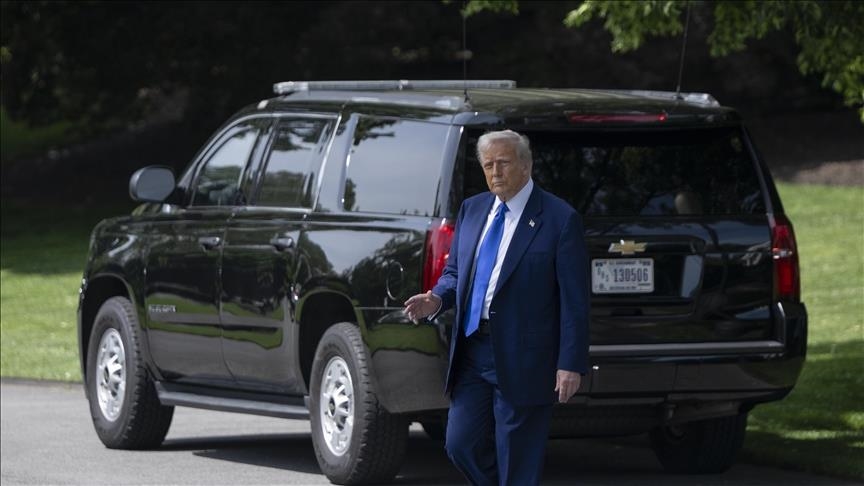
White House Correspondents’ Association protests lack of wire reporters on Trump's Middle East flight

'Leaving out the wires is a disservice to Americans who need news about their president,' association says

Rabia Iclal Turan |13.05.2025
TRT/AA


WASHINGTON

The White House Correspondents’ Association (WHCA) said Monday that it is "disturbed" over the exclusion of reporters from three major wire services from traveling with US President Donald Trump on Air Force One to the Middle East.

In a statement, the WHCA said reporters from The Associated Press, Bloomberg News and Reuters were not allowed to board Air Force One to cover the trip.

"Leaving out the wires is a disservice to Americans who need news about their president, especially on foreign trips where anything could happen and the consequences can impact the entire world," the statement said.

The WHCA emphasized the vital role of wire services in providing timely and accurate coverage to global audiences.

"The WHCA is disturbed by this new restriction on who can cover this White House and continued retaliation for independent editorial decisions. The WHCA is advocating for the wire service journalists to return to their seats on Air Force One where they have reliably covered every president for decades, not for us but for the millions of Americans who depend on their reporting every day," it added.

The decision follows the White House’s announcement that it would control rotation of the small handful of journalists who are granted access to most of the president's events, a role traditionally managed by the WHCA.

White House spokesperson Karoline Leavitt framed the move as an effort to increase inclusion within the press pool.

"The White House Correspondents' Association has long dictated which journalists get to ask questions of the President of the United States in these most intimate spaces. Not anymore," Leavitt told reporters.

The White House barred AP from presidential events, the Oval Office and Air Force One after the agency continued referring to the "Gulf of Mexico" in its reporting, despite an executive order from Trump renaming it the "Gulf of America."