Tuesday, August 19, 2025

WILDCAT!
Air Canada flight attendants vow to defy back-to-work order as strike talks resume

Toronto (Canada) (AFP) – Striking Air Canada flight attendants vowed Monday to defy another back-to-work order from the country's labor tribunal, but resumed talks seeking to end a walkout that has cancelled travel for half a million people worldwide.


Issued on: 19/08/2025 - 

Passengers look at a depatures board in Montreal, Canada, during the Air Canada strike © ANDREJ IVANOV / AFP

Roughly 10,000 flight attendants walked off the job after midnight Saturday, insisting the airline had failed to address their demands for higher wages and compensation for unpaid ground work, including during boarding.

Canada's national carrier, which flies directly to 180 cities domestically and abroad, said the strike had forced cancellations impacting 500,000 people.

Over the weekend, federal labor minister Patty Hajdu invoked a legal provision to halt the strike and force both sides into binding arbitration.

Following Hajdu's intervention, the Canada Industrial Relations Board (CIRB), a regulatory tribual, ordered the flight attendants back to work Sunday.

The flight attendants' union said it would defy the order, forcing Air Canada to walk back plans to partially restore service.

CIRB regulators upped the pressure Monday.


It ordered the union "to resume the performance of their duties immediately and to refrain from engaging in unlawful strike activities," Air Canada said in a statement.

The tribunal gave the Canadian Union of Public Employees until 12:00 pm (1600 GMT) to communicate to members that they "are required to resume the performance of their duties," the carrier added.

Speaking after that deadline, CUPE president Mark Hancock told reporters the solution "has to be found at a bargaining table," and that the union will not respect the tribunal's ruling.

"None of us want to be in defiance of the law," he said, but stressed the union would not waver in advocating for people asked to work hours on the ground during flight delays without "getting paid a dime."

If Air Canada "thinks that planes will be flying this afternoon, they're sorely mistaken," Hancock said.

The union said later Monday that it had resumed talks with the airline as part of "continued attempts to reach a fair deal."

The evening meetings were taking place in Toronto with the assistance of a mediator, William Kaplan, CUPE's Air Canada component said in a statement on Facebook.

But it added that "at this time, the strike is still on, and the talks have just commenced."

Carney 'disappointed'


Rafael Gomez, an industrial relations expert at the University of Toronto, told AFP the union may be on solid legal footing.

The provision "is written in such a way that it's really for a situation where strikes have gone on a long time and there's no way forward," he said, suggesting that standard could not credibly apply to a strike that is just a few days old.

Prime Minister Mark Carney told reporters Monday it was "disappointing" that eight months of negotiations between the carrier and union did not produce an agreement.

"We recognize very much the critical role that flight attendants play in keeping Canadians and their families safe as they travel," he said.

"It is important that they're compensated equitably."

But, he added, Canada faced a situation where hundreds of thousands of citizens and visitors were facing travel uncertainty.

On Thursday, Air Canada detailed the terms offered to cabin crew, indicating a senior flight attendant would on average make CAN$87,000 ($65,000) by 2027.

CUPE has described Air Canada's offers as "below inflation (and) below market value."

In a statement issued before the strike began, the Business Council of Canada warned an Air Canada work stoppage would exacerbate the economic pinch already being felt from US President Donald Trump's tariffs.

Fightback campaign

On Thursday, Air Canada detailed the terms offered to cabin crew, indicating a senior flight attendant would on average make CAN$87,000 ($65,000) by 2027.

CUPE has described Air Canada's offers as "below inflation (and) below market value".

In a statement issued before the strike began, the Business Council of Canada warned an Air Canada work stoppage would exacerbate the economic pinch already being felt from US President Donald Trump's tariffs.

Other labour organisations are voicing support for the flight attendants. Bea Bruske, President of the Canadian Labour Congress, Canada's largest labour organisation, told Reuters they are ready to join the Air Canada strike if necessary.

"All cards are on the table in terms of what unions are prepared to do to ramp up a fightback campaign," said Bruske, whose organisation represents 3 million workers across Canada.

Help could include financial contributions to cover legal costs for CUPE, she said.

Air Canada's pilot union, the Air Line Pilots' Association, said it encouraged its members to join the picket lines during their time off.

"Air Canada pilots support our flight attendant colleagues in their ongoing struggle to achieve the fair contract they have earned," it said in a statement. "This is an important moment for organised labour across Canada."

(FRANCE 24 with AFP and Reuters)


Air Canada suspends restart plans after flight attendants union defies return to work order
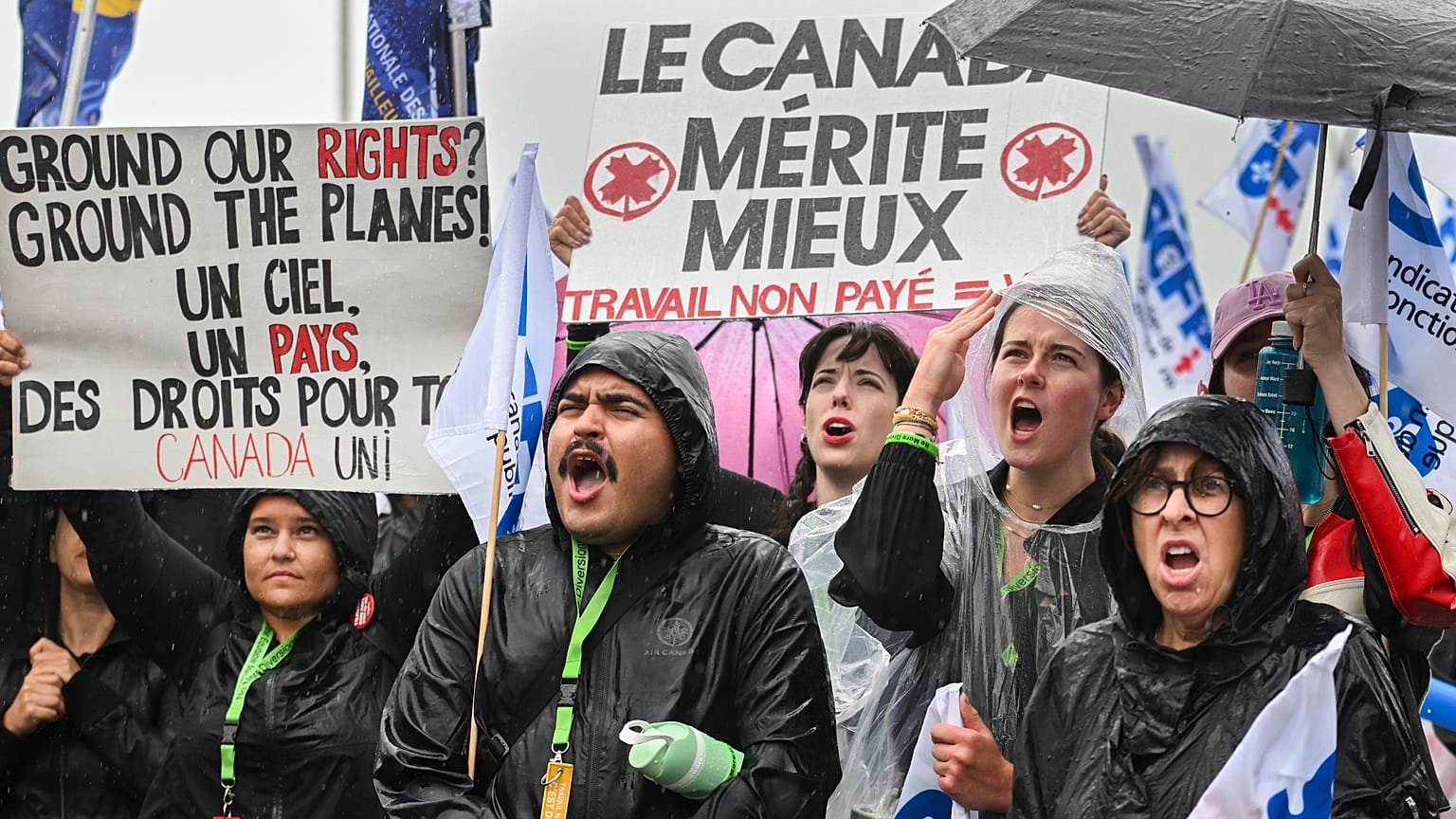
The Canada Industrial Relations Board had ordered airline staff back to work by 2 pm Sunday after the government intervened.


Copyright Graham Hughes/The Canadian Press via AP

By Euronews with AP
Published on 18/08/2025 - 
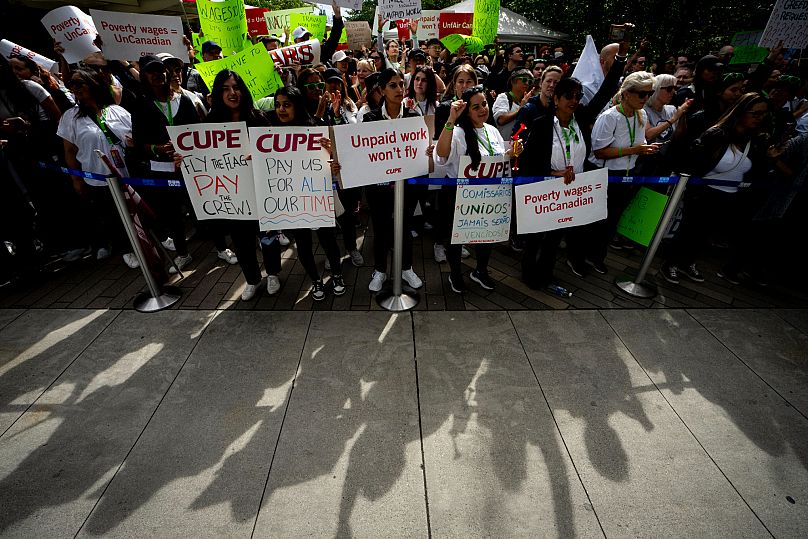
Air Canada said it suspended plans to restart operations on Sunday after the union representing 10,000 flight attendants said it will defy a return to work order.

The strike was already affecting about 130,000 travellers around the world per day during the peak summer travel season.

The Canada Industrial Relations Board ordered airline staff back to work by 2 pm on Sunday after the government intervened and Air Canada said it planned to resume flights Sunday evening.

Canada’s largest airline now says it will resume flights Monday evening. Air Canada said in a statement that the union “illegally directed its flight attendant members to defy a direction from the Canadian Industrial Relations Board.”

However, union members say they will continue to refuse work until their demands are heard, calling the return to work order unconstitutional.
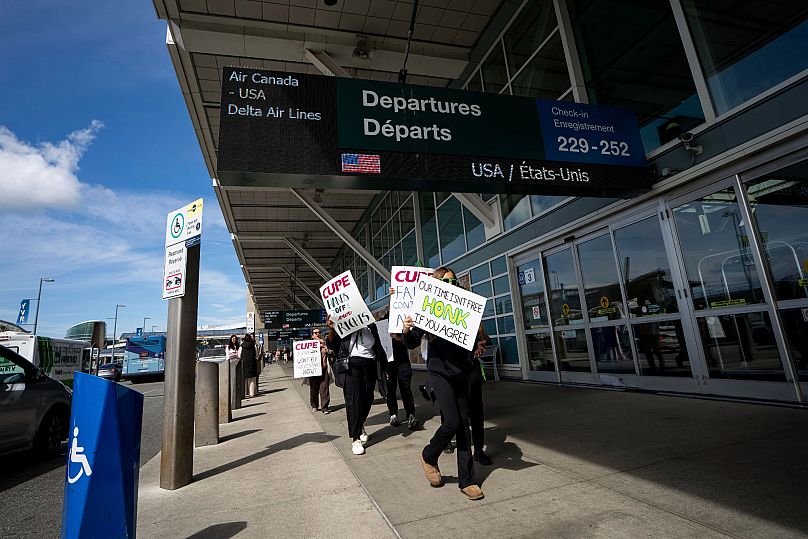
Picketers march around the departures level at the Vancouver International Airport in Richmond, British Columbia, Sunday, Aug. 17, 2025. Ethan Cairns/The Canadian Press via AP

“Our members are not going back to work,” Canadian Union of Public Employees national president Mark Hancock said outside Toronto's Pearson International Airport. “We are saying no.”

Hancock ripped up a copy of the back-to-work order outside the airport’s departures terminal where union members were picketing Sunday morning. He said they won't return Tuesday either.

Flight attendants chanted “Don’t blame me, blame AC” outside Pearson.

“Like many Canadians, the Minister is monitoring this situation closely. The Canada Industrial Relations Board is an independent tribunal," Jennifer Kozelj, a spokeswoman for Federal Jobs Minister Patty Hajdu said in a statement.

Contract talks at an impasse

Less than 12 hours after workers walked off the job, Federal Jobs Minister Patty Hajdu ordered the 10,000 flight attendants back to work, saying now is not the time to take risks with the economy and noting the unprecedented tariffs the US has imposed on Canada. Hajdu referred the work stoppage to the Canada Industrial Relations Board.

The airline said the CIRB has extended the term of the existing collective agreement until a new one is determined by the arbitrator.

The bitter contract fight escalated Friday as the union turned down Air Canada’s prior request to enter into government-directed arbitration, which allows a third-party mediator to decide the terms of a new contract.

Hajdu maintained that her Liberal government is not anti-union, saying it is clear the two sides are at an impasse.

Air Canada workers picket at the Vancouver International Airport in Richmond, B.C., on Sunday, Aug. 17, 2025. Ethan Cairns/The Canadian Press via AP

Passengers whose flights are impacted will be eligible to request a full refund on the airline’s website or mobile app, according to Air Canada.

The airline said it would also offer alternative travel options through other Canadian and foreign airlines when possible. Still, it warned that it could not guarantee immediate rebooking because flights on other airlines are already full “due to the summer travel peak.”

Air Canada and CUPE have been in contract talks for about eight months, but they have yet to reach a tentative deal. Both sides have said they remain far apart on the issue of pay and the unpaid work flight attendants do when planes aren’t in the air.

The airline’s latest offer included a 38% increase in total compensation, including benefits and pensions, over four years, that it said “would have made our flight attendants the best compensated in Canada.”

But the union pushed back, saying the proposed 8% raise in the first year didn’t go far enough because of inflation.


NO STATE INTERVENTION!

Quebec union leaders say workers could face same fate as Air Canada flight attendants

By The Canadian Press
August 18, 2025 

The president of the FTQ, Magali Picard, photographed during a press conference in Quebec City, 
. THE CANADIAN PRESS/Jacques Boissinot

The presidents of two major Quebec unions fear workers in the province could soon face the same treatment as striking Air Canada flight attendants under a provincial law passed in May.

The law gives Quebec’s labour minister the power to end a labour dispute by imposing arbitration when the strike or lockout is deemed likely to cause serious or irreparable harm to the public.

Magali Picard with the FTQ and Éric Gingras with the CSQ say Quebec employers now have an incentive to drag their feet on negotiations while waiting for the government to intervene.

The two union presidents are drawing a parallel between the new Quebec law and federal legislation that permits Ottawa to force two sides in a labour dispute into binding arbitration.

Ottawa has done just that in the conflict between Air Canada and its flight attendants’ union, and the federal labour relations board has ruled the union’s strike unlawful.


However, the union representing the Air Canada flight attendants has defied the order from the labour relations board and says the strike will continue.

This report by The Canadian Press was first published Aug. 18, 2025.


France ‘dismayed’ over Russia’s ban on Reporters Without Borders

The French government has condemned Moscow’s latest move against independent voices after Russia banned Reporters Without Borders, adding the press freedom NGO to its list of "undesirable organisations".


Issued on: 18/08/2025 - RFI


France’s Foreign Ministry says it is dismayed by the announcement that the NGO Reporters Without Borders has been added to Russia’s list of “undesirable organisations", Monday 18 August 2025. © AFP - BERTRAND GUAY

France has voiced its "dismay" at Russia’s decision to outlaw the press freedom NGO Reporters Without Borders (RSF).

The French Foreign Ministry said on Monday that the move formed part of a broader campaign of repression against critical voices, carried out in "flagrant disregard for freedom of expression and press freedom."

Paris also renewed its call for the "immediate and unconditional release of all those prosecuted for political reasons" and urged Russia to honour its international commitments on the right to information and free access to news.

Russian journalist exiled in Paris has 'no regrets' over criticising Ukraine war
'Undesirable organisations'

On 14 August, Russia’s Ministry of Justice announced that RSF had been added to its list of so-called undesirable organisations.

The designation effectively bans the group’s activities inside Russia, placing staff, supporters and funders at risk of prosecution and possible prison sentences.

The Paris-based NGO, campaigns globally for press freedom, documenting violations and providing practical support to journalists working in hostile environments.

In Russia, the group has consistently denounced attacks on independent reporting, censorship, and the targeting of reporters who investigate sensitive topics such as corruption, abuses of power and the war in Ukraine.

Global decline in freedom of expression over last decade, watchdog warns
Decade-long clampdown

This is not the first time Moscow has sought to muzzle international organisations. Over the past decade, Russian authorities have tightened restrictions on foreign NGOs through laws branding them as "foreign agents" or "undesirable."

Amnesty International, Human Rights Watch, and Memorial – one of Russia’s most prominent human rights groups – have all faced severe curbs or outright bans.

Such measures typically criminalise normal organisational activity, exposing staff and even supporters to fines or prison terms, and are widely seen as part of a strategy to isolate Russian society from international scrutiny.

The clampdown has grown sharper since Russia launched its full-scale invasion of Ukraine in 2022.

RSF has pledged to continue its work despite the ban, insisting that it will not abandon the Russian journalists it supports.
Macron says Russia does not want peace, stresses security for Ukraine

Ahead of Monday’s meeting between Ukrainian President Volodymyr Zelensky and US president Donald Trump, French President Emmanuel Macron stressed the necessity of security guarantees for Ukraine in any peace agreement with Russia, adding that Russia did not want peace but rather Ukraine’s “capitulation”.

Issued on: 18/08/2025 - RFI

French President Emmanuel Macron attends a video conference with European Commission Ursula von der Leyen and Ukrainian President Volodymyr Zelensky ahead of Zelensky's meeting with US President Donald Trump in Washington on Monday, 17 August 2025 © Philippe Magoni/Pool via Reuters


"Do I think President Putin wants peace? If you want my honest opinion, no. He wants the capitulation of Ukraine, that's what he proposed,” Macron said about Russia's President Vladimir Putin, who met with Trump in Anchorage, Alaska, on Friday.

Following a videoconference meeting with other European leaders Sunday to coordinate their position before the meeting in Washington Monday, Macron said that a “robust, lasting peace” would respect Ukraine’s “sovereignty and territorial integrity”, while Trump appears to be seeking just an end to fighting between Russia and Ukraine.

Any possible peace agreement must include security guarantees for Ukraine Macron said, to deter Russia from attacking again, and pushing farther into Europe.

“The security of Europeans and France is at stake,” he said, speaking from his summer residence at Fort de Brégançon in south-east France.

Macron and other leaders will accompany Zelensky to “present a united front between Europeans and Ukrainians”, he said, and ask the United States “to what extent” they are prepared to contribute to the security guarantees for Ukraine.

Macron was cautious about a suggestion that the US could contribute to a security guarantee that resembles Nato’s defence mandate

Sunday evening, Trump’s special envoy Steve Witkoff told US broadcaster CNN that the US “is potentially prepared to be able to give Article 5 security guarantees, but not from Nato - directly from the United States and other European countries.”

“I believe that a theoretical article is not enough,” said Macron. “The question is one of substance.”

(with AFP)
Valls heads to New Caledonia in wake of collapse of independence deal

COLONIALIST INDEPENDENCE IS NOT
INDEPENDENCE FROM COLONIALISM

Political tensions in New Caledonia have flared, as its main pro-independence coalition FLNKS voted against a deal that would have given the French overseas territory some sovereign powers – but no independence referendum, a key demand for activists. France's Overseas Minister Manuel Valls is now heading to the archipelago, in what will be a decisive week for its future.


Issued on: 18/08/2025 - RFI

A Kanak flag flies between French and European Union flags in front of Nouméa City Hall in 2024 AFP - SEBASTIEN BOZON

By:David Coffey with RFI

New Caledonia is once again at a political turning point.

The Kanak Socialist National Liberation Front (FLNKS) voted on 9 August to reject outright the Bougival agreement – a French plan signed last month to give the territory its own nationality and some powers, but no new independence referendum, which had been hailed as a potential breakthrough.

The FLNKS is calling instead for a new "Kanaky agreement" and elections this November.

Valls will fly to the Pacific archipelago this week, tasked with navigating a fraught political landscape and seeking an opportunity to restart dialogue.

The agreement, signed in mid-July in the Bougival suburb of Paris, had been presented as a historic step for the Pacific territory.

It proposed the creation of a New Caledonian nationality and envisaged the transfer of key sovereign powers to the territory, including over currency, justice and policing.

New Caledonia independence bloc rejects deal giving powers but no referendum

It was also the first concrete move towards a fresh constitutional settlement after years of tension following the 1998 Nouméa Accord.

Under that deal, France had pledged to steadily hand more political power to New Caledonia and its indigenous Kanak people, setting the stage for two decades of greater self-government.

But after an internal review, the FLNKS rejected the Bougival deal, with Dominique Fochi, secretary-general of the Caledonian Union, saying it clashed with the "foundations and achievements" of their struggle for independence.

FLNKS president Christian Tein described the accord as rushed and "humiliating" for the Kanak people, claiming the negotiators in Paris had no proper mandate.

This rejection has left the Bougival text in limbo, as no settlement is possible without the FLNKS on board.
'The door remains open'

Valls had already announced plans to visit New Caledonia during the week of 18 August prior to the FLNKS’s formal withdrawal from the deal.

In a social media post, he called the Bougival accord "an extraordinary and historic opportunity" but stressed that his "door remains open" in terms of understanding the reasons behind its rejection.

The challenge for Valls will be to break a political deadlock.

Relations between pro and anti-independence camps had shown tentative improvement in recent months – evidenced by a rare handshake between Loyalist MP Nicolas Metzdorf and independence leader Emmanuel Tjibaou in Bougival – but that goodwill has now all but evaporated.

Independence party walks away from French deal on New Caledonia
Election demands

The independence movement has made its conditions for talks clear.

It wants provincial elections to be held in November 2025, arguing that fresh mandates are needed to establish the legitimacy of both camps.

These elections were originally scheduled for May 2024, but were postponed twice due to last year’s deadly riots.

The Bougival agreement would have delayed them further, to mid-2026 – a move Valls and New Caledonia's loyalists support, but which the FLNKS rejects outright.

The independence coalition is also demanding a new "Kanaky agreement", to be signed on New Caledonia Day this year – 24 September. This agreement which would set a roadmap for New Caledonia to achieve "full sovereignty" before France’s 2027 presidential election.

It also insists that talks be held under the supervision of Tein, despite his ongoing legal troubles related to his arrest in 2024, when he was accused of instigating violence during the riots.
What would the ‘Kanaky Agreement’ mean?


While the FLNKS has not published a full draft, the proposed Kanaky agreement appears to go further than the Bougival accord in transferring powers from Paris to Nouméa. Where Bougival left room for gradual, negotiated change, Kanaky would set a fixed timetable towards independence, with sovereignty – including foreign affairs, defence, currency and justice – transferred ahead of 2027.

It would likely include provisions for:

Recognition of a Caledonian/Kanaky nationality as the basis for citizenship rights.


Full control over internal governance, including policing and judicial systems.


Economic self-management, potentially including currency creation or control.


International recognition, paving the way for United Nations membership.

The FLNKS vision is for this agreement to be signed on New Caledonia Day – 24 September – a symbolic nod to the territory’s complex colonial history.
Loyalist counter-measures

The Loyalists – the coalition against independence – meanwhile, are working to keep the Bougival process alive, even without the FLNKS.

They’ve proposed an editorial committee to draft a legal framework for the accord, as well as an ad-hoc technical group including any independence supporters still on board.

The aim is to maintain momentum and isolate FLNKS hardliners.

Metzdorf has highlighted that two moderate independence parties – Palika and the Progressive Union of Melanesia – have already left the FLNKS, reducing its breadth of representation.

The pro-French bloc argues that the Bougival agreement remains the best way to secure political stability, warning that FLNKS demands amount to "blackmail" and could trigger more violence.
Manuel Valls, flanked by French High Commissioner for New Caledonia Louis Lefranc and Nouméa Mayor Sonia Lagarde, in Nouméa on 22 February, 2025. © Delphine MAYEUR / AFP

French deal on New Caledonia 'state' hits early criticism


Legal backdrop

The Nouméa Accord – the 1998 deal governing New Caledonia’s gradual decolonisation – states that until a new agreement is reached, its provisions remain in place.

It states that provincial elections must be held every five years, with November 2025 the next deadline. This could bring the election timetable closer to the FLNKS’s preference, but without their preferred early sovereignty clause.

Macron meets New Caledonian leaders to discuss future after riots

The scars of the 2024 riots, sparked by changes to the electoral roll, remain on both sides.

Loyalists fear a repeat if talks collapse again, particularly if hardliners ramp up street pressure.

While for their part, independence supporters argue that the Bougival agreement’s delays and partial transfer of power risk entrenching the status quo indefinitely.


Meet the NGOs striving to save the last forests of the Comoros

On the most mountainous and densely populated island in the Comoros, only the most remote forests have escaped decades of deforestation – ravages which several NGOs are now trying to repair.


Issued on: 18/08/2025 - RFI

A man fills a basket with flowers from the ylang-ylang tree
 in Morori, Comoros Islands. AFP

Strips of bare land scar the lush and green mountainsides towering above Mutsamudu, the capital of the Indian Ocean island of Anjouan.

"We lost 80 percent of our natural forests between 1995 and 2014," Abubakar Ben Mahmoud, environment minister of the country off northern Mozambique, told French news agency AFP in a recent interview.

The clearing of the forest for cultivation has compounded damage caused by the production of ylang-ylang essential oil, used in luxury perfumes, and the manufacture of traditional carved wooden doors for which the island is renowned.

With a high population density of more than 700 residents per square kilometre, "Deforestation has been intensified as farmers are looking for arable land for their activities," the minister said.

The brown and barren patches on the slopes are starkly visible from the headquarters of Dahari, a leading organisation in the fight against deforestation, based in the hills of Mutsamudu.

Water guardians

The NGO last year launched a reforestation programme, working hand-in-hand with local farmers who are called "water guardians".

Under a five-year conservation contract, the farmers commit to replanting their land or leaving it fallow in exchange for financial compensation, said one of the project's managers, Misbahou Mohamed.

The first phase has included 30 farmers, with compensation paid out after inspection of the plots.

Another significant contributor to deforestation on Anjouan, the ylang-ylang essential oil industry, has in recent years heeded calls to limit its impact.

The Comoros is among the world's top producers of the delicate and sweet-smelling yellow flower, prized for its supposed relaxing properties and widely used in perfumes like the famous Chanel No 5.

Protected areas offer hope for Africa's vanishing forests and wildlife

The production of ylang-ylang, vanilla and cloves makes up a large part of the archipelago's agricultural output, which represents a third of its GDP.

The country has around 10,000 ylang-ylang producers, most based on Anjouan, according to a report commissioned by the French Development Agency for a project to support Comoran agricultural exports.

Burning wood is the cheapest source of fuel for the distillation process, the report highlighted, with 250 kilogrammes (550 pounds) needed to produce one litre of essential oil.

Some producers are trying to limit their use of wood, such as Mohamed Mahamoud, 67, who said he halved consumption by upgrading his equipment.

"I now use third-generation stainless steel alembics, with an improved oven equipped with doors and chimneys," said Mahamoud, who has grown and distilled ylang-ylang near the town of Bambao Mtsanga for nearly 45 years.

To avoid encroaching on the forest, most of his wood now comes from mango and breadfruit trees he grows himself.


Rivers drying up

Some producers have in recent years switched to crude oil to fuel their stills.

But that costs twice as much wood, said one ylang-ylang exporter, who asked to remain anonymous.

And high electricity prices in Comoros mean that using electrical energy would cost 10 times more, "not to mention the long periods of power cuts", he said.

Part of the drive to reduce wood consumption comes from an alarming observation: not only is deforestation stripping Anjouan's mountains, it is also drying up its rivers.


Forests are essential for "the infiltration of water that feeds rivers and aquifers... like a sponge that retains water and releases it gradually", said hydroclimatologist Abdoul Oubeidillah.

"In 1925, there were 50 rivers with a strong year-round flow of water," said Bastoini Chaambani, from the environmental protection NGO Dayima. "Today, there are fewer than 10 rivers that flow continuously."

The Comoros government has meanwhile announced it also intends to take part in reforestation efforts.

"We will do everything we can to save what little forest we have left," said the environment minister.

(with AFP)


Americans are rethinking alcohol amid growing concerns over health risks

A group of people raise a toast at a party.
Copyright Canva


By Euronews with AP
Publishd on 

A new survey found that 54 per cent of US adults drink alcohol, the lowest point in the past three decades.

Fewer Americans are reporting that they drink alcohol amid a growing belief that even moderate alcohol consumption is a health risk, according to a Gallup poll released Wednesday.

A record high percentage of US adults, 53 per cent, now say moderate drinking is bad for their health, up from 28 per cent in 2015.

The uptick in doubt about alcohol’s benefits is largely driven by young adults – the age group that is most likely to believe drinking “one or two drinks a day” can cause health hazards – but older adults are also now increasingly likely to think moderate drinking carries risks.

As concerns about health impacts rise, fewer Americans are reporting that they drink. The survey finds that 54 per cent of US adults say they drink alcoholic beverages such as liquor, wine or beer. That’s lower than at any other point in the past three decades

The findings of the poll, which was conducted in July, indicate that after years of many believing that moderate drinking was harmless – or even beneficial – worries about alcohol consumption are taking hold.

According to Gallup’s data, even those who consume alcohol are drinking less.

Before the COVID-19 pandemic, US government data showed Americans' alcohol consumption was trending up. But other US government surveys have shown a decline in certain types of drinking, particularly among teenagers and young adults.

The US is not alone in this trend. European countries, including Belgium, have recorded a decline in alcohol consumption in recent years.

This comes alongside a new drumbeat of information about alcohol’s risks. While moderate drinking was once thought to have benefits for heart health, health professionals in recent years have pointed to overwhelming evidence that alcohol consumption leads to negative health outcomes and is a leading cause of cancer.

Growing scepticism about alcohol’s benefits

In the past, moderate drinking was thought to have some benefits. That idea came from imperfect studies that largely didn’t include younger people and couldn’t prove cause and effect.

Now the scientific consensus has shifted, and several countries recently lowered their alcohol consumption recommendations.

Earlier this year, the outgoing US surgeon general, Vivek Murthy, recommended a label on bottles of beer, wine, and liquor that would clearly outline the link between alcohol consumption and cancer.

The federal government’s current dietary guidelines recommend Americans not drink or, if they do consume alcohol, men should limit themselves to two drinks a day or fewer while women should stick to one or fewer.

Gallup’s director of US social research, Lydia Saad, said shifting health advice throughout older Americans’ lives may be a reason they have been more gradual than young adults to recognise alcohol as harmful.

“Older folks may be a little more hardened in terms of the whiplash that they get with recommendations,” Saad said.

“It may take them a little longer to absorb or accept the information,” she added. “Whereas, for young folks, this is the environment that they’ve grown up in. ... In many cases, it would be the first thing young adults would have heard as they were coming into adulthood”.

The US government is expected to release new guidelines later this year.

Romania, NATO and sham accounts: Fake Euronews content persists online
Copyright AP Photo/Vadim GhirdaBy James Thomas19/08/2025 - EURONEWS

False videos in the style of Euronews reports claim that a Romanian politician has called for the country to leave NATO and join forces with Russia.

Since Russia's full-scale invasion of Ukraine, the Kremlin has intensified a specific kind of propaganda campaign, which consists of digitally altering and faking news reports from mainstream news outlets.

For instance, a news segment which was aired on the Euronews programme Good Morning Romania in February recently surfaced on pro-Russian social media accounts and Telegram channels.

They took a statement made by Cristian Diaconescu, head of Romania's presidential chancellery, out of context, to make it seem like he supported the idea of Romania leaving NATO and joining Russia.

"Romania must join Russia. We don't need NATO," the caption superimposed onto the video reads.

The video takes a Euronews report out of context
The video takes a Euronews report out of context Euronews

The accounts that reposted the clip cut it short and inserted Romanian and Russian flags, as well as the communist hammer and sickle symbol, to further push a pro-Kremlin narrative. 

In the real report broadcast in February, Diaconescu suggested that Moscow wants NATO to revert its security guarantees to what they were in 1997.

This would mean that countries that joined the alliance after 1997, such as Romania, wouldn't be covered, according to the report.

In 1997, there were 16 NATO countries compared to today's 32. Back then, the alliance was mostly confined to Western Europe, the US and Canada, sharing a relatively small border with Russia via the northeastern part of Norway.

Romania officially joined NATO in 2004, around the time many other European countries that had historically been under Soviet influence, or indeed forcibly incorporated into the Soviet Union, were doing the same, including Bulgaria and the Baltics.

Diaconescu also said that Russia wants to unilaterally establish a sphere of influence over Eastern Europe and force the West to accept it.

He later clarified that neither issue is up for discussion, and that Russia's President Vladimir Putin first released the information at the beginning of his full-scale invasion of Ukraine, as potential measures he would accept to stop his offensive.

Romania's Ministry of Foreign Affairs has rejected any of the allegations made in the fake Euronews report, stating that it amounts to a typical line of attack by pro-Russian actors.

Other Euronews bureaus have also been targeted, with fake Instagram and Telegram accounts which purport to be Euronews' Uzbekistan bureaus also cropping up recently. 

This comes as the pro-Russian Matryoshka campaign ramps up its efforts to spread disinformation in Moldova, ahead of its elections, often in the form of fake Euronews reports, in addition to videos allegedly created by other reputable news outlets.

EuroVerify has already debunked various instances of this, including false Euronews videos posted by fake journalists alleging criminality in Moldova, and others claiming that Romania cautioned French authorities over interference in the Romanian presidential election runoff.

REAL FAKE NEWS
Conservative network Newsmax agrees to pay US$67M in defamation case over bogus 2020 election claims

By  The Associated Press
August 18, 2025 

A display shows a Newsmax logo on the day of their IPO on the floor at the New York Stock Exchange in New York, March 31, 2025. (AP Photo/Seth Wenig, File)

DENVER — The conservative network Newsmax will pay US$67 million to settle a lawsuit accusing it of defaming a voting equipment company by spreading lies about President Donald Trump’s 2020 election loss, according to documents filed Monday.

The settlement comes after Fox News Channel paid $787.5 million to settle a similar lawsuit in 2023 and Newsmax paid what court papers describe as $40 million to settle a libel lawsuit from a different voting machine manufacturer, Smartmatic, which also was a target of pro-Trump conspiracy theories on the network.

Delaware Superior Court Judge Eric Davis had ruled earlier that Newsmax did indeed defame Denver-based Dominion Voting Systems by airing false information about the company and its equipment. But Davis left it to a jury to eventually decide whether that was done with malice, and, if so, how much Dominion deserved from Newsmax in damages. Newsmax and Dominion reached the settlement before the trial could take place.

The settlement was disclosed by Newsmax on Monday in a new filing with the U.S. Securities and Exchange Commission. It said the deal was reached Friday. A spokesperson for Dominion said the company was pleased to have settled the lawsuit.

The disclosure came as Trump, who lost his 2020 reelection bid to Democrat Joe Biden, vowed in a social media post Monday to eliminate mail-in ballots and voting machines such as those supplied by Dominion and other companies. It was unclear how the Republican president could achieve that.

The same judge also handled the Dominion-Fox News case and made a similar ruling that the network repeated numerous lies by Trump’s allies about his 2020 loss despite internal communications showing Fox officials knew the claims were bogus. At the time, Davis found it was “CRYSTAL clear” that none of the allegations was true.

Internal correspondence from Newsmax officials likewise shows they knew the claims were baseless.

“How long are we going to play along with election fraud?” Newsmax host Bob Sellers said two days after the 2020 election was called for Biden, according to internal documents revealed as part of the case.

Newsmax took pride that it was not calling the election for Biden and, the internal documents show, saw a business opportunity in catering to viewers who believed Trump won. Private communications that surfaced as part of Dominion’s earlier defamation case against Fox News also revealed how the network’s business interests intersected with decisions it made related to coverage of Trump’s 2020 election claims.

At Newsmax, employees repeatedly warned against false allegations from pro-Trump guests such as attorney Sidney Powell, according to documents in the lawsuit. In one text, even Newsmax owner Chris Ruddy, a Trump ally, said he found it “scary” that Trump was meeting with Powell.

Dominion was at the heart of many of the wild claims aired by guests on Newsmax and elsewhere, who promoted a conspiracy theory involving deceased Venezuelan president Hugo Chavez to rig the machines for Biden. The network retracted some of the more bombastic allegations in December 2020.

Though Trump has insisted his fraud claims are real, there’s no evidence they were, and the lawsuits in the Fox and Newsmax cases show how some of the president’s biggest supporters knew they were false at the time. Trump’s then-attorney general, William Barr, said there was no evidence of widespread fraud.

Trump and his backers lost dozens of lawsuits alleging fraud, some before Trump-appointed judges. Numerous recounts, reviews and audits of the election results, including some run by Republicans, turned up no signs of significant wrongdoing or error and affirmed Biden’s win.

After returning to office, Trump pardoned those who tried to halt the transfer of power during the Jan. 6, 2021, attack on the U.S. Capitol and directed his Department of Justice to investigate Chris Krebs, a former Trump cybersecurity appointee who had vouched for the security and accuracy of the 2020 election.

As an initial trial date approached in the Dominion case earlier this year, Trump issued an executive order attacking the law firm that litigated it and the Fox case, Susman Godfrey. The order, part of a series targeting law firms Trump has tussled with, cited Susman Godfrey’s work on elections and said the government would not do business with any of its clients or permit any of its staff in federal buildings.

A federal judge put that action on hold, saying the framers would view it as “a shocking abuse of power. ”


Nicholas Riccardi, The Associated Press


'Traitorous liars': Conservative network slammed over $67 million election defamation settlement


Voters in Des Moines precincts 43, 61 and 62 cast their ballots at Roosevelt High School. (Photo: Phil Roeder / Creative Commons)
August 18, 2025
ALTERNET


A recent regulatory filing shows that conservative cable network Newsmax has agreed to pay $67 million to Dominion Voting Systems to resolve a defamation lawsuit — stemming from unfounded allegations that the 2020 presidential election was manipulated.

According to NBC News, this agreement prevents what had been anticipated as a prominent courtroom showdown.

According to a filing with the Securities and Exchange Commission, Newsmax and Dominion Voting Systems finalized the settlement on Friday.

In their official release regarding the matter, Newsmax said they felt it was “critically important for the American people to hear both sides of the election disputes that arose in 2020.”

“We stand by our coverage as fair, balanced, and conducted within professional standards of journalism," Newsmax added.

Social media strongly reacted to the news.

Columnist Sophia Nelson wrote on the social platform X: "Another one bites the dust."

Writer Amy McGrath wrote: "$67 million is not enough."

Podcaster Jim Stewartson wrote: "FUN FACT: On the board of NEWSMAX is the former US Attorney and Secretary of Labor Alex Acosta who gave Epstein his horrific plea deal. This may explain why this channel is the leading defender of Ghislaine Maxwell."


Mediaite editor-in-chief Aidan McLaughlin wrote: "Between this and the Smartmatic settlement, Trump's 2020 election claims have now cost Newsmax a total of $107 million."

An X user wrote: "Doesn't seem like nearly enough. These traitorous liars need to be fined so much they don't dare pull that s-- -- again."


Finland’s war on fake news starts in schools. AI could make that a lot harder

AI could change the fight against disinformation that is being waged in Finnish schools, experts say.
Copyright Canva


By Anna Desmarais
Published on 

While Finnish students learn how to discern fact from fiction online, media literacy experts say AI-specific training should be guaranteed going forward.

In a Finnish classroom full of children under six earlier this year, a teacher suggested writing a story as a group using a new online tool – artificial intelligence (AI). 

With the teacher’s help, the children decided the genre (horror), the story’s plot, and the characters to include. 

The teacher wrote all of the children’s suggestions into a prompt for an AI system. It not only generated the text, but also some images to illustrate the horror story – to the delight and surprise of the kids, according to an AI literacy expert who watched the exercise.

The story exercise is one way the Nordic country, which lands at the top of an index tracking resilience to fake news across Europe, is starting to teach its youngest citizens how to interact with AI.

Media literacy creates a public that is “both critically and digitally literate,” making it easier for them to assess information they encounter online, according to the European Digital Media Observatory (EDMO)

For decades, media literacy and critical thinking skills have been ingrained in Finnish schools, from math to history and science courses. But Finland’s education experts say the country is still trying to figure out how to integrate AI into their curricula.

“The students need skills to understand AI and understand how it works,” Nina Penttinen, counsellor of education at the Finnish National Agency for Education, told Euronews Next. “In schools, they need to produce texts without AI”. 

Media literacy as a life skill

Finland started teaching its citizens about media literacy in the 1970s, focusing back then on how to interpret radio and TV programmes, experts told Euronews Next. 

The most recent curriculum update in 2014 – coincidently, just months after Russia illegally annexed Crimea, prompting a flurry of disinformation in Finland and nearby countries –  brought the world of social media and smartphones into the fold. 

The curriculum works around a concept called “multiliteracy,” the idea that understanding, evaluating, and analysing different sources of information is a skill for life and not an individual course that children can take.

The curriculum is complemented by approximately 100 different organisations that promote media literacy throughout the country. They also contribute teaching materials to classrooms, according to the Finnish National Audiovisual Institute (KAVI). 

In their system, children as young as three start to understand the digital environment by researching some images or sounds that they find funny. 

By ages seven or eight, children start to receive guidance from their teachers about whether the information they find online is reliable or not. 

A couple years later, students who are nine or 10 begin learning how to put together research, with emphasis placed on which perspectives they are selecting and which they could be leaving out. 

Leo Pekkala, KAVI’s deputy director, said teachers might explain in math class how algorithms work and how they’re made. 

Ultimately, Penttinen said it’s up to the teachers to decide how to integrate critical thinking into their subjects and lessons and to evaluate whether students are meeting expectations.

Pekkala said their approach appears to be working, citing the  limited success of disinformation campaigns in Finland.

Most people “seem to recognise really well” that it is malicious, he said.

“There were certain international conspiracy theories [during the COVID-19 pandemic] that were also spread in Finland, but they never kind of spread very largely and people recognised them rather easily and there was discussion that, yeah, that's absurd,” Pekkala said. 

Literacy skills will help with AI, experts say

Deepfakes are one AI-related challenge in the classroom. The World Intellectual Property Organisation (WIPO) defines deepfakes as videos or images that synthesise media by either superimposing human features onto another body or manipulating sounds to generate a realistic video. 

This year, high-profile deepfake scams have targeted US Secretary of State Marco Rubio, Italian defense minister Guido Crosetto, and several celebrities, including Taylor Swift and Joe Rogan, whose voices were used to promote a scam that promised people government funds.

The surface technology [of AI] which is developing at high speed, doesn’t take away the need for basic critical understanding of how media works.
 Leo Pekkala 
Deputy Director, Finnish National Audiovisual Institute (KAVI)

This material is “very, very difficult to separate from real material,” Pekkala said. 

The hope is that students will be able to use the skills they learned in school to identify that content in an AI-generated video could potentially be “off”. To confirm that suspicion, students would check another source to verify whether that video was truthful or not. 

“The surface technology [of AI] which is developing at high speed, doesn’t take away the need for basic critical understanding of how media works,” Pekkala added. 

Children will also learn some signs that a video, picture, or audio clip is fake, for example if it generates a “really emotional reaction,” Penttinen added. 

Despite the risks, she added that children need to learn “how AI works and [how] the companies are developing it”.

‘It’s a huge task ahead of us’

Kari Kivinen, an education outreach expert for the European Observatory on Infringements of Intellectual Property Rights (EUIPO), said Finnish teachers are already changing how they work with AI in the classroom.

That could include asking for handwritten assignments in class instead of online essays or specifying that AI can be used for tasks like brainstorming, but not for a final assignment. He cited the teacher's horror story exercise as a way to introduce young children to AI.

The government introduced some AI guidelines, including recommendations for early education teachers, earlier this year.

The document suggests that teachers disclose how and when they use AI in their own work and to tell their students what errors and biases could come from its use. 

The AI tools have been developing so fast that the education systems have not been able to follow it sufficiently so far
 Kari Kivinen 
Education Outreach Expert, European Observatory on Infringements of Intellectual Property Rights (EUIPO)

Pettinen pointed to some flaws in the guidelines, saying that because they are not baked into the curriculum, schools and teachers may not adopt them. A curriculum-wide review typically happens every 10 years, she added, but it has not yet started. 

Kivinen said he is working on a joint AI literacy framework for the European Union and other developed countries, which could provide some more guidance. 

The framework, to be published in early 2026, will provide guidelines for how students should use AI, how to communicate that they are using AI, and how to get more reliable results from AI. 

Eventually, it aims to eventually measure the AI skills of 15-year-olds in 100 countries, he added. He said the AI literacy framework is “aligned with the Finnish approach”. 

“[AI use is] not only a Finnish problem, it’s a problem all over Europe and the world at this moment,” Kivinen said. “The AI tools have been developing so fast that the education systems have not been able to follow it sufficiently so far”.

“It’s a huge task ahead of us”.


EU Commission defends funding for Islam and Islamophobia research projects

UNDERSTANDING YOUR NEIGHTBOURS
An ERC-backedproject, coordinated by Istanbul Bilgi University between 2018 and 2019, received €2.3 million to study the rise of populist and Islamophobic discourse in Europe.
Copyright AP Photo

By Gerardo Fortuna
Published on 


The EU executive has pushed back against far-right criticism over the allocation of over €17 million in grants by the leading European Research Council (ERC) to Islam-related projects, insisting they won funding on scientific merit.

The European Commission has countered criticism from far-right political groups for allocating EU research funds over the past years on projects focused on subject matters like Islam, the Qur’an, Sharia, and Islamophobia.

The controversy began after Italian hard-right MEP Silvia Sardone questioned the value of the projects, describing them as “studies of questionable utility, all focused on Islam,” and demanding that the Commission justify the use of public funds.

Similar concerns were raised by French far-right MEP Jean-Paul Garraud. Both lawmakers, who sit in the Patriots for Europe group in the European Parliament, suggested the projects unfairly promoted Islam or exaggerated the existence of Islamophobia in Europe.

In a response made public on Monday, the EU Commissioner for research, Ekaterina Zaharieva, stood by the European Research Council (ERC), the bloc’s scientific funding body, pointing out that the projects in question are “world-class scholarly undertakings that advance the frontiers of knowledge.”

She noted that the funded research spans a wide range of topics, including minority inclusion in democratic societies and the evolution of Islamic law.

Examples of ERC-backed initiatives include a €2.5 million project led by France’s National Centre for Scientific Research, which is mapping the evolution of Sharia law and will run until 2029.

Another project, coordinated by Istanbul Bilgi University between 2018 and 2019, received €2.3 million to study the rise of populist and Islamophobic discourse in Europe.

At Ludwig-Maximilians University in Munich, researchers were awarded €2.3 million for a study completed in 2023 on the role of animals in Islamic philosophy. Meanwhile, Oxford University is conducting a €2.7 million project, running from 2021 to 2027, that examines the experiences of Muslim youth in Europe and the UK.

The Commission rejected allegations of bias, stressing that the ERC employs rigorous independent peer review in assessing proposals and that these grants were awarded through a transparent and highly competitive process.

“The sole criterion for funding is the scientific excellence of the proposal,” Zaharieva said, highlighting that all projects undergo detailed ethics reviews before funding is approved.

Since its creation in 2007, the ERC has supported more than 17,000 projects and over 10,000 researchers across disciplines ranging from engineering and life sciences to social sciences and humanities.

This work has resulted in more than 200,000 scientific publications, 2,200 patents and intellectual property applications, and numerous international accolades, including fourteen Nobel Prizes, seven Fields Medals, and eleven Wolf Prizes, according to the European Commission.