Sunday, September 28, 2025

Heavy industry must ‘set the course’ for net zero


ByDr. Tim Sandle
SCIENCE EDITOR
DIGITAL JOURNAL
September 23, 2025

OUTLAW DEEP SEA MINING

The research ship MV Anuanua Moana is pictured at a port in Rarotonga, Cook Islands, during an expedition to far-flung South Pacific waters in June 2025, spearheading efforts to dredge the tropical waters for industrial deep-sea mining.
 - Copyright AFP William WEST

The global net-zero drive crosses many sectors. Generally, it is consumer-facing sectors like EVs and packaging, as well as the energy sector, that grab the headlines. A neglected area, as far as mainstream reports cover, is heavy industry and transport. These sectors can contribute significantly to decarbonisation and climate change. With over 30% of global emissions tied to these sectors, the potential for transformative impact is large.

It has been estimated that 85% in emission cuts are possible for the sector through measures like carbon capture, green hydrogen, and other technologies (if appropriately scaled).

Safwan Sobhan, Founder & Chairman at Safwan Bashundhara Global (SBG), has told Digital Journal why and how heavy industry must lead this transition and why emerging markets are uniquely positioned to lead it.

Heavy industry is not the obstacle


The sector represents around a quarter of global greenhouse gas emissions. Taken together, industry and transport generate nearly 30% of global carbon emissions, placing them at the forefront of both the challenge and the opportunity in the climate fight.

Sobhan’s assessment is that, unlike diffuse emissions from cars or households, industrial emissions are concentrated, measurable and technologically addressable.

He explains: “Once breakthroughs are adopted at scale, they can cut emissions globally in one sweep. Industrial decarbonisation technologies, from carbon capture to green hydrogen, could reduce emissions in these sectors by up to 85% if deployed effectively.”

There are obstacles: “Yet, current deployment remains limited, with around 50 commercial carbon capture facilities operating today, alongside roughly 230 green hydrogen projects worldwide. While there are hundreds more in the pipeline, industrial applications account for less than 10% of total carbon capture capacity, and many hydrogen projects face delays.”

Emerging economies hold the real opportunity

Too often, the global debate assumes that solutions will be invented in the West and adopted elsewhere. But emerging markets are where the scale is greatest, the infrastructure is newest, and the incentives for progression are strongest.

Sobhan cites: “Bangladesh, for example, is industrialising at speed. This allows it to integrate innovations like green hydrogen, a clean fuel made using renewable energy; carbon capture, which traps carbon dioxide emissions before they reach the atmosphere; or ammonia-powered vessels, ships that run on carbon-free ammonia instead of polluting fuels.”

To illustrate this: “Reports show 59% of the world’s proposed clean industry projects, valued at $1.6 trillion, are located in ‘Sunbelt’ countries like India and Mexico, outpacing Western economies.6 Emerging economies are already proving they can lead, not follow.”

First movers will own the future

This transition is not just about compliance but about competitive advantage, Sobhan adds.

He observes: “Ports that run on renewable power will become the preferred global trade hubs. Steel mills that adopt green hydrogen will supply the infrastructure of the next generation of cities, and shipping companies that transition to ammonia or methanol will dominate decarbonised supply chains. Every industrial revolution has created winners who dared to lead. The net-zero transition will be no different, but the opportunity window is narrow. The shipping sector is on a rebound, with CO2 emissions rising 5% in 2022 and reliance on alternative fuels still below 0.5%. Those who move first will set the global standards others must follow.”

Integration is the missing piece


The challenge is not only technological, but systemic. As Sobhan points out: “A port cannot decarbonise without green ships, and a cement plant can’t transition without low-carbon power. Industrial ecosystems are positioned to synchronise these shifts, creating momentum that isolated companies cannot achieve. This is where emerging-market industrial groups, often spanning shipping, power, logistics and construction, have an outsized role to play. Integration is their competitive advantage, and it can be a global accelerator.”

Sobhan concludes: “If we want to get to net zero, heavy industry has to be part of the solution and not seen as the problem. Industry and transport together generate close to a third of global emissions, so progress depends on how these sectors
French consumer group seeks Perrier sales ban


By AFP
September 24, 2025


The Perrier controversy is bubbling up again in France 
- Copyright AFP/File Brendan SMIALOWSKI

An influential consumer rights association on Wednesday urged a court to ban the sale of Perrier bottled water in France, saying the brand’s claim that its product is “natural” was misleading.

UFC-Que Choisir, which lodged its request with a court in Nanterre near Paris, said the Nestle-owned Perrier brand should be banned temporarily from selling its sparkling water and be ordered to stop its “dishonest” description of the water.

“Consumers buy water that is sold as natural mineral water but it isn’t natural because it has been treated,” the association’s lawyer Alexis Macchetto told AFP.

In early 2024, media reported that Nestle Waters — which also owns the Vittel and Contrex brands — had deployed banned processes to improve its quality, including ultraviolet treatment and activated carbon filters.

Such treatment is contrary to French and European law which states that natural mineral water cannot undergo any processes that changes its original state.

Nestle Waters told AFP Wednesday that it would contest UFC’s complaint, adding it had always “operated under official control”.

But UFC argued that the alteration of the water carried health risks. “If nothing is done, somebody could fall ill”, said Macchetto.

Perrier is obtained from a spring in southern France.

Contamination by bacteria from fecal matter has been found on several occasions in the wells supplying Perrier, especially following heavy rainfall.

Nestle Waters has argued that such incidents have been rare, and that it was no longer using the affected wells.

But Macchetto said Nestle’s recent decision to replace its 0.2 micrometre filters with 0.45 micrometre filters heightened risks for consumers because the change made filtering “obviously less efficient”.

The controversy took a political turn earlier this year, when an investigation by France’s upper house of parliament found that the government “at the highest level” had covered up a scandal over the treatment of mineral water by Nestle.

The commission alleged that President Emmanuel Macron’s office “had known, at least since 2022, that Nestle had been cheating for years”.

The Swiss conglomerate had been already been under pressure over Perrier and its other brands as EU regulations strictly limit what treatments are allowed for any product marketed as natural mineral water.

In 2024, Nestle Waters admitted using banned filters and ultra-violet treatment on mineral waters.

The company paid a two-million-euro ($2.2-million) fine to avoid legal action over the use of illegal water sources and filtering.

In June of this year, Nestle Waters was fined more than $610,000 in Switzerland for having used activated carbon filters on its Henniez bottled mineral water.
EU chief backs calls to keep children off social media


By AFP
September 24, 2025


French lawmakers have expressed particular concerns about harms posed by TikTok as they called for a 'digital curfew' for minors - Copyright AFP/File Angelos Tzortzinis

EU chief Ursula von der Leyen on Wednesday threw her support behind growing calls to ban social media use for children, promising to weigh action at the European level in coming months.

“Many member states believe the time has come for a ‘digital majority age’ for access to social media,” the European Commission head told an event on the sidelines of the UN General Assembly.

“I must tell you as a mother of seven children, and grandmother of five, I share their view,” she told the gathering in New York.

Von der Leyen was speaking alongside Australian Prime Minister Anthony Albanese, whose country is at the forefront of global efforts to curb internet harms — with its social media ban on under-16s a world-first.

“We all agree that young people should reach a certain age before they smoke, drink, or have access to adult content,” she said. “The same can be said for social media.”

Von der Leyen said she would establish a panel of experts and talk to parents, teachers and young people “to assess what steps make sense” at the EU level.

The 27-nation bloc has some of the world’s strictest rules to fight harmful content online, with several investigations looking into how the biggest social media platforms protect children — or not.

France, Greece and Spain are among several EU states pushing for restrictions on minors’ access to online platforms.

They proposed earlier this year setting an age of digital adulthood across the bloc, but Brussels initially appeared lukewarm.

Von der Leyen’s commission said at the time such a move would be for each member state to decide, rather than be imposed by the union’s executive arm.

Social media companies including Facebook and Instagram owner Meta have expressed concerns about Australia’s law.

– French pressure –

Denmark, which holds the six-month rotating EU presidency, has made the issue a priority and vowed to push the bloc to do more.

France has also driven the issue to the top of the agenda, having already passed a 2023 law requiring parental consent for social media users under the age of 15, higher than the 13=year-old limit set by the platforms themselves.

French lawmakers have gone further in calling for a “digital curfew” for older minors, for example, between 10 pm and 8 am for 15 to 18-year-olds.

They have focused particularly on concerns about TikTok — owned by China-based ByteDance — including content encouraging self harm.

France is also one of five EU countries testing an app aimed at preventing children from accessing harmful content online by checking users’ ages.

Denmark, France, Greece, Italy and Spain will customise a prototype of an age-verification app to launch national versions within several months.


WhatsApp, Twitch among sites that could face Australia under-16s social media ban


By AFP
September 24, 2025


Tech companies including WhatsApp and Reddit as well as streaming giant Twitch and gaming firm Roblox could be among more than a dozen sites added to Australia's social media ban for under-16s, the country's regulator said Wednesday - Copyright AFP/File Kirill KUDRYAVTSEV


Laura CHUNG

Tech companies including WhatsApp and Reddit as well as streaming giant Twitch and gaming firm Roblox could be among more than a dozen sites added to Australia’s social media ban for under-16s, the country’s regulator said Wednesday.

Platforms such as Facebook, Snapchat, TikTok and YouTube were already included in the ban — a world-first.

But the head of Australia’s eSafety Commissioner, Julie Inman Grant, has written to 16 more companies to “self-assess” whether they fall under the ban’s remit.

The list also included Pinterest as well as Lego Play, streaming company Kick and gaming platform Steam.

Companies will need to make a case if they believe their platform should be exempt from the ban, the national broadcaster ABC said.

Inman Grant told the network that while some cases were “pretty clear”, the regulator would “give them the due diligence process”.

“We need to hear them all out,” she said.

The regulator said it will initially focus on platforms with the greatest number of users, where there are higher risks of harm.

Australia has been a leader in global efforts to prevent internet harm, but current legislation offers almost no details on how the ban will be enforced — prompting concern among experts that it will simply be a symbolic piece of unenforceable legislation.

The eSafety Commission will be able to fine social media companies up to Aus$49.5 million ($32.6 million) for failing to comply with the rules.

Social media companies have described the laws as “vague”, “problematic” and “rushed”.

Canberra has struggled to pin down how precisely platforms will verify the ages of their users.

This month, Communications Minister Anika Wells conceded that firms would need to self-regulate.

An independent study ordered by the Australian government found this month that age checking can be done “privately, efficiently and effectively”, though it admitted no single solution would fit all contexts.

The regulator has also introduced a number of rules taking effect in Australia in the coming months to protect children from “lawful but awful” content, including online pornography and AI chatbots capable of sexually explicit conversations.

This month, Roblox agreed to curb the risk of adults grooming children on its platform in Australia.
OLD WIVES TALE
Journal retracts study linking apple cider vinegar to weight loss


By AFP
September 23, 2025


Vinegar ultimately made from apples has become a byword for unverified health claims promoted on social media - Copyright AFP PATRICK MEINHARDT

An influential study claiming that drinking a small amount of apple cider vinegar every day helps people lose weight was retracted on Wednesday after an investigation found it contained multiple errors.

The small clinical trial, which was published in the journal BMJ Nutrition, Prevention & Health last year, is currently cited in many online articles touting the much-hyped health benefits of apple cider vinegar.

However, the study quickly attracted criticism from outside researchers, prompting the journal’s publisher to launch an investigation.

The investigators found statistical errors and could not replicate the study’s results, leading to it being retracted, the BMJ Group said in a statement.

The authors of the research, which was conducted in Lebanon, said in a statement the errors were “honest mistakes” but added that they agreed with the decision to retract.

Rosemary Stanton, an Australian public health nutritionist who criticised the study when it was first published, told AFP she was glad it had finally been retracted.

“We should have a healthy degree of scepticism to something that sounds too good to be true,” she said.

After Netflix released a series called “Apple Cider Vinegar” in January about Australian wellness influencers, the common pantry item has become emblematic of unverified health claims promoted on social media.

Stanton added that some of apple cider vinegar’s other supposed health benefits were also not supported by evidence.

Claims that it is a good source of nutrients such as potassium, calcium and magnesium are “false”, she said.

“Because apple cider vinegar damages tooth enamel, if you do use it, always rinse your mouth thoroughly with water.”

Stanton also lamented that many people no longer got nutrition advice from experts, but instead from unqualified influencers who often profit from promoting or selling products.
Cities face risk of water shortages in coming decades: study


By AFP
September 23, 2025


Scientists say hotspots of extreme water scarcity could emerge in some parts of the world by the 2020s and 2030s, with urban areas particularly affected. - Copyright AFP Fred TANNEAU

Hotspots of water scarcity could emerge by the 2020s and 2030s across the Mediterranean, southern Africa, and North America, as climate change intensifies droughts, a new study said Tuesday.

Scientists have established that climate change is making droughts longer, stronger and more frequent, but less well understood is when and where these extreme dry conditions could trigger acute shortages of drinking water.

South Africa’s Cape Town faced the threat of a “Day Zero Drought”, where the taps nearly ran dry for millions of people in 2018. India’s Chennai faced a similar crisis the following year.

In new peer-reviewed research in the journal Nature Communications, researchers warned that the frequency of “Day Zero” episodes could increase much sooner than previously anticipated.

To study how global warming might impact these events in future, researchers used the latest climate models to estimate when water demands would exceed supply from rainfall, rivers and reservoirs.

The simulations showed that “Day Zero” hotspots are likely to emerge in 35 percent of drought-prone regions within the next 15 years, with the Mediterranean, southern Africa, and parts of North America most affected.

By 2100, such conditions could threaten 750 million people globally — roughly two thirds in cities and the rest in rural areas — under a high emissions scenario, the study said.

Urban populations in the Mediterranean are most exposed, with 196 million city dwellers at risk, while rural areas in Asia and northern and southern Africa are disproportionately impacted.

Human-induced climate change and increased water consumption were both factors driving “Day Zero” events, the study said.


– Not a distant threat –


Even if global warming is held at 1.5 degrees Celsius above preindustrial levels “hundreds of millions of people will still face unprecedented water shortages”, said Vecchia Ravinandrasana, one of the study’s authors, in a press release.

“Our study shows that global warming causes and accelerates Day Zero Drought conditions worldwide,” said Ravinandrasana from Pusan National University in South Korea, which led the research.

The world is on track to shoot past 1.5C as early as this decade. Under the Paris climate pact, nations have agreed to limit global temperature rises to well below 2C to avoid the worst impacts.

The study could not account for groundwater, the authors said, overlooking its critical role “as a vital buffer during drought” particularly in regions where it is a key water source.

Global warming is altering the water cycle, disrupting rainfall and spurring droughts in some parts of the world and devastating rainfall in others.

Cape Town narrowly avoided a “Day Zero” episode during a multi-year drought when rivers hit record lows and major reservoirs drained to near empty.

But other cities have experienced similar crises, while major capitals like Los Angeles “remain highly vulnerable”, the study said.

Such events were “not just a future concern in a warming world, but also a near-term reality” and better planning was needed.
Dr. Oz gets swift pushback from CNN's Jake Tapper over key autism claim about Tylenol


Nicole Charky-Chami
September 26, 2025 
RAW STORY


Dr. Mehmet Oz responded to the Trump administration claims that pregnant women should not take Tylenol. (Screenshot/CNN)

CNN's Jake Tapper delivered swift pushback on Dr. Mehmet Oz over key autism claims Friday after the Trump administration attempted to blame pregnant women's use of Tylenol for autism among children.

Oz, former TV host and current administrator for the Centers for Medicare & Medicaid Services, joined Tapper to follow up on the Monday press conference where President Donald Trump proclaimed that pregnant women should not take the pain reliever.

"In a letter to physicians, though, the Food and Drug Administration said that a causal relationship between taking Tylenol by pregnant mothers and autism has not been firmly established, the HHS says doctors should use their best judgment," Tapper clarified.

The president said "nearly a dozen times" that pregnant women should not take Tylenol, he added.

Oz tried to argue that autism is more prevalent now than when he was growing up — but Tapper corrected him, saying that doctors now have more information about it, so it makes sense that there are more cases because it's identified more often.


"...Look at someone my age, our age. Bobby — Secretary Kennedy's age. We don't have a lot of people in our lives, our age who are on the autism spectrum," Oz said.


But Tapper didn't sit back on that claim.

"Well, we maybe don't have as many people who were diagnosed on the autism," Tapper said, pushing back.

"But think about it right now, if you look around at your friend group or people you grew up with, just think back in time. How many people who are — I'm 65 this year — I don't remember ever meeting a child when I was a kid who was on the spectrum," Oz said.


Tapper corrected that there "just wasn't the same understanding of it."

"I agree, but even so, if you look around, you see children who have autism in many different settings with families," Oz said, trying to change the subject.


'We feel it is important to fact check': MSNBC pushes back on new Trump Tylenol claim

Sarah K. Burris
September 26, 2025 
RAW STORY


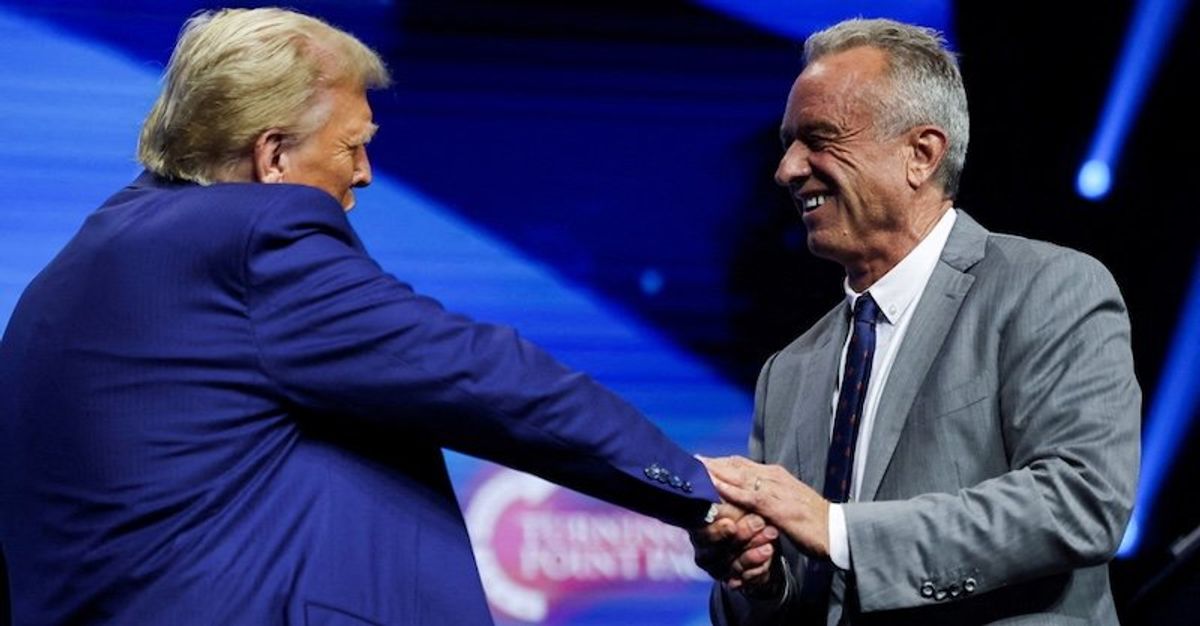
Donald Trump and Robert F. Kennedy Jr. (Reuters)

MSNBC Dr. Vin Gupta was hauled into the studio to call out President Donald Trump's tall tale about Tylenol.

In a Truth Social post Friday morning, Trump demanded in all capital letters that pregnant women "DON’T USE TYLENOL..."

Trump announced his war against the over-the-counter pain reliever earlier this week, alongside Health and Human Services Secretary Robert Kennedy Jr., who is neither a scientist nor a doctor.

"Because the president has put that out there, we feel it's important to fact-check all of that," said host Ana Cabrera.

Appearing on video from a hospital room and dressed in scrubs, Dr. Gupta promised that pregnant women and children can safely take Tylenol.

"As you and I have talked about recently, there is the highest quality clinical research published public, that looked at 2.5 million children in Sweden. And specifically, it looked at children and it looked at siblings of children who took Tylenol or whose moms took Tylenol during pregnancy, compared it to siblings, where those same moms didn't take Tylenol during pregnancy. So sibling matched studies. And what they found was that when you account for family genetics and environmental risk factors, all the things you need to a specific family, you account for those variables, taking Tylenol during pregnancy or not taking Tylenol during pregnancy does not in any way increase your risk of autism."

It means that the "best quality research does not substantiate what the president put out there."

A federal judge dismissed hundreds of lawsuits from families alleging Tylenol caused autism a year ago.

Dr. Gupta went on to encourage moms to feel comfortable using Tylenol for lowering fevers.

He also fact-checked Trump's attack on the measles, mumps, and rubella vaccine, saying that it doesn't need to be broken up.

"You know, I'm not sure who's advising him, but those three shots measles, mumps, rubella and that's what constitutes MMR, that vaccine that does not exist as monovalent vaccines," he said noting that it isn't even available to get separately.

"So, I don't know what he's talking about," Dr. Gupta confessed.

He also said that it's fine to break up the chickenpox vaccine from MMR between 12 and 15 months of age. Prior to Trump, it was recommended that those be taken at different times.

Sociology professor at California Polytechnic State University, Martine Lappé, told NPR that Trump's accusations are part of "a long history of blaming mothers in this country, and we're seeing that reinforced through the narratives around autism's causes right now."

The comments add to a long list of doctors and scientific experts who challenge the idea that Tylenol causes Autism.


WHO sees no autism links to Tylenol, vaccines

By AFP
September 23, 2025


Lee Da-bin, a South Korean with autism, told AFP many people don't realise when they are encountering milder forms of autism - Copyright AFP Jung Yeon-je

Nina LARSON

Neither the painkiller Tylenol nor vaccines have been shown to cause autism, the World Health Organization said on Tuesday, following comments from the US president and his administration to the contrary.

President Donald Trump insisted on Monday that pregnant women should “tough it out” and avoid Tylenol due to an unproven link to autism and also urged major changes to the standard vaccines administered to babies.

Medical groups have long cited acetaminophen, or paracetamol — the primary ingredient in Tylenol — as among the safest painkillers to take during pregnancy.

WHO spokesman Tarik Jasarevic acknowledged that some observational studies — which are based purely on observations and do not include control or treatment groups — had “suggested a possible association between prenatal exposure to acetaminophen or paracetamol and autism”.

But, he told reporters in Geneva, “the evidence remains inconsistent” with other studies finding “no such relationship”.

“If the link between acetaminophen and autism were strong, it would likely have been consistently observed across multiple studies,” he said, warning against “drawing casual conclusions about the role of acetaminophen in autism”.

– ‘No evidence’ –


European medical regulators meanwhile said their recommendations that pregnant women can use paracetamol for pain relief had not changed.

“Patient safety is our top priority. There is no evidence that taking paracetamol during pregnancy causes autism in children,” Alison Cave, safety chief at Britain’s Medicines and Healthcare products Regulatory Agency (MHRA), said in a statement.

Steffen Thirstrup, chief medical officer at the European Medicines Agency, agreed.

“Our advice is based on a rigorous assessment of the available scientific data and we have found no evidence that taking paracetamol during pregnancy causes autism in children,” he said.

TWO CRIMES AGAINST HUMANITY VILLANS 


Autism claims by Trump (L) and Kennedy (R) are not backed by consistent scientific evidence, WHO says –
Copyright AFP TIMOTHY A. CLARY

Vaccines were also on the rambling agenda of Trump’s press conference on Monday, when he repeated anti-vax movement talking points.

He sowed doubt over standard vaccines including the MMR shot — which covers measles, mumps and rubella — and implied he would end the common use of aluminium in vaccines, the safety of which has been widely studied.

Identifying the root of autism — a complex condition connected to brain development that many experts believe occurs for predominantly genetic reasons — has been a pet cause of Trump’s health secretary, Robert F. Kennedy Jr.

Kennedy has for decades spread claims that vaccines cause autism.

– ‘Vaccine schedules evolve with science’ –

Asked about the fears raised by the US president and his administration over childhood vaccines, Jasaravic said: “Vaccines do not cause autism.”

“The childhood immunisation schedule, carefully guided by WHO, has been adopted by all countries and has saved at least 154 million lives over the past 50 years,” he added.

“These schedules have continually evolved with science and now safeguard children, adolescents and adults against 30 infectious diseases,” he said.

He warned, however, that “when immunisation schedules are delayed or disrupted, or altered without evidence review, there is a sharp increase in the risk of infection not only for the child but also for the wider community”.

“Each missed dose increases the chances of contracting a life-threatening infectious disease.”

The WHO spokesman said that 62 million people were known to be living with autism spectrum disorder worldwide.

The global community needed to do more, he acknowledged, “to understand the causes of autism and how best to car for and support the needs of autistic people and their families”.

But science had “proven” there was no link to vaccines, he said, adding: “These things should not really be questioned.”

EU proposes new delay to anti-deforestation rules


By AFP

September 23, 2025


A palm oil plantation next to a peat forest in Indonesia - 
Copyright AFP STR
Umberto BACCHI

The EU said Tuesday it will seek a new one-year delay to sweeping anti-deforestation rules cheered by green groups but assailed by key trading partners from the United States to Indonesia.

Environmental groups reacted angrily to the prospect of postponing the bill, which was to ban imports of products driving deforestation from the end of 2025, saying it called into question the EU’s climate commitment.

But the European Commission said the logistical infrastructure for implementing the law — already once pushed back a year — was not yet ready.

“We have concluded that we cannot meet the original deadline without causing disruptions to our businesses and supply chains,” commission spokesman Olof Gill told a press conference in Brussels.

The European Union executive will push to delay the law’s entry into force to late 2026, “to avoid uncertainty for authorities and to avoid operational difficulties for companies,” he added.

The postponement needs approval by member states and the European Parliament.

The move is set to bring renewed scrutiny to the EU’s commitment to a greener future, which has come under increased pressure from governments and industry over the past year.

It came hours after the commission struck a free-trade deal with Indonesia, a prominent critic of the law — although environment commissioner Jessika Roswall said the two developments were “not linked at all”.

The deforestation law was hailed by environmental groups when it was adopted as a major breakthrough in the fight to protect nature and combat climate change.

It prohibits a vast range of goods — from coffee to cocoa, soy, timber, palm oil, cattle, printing paper and rubber — if produced using land that was deforested after December 2020.

– ‘Capacity concerns’ –

Firms importing the merchandise in question to the 27-nation EU will be responsible for tracking their supply chains to prove goods did not originate from deforested zones, relying on geolocation and satellite data.

But the ban has faced opposition from trading partners including Brazil and the United States, and some EU capitals, amid concerns over red tape, costs and lack of clarity over some aspects of the law.

Partially because of this, its entry into force was pushed back by 12 months a first time in 2024.

The commission said the new delay had to do with “serious capacity concerns” regarding the IT system designed to support implementation of the rules.

The EU has adapted an in-house platform already in use in other domains to receive declarations from importers, re-sellers and other operators that the goods they are dealing with do not come from deforested areas.

But it had largely underestimated how many would use the site and failed to foresee that some users would prompt it more than once to receive a reply, an EU official speaking on condition of anonymity explained.

Tests showed initial estimates that the site would handle around 100 million declarations per year are off by at least a factor of 10, the official said, adding the commission needed time to “find the most appropriate solution”.

– ‘Wider battle’ –

Environmentalists fear the delay will provide room for critics to water down the bill’s requirements — something EU lawmakers on the right already unsuccessfully attempted to do after the first postponement.

The push comes as climate has increasingly taken a back seat in Brussels, with global trade tensions and the war in Ukraine shifting the focus to industry and defence.

“This is part of a wider battle: between those who want to protect the natural world and the life systems which depend on it, and those intent on destroying it, often driven by narrow self-interest,” said Nicole Polsterer, of environmental group Fern.

“Every day this law is delayed equates to more forests razed, more wildfires and more extreme weather.”

Critics of the law say it imposes an excessively heavy administrative burden on farmers and companies.

But WWF, another environmental group, said a new delay would lead to “massive stranded costs” for all firms that had already invested in complying with the new rules.

“If this technical issue is real, this shows not only incompetence, but also a clear lack of political will to invest sufficiently in a timely implementation,” said Anke Schulmeister-Oldenhove, WWF’s forest policy manager.

Germany’s Merz rejects claims he is slowing green shift


By AFP
September 24, 2025


The German government wants to build more gas power plants - Copyright AFP William WEST

German Chancellor Friedrich Merz on Wednesday rejected claims his government was undermining the climate change fight, but insisted that industry also needed to be protected to revive the crisis-wracked economy.

Critics charge that Merz’s conservative-led coalition is putting a brake on the shift to green energy through measures ranging from a planned expansion of gas power to proposals to scrap some renewable energy subsidies.

In a fiery debate in parliament marked by loud heckling from the opposition benches, the chancellor noted his critics claimed he was “undermining climate protection”.

“Nothing could be further from the truth,” said Merz, whose centre-right CDU/CSU bloc governs in coalition with the centre-left SPD.

He stressed he wanted climate protection “without ideology. That is the difference between us and the last government”.

In the previous administration, the Greens party helmed the economy ministry and pushed ambitious measures to accelerate the energy transition — some of which caused unease among businesses about extra burdens at a time they were already struggling.

“Climate protection that jeopardises or even destroys the industrial base of our country, climate protection that jeopardises our country’s prosperity — that will not be accepted by the population,” Merz said.

Anyone who did not take this into account will “not only fail in climate protection — they will also fail fundamentally in terms of social cohesion in our country”, he said.

Merz repeatedly stressed his government was open to using various different technologies — from gas power plants to carbon capture and storage — in an effort to achieve greenhouse gas neutrality while also protecting vital industries.

Germany aims to reach greenhouse gas neutrality by 2045, and a substantial proportion of electricity in Europe’s top economy already comes from renewable sources.

Greens party lawmaker Britta Hasselmann accused Merz of taking a “step backwards into the past”.

“If you invoke this openness to technology, why do you want to stifle the very thing that has made this country so successful — namely, the expansion of renewable energies?”

Merz’s government is seeking to revive the eurozone’s traditional powerhouse, which shrank for the past two years, and advocates a more pragmatic approach to the energy transition that it says will ensure costs stay manageable.
Iran’s carpet industry unravelling under sanctions

By AFP
September 23, 2025


A man inspects a handmade rug in a carpet shop in northern Tehran 
- Copyright AFP ATTA KENARE

Payam DOOST MOHAMADI

Once a symbol of cultural prestige, Iran’s handmade rugs are no longer selling as fast as they once did, as sanctions weigh on an already troubled economy and buyers’ tastes change.

Commanding more than $2 billion in export revenues in its heyday of the early 1990s, the industry now struggles to scrape together around $40 million, marking a dramatic collapse of more than 95 percent.

The reimposition of sanctions in 2018 meant the age-old craft lost what was traditionally its largest market — the United States.

“In the years when the unkind and cruel US sanctions on the hand-woven carpet sector were imposed… we lost the US, the buyer of more than 70 percent of Iranian hand-woven carpets,” Zahra Kamani, head of Iran’s National Carpet Centre, told state TV.

In 2017, just before the sanctions were revived, rugs were still considered one of the country’s key non-oil exports, with a revenue of more than $400 million.

But Iran’s customs organisation said that during the last year of the Persian calendar that ended in March, exports stood at just $41.7 million.

Exports went to 55 countries that year, topped by Germany, the United Arab Emirates, Japan and China.

In the interim, competitors such as India, China, Nepal and Pakistan have seized the opportunity, seeking to fill the gap in the global market.


– ‘High price tag’ –


Some of those rugs even make their way to Iran, where, according to Kamani, at least two million people, including women in rural areas, depend on the carpet-weaving industry for their livelihood — sometimes earning as little as a few dollars a day.

Carpet trader Hamed Nabizadeh told AFP that “Iran is importing carpets from other countries, such as India, Turkey and China. We are losing a part of our domestic sales volume in the Iranian market due to these imports”.

For decades, Western tourists would pass through Iran, picking up rugs as souvenirs or gifts. But with the country’s tourism industry also hit by travel warnings and hostile relations, fewer foreigners are visiting, translating to fewer rug sales.

Nabizadeh moreover says that even the tourists who come “might not be interested in our work as consumer tastes have changed” and “the price tags are quite high”.

“It is somewhat difficult for even someone living in a European country to buy a silk carpet for, say, $30,000 to $40,000. The transportation of the carpet is also quite challenging for tourists,” he added.

Experts attribute the market slump to a tangle of economic and political factors.

Broad international sanctions have cut off vital markets, while flawed domestic currency and foreign-exchange policies — especially those restricting repatriation of export revenues — have crippled competitiveness.

Compounding the issue, rising production costs and weak government support have squeezed the industry.


– Revitalising industry –


Iranian officials insist that the revival of the industry and the art of carpet-weaving, which dates back to the Bronze Age of Persia, is possible.

“We have lost some international markets, but we hope that with the country’s trade and currency laws we can resuscitate this industry,” Trade Minister Mohammad Atabak was quoted as saying by state news agency IRNA in June.

“We are trying to promote and facilitate exports for the country’s merchants with newly signed agreements,” he added.

For Nabizadeh, the way out of this crisis is to pay more attention to “current trends in decoration”.

“We should produce carpets based on those trends and not be too prejudiced that the carpet must have the same old shapes and patterns.”

He cited “attracting online customers through social media” and “creating strong branding for carpets” as other possible solutions.

But with the collapse of the national currency against the dollar, even the domestic market is at risk of evaporating.

“Even though I always wanted handwoven carpets for my dowry and my family had promised me that, they couldn’t afford them. Instead, we opted for factory-made ones,” said Shima, a 31-year-old bride-to-be.

“It is an age-old marriage tradition that the bride should provide the carpets of the house,” said Shima, who did not wish to provide her full name to maintain her privacy.

“However, many families are choosing factory-made rugs these days because of their lower prices or do not buy carpets altogether if they are of the more needy classes.”

Now, with Iran increasingly losing domestic customers and global markets dominated by lower-cost imitations, the Persian rug risks becoming a relic of a lost golden age, with its legacy hanging by a thread.


Australian telco giant slapped with $66 million fine over ‘appalling’ conduct


By AFP
September 24, 2025


Embattled Australian telco giant Optus was hit with a $66 million fine on Wednesday over "appalling" sales conduct - Copyright AFP William WEST

Embattled Australian telco giant Optus was hit with a $66 million fine on Wednesday over “appalling” sales conduct as the firm grapples with fallout from a network outage linked to several deaths.

A federal court ruled the company — one of Australia’s top telecoms providers — should be punished for selling products to vulnerable customers between 2019 and 2023 that they did not need or want, leaving many in debt.

Many of these people were also Indigenous and lived in remote parts of the country.

Federal Court’s Justice Patrick O’Sullivan labelled the company’s conduct as “extremely serious” and “appalling”.

Consumers incurred thousands of dollars of debt while on modest incomes and became embarrassed or stressed over how they would pay these, he added.

The court formally approved the penalty Wednesday, which Optus and the Australian Competition and Consumer Commission had agreed to in June.

Optus previously described its sales practices during the offending period as “unconscionable conduct and inappropriate”.

Following the ruling, Optus said it had changed its sales practices to better support customers.

“Optus is remediating impacted customers as a matter of priority,” the company said.

It will also donate $662,300 to improve the financial literacy of Indigenous communities.

Wednesday’s fine comes just days after an outage impacted 600 people across South Australia, Western Australia and the Northern Territory for at least ten hours.

The outage prevented calls to emergency services, with four deaths now linked to the outage.

On Wednesday, Optus announced details of an independent review that will probe the series of events that took place and determine why emergency calls did not connect.

“There are no words that can express how sorry I am about the very sad loss of the lives of four people, who could not reach emergency services in their time of need,” chief executive Stephen Rue said.

Optus was previously fined $7.9 million after an outage halted its mobile and internet systems for nearly 12 hours in 2023.
Danish PM to apologise to victims of Greenland forced contraception

CANADA ALSO CONDUCTED STERILIZATION OF INIGENOURS AND INNU COMMUNITIES


By AFP
September 24, 2025


Prime Minister Mette Frederiksen has called the forced contraception programme a 'dark chapter' in Denmark's ties with Greenland - Copyright Ritzau Scanpix/AFP/File Emil Nicolai Helms

Camille BAS-WOHLERT

Danish Prime Minister Mette Frederiksen has arrived in Denmark’s autonomous territory Greenland for a ceremony Wednesday to apologise in person to the victims of a forced contraception programme that Copenhagen ran for more than three decades.

After landing, Frederiksen said in a post to social media that the apology constituted an “important marking” of a “dark chapter in our shared history”.

“It will be a very important moment for these women, obviously, but also for society as a whole,” Aaja Chemnitz, an MP who represents Greenland in the Danish parliament, told AFP.

“It’s a second step in the reconciliation process after first announcing the apology” in late August, she said.

A special ceremony in Nuuk, the capital of Greenland, was to begin at 2:00 pm (1500 GMT).

From the late 1960s until 1992, Danish authorities forced around 4,500 Inuit women, around half of all those of child-bearing age, to wear a contraceptive coil — or intrauterine device (IUD) — without their consent.

The aim was to reduce the Inuit birth rate.

Many of the women were left sterile and almost all of them have suffered from physical or psychological problems.

The scandal is one of several sensitive issues tainting Denmark’s ties to Greenland, including forced adoptions and the forced removal of Greenlandic Inuit children from their families.

Denmark has over the past year been keen to smooth over tensions with its strategically located, resource-rich Arctic territory, which US President Donald Trump has said he wants to take over for security reasons.

At the end of August, Frederiksen presented a long-awaited apology to the victims of the forced contraception campaign, in a written statement.

On Monday, she also announced the creation of a “reconciliation fund” to compensate the victims, as well as other Greenlanders who suffered discrimination because of their Inuit heritage.

“It’s very good news because my clients are not satisfied with just an apology,” said lawyer Mads Pramming, who represents around 150 of the victims who have sued the Danish state for violating their rights and sought financial compensation.

“The timing is good. She would not have been warmly welcomed if she hadn’t suggested (the compensation) in advance,” he told AFP


– ‘External pressure’ –


Chemnitz said the apology was a direct result of Trump’s assertive statements about taking over Greenland.

“It’s the external pressure, especially from the United States, that is forcing Denmark to increase its efforts,” she said.

“I’ve been an MP for 10 years and I’ve never seen so much effort until now.”

Frederiksen has broken with the tradition of her predecessors who insisted Denmark had no reason to apologise.

“In the past, the Danish prime ministers have always been extremely reluctant to acknowledge injustices committed in Greenland. They argued there was nothing to apologise for,” said historian Astrid Andersen, a researcher at the Danish Institute for International Studies.

The scandal came to light when one of the victims spoke out in the media several years ago about the trauma she experienced.

A podcast series in 2022 then revealed the full extent of the campaign.

The Danish and Greenlandic governments agreed to launch an independent inquiry into the scandal, which was recently completed.

“At this point, it is important to many Greenlanders to mourn as a community and to have full recognition of this horrible thing that happened,” Andersen said.

A separate inquiry into the legal implications of the campaign is still underway.

Its report, which is tasked with determining whether the Danish campaign constituted a “genocide”, is to be published in early 2026.