Tuesday, February 17, 2026

Insider Trading And The Wolves Of Capitol Hill – OpEd


February 17, 2026 
By Craig Eyermann

2025 was a good year for the stock market. Americans who invested in a broad market index like the Standard and Poor 500 did really well. But not as well as 29 members of the U.S. Congress who beat the market in 2025.

Beating the market is not easy and beating an index like the S&P 500 in 2025 means getting gains of more than 16.8%. Unusual Whales compiled a report on the members of Congress whose investments beat that return in 2025. I compiled the chart below from the report to focus on the 29 members of Congress whose investment portfolios grew by more than 16.8% last year.


The list is almost evenly split between Democrats and Republicans. There are 15 Democrats and 14 Republicans, indicating a lack of adequate rules governing members of Congress’s trading activities. It’s like an equal-opportunity exercise in insider trading, in which members of Congress have an edge because they know which laws and regulations are in the works that could materially affect their investments.

More than a few members of Congress had trades in 2025 with very questionable timing.

The reigning queen of questionable trading is former House Speaker Nancy Pelosi (D: CA-11), who has truly made bank throughout her long congressional career. In November 2025, the New York Times reported on her lifetime achievement:
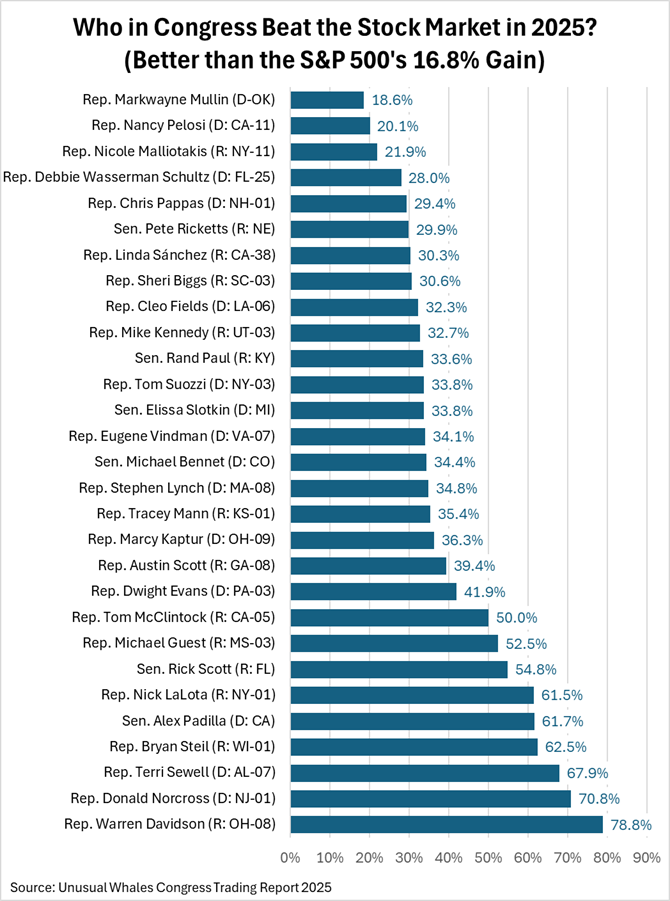

Who in Congress Beat the Stock Market in 2025?

Before first taking Congressional office in 1987, the then-47-year-old freshman and her hubby, venture capitalist Paul Pelosi, reported between $610,000 and $785,000 in stocks in their portfolio, according to a copy of her “hand delivered” 1987 financial disclosure form.

They held a dozen stocks, including CitiBank, and in many companies no longer publicly traded.

That portfolio has soared to $133.7 million today, according to the latest estimates from Quiver Quantitative.

That represents an eye-watering profit of 16,930%—compared to 2,300% for the Dow Jones over those years.

Even with the power of compound interest, the windfall represents a staggering 14.5% average annual return—beating out the S&P 500, NASDAQ and Dow Jones performances over those years, around 7% to 9%.

Most professional money managers are unable to beat the major stock market indices for more than a few years. Repeatedly beating them over decades is a very rare achievement. Or would be without an insider’s edge.

Pelosi has announced she is retiring from Congress at the end of 2026. Will this be the year she really cashes in because it’s her last chance to exploit her inside edge?This article was published by the Independent Institute


Craig Eyermann

Craig Eyermann is a Research Fellow at the Independent Institute. He is also the creator of MyGovCost.org: Government Cost Calculator. He received his M.S. in mechanical engineering from New Mexico State University and M.B.A. from the University of Phoenix, having received a B.S. in both mechanical and aerospace engineering from the Missouri University of Science and Technology.
TRUMP CUTS

Radio Free Europe’s Bulgaria, Romania Services To Close

February 17, 2026 
Balkan Insight
By Marian Chiriac

The Bulgarian and Romanian services of Radio Free Europe/Radio Liberty (RFE/RL) are set to cease operations on March 31, sources with knowledge of the situation told BIRN, ending two of the most prominent Western-supported journalism initiatives active in the contemporary media environment.

The closures follow the ending of RFE/RL’s Hungarian service on November 21 and are the direct result of the Trump administration’s drive to choke off federal funds for RFE/RL, Voice of America and the other public media outlets supported by the US Agency for Global Media (USAGM).

The Prague-based RFE/RL – which provides high-quality reporting in more than 20 language versions, including Ukrainian, Russian, Belarusian, Armenian and Persian – has been forced to cut 90 per cent of its freelancers and furlough about 25 per cent of its staff since the Trump administration issued an executive order in March 2025 aimed at closing USAGM.

A measure of predictability returned to RFE/RL’s operations on February 3 when President Donald Trump signed the 2026 appropriations bill, which includes funding for USAGM for the next fiscal year but is roughly 25 per cent down from previous years. Congress had appropriated 148.7 million dollars for RFE/RL in the fiscal year 2025 Congressional Budget Justification.

For many local journalists and media analysts, the closure of RFE’s Romania service (Europa Libera Romania) primarily signals an erosion of investigative capacity and editorial pluralism within an already strained media environment. “This is more than the shutdown of a newsroom – it amounts to the extinguishing of a symbol,” media analyst Petrisor Obae told BIRN.

“At a time when the avalanche of fake news, disinformation and manipulation is greater than ever, the need for a benchmark of responsible journalism is more acute than at any other moment. Yet instead of reinforcing a trusted source, the Trump administration opted to close it down,” he added.

No official statement has been issued by Europa Libera Romania and, so far, none of the journalists have departed the Bucharest office, appearing to remain fully engaged in their reporting duties. In informal remarks, some staff members said the organisation has consistently provided the editorial independence required to carry out their work professionally and without interference.

The Romanian service currently employs around 20 people and is the successor to the original Radio Free Europe broadcaster, which played a crucial societal role during the Cold War, when it served as one of the few credible sources of uncensored information for the population at a time of strict state control over the domestic media. Radio Free Europe maintained operations in Romania until 2008, the year the country consolidated its status as a member of the EU. After a decade-long hiatus, it re-established its online-only Romanian service in 2018, amid mounting concerns within the US administration about disinformation and democratic backsliding in the region.

The Bulgarian service (Svobodna Evropa) had not responded to BIRN enquiries by time of publication.

Questions have inevitably turned to the future of RFE/RL’s Moldovan service (Radio Europa Libera Moldova), particularly given the small yet strategically important Southeast European country faces growing interference from Moscow in its elections and media landscape. Sources say the service is safe for this year, though is operating with a skeleton crew. Its longer-term future could be secured with proposed external funding from EU and/or non-EU sources, though the upheavals at RFE/RL have complicated this effort.


Balkan Insight

The Balkan Insight (formerly the Balkin Investigative Reporting Network, BIRN) is a close group of editors and trainers that enables journalists in the region to produce in-depth analytical and investigative journalism on complex political, economic and social themes. BIRN emerged from the Balkan programme of the Institute for War & Peace Reporting, IWPR, in 2005. The original IWPR Balkans team was mandated to localise that programme and make it sustainable, in light of changing realities in the region and the maturity of the IWPR intervention. Since then, its work in publishing, media training and public debate activities has become synonymous with quality, reliability and impartiality. A fully-independent and local network, it is now developing as an efficient and self-sustainable regional institution to enhance the capacity for journalism that pushes for public debate on European-oriented political and economic reform.


Shrinking cloud cover adds to accelerating Climate Crisis

Shrinking cloud cover adds to accelerating Climate Crisis
Satellite data show declining low-level cloud cover over subtropical oceans, reducing the Earth’s reflectivity and accelerating the planet’s energy imbalance as global temperatures outpace climate model projections. / bne IntelliNews
By Ben Aris in Berlin February 14, 2026

Earth’s cloud cover is diminishing in key regions, reducing the planet’s ability to reflect sunlight back into space and adding to the accelerating Climate Crisisresearch reported by Science found.

As bne IntelliNews reported, shrinking cloud cover is reflecting less sunlight from the and adding to the warming effect of Green House Gases (GHGs). Currently global warming is happening faster than all the 30-plus climate models used by the Paris Agreement to determine the rates of reduction of emissions. The United Nations’ Intergovernmental Panel on Climate Change (IPCC) says the 1.5°C – 2.0°C targets have already been missed and the world is on course to warm by 2.7°C-3.2°C in the coming decades.

Decreasing cloud cover with only bring that end point closer. Satellite observations and climate analyses suggest that low-lying marine clouds — particularly over subtropical oceans — have declined in recent decades, weakening what scientists describe as a critical planetary cooling mechanism. Because such clouds act as a mirror, reflecting incoming solar radiation, even small reductions can produce measurable warming effects.

The shrinking cloud cover is added to the earth’s energy imbalance (EEI) which is acting on top of the greenhouse effect of emitted gases like CO₂ and methane. More energy than ever before is coming into the planet (absorbed sunlight) than is going out (heat radiated to space), said the scientists. The earth’s energy imbalance (EEI) has escalated in the past decade, they said. The imbalance so far in the 2020s is almost double the rate during the study’s calibration period, from mid-2005 to mid-2015.

The findings come as global temperatures have repeatedly broken records, with the last three years being the hottest year in documented history. Researchers say the loss of reflective cloud cover may be helping to explain why temperatures are rising faster than the models predicted.

Scientists cited by Science report that changes are especially evident in stratocumulus cloud decks over the Pacific and Atlantic oceans. These bright, persistent cloud formations have historically offset a portion of greenhouse gas-driven warming. Their retreat means more heat is absorbed by darker ocean waters.

The causes remain under investigation. One hypothesis links the trend to cleaner shipping fuels. Regulations introduced by the International Maritime Organization in 2020 reduced sulphur emissions (SO₂) from marine fuel, cutting aerosol pollution that can seed cloud formation and increase cloud brightness. With fewer aerosols available, clouds may form less readily or reflect less sunlight.

Other researchers point to feedback loops within the climate system. As oceans warm, atmospheric circulation patterns can shift, thinning cloud layers and reinforcing additional warming. This self-reinforcing cycle is a longstanding concern in climate science because it could accelerate temperature rises beyond earlier expectations.

Clouds remain one of the biggest sources of uncertainty in climate modelling as they are not well understood, and small variations in their behaviour can alter projections of future warming by tenths of a degree Celsius or more. A sustained reduction in low-cloud cover would effectively increase the Earth’s climate sensitivity to greenhouse gas concentrations.

While further study is required to determine whether the recent decline represents a long-term shift or natural variability, researchers warn that the trend highlights the complexity of efforts to curb warming, as reductions in air pollution can produce unintended climatic side effects even as they deliver clear public health benefits.


Australia trapped under a “heat dome”, braces for extreme 50°C temperatures

Australia trapped under a “heat dome”, braces for extreme 50°C temperatures
High-pressure heat dome pushes Australian temperatures towards 50C, prompting catastrophic fire danger warnings in South Australia and Victoria / bne IntelliNews
By Ben Aris in Berlin February 16, 2026

Australia has found itself trapped under a “heat dome” that threats to send temperatures up above 50°C. Authorities are already warning residents to stay indoors during the day.

An intense heatwave has settled over the country as a vast high-pressure system covers the continent, pushing temperatures into extreme territory and prompting authorities to issue catastrophic fire danger warnings across parts of South Australia and Victoria.

Severe Weather Europe reported that the so-called heat dome has effectively sealed the continent, trapping and compressing hot air near the surface. The system has been reinforced by energy from Tropical Cyclone Luana, helping to drive temperatures towards what the forecaster described as “a scorching 50 °C”.

Under a heat dome, sinking air associated with high pressure warms as it descends, suppressing cloud formation and allowing solar radiation to intensify surface heating. AS bne IntelliNews reported, shrinking cloud cover is adding to the earth’s energy imbalance (EEI) and accelerating global heating adding to the greenhouse effect of emissions.

In inland regions where soils are already parched, the lack of moisture also limits evaporative cooling, creating a positive feedback loop in which heat further dries the ground, amplifying temperature extremes, according to meteorologists.

Towns including Ouyen and Mildura are bracing for temperatures approaching 48C. Authorities have warned that the conditions resemble those seen during the infamous 2019-2020 “Black Summer” when  bushfires swept the country due to extreme heat. Prolonged heat and drought contributed to blazes that burned more than 24mn hectares and killed 33 people, with many more deaths linked to smoke exposure.

Severe Weather Europe said the event differs from a standard seasonal heatwave because it is being “sustained by a dangerous feedback loop” driven by dry soils and persistent high pressure.

Fire services in affected states have issued danger ratings at the top of their scale under Australia’s warning system, and urged residents in high-risk areas to activate bushfire survival plans. Extreme heat also poses risks to health, infrastructure and electricity networks, particularly in remote communities.


Chinese EV company CATL unveils a new super battery

Chinese EV company CATL unveils a new super battery
CATL has unveiled a battery it says can charge in 12 minutes and retain 80% capacity after 1.5mn miles, potentially reshaping competition in the global electric vehicle market. / bne IntelliNews
By Ben Aris in Berlin February 17, 2026

Contemporary Amperex Technology Co Limited (CATL) has unveiled a new electric vehicle battery that it says can fully charge in 12 minutes and retain 80% of its capacity after 1.5mn miles, marking a potential breakthrough in durability and charging speed in the global EV market.

The Chinese battery manufacturer said the new system incorporates advanced thermal management, smart cooling and self-repair technologies designed to limit degradation over extended use. If validated at scale, the development could address two of the main barriers to wider electric vehicle adoption: charging time and battery longevity.

“12-minute charge with 1.5M mile degradation to only 80% capacity is game-changing if true - that's basically solving the two biggest EV adoption barriers simultaneously. CATL's likely using lithium iron phosphate with advanced thermal management and self-healing electrolytes. The real test is cost and scalability –”

CATL is already the world’s largest EV battery maker, supplying carmakers including Tesla, BMW and Volkswagen. Tesla currently offers eight years or 100,000 miles, whichever comes first, as a Battery Limited Warranty for its Model Y, highlighting the potential scale of improvement implied by CATL’s claims.

The company has previously commercialised lithium iron phosphate batteries, known for lower costs and improved safety compared with nickel-based chemistries, though typically at the expense of energy density. Industry analysts say advances in cell chemistry and thermal control have narrowed that gap in recent years.

Sodium-ion batteries are also in development as a lower-cost alternative to lithium-based technologies, aiming to reduce reliance on critical minerals and further drive down prices.

Sodium-ion (Na-ion) batteries offer a safer, lower-cost alternative to the lithium-ion systems that currently dominate the business, according to recent studies published in Advanced Materials and Advanced Functional Materials.

Li-ion batteries currently account for roughly 70% of the world’s rechargeable batteries, with the energy sector alone consuming over 90% of global supply, according to data from the International Energy Agency.

The long-sought breakthrough outlines a novel solid-state battery architecture that achieves 99.26% efficiency after 600 charge cycles, while eliminating lithium, cobalt, and flammable liquid electrolytes — long-standing weaknesses in current lithium-ion (Li-ion) designs.

Battery production costs have fallen by about 40% over the past year as a battery revolution gathers pace.

In parallel, research is under way into silver-ion batteries, which developers claim could potentially double capacity and enable faster charging than conventional lithium-ion systems, although such technologies remain at an earlier stage of commercial readiness.


China’s vast water diversion project reshapes growth in the arid north

China’s vast water diversion project reshapes growth in the arid north
South-to-North Water Transfer Project delivers 64.73bn cubic metres in a year, underpinning growth and urban expansion across northern China / bne IntelliNews
By Ben Aris in Berlin February 17, 2026

China’s South-to-North Water Transfer Project has delivered 64.73bn cubic metres of water to the country’s arid north over the past year, bringing cumulative transfers to more than 83bn cubic metres since operations began, according to official data released in November 2025. Nearly 118mn people now rely on the system for daily supply, as water security moves up the agenda in the midst of accelerating temperature rises and increasing extreme weather events.

Over the past five years alone, more than 52mn residents have been added to the project’s service area. The Middle Route — the most politically significant of the three channels — now forms the backbone of water provision for the Beijing-Tianjin-Hebei region, long constrained by chronic scarcity. The area holds just 7.2% of China’s water resources but supports almost one-third of its population.

China faces similar problems to the Western US states where a mounting water shortage threatens to become critical after several states with overlapping water interests failed to come to an agreement to make critical and deep cuts to their water usage, the Guardian reported.

This month seven states remained at a stalemate over who should bear the brunt of the enormous water cuts needed to pull the imperilled Colorado River back from the brink. Collectively they need to cut their usage by a quarter of face the prospect of not having enough water. But after months of talks no agreement was reached and now the outlook for water supply for a region that includes cities like Las Vegas looks bleak.

China’s northern region faces similar imbalances but decisive government action appears to have dealt with the biggest problems after groundwater overdraft, land subsidence and seasonal river depletion was already limiting industrial expansion.

Beijing’s groundwater table has risen by more than 13 metres over the past decade, with official figures indicating that over-extraction zones have been eliminated. More than 11.8bn cubic metres of ecological water have been channelled into 50 northern rivers, including the Hutuo and Juma, helping reverse years of environmental degradation.

The easing of resource constraints has gone hand in hand with a broader spatial reorganisation of the Beijing-Tianjin-Hebei economic cluster, which generated CNY11.5tn ($1.6 trillion) in gross domestic product in 2024. Cities have literally been rebuilt on the basis of resource availability to produce sustainable cities that could have otherwise died.

At the centre of this strategy lies Xiong’an New Area, launched in 2017 to absorb Beijing’s non-capital functions. The district has attracted more than CNY830bn ($115bn) in cumulative investment and seen 4,700 buildings constructed.

Institutional infrastructure is following. Beijing No.4 High School has opened a campus in Xiong’an, while Xiong’an Xuanwu Hospital has recorded 200,000 patient visits. The Xiong’an Zhongguancun Science Park hosts more than 130 enterprises. Fifteen Beijing universities, including Beijing Jiaotong University and the University of Science and Technology Beijing, are establishing branch campuses under a “one university, two campuses” model, with capacity for about 250,000 students by 2030.

Researchers from Capital University of Economics and Business wrote in the 2025 Beijing-Tianjin-Hebei Bluebook that deeper integration of education, technology and talent would enable the region to shift from “scale pursuit to capability leap”. Water security underpins that ambition, removing what had been a binding constraint on laboratories, semiconductor fabrication plants and urban expansion.

The infrastructure itself is evolving. Operators have introduced digital twin systems for real-time monitoring, while robotics and AI tools conduct inspections along the route. A supplementary Yangtze-to-Han River diversion, now under construction, will further reinforce supply. By 2027, operators aim to achieve zero-carbon operations along the Middle Route.

The completed Middle Route can transport 9.5bn cubic metres of water annually. For policymakers, the question is no longer whether northern China can sustain its population, but what form of growth it will pursue now that its most basic resource constraint has been eased.


China overtakes the US in nuclear submarine production, says IISS

China overtakes the US in nuclear submarine production, says IISS
China has increased nuclear-powered submarine production at its Bohai shipyard, surpassing US launch numbers and tonnage between 2021 and 2025, according to IISS. / bne IntelliNews
By Ben Aris in Berlin February 17, 2026

China has long ago overtaken the US when it comes to the navy, but now Beijing has also overhauled the US in submarines.

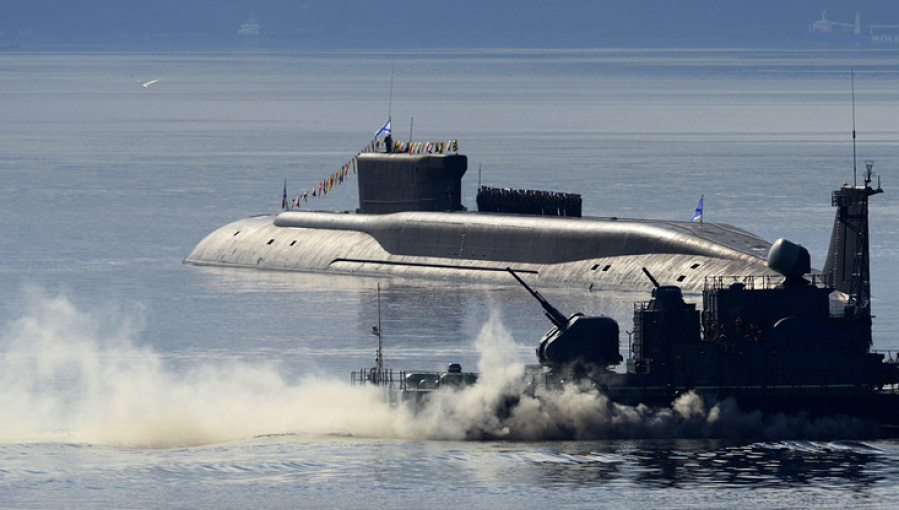
China has rapidly expanded its nuclear-powered submarine production, surpassing US launch numbers and tonnage between 2021 and 2025, according to the International Institute for Strategic Studies (IISS), highlighting a shift in the balance of naval industrial capacity.

In an analysis published on February 16, IISS said Beijing’s shipyards, particularly at Bohai, have increased output at a pace that exceeds that of the US over the past four years. Although qualitative differences compared with US and European designs persist, the increasing number of Chinese submarines presents a growing challenge for Western countries struggling to expand their own production.

China’s expansion reflects sustained investment in naval modernisation by President Xi Jinping, who has prioritised the People’s Liberation Army Navy as part of a broader push to project power further from the mainland. Satellite imagery and open-source assessments cited by IISS indicate multiple hulls under construction simultaneously at the Bohai Shipyard, suggesting improvements in modular construction and industrial throughput.

A maritime arms race is well underway that the Chinese navy is winning. China currently has more ships in its fleet than the US and is adding the equivalent of the entire French navy every four years.

China built between 115 and 125 military warships from 2020 to 2025, averaging 19 to 21 units per year. This rate surpasses the combined production of powers such as the United States, Japan, and South Korea, which together added only about 46 to 51 ships in the same period. Even if we added European production to that of the US, South Korea, and Japan, it wouldn't change much. The Chinese fleet now totals approximately 395 combat ships, eclipsing the 296 of the US, the roughly 140 of South Korea, and the 103 of Japan.

The story is similar in Chinese anti-ship ballistic missiles, where it also has a clear lead over the US, which has been asleep at the wheel, according to an analysis by bne IntelliNews military analyst Patricia Marins.

China has been trailing in submarine production until now. While US submarines are widely regarded as quieter and more technologically advanced, Washington has faced delays and cost overruns in its Virginia-class programme, according to IISS. The US Navy has acknowledged production bottlenecks in its industrial base, complicating efforts to meet domestic fleet targets while also fulfilling commitments under the AUKUS security pact with the UK and Australia.

European producers face similar constraints. The UK’s Astute-class and forthcoming Dreadnought-class submarines have encountered schedule pressures, while France’s Naval Group is balancing domestic and export orders.

IISS noted that although qualitative differences compared with US and European designs persist, the sheer scale of China’s output is altering strategic calculations. A larger fleet enhances Beijing’s ability to maintain continuous at-sea deterrence patrols and expand operations in the western Pacific.

One of the major constraints on the Chinese submarine fleet is that China has no deep-water ports on its coastline. The South China Sea is shallow, making any submarine launch from a Chinese port visible to US satellites and potentially vulnerable to missile strikes. However, the eastern coast of Taiwan drops off to several thousand meters almost immediately making it perfect for a submarine base where launches would immediately disappear into deep water making them untrickable – giving Beijing a significant military motivation for taking back control of the island state.


Sarajevo protests enter fourth day after deadly tram crash

Sarajevo protests enter fourth day after deadly tram crash
/ Sarajevo municipality
By bne IntelliNews February 16, 2026

Protests in Bosnia’s capital entered a fourth day on February 16 as demonstrators demanded accountability after a tram derailment killed a 23-year-old man and seriously injured several others, including a teenage girl who lost a leg.

The protests were triggered by the February 12 crash, when a tram derailed at speed near a stop, killing Erdoan Morankic and injuring four other passengers.

High school and university students again gathered in central Sarajevo, chanting “Justice, justice”, as they called for the release of maintenance records, video footage from the tram and the withdrawal of unsafe vehicles from service, according to local media reports.

The demonstrations have already led to political fallout. Sarajevo Canton Prime Minister Nihad Uk resigned on Sunday, causing the cantonal government to collapse, while Senad Mujagic, director of the city’s public transport company GRAS, stepped down on February 16.

Uk said his decision reflected the pressure from young protesters, who organised the rallies through Instagram pages.

“When I took over the position of prime minister of Sarajevo Canton, in my address, I primarily spoke about young people. How to be their support, how to turn towards their future and not our past. Young people have taken to the streets,” Uk said in his statement, published by N1.

He added: “The message of my fellow citizens, the message of young people, is important to me. Certainly more important than my position. And when I choose between the voice and courage of young people on one side and my position on the other, the choice is clear.”

Organisers said the protests were aimed at showing unity and solidarity with the victims and forcing authorities to accept responsibility.

They have outlined four key demands: full transparency of the investigation, including maintenance documentation and onboard video; the immediate withdrawal of unsafe trams; the resignation of officials responsible for transport oversight; and long-term reforms to create a safe and reliable public transport system.