India, Brazil sign mining pact as Modi targets $20B trade in five years
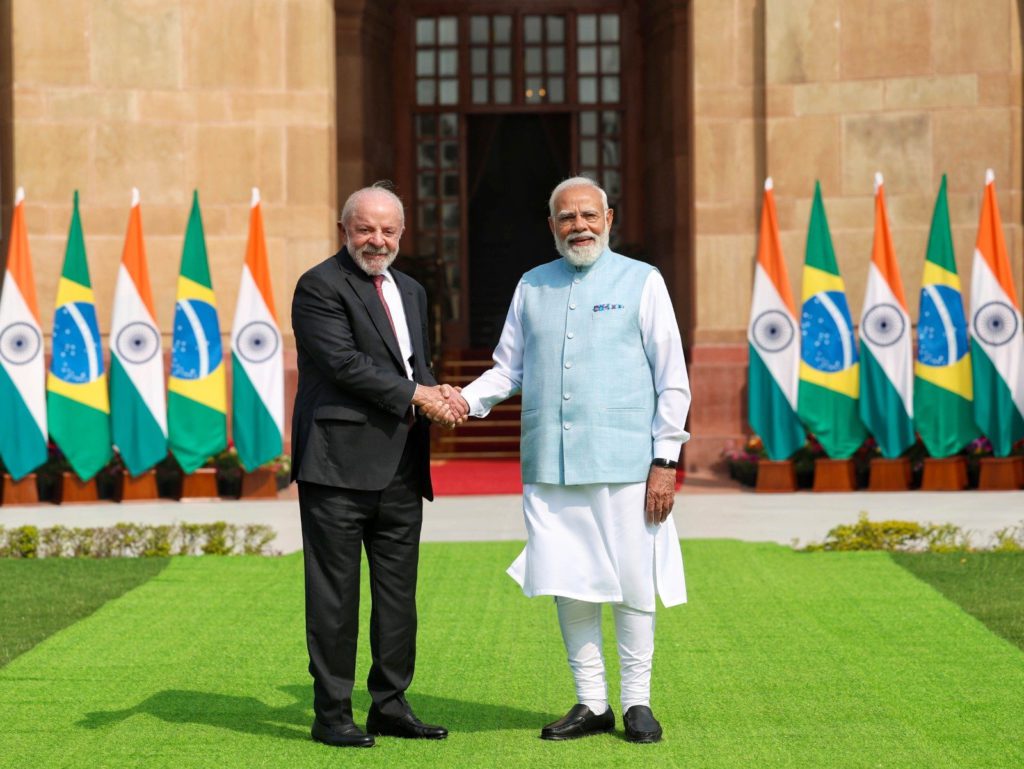 Brazilian President Luiz Inacio Lula da Silva and India’s Prime Minister Narendra Modi. Credit: Narendra Modi’s official X account
India moved to deepen trade ties with Brazil on Saturday, signing a pact to expand cooperation in mining and minerals as it seeks to meet rising domestic steel demand and support capacity expansion amid a global race for raw materials.

The agreement was signed in the presence of India’s Prime Minister Narendra Modi and Brazilian President Luiz Inacio Lula da Silva, who arrived in New Delhi earlier this week for a three-day visit.
Brazil is among the world’s top producers of iron ore and holds large reserves of minerals critical to steelmaking. Closer cooperation is expected to improve India’s access to raw materials and technologies needed to sustain long-term growth in its steel sector, an Indian government statement said.
India moved to deepen trade ties with Brazil on Saturday, signing a pact to expand cooperation in mining and minerals as it seeks to meet rising domestic steel demand and support capacity expansion amid a global race for raw materials.
The agreement was signed in the presence of India’s Prime Minister Narendra Modi and Brazilian President Luiz Inacio Lula da Silva, who arrived in New Delhi earlier this week for a three-day visit.
Brazil is among the world’s top producers of iron ore and holds large reserves of minerals critical to steelmaking. Closer cooperation is expected to improve India’s access to raw materials and technologies needed to sustain long-term growth in its steel sector, an Indian government statement said.
Infrastructure investment
The cooperation will focus on attracting investment in exploration, mining and steel sector infrastructure, the statement said.
India has steelmaking capacity of 218 million metric tons, and companies are expanding output to meet rising domestic demand driven by infrastructure development and industrialization.
Addressing a meeting with a Brazilian delegation led by Lula, Modi said their talks had focused on ways to deepen the India-Brazil trade partnership.
“We are committed to taking bilateral trade much beyond $20 billion in the next five years,” Modi said.
Bilateral trade between the two countries currently stands at about $15 billion.
“Our nations will also work closely in areas such as technology, innovation, digital public infrastructure, AI, semiconductors and more,” Modi said.
The cooperation will focus on attracting investment in exploration, mining and steel sector infrastructure, the statement said.
India has steelmaking capacity of 218 million metric tons, and companies are expanding output to meet rising domestic demand driven by infrastructure development and industrialization.
Addressing a meeting with a Brazilian delegation led by Lula, Modi said their talks had focused on ways to deepen the India-Brazil trade partnership.
“We are committed to taking bilateral trade much beyond $20 billion in the next five years,” Modi said.
Bilateral trade between the two countries currently stands at about $15 billion.
“Our nations will also work closely in areas such as technology, innovation, digital public infrastructure, AI, semiconductors and more,” Modi said.
Largest trading partner in Latin America
India and Brazil have been strategic partners since 2006, with cooperation spanning trade, defence, energy, agriculture, health, critical minerals, technology and digital infrastructure.
Brazil is India’s largest trading partner in the Latin America and Caribbean region, and the two countries work closely on global issues such as UN reform, climate change and counter-terrorism.
Lula on Thursday advocated for Brazil and India to conduct trade in their own currencies rather than settling transactions in US dollars, but dismissed speculation that the BRICS group of countries, of which both nations are members, would create a common currency.
(By Manoj Kumar and Mayank Bhardwaj; Editing by Jan Harvey)
India and Brazil have been strategic partners since 2006, with cooperation spanning trade, defence, energy, agriculture, health, critical minerals, technology and digital infrastructure.
Brazil is India’s largest trading partner in the Latin America and Caribbean region, and the two countries work closely on global issues such as UN reform, climate change and counter-terrorism.
Lula on Thursday advocated for Brazil and India to conduct trade in their own currencies rather than settling transactions in US dollars, but dismissed speculation that the BRICS group of countries, of which both nations are members, would create a common currency.
(By Manoj Kumar and Mayank Bhardwaj; Editing by Jan Harvey)
Kazatomprom inks massive supply deal with India
 State-controlled Kazatomprom forecasts production will rise this year. (Image courtesy of Kazatomprom.)
Kazatomprom, the world’s top producer of uranium, plans to sell a significant portion of its output to India, a move that could further tighten the global market for nuclear fuel.
In an announcement on Friday, the Kazakh state miner said has it reached a massive supply agreement representing over 50% of the company’s booked asset value with India’s Department of Atomic Energy.
Under Kazakh law, a deal of this magnitude would require shareholder approvals. As such, the company has called for an extraordinary general meeting for shareholders to cast their votes. Notice of the meeting is expected at a later date.
The deal, if approved, could potentially remove a sizeable share of uranium supply off the market. Kazatomprom is currently the world’s single-largest resource holder and accounts for about 20% of global production.
Last year, the Kazakh group produced about 67.2 million lb. uranium concentrates (on a 100% basis), which is in line with guidance and 10% higher than 2024. This year, it is expecting another 9% rise in production.
Despite this projected growth, analysts believe the global uranium market will remain in a structural deficit. Analysts at Teniz Capital, an Abu Dhabi-based investment bank, said the entire sector is undergoing a “second nuclear renaissance” that could see demand outpacing supply in the coming years.
Kazatomprom, the world’s top producer of uranium, plans to sell a significant portion of its output to India, a move that could further tighten the global market for nuclear fuel.
In an announcement on Friday, the Kazakh state miner said has it reached a massive supply agreement representing over 50% of the company’s booked asset value with India’s Department of Atomic Energy.
Under Kazakh law, a deal of this magnitude would require shareholder approvals. As such, the company has called for an extraordinary general meeting for shareholders to cast their votes. Notice of the meeting is expected at a later date.
The deal, if approved, could potentially remove a sizeable share of uranium supply off the market. Kazatomprom is currently the world’s single-largest resource holder and accounts for about 20% of global production.
Last year, the Kazakh group produced about 67.2 million lb. uranium concentrates (on a 100% basis), which is in line with guidance and 10% higher than 2024. This year, it is expecting another 9% rise in production.
Despite this projected growth, analysts believe the global uranium market will remain in a structural deficit. Analysts at Teniz Capital, an Abu Dhabi-based investment bank, said the entire sector is undergoing a “second nuclear renaissance” that could see demand outpacing supply in the coming years.