Saturday, September 27, 2025

Lufthansa planning thousands of job cuts: sources


By AFP
September 26, 2025


Lufthansa has lost ground to key European rivals IAG and Air France-KLM, which have outperformed the German group in terms of profitability - Copyright AFP Issam AHMED

Lufthansa is planning to cut thousands of administrative staff as the German aviation giant seeks to reduce costs following a fall in earnings, sources close to the matter said Friday.

The group’s profits tumbled nearly a fifth in 2024 due to problems ranging from a string of walkouts to aircraft delivery delays.

Two sources, speaking on condition of anonymity, confirmed to AFP that Lufthansa was planning to axe up to 20 percent of its administrative staff.

The Handelsblatt financial daily, which also reported on the job cuts, said the group employs some 15,000 office staff. Its total workforce currently numbers around 103,000.

Lufthansa — whose carriers also include Eurowings, Austrian, Swiss and Brussels Airlines — declined to comment when contacted by AFP.

But the group’s shares jumped over three percent in Frankfurt after reports emerged of the plans, which follow growing investor concerns about the airline giant’s flagging profitability.

Lufthansa is planning to update investors on its strategy and outlook on Monday.

Gerald Wissel, an aviation expert at Airborne Consulting, said Lufthansa wanted to centralise its management.

“In this context, the job cuts at the office level seem justified, but it will still be difficult to lay off so many employees in a socially acceptable manner,” he told AFP.

The Verdi union, which represents some Lufthansa workers, said it would not accept “drastic cuts”.

“We will use the next round of collective bargaining” to combat any such measures, the group’s Marvin Reschinsky told AFP.

Lufthansa has lost ground to key European rivals IAG and Air France-KLM, which have outperformed the German group in terms of profitability.


The Ganges River Drying Worst In Over 1300 Years – OpEd

ganges river india boat people sun hot heat

By 

The Ganges River, a lifeline for 600 million people in India and neighboring countries, is experiencing its worst drying period in over 1,300 years. Using a combination of historical data, paleoclimate records and hydrological models, researchers from IIT Gandhinagar and the University of Arizona discovered that human activity is the main cause. They also found that the current drying is more severe than any recorded drought in the river’s history. 


Not only is the Ganges river drier overall, but droughts are now more frequent and last longer. The main reasons are the weakening of the summer monsoon and global warming. 

In their study, published in the Proceedings of the National Academy of Sciences, researchers first reconstructed the river’s flow for the last 1,300 years (700 to 2012 C.E.) by analyzing tree rings from the Monsoon Asia Drought Atlas dataset. The scientists found that the recent drying of the Ganges River from 1991 to 2020, is the worst Ganges River’s drying in 1,300 years, which occurred during the 16th century. 

The Ganges river’s present drying, as the worst in 1300 years, is a warning for India and neighboring countries similar to the western world’s warning of Armageddon.

The Greek word Armageddon is a transliteration of the Hebrew har məgiddô, a mountain near Megiddo, a hilltop fortification built by King Ahab, that dominated the Plain of Jezreel. Har Magedon is the symbol of a battle in which, when the need is greatest and believers are most oppressed, God suddenly reveals His power to distressed peoples and the evil enemies are destroyed. 

Armageddon is a warning of humanity’s need to change to avoid Armageddon. The term “apocalypse” comes from the Greek word “apokalypsis,” meaning “revelation.” Although often associated today with the end of the world, apocalypses in ancient Jewish thought were a source of encouragement in times of great hardship or persecution.


The majority of Christians, Jews, and Muslims do not believe that all of humanity is moving closer and closer to many catastrophic nature Judgement Days. The minority who do think that Judgement Day is coming soon share the usual negative, fear-filled views of most end-times thinkers: Christians, Jews and especially Muslims, who do believe that: “The hour (of Judgement) is near” (Qur’an 54:1); and ˹The time of˺ people’s judgment has drawn near, yet they heedlessly turn away.” (Qur’an 21:1) 

Like Judaism and Christianity, Islam has a powerful eschatological strain. It anticipates the end to the world as we know it; a final historical confrontation between good and evil (Armageddon); after which, with God’s help, human life will be rewarded and transformed. 

As the Qur’an states: “Verily! Those who believe and those who are Jews, Christians, and Sabians, whoever believes in Allah and the Last Day, and do righteous good deeds, shall have their reward with their Lord, on them shall be no fear, nor shall they grieve.” (2:62 and 5:69) Notice that the Qur’an specifically stresses religious pluralism applies on God’s judgment day. 

As Pope Francis said: ‘All Religions Are Paths To God’ This is a new and very strong support for religious pluralism.

Yet a Pew Research Center poll found that in South and Southeast Asia 55-60% of all Muslims believe in the Madhi’s imminent return; and in the Middle East and North Africa 51% do.

A hadith says that Prophet Jesus, will return to a place east of Damascus and will join forces with the Islamic messiah, the Mahdi, in a battle against the false messiah, the one eyed Dajjal. As ibn Babuya writes in Thawab ul-A’mal, “The Apostle of God said: `There will come a time for my people when there will remain nothing of the Qur’an except its outward form, and nothing of Islam except its name, and they will call themselves by this name even though they are the people furthest from it. The mosques will be full of people but they will be empty of right guidance. 

“The religious leaders (Fuqaha) of that day will be the most evil religious leaders under the heavens; sedition and dissension will go out from them and to them will it return.” This sounds, and indeed is, terrible. But, those who trust in God know that the night is coldest in the last hours before sunrise.

Secularists believe that these apocalyptic visions of a future (Armageddon) are absurd, although many secularists themselves fervently believe that runaway genetic modification of food and/or extreme climate change is going to doom human civilization in future generations. 

The basic difference between the pessimistic, humanist secularists and the religious optimists is that those who believe in the God of Abraham also believe that God’s inspiration and guidance guarantees that the spiritual forces of good, will overcome all the world’s evils at the end of days; and  justice, peace and religious pluralism will prevail. Or as Prophet Micah envisions it: (4:1-5)

“In the end of days the mountain of the Lord’s Temple will be established  as the highest mountain; it will be exalted above the hills, and peoples will stream to it. Many (not all) nations will come and say, ‘Come, let us go up to the mountain of the Lord, to the Temple of the God of Jacob. who will teach us his ways, so that we may walk in his paths.

“Torah will be broadcast from Zion, and the word of the Lord from Jerusalem. God will judge between many (not all) peoples and will settle disputes among powerful nations far and wide. They will beat their swords into ploughs, and their spears into pruning hooks. Nation will not take up sword against nation, nor will they train for war any more.


“Everyone will sit under their own vine and under their own fig-tree, and no one will make them afraid, for the Lord Almighty has spoken. All the nations will walk in the name of their gods, and we (Jews) will walk in the name of the Lord our God for ever and ever.”

Thus, the Bible and the Qur’an’s final judgement is the self-destruction of violent, hate filled, religion twisted terrorism and narrow ‘my way or death’ philosophy (Armageddon); and the victory of kindness, love, democracy and religious pluralism. 

The Qur’an refers to Prophet Abraham as a community or a nation: “Abraham was a nation/community [Ummah]; dutiful to God, a monotheist [hanif], not one of the polytheists.” (16:120) If Prophet Abraham is an Ummah then fighting between the descendants of Prophets Ishmael and Isaac is a civil war and should always be avoided. Remember: “The very earth itself is a granary and a seminary,” said Henry David Thoreau  “and every seed means not only birth; but rebirth.

If all Arabs and Jews can live up to the ideal that ‘the descendants of Abraham’s sons should never make war against each other’ is the will of God; we can help fulfill the 2700 year old vision of Prophet Isaiah: “In that day there will be a highway from Egypt to Assyria. The Assyrians will go to Egypt, and the Egyptians to Assyria. The Egyptians and Assyrians will worship together. 

“On that day Israel  will join a three-party alliance with Egypt and Assyria, a blessing upon the heart. The LORD of Hosts will bless them saying, “Blessed be Egypt My people, Assyria My handiwork, and Israel My inheritance.”  (Isaiah 19:23-5)



Rabbi Allen S. Maller

Allen Maller retired in 2006 after 39 years as Rabbi of Temple Akiba in Culver City, Calif. He is the author of an introduction to Jewish mysticism. God. Sex and Kabbalah and editor of the Tikun series of High Holy Day prayerbooks.


 

China, Russia, Pakistan and Iran push back on Trump ambitions in or near Afghanistan

China, Russia, Pakistan and Iran push back on Trump ambitions in or near Afghanistan
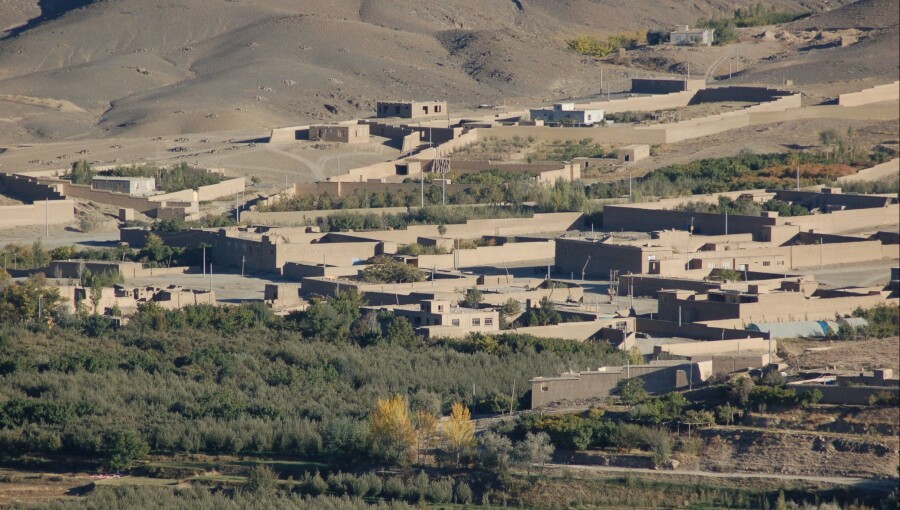
Wardak - west of the Afghan capital Kabul / Bashir Ahmadi - Unsplash
By Mark Buckton - Taipei September 28, 2025

In a rare display of alignment, Pakistan, China, Iran and Russia have jointly rejected proposals for the establishment of any US military bases in or around Afghanistan, insisting upon respect for Kabul’s sovereignty and territorial integrity, The Times of India states. The statement was issued following a meeting of the foreign ministers from each of the four nations on the sidelines of the 80th session of the United Nations General Assembly in New York.

In a communiqué published on September 27, it was stressed that any foreign military installations in the region would be contrary to the principle of non-interference. To this end it was declared that no military bases in or around Afghanistan should be permitted. In just the past week, US President Donald Trump has been pushing for the US military to retake control of the sprawling Bagram Afghan airbase near Kabul, long operated by the US Air Force, in what is being painted in the US media at least as a move to help limit Chinese nuclear expansion in the area.

Trump’s administration has, according to The Times of India citing regional sources, been exploring options for keeping a military footprint in Afghanistan.

Key stakeholders in the region have, however, expressed concern that permanent bases or even long-term military deployments could undermine regional stability. For Islamabad, the issue carries high political stakes, especially given its historical sensitivity over any foreign military presence near its borders. Meanwhile, Beijing, Moscow and Tehran also share apprehensions about US influence extending into areas they regard as within their strategic periphery, The Times of India adds.

During the foreign ministers’ meeting, Pakistan, China, Iran and Russia urged that any arrangements involving foreign defence infrastructure should be made only with the full consent of the Afghan government in order to help preserve its territorial integrity.

No obvious response from the US has yet been made, although Secretary of War, Pete Hegseth has called a meeting in the coming days in which, according to abc NEWS, hundreds of senior US generals and admirals will sit before Hegseth as he “delivers his message of restoring the "warrior ethos" to the US military and presents new standards toward that goal.” Pentagon figures reveal that the US currently has over 830 generals and admirals, and with all on one place, at one time this itself poses a major security risk.

Yet, with international attention on Afghanistan set to intensify, particularly with regards to governance and security, the rejection of proposed US bases by four countries often seen as hostile to the US only adds another layer of complexity to the diplomatic landscape.


Germany preparing to enter direct negotiations with Afghanistan’s Taliban government

Germany preparing to enter direct negotiations with Afghanistan’s Taliban government
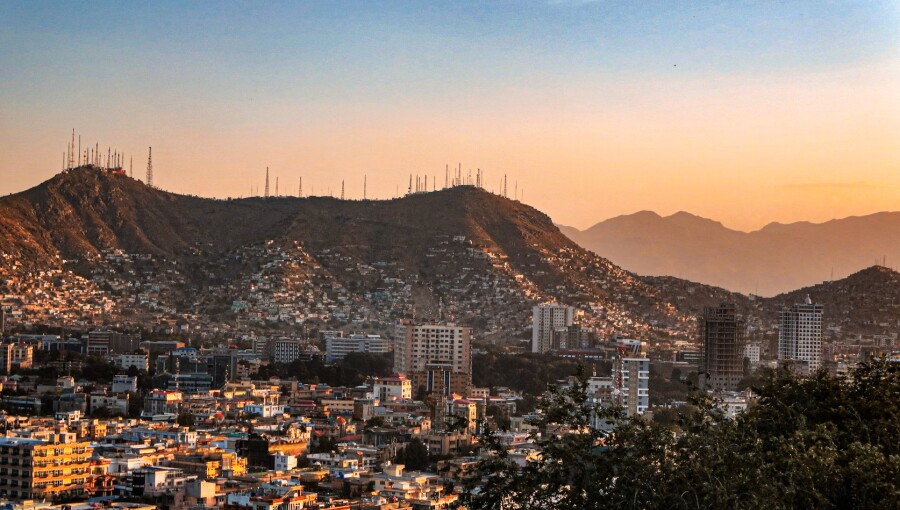
Kabul - the Afghan capital / Mohammad Husaini - Unsplash
By bno - Kolkata Office September 28, 2025

In a striking shift of policy, the German federal government is reportedly preparing to enter direct negotiations with the Taliban in Kabul as early as October over the deportation of Afghan nationals, Spiegel Politik reports. The move signals a sharp departure from past reliance on third-party intermediaries and has already drawn fierce criticism from human rights organisations.

A representative of the Federal Ministry of the Interior is said to have confirmed plans to dispatch officials to the Afghan capital next month to establish mechanisms for returning so-called serious criminals and security risks, it has been reported.

In recent months, the subject of deporting several million Afghans back to Afghanistan has made headlines across southern Asia, with Iran and Pakistan in particular keen to return large numbers of Afghans, many of whom have spent decades abroad.

Germany has long lacked diplomatic representation in Afghanistan since the Taliban’s return to power in August 2021. Previous repatriation efforts relied on third-party intermediaries – most notably Qatar - to help broach deals for charter flights.

According to the report in Spiegel Politik, the decision comes amid growing domestic and international controversy. Pro Asyl, Germany’s leading refugee rights organisation, castigated the shift, arguing that such deportations may violate international law given the deteriorating human rights situation in Afghanistan, including reports of reprisals, eroded civil liberties, and draconian penalties for minor infractions.

It has also been speculated that Germany might be readying to accept a liaison presence on the part of the Afghan government, that stops short of full recognition.

In recent months, debates have intensified over whether Germany and other countries in Europe should resume deportations of serious offenders to Afghanistan, and while some government officials see the move as fulfilling a duty to deter crime and maintain order, critics warn of grave legal and moral risks, the report adds.


Growing calls for France to lift 'collective punishment' ban on visas for Gazans

France's recognition of Palestinian statehood at the United Nations this week has led to calls for it to reinstate evacuations from Gaza, which were halted on 1 August following antisemitic posts by a Gazan student at Lille University. The suspension has left scientists, artists and students who were due to arrive in France on special visas in limbo.


Issued on: 26/09/2025 - RFI

A group of French people have helped Gazan poet Alaa al-Qatrawi file an application to come to France via the Pause programme, which offers special one-year "talent" visas. 
© Alaa al-Qatrawi

By:Alison Hird


Of the hundreds of people evacuated from Gaza to France since the conflict in the enclave broke out in October 2023, 73 have come as part of a partly state-funded humanitarian programme known as Pause.

Run by the prestigious Collège de France research institute, Pause provides special one-year visas to artists and scientists in danger.

Since 2017, it has supported more than 700 people from more than 40 countries, including Ukraine, Syria and Afghanistan. For Palestinians in Gaza, it represents one of the few pathways to safety.

'A life jacket'

"The Pause programme was literally a life jacket for us," says Abu Joury, a well-known Gazan rapper who arrived in the town of Angers in western France in January, with his wife and three children.

Sponsored by a local organisation, Al Khamanjati, he has been able to provide financial stability and security for his family – something he says has become impossible in Gaza.
Rap artist Abu Joury waits to perform with the Radio Gaza collective in Grigny, south of Paris, 23 September, 2025. © A.Hird/RFI

But that life jacket is no longer available.

On 1 August, Foreign Minister Jean-Noël Barrot announced that "no evacuation of any kind" would take place until further notice.

The trigger was a Palestinian student at Sciences Po Lille who was accused of sharing antisemitic statements in 2023, and was subsequently expelled to Qatar.

The student was not part of the Pause programme, but the decision to halt all evacuations has left more than 120 people – 25 approved candidates and their families – stranded in what the UN has described as genocidal conditions.

France halts Gaza evacuations over antisemitic posts by Palestinian student

"They’ve been waiting for months and are sending us constant messages calling for help,” says Marion Gués Lucchini, head of international diplomacy for the Pause programme. "They’re saying: 'why are we being condemned for comments made by just one person? Why have we been abandoned?'"

The decision is unprecedented, Gués Lucchini says. "Because of a single person, all the others are condemned to remain in Gaza.

"We've been around for eight years. We've had people from all over the world, including countries where there may be sensitivities – Russia, Iran and so on. We've never had a security problem, we've never had anyone who was supposedly close to a terrorist group. Never."

She adds that all Pause candidates are subject to rigorous screening by four different ministries, including security checks by the Interior Ministry.

Listen to an audio report featuring Abu Joury on the Spotlight of France podcast:


‘Collective punishment’


After President Emmanuel Macron recognised Palestinian statehood at the UN on Monday, the French government now faces mounting pressure to reinstate evacuations.

A collective of Palestinian and migrant rights groups has filed a case with the Conseil d’Etat – France’s top court – claiming the suspension of evacuations for Gazans is in breach of the constitution.

Last week, some 20 acclaimed writers, including French Nobel laureates Annie Ernaux and J.M.G. Le Clézio, called on Macron to "restore this lifeline" as soon as possible.

“This suspension of evacuation programmes on the basis of one case of a racist social media post is a form of collective punishment at a time when all signatories to the Genocide Convention should be doing their utmost to save Palestinians from annihilation and should refuse to be complicit in crimes against humanity,” they wrote in an open letter.

While evacuating only writers, artists and researchers was “inadequate and even cruel in the context of the killings and destruction in Gaza”, they underlined that “today this programme is one of the only ways by which a few people in Gaza can be saved from genocide, a part of which is scholasticide".

The authors called on France to “follow through on its proclaimed humanist values”.

'I fear for my friend'


Mathieu Yon, a 48-year-old fruit farmer from southern France, has become an unlikely advocate for Palestinian evacuation rights.

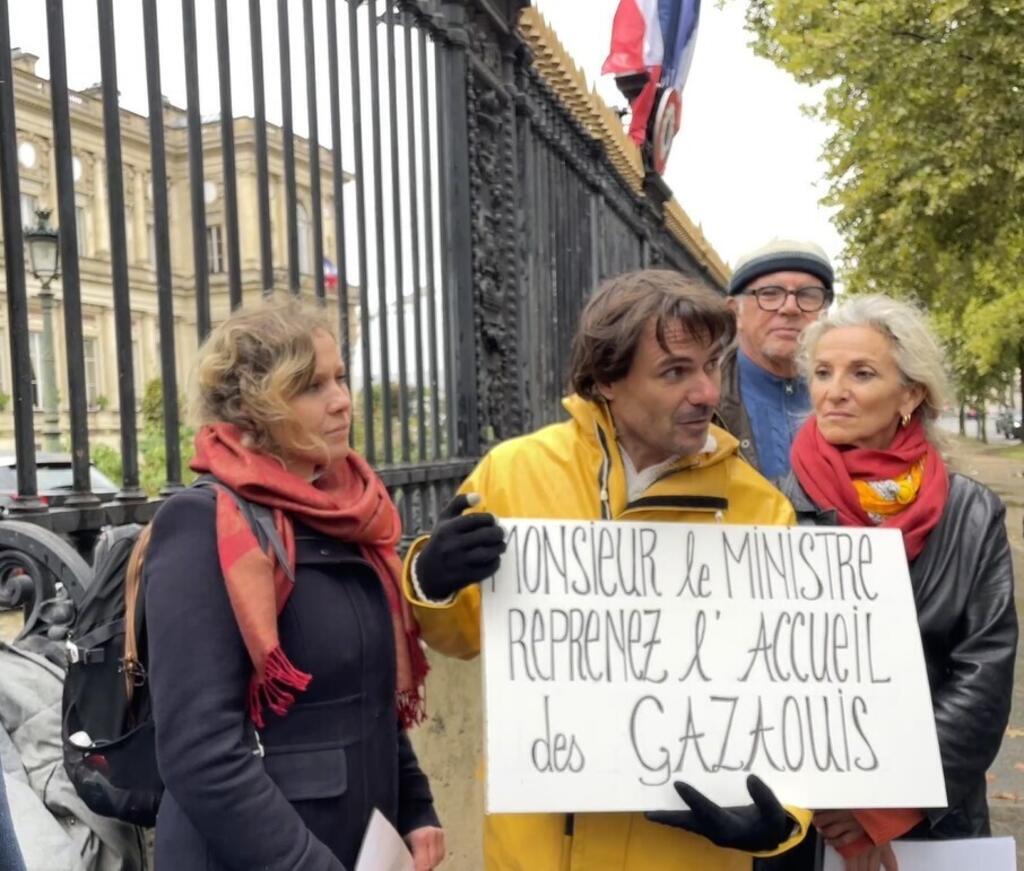
On Wednesday he took up position on a bench in front of the Foreign Ministry holding a sign addressed to Barrot: "Monsieur le ministre, resume the reception of Gazans."

Around six months ago, Yon struck up a friendship with Gazan poet Alaa al-Qatrawi after reading her poem “I’m not well”, about losing her four children in an Israeli bombing in December 2023.

“She lost her four children and yet she’s still full of love and without any anger or aggression,” he says. “I fear for my dear friend.”

He, his wife and two friends have raised the necessary €48,000 to cover al-Qatrawi’s year-long residency.

They have work and accommodation lined up for her in their home town of Dieulefit, north of Avignon. "Everything is in place," Yon said, hoping that his protest will see her file, handed in on 26 August, treated as a matter of urgency.

Left to right: Julie Yon, Mathieu Yon (centre), Alric Charbit and Sophie Charbit protest in front of the Foreign Ministry on 24 September, 2025, to call on Jean-Noel Barrot to restart evacuations of Gazans to France. © A. Hird/RFI

From a refugee camp in Gaza, al-Qatrawi describes the constant danger: "Every Palestinian living now in Gaza is at risk of being killed at any second and in any place you can think of. You are exposed to assassination attempts throughout the day. And if you survive, you think about how you are going to survive the next day."

Her four children – Orchid, Kenan, Yamen and Carmel – were killed on 13 December, 2023. "There was a cordon around the area. The occupation [by the Israeli army] prevented ambulances from arriving," she told RFI’s sister radio station MCD.

The Ma'an collective, which helps Pause applicants, reports receiving increasingly desperate messages from Gaza.

"These are no longer calls for help, but testaments and farewells," it said in a statement. One read: "I am writing to you, and maybe my last words. We are starving and losing everything around us."

Ahmed Shamia, an architect who had been accepted by the Pause programme, was killed in bombardments on 1 May this year, just days before he was due to be evacuated.

"It was very difficult for us all," says Gués Lucchini. "It was the first time [someone selected for] the programme had died."

"I am one of thousands of mothers...who lost children in this war," says Palestinian poet Alaa al-Qatrawi. 
© Monte Carlo Douliya

Conflating Gazans with terrorists

Gués Lucchini laments that a programme offering a lifeline to scientists and artists has become a target for the far right, with Pause dealing with online attacks.

“These accounts created the controversy surrounding the student [in Lille], which led to the suspension of the evacuations. Since then there have been other smear campaigns against [people selected for] the Pause programme. It’s clear there is a desire to confuse aid and support for Gazans – scientists, artists and others – with support for a terrorist group.”

The French Sunday newspaper Le Journal du Dimanche, which has a controversial far-right editor, recently accused Pause of "opening the door to Hamas”.

Yon, who has Jewish ancestry and whose great-uncle was deported to Auschwitz, rejects any suggestion that Gazans pose an inherent security risk. "There are antisemitic people in Gaza. But I think there are in France, too. There are in all countries, not especially in Gaza."

He added: "This is a collective punishment without any kind of justice. In France we have the principle of presumption of innocence, but this is presumption of guilt."

France’s Foreign Ministry has not commented publicly on when evacuations of Gazans will resume. But a diplomatic source told RFI: “Since the Israeli authorities have suspended evacuations, no operation is possible at this stage."

French services are effectively dependent on local authorities, in this case Israel, who grant or deny exit permits based on lists submitted by the French authorities.


Race against time

For those still waiting, time is running out. "Every day that passes is another day that we take the risk that someone supported by a French national programme will die,” Gués Lucchini warns.

Joury could be considered one of the lucky ones. But despite finding safety and a “very warm welcome” in France, he remains haunted by those left behind – especially his mother and brother, who didn't manage to reach Egypt before Israel closed the Rafah crossing.

"I'm physically out. But my mind is still in Gaza. My mother and my brother, I'm thinking of them all the time. My soul is still in Gaza," he said.

As Yon continues his vigil outside the Foreign Ministry, he reflects on how hard it was to tell al-Qatrawi evacuations had been halted.

“She said, ‘even if it doesn't happen, this relationship, this poetry exists. Even if the result is sad for our life, all of this poetry, all of this love, all of this kindness is real’.

“This relationship has a value in itself," Yon concludes. A lifeline of friendship – but no life jacket.
Gustavo Petro: US to revoke visa of leftist Colombian leader
DW with AP, AFP, Reuters
September 27, 2025

The left-wing Colombian president is a critic of Trump and vocally opposes Israel's operation in Gaza. Petro is in New York for the UN General Assembly and had called on US soldiers to disobey Trump.

Colombian President Gustavo Petro strongly condemned the Trump administration's strikes on alleged drug-trafficking boats in the Caribbean Sea during his UNGA addressImage: Leonardo Munoz/AFP

The US Department of State said Friday that it will revoke the US visa held by left-wing Colombian President Gustavo Petro.

The State Department said in a post on X that the revocation was due to Petro's "reckless and incendiary actions."

What do we know so far?

Petro is in New York City for the United Nations General Assembly. Earlier on Friday, he told a group of protesters in New York that US soldiers should "disobey the orders of Trump" and "Obey the orders of humanity!"

Those comments seem to be the last straw for US President Donald Trump's administration. Under the US Constitution, the president is the commander-in-chief of the US mlilitary.

During his speech at the United Nations General Assembly, Petro strongly criticized the Trump administration's strikes on alleged drug-trafficking Venezuelan boats in the Caribbean Sea. The Colombian president even went so far as to say that Trump should face "criminal proceedings" over the killings.


Petro, who took office in August 2022, is also a strong critic of Israel's military campaign in Gaza, putting him at odds with the Trump administration. Trump, meanwhile, has said the Colombian government is failing to meet its "drug control obligations."

Petro in standoff with Trump administration over deportees earlier this year

Earlier this year, Colombia blocked two US military planes which were transporting deported migrants from landing on Colombian territory. Petro was not happy with the treatment of Colombian deportees by the Trump administration.

In retaliation, the Trump administration revoked visas for Colombian officials and even announced 25% tariffs on Colombia, a major coffee producer. In response, Petro announced tariffs on US goods.

That standoff was ended when then-Colombian Foreign Minister Luis Gilberto Murillo announced Colombia would take back its citizens. Trump then announced he would not move forward with the implementation of the punitive measures on Colombia.

Edited by: Kieran Burke
Wesley Dockery Journalist and editor focused on global security, politics, business and music

Slovakia's government is fighting on all fronts

DW
September 25, 2025

After a relatively quiet summer, there have been a number of anti-government protests in Bratislava and across Slovakia over the past two weeks. What has motivated protesters to take to the streets again?


Anti-government protesters showed their displeasure with signs reading 'Entrepreneurs are not the government's ATM
'Image: Radovan Stoklasa/REUTERS

Around 10,000 people filled Bratislava's Freedom Square on Tuesday evening to protest the policies of Prime Minister Robert Fico's government, with rallies also taking place in several other cities across Slovakia.

The turnout was smaller than last week, when 16,000 gathered in the capital. On that occasion, demonstrators also heard four liberal opposition parties announce a cooperation deal.

The protests are an extension of the series of demonstrations that began after Fico returned as prime minister in late 2023.

They also add to a growing list of challenges — both domestic and international — faced by the strongman premier.

International opprobrium


At the international level, attention remains focused on Fico's cozy relations with Russia and China, which sparked the early grassroots-led protests.

The leaders of four parties, (from left: Jaroslav Nad, Branislav Groehling, Michal Simecka and Milan Majersky) addressed a crowd protesting the government's proposed cost-cutting measures last week
Image: Joe Klamar/AFP

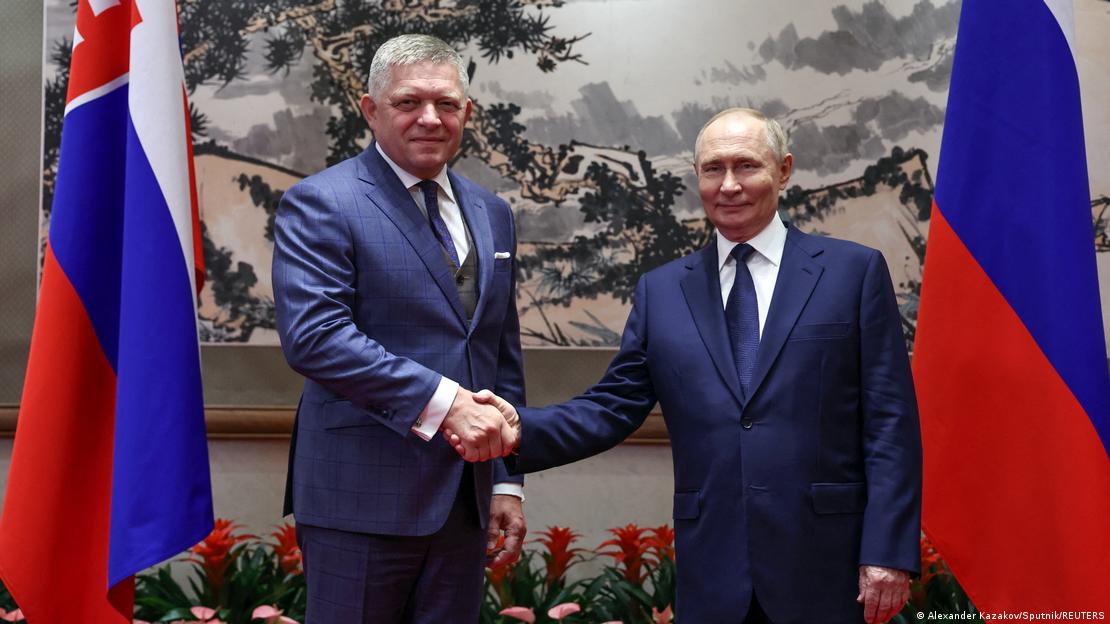
European noses were put out of joint again by Fico's early September meetings with Russian President Vladimir Putin and Chinese President Xi Jinping, his refusal to stop buying Russian energy and his push to change the constitution to give Slovak law precedence over that of the EU.

All this, alongside authoritarian clampdowns on media and NGOs, has reportedly convinced the Party of European Socialists (PES) to permanently exclude Fico's nominally left-leaning Smer party from the EU faction.

Michal Simecka, leader of the opposition liberal Progressive Slovakia (PS) party, told DW that the move, which PES is expected to ratify in mid-October, "marks a significant blow to Mr. Fico's reputation."

Domestic issues more important to Slovaks


However, analysts say that the depth of political polarization in Slovakia means that international issues barely make a mark there at present.

Radoslav Stefancik of the University of Economics in Bratislava told DW that the move by PES "will not even be noticed by Smer voters."

Domestic issues are clearly the main battleground in Slovakia right now.

Recent opposition rallies, which have been organized under the banner "Protest against impoverishment!" have aimed squarely at Fico's economic policies.

They are a response to a consolidation package announced by the government, its third set of austerity measures since taking power.

Despite pressure to cut back its Russian oil and gas imports, the Slovak government says it would be too expensive to do so. Pictured here: Slovak PM Robert Fico (left) with Russian President Vladimir Putin earlier this monthImage: Alexander Kazakov/Sputnik/REUTERS

The package, which was approved by Slovakia's parliament on Wednesday evening, is a bid to contain the country's economic crisis, a struggle not helped by US tariffs on Slovakia's key auto industry.

It aims to cut €2.7bn from the 2026 budget deficit. While no one disputes the need to act, the emphasis on raising taxes and contributions, slashing public sector salaries and jobs and cutting social benefits is provoking fury.

Critics contend that the package will hit ordinary citizens while sparing oligarchs linked to Fico's Smer party. Business groups complain it will weaken competitiveness.

The government's media office did not respond to a request for comment.

Government instability

Some suggest that the widespread anger over the consolidation plan could revive the instability that has plagued the three-party governing coalition since it came to power almost two years ago.

After slipping to a minority earlier this year as rebel MPs sought to leverage the government's slim majority to push through demands, Fico bought back their loyalty with ministerial posts, leaving him with 79 of the 150 seats in parliament.

Adrius Tursa of the London-based risk consultancy Teneo Intelligence said in an analysis note that he expects the parliamentary debate on the package to "test Fico's fragile majority."

Coalition partners unwilling to rock the boat

The opposition is keen to use the current situation to help push the coalition over the edge. But this will be no easy task.

Thousands of Slovaks gathered in Bratislava on Tuesday shouting 'Enough of Fico! Fico go to jail!' and 'It is enough. We are fed up!'
Image: Radovan Stoklasa/REUTERS

Although, as Simecka says, "the representatives of each party are now publicly bickering about the consolidation package," Smer's junior coalition partners — the center-left Hlas and radical-right Slovak National Party — are wary of rocking the boat, given they've seen their support fall since the last election.

None of them "wants to repeat the situation from 2020 to 2023, when they were in opposition," says Stefancik.

Would voters back the liberals?

At the same time, voters have not forgotten those same three years when a bickering governing coalition cobbled together by liberal parties caused chaos.

Asked how they can convince the country that the newly announced cooperation deal will be different, Simecka stressed that PS has been "touring the regions … talking to disenchanted people who voted for Fico's coalition."

However, analysts suggest that these voters — most of whom belong to the poorer cohort and will feel the economic effects of the consolidation package most keenly — are more likely to turn to parties such as the far-right Republika than to the liberal parties.


Link to the past

Aware of this threat, some in the liberal opposition are attempting to use Fico's pro-Russian stance to draw a line linking the controversy over the consolidation package to 1989's Velvet Revolution.

Perhaps the most contentious part of the consolidation package is a proposal to ditch two national holidays, one of which is the November 17 celebration of the revolt that kick-started the collapse of the communist regime in erstwhile Czechoslovakia.

Since his return to power in 2023, Fico has faced a series of protests over his curbing of rights and close ties with Russian President Vladimir Putin. The placard in the photo reads 'Enough Red Bolshevik'
Image: Joe Klamar/AFP

Some opposition parties have called for a general strike to mark the date, as happened 36 years ago.

However, others among the opposition are wary that it could prove an embarrassing — and extremely expensive — flop.

Observers appear no less skeptical. Andrej Matisak, an editor at the Slovak broadsheet Pravda, brands the idea "unrealistic," insisting that the momentum is not there to carry it off.

Radoslav Stefancik notes that the mood in the country is very different today than it was in 1989: "At that time, the majority sought democracy, political freedoms and a market economy," he says. "Now the country is polarized, and many would not join the protest."

Simecka suggests that his PS party will remain patient, insisting that it "stands ready to challenge Mr. Fico in the upcoming elections, whether they come in two years or tomorrow."

Observers suggest that the scheduled date of 2027 appears the most likely.

Fico already gave up power once in 2018, following the murder of journalist Jan Kuciak, and ended up in the political wasteland and facing prosecution. "He's not going to do that again without a big fight," says Matisak.

Edited by: Aingeal Flanagan

Tim Gosling Journalist covering politics, economics and social issues across Central and Eastern Europe
Living with the legacy of France's nuclear weapons testing

DW
26/09/2025

France tested nuclear weapons for 30 years in the Pacific. The people of French Polynesia bore the brunt of the testing.


For 30 years, France tested nuclear bombs on the Mururoa Atoll in the South Pacific
Image: dpa/picture alliance

"For 30 years, we were France's guinea pigs," says Hinamoeura Morgant-Cross, a young member of parliament from French Polynesia.

This South Pacific archipelago, a French overseas territory that includes Tahiti and is famed for its white beaches, swaying palms, and turquoise waters, is often romanticized as a paradise.

But beneath the idyllic image lies a painful legacy: decades of nuclear testing and its enduring consequences.

Between 1966 and 1996, the French military detonated 193 nuclear bombs on the remote atolls of Mururoa and Fangataufa. These tests were carried out in Ma'ohi Nui, as the territory is known to its indigenous inhabitants. The first explosion, codenamed Aldebaran, took place on July 2, 1966. It marked the beginning of a long chapter that would leave deep scars on the land and its people.

In 2025, Morgant-Cross journeyed over 15,000 kilometers (more than 9,320 miles) to Berlin to speak at an event in May, hosted by the international medical NGO International Physicians for the Prevention of Nuclear War, or IPPNW. There, she delivered a searing testimony about the long-term consequences of France's nuclear testing program: disproportionately high cancer rates, children born with deformities and ongoing contamination of the region's water and soil.

"So they really poisoned the ocean where we found all our food," says Morgant-Cross who has also addressed the United Nations in New York. "We have been poisoned for the greatness of France, for France to be a state with a nuclear weapon."

Hinamoeura Morgant-Cross received the Nuclear-Free Future Award in 2023, for her commitment to the victims of French nuclear weapons testing
Image: IPPNW


The 'clean bomb' myth


The French government at the time knowingly gave false assurances to the islanders about the dangers of the nuclear testing.

Then-President Charles de Gaulle described the French atomic bomb as "green and very clean," suggesting it was safer or more environmentally friendly than the bombs dropped on Hiroshima and Nagasaki .

Morgant-Cross calls it nothing more than "French propaganda."

In reality, radioactive clouds drifted across vast parts of the South Pacific and even reached the main island of Tahiti, more than 1,000 kilometers from the test site. Often, residents of nearby islands weren't informed or evacuated.

No Apology from France


France didn't cease its nuclear testing program until 1996, following intense domestic and international outcry. Despite the halt, the French government has never formally apologized for the harm caused to its overseas territories.

During a 2021 visit to French Polynesia, President Emmanuel Macron acknowledged France's role, stating, "The guilt lies in the fact that we conducted these tests."

"We would not have carried out these experiments in Creuse or Brittany [in mainland France]," he said.

United Nations and various NGOs have observed September 26th as the International Day for the Total Elimination of Nuclear Weapons since 2014. The days is a solemn reminder of the ongoing responsibility borne by nuclear-armed states.

Yet the suffering endured by victims of nuclear testing is in danger of being forgotten. In response, a rising generation from former test sites is refusing to accept the silence of those in power. They are mobilizing across borders, channeling their concern into coordinated action.

Parliamentarian Hinamoeura Morgant-Cross is among those speaking out. While visiting Berlin, she shared her family's painful legacy: her grandmother was 30 when the nuclear tests began and later developed thyroid cancer as did her mother and aunt.

Morgant-Cross, born in 1988, revealed that both she and her sister also developed cancer, underscoring the generational toll of radioactive exposure.


Cancer can develop generations later

Experts warn that nuclear testing has led to clusters of cancer cases within affected families. Exposure to ionizing radiation can cause genetic mutations, which may be inherited by subsequent generations.

"The insidious nature of ionizing radiation lies in its ability to affect people across generations," says nuclear weapons expert Jana Baldus of the European Leadership Network (ELN). "It significantly increases the risk of various cancers, particularly lymphoma and leukemia."

Another consequence of nuclear testing is reproductive harm.

"Women exposed to radiation during the tests have given birth to children with congenital defects and have suffered miscarriages," Baldus tells DW. "These effects can be passed down through generations, potentially leading to infertility in women."

For Hinamoeura Morgant-Cross, the multiple cancer diagnoses in her family were a driving force behind her decision to enter politics.

She is now calling on France — the state responsible for the nuclear tests — to provide greater support for her fellow citizens.

"We don't have the medical care that we should have, that we deserve, because we are 30 years late, in terms of medicines. We don't have technology like medical scans." she says. "It really pushed me to go into politics, and to demand that we deserve a better hospital, we deserve better treatment."

Only a small fraction of those affected have the means to travel to Paris for medical treatment, leaving many without access to adequate care.

Victims face an uphill battle for compensation


In 2010, the French government enacted legislation to provide compensation to victims of nuclear testing. However, each case is assessed individually, and claimants must demonstrate a direct link between their illness and the nuclear tests. That burden of proof is not always easily achieved.

Expert Jana Baldus points out a major hurdle.

"Victims must prove they were physically present at the exact location when the tests occurred — a nearly impossible task decades later." In addition, compensation is limited to a narrow list of officially recognized illnesses. According to the global coalition ICAN (International Campaign to Abolish Nuclear Weapons), only 417 residents of French Polynesia received compensation between 2010 and July 2024.

For Hinamoeura Morgant-Cross, the fight isn't only about securing practical support, it's also about education.

In her homeland, a persistent narrative still portrays the nuclear tests as a so-called clean endeavor that brought prosperity.

"For decades, we had pictures of the nuclear mushroom in all the living rooms of the Tahitian people because we were proud the French decided to choose us," she recalls. Her mission now is to dismantle what she calls that "colonial mindset" and shed light on the true consequences of the tests.


The future of nuclear testing: risk or rhetoric?

France wasn't alone in conducting extensive nuclear tests. The Soviet Union, the United States, the United Kingdom and China also carried out large-scale detonations.

In total, more than 2,000 nuclear explosions have taken place. The resulting radioactive fallout not only contaminated the immediate test sites but also contributed to elevated radiation levels across the globe.

Nuclear testing was halted primarily through moratoriums and international negotiations surrounding the Comprehensive Nuclear-Test-Ban Treaty (CTBT).

In recent years, North Korea has been the only country to conduct such tests. Yet amid rising geopolitical tensions, experts warn that a resurgence of nuclear testing remains a real possibility.

This article was originally published in German.
REST IN POWER 
Assata Shakur: Fugitive Black activist dies in exile in Cuba

Jenipher Camino Gonzalez 
DW with AP, EFE
26/09/2025

Assata Shakur had lived in exile in Cuba since 1979, after escaping a prison sentence for killing a police officer.

Assata Shakur died of health conditions and advanced age, Cuban officials said
Image: AP Photo/picture alliance


The Cuban government announced on Friday that Assata Shakur had passed away at the age of 78. Shakur had lived in exile in Cuba since 1979, after escaping from a US prison.

The Black liberation activist died of "health conditions and advanced age," Cuba's Ministry of Foreign Affairs said in a statement. Her daughter Kakuya Shakur, also confirmed her mother's death in a Facebook post.

Shakur, who was born Joanne Deborah Byron, had been convicted and sent to prison for killing a police officer. Shakur and her supporters maintained she was innocent.

Members of the Black Liberation Army stormed the female prison posing as visitors, taking two guards hostage and enabling Shakur to escape.


She emerged in Cuba in 1984, where Fidel Castro granted her asylum. In 2013, the FBI added her to its list of "most wanted terrorists."

BLM celebrates Shakur's 'courage'

In her writings from Cuba, Shakur said she did not shoot anyone and had her hands in the air when she was wounded during the gunfight with New Jersey State Police troopers, where she was accused of murdering one of the policemen.

Many of her followers believed her and celebrated her role in Black activism in the 1970s.

"It is our duty to fight for our freedom. It is our duty to win," Shakur wrote in a biography published in 1988.

"We must love each other and support each other. We have nothing to lose but our chains."

Her writings also became a rallying cry for the Black Lives Matter movement in recent years, although her opponents accused her of being influenced by Marxist and communist ideology.


Black Lives Matter Grassroots Inc., the group representing activists of racial justice activists from across the US, paid tribute to Shakur on Friday.

"May her courage, wisdom, and deep, abiding love permeate through every dimension and guide us," the group said in a statement.

"May our work be righteous and brave as we fight in her honor and memory."

Edited by: Zac Crellin