Brazil Is Prosecuting a Union Leader for Palestine Solidarity
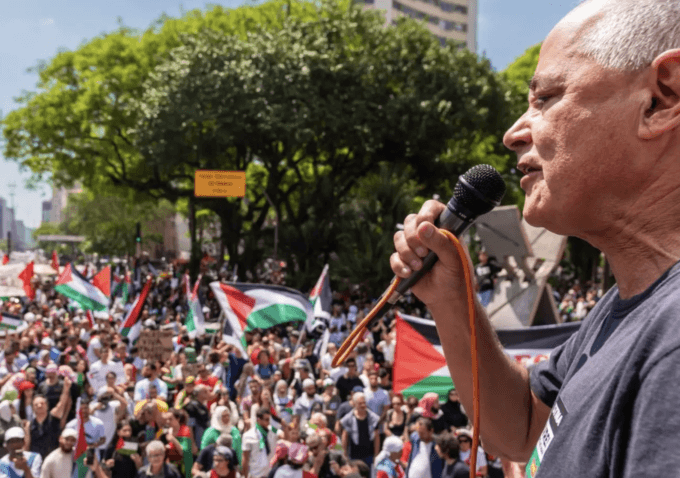
Zé Maria. Image courtesy IWL-FI.
The conviction of veteran labor organizer Zé Maria signals a new phase in the legal weaponization of antisemitism — aimed at disciplining militant currents in the labor movement.
The conviction of Brazilian worker of union and political leader José Maria de Almeida is not simply a case of judicial overreach or a dispute over the boundaries of political speech. It marks a new phase in the use of antisemitism law as a weapon against militant currents in the labor movement — particularly those that link working-class struggle to international solidarity with Palestine.
On April 28, a federal court in São Paulo sentenced de Almeida — known as Zé Maria, national president of the Unified Socialist Workers’ Party (PSTU) — to two years in prison for racism. The charge stemmed from a speech he delivered at an October 2023 rally in solidarity with Palestinians, in which he denounced the Israeli state and invoked the slogan “Free Palestine, from the river to the sea.” The complaint, filed by the Israeli Confederation of Brazil (CONIB) and the Israeli Federation of the State of São Paulo (FISESP), argued that such statements constituted antisemitism. The court agreed. (Read the full court ruling here)
Zé Maria is not a marginal figure. He is a veteran of Brazil’s labor struggles. A metalworker, he was first arrested in 1977 for distributing May Day pamphlets under Brazil’s military dictatorship and again in 1980 during the historic ABC region strikes alongside Luiz Inácio Lula da Silva. He helped found the Workers’ Party (PT) and later broke with it over its accommodation to ruling-class alliances, going on to build the PSTU and the CSP-Conlutas union federation. He represents a current of independent, combative unionism that has consistently opposed both neoliberal restructuring and the political subordination of labor to electoral projects.
That such a figure can now be criminally prosecuted for a speech delivered at a political rally signals a shift in terrain. What is at stake is not simply the policing of rhetoric, but the imposition of new legal limits on the forms of internationalism that sectors of the labor movement are permitted to express.
For American readers, the stakes are immediate. The same legal logic that convicted Zé Maria — rooted in the conflation of anti-Zionism with antisemitism — has been codified in the International Holocaust Remembrance Alliance (IHRA) working definition, which 47 countries have adopted. The United States has enshrined it by executive order, and the Department of Education now uses it to prosecute discrimination complaints under Title VI of the Civil Rights Act. What is happening to Zé Maria in São Paulo is a warning about what is coming for the American left if we do not fight back.
From Dictatorship-Era Militancy to Criminal Court
Zé Maria’s trajectory is inseparable from the history of Brazil’s working-class movement. Born in 1957, he became politically active during the final decades of military rule. His arrests in 1977 and 1980 placed him squarely within the wave of labor militancy that helped destabilize the dictatorship and usher in a new era of working-class organization.
In the early 1980s, he participated in the founding of both the PT and the Central Única dos Trabalhadores (CUT), Brazil’s largest union federation. In 1988, he led the Mannesmann strike, during which workers occupied the factory and maintained production under their own management. He served on the CUT’s national board. But by the 1990s, as the PT increasingly oriented toward institutional alliances and governance, Zé Maria broke with the party. He later helped found CSP-Conlutas, a union federation committed to political independence from the state and to linking workplace struggles with broader social and international causes. Today, CSP-Conlutas represents more than 2 million affiliated workers across Brazil.
This trajectory matters for understanding the present case. Zé Maria does not simply represent “the left” in the abstract. He embodies a specific political current within the labor movement — one that insists on independence, militancy, and internationalism.
A Speech Recast as a Crime
The charges focused on statements Zé Maria made at a public rally in solidarity with Palestinians, where he sharply criticized the Israeli state and defended Palestinian resistance. Prosecutors argued that these statements constituted antisemitic racism rather than political critique. The court accepted this argument, convicting him under Brazil’s anti-racism law and sentencing him to two years in an open regime, along with a fine.
The defense argued that his remarks were protected political expression under Brazil’s constitution and pointed to Jewish organizations internationally that hold similar positions. Jewish Voice for Peace, the largest progressive Jewish anti-Zionist organization in the world, stated in a June 2025 amicus brief that “anti-Zionism means supporting justice for the Palestinian people, including their right to live in freedom and equality.” These arguments were rejected. In the court’s reasoning, the State of Israel was treated as representative of a “Jewish collectivity,” collapsing the distinction between a political project and a people.
Zé Maria rejected the ruling in unequivocal terms. In a May 1 address, he declared: “This sentence has no basis — historical, political, or legal. It is based on the worn-out arguments that the Zionist movement uses to try to defend the indefensible — the genocide of the Palestinian people — and to try to silence criticism of the racist, colonialist, Zionist State of Israel.”
Writing in Folha de S. Paulo, he clarified the distinction at stake: ” Antisemitism is racism, which I repudiate with all my might. Zionists make up a political movement — Zionism, whose racist and colonialist ideology is the basis of the State of Israel.”
By redefining political criticism of a state as an attack on an ethnic or religious group, the ruling establishes a mechanism through which specific political positions can be recast as forms of racism — and therefore subjected to criminal sanction.
Why Target a Union Leader?
The choice of target is revealing. In recent years, Palestine solidarity has increasingly taken root within organized labor. In Brazil, one of the most consistent expressions of this trend has come from CSP-Conlutas, the independent union federation that Zé Maria helped build after breaking with the PT-aligned CUT.
CSP-Conlutas has positioned itself as an alternative pole within the labor movement: critical of the PT’s alliances with business sectors, opposed to austerity measures, and committed to an internationalist politics that links domestic struggles to global ones. As detailed in a May 2026 profile of Zé Maria, the federation is characterized by its effort to “articulate union struggles with broader social movements.” Its support for the Boycott, Divestment, and Sanctions (BDS) movement and its participation in solidarity initiatives with Gaza are not peripheral stances, but integral to its political orientation.
From this perspective, the prosecution of Zé Maria appears less as an isolated response to a controversial speech than as an attempt to discipline a specific current within the labor movement — one that insists on maintaining political independence and articulating solidarity across borders. By recasting anti-Zionist positions as forms of racism, the legal system creates a mechanism through which such currents can be delegitimized and potentially criminalized.
This dynamic is particularly significant in a context where much of Brazil’s institutional labor leadership remains tied to the governing coalition. Independent federations like CSP-Conlutas — which represents more than 2 million workers — retain the capacity to mobilize opposition and connect workplace struggles to broader political questions. Targeting one of their most prominent leaders sends a clear signal: certain forms of militancy — especially those that extend beyond national boundaries — may now fall outside the limits of legally acceptable politics.
Zé Maria himself has framed the case in collective terms, calling for unity across political differences to build a non-sectarian united front: “I call on everyone, to political and popular organizations, regardless of whether they agree with the PSTU or not, to unite to defend basic things: the democratic right of every citizen to express their opinions.”
The implications extend far beyond any single organization. If positions like his can be treated as criminal offenses, then unions, rank-and-file networks, and social movements that adopt similar stances may face comparable risks. What is at stake is whether the labor movement can continue to articulate an independent internationalism at all.
The Legal Weapon: Antisemitism Frameworks and the IHRA
The broader significance of the case becomes clearer when situated within the growing international use of the International Holocaust Remembrance Alliance (IHRA) definition of antisemitism. While presented as a nonbinding “working definition,” the IHRA framework has increasingly been incorporated into legal and institutional settings, where its accompanying examples — including those that equate certain forms of anti-Zionism with antisemitism — take on practical force.
Forty-seven countries have adopted the IHRA definition in some form. Brazil was one of them under Jair Bolsonaro, who joined the IHRA in 2021. The Lula administration withdrew from the IHRA in July 2025, but the framework has reemerged through judicial interpretation and proposed legislation. Bill 1424/2026, introduced by Congresswoman Tabata Amaral (PSB-SP), would formally codify the IHRA definition and treat the State of Israel as a “Jewish collectivity.” If enacted, activists involved in boycott campaigns could face up to five years in prison.
The irony is unmistakable. In July 2025, Amaral formally questioned the Foreign Ministry about Lula’s IHRA withdrawal. Now she leads the charge to enshrine the same definition Lula rejected.
The IHRA Definition Has Become U.S. Government Policy
In the United States, the same legal framework is now official policy. Since 2019, Executive Order 13899 has directed the Department of Education to consider the IHRA definition when evaluating antisemitic discrimination under Title VI of the Civil Rights Act — which applies to virtually every public and private university receiving federal funding. The Antisemitism Awareness Act of 2025 (S. 558), currently pending in the Senate, would codify this into law.
A turning point came in March 2025, when Mahmoud Khalil, a Columbia University student and Palestinian refugee, was arrested by ICE. Columbia, facing the loss of $400 million in federal funding, formally adopted the IHRA definition in July 2025.
This pattern extends beyond the United States. In Germany, more than twelve thousand “Gaza-related” criminal cases have been opened against activists. In France, a proposed IHRA-based law would criminalize calling for the destruction of a state recognized by France; UN experts condemned the bill in April 2026, stating that “criticism of Israel and Zionism does not constitute antisemitism.”
While the specific legal frameworks differ, the pattern is consistent: political positions associated with solidarity with Palestine are increasingly reframed as forms of extremism or discrimination, enabling their regulation through legal means.
Leading Voices Against the Weaponization of Antisemitism
Criticism of the IHRA framework has come from many quarters — including from its own drafter. Kenneth Stern, who wrote the IHRA working definition, has warned against its use as a regulatory tool, insisting it was intended only for data collection. More than 300 scholars have since developed the Jerusalem Declaration on Antisemitism (2021) as an alternative framework, emphasizing that criticism of Israeli state policy and Zionism is not inherently antisemitic. And more than 700 Jewish faculty members have signed statements rejecting the IHRA definition, arguing that “criticism of the state of Israel, the Israeli government, policies of the Israeli government, or Zionist ideology is not — in and of itself — antisemitic.”
Similar critical voices have risen in Latin America. Argentine artist-publisher Dani Zelko has written on dismantling hegemonic Jewish identity in the context of the Palestinian genocide. In Brazil, journalist Breno Altman has argued that anti-Zionism is a political critique, not racism, and that before Zionism, Palestine was one of the safest places for Jews.
U.S. Labor and Academic Opposition to IHRA
American unions and academic associations are not waiting for Zé Maria’s fate to be decided in São Paulo. They have already started fighting back — because they know that what happened to him could happen here.
In New York City, public-sector workers are putting their pension funds on the line. At least four unions have passed divestment resolutions, refusing to let their dues bankroll what they call apartheid and genocide. Local 1113 declared in April 2026 that it “refuses to allow its members’ dues to financially support apartheid, persecution and genocide” and called for divestment from Israeli companies. Local 3005 followed suit in September 2024, with its president stating: “Divesting from genocidal violence is more important than ever.”
The Massachusetts Teachers Association passed a resolution in June 2025 rejecting the IHRA definition outright — arguing it has become a political cudgel to silence pro-Palestinian advocacy. For the MTA, this is a matter of academic freedom and First Amendment rights.
Then there is the AAUP. Under its new president, Todd Wolfson, the organization has embraced a more confrontational posture. That shift is visible in the AAUP’s formal rejection of the IHRA definition. The association has sent letters to the Department of Education opposing its adoption and has listed refusal of the IHRA definition as an explicit demand. In September 2025, the AAUP’s Committee A on Academic Freedom and Tenure argued that the Trump administration has “used antisemitism as a smokescreen” to attack universities. Read the AAUP’s position here.
The most aggressive institutional pushback has come from the California Faculty Association, representing faculty across the 23-campus California State University system. The CFA’s Palestine, Arab, and Muslim (PAM) Caucus has over a hundred members and states flatly that “anti-Zionism is categorically not antisemitism.” In March 2024, the CFA Board joined the National Labor Network for Ceasefire statement. The union’s LA chapter was even earlier, endorsing a ceasefire in November 2023. When Cal Poly Humboldt students were disciplined for pro-Palestine protests, the CFA condemned “police brutality and continued repression”. At the CFA’s 2026 Equity Conference, the union hosted a panel on “detangling antisemitism,” arguing the term “has become so elastic…that it now obscures more than it clarifies.”
Beyond these institutions, two networks are doing real organizing. Labor for Palestine National Network (L4PNN) works inside unions, helping workers distinguish anti-Zionism — a political critique — from antisemitism, racism against Jews. They have produced toolkits for labor activists facing IHRA weaponization. (Find them at Labor for Palestine.)
The Coalition for Action in Higher Education (CAHE) operates on campuses, helping educators fight back through faculty senate resolutions, teach-ins, and legal defense for colleagues targeted by Title VI complaints. CAHE’s annual National Days of Action have involved more than 200 campus actions nationwide.
This is not an academic abstraction. These networks — and unions like the CFA — are building the resistance the moment demands. They know that the legal weaponization of antisemitism is already here. The only question is whether we organize against it now, or wait until it’s our turn in court.
Brazil Labor’s Response — and What Is at Stake
The response from Brazil’s labor movement has been notable for its breadth. On April 29, nine national union centrals — including CUT, Força Sindical, and CSP-Conlutas — issued a joint note condemning the conviction as “a serious attack on freedom of expression and a restriction on international solidarity,” situating it within “a broader context of persecution of voices that denounce what they classify as genocide of the Palestinian people.”
On May 7, the National Federation of Federal Judiciary Workers (Fenajufe) issued a motion of support warning that “political manifestations, especially those linked to international solidarity among peoples, are being criminalized,” calling the ruling “a worrying precedent” for “the entirety of trade union organizations and social movements.”
The Rio de Janeiro State Union of Education Professionals (Sepe-RJ) added: “If today they seek to silence Zé Maria, tomorrow they may try to silence teachers, students, and workers who rise up against injustices.”
These responses reflect a clear understanding of what is at stake. If the legal reasoning applied in this case is generalized, it could reshape the terrain on which unions operate. Positions taken in solidarity with international struggles could expose individuals to legal liability. More broadly, the ability of labor organizations to articulate independent political perspectives could be curtailed through the selective application of criminal law.
Zé Maria has warned explicitly about this trajectory: “If this trend catches on, Zionism will have succeeded in transforming the Brazilian justice system into an instrument for defending the atrocities committed by Israel. And those who dare to criticize the killing could be imprisoned.”
What is at issue, then, is not only the fate of a single union leader, but the future of a particular kind of labor politics — one that seeks to connect workplace struggles with global questions and refuses to confine itself within the limits of state-sanctioned discourse.
International Solidarity Is Needed
Zé Maria’s appeal is pending before the Federal Court of São Paulo (TRF3). Bill 1424/2026 is pending in the Chamber of Deputies. International solidarity can make a difference — especially when it comes from U.S. unions. In the U.S., activist and union organizations can sign the international petition for Zé Maria’s acquittal and, if possible, send solidarity motions from their unions or organizations to internacional@cspconlutas.org.br.
Zé Maria closed his Folha op-ed with a rallying cry that now resonates across borders: “They will not silence us. And Palestine will be free, from the Jordan River to the sea.”

No comments:
Post a Comment