The Nakba Never Stopped
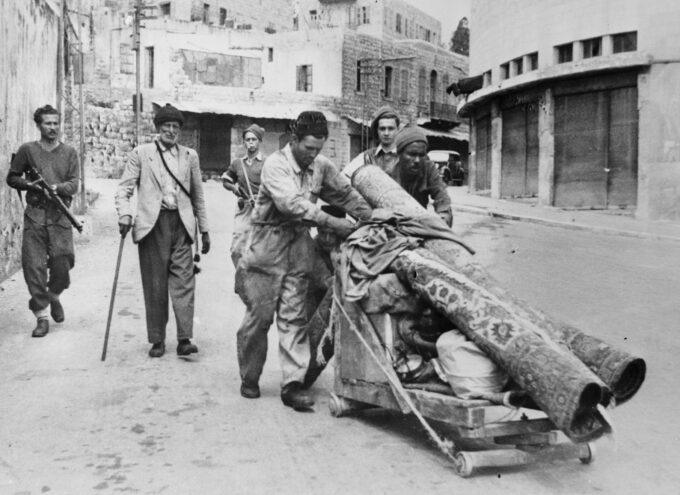
“Arab residents being forced out of Haifa, by the armed Haganah men, April, 1948.” per Haaretz – Public Domain
My grandmother used to keep a rusted iron key in a small wooden box lined with faded velvet. As a child, I thought it was just a broken relic, but every time she held it, her eyes would grow distant. That key, she told me, once opened the front door of their family home that I have never seen in Beir Al Sabaa — in a neighborhood now erased from every map but the one burned into our memory. When my grandparents were forced to leave in 1948, they carried that key, the clothes on their backs, and the unshakable conviction that they would return in a week or two. Seventy-eight years later, that key still sits in a box, and we are still waiting.
The Nakba — the catastrophe — did not end in 1948. It continued in different forms, deepening Palestinian suffering while also sharpening a new awareness: among Palestinians, yes, but also among a global generation that refuses to unsee what it has witnessed. What we do with that awareness, together, will determine whether this moment becomes a genuine turning point or just another chapter of outrage that fades.
For millions of Palestinians, May 15 is not an abstract date. It is a wound that never closed. The 1948 Nakba was the violent expulsion of over 750,000 people, the destruction of more than 500 villages, and a deliberate campaign of terror designed to erase a society. But as the Palestinian revolutionary writer Ghassan Kanafani taught us through his analysis of the 1936–1939 revolt, the catastrophe did not come out of nowhere. It was prepared by years of colonial manipulation, internal division, and a reliance on outside forces that ultimately betrayed the struggle. The defeat of that revolt, Kanafani argued, was a blueprint for understanding how liberation movements fail — not from a lack of courage, but from a lack of unified strategy, self-reliance, and clear-eyed analysis. It is a lesson that applies not only to Palestinians but to every solidarity movement that wants to be more than a moment of moral feeling.
And the Nakba never stopped. It simply changed uniforms. In September 1993, the Oslo Accords were signed, marketed to a weary people and a hopeful world as the path to peace. Instead, Oslo became a major defeat for the resistance. It fragmented Palestinian territory into zones of control, transformed a liberation movement into a security subcontractor for the occupation, and removed the refugees and the right of return from the negotiating table entirely. As one Arab analyst wrote, “Imposed peace — peace by coercion and criminality — is utterly void, a humiliating surrender.” Oslo was exactly that: an attempt to impose peace through power, to replace national rights with a deal that dissolved the cause into administrative zones. But history proves you cannot bomb collective memory into submission. National rights do not die. Identity cannot be erased by settlement agreements, no matter how many signatures are forced onto them.
Today, the most savage form of the continuing Nakba is unfolding in Gaza. Since October 2023, a genocidal state has been carrying out an all-out war that is nothing less than the accelerated ethnic cleansing of an entire population. Mass killing, deliberate starvation, the annihilation of entire family lines, the systematic destruction of hospitals, schools, and universities — all funded and armed by Western governments. For US taxpayers, this is not a foreign tragedy in which you have no part; it is a crime enabled by your tax dollars, your political institutions, and your silence. The outrage that has poured into the streets around the world is righteous, but outrage alone cannot stop a genocide that is produced by long-standing structures of power. We all — Palestinians and every person who seeks justice — must transform this immense energy of determination and anger into energy that actually changes the world we live in, the world that has so far proven incapable of stopping the slaughter.
This is the hard truth that solidarity must now confront. Many of us have participated in marches, shared infographics, or pressured our representatives, yet the bombs continue to fall. This does not mean our actions are meaningless; it means we have not yet built the kind of sustained, strategic, and disruptive movement required to shift the calculations of empire. Kanafani’s analysis of 1936–1939 is again instructive here. He showed that a revolt can burn brightly and still be crushed if it lacks unified political leadership, independent resources, and a strategy that targets the enemy’s structural vulnerabilities rather than just reacting to its provocations. Solidarity today faces a similar challenge: to move beyond episodic moral expression toward long-term, organized pressure capable of severing the military, economic, and diplomatic arteries that keep the occupation and its genocide on life support.
This means, concretely, that commemorating the Nakba cannot remain an annual ritual of memory alone — whether in a refugee camp or at a rally in a Western capital. Memory is essential; it is the condition of survival for an uprooted people. The keys to the old homes must still be held high. But memory becomes a trap when it substitutes for the hard work of building institutions, knowledge, and strategic campaigns. We need, as another writer urged, to turn the commemoration of the Nakba into a space of collective labor: oral history projects, legal documentation, political education in camps and community centers, and the construction of independent research institutions that can arm the movement with data and strategies that outlast any single news cycle.
This essay is not only for Palestinians. It is for everyone who, over the past months, has filled the streets of London, New York, Sana’a, Johannesburg, and a hundred other cities, outraged by a genocide unfolding in real time. It is for the activist in Chicago who feels their protest has not yet stopped the bombs, and for the taxpayer in Boston beginning to realize that their money is directly funding the destruction of children’s bodies in Gaza. If you have ever asked yourself what more you can do, this is for you.
For supporters of the Palestinian struggle, this means reorienting our solidarity from a posture of pity or guilt to one of partnership and strategic alignment. It means understanding that the right of return is not a metaphor; it is a legal and political demand that must be studied, explained, and advocated for in our own societies. It means challenging the anti-Palestinian frameworks embedded in Western media, academia, and legislation — not just once a year, but as an ongoing campaign. And it means recognizing that the same systems that displace and kill Palestinians are also connected to wars, austerity, and surveillance at home. Our liberation is bound together.
Seventy-eight years of ongoing Nakba have not extinguished the right of return; they have clarified it. And the global uprising of conscience we witnessed in recent months has shown that millions of people are ready to be part of this clarification. What is needed now is not to let that fire dissipate into despair or mere commemoration, but to channel it into the unglamorous, patient, and coordinated work of building political force. As Kanafani insisted, the question is not whether justice is on our side — it is whether we are prepared to organize with the same seriousness as those who deny it.
Notes.
Al-Nakba — “the catastrophe” — refers to the 1948 ethnic cleansing of Palestine, during which over 750,000 Palestinians were forcibly displaced and more than 500 villages destroyed, creating the world’s most protracted refugee crisis.
The 1936–1939 Palestinian revolt was a mass anti-colonial uprising against British rule and Zionist settlement, whose defeat, analyzed in depth by Ghassan Kanafani, revealed strategic weaknesses that would pave the way for the Nakba a decade later.
Citation.
Kanafani, Ghassan. The 1936–39 Revolt in Palestine. (Originally published as Thawrat 1936–1939.

No comments:
Post a Comment