Wednesday, February 23, 2022

Asda workers near Glasgow say they are struggling to make ends meet

Asda workers claim that they have had to turn to foodbanks amid 'cost of living crisis'

By Sarah Campbell @sz_campbellDigital Journalist


Members of staff at Asda have claimed that they have been forced to turn to foodbanks to make ends meet amid a cost of living crisis.

The Sunday Mail reports that a survey carried out but the GMB union with almost 800 Asda employees has shone a light on the worsening financial struggle.

Over 500 workers said that not being able to stretch their wages far enough has started to have a negative impact on their mental health.

Almost half of those surveyed said that they had been forced to borrow money from friends and family members to make ends meet while five per cent said that they had taken time off work because they could not afford to travel to their shift.

Seven per cent have said that they have had to rely on food banks for basic provisions.

Although Asda has announced an upcoming pay increase to £9.66 an hour starting in April, workers say that this is not enough to help them stay afloat.

Others have pointed out the stark contrast between the planned increase compared with Supermarket giants reported profits of £368million in 2020.

Bishopbriggs Asda worker and mum of one Diane Brownlee, 41, told the Sunday: “Asda has made record-breaking profits since the beginning of lockdown, with directors paying themselves eye-watering bonuses.

“Workers have been putting their lives on the line by going into work throughout the
pandemic. But our hard work hasn’t been recognised. We kept people fed during the pandemic.

“With the pay increase, I can no longer afford to work in Asda. And I certainly can’t afford to shop there without my staff discount. Asda bosses told us we are frontline staff. But many of us feel like we are on the breadline.”

GMB Scotland organiser Robert Deavy hit out at the below-inflation pay increase saying: “Asda bosses should be shamefaced at the prospect of staff being unable to afford the food they stock on the shelves and any politician worth their salt should be stunned – there is no ‘levelling up’ or ‘fair work’ in Asda.

“For the last two years staff have been told they are key workers, they’ve helped keep the country fed and watered throughout the grip of Covid-19, yet after everything they’ve done for all of us, their ‘thank you’ will be a wage of just £9.66 an hour while inflation soars to a 30-year high.

“Without intervention, these daily struggles are only going to get worse and for tens of thousands of key workers in Asda it is a real possibility they’ll go from the frontline to below the breadline in 2022.”

However, a spokesperson for Asda has said that the deal which was completed with Union Usdaw will lead to a higher wage within two years.

He said: “This pay offer was negotiated with Usdaw and will see colleague hourly pay increase by 7.35 per cent over the next two years, with rates rising to £9.66 in April and to £10.06 next year.

"We are the only supermarket to pay store colleagues a bonus, worth an average of £413 this year for full-time colleagues, as part of a comprehensive benefits package, which also includes 10 per cent discount in-store and online.”
The 'groyper army' is looking to make white nationalism mainstream – it has key allies in the GOP

Jerod Macdonald-Evoy, Arizona Mirror
February 23, 2022

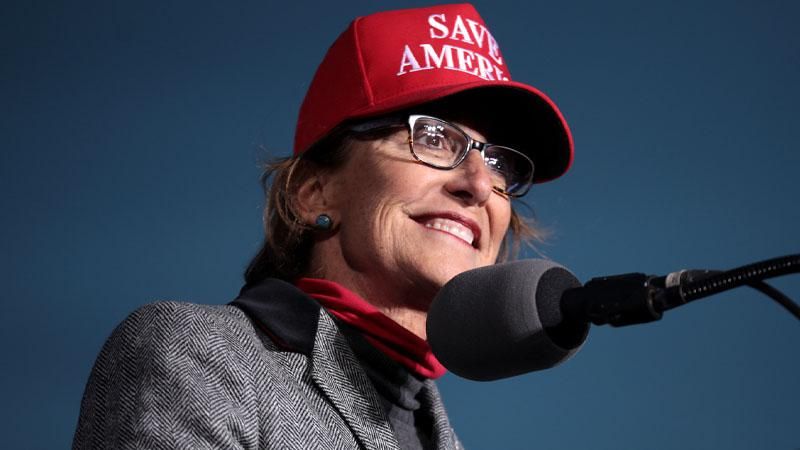
Arizona State Senator Wendy Rogers speaking at a rally.
 (Photo credit: Gage Skidmore)

The Republican state senator was clear in what she wanted in a recent post on Telegram, the encrypted messaging app that has become a haven for far-right politics and extremists.

“Dear Groyper army, please hit Ron Watkins. Love, Wendy,” she wrote.

State Sen. Wendy Rogers was asking her fans and allies in the “groyper army” to go after the QAnon conspiracy theorist turned Congressional candidate because he had alleged Rogers, who has built her political brand on spreading lies about the 2020 election, was involved in some sort of “backroom deal” that was preventing Splunk logs and routers from being examined for alleged election fraud. There is no evidence of such a backroom deal.

But who or what is the “groyper army” that Rogers, a Flagstaff Republican, was calling to act?


The self-styled online “army” that Rogers was imploring to rally to her aid is a collection of white nationalists who often use online trolling tactics against people they don’t like. Their goals broadly include normalizing their extreme and racist views by aligning them with Christianity and so-called “traditional” values.

“It’s a pretty unprecedented move,” Devin Burghart, president and executive director of the Institute for Research and Education on Human Rights, said about Rogers’ request. “These are things that help their ability to move from the margins to the mainstream.”

Burghart and the IREHR have been tracking white nationalist extremist groups for decades, and Rogers’ request for groypers to help her startled their researchers. And they fear it could help the group find legitimacy, something that they’ve been attempting for some time now.

The movement was birthed in part over 2,000 miles away and nearly five years ago in the warm glow of tiki torches.

The violent “Unite the Right” rally held in Charlottesville, Va., brought white nationalists together from across the country. It was marred by bloody fistfights between the racists and counter-protesters, and culminated in the death of anti-racist activist Heather Heyer, who was mowed down by a white nationalist who drove into a crowd leaving the rally.

The rally organizers faced a lawsuit for conspiring to commit violence, and a jury found them liable for lawsuits. A number of lawsuits descended upon many who helped organize the rally and a recent ruling hit the organizers with a $25 million judgment.

The violence brought national attention to the festering issues of white nationalism driving the “alt-right,” making the moniker toxic. For those working behind the scenes of white nationalist movements, a new approach was needed to court those in power and to distance themselves from what they had seen on television and headlines — something that could be digested by mainstream Republicans.

That thing has been the groyper movement, which is now moving more and more into the mainstream. Their annual conference, the America First Political Action Conference or AFPAC, is set to be the biggest one yet and with a major Arizona presence.

Rogers will be a featured speaker. She’ll be joined by former Maricopa County Sheriff Joe Arpaio and local groyper Anthime Joseph “Tim” Gionet, who goes by the moniker Baked Alaska online. Last year’s conference featured the first ever speech by a sitting politician, Arizona’s own Congressman Paul Gosar, R-Prescott. But AFPAC is just the start of the Arizona push by groypers.

Next month, prominent members will be holding a retreat in the state, and local politicians are doing more than just asking their “army” for support.
Enter the groypers

Groyper started off as a meme, a fatter and more grotesque iteration of Pepe the Frog, the cartoon that became something of a mascot for the alt-right as it began to coalesce into a political movement.

In the past few years, groypers have been increasingly active in internet trolling and “irl,” or “in real life,” trolling. But while many on the right focus their efforts on badgering liberals, groypers have made sport of targeting conservatives they feel have not been extreme enough.


Groypers are also largely followers of white nationalist Nick Fuentes and Patrick Casey. Fuentes is a Holocaust-denier who routinely makes antisemitic remarks and has said that Blacks in the South were better off under Jim Crow. Casey is the founder of American Identity Movement, a white nationalist group formerly known as Identity Ervopa.


The two men led the “Groyper Wars” in 2019, an effort to inject their views into mainstream conservatism, pull more young men like themselves into the movement and harass their political opponents. But while most conservative movements focus their energies on liberals, groypers instead took aim at the conservative establishment.

In 2019, they heckled Donald Trump Jr. at an event in California and asked antisemtic and racist questions at other events. They also disrupted multiple Turning Point USA events, and targeting the Arizona-based group was a main priority of Fuentes and Casey for some time.


Researchers said the strategy worked, as evidenced by the more radical positions taken since by Turning Point USA and its founder, Charlie Kirk.

“And now Charlie Kirk’s rhetoric sounds a lot more like Nick Fuentes than it ever has before,” Burghart said.


Kirk has recently defended the white supremacist “Great Replacement” conspiracy theory on his YouTube channel. The “Great Replacement” theory, an idea popular among white supremacists that has inspired real world violence, holds that white Americans are being replaced by immigrants and other minority groups. It has been seized upon by extremist groups like the American Identity Movement and Generation Identity.

In 2020, the groypers would start reimagining how their movement would grow — and how to take it into the mainstream.

America First

America First Students was one of the first initiatives bearing the name “America First” to come out of the groypers. Its leader, a former TPUSA leader in Kansas and known groyper, has used homophobic slurs and has links to many prominent white nationalists.

The group was quickly promoted by both Casey and Fuentes, and other “America First” groups have been popping up across the country. America First quickly became the go-to phrase for the groyper movement.


The phrase “America First” has been a centerpiece of former President Donald J. Trump’s appeal to an overwhelmingly white voter base, but it has roots in America’s racist past.

It was used as far back as 1896 by President William McKinley, but became prominent in isolationist and xenophobic circles in the 1920s when the Ku Kluk Klan adopted it. “America First” was later promoted by American Nazi sympathizers. And David Duke, the former Grand Wizard of the KKK, would use the term in 2016 when describing his foreign policy platform as a U.S. Senate candidate.

In 2020, Arizona saw the launch of its own America First Union chapter. Its Instagram and Twitter pages quickly began spreading hateful content and misinformation.

The account was one of many AFU accounts that adopted similar imagery, a wooly mammoth in front of a state flag with the name of the account. The Arizona account shared antisemitic posts, touted the “great replacement” theory, provided updates on the Arizona 2020 election “audit” and told followers to “fight for your blood and soil,” a slogan associated with Nazi Germany.

At the Jan. 6 riot in Washington D.C., flags bearing Fuentes’ America First logo can be seen throughout the day’s events. Fuentes encouraged violence against lawmakers and police in the days leading up to the failed overthrow of the 2020 election.

“What can you and I do to a state legislator besides kill them?” Fuentes said days before the insurrection. He later couched his comments: “We should not do that. I’m not advising that. But, I mean, what else can you do, right? Nothing.”

The latest stage of the movement’s evolution has seen the groyper moniker take a back seat to “America First” because it appeals so readily to mainstream conservatives and Trump voters.

“You’ll still see them use (the term) groyper, but they have really taken up America First as a tool to enter into recruitment and movement-building with the Trump base, which was initially how they formed to go after TPUSA,” IREHR Research Director Chuck Tanner said. “They’ve really taken up this America First mantle.”

Two leaders in the Arizona groyper movement would emerge In 2021: Kyle Clifton, the man behind the AFU account, and Greyson Arnold. Both gained notoriety on the far right when they confronted a Jan. 6 riot attendee named Ray Epps, furthering a conspiracy theory that Epps was a federal informant.

Arnold, who goes by “American Greyson” online, is behind a popular Telegram account dubbed “Pure Politics.” The channel often shares posts by Fuentes, Rogers and others; comments in the channel’s exclusive chat are often riddled with racist and antisemitic messages.

Greyson and Clifton both have been active in Arizona politics, as well.

Rogers met with both Greyson and Clifton when she did an interview with the groyper-aligned American Populist Union.

Greyson has also met a number of other local politicians, including Congressman Paul Gosar, R-Prescott.

Greyson interviewed Gosar at an event in Lake Havasu City and appeared in a video Gosar posted to his Twitter account where he helped pick up trash along the U.S.-Mexico border nearl San Luis.

He has also shared content from groyper accounts on Gab that have signaled their intentions to bring white nationalism into the mainstream without using violence.

“‘W**nats’ are mad when politicians like Paul Gosar and Wendy Rogers come on Gab,” a post by one popular groyper account shared by Greyson said. “They are success averse, they simply want their little internet ghetto to say racial slurs and talk about how much they dislike jews…as much as you guys hate us, we will drag you to success kicking and screaming!”

The term “w**nats” is used by the alt-right to describe people within the white nationalist movement that generally advocate for violence, antisemitism and accelerationism, the idea that violent acts are required to drive radical changes to lead to a white ethno state. The New Zealand Christchurch shooter was a firm believer in these ideals.

On his Telegram account, Greyson has shown that he is getting closer to politicians and getting the groypers closer to that success, posting a picture with Gosar and claiming he is “interested in 76fest.”
The groypers come to Phoenix

In March, Phoenix will be the site of 76Fest, a three-day groyper conference. Last year’s event was described by one of the event’s headliners as “Hitler Youth, without the Hitler.”

The event is to be a who’s who of the groyper movement and includes workshops like “Aesthetic Warfare” and is organized in part by Clifton.

One confirmed speaker for the event is Lauren Witzke, who formerly was a host of the online show TruNews, which posted antisemitic content and interviewed Rogers twice. Witzke also said in an interview that the groypers were instrumental in her failed U.S. Senate campaign.

“They’re equipping the next generation of Republican leaders,” Burghart said about the groypers. “This is an attempt to mainstream white nationalist ideas. This isn’t just about meme wars, this isn’t just about trolling. This is an effort by Holocaust-deniers and supporters of fascism to move these ideas into mainstream Republican ideas.”

The Arizona Mirror reached out to both Gosar and Rogers about their connections to prominent Arizona groypers, their comments, the history of the movement and asked if they’d be planning to attend any Groyper events such as 76Fest or the Fuentes’ sponsored America First Political Action Conference, also known as AFPAC.

Neither Gosar or Rogers replied to the Mirror’s request for comment.

Gosar attended Fuentes’ AFPAC conference in 2021, the first ever sitting politician to do so.


In recent weeks, both Rogers and Gosar have shared posts on Twitter and Gab by prominent groyper artists and groyper influencers. The Mirror also discovered that Rogers follows Harry Hughes, the National Socialist Movement’s regional director in Arizona, on Twitter.

“They rely on that legitimacy provided by those legislators to further worm their way into every recess of the Republican party,” Burghart said of people like Rogers and Gosar.

Rogers has tweeted and posted multiple times about her fondness for Fuentes who has boosted her to his followers by sharing screenshots of her posts about him.

“It’s really disturbing. They’ve got allies in positions of power in the government,” Tanner said.


Arizona Mirror is part of States Newsroom, a network of news bureaus supported by grants and a coalition of donors as a 501c(3) public charity. Arizona Mirror maintains editorial independence. Contact Editor Jim Small for questions: info@azmirror.com. Follow Arizona Mirror on Facebook and Twitter.
Razzie Award Founders Stand By ‘The Shining’ Nomination, But Would Rescind Shelley Duvall’s ‘Worst Actress’ Nod

Rachel West -AP

More than 40 years after the Razzie Awards nominated Stanley Kubrick's "The Shining", the organization's founders say they stand by the film's nod for Worst Director, but not its Worst Actress nomination for Shelley Duvall. Ultimately, the film won neither award, with Duvall losing to Brooke Shields in "The Blue Lagoon" and Kubrick losing to "Xanadu" director Robert Greenwald.


Shelley Duvall, Danny Lloyd, and Jack Nicholson in "The Shining"

Though the critically-acclaimed adaptation of Stephen King's novel is considered a classic horror film, founders John J.B. Wilson and Maureen Murphy are adamant in their displeasure of the film, saying they "didn't care for" Kubrick's adaptation.

"The voting membership the very first year were largely people that Maureen and I worked with at a trailer company," Wilson tells Vulture of the inaugural 1980 awards that recognize the "worst" in film. "A group of us who had read Stephen King’s novel went to see ‘The Shining’ the night it opened at the Chinese, and we didn’t care for what Kubrick had done with the novel. The novel was far more visually astounding, far more terrifying, far more compelling, and we couldn’t understand why you would buy a novel that had all of that visual opportunity in it and then not do the topiary thing, not do the snakes in the carpet, not do the kids’ visions. If you’re going to say it’s ‘The Shining,’ you have to have certain key things in there that were not."

"And as I understand it, Kubrick was the one who decided what they cut out from the novel. So I don’t feel that badly about Stanley Kubrick," Wilson adds, while Murphy calls the famed director "overrated."

Murphy says she would rescind Duvall's nomination for Worst Actress in "The Shining".

"Knowing the backstory and the way that Stanley Kubrick kind of pulverized her, I would take that back," she says. "We’re willing to say, 'Yeah, maybe that shouldn’t have been nominated.' Everybody makes mistakes. That’s being human."

Two years ago, Wilson wrote about Duvall's nomination in a 2020 Razzie Retrospective, writing, in part, "Shelley Duvall’s shrill, one-note, over-the-top hysterical performance as Nicholson’s wife was among our ten inaugural Worst Actress nominees. In defense of Duvall, we learned later, that Kubrick apparently drove her to the brink of madness due to his abusive behaviour. He subsequently got labelled a genius (by some) and she coo-coo. We suspect he badgered her into a cowering performance and in retrospect, we would like to place the blame solely on him."
‘Superbly preserved’ pterosaur fossil unearthed in Scotland

By SYLVIA HUI

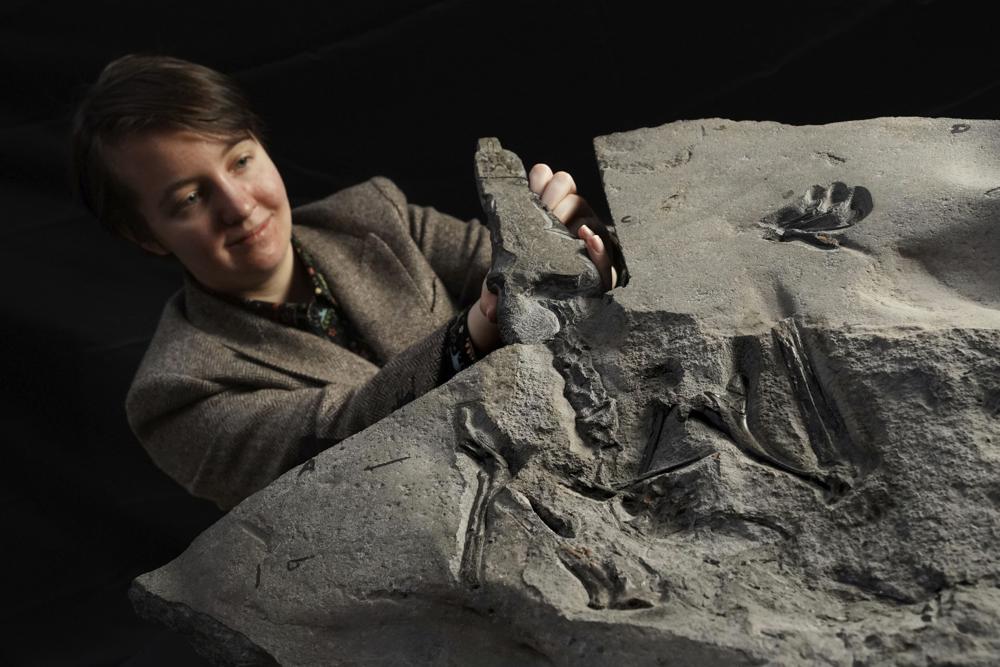
In this undated photo issued by the National Museums Scotland on Tuesday, Feb. 22, 2022, University of Edinburgh PhD student Natalia Jagielska poses for a photo with the world's largest Jurassic pterosaur unearthed on the Isle of Skye. The fossil of a 170-million-year-old pterosaur, more popularly known as pterodactyl, billed as the world’s best-preserved skeleton of the prehistoric winged reptile, has been found on the Isle of Skye in remote Scotland. The National Museum of Scotland said the fossil of the pterosaur is the largest of its kind ever discovered from the Jurassic period.
 (Stewart Attwood/National Museums Scotland via AP)


LONDON (AP) — The fossil of a 170 million-year-old pterosaur, described as the world’s best-preserved skeleton of the prehistoric winged reptile, has been found on the Isle of Skye in Scotland, scientists said Tuesday.

The National Museum of Scotland said the fossil of the pterosaur, more popularly known as pterodactyls, is the largest of its kind ever discovered from the Jurassic period. The reptile had an estimated wingspan of more than 2.5 meters (8.2 feet), similar to that of an albatross, the museum said.

The fossil was discovered in 2017 by PhD student Amelia Penny during a field trip on the Isle of Skye in remote northwestern Scotland, when she spotted the pterosaur’s jaw protruding from rocks. It will now be added to the museum’s collection.

“Pterosaurs preserved in such quality are exceedingly rare and are usually reserved to select rock formations in Brazil and China. And yet, an enormous superbly preserved pterosaur emerged from a tidal platform in Scotland,” said Natalia Jagielska, a doctoral student at the University of Edinburgh who is the author of a new scientific paper describing the find.

Steve Brusatte, a professor of palaeontology at Edinburgh University, said the discovery was the best one found in Britain since the early 1800s, when celebrated fossil hunter Mary Anning uncovered many significant Jurassic fossils on the southern English coast.

He said the fossil had “feather light” bones, “as thin as sheets of paper,” and it took several days to cut it from rock using diamond-tipped saws as his team battled against encroaching tides.

It “tells us that pterosaurs got larger much earlier than we thought, long before the Cretaceous period when they were competing with birds, and that’s hugely significant,” Brusatte added.

The pterosaur has been given the Gaelic name Dearc sgiathanach, which translates as “winged reptile.”

Pterosaurs were the first vertebrates to fly, some 50 million years before birds. They lived as far back as the Triassic period, about 230 million years ago. They were previously thought to have been much smaller during the Jurassic period.
Airbus plans to test hydrogen engine on A380 jumbo jet to fly in 2026

Airbus will test hydrogen propulsion on an A380, its largest passenger plane.
The manufacturer is working with engine maker CFM International, a joint venture of GE and France's Safran.


© Provided by CNBCAirbus hydrogen A380 demonstrator

Leslie Josephs - 

Airbus said it plans to test a hydrogen-powered engine on a modified A380 by the middle of the decade, in hopes of bringing lower-emission fuels to commercial air travel.

The European aircraft giant said Tuesday that it's working with engine maker CFM International — a joint venture of General Electric's aviation arm and France's Safran — on the test plane, which will include a modified version of an engine already in use that will have to handle higher temperatures at which hydrogen burns. Test flights could begin 2026, Airbus said.

Aircraft manufacturers and airlines are scrambling to slash their carbon emissions, which account for more than 2% of the world's total. Airbus has aggressively pursued hydrogen and said it is working on a passenger aircraft powered by the fuel that it expects will enter service in 2035.

Rival Boeing has focused on more sustainable aviation fuels, which currently make up less than 1% of the jet fuel supply and are more expensive than conventional jet fuel. CEO Dave Calhoun said at an investor conference last June that he didn't expect a hydrogen-powered plane on "the scale of airplanes that we're referring to" before 2050.

"It will work for some very small packages," he said.

One big challenge in using hydrogen fuel is that storing it would require additional equipment that adds weight to the aircraft, reducing the number of people or amount of cargo that a plane could carry, said Richard Aboulafia, managing director at Aerodynamic Advisory, an aviation consulting firm.

"Hydrogen is what happens when engineers and economists don't talk to each other," he said.

Airbus said it selected its A380, the world's largest passenger plane, because it had room to store the liquid hydrogen tanks and other equipment.


Exclusive-Shale oil producer Ovintiv considers options for Utah land - sources

By Shariq Khan

(Reuters) - Shale producer Ovintiv Inc is looking to hire an investment bank to consider options for its acreage in the Uinta basin of Utah, as it looks to cash in on a boom in energy prices to cut debt, three sources familiar with the matter told Reuters on Tuesday.

A full or partial sale would be among the options for Ovintiv, one of the top producers in the Uinta basin, the sources said, adding that a sale of the assets could fetch around $1 billion.

No final decision has been made about the assets and Ovintiv could still decide to retain them, the sources cautioned. They requested anonymity as the discussions are confidential.

An Ovintiv spokesperson said the company does not comment on potential or rumored acquisition or divestiture activity.

A sale, if it happens, would be the second from a major player in the oil-rich basin after privately owned EP Energy sold its position to KKR-backed Crescent Energy last week for $815 million.

EP faced months of antitrust challenges on a previous plan to sell the holdings to EnCap-backed XCL Resources, which already had some assets in the region.

Publicly traded U.S. shale producers have been looking to take advantage of crude oil nearing $100 per barrel by selling off operations no longer key to their development plans and using the cash to clean up balance sheets or reward investors.

Ovintiv, which in the past operated as EnCana and was once Canada's biggest company, moved to the United States in January 2020 in the hopes of attracting more investors after years of challenges in the Canadian energy sector.

However, the onset of the coronavirus pandemic just months after its change in headquarters saw the company's stock plummet along with other U.S. oil and gas producers. A year later, Ovintiv faced more pressure from an activist investor calling for changes in its budget and non-core asset sales.

Ovintiv settled with the activist fund Kimmeridge in March 2021, and with oil prices making a strong recovery, it sold its assets in the Eagle Ford and Duvernay shale plays.

Ovintiv used the money raised from those sales to cut its debt pile and set a target to bring its $4.8 billion net debt to under $3 billion by the end of 2022.

The company, which classifies its holdings in the Uinta basin as non-core, has scaled back spending on them in recent years and diverted budget to more profitable regions in the Anadarko and Permian basins.

Ovintiv's assets spanned around 207,000 net acres in central Utah and had production of around 13,000 barrels of oil equivalent per day as of its 2020 annual report.

Ovintiv is scheduled to post its fourth-quarter results on Thursday.

(Reporting by Shariq Khan in Bengaluru; Editing by Maju Samuel)
THE NEW COLD WAR
Chinese government agency that works with Canadians is involved in espionage, Federal Court affirms

Tom Blackwell - National Post

© Provided by National Post
The Embassy of the People's Republic of China in Ottawa. It’s unclear how many Chinese officials stationed at the embassy and consulates in Canada are involved with the Overseas Chinese Affairs Office.

The outfit has worked with a top Canadian scientist, a member of the Ontario legislature and children in the Toronto area.

Its name sounds more bureaucratic than menacing.

But the Chinese government’s Overseas Chinese Affairs Office (OCAO) is involved in espionage that harms Canada’s interests, a Federal Court judge has affirmed in what appears to be a precedent-setting new ruling .

Beijing critics say the judgement — upholding an immigration officer’s decision on the issue as “reasonable” — represents a rare official rebuke of the office, now a bureau of a larger Communist Party department.

Despite its apparently longstanding efforts to influence and monitor Chinese Canadians, the agency has rarely been publicly called-out by authorities here, says Charles Burton, a former diplomat in Beijing and senior fellow with the Macdonald-Laurier Institute.

“I’m thrilled about the ruling,” he said. “I hope it sets a terrific precedent.”

The Canadian Security Intelligence Service and RCMP both have advised the government about interference by such Chinese organizations, he said, but politicians tend to suppress the information for fear of undermining trade between the two countries.

The actual targets of the Office are often too frightened — for themselves or for their relatives in China — to speak out, said Burton.

A spokesperson for the United Front Work Department, the Chinese Communist Party division that now controls the OCAO, did not comment directly on the court ruling, but through the Chinese embassy in Ottawa depicted its work as above-board and positive.

“The united front led by the Communist Party of China is to unite people’s hearts and minds, gather strength, actively promote harmony in relations among political parties, ethnic groups, religions, classes and compatriots at home and abroad … to achieve national prosperity, national rejuvenation and people’s happiness,” said a statement from the embassy.

In foreign relations, it said, the party has “always advocated tolerance and mutual appreciation among different civilizations in the world.”

The decision came in the case of a Chinese couple sponsored by their adult daughter — a naturalized Canadian citizen — to become permanent residents here. They were turned down on the grounds that the husband had worked 20 years at the OCAO in China, in later years as a senior administrator.

An Immigration Citizenship and Refugees Canada (IRCC) officer cited legislation that bars members of organizations that engage in espionage and hurt Canada’s interests from immigrating here, and concluded that the Overseas Chinese Affairs Office fit the bill.

The couple asked the Federal Court for a judicial review of the decision. The court does not retry such cases but Justice Vanessa Rochester upheld the IRCC ruling , saying it was reasonable to conclude the OCAO was involved in espionage given the evidence available to the officer.

“I would say it’s about time,” said Cheuk Kwan of the Toronto Association for Democracy in China. “It’s about time we stopped dodging the question and confront the fact that there is Chinese spying and espionage and harassment of dissidents in this country.”

Overseas Chinese is a term Beijing uses for ethnic Chinese people living in other countries, even when their families have resided outside China for generations.

The officer’s decision and that of Rochester relied largely on research by James Jiann Hua To , a senior advisor at the Asia New Zealand Foundation who was cited as an expert by both sides in the case.

While the OCAO claims ostensibly to provide support to members of the Chinese diaspora, To wrote, its goal is really to “legitimize and protect” the party’s hold on power, burnish China’s international image and exert its influence.

To that end it gathers intelligence on and tries to influence people of Chinese descent in foreign countries, says To.

Case law on the immigration legislation defines espionage as intelligence-gathering done covertly.

The lawyer for would-be immigrants Yuxia Gao and Yong Zhang argued that while the office’s work may be unpalatable to Canadians, its aims are well known, especially to any of its potential targets.

But Rochester ruled that the evidence available to the IRCC suggested the office’s methods, including surveillance, subversion and intelligence-gathering, are indeed surreptitious.

It’s unclear how many of the large contingent of Chinese officials stationed at the embassy and consulates in Canada are involved with the office. But the agency’s presence here has surfaced repeatedly.

Vincent Ke, a Conservative member of the Ontario legislature , attended a week-long seminar in China in 2013 organized by the office, where delegates were urged to pursue the “Chinese dream.”

An esteemed engineering professor at Polytéchnique Montreal and a University of Waterloo professor on the institution’s advisory “secretariat” have both served as expert advisors to the OCAO.

The Office heaped praise on the Confederation of Toronto Chinese Canadian Organizations in an online article a few years ago, citing its willingness to promote Chinese interests.

The website of the greater-Toronto-based Council of Newcomers Organizations described “roots-seeking” trips for local children to China run by the OCAO.

The office was subsumed three years ago into the United Front Work Department, a CCP agency that spearheads influence operations in foreign countries. The merger means China is devoting “far more resources” to such efforts, leading Australian researcher Alex Joske has argued.
Q and A: Transitioning to a new world order with U of A professor Andy Knight

Hamdi Issawi - 
Edmonton Journal

Thinking about the future of global governance, University of Alberta political science professor Andy Knight has his eye on the international stage and the complex, interconnected pieces holding it together. But for how long?


© Provided by Edmonton Journal
Prof. Andy Knight is a political science professor at the University of Alberta in Edmonton.

Currently the Fulbright Distinguished Chair in International and Area Studies at Yale University, Knight is spending the academic year south of the border to research and write a book on the subject, tentatively titled International Organization Today, which posits that the world as we know it is in a transitional state marked by uncertainty, disorder and fragmentation as it shifts to a new world order.

In a telephone interview with Postmedia, Knight said he’s still keeping tabs on current events both foreign and domestic — from the streets of downtown Ottawa to Ukraine’s borders — noting signs of this transitional state, which he plans to explore, among other ideas, in the upcoming book.

Is it a stretch to call the current Russia-Ukraine crisis a sign of this transition to a new world order?

Not really. One of the premises I begin with is that we are living in an interregnum — a period of time when there is a transition from one world order to the next. I’m of the view that we are living in that kind of transition right now, from the 1945 world order, which we’ve come to embrace and understand quite well, to a different kind of a world order that we haven’t yet seen the full outlines of.

This period of interregnum is one that’s filled with flux, uncertainty, disorder and violence. If you go into history, you’ll find that almost every single transitional period is also accompanied by this kind of fragmentation and violence and disequilibrium.

What you see happening between Russia and Ukraine is simply one symptom of that broader pattern, and part of this transitional moment. The reason it’s difficult to resolve is we don’t have a power that’s strong enough to control Russia right now. The United States is very reluctant to have a military confrontation with Russia for obvious reasons. They both hold nuclear weapons and could cause a major problem if those two countries decided to utilize those weapons.

What about closer to home, like the convoy protest in Ottawa?

You have to ask yourself, ‘What else is driving this?’ Over time, the demonstrations have been morphing from anti-vaccine mandate protests to anti-Trudeau or anti-government protests. They’re dissatisfied with the government and the way the government handles these things.

But there’s an element of right-wing political violence that’s been creeping into this movement. We saw the arrests of some of the leaders or architects of this convoy, and you get a sense that there is something else behind it that’s a little bit more sinister.

It could be anti-government, which means that it could be closer to the Jan. 6, 2021, insurrection in Washington, D.C. There could also be anti-immigrant and antisemitic sentiments because you see the swastikas and the different flags of white supremacy.

There are a lot of things happening, but the main thing I see is this tension and a lack of civility. They talk about freedom, but it’s freedom for themselves, not freedom for the other people around them.

This whole thing is an indication of the kind of fragmentation I’m talking about, where all ideas are being questioned, forms of governance are being questioned, the material capabilities of people and businesses are being challenged. This seems to be an indication that the old world order — from 1945 to the present — is beginning to die, and the new one is emerging somehow.

So the question would be, “How best can we shape that new world order?”

When did this period of transition begin?

I think it begins around 1989-1990, at the end of the Cold War when the Soviet Union fell apart and the Berlin Wall came down. These are all signs that something was changing. Involvement in Afghanistan was one of the biggest factors in the fall of the Soviet Union. It overstretched itself, and big powers tend to do that.

We went from a bipolar structure in the world to a unipolar system in the sense that the United States became the global policeman, and the go-to country for countries who wanted to get social and economic development and loans, et cetera.

The new challenge is this competition between the United States and China. There’s a kind of movement towards another bipolar arrangement, whereby the United States is declining in its influence at the same time that China seems to be rising.

What will the next world order look like?

We don’t know what the end picture is going to look like. What I can do, though, is identify the elements that are creating this new world order.

We’ve gotten a lot of agreement around things like sustainable development goals and getting people out of poverty. In 1945 there wasn’t a lot of attention paid to that, but it has now become a big issue, along with the environment and idea of building resilient health-care systems to address pandemics.

The creation of parallel institutions to the United Nations is another one, because not everything gets done within the UN. Sometimes you have to do things outside that system, so we’ve created a number of bodies like the G7 (or G8 dependent on whether Russia is in or not).

This changing environment within which this new world order is emerging, and institutions that have been developed, is a little different. The ideas created to undergird these institutions may be a little different, too. Who knows what the next dominant ideology will be?

That’s why I keep calling for things like justice, equity, fairness, diversity and inclusion — I think these represent, in large part, the best of people. Let’s see if we can focus on the more positive things, and maybe — in our social construction of this new world order — construct a world that’s much better than the one we’re living in right now.

Answers have been edited for clarity and brevity.

hissawi@postmedia.com

@hamdiissawi
Concordia University of Edmonton Faculty Association votes no confidence in university's president

Kellen Taniguchi - EDMONTON JOURNAL

A large majority of Concordia University of Edmonton Faculty Association (CUEFA) members have voted they have no confidence in the current president’s leadership.


© Provided by Edmonton Journal
Tim Loreman, president and vice-chancellor of Concordia University of Edmonton, outside the Magrath Mansion on Aug. 18, 2021.

In a Tuesday news release, CUEFA said 91 per cent of its members registered to vote and 90 per cent voted no confidence in president Tim Loreman’s leadership.

Glynis Price, acting CUEFA president, said when the faculty association was on strike in January , members spent a lot of time together and noticed a lot of members had similar views of Concordia University of Edmonton’s (CUE) current leadership and the feelings remained post-strike.

“The workplace was still a very toxic, a very unstable workplace culture which is incredibly difficult when we’re looking at a workplace characterized by disfunction, by fear, threats and reprisal,” Price told Postmedia.

Price said there has been “significant issues” with decisions about research at the university, funding research for its membership, financial health and the lack of long-term fundraising. She noted there has been a surplus in the past, but fundraising is one of a university president’s main jobs.

CUEFA members pointed to four main areas of concern when voting they had no confidence in the school’s leadership — a toxic workplace culture, the president’s failure to effectively manage the core operations of the university, the financial management of the institution and the damage done to relations between CUE and key stakeholders.

“It’s really difficult if we’re trying to be collaborative and work in relationships with all of these different stakeholders if we have broken relationships,” said Price.

Price said CUEFA notified the chair of CUE’s board of governors about the no-confidence vote on Feb. 14 and requested the board give a formal reply by Tuesday. CUEFA said it didn’t receive a reply by its deadline.

Although the strike came to an end last month, Price said it didn’t address the ongoing leadership problems.

“If we don’t work on these issues, if we maintain the current course with the issues that are in place, it’s not going to be sustainable in the long run for the health or advancement of the university,” said Price.

She said CUEFA is not expecting a resignation letter or a firing, but it wants more conversations to happen to take steps forward in addressing the university’s current issues.

ktaniguchi@postmedia.com

twitter.com/kellentaniguchi

U.S. warns Canada, again, that it's not happy about proposed digital services tax


WASHINGTON — The U.S. Trade Representative's office has once again made its feelings clear about Canada's plan to implement a controversial new tax on digital services.

The office issued an abrupt statement today, the final day of public consultation on the proposal, urging the federal government to change course.

It wants Ottawa to focus instead on a multilateral plan for a global tax regime for so-called multinational enterprises — tech giants like Meta, Facebook's parent company, and Alphabet Inc., which owns Google.

Canada's proposal, which includes a three per cent tax worth $3.4 billion in revenue over five years, would only take effect in 2024 if those efforts don't come to pass.

But the USTR says that as a signatory to what's known as the "two-pillar" solution, Canada's unilateral alternative risks undermining the global tax plan by encouraging other countries to follow its lead.

The office says should Canada's plan go ahead, it would be seen by the U.S. — home to many of the impacted companies — as discriminatory and a violation of American trade law.

The global minimum tax agreement is supported by 136 countries, including all members of the G20 as well as the Organization for Economic Co-operation and Development.

The first "pillar" of that plan is a moratorium on new digital service taxes while G20 and OECD members hash out the jurisdictional and sharing details of the complex scheme.

"As Canada is fully aware, the United States has serious concerns about measures that single out American firms for taxation while effectively excluding national firms engaged in similar lines of business," the USTR says in its public submission.

It calls the plan a "counterproductive unilateral measure" and urges Canada to "focus efforts on engaging constructively in the multilateral OECD negotiations — ensuring that its unilateral measure proposal is unnecessary and that Canadian interests are protected."

Deputy Prime Minister Chrystia Freeland promised to delay the implementation of the tax for two more years, provided the OECD plan has not already kicked in. But the USTR notes it would be retroactive until the start of the current year.

Officials in Freeland's office say they are pressing ahead with the plan in the name of defending Canadian interests, but hope it won't be necessary to implement it.

Federal ministers have cited the Liberal government's own election promises, including a commitment to require digital companies to compensate legacy media outlets for linking to their work.

This report by The Canadian Press was first published Feb. 22, 2022.

The Canadian Press