Thursday, February 24, 2022

AP-NORC poll: Most in US oppose major role in Russia strife

By NOMAAN MERCHANT and HANNAH FINGERHUT

1 of 8
FILE = This image provided by The White House via Twitter shows President Joe Biden at Camp David, Md., Feb. 12, 2022. A new poll finds little support among Americans for a major U.S. role in the Russia-Ukraine conflict. President Joe Biden has acknowledged the growing likelihood of a new war in Eastern Europe will affect Americans even if U.S. troops don’t deploy to Ukraine. Just 26% of Americans say the U.S. should have a major role in the conflict between Russia and Ukraine, according to a new poll from The Associated Press-NORC Center for Public Affairs Research.
(The White House via AP, File)


WASHINGTON (AP) — There’s little support among Americans for a major U.S. role in the Russia-Ukraine conflict, according to a new poll, even as President Joe Biden imposes new sanctions and threatens a stronger response that could provoke retaliation from Moscow.

Biden has acknowledged a growing likelihood that war in Eastern Europe would affect Americans, though he has ruled out sending troops to Ukraine. Gas prices in the U.S. could rise in the short term. And Russian President Vladimir Putin has a range of tools he could use against the U.S., including cyberattacks hitting critical infrastructure and industries.

“Defending freedom will have costs for us as well, here at home,” Biden said Tuesday. “We need to be honest about that.”

Just 26% say the U.S. should have a major role in the conflict, according to a new poll from The Associated Press-NORC Center for Public Affairs Research. Fifty-two percent say a minor role; 20% say none at all.

The findings are a reminder for Biden and fellow Democrats that while the crisis may consume Washington in the coming months, pocketbook issues are likely to be a bigger priority for voters heading into the midterm elections. A December AP-NORC poll showed that Americans are particularly focused on economic issues, including rising inflation.


The Biden administration has argued that supporting Ukraine is a defense of fundamental American values and has made a concerted effort to declassify intelligence findings underscoring the dangers it sees for Ukraine and the wider European region. But the survey shows widespread public skepticism of the U.S. intelligence community.

Democrats are more likely than Republicans to think the U.S. should have a major role in the conflict, 32% to 22%. Overall, the poll shows 43% of Americans now approve of Biden’s handling of the U.S. relationship with Russia, a downtick from 49% in June of last year.

Despite the clear reluctance about major involvement in the conflict, Americans are hardly looking at Russia through rose-colored glasses. The poll finds 53% say they’re very or extremely concerned that Russia’s influence around the world poses a threat to the U.S., an uptick from 45% in August 2021.

Jennifer Rau, a 51-year-old mother of three adopted teenagers who lives on Chicago’s South Side, said she listens to local public radio for her world news. But in recent days, when the news turns to Russia and Ukraine, she has started to turn it off.

“I’m so frustrated. It’s enough. We’re bombarded,” Rau said. “There are other stories in Chicago that need to be covered.”

Rau is a political independent who voted for Biden. But she believes the U.S. gets involved in foreign wars to make money. She is more concerned about rising crime in Chicago, the prevalence of guns, and systemic racism that affects her three children, who are Hispanic.

“I just feel like there’s a war going on in the United States, every day, in Chicago,” she said. “And it is really scary. And I feel like no one helps us.”

Edward Eller, a 67-year-old retiree from Shady Valley, Tennessee, said the White House needs to focus on lowering oil prices.

“They want to send millions of dollars of ours to stop a war that we have nothing to do with,” he said. “I’m sorry they’re involved in a mess, but it’s not our problem.”

The poll was conducted Friday to Monday during a period of rapidly escalating tensions, culminating with Putin recognizing the independence of two separatist regions in eastern Ukraine, widely seen in the West as a step toward a wider war. Russian-backed separatists and Ukrainian forces have been locked since 2014 in fighting that’s killed 14,000 people.

Asked on Tuesday why people in the U.S. should have to sacrifice for the conflict, White House press secretary Jen Psaki said, “This is about standing up for American values.”

“We have repeatedly throughout history been leaders in the world in rallying support for any effort to seize territory from another country,” she said.

Russia has massed at least 150,000 troops on three sides of Ukraine and continues to establish bridges, camps, and logistics necessary for a protracted invasion. U.S. officials believe Putin could attack Ukraine at any time. A full-on war in Ukraine could result in thousands of deaths and huge numbers of refugees fleeing for the U.S. or elsewhere in Europe.

The U.S. has imposed sanctions on Russian banks and oligarchs with more measures possible this week.

The White House has warned in increasingly strong words about a Russian invasion while trying to persuade Putin against launching one. It has declassified Russian troop positions and detailed allegations of “false-flag” plots that could set a pretext for a military attack on Ukraine.

However, the poll shows there remains skepticism among Americans of the U.S. intelligence community. Only 23% said they had a “great deal of confidence” in intelligence agencies. Another 52% say they have some confidence and 24% have hardly any.

U.S. Rep. Mike Quigley, an Illinois Democrat who serves on the House Intelligence Committee, says the intelligence he’s received on Ukraine “has been very, very good. Sadly, it’s been accurate.” But he often hears from constituents who are uninterested in Ukraine and more focused on health care and the coronavirus pandemic.

Over time, Quigley said, he has developed comments about why Ukraine matters to the U.S.: its role as a strategic ally and a “sovereign democratic nation at Putin’s doorstep,” and how a new war could hit already disrupted technology supply chains that use exports from Russia and Ukraine.

Among Russia’s biggest threats to Americans is its capability to wage cyberwarfare. Previous Russia-linked cyberattacks have cut off services at hospitals and breached the servers of American government agencies. A ransomware attack on Colonial Pipeline linked to a Russia-based hacking group temporarily shut down gas stations across the East Coast. And Russia was accused of interfering in both the 2016 and 2020 presidential elections.

“I think it’s an incredibly difficult time to message because of everything else that’s topping the list of what Americans care about. It’s hard to bump COVID, inflation, safety issues away,” Quigley said. “But you’ve got to try.”

___

The AP-NORC poll of 1,289 adults was conducted Feb. 18-21 using a sample drawn from NORC’s probability-based AmeriSpeak Panel, which is designed to be representative of the U.S. population. The margin of sampling error for all respondents is plus or minus 3.7 percentage points.

___

Associated Press journalist Zeke J. Miller contributed to this report.

Broad majority of Americans support Russia sanctions - poll


The Russian Embassy, as President Biden announces new sanctions on Russia, in Washington

Wed, February 23, 2022
By Jason Lange

WASHINGTON (Reuters) - More than two-thirds of Americans think the United States should impose additional sanctions against Russia as it masses its forces along the border with Ukraine, according to a Reuters/Ipsos poll completed on Wednesday.

Nearly half of respondents to the poll disapproved of President Joe Biden's handling of the crisis, in keeping with his low overall job approval ratings, with 48% saying Ukraine's problems are not America's business.

Biden has vowed Russia will pay a steep price for launching an invasion of Ukraine but he has pledged to keep U.S. troops out of the conflict.

The poll, conducted online on Tuesday and Wednesday, found some 69% of Americans - majorities of Republicans and Democrats - support additional sanctions on Russia.

The president on Tuesday toughened measures against Russian companies and individuals, effectively kicking two Russian banks out of the U.S. banking system

The poll found 62% oppose sending U.S. troops to defend Ukraine against a Russian invasion, with opposition strongest among Republicans. A majority also opposed air strikes.

Republican lawmakers, who are seeking to win control of the U.S. Congress in the Nov. 8 midterm election, have criticized Biden's response to Russian President Vladimir Putin as too little, too late.

The poll found that just 12% of Republicans approved of Biden's handling of the crisis, compared with 58% of Democrats.

Still, relatively few Americans blame Biden for the crisis.

According to the poll, about half the country, including a majority of Democrats and nearly half of Republicans, blame Putin, who on Tuesday ordered Russian troops to enter Ukrainian territory claimed by ethnic Russian separatists. Only 25% of Republicans polled said Biden was to blame.

Despite broad support for sanctions, only about half of Americans said sanctions were worthwhile if they increased fuel and gas prices, according to the poll. Russia is a major oil and natural gas producer and worries over the conflict have pushed prices for some oil contracts to their highest levels since 2014.

The poll was conducted online and in English throughout the United States. It gathered responses from 1,004 adults including 420 Democrats, 394 Republicans and 131 independents. The results have a credibility interval, a measure of precision, of 4 percentage points.

(Reporting by Jason Lange, additional reporting by David Morgan; Editing by Scott Malone and Cynthia Osterman)

The parts of America paying closest attention to the Russia-Ukraine crisis


Stef W. Kight
Tue, February 22, 2022

Data: Google Trends; Chart: Will Chase/Axios

Russia's talk of invading Ukraine has now captured America's attention, although residents in some congressional districts are paying closer attention than others, according to new Google Trends data and analysis.

Why it matters: Some Republicans criticized President Biden on Tuesday for not taking stronger actions. Some Democrats have largely supported his focus on diplomacy. It's unclear how much the issue will affect the midterms in November — but right now, interest among potential voters is growing.

The districts visualized in the accompanying map reflect congressional maps in effect as of Feb. 1. Some of the lines will change as the once-per-decade redistricting process continues this year across the country.

Google measures search interest on a scale of 0-100, which reflects the percentage of total Google searches dedicated to a topic.

By the numbers: Nationwide, searches for the "MOEX Russia Index" increased +4,900% in the past day, and use of the terms “russia ukraine news latest update” increased +1,750% over the past week, Google Trends' Simon Rogers notes in his Tuesday newsletter.

Congressional districts encompassing Colorado Springs, Colorado, and Buffalo, New York, saw high interest in the search term "Russia" earlier than most other districts.

During the past week, "Russia" made up the greatest percentage of Google searches in the newly drawn district for Rep. Jimmy Panetta (D-Calif.), whose territory includes Monterey, California.

The Naval Postgraduate School in Monterey, the United States Air Force Academy in Colorado Springs, as well as other military bases and communities in other high-ranking areas could explain the interest in some districts.

The districts with the highest percentage of Google searches for "Russia" in the past week were:


CA-19: Jimmy Panetta (D)


CO-05: Doug Lamborn (R)


NY-26: Brian Higgins (D)


CA-51: Sara Jacobs (D)


MA-03: Lori Trahan (D)


AZ-02: Tom O'Halleran (D)


CT-04: Jim Himes (D)


WA-10: Marilyn Strickland (D)


VA-11: Gerry Connolly (D)


CA-49: Mike Levin (D)

What to watch: Axios and Google Trends have been looking at congressional-level Google search trends across the country.


Keep an eye out for future projects in the coming months.

More from Axios: Sign up to get the latest market trends with Axios Markets.
NAZIFICATION OF UKRAINE
EXPLAINER: Why Putin uses WWII to justify attacks in Ukraine

By TIA GOLDENBERG

 Russian President Vladimir Putin speaks during a news conference in Moscow, Russia, Feb. 1, 2022. (Yuri Kochetkov/Pool Photo via AP, File)

TEL AVIV, Israel (AP) — Vladimir Putin told the world in the lead-up to Thursday’s attacks on Ukraine that his operation aims to “denazify” Ukraine, a country with a Jewish president who lost relatives in the Holocaust and who heads a Western-backed, democratically elected government.

The Holocaust, World War II and Nazism have been important tools for Putin in his bid to legitimize Russia’s moves in Ukraine, but historians see their use as disinformation and a cynical ploy to further the Russian leader’s aims.

Israel has proceeded cautiously, seeking not to jeopardize its security ties with the Kremlin, despite what it considers the sacred memory of the 6 million Jews who were murdered by the Nazis in the Holocaust.

Here’s a closer look at how the ghosts of the past are shaping today’s conflict:

THE WAR THAT DEFINES RUSSIA

World War II, in which the Soviet Union lost an estimated 27 million people, is a linchpin of Russia’s national identity. In today’s Russia, officials bristle at any questioning of the USSR’s role.

Some historians say this has been coupled with an attempt by Russia at retooling certain historical truths from the war. They say Russia has tried to magnify the Soviet role in defeating the Nazis while playing down any collaboration by Soviet citizens in the persecution of Jews.

On Ukraine, Russia has tried to link the country to Nazism, particularly those who have led it since a pro-Russian leadership was toppled in 2014.

This goes back to 1941 when Ukraine, at the time part of the Soviet Union, was occupied by Nazi Germany. Some Ukrainian nationalists welcomed the Nazi occupiers, in part as a way to challenge their Soviet opponents, according to Yad Vashem, Israel’s Holocaust memorial. Historians say that, like in other countries, there was also collaboration.

Some of Ukraine’s politicians since 2014 have sought to glorify nationalist fighters from the era, focusing on their opposition to Soviet rule rather than their collaboration and documented crimes against Jews, as well as Poles living in Ukraine.

But making the leap from that to claiming Ukraine’s current government is a Nazi state does not reflect the reality of its politics, including the landslide election of a Jewish president and the aim of many Ukrainians to strengthen the country’s democracy, reduce corruption and move closer to the West.

“In terms of all of the sort of constituent parts of Nazism, none of that is in play in Ukraine. Territorial ambitions. State-sponsored terrorism. Rampant antisemitism. Bigotry. A dictatorship. None of those are in play. So this is just total fiction,” said Jonathan Dekel-Chen, a history professor at Jerusalem’s Hebrew University.

What’s more, Ukrainian President Volodymyr Zelenskyy is Jewish and has said that three of his grandfather’s brothers were killed by German occupiers while his grandfather survived the war. That hasn’t stopped Russian officials from comparing Zelenskyy to Jews who were forced to collaborate with the Nazis during the Holocaust.

HOLOCAUST DISTORTION


Putin’s attempts to stretch history for political motives is part of a trend seen in other countries as well. Most prominently is Poland, where authorities are advancing a nationalist narrative at odds with mainstream scholarship, including through a 2018 law that regulates Holocaust speech.

The legislation sought to fight back against claims that Poland, a victim of Nazi Germany, bore responsibility for the Holocaust. The law angered Israel, where many felt it was an attempt to whitewash the fact that some Poles did kill Jews during the German occupation during World War II. Yad Vashem also came out against the legislation.

Havi Dreifuss, a historian at Tel Aviv University and Yad Vashem, said the world was now dealing with both Holocaust denial and Holocaust distortion, where countries or institutions were bringing forth their own interpretations of history that were damaging to the commemoration of the Holocaust.

“Whoever deals with the period of the Holocaust must first and foremost be committed to the complex reality that occurred then and not with wars over memory that exist today,” she said.

ISRAELI INTERESTS

The Holocaust is central to Israel’s national identity. The country comes to a two-minute standstill on its Holocaust remembrance day. Schoolchildren, trade groups and soldiers makes regular trips to Yad Vashem’s museum. Stories of the last cohort of Holocaust survivors constantly make the news.

Israel has butted heads with certain countries, like Poland, over the memory of the Holocaust. But Israel has appeared more reticent to challenge Putin and his narrative, according to some observers, because of its current security interests. Israel relies on coordination with Russia to allow it to strike targets in Syria, which it says are often weapons caches destined for Israel’s enemies.

Israel came under fire from historians in 2020 after a speech by Putin and a separate video presentation at a meeting of world leaders in Jerusalem to commemorate the liberation of the Auschwitz-Birkenau death camp, which they said skewed toward his narrative and away from the historical facts.

Israel was conspicuously muted in its criticism of Russia in the lead-up to the attacks on Ukraine. Commentator Raviv Drucker wrote in the daily Haaretz that Israel was “on the wrong side of history” with its response, which initially sought to support Ukraine while not rattling Russia. On Thursday, Israel condemned Russia’s attacks as “a grave violation of the international order.”

Vera Michlin-Shapir, a former official at Israel’s National Security Council and the author of “Fluid Russia,” a book about the country’s national identity, said that Israel’s regional security concerns were of greater interest than challenging Russia on its narrative.

“Russia can provide weapons systems to our worst enemies and therefore Israel is proceeding very cautiously — you could say too cautiously — because there is an issue here that is at the heart of Israel’s security,” she said.
RUSSIA CHAIRS THE SECURITY COUNCIL

‘It’s too late’: Russian move roils UN meeting on Ukraine

By JENNIFER PELTZ and EDITH M. LEDERER

1 of 6
In this image from UNTV video, Ukraine's Ambassador to the United Nations Sergiy Kyslytsya, holds up a phone as he speaks an emergency meeting of the U.N. Security Council Wednesday, Feb. 23, 2022, at U.N. headquarters. (UNTV via AP)


UNITED NATIONS (AP) — The emergency U.N. Security Council meeting was meant as an eleventh hour effort to dissuade Russia from sending troops into Ukraine. But the message became moot even as it was being delivered.

While diplomats at U.N. headquarters were making pleas for Russia to back off — “Give peace a chance,” Secretary-General Antonio Guterres implored — Russian President Vladimir Putin went on television in his homeland to announce a military operation that he said was intended to protect civilians in Ukraine.

Putin warned other countries that any effort to interfere with the Russian operation would lead to “consequences they have never seen.”

The council, where Russia holds the rotating presidency this month, gathered Wednesday night hours after Russia said rebels in eastern Ukraine had asked Moscow for military assistance. Fears that Russia was laying the groundwork for war bore out about a half hour later.

“It’s too late, my dear colleagues, to speak about de-escalation,” Ukrainian Ambassador Sergiy Kyslytsya told the council. “I call on every one of you to do everything possible to stop the war.”

In a spontaneous exchange not often seen in the council chamber, Kyslytsya challenged his Russian counterpart to say that his country wasn’t at that very moment bombing and shelling Ukraine or moving troops into it.

“You have a smartphone. You can call” officials in Moscow, Kyslytsya said.

“I have already said all I know at this point,” Russian Ambassador Vassily Nebenzia responded.

He added that he didn’t plan to wake up Russia’s foreign minister — and said that what was happening was not a war but a “special military operation.”

Kyslytsya dismissed that description outside the meeting as “lunatic semantics.”


At the council’s second emergency meeting this week on Ukraine, members found themselves delivering prepared speeches that were instantly outdated. Some ultimately reacted in a second round of hastily added remarks.

“At the exact time as we are gathered in the council seeking peace, Putin delivered a message of war, in total disdain for the responsibility of this council,” U.S. Ambassador Linda Thomas-Greenfield said.

She added that a draft resolution would be circulated to the council Thursday.

The resolution would declare that Russia is violating the U.N. Charter, international law and a 2015 council resolution on Ukraine, a European diplomat said, speaking on condition of anonymity because the discussions were private. The resolution would urge Russia to come back into compliance immediately, the diplomat said.

Earlier Wednesday, diplomats from dozens of countries took the floor at the U.N. General Assembly to deplore Russia’s actions toward Ukraine and plead for dialogue, while Russia and ally Syria defended Moscow’s moves.

Echoing a narrative being broadcast to Russians at home, Nebenzia portrayed his country as responding to the plight of beleaguered people in the breakaway areas. Russia claims Ukraine is engaging in violence and oppression, which Ukraine denies.

“The root of today’s crisis around Ukraine is the actions of Ukraine itself,” he told the council Wednesday.

Ukrainian Foreign Minister Dmytro Kuleba implored countries to use tough economic sanctions, strong messages and “active diplomacy” to get Russia to back off. A lackluster response would jeopardize not only Ukraine but the concept of international law and global security, he warned.

Meeting a day after Western powers and some other countries imposed new sanctions on Russia, the 193-member General Assembly didn’t take any collective action. But the comments from nearly 70 nations, with more scheduled for Monday, represented the broadest forum of global sentiment since the crisis dramatically escalated this week.

Russia seized Ukraine’s Crimea Peninsula in 2014, and pro-Russia rebels have since been fighting Ukrainian forces in the eastern areas of Donetsk and Luhansk. More than 14,000 people have been killed in the conflict.

After weeks of rising tension as Moscow massed over 150,000 troops on Ukraine’s borders, Putin on Monday recognized the two regions’ independence and ordered Russian forces there for what he called “peacekeeping.”

Guterres disputed that, saying the troops were entering another country without its consent.

By the end of the night Wednesday, as explosions were heard in Kyiv and other cities across Ukraine, Guterres’ appeal to “give peace a chance” had become a darker and more desperate plea.

“President Putin, in the name of humanity, bring your troops back to Russia,” the secretary-general said in remarks to reporters. “In the name of humanity, do not allow to start in Europe what could be the worst war since the beginning of this century.”
US Poll: Stark racial gap in views on Black woman on high court


By CHRIS MEGERIAN

WASHINGTON (AP) — Americans are starkly divided by race on the importance of President Joe Biden’s promise to nominate a Black woman to the Supreme Court, with white Americans far less likely to be highly enthusiastic about the idea than Black Americans — and especially Black women.

That’s according to a new poll from The Associated Press-NORC Center for Public Affairs Research that shows 48% of Americans say it’s not important to them personally that a Black woman becomes a Supreme Court Justice. Another 23% say that’s somewhat important, and 29% say it’s very or extremely important. Only two Black men have served on the nation’s highest court, and no Black women have ever been nominated.

The poll shows Biden’s pledge is resonating with Black Americans, 63% of whom say it’s very or extremely important to them personally that a Black woman serves on the court, compared with just 21% of white Americans and 33% of Hispanics. The findings come as Biden finalizes his pick to fill the seat that is being vacated by Stephen Breyer, who announced his retirement last month.

“While I’ve been studying candidates’ backgrounds and writings, I’ve made no decisions except one: The person I will nominate will be someone with extraordinary qualifications, character, experience and integrity, and that person will be the first Black woman ever nominated to the United States Supreme Court,” Biden said in his remarks on Breyer’s impending retirement. “It’s long overdue, in my view.”

Black women are particularly moved by the idea, with 70% placing high importance on the nomination, compared to 54% of Black men.

Diana White, a 76-year-old Democrat from Hanley Hills, Missouri, said Biden wouldn’t choose someone if “she didn’t have the potential and the professionalism and the knowledge to do the job.”

White, who is Black, said making a groundbreaking nomination could be inspirational to younger people.

“That’s what I think about, things for other people to look forward to later in life,” she said.

Any enthusiasm that could be generated by Biden’s nomination could benefit his party in this year’s midterm elections, when Democrats risk losing control of Congress. So far Biden has struggled to deliver on other goals for the Black community, such as police reform legislation and voting rights protections.

Some 91% of Black voters backed Biden in the 2020 presidential election, according to AP VoteCast, an expansive survey of the electorate.

But recent polls suggest Biden’s approval rating has dipped substantially among Black Americans since the first half of 2021, when about 9 in 10 approved of how he was handling his job. The new poll shows that his approval among Black Americans stands at 67%.

Jarvis Goode, a 35-year-old Democrat from LaGrange, Georgia, agreed that it’s “overdue” to have a Black woman on the court.

Goode, who is Black, said he hopes the nomination would provide further proof that “women can do the same as men.”

Biden first promised to choose a Black women for the Supreme Court when he was running for president. According to a person familiar with the process, he’s interviewed at least three candidates for the position — judges Ketanji Brown Jackson, J. Michelle Childs and Leondra Kruger — and he’s expected to announce his decision next week.

The poll shows that most Democrats say a Black woman on the court is at least somewhat important, though only half think it’s very important. Among Republicans, about 8 in 10 say it’s not important.

John Novak, a 52-year-old Republican from Hudson, Wisconsin, said he disliked Biden’s pledge to choose a Black woman, saying there’s too much focus on “checking boxes” when it comes to nominating people.

“It should have been stated that we’re going to pick the best candidate who is going to follow the Constitution,” said Novak, who is white. “And then throw in that we’d like her to be a woman and woman of color.”

There’s been a mixed reaction from Republican elected officials.

Sen. Ted Cruz, R-Texas, described Biden’s promise as “offensive” because it sends a message to most Americans that “I don’t give a damn about you, you are ineligible.”

However, Senate Minority Leader Mitch McConnell, R-Ky., said it did not bother him, and he noted that President Donald Trump and President Ronald Reagan had promised to nominate women for the Supreme Court.

“I heard a couple of people say they thought it was inappropriate for the president to announce he was going to put an African American woman on the court. Honestly, I did not think that was inappropriate,” said McConnell said during a Tuesday event in his home state.

The poll found that Americans’ faith in the Supreme Court continues to wane. Only 21% said they have a great deal of confidence in the high court, while 24% said they have hardly any confidence. The latter number has risen somewhat from 17% in September 2020, the last time the question was asked.

New poll: 55% of Americans say nominating a Black woman to the Supreme Court is not ‘important’ (yahoo.com)

___

The AP-NORC poll of 1,289 adults was conducted Feb. 18-21 using a sample drawn from NORC’s probability-based AmeriSpeak Panel, which is designed to be representative of the U.S. population. The margin of sampling error for all respondents is plus or minus 3.7 percentage points.
US regulators lift in-person restrictions on abortion pill

By MATTHEW PERRONE

This Sept. 22, 2010 file photo shows bottles of abortion pills at a clinic in Des Moines, Iowa. The Food and Drug Administration on Thursday, Dec. 16, 2021 loosened some restrictions on the pill mifepristone, allowing it to be dispensed by more pharmacies. (AP Photo/Charlie Neibergall, file)


WASHINGTON (AP) — The Food and Drug Administration on Thursday permanently removed a major obstacle for women seeking abortion pills, eliminating a long-standing requirement that they pick up the medication in person.

Millions of American women will now be able to get a prescription via an online consultation and receive the pills through the mail. FDA officials said a scientific review supported broadening access, including no longer limiting dispensing to a small number of specialty clinics and doctor’s offices.

But prescribers will still need to undergo certification and training. Additionally, the agency said dispensing pharmacies will have to be certified.

The decision is the latest shift in the polarized legal battle over medication abortion, which has only intensified amid the disruptions of the COVID-19 pandemic. It is certain to spur legal challenges and more restrictions in Republican-led states.

Earlier this year the FDA stopped enforcing the in-person requirement because of the pandemic. Under Thursday’s decision, the agency permanently dropped the 20-year-old rule, which has long been opposed by medical societies, including the American Medical Association, which say the restriction offers no clear benefit to patients.

The FDA’s latest scientific review stems from a 2017 lawsuit led by the American Civil Liberties Union, which argued that the agency’s restrictions block or delay medical care, especially for people in low-income and rural communities.

The ACLU hailed the elimination of the strictest requirements but said regulators should have gone further and allowed prescribing by any physician and broader pharmacy dispensing. Abortion opponents said the FDA decision would result in more drug-related side effects and complications for women.

Physicians who prescribe the drug, mifepristone, will have to certify that they can provide emergency care to deal with potential adverse effects, including excessive bleeding, FDA officials said Thursday.

The change still means many more doctors will be able to write prescriptions and American women will be able to fill their orders at far more pharmacies, including via online and mail-order services.

The effect will vary by state. More than a dozen Republican-led states have passed measures that limit access to the pills, including outlawing delivery by mail.

Increased use of mail-order abortion pills could pose a dilemma for the anti-abortion movement, given that its leaders generally say they don’t favor criminalizing the actions of women seeking abortions and because mail deliveries can be an elusive target for prosecutors.

The latest policy shift comes as advocates on both sides of the abortion debate wait to see whether the conservative Supreme Court will weaken or even overturn the Roe v. Wade decision that guarantees the right to abortion nationwide.

Roe’s demise would likely prompt at least 20 Republican-governed states to impose sweeping bans while perhaps 15 states governed by Democrats would reaffirm support for abortion access. More complicated would be politically divided states, where fights over abortion laws could be ferocious.

Medication abortion has been available in the United States since 2000, when the FDA first approved mifepristone to terminate pregnancies up to 10 weeks. Taken with another drug called misoprostol, it constitutes the so-called abortion pill.

About 40% of all abortions in the U.S. are now done through medication — rather than surgery — and that option has become more pivotal during the COVID-19 pandemic.

At the time of approval, the FDA imposed limits on how the drug could be distributed, including barring it from regular pharmacies and requiring that all doctors providing the drug undergo special certification. Women were also required to sign a form indicating they understood the medication’s risks. The FDA said Thursday there have been 26 deaths associated with the drug since 2000, though not all of those can be directly attributed to the medication due to underlying health conditions and other factors.

Common drug side effects include cramping, bleeding, nausea, headache and diarrhea. In some cases excess bleeding needs to be stopped with a surgical procedure.

Near the beginning of the outbreak, the FDA waived in-person requirements for virtually all medications, but left them in place for mifepristone.

That triggered a lawsuit from the American College of Obstetricians and Gynecologists, which successfully overturned the restriction in federal court. The Trump administration then appealed the ruling to the Supreme Court, which reinstated the requirement in January.

The point became moot — at least temporarily — in April when the FDA said it would not enforce the dispensing limits during the current public health emergency.

“The FDA’s decision will come as a tremendous relief for countless abortion and miscarriage patients,” said Georgeanne Usova, a lawyer with the ACLU. “However, it is disappointing that the FDA fell short of repealing all of its medically unnecessary restrictions on mifepristone and these remaining obstacles should also be lifted.”

Jeanne Mancini, president of the March for Life Education and Defense Fund, said the decision “will lead to more lives lost to abortion, and will increase the number of mothers who suffer physical and psychological harm from chemical abortions.”

___

Associated Press writer David Crary contributed to this story from New York.

___

The Associated Press Health and Science Department receives support from the Howard Hughes Medical Institute’s Department of Science Education. The AP is solely responsible for all content.

___

This story was first published on December 16, 2021. It was updated on February 24, 2022 to delete an incorrect description of the drug misoprostol as a hormone blocker.

Over half of U.S. abortions now done with pills, not surgery

By LINDSEY TANNER

Containers of the medication used to end an early pregnancy sit on a table inside a Planned Parenthood clinic, Oct. 29, 2021, in Fairview Heights, Ill. A report released Thursday, Feb. 24, 2022 says most U.S. abortions are now done with pills rather than surgery. The trend spiked during the pandemic as telemedicine increased and pills by mail were allowed. (AP Photo/Jeff Roberson)

More than half of U.S. abortions are now done with pills rather than surgery, an upward trend that spiked during the pandemic with the increase in telemedicine, a report released Thursday shows.

In 2020, pills accounted for 54% of all U.S. abortions, up from roughly 44% in 2019.

The preliminary numbers come from the Guttmacher Institute, a research group that supports abortion rights. The group, by contacting providers, collects more comprehensive abortion data than the U.S. government.

Use of abortion pills has been rising since 2000 when the Food and Drug Administration approved mifepristone — the main drug used in medication abortions.

The new increase “is not surprising, especially during COVID,” said Dr. Marji Gold, a family medicine physician and abortion provider in New York City. She said patients seeking abortions at her clinic have long chosen the pills over the medical procedure.

The pandemic prompted a rise in telemedicine and FDA action that allowed abortion pills to be mailed so patients could skip in-person visits to get them. Those changes could have contributed to the increase in use, said Guttmacher researcher Rachel Jones.

The FDA made the change permanent last December, meaning millions of women can get a prescription via an online consultation and receive the pills through the mail. That move led to stepped-up efforts by abortion opponents to seek additional restrictions on medication abortions through state legislatures.

The procedure includes mifepristone, which blocks a hormone needed for pregnancy to continue, followed one or two days later by misoprostol, a drug that causes cramping that empties the womb. The combination is approved for use within the first 10 weeks of pregnancy, although some health care providers offer it in the second trimester, a practice called off-label use.

So far this year, 16 state legislatures have proposed bans or restrictions on medication abortion, according to the Guttmacher report.

It notes that in 32 states, medication abortions must be prescribed by physicians even though other health care providers including physician assistants can prescribe other medicines. And mailing abortion pills to patients is banned in three states — Arizona, Arkansas and Texas, the report says.

According to the World Health Organization, about 73 million abortions are performed each year. About 630,000 abortions were reported to the U.S. Centers for Disease Control and Prevention in 2019 although information from some states is missing. Guttmacher’s last comprehensive abortion report dates to 2017; the data provided Thursday comes from an update due out later this year.

Global numbers on rates of medication versus surgical abortions are limited. Data from England and Wales show that medication abortions have outpaced surgical abortions for about 10 years.

___

Follow AP Medical Writer Lindsey Tanner at @LindseyTanner.

___

The Associated Press Health and Science Department receives support from the Howard Hughes Medical Institute’s Department of Science Education. The AP is solely responsible for all content.
'Frozen' Bitcoin Tied to Canadian Protests Lands at Coinbase, Crypto.Com


Anna Baydakova, Sam Reynolds
Tue, February 22, 2022,

Cryptocurrency tied to the Canadian truckers protesting COVID-19 restrictions has been on the move, in defiance of the authorities’ orders to freeze funds, blockchain analysis shows.

Nearly all of the roughly 20 BTC (about $788,000 U.S. at current exchange rates) sent to the Tallycoin fundraiser is gone from that address, with only 0.11 BTC left, according to Blockchain.com data.

Most of the 30 bitcoin wallets identified by the Royal Canadian Mounted Police (RCMP) as being attached to the fundraising have been largely drained as well, with only 6 BTC combined between them, on-chain data shows.

Whether the recipients will be able to use the funds to buy goods or services remains to be seen, however.

A CoinDesk review of the public ledger shows that four small portions of the roughly 20 bitcoin raised – about 0.14 BTC each – ended up at two centralized exchanges, Coinbase and Crypto.com. It is not clear whether the funds were cashed out for fiat or frozen at those platforms.

The situation highlights the limitations of a government’s ability to thwart transactions through decentralized, censorship-resistant systems – but also the limitations of those systems to circumvent such sanctions.

While the authorities cannot veto transactions on Bitcoin and similar networks, they have leverage over regulated companies that serve as the on- and off-ramps to those networks.
Honk honk

Backing up, in recent weeks, thousands of Canadians took to the streets in major cities to protest vaccine mandates and other COVID-19 restrictions. Dozens of trucks blocked the roads of Ontario as well as various border crossings to the U.S., filling the air with honking and bringing economic disruption.

The nation’s capital, Ottawa, found itself practically under siege. In order to disperse the trucks and protesters and bring an end to the weeks-long disruptions, on Feb. 14 Canadian Prime Minister Justin Trudeau invoked the Emergencies Act for the first time since it was enacted in 1988. Part of the Act gives the government and banks the authority to freeze financial assets and accounts linked to protestors without a court order or judicial review process.

It also enabled police forces from across the country to coordinate and combine resources as they dismantled the convoy in Ottawa and elsewhere: As of Feb. 22, 191 people have been arrested and 107 people have been charged with obstructing police, disobeying a court order, assault, mischief, possessing a weapon and assaulting a police officer, CNN reported.

Unlike bank wires, transactions on decentralized blockchains typically cannot be stopped or frozen. An exception is when the smart contract for a non-native asset, such as an ERC-20 token on Ethereum, allows the issuer to freeze certain addresses and prevent any further transactions, as Tether, the issuer of the world’s largest stablecoin, USDT, has done several times.

In contrast, bitcoin is not controlled by any central entity, so in case of a criminal investigation authorities can only blacklist certain addresses and order regulated crypto services to freeze any funds coming from them and not let the money out of their custodial wallets.
Following the money

On Feb. 16, Canadian police ordered that all regulated financial firms stop facilitating transactions for 34 wallets associated with the protestors (30 were bitcoin wallets and the rest held other cryptocurrencies). The police sent a letter to a number of banks and crypto exchanges, Canada’s The Globe and Mail reported, but didn’t specify which ones received the warning.

That night, at least some of the funds were distributed among unidentified parties and later sent to centralized exchanges Coinbase and Crypto.com, blockchain data shows. An address connected to the Tallycoin fundraising address, which the truckers had used to accumulate funds, sent 14.28 BTC to 101 addresses in even fractions of 0.14 BTC each.

On Feb. 17, in a separate legal fight brought by locals affected by the protest, the Ontario Superior Court of Justice ordered that nine crypto platforms freeze accounts associated with 120 cryptocurrency addresses belonging to the movement. This means that if those platforms received funds from the listed addresses they should prevent any further movement of them. The list of addresses was provided via a Mareva injunction – a form of court-provided asset freezing.

The sending address for the Feb. 16 transaction was mentioned in the Mareva injunction, but not in the earlier list from the Canadian police.

On Feb. 17 and 18, four of the addresses on the Mareva injunction list sent 0.14 each BTC to Coinbase (1, 2) and Crypto.com (1, 2), either directly or via several intermediary addresses, according to data from the Crystal Blockchain analytics system. (Crystal confirmed CoinDesk’s findings.). It’s unclear whether users managed to sell the funds for fiat at these platforms.


Visualization of the bitcoin distribution: 14.28 BTC from a wallet related to the Freedom Convoy gets split and sent to 101 new addresses. Four of them then send funds to Coinbase and Crypto.com. (Crystal Blockchain)

Coinbase’s director of global policy communications, Ian Plunkett, said the firm has “nothing to share on specific transactions and accounts for obvious reasons,” and referred CoinDesk to a blog post by the exchange’s CEO, Brian Armstrong, on its rules for removing user accounts.

Crypto.com also declined to comment.

Do exchanges have to comply?

Centralized exchanges’ approaches to wallets sanctioned or blacklisted by authorities can vary, Crystal Blockchain’s head of data intelligence, Nicholas Smart, told CoinDesk.

“First off, does the exchange have to apply the sanctions? They may not if they are not facing the sanctioning market and don't do business there,” Smart said.

Coinbase and Crypto.com both do business in Canada (although they are not listed among financial institutions ordered to freeze funds by the Mareva injunction in the private lawsuit).

“Second, did they know about the listing, and at what point did they find out?” Smart went on. “This will change if they will stop a transfer and report it or if they simply will report the activity. That detection is also dependent on how good their transaction monitoring system is.”

Regulated financial institutions are also subject to “strict rules on tipping off criminals or others who are suspected of money laundering, so in that case they may process a transaction and report it,” Smart noted. “It's a sealed box though; we don't know if they are or are not reporting.”
‘Eight grand in there’

The global bitcoin community has been closely watching the Freedom Convoy-related wallets, and the distribution of funds was immediately spotted by blockchain watchers.

The Twitter account of the privacy-focused Samourai wallet warned: “It is absolutely essential that any truckers who received bitcoin yesterday from @HonkHonkHodl do not attempt to cash out using a centralized exchange. These funds are subject to a Mareva injunction and violation of that order is a criminal act.”

On Feb. 16, Tim Pastoor, a digital identity researcher in the Netherlands, tweeted a video of a person coming up to a truck and handing a large paper envelope to the driver, saying it contained “some sats” – slang for “satoshis,” small fractions of bitcoin. “Eight grand of bitcoin in there,” says the donor, who then explains the envelope contains the recovery phrase for a software wallet containing bitcoin along with a set of instructions.


On Feb. 17, Twitter user NobodyCaribou wrote that fundraisers for the Freedom Convoy, as the protesting truck drivers are calling themselves, distributed 14.6 BTC among 90 protestors.

“Epic P2P bitcoin wallet airdrop. Team of two, distributed to 90 (ish) truckers over 24 hours. 14.6 btc,” he tweeted, adding: “This was the most satisfying thing I’ve ever done and also the hardest thing I’ve ever done.”

CoinDesk asked NobodyCaribou via Twitter direct message whether people had any problems cashing out the bitcoin on centralized exchanges, but the account’s owner hasn’t responded so far. Tallycoin also hasn’t responded to a request for comment.

Sage D. Young and Fran Velasquez contributed reporting.

HUBRIS & ECOCIDE
Elon Musk dismissed claims that Tesla's German Gigafactory will suck up too much water, but experts say there's not enough to go around

Kate Duffy
Tue, February 22, 2022

Tesla CEO Elon Musk talks to the press as he arrives at the construction site of the new Tesla Gigafactory near Berlin
.Maja Hitij/Getty Images

Location of Tesla's German Gigafactory has experienced droughts due to climate change, Bloomberg reported.


Experts told Bloomberg there won't be enough water in the area when Tesla scales up its factory.


It comes after Elon Musk laughed at water supply concerns in August, saying it was "everywhere."


Elon Musk last year laughed at suggestions that Tesla's new factory in Germany would take too much water from local supply, but a continued decline in water levels could now delay the plant's development, Bloomberg reported.

Groundwater levels in the Brandenburg area have been dropping for the past three decades because of climate change, and the region has experienced droughts in each of the last four years, Bloomberg reported. That means there wouldn't be enough water for residents when Tesla scales up its factory, experts and local authorities told the newswire.

Environmental activists, including local environmental group Grüne Liga, have argued that Tesla's German Gigafactory could threaten the area's surroundings, in particular the drinking water.

They are now taking Brandenburg's environment office to court, with a first hearing set for March 4, claiming that the effects of climate change were not considered when authorities gave the green light for a groundwater pump for Tesla's Gigafactory, Bloomberg reported.

The legal action could result in further delays to the factory, per Bloomberg.

Tesla started building the facility near Berlin in early 2020. It was supposed to open on July 1 but has been set back following challenges by environmental activists, permit delays and a lizard problem. The company eventually plans to churn out 500,000 cars at the site.

"This region has so much water, look around you," Musk said in reply to a question about the water supply during his visit to the Gigafactory in August, Reuters reported. "It's like water everywhere here. Does this seem like a desert to you?" he laughed, per Reuters.

Joerg Steinbach, Brandenburg's economy minister, told Bloomberg that "the current water supply is sufficient for the first stage of the factory" but when Tesla expands the factory, the area will need more water. Authorities in Brandenburg are supporting efforts to drill for more water locally and supply could be brought in from other areas if needed, Steinbach was reported as saying.

Tesla's proposed factory would exacerbate the problem of low groundwater levels, Irina Engelhardt, head of the hydrogeology department at Berlin's Technical University, told Bloomberg, adding that "there might not be enough water for everyone."

Axel Bronstert, hydrology professor at the University of Potsdam, told Bloomberg that the amount of water consumed in the region would double because of the factory and described the water supply issue as "serious."

Insider has reached out to Tesla and Brandenburg's environment ministry for comment. Neither the company nor the ministry replied to Bloomberg's requests for comments.

Tesla faces day of reckoning on water 
supply for planned German plant


 The entrance to the construction site of the future Tesla Gigafactory in Gruenheide


Wed, February 23, 2022
By Victoria Waldersee

BERLIN (Reuters) - Tesla may lose the water supply contract for its long-delayed German plant if environmental groups win a court case challenging a licence granted to its water supplier at a hearing next week.

The Frankfurt Oder administrative court will hear on March 4 a complaint filed by local groups claiming the Brandenburg environmental ministry carried out insufficient checks before granting the licence to the Wasserverband Strausberg-Erkner (WSE) utility.

If the groups win, WSE said it must cancel its contract with Tesla, and negotiations will begin again on where the plant could source its water – likely a lengthy process with no guaranteed solution.

A spokesperson for the court said a decision was expected the day of the hearing. Tesla declined to comment on the case.

A further delay would put another spanner in the works for the facility just as a broader approval process reaches its final stages.

Elon Musk had hoped to have the plant - key to his ambitions to conquer the European market where Volkswagen currently holds the upper hand with a 25% share of electric vehicle sales to Tesla's 13% - up and running six months ago.

Following delays, he said in October last year that he hoped to have it operational by December. The company has not further updated its timetable for the launch.

The groups bringing the complaint, Gruene Liga and Nabu, fear the 1.4 million cubic metres of water a year Tesla needs for the plant – akin to the usage of a 30,000-person town – will drain the region of drinking water.

Municipally-run WSE has itself flagged concerns over water supply.

While the Tesla plant does not use a particularly large quantity of water – others such as BASF's battery plant a few hours away use more - the region's reserves are finite, WSE spokesperson Sandra Ponetsky said.

"We are a relatively water-rich country," she said. "But we need help from other regions… Which supplier has the capacity to just magic that much water out of a hat in such a short time period?"

ABILITY TO EXPAND

The dispute adds to a list of challenges faced by Tesla in recent months, from recalls in China and the United States to scrutiny by U.S. regulators of everything from Musk's social media posts to accusations of discrimination towards workers.

The U.S. automaker reported record vehicle deliveries in the last quarter of 2021, but CFO Zach Kirkhorn said last month that ramping up both the Berlin and Austin plants was needed to make up for production lost earlier last year to supply chain and logistics issues.

"We've intentionally set these factories in locations in which they have a quite significant amount of land and ability to expand," he said a few months prior in October.

But WSE has made clear that even if the court allows it to extract the water for Tesla's first stage of production, servicing any future expansion to the plant will be impossible without importing water from other regions.

"We knew we were reaching our limits - but we predicted we'd get there in 2050," Ponetsky said. "Through Tesla we were catapulted forward 30 years."

Elon Musk has expressed his irritation at Germany's complex bureaucracy on multiple occasions, arguing it is at odds with the urgency needed to fight climate change.

But activists in Brandenburg have raised numerous red flags against Musk's factory on environmental grounds, expressing concern about everything from the trees cleared for the plant to an endangered snake species on the site – and now, water.

"The local populace here has been told for years to reduce its water use. Then the richest man in the world comes along and gets everything laid out at his feet," Manuela Hoyer, Gruenheide resident and leader of a citizen's initiative opposing the plant, said. "There's something wrong with the system."

The local environmental ministry in Brandenburg maintains there is enough water to service the region and the Tesla plant.

"The local government does not see drinking water for the 170,000 people in the region as threatened," regional environment minister Axel Vogel said in local parliament in January.

The court case is separate to the wider licensing process Tesla is currently undergoing for the plant.

The ministry is in the final stages of approving Tesla's 13,500-page application to begin commercial production, but will still take "some time", a spokesperson said.

"Even if it is positive, the decision will have a three-digit number of pages, and not in the lower end, with many conditions and requirements," the spokesperson said.

(Reporting by Victoria Waldersee; Additional reporting by Nadine Schimroszik; Editing by Jan Harvey)

We Have Failed Ukraine—and All Those Erased By Putin

Allison Quinn
Wed, February 23, 2022

ANDREY BORODULIN/AFP via Getty Images

There are a few things you’ll probably never shake if you find yourself in the Donbas in wartime. Apart from the haunting wails of starving, abandoned pets and elderly and disabled civilians left behind, the stains on the ground are a big one.

They all get washed away eventually. But not before they’re burned into the back of your eyelids, and the eyelids of all those who used to call that stretch of land in Eastern Ukraine home. Not before they become an eternal marker of death.

And that’s the most soul-crushing tragedy of what is happening in the Donbas right now, buried deep down beneath all the suffering that ordinary people have endured in this long-simmering catastrophe. Thousands of Ukrainians gave their lives so that what is happening in the Donbas today wouldn’t happen. Their blood literally stains the ground.

And now it will have been for nothing.

I’m not just talking about soldiers. I’m talking about the ordinary people killed by landmines as they rode buses to visit relatives, those struck by sniper fire as they walked down the road, cut down by mortar shells as they passed through checkpoints—all those whose lives were deemed insignificant in Putin’s sick geopolitical game.

Fourteen thousand and counting.

As I write this now from the safety and comfort of a suburban American home, it’s hard not to remember their faces from my time in the Donbas in 2015 and feel an overwhelming sense of guilt. Guilt that they’re no better off now than they were back then, guilt that we failed them in the first place by ever allowing Moscow to hoodwink the West with claims of plausible deniability.

Guilt that words never made a difference.

Putin’s Own Minions Are Exposing Him for the Liar He Is

There was Sartana, in the Donetsk region, where a young mother was struck down by mortar fire as she held hands and walked with her 10-year-old daughter. They were on their way to pick up groceries at the corner store.

I don’t know the woman’s name. But I will never forget staring at the glistening spot on the ground where she had bled out.

And I will never forget the absolutely justified rage of a local woman as she passed by, screaming, “All we have is blood here. That is our life now, blood in the streets.”

There were so many more—and not all of them died. The others left in that hellish landscape were just as haunting.

Sasha, the 11-year-old boy in Shyrokyne forced to navigate his bike around unexploded munitions primed to detonate at the slightest vibration in the road.

Nina, the 80-something-year-old woman who survived two world wars only to be left for dead in her bombed out home in Maryinka.

Kremlin TV Asks ‘Where’s the Champagne?’ as Ukraine’s Kids Are Prepped for War

“Will you help me?” is all I remember her asking.

The real horror is that she and others like her will not be remembered.

Eight years after the Kremlin first sank its hooks into Ukraine and refused to let go, and thousands of deaths later, we’ve largely forgotten—or never knew in the first place—the names of all those whose blood stained the ground of the Donbas to keep Russia at bay. But we see Putin’s botoxed face every goddamn day.

And now, frustratingly, devastatingly, there will be more Ukrainian lives erased, replaced by that same dictator’s face.

Will the world remember any of them?
Blackstone Swears Off Oil-Patch Investing as Private Equity’s Retreat Widens


Dawn Lim and Sabrina Willmer
Tue, February 22, 2022

(Bloomberg) -- After watching big banks curtail lending and asset managers pare bets, fossil fuel producers are now losing access to some of Wall Street’s deepest pockets.

Blackstone Inc., once a major player in shale patches, is telling clients its private equity arm will no longer invest in the exploration and production of oil and gas, according to people with knowledge of the talks. The firm’s next energy fund won’t back those upstream investments — a first for the strategy. Blackstone's credit arm is swearing them off too.

The pledge by the world’s largest alternative asset manager comes after its energy returns have see-sawed and culminates a years-long retreat by the industry from the oil patch after hefty losses for some players. Apollo Global Management Inc. has also been pulling back, and recently told prospective backers its next buyout fund won’t make fossil-fuel investments. Long-time energy investors including Riverstone Holdings are among others that have shifted focus.

At Blackstone, the view in the executive suite has hardened: The world will rely less on extracting hydrocarbons from the ground for energy needs. Though its energy private equity arm hasn’t made a new oil and gas investment since 2017, the formal prohibition is new, and it’s getting stitched into its rules. Since that year, buyout firms have slashed their annual spending on U.S.-focused energy and utility investments by more than 60% to $11 billion in 2021, according to data provider Preqin.


Meanwhile, fundraising expenses for oil and gas projects, known as their “cost of capital,” have been climbing, giving urgency to Republican efforts to head off a broader retreat by financial backers. After a number of big banks said they will stop financing artic oil exploration, Texas Governor Greg Abbott signed a law last year to ban state dealings with any companies that cut ties with the industry.

Private equity’s withdrawal adds to a number of pressures on the American oil patch that have contributed to the pain at the pump for U.S. consumers. Now, with the economy bouncing back from pandemic lows and a potential Russian invasion of Ukraine looming, crude oil has shot to nearly $100 a barrel, the highest since 2014. The dislocation is at least bumping up stock prices: Publicly listed energy companies have far outperformed the S&P 500 in the past year.

Blackstone has been taking advantage of those rising valuations to sell out of holdings, leaving more opportunities for firms such as Quantum Energy Partners that remain bullish on the sector.


`Reading the Signals’

Blackstone was among the most prominent backers of the U.S. shale boom a decade ago. As hydraulic fracturing and horizontal drilling opened up new frontiers for private equity, it raised multibillion war chests for energy plays. Companies in its portfolios included those in a variety of upstream strategies, such as natural gas developer Vine Energy and ventures focused on deepwater exploration in the Gulf of Mexico.

Blackstone is now betting that the wave of government policies aimed at combating climate change will boost companies whose businesses ease the economy’s reliance on fossil fuels.

“Over the last several years, we have found that the risk and return characteristics on our energy transition investments are more attractive than in the upstream sector,” David Foley, who leads Blackstone’s energy business, said in an interview.

That lines up with demand for more sustainable investments from some of its backers — typically including pensions, university endowments and family offices. Renewables funds raised a record $75 billion last year compared with a record low of $4.6 billion for traditional energy pools, according to Preqin. A key priority for Blackstone is ensuring its new energy fund and others meet European standards for what qualifies as an environmental, social and governance-focused fund, said Jean Rogers, Blackstone’s head of ESG.

“It’s not a moral or ethical stance. It is reading the signals in the market,” she said. “We’re undergoing the transition to net zero and need to be responding assertively if we are going to capture the opportunity.”

Blackstone’s next energy fund will focus on energy transition. It’s seeking more than $4 billion, a person familiar with the plan said. As older funds wind down, it will consider prohibiting upstream bets for new funds that turn on, too.

Energy transition is a wide-ranging category that can include wind farms, lithium storage and technology for measuring carbon emissions. It’s a sector that Blackstone says it got into 15 years ago, before ramping up investments three years ago -- deploying some $15 billion since 2019. Over the past decade, the firm has been helping lay the groundwork for a proposed transmission project linking Quebec to New York City that’s supposed to provide hydropower to the U.S. metropolis by 2025. This year it invested in Invenergy, which operates power generation and energy storage projects.

Yet the popularity of ESG investing already has driven up the valuations of renewables deals.

“Traditional energy managers are pivoting at exactly the wrong time,” said Jay Yoder, who leads natural resource investing at consulting giant Mercer, which advises pensions and investors. “We’ve seen a lot of capital coming into the renewable sector for noninvestment reasons.”

Blackstone isn’t planning to get out of the business of transporting, storing and processing gas and fuel. But it predicts pipelines will increasingly be used for renewables as well as carbon dioxide from carbon-capture projects. Firms make money from that business by collecting “tolls” that are less susceptible to price swings.

Humbling Experiences


Private equity investor Riverstone Holdings rode the flood of money that powered the shale revolution, before a global oil glut sent energy prices and profits tumbling. One of its funds is still in the red, while another rebounded into positive territory as of year-end, according to a person familiar with the matter.

Founded by Goldman Sachs Group Inc. energy bankers, Riverstone no longer plans to provide financing for oil and gas extraction. It expects its next credit fund to lend to businesses in other parts of the energy supply chain that take steps to combat climate change, the person said.

Some firms are poised to take advantage of a less crowded field. In December, KKR & Co. built a shale-oil acquisition vehicle with the $3.7 billion combination of two explorers that created Crescent Energy.

The firm is betting that economies will turn to new sources of energy, but recognizes that supplying oil and gas is still important to communities, said Kristi Huller, a KKR spokeswoman. “Where we do invest in conventional, we emphasize progress towards a stable energy transition and improved ESG practices.”

For example, Crescent Energy recently joined an initiative to increase its reporting on methane emissions. KKR is also focused on making investments in renewables, said Huller.

Quantum Energy, which made its name betting on upstream oil and gas in the Permian Basin, raised consecutively bigger funds over the past decade. But in a break with that, it’s targeting a $5.6 billion fundraising round, on par with the last one in 2018. That’s a nod to the diminishing appetite from pensions and endowments. And in a change, Quantum decided to earmark up to 30% of the new fund for energy transition bets.

Chief Executive Officer Wil VanLoh has told pensions and endowments that investing in U.S. oil and gas helps the country by reducing dependence on Saudi Arabia, Russia and foreign rivals.

Blackstone’s New Bet

Oil’s slump in the wake of the Covid-19 pandemic in 2020 shocked executives across the industry and at Blackstone, where co-founder Steve Schwarzman is known for his mantra: Don’t lose money.

That April, finance chief Michael Chae detailed on an investor call how “an unprecedented confluence of supply and demand shocks” caused energy to be the biggest drag on the firm’s credit and private equity holdings.

Shale driller Gavilan Resources, formed with Blackstone money in 2017, filed for bankruptcy in 2020 after getting caught in a legal fight with another financially-challenged business partner. Several investments would rebound, and its energy private equity portfolio delivered net returns of 55% in 2021.Meanwhile, Blackstone has distanced itself from past energy bets when promoting its buyout track record. In a part of the pitch labeled “competitive differentiation,” the company highlighted that its flagship buyout fund from 2020 had generated more than $6 billion in value. In a footnote, it disclosed that the figure excludes energy investments.

The firm has told investors that its last energy fund, now almost entirely invested in energy transition, was delivering 64% returns at the end of 2021 -- though final results will depend on what Blackstone gets when exiting stakes.

Blackstone is confident it can find yet more opportunities there. How quickly it raises money for the next energy fund will show whether investors agree.


Two Studies Lay Out New Cases School Unmasking Could Trigger


Asher Lehrer-Small
Tue, February 22, 2022


In early February, a flurry of Democratic states including New Jersey, Massachusetts and Connecticut announced the end of their K-12 face-covering rules. Yet a few holdout states, and many individual districts, still require students to cover up without a set end date — and decision makers are seeking further clarity on when to safely drop the practice.

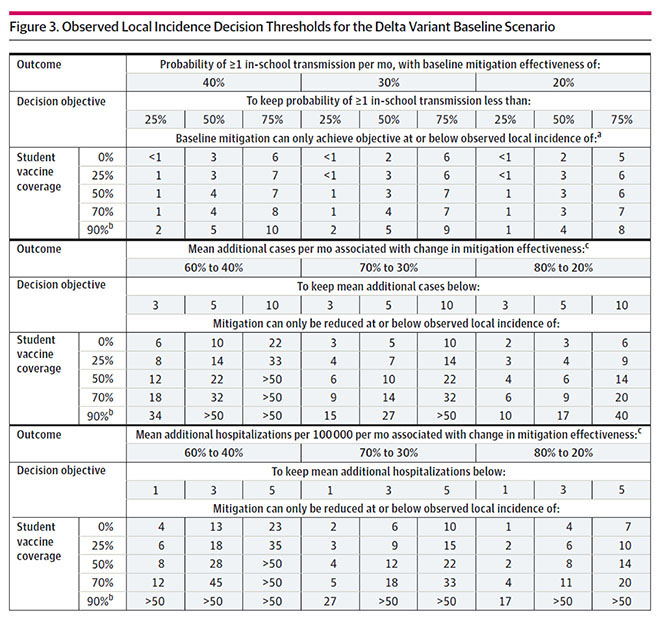
As if on cue, two new papers deliver a clear, quantitative look at just how many cases unmasking might trigger, helping school leaders set customized benchmarks for the end of mandates based on their community’s expressed goals.

“Instead of saying, ‘Well, you know, masks off, people get sick. Masks on, fewer people get sick,’ [officials can understand] what exactly the magnitude of these outcomes are,” said John Giardina, the lead author of one of the papers and a Harvard University Ph.D student.

His study, which was peer-reviewed and published Feb. 14 in JAMA Network, uses simulation modeling to identify the COVID transmission levels at which virus spread would stay in control even when classrooms are mask-optional.

It comes as New York Gov. Kathy Hochul said leaders in her state are considering metrics such as community COVID transmission levels and pediatric hospitalizations as they decide whether to lift the statewide school mask mandate in March. And California officials say they are examining student vaccination rates to announce on Feb. 28 when schools might be able to scrap their mask rules, even as health officials say the county will likely lift its indoor masking mandate for other settings by late March.

“We’re among the 13 states that have not ended their school masking requirements,” California Gov. Gavin Newsom said last week. “I have stated very clearly that on the 28th of this month we will be announcing a specific date. That date with destiny, the masks will come off, and we’ll do it in an appropriate manner.”

Meanwhile, the Centers for Disease Control and Prevention have signaled that they will be looking to update their face-covering guidance in the coming weeks, with an emphasis on preventing hospitalizations rather than avoiding transmission altogether.

The study Giardina published with co-authors from universities such as Stanford, Brown and Johns Hopkins allows decision makers to consider all of those metrics — case rates, vaccination levels and hospitalizations — simultaneously.
Using the ‘formula’

School leaders can select from three possible objectives: Avoiding all in-school transmission (which Giardina acknowledges may be an unrealistic standard), keeping the average additional cases due to unmasking below a specified level, such as 5 per month, or keeping the average additional hospitalizations under a threshold, such as 3 per 100,000 people per month.

Then, based on the share of students who have been inoculated with COVID vaccines, they can find the appropriate community transmission level for unmasking.


John Giardina (Center for Health Decision Science at Harvard University)

“If you have your goals and you have the context you’re in in your community when it comes to vaccination and how effective you think masks are, you could certainly look at that table as a kind of formula and say, ‘Should we take off masks, or shouldn’t we?’” Giardina told The 74.

He cautions, however, that the model used in the study relies on certain assumptions that decision makers should take into account. For example, it uses transmission rates from Delta rather than Omicron, and assumes a school with 638 students and 60 staff.

“I would still hope policymakers take all the uncertainties into account and how things might differ for each particular community,” he said.


In the table above, schools can usually focus on the middle column, the researcher explained, which assumes the switch to mask-optional classrooms will decrease overall COVID mitigation effectiveness from 70 percent to 30 percent. But if the building has particularly effective ventilation, staving off some virus particles even when kids don’t cover up, they might push to the left column, where mitigation remains slightly higher even after scrapping face coverings. Conversely, if the school previously helped students access high-quality masks like KN95s, the dropoff in mitigation effectiveness when unmasking might be steeper, pushing schools to the right column.

Related: Pfizer Postpones Request that FDA Authorize Vaccine Doses for Kids Under 5

A school with 50 percent student vaccination that assumes an average drop in protection without masks (middle column) and is willing to accept an average of up to 10 additional COVID cases per month due to the policy change could go mask optional once community transmission falls below 22 cases per 100,000 residents per day, according to the table. If the school increases its student vaccination rate to 70 percent, the threshold jumps to 32 cases per 100,000 because the stronger immunization rate will help stave off the higher community transmission rate.

Fifteen states and Washington, D.C. were at or below 22 cases per 100,000 residents per day, as of Feb 22. Another 15 were below 32 per 100,000. Nationally, case counts are trending downward, in some communities dramatically with 60 to 75 percent declines over the last 14 days.

Of the 500 largest U.S. school districts, 52 percent currently require students to wear masks, according to data collected by Burbio, which has tracked school policy through the pandemic. That’s down from 60 percent at the beginning of February, and other districts have mask-optional policies set to kick in in the coming weeks.

In New York, where no end to the statewide school masking rule has yet been specified, 58 percent of registered voters said they supported Gov. Hochul’s plan to review COVID data in early March before making any changes, while 30 percent thought the mandate should already have been lifted, according to a poll from the Siena College Research Institute released Tuesday. Another 10 percent said they wanted the policy to end after this week’s school vacation.

Related: Vax Up, Masks Down: Maryland, Massachusetts Lead Effort to ‘Off-Ramp’ Face Coverings in School

A second datapoint

As the move toward unmasking continues, a research brief out of Duke University’s ABC Science Collaborative corroborates Giardina’s findings, adding a second tool for school leaders to use in their decision making.

Like the study published in JAMA Network, the ABC Science Collaborative paper links school face-covering policies to additional likely COVID cases based on community transmission rates.

“You can see the differences in masking versus not masking and how many cases per week will happen in the community as a result of school policy,” said Danny Benjamin, professor of pediatrics at Duke and co-chair of the Collaborative, explaining his findings to educators in a Feb. 14 webinar. “You can then match these differences with your community’s risk tolerance as it relates to COVID.”

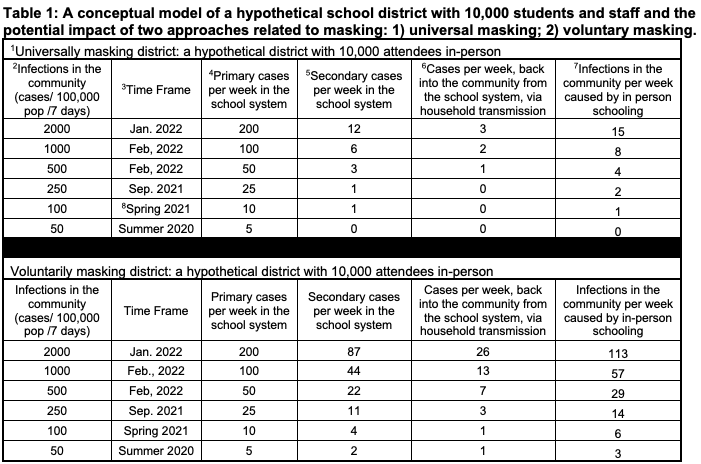
The paper, which the authors call a “blueprint” for navigating school policy this spring, draws on data from 61 school districts with varying mask rules. The researchers used those figures to then project the implications of mask-optional versus mask-required policies in a hypothetical 10,000-student school system.


When community case rates are high, mask mandates prevent much would-be transmission, the authors found. In universally masked schools, it generally takes 20 to 25 COVID-positive individuals to set foot in the building for one case of in-school transmission to occur, said Benjamin, compared to other settings where the average infected person tends to pass the virus on to at least one other person.

“The short version is that masking clearly works,” he said.

Related: Kids Wearing Masks Reduces Child Care Center Closures, Year-Long Yale Study Finds

However, when community case rates are low, the difference in prevented cases shrinks and school leaders may decide that enforcing a mandate is not worth the downsides. Research suggests that masks may hinder youngsters’ language and speech development and interfere with emotional recognition for people of all ages.

When case rates are just 100 per 100,000 residents per week, or about 14 per 100,000 per day (roughly the infection level before the Delta surge), districts with universal masking prevent only three additional cases compared to districts with voluntary masking. At 250 per 100,000 residents per week, where many communities currently stand, school mask mandates fend off an extra 10 cases in the district per week, the paper projects.

The brief does not break down expected cases by school vaccination rates. Nationwide, just under a quarter of children aged 5 to 11 and 56 percent of youth aged 12 to 17 are fully vaccinated against COVID-19, according to data from the American Academy of Pediatrics.

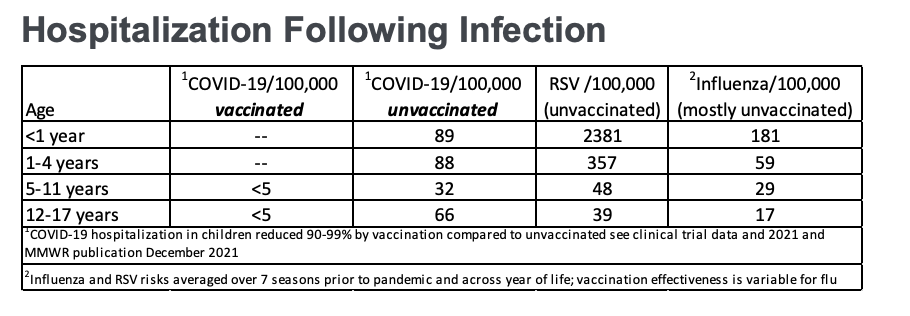
For some broader perspective, Benjamin reminded school leaders that children are just as likely or more likely to be hospitalized when they catch the flu or RSV compared to the coronavirus in all age groups except for 12- to 17-year-olds who have not been vaccinated against COVID.


Still, Benjamin’s co-chair at the Collaborative, Kanecia Zimmerman, emphasized that any shift in policy has implications not just for families’ physical health but also their mental health. An early February poll conducted by CBS News found that 57 percent of parents of school-aged children believe masks should still be required in school while only 36 percent said they should be optional. Another 7 percent want face coverings banned in classrooms.

Even when epidemiologically sound, a shift to voluntary masking may create distress for families, and the Duke associate professor of pediatrics urged school officials to consider bolstering the mental health supports available to students.

“Unmasking … is going to represent a substantial change for many families, for many districts, for many children,” she said. “When you’re making decisions about how to move forward, make those decisions in light of how you might be able to do things for the whole child.”