Thursday, February 24, 2022

BOSSES LOCKOUT
MLB: Season to be shortened if no deal by end of Monday

By RONALD BLUM

1 of 4
Major League Baseball Players Association executive director Tony Clark, left, and chief negotiator Bruce Meyer arrive for contract negotiations at Roger Dean Stadium in Jupiter, Fla., Wednesday, Feb. 23, 2022. (Greg Lovett/The Palm Beach Post via AP)


JUPITER, Fla. (AP) — Major League Baseball said only five days remain to salvage March 31 openers and a full season, telling locked out players that games would be canceled if a labor contract is not agreed to by the end of Monday.

After the third straight day of negotiations with little movement, MLB went public with what it had told the union on Feb. 12.

“A deadline is a deadline. Missed games are missed games. Salary will not be paid for those games,” an MLB spokesman said after Wednesday’s bargaining ended. The spokesman spoke on behalf of MLB on the condition the spokesman not be identified by name.

Players have not accepted Monday as a deadline and have suggested any missed games could be made up as part of doubleheaders, a method MLB said it will not agree to.

The union told MLB if games are missed and salaries are lost, clubs should not expect players to agree to management’s proposals to expand the postseason and to allow advertisements on uniforms and helmets.

Bargaining is scheduled to continue Thursday, and both sides said they are prepared to meet through Monday.

A shortened season would be baseball’s second in three years following a 2020 schedule cut from 162 games to 60 because of the coronavirus pandemic. The last seasons truncated by labor strife were during the strike that ended the 1994 schedule on Aug. 12 and caused the start of the following season to be delayed from April 2 to April 25. The 1995 schedule was reduced from 162 games to 144.

Players are paid only during the regular season, accruing 1/162nd of their salary daily. Players would be subject to losing as much as $232,975 daily in the case of Mets pitcher Max Scherzer, or as little as $3,441 for a player at a $640,000 minimum.

Baseball’s work stoppage was in its 84th day, and the three sessions this week increased the total on core economic issues to just nine since the lockout began Dec. 2.

Spring training workouts had been scheduled to start on Feb. 16, and MLB already has canceled the first week of exhibitions, which were to begin Friday.

Baseball Commissioner Rob Manfred said on Feb. 10 a minimum of four weeks of training are needed before starting the season. A deal by Monday would allow that plus a few days for players to report to camps in Arizona and Florida.

Manfred has spoken publicly just once since the day the lockout began and union head Tony Clark not at all.

MLB’s public statement was interpreted as a pressure tactic by the union, which was angered payrolls decreased during the expired five-year deal and an increased number of teams jettisoned higher-salaries veterans and transitioned to rebuilding mode.

“To get bears in the forest, you can’t offer them bear traps,” said Scott Boras, agent for five of eight players on the union’s executive subcommittee.

Labor talks resume with MLB deadline looming

A day after the union made only small moves in response to management’s incremental proposal of a day earlier, MLB advanced only one change: Teams offered to increase the minimum salary from $570,500 to $640,000, up from their previous proposal of $630,000. The minimum would increase by an additional $10,000 each season during a five-year agreement. Clubs withdrew their proposal for a tiered minimum, which players opposed.

Players have asked for $775,000 in 2022 and additional $30,000 jumps in each succeeding season. The union evaluated MLB’s proposal as adding $5 million annually.

There was no discussion Wednesday on the key issue of luxury tax thresholds and rates, but players voiced their concern over a lack of competition and the need for younger players to get higher salaries earlier in their careers.

The union proposed a $115 million pool of money that would go to 150 pre-arbitration players annually, while the clubs offered $20 million that would be distributed to 30.

Yankees pitchers Gerrit Cole and Zack Britton joined the talks, two of six members on hand from the executive subcommittee that supervises the negotiations. They were joined by Scherzer, free agent pitcher Andrew Miller, Mets shortstop Francisco Lindor, and Houston catcher Jason Castro.

After meeting at the start of the day at Roger Dean Stadium, the vacant spring training home of the Miami Marlins and St. Louis Cardinals, the sides caucused and then had a smaller group meeting that included Deputy Commissioner Dan Halem, Colorado CEO Dick Monfort, Scherzer and Miller.

Teams have told the union they will not decrease revenue sharing and will not add new methods for players to accrue service time, which the union said is needed to prevent teams from holding players back to delay free agency.

Clubs also are refusing to increase arbitration eligibility among players with at least two years of service and less than three, of which the top 22% by service time are eligible. The union wants it expanded to 75%.

___

More AP MLB: https://apnews.com/hub/MLB and https://twitter.com/AP_Sports

MLB lockout could cost Scherzer $232K daily, Cole $193K

By RONALD BLUM

FILE - Los Angeles Dodgers starting pitcher Max Scherzer tosses the ball during the third inning of the team's baseball game against the Colorado Rockies on Sept. 23, 2021, in Denver. Sometime soon, lockout costs become real: Scherzer would forfeit $232,975 for each regular-season day lost and Gerrit Cole $193,548. Based on last year's base salaries that totaled just over $3.8 billion, major league players would combine to lose $20.5 million for each day wiped off the 186-day regular season schedule.
 (AP Photo/David Zalubowski, File)


JUPITER, Fla. (AP) — Sometime soon, lockout costs become real: Max Scherzer would forfeit $232,975 for each regular-season day lost, and Gerrit Cole $193,548.

Based on last year’s base salaries that totaled just over $3.8 billion, major league players would combine to lose $20.5 million for each day wiped off the 186-day regular-season schedule.

Major League Baseball has told the players’ association a labor deal must be reached by Monday in order for opening day to come off as scheduled on March 31 and a 162-game season to remain intact. The union hasn’t said whether it believes that deadline, and there likely is some leeway based on timing after the 1990 lockout, the 1994-95 strike and the 2020 pandemic delay.

Talks resumed this week in the second-longest work stoppage in baseball history, which started Dec. 2.

A player at management’s proposed $630,000 minimum would lose $3,387 for each day he’s not on a big league roster, the amount rising to $4,167 under the union’s offer of a $775,000 minimum.

While medical insurance would expire after March 31 for players in the major leagues when last season ended, the union would pay COBRA payments to continue their coverage and also will cover the subsidy usually paid for the medical coverage of former players.

It’s harder to calculate what owners of the 30 teams would lose if games are lost, but a similar amount is likely. While players received about half of industry revenue that reached a high of $9.7 billion in 2019 (a percentage that includes spending on draft picks and international amateurs), they are paid during the regular season, and teams receive a substantial percentage of revenue from the postseason.

For players, the cost is clear: Each earns 1/186th of his base salary each day.

Scherzer and Cole are on the union’s eight-man executive subcommittee, which supervises the negotiations. Among others in the union’s leadership group, the daily price comes to $172,043 for Francisco Lindor, $134,409 for Marcus Semien, $75,269 for Zack Britton, $32,258 for James Paxton and $20,161 for Jason Castro. Andrew Miller, the other member, is among the hundreds of players who remained unsigned heading into the transaction freeze that began with the lockout.

Veterans are likely to have savings to rely on. Scherzer last season finished a $210 million, seven-year contract he signed with Washington. That deal included deferred money that called for him to receive $15 million each July 1 from 2022 to 2028, though the pandemic-shortened 2020 season will reduce the amount slightly.

Cole earned $25,895,061 in major league pay from 2013 to 2019 before signing a $324 million, nine-year contract with the Yankees that raised his earnings through last season to $71,228,394. Lindor has earned $41,548,655 and Semien $33,714,217.

Stoppage costs would compound in future seasons due to the major league service time that wouldn’t be accrued. Once 15 days of the regular season are missed, the free-agent eligibility of some players would be delayed by one year unless management agrees to give credit in an eventual agreement, which it hasn’t done in the past.

That would delay free-agent eligibility for Shohei Ohtani from 2023 to 2024, Pete Alonso from 2024 to 2025, Jake Cronenworth from 2025 to 2026 and Jonathan India from 2026 to 2027.

Others in danger of delayed free agency after 15 missed days — players currently with major league service ending in an even number of years with no additional days — include Tejay Antone, Jordan Hicks, Cristian Javier, Brad Keller, Isiah Kiner-Falefa, Chris Paddack, Brady Singer, Andrew Vaughn and Garrett Whitlock.

In Lindor’s case, because of deferred compensation in his contract, he would lose money both this year and a decade from now. He would forfeit $145,161 each day from the $27 million he is owed this season and $26,882 each day from the $5 million due on July 1, 2032.

Players also may find it more difficult to reach provisions in their contracts to guarantee future seasons triggered by statistics such as plate appearances, games and innings, but the sides have agreed to prorating those in past settlements.

Clubs would lose broadcast revenue and ticket money, though the impact is somewhat uneven. Some teams generate less revenue from April games than they produce in the summer, and there likely are different contractual arrangements regarding the flow of broadcast fees, credits, refunds and delayed/forfeited payments.

In addition, a large percentage of broadcast revenue is for the postseason. MLB gave the union a slide two years ago that contracts called for $787 million in media money from the 2020 postseason: $370 million from Fox, $310 million from Turner, $27 million from ESPN, $30 million from MLB Network and $50 million from international and other.

The prospect of an extended stoppage to some degree is likely to have depressed ticket sales among fans wary of purchasing tickets for games that may not be played.

And there is no public knowledge of debt financing among the clubs and how much liabilities increased during a pandemic that caused a huge revenue loss.

___

More AP MLB: https://apnews.com/hub/MLB and https://twitter.com/AP_Sports
SNL MEETS FOX
Russia state TV paints Moscow as savior of eastern Ukraine
By DASHA LITVINOVA
The app of the Russian government newspaper is displayed on an iPhone screen showing Russian President Vladimir Putin during his speech in the Kremlin in Moscow, Russia, Tuesday, Feb. 22, 2022. As the West sounds the alarm about the Kremlin ordering troops into eastern Ukraine and decries an invasion, Russian state media paints a completely different picture. It portrays the move as Moscow coming to the rescue of war-torn areas tormented by Ukraine’s aggression and bringing them much-needed peace. (AP Photo/Alexander Zemlianichenko Jr)


MOSCOW (AP) — As the West sounded the alarm about the Kremlin ordering troops into eastern Ukraine and decried it as an invasion, Russian state media painted a completely different picture — of Moscow coming to the rescue of war-torn areas tormented by Ukraine’s aggression and bringing them peace.

The fanfare came hours after Vladimir Putin announced Russia’s recognition of the separatist areas in eastern Ukraine as independent states and ordered its troops to “maintain peace” in territory where Russia-backed rebels have been fighting Kyiv’s forces since 2014 — a conflict that has killed over 14,000 people.

TV presenters hailed the “historic” day and professed the end of suffering for the residents of the breakaway regions.

“You paid with your blood for these eight years of torment and anticipation,” anchor Olga Skabeyeva told residents of the areas known as Donbas during a popular political talk show Tuesday morning on Russia 1 state TV. “Russia will now be defending Donbas.”

TV pundit Vladimir Solovyev echoed those sentiments on his morning show on state Vesti.FM radio. “We will ensure their safety,” he declared. “It is now dangerous to fight with them … because one will now have to fight with the Russian army.”

Channel One, another popular state-funded TV station, struck a more festive tone, with its correspondent in Donetsk asserting that local residents “say it is the best news over the past years of war.”

“Now they have confidence in the future and that the years-long war will finally come to an end,” she said.

Whether ordinary Russians are buying it is another question.

After his announcement Monday evening, Putin said he was “positive about the people’s support.”

But critics denounced the moves as harmful for both Ukraine and Russia.

Imprisoned opposition leader Alexei Navalny, in a message from behind bars posted on social media, said Putin “won’t let Ukraine develop, drag it into a swamp, but Russia will also pay the same price.”

A Facebook campaign with the hashtag “I’m not staying silent,” launched by independent Russian news site Holod urged people “to express their opinion about the war aloud — and also to remember that each of us has something connecting us to Ukraine.” It brought dozens of posts sharing memories about Ukraine and condemning the Kremlin’s moves.

Still, many have voiced their wholehearted support for Putin’s decision.

“It should have been done a long time ago,” said Irina Nareyko, a Moscow resident. “These poor people who identify as Russian, who mainly identify as Orthodox, who cannot wait anymore and live expecting to be killed … we should have accepted them a long time ago.”

Denis Volkov, director of the Levada Center, Russia’s top independent pollster, said that according to its poll data, more than half of Russians were ready to support Putin’s moves.

“The situation, as it is understood by the majority, is that the West is pressuring Ukraine” to make a move against the rebel-held areas, “and Russia needs to somehow help,” Volkov told the AP. “This notion of helping in an extraordinary situation translates into support” for recognition of the separatist regions.

The narrative of Ukraine having aggressive designs on Donbas has been actively promoted by the Russian authorities — along with accusations that the West is pumping Ukraine full of weapons and warmongering.

The Kremlin has denied plans to invade Ukraine, something the West fears due to a massive buildup of Russian troops along Ukraine’s borders. Russian officials point fingers at Kyiv instead, saying it has massed its own troops and could try to retake the rebel-held areas by force, which the Ukraine government denies.

The official rhetoric heated up last week, when Putin charged that “what is now happening in Donbas is genocide.” Popular newscasts and political talk shows on state TV channels started widely using the term.

Prominent news anchor Dmitry Kiselev likened what was happening in Donbas to World War II atrocities committed by Nazi Germany and dressed down German Chancellor Olaf Scholz for challenging Putin’s use of the word “genocide.”

“It is, simply, solidarity with the genocide of today,” he charged on Russia 1′s flagship news show .

Over the weekend, separatist officials added a sense of urgency to the picture, announcing mass evacuations of Donetsk and Luhansk residents into Russia and mobilizing troops in the face of a purportedly imminent attack by Ukrainian forces.

News bulletins showed emotional visuals of women and children lining up to board buses, followed by segments alleging massive shelling of the areas by Ukrainian forces. Some of those segments stressed that Kyiv’s military was deliberately targeting civilians.

Ukrainian President Volodymyr Zelenskyy’s speech at a Munich security conference Saturday, during which he threatened to pull out of an agreement to abandon the nuclear weapons left in Ukraine after the Soviet collapse in exchange for security guarantees, fueled the fire even further.

Russian state TV channels aired multiple segments about Kyiv’s capability to develop its own nuclear weapons, and news show hosts warned the threat shouldn’t be taken lightly.

Finally, to drive home the point about Ukraine’s alleged aggressions, Russian officials on Monday accused Ukrainian forces of an attempted incursion into Russia— an allegation Ukraine dismissed as false “disinformation.”

“The invasion has begun,” Russia 1 TV host Yevgeny Popov proclaimed. “But it wasn’t Putin who invaded Ukraine — instead, Ukraine went to war with Russia and Donbas.”

Several hours later, Putin announced recognition of the self-proclaimed republics in eastern Ukraine.

Political analyst Abbas Gallyamov says that while the majority of Russians will support the decision, the impact of such propaganda on the domestic audience is limited, compared to 2014, when the Kremlin managed to rally Russians around the idea of annexing Crimea.

The only popular show of support for the moves on eastern Ukraine took place in St. Petersburg on Wednesday — the day Russia celebrates Defender of the Fatherland Day, a holiday that commemorates the country’s veterans.

Russian media reported several hundred pro-Kremlin activists gathered in the city center with Russian flags and banners saying: “We don’t abandon our own.” According to reports, some of the demonstrators didn’t know what the rally was about and said they were promised a hot meal after it.

At the same time, rights groups in Moscow reported six protesters detained over holding pickets against a war with Ukraine.

State TV channels showed a top official from the Kremlin’s United Russia party laying flowers at a memorial for the “defenders of Donbas” in Donetsk, along with the area’s separatist leader.

Putin will score some political points at home, but not too many, Gallyamov believes.

“People remember what (the annexation of Crimea) led to. People understand that there will be sanctions now, the economy will decline even further, and living conditions will continue to worsen.”

“They remember that there was a hangover after the party.”

Moscow resident Sergei, who only gave his first name, appeared to be one of those skeptics. “It’s terrible, it’s very bad,” he said.

“As usual, nobody asked anybody about anything,” he said. “The economic repercussions are economic repercussions for us, not the ruling elite.”

___

Vladimir Kondrashov and Anatoly Kozlov in Moscow contributed to this report.
What Lies Beneath: Vets worry polluted base made them ill


By MARTHA MENDOZA, JULIET LINDERMAN and JASON DEAREN
February 23, 2022 

FORT ORD NATIONAL MONUMENT, Calif. (AP) — For nearly 80 years, recruits reporting to central California’s Fort Ord considered themselves the lucky ones, privileged to live and work amid sparkling seas, sandy dunes and sage-covered hills.

But there was an underside, the dirty work of soldiering. Recruits tossed live grenades into the canyons of “Mortar Alley,” sprayed soapy chemicals on burn pits of scrap metal and solvents, poured toxic substances down drains and into leaky tanks they buried underground.

When it rained, poisons percolated into aquifers from which they drew drinking water.

Through the years, soldiers and civilians who lived at the U.S. Army base didn’t question whether their tap water was safe to drink.

But in 1990, four years before it began the process of closing as an active military training base, Fort Ord was added to the Environmental Protection Agency’s list of the most polluted places in the nation. Included in that pollution were dozens of chemicals, some now known to cause cancer, found in the base’s drinking water and soil.

Decades later, several Fort Ord veterans who were diagnosed with cancers — especially rare blood disorders — took the question to Facebook: Are there more of us?

Soon, the group grew to hundreds of people who had lived or served at Fort Ord and were concerned that their health problems might be tied to the chemicals there.

The Associated Press interviewed nearly two dozen of these veterans for this story and identified many more. The AP also reviewed thousands of pages of documents, and interviewed military, medical and environmental scientists.

There is rarely a way to directly connect toxic exposure to a specific individual’s medical condition. Indeed, the concentrations of the toxics are tiny, measured in parts per billion or trillion, far below the levels of an immediate poisoning. Local utilities, the Defense Department and some in the Department of Veterans Affairs insist Fort Ord’s water is safe and always has been.
ADVERTISEMENT


But the VA’s own hazardous materials exposure website, along with scientists and doctors, agree that dangers do exist for military personnel exposed to contaminants.

The problem is not just at Fort Ord. This is happening all over the U.S. and abroad, almost everywhere the military has set foot, and the federal government is still learning about the extent of both the pollution and the health effects of its toxic legacy.

The AP’s review of public documents shows the Army knew that chemicals had been improperly dumped at Fort Ord for decades. Even after the contamination was documented, the Army downplayed the risks.

And ailing veterans are being denied benefits based on a 25-year-old health assessment. The CDC’s Agency for Toxic Substances and Disease Registry concluded in 1996 that there were no likely past, present or future risks from exposures at Fort Ord.


But that conclusion was made based on limited data, and before medical science understood the relationship between some of these chemicals and cancer.

This is what is known:

Veterans in general have higher blood cancer rates than the general population, according to VA cancer data. And in the region that includes Fort Ord, veterans have a 35 percent higher rate of multiple myeloma diagnosis than the general U.S. population.

Veterans like Julie Akey.

Akey, now 50, arrived at Fort Ord in 1996 with a gift for linguistics. She enlisted in the Army on the condition that she could learn a new language. And so the 25-year-old was sent to the Defense Language Institute in Monterey, California, and lived at Fort Ord as a soldier. By then the base was mostly closed but still housed troops for limited purposes.

“It was incredibly beautiful,” she said. “You have the ocean on one side, and these expansive beaches, and the rolling hills and the mountains behind.”

What she didn’t know at the time was that the ground under her feet, and the water that ran through the sandy soil into an aquifer that supplied some of the base’s drinking water was polluted. Among the contaminants were cancer-causing chemicals including trichloroethylene, also known as the miracle degreaser TCE.

She’d learn this decades later, as she tried to understand how, at just 46 and with no family history of blood cancers, she was diagnosed with multiple myeloma.

“No one told us,” she said.

___


Despite the military’s claims that there aren’t any health problems associated with living and serving at Fort Ord, nor hundreds of other shuttered military bases, almost every closure has exposed widespread toxic pollution and required a massive cleanup. Dozens have contaminated groundwater, from Fort Dix in New Jersey to Adak Naval Air Station in Alaska. Fort Ord is 25 years into its cleanup as a federal Superfund site, and it’s expected to continue for decades.

To date, the military has only acknowledged troops’ health could have been damaged by drinking contaminated water at a single U.S. base: Camp Lejeune, North Carolina, and only during a 35-year window, between 1953 to 1987. Servicemembers there were found by federal epidemiologists to have higher mortality rates from many cancers, including multiple myeloma and leukemia. Men developed breast cancer, and pregnant women tended to have children with higher rates of birth defects and low birth weight. Like Fort Ord, Camp Lejeune began closing contaminated wells in the mid-’80s.

Soldiers are often stationed at different bases during their years of military service, but neither the Defense Department nor the VA has systematically tracked toxic exposures at various locations.

Fort Ord’s primary mission was training troops who deployed to World Wars I and II, Korea and Vietnam. It supported several thriving small towns on a piece of coastal land the size of San Francisco. Soldiers and their families lived in houses and apartments connected to its water system, and civilians worked at its airfields, hospitals and other facilities.

In the course of their work preparing for battle, they spilled solvents into the base’s drains, sloughed chemical sludge into underground storage tanks and discarded 55-gallon drums of caustic material in the base landfill, according to a 1982 hazardous waste inventory report.


Curt Gandy, a former airplane mechanic, recalls being routinely doused with toxic chemicals from the 1970s to the 1990s. He said he hosed down aircraft with solvents, cleaned engine parts and stripped paint off fuselages without any protection. There were barrels of toluene, xylene, jet fuel and more.

“It gets on your body, it gets in your face, you get splashed with it, and we’re using pumps to spray this stuff,” he said. “It’s got 250 pounds of pressure and we’re spraying it into the air and it’s atomized.”

On Fridays, crews would forklift barrels of the used flammable liquids down a bumpy sandy road, dumping solvents, paint and metal chips onto the hulks of broken aircraft and tanks at a burn pit. One weekend a month, airfield firefighters would light up the toxic sludge and then douse the roaring fires with foam.

In 1984, an anonymous caller tipped off Fort Ord’s officials that “approximately 30 55-gallon drums,” containing about 600 gallons of a “solvent-type liquid” had been illegally spilled there, an Army report said. The state, which ordered a cleanup two years later, determined the Army had mismanaged the site in a way that threatened both ground and surface waters.

And the burn pit wasn’t the base’s only polluted site.

In 1991, when the Army began investigating what had actually been disposed of at the base’s dump overlooking Monterey Bay, officials told the public the trash was similar to what one would find in the landfill of any small city, according to transcripts of community meetings.


(AP Video/Serginho Roosblad and Marshall Ritzel)

While it’s true that much of the trash going into that dump came from nearby houses — food scraps, old furniture, busted appliances, even gasoline — the Army officials who spoke at the meetings made no mention of the toxic stew of paints and solvents that today are banned from open landfills. The solvent TCE was among dozens of pollutants that scientists discovered as early as 1985 and today still exists in concentrations above the legal limit for drinking water in the aquifer below, according to local and federal water quality reports.

“The water from the aquifer above leaks down into the aquifer below and the pollution just gets deeper,” said Dan O’Brien, a former board member of the Marina Coast Water District, which took over the Army’s wells in 2001. “The toxic material remains in the soil under where it was dumped. Every time it rains, more of the toxin in the soil leeches down into the water table.”

The Army’s early tests of Fort Ord’s wells near the landfill detected levels of TCE 43 separate times from 1985 to 1994. The VA told the AP the contamination was “within the allowable safe range” in areas that provided drinking water.

But 18 of those TCE hits exceeded legal safety limits; one reading was five times that amount. It’s unclear how long and at what concentrations TCE may have been in the water before 1985. And TCE was only one problem. The EPA identified more than 40 “chemicals of concern” in soil and groundwater.

“It was not recognized that it was so toxic back then, and they threw it on the ground after use. They used a ton of it. Now, it’s the most pervasive groundwater contaminant we have,” said Thomas Burke, an environmental epidemiologist at Johns Hopkins Bloomberg School of Public Health and a former EPA official.


Contractors initially brought in to clean up the contaminated groundwater were warned not to tell community members what they found in their drinking water, specifically not the news media or even local public agencies, according to a 1985 military memo.

At the time, there were elevated levels of TCE in the aquifers, yet the military assured the public the drinking water was safe.

“There never have been any test results that indicate that Fort Ord’s water was unsafe,” an Army official told several local papers in August 1985.

Since then, advances in medical science have increased the understanding of the dangers of the chemicals at Fort Ord. TCE, for example, is now a known human carcinogen, and epidemiological studies indicate a possible link between TCE and blood cancers like non-Hodgkin lymphoma and multiple myeloma.

TCE “circulates in the body real effectively when you breathe it or drink it,” Burke said. “It’s related strongly to kidney cancer, the development of kidney cancers and suspected in several other cancers.”

Julie Akey spent years collecting names of people who lived at Fort Ord and were later diagnosed with cancers. Her database eventually grew to more than 400 people, nearly 200 of which were listed as having those blood cancers.
ADVERTISEMENT


___

Akey spent most of her Fort Ord days in a classroom, studying Arabic. But in the afternoons and evenings, she’d run along the coastline and do military drills. At home, she watered her small vegetable plot with the base’s water supply, harvesting the fresh crops to chop into salads.

She filled her water bottle from the tap before heading out each morning, and thought nothing of the showers she took each night. After all, she was among hundreds of thousands of soldiers in the base’s history who did the same.

She fell ill in Bogota, Colombia, in 2016. She’d left the military after nearly six years as a translator and interrogator to become a State Department foreign service officer, a dream job that gave her the chance to travel the world with her twin sons. Quite suddenly she became fatigued with a persistent ache in her bones. Soon she was in screaming pain.

When the Colombian doctors couldn’t find a cause, Akey was sent to the U.S. for what she assumed would be a quick trip. She left plants on the mantel, food in the refrigerator and clothes at the dry cleaners.

She never went back.

After weeks at the Cleveland Clinic, she was diagnosed with multiple myeloma, a rare and aggressive form of cancer that attacks plasma cells, and is most often detected in elderly African American men. The disease is treatable but has no cure.

“I was a zombie,” she said. “I cried all the time.”

Worried about keeping her government health insurance, she applied to work at a nearby airport as a part-time baggage checker while recovering from a bone marrow transplant.

“You don’t ever think you’re going to have cancer at 46. Why? Why do I get this crazy cancer that no one’s ever heard of? So, I started looking for answers,” she said.


Akey meticulously reviewed her assignments in Spain and Haiti, her stints in Guyana, Ecuador, Nigeria, at Fort Bragg in North Carolina and Fort Gordon in Georgia. And Fort Ord — a federal Superfund site.

“I think that that was my answer,” she said.

Akey read as much as she could about the base, and searched for others like her. She combed through EPA reports, water records, newspaper clippings and obituaries. She scoured social media, and built a database of sick veterans; it’s grown to 491 people to date.

Soon after Akey started a Facebook group in June of 2019, she connected with Tracy Lindquist. Lindquist’s husband, Scott, was stationed at Fort Ord for two years in the 1980s. He has three types of rare cancers, including multiple myeloma. He had a stem cell transplant a few years back, and has been on chemotherapy since 2014.

He has health insurance through the VA, but when he applied for disability payments that would have allowed him to stop working, Tracy said, his claims were denied — twice.

Until May, he drove a van for $11 an hour, shuttling people with developmental disabilities from their group homes to daylong workshops. Sometimes he had to change the oil or do maintenance, and the physical labor was hard on him, Tracy said. Then he started having seizures, and could no longer drive. He tried working three days a week, cleaning the vans and assisting clients, but he couldn’t even manage that. Earlier this month, he was approved for Social Security disability payments.

“Scott hardly ever left the base and he drank water like a fish, and that water was contaminated,” Tracy said. “I know there are people out there, they’ve lost legs and arms, and they need to take care of those people who got hurt in action. But this is a disability, too.”

Debi Schoenrock, who lived around the corner from Akey’s house at Fort Ord, was diagnosed in 2009 with multiple myeloma at 47. Like Akey, she was stunned. She was a military wife and lived on base for three years, from 1990 until 1993. She’d never been sick, and had no family history of cancer. Nobody said anything about toxic substances, she said.


In 1991, the Army surveyed dozens of community members to find out what they knew about groundwater contamination at Fort Ord. Everyone said they were concerned, and no one reported receiving any information from the Army.

Five years later, a federal report assured them that “because the concentration of contamination detected in the past in Fort Ord and Marina drinking water wells was low and the duration was not over a lifetime (70-years), those exposures will not likely result in adverse health effects.”

Decades on, such health assessments at Fort Ord and other military bases are outdated and based on old science, said Burke of Johns Hopkins.

“A 1990s health assessment is a weak thing,” he said.

Peter deFur, a biologist who worked as an EPA-funded scientific adviser at the base, agrees. The report “stated that there could not be future health effects, which is not possible to know,” he said.

While the federal government has established acceptable standards for the amount of TCE in drinking water, no level of such carcinogens is safe, according to the Safe Drinking Water Act of 1974. Complicating matters, TCE vaporizes easily, and when it is inhaled it can be even more dangerous, according to a National Toxicology Program assessment.

William Collins, who is leading Fort Ord’s cleanup for the Army, said he’s never heard of anyone sickened by pollution at the base. Like the VA, Collins points to the 25-year-old study that found no likely human risks from exposure at Fort Ord. He said anyone can request a new, updated study if they want, which is what happened at Camp Lejeune in 2017.

Federal health officials told the AP no one has done so at Fort Ord.

___


LeVonne Stone and her husband, Donald, were living at Fort Ord when the base shut down. LeVonne had a civilian job there, and Donald had been in the 7th Infantry Division.

During the base conversion, Stone formed the Fort Ord Environmental Justice Network, demanding answers about the toxic materials and the impact on friends and neighbors, who, at the time, made up the only significant Black community on California’s central coast. But she said military and state officials were determined to develop the valuable coastal property and, in her mind, didn’t want to deal with the pollution.

“We tried telling everybody, the state, the federal, everybody,” she said. “There’s so many people who have died of cancer. They have not done anything for the community locally. … They just turned their heads, they looked the other way.”

There have been efforts in recent years to force the government to come to grips with the effects of the military’s environmental abuses.

Numerous bills have been introduced seeking to compensate veterans sickened by exposure to toxic chemicals during their service, but nothing significant has passed.

Last year President Joe Biden called on the VA to examine the impact of burn pits and other airborne hazards. In November, the White House announced that soldiers exposed to burn pits in a handful of foreign countries, who developed any of three specific ailments — asthma, rhinitis and sinusitis — within 10 years can receive disability benefits.

The Board of Veterans Appeals has ruled repeatedly that there’s no presumptive service connection for any disease — stroke, cancer, vision problems, heart disorders and more — due to exposure to toxic chemicals at Fort Ord, according to an AP review of claims.

The VA told the AP that it is updating how it determines links between medical conditions and military service, and encourages veterans who believe their ailments may have been caused by their service to file a claim.

Burke, the Johns Hopkins epidemiologist, said doing a study of health effects of living at Fort Ord now is difficult, if not impossible. “We can’t reproduce what happened on that base in California,” he said. “We need to admit we exposed people to a huge amount of toxic materials.”

And it’s not just a matter of exposures in the past.

Today Fort Ord is home to a small public university; some students live in former Army housing and spend weekends “Ording,” exploring the abandoned, and contaminated, military buildings. More than 1.5 million mountain bikers, hikers and horseback riders a year enjoy some 85 miles of trails in a vast national monument. Brand-new neighborhoods with million-dollar homes are being built across the street from the Superfund landfill cleanup. Local water officials say drinking water is now pulled from other areas and treated before being delivered to customers.


Former Defense Secretary Leon Panetta grew up next to Fort Ord, went through basic training on the base and now runs a nonprofit institute there.

Too often, he said, the military does whatever is necessary at its bases to ready troops for war, “and they don’t spend a lot of time worrying about the implications of what will happen once they leave.”

Panetta said the military is abandoning communities, leaving huge messes to clean up.

“I think that they have every right to ask the question whether or not whatever physical ailments they may have was in part due to the failure to provide proper cleanup,” Panetta said. “And in those situations, there is liability. And somebody has to take care of people who have been adversely impacted.”

___

For Akey and other veterans with cancer, it’s a matter of accountability. Health insurance, disability benefits and an acknowledgment of wrongdoing, she said, “isn’t asking for too much.”

“You’re not just serving for six years, like me, and then you’re out,” she said. “If you’ve been given cancer, that’s a life sentence.”

On a recent foggy morning, Gandy, the former airplane mechanic, walked past the rusting hangar at the old airfield where he used to work. The single-landing strip and buildings are now the Marina Municipal Airport. But much of the legacy military infrastructure remains, including sheds with old paint cans, an oil separator the size of a school bus and disconnected nozzles and hoses.

Gandy became an outspoken activist along with LeVonne Stone, and also founded community groups to maintain pressure on the military to clean up the site.

His group repeatedly sued the Army, but a judge agreed with Defense Department attorneys who said the claims were moot because a rigorous cleanup was underway.

Gandy, now 70, said he talked to the base commanders, every mayor and health and safety officer. Twenty-five years later, Gandy’s comments — captured in videos and transcripts of contentious community meetings — seem prescient.

“I told them, ‘If we do what we need to do now, nobody will know that we did the right thing. But if we do it wrong, they’re going to know, because in about 20 years people are going to start dying,’” he said.

The AP obtained a roster of Gandy’s co-workers on a single day at the airfield in 1986. There were 46 pilots and welders, mechanics and radio engineers. Today, he was told, almost a third of them are dead, many of cancers and rare diseases, some in their 50s.

He knew three former colleagues had died, not 13. “I feel terrible,” he said, tearing up. “It breaks my heart. Those guys were good guys and they deserved better.”

___

Contact AP’s global investigative team at Investigative@ap.org.
US vaccination drive is bottoming out as omicron subsides

By JAY REEVES and MIKE STOBBE

1 of 10
Nurse Jordan Ledbetter prepares to perform a test for COVID-19 outside the Marion County Health Department in Hamilton, Alabama, on Tuesday, Feb. 15, 2022. The reality of the COVID-19 pandemic reality is colliding with the hope for a late surge of new vaccinations in the county, a rural, mostly white area that trails much of the nation in immunizations. (AP Photo/Jay Reeves)


HAMILTON, Ala. (AP) — A handwritten log kept by nurses tells the story of the losing battle to get more people vaccinated against COVID-19 in this corner of Alabama: Just 14 people showed up at the Marion County Health Department for their initial shot during the first six weeks of the year.

That was true even as hospitals in and around the county of roughly 30,000 people filled with virus patients and the death toll climbed. On many days, no one got a first shot at all, while a Mexican restaurant up the street, Los Amigos, was full of unmasked diners at lunchtime.

The vaccination drive in the U.S. is grinding to a halt, and demand has all but collapsed in places like this deeply conservative manufacturing town where many weren’t interested in the shots to begin with.

The average number of Americans getting their first shot is down to about 90,000 a day, the lowest point since the first few days of the U.S. vaccination campaign, in December 2020. And hopes of any substantial improvement in the immediate future have largely evaporated.

About 76% of the U.S. population has received at least one shot. Less than 65% of all Americans are fully vaccinated.

Vaccination incentive programs that gave away cash, sports tickets, beer and other prizes have largely gone away. Government and employer vaccine mandates have faced court challenges and may have gone as far as they ever will.


And with COVID-19 cases, hospitalizations and deaths subsiding across the U.S., people who are against getting vaccinated don’t see much reason to change their minds.

“People are just over it. They’re tired of it,” said Judy Smith, administrator for a 12-county public health district in northwestern Alabama.

The bottoming-out of demand for the first round of vaccinations is especially evident in conservative areas around the country.

On most days in Idaho, the number of people statewide getting their first shot rarely surpasses 500.

In Wyoming, a total of about 280 people statewide got their first shot in the past week, and the waiting area at the Cheyenne-Laramie County Health Department stood empty Tuesday morning. The head of the department fondly recalled just a few months ago, when the lobby was bustling on Friday afternoons after school with children getting their doses. But they aren’t showing up anymore either.

“People heard more stories about, well, the omicron’s not that bad,” Executive Director Kathy Emmons said. “I think a lot of people just kind of rolled the dice and decided, ‘Well, if it’s not that bad, I’m just going to kind of wait it out and see what happens.’”

Marion County, along the Mississippi line, is part of a band of Alabama counties where most people aren’t fully vaccinated more than a year after shots were rolled out. Just to the east, Winston County has the state’s lowest share of fully vaccinated residents, at 26%, according to the Centers for Disease Control and Prevention. About 42% are fully immunized in Marion County.

The digital sign outside First National Bank flashes Bible verses along with the temperature, and many Marion County residents work in small plants that make mobile homes and components for prefab housing. Most area jobs are blue-collar, and TVs are typically turned to Fox News. A conservative, working-class ethic runs deep.

The area went heavily for President Donald Trump in the 2020 election. And yet resistance to the vaccine is so strong that two counties over, in Cullman, some booed Trump when he encouraged vaccinations during a rally that drew thousands last summer.


COVID-19 has killed almost 18,000 people in Alabama, giving the state the nation’s fourth-highest rate of deaths relative to population. Marion County’s rate exceeds the state average at 1.78%, with more than 140 deaths, according to data from Johns Hopkins University.

Health officials expected to have a hard time persuading Black people to get government-sponsored vaccines in Alabama, home of the infamous Tuskegee syphilis study and a place where distrust of Washington runs deep. They started work on public education campaigns weeks early in mostly Black areas, which now have some of the state’s highest vaccination rates, at 60% or more.

But they didn’t expect the stiff resistance among rural whites that has kept vaccination numbers stubbornly low in places like Marion County, which is 94% white. While rural transportation difficulties, confusion over vaccine costs — they’re free — and a lack of health care access have also been factors, the partisan divide in America killed the vaccine drive for some before it really got started, officials said.

“Rural white men who identify as conservative are just not interested in this. That caught us off guard,” said Dr. Scott Harris, head of the Alabama Department of Public Health. “By the first or second month of the vaccine campaign, it became clear that those folks just weren’t going to come in.”

Richard Kitchens is among that group. The owner of a clothing and sports shoe shop on the square in Hamilton, Kitchens said he isn’t interested in the vaccine after getting COVID-19 in 2020 before vaccines were available and having relatives who contracted the illness, developed only minor symptoms and recovered.

Short of a proven guarantee against illness — which no vaccine provides — he doesn’t see the point.

“I guess if I knew I could go out and get a shot and wouldn’t get it or spread it, I would go get it, and they say it helps,” Kitchens said. “But I think that will be determined sometime down the road maybe.”

Doris Peterson is fully vaccinated, but she said she didn’t get a booster on the advice of her two adult daughters, neither of whom is vaccinated. Peterson said she is used to being one of the few people around still wearing a mask in public.


“Most of the time I am it,” she said.

Kelly Moore, a former Tennessee health official who now heads a CDC-funded vaccination advocacy organization named Immunize.org, recalled seeing data from a recent survey that hit her like a punch to the gut.

The results were presented at a CDC meeting of vaccine experts earlier this month. The January survey of about 1,000 adults asked unvaccinated participants what, if anything, would change their mind and persuade them to get a shot. Half said “nothing.”

“It was quite demoralizing to see those results, frankly,” Moore said.

With the pandemic still a mortal threat, public health workers haven’t given up on getting more people vaccinated, even if it feels like an uphill slog.

Jordan Ledbetter, a nurse who works at the Marion County Health Department, was thrilled when two people came in for first-time shots on the same day recently.

“That was exciting,” she said. “There are days when I haven’t given any vaccines.”

___

Associated Press Writer Mead Gruver contributed to this report from Cheyenne, Wyoming.


High court wades into clash over Trump-era immigration rule

By JESSICA GRESKO

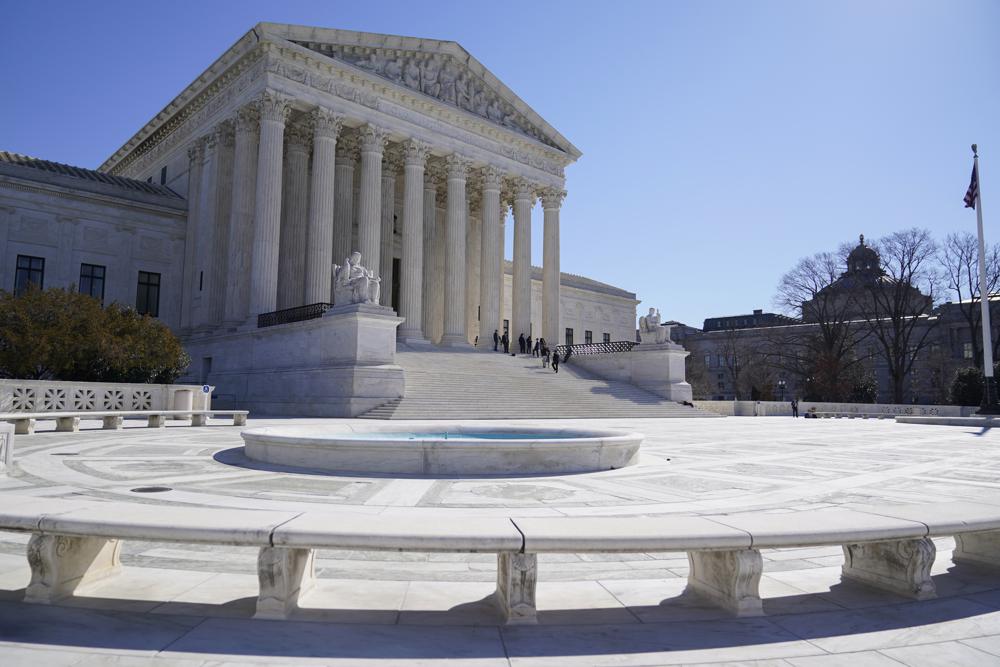
People stand on the steps of the U.S. Supreme Court on Friday, Feb.11, 2022, in Washington. (AP Photo/Mariam Zuhaib)

WASHINGTON (AP) — The Supreme Court waded into a political clash Wednesday between the Biden administration and Republican-led states seeking to defend a signature Trump-era immigration rule that the new administration has abandoned.

Conservative and liberal Supreme Court justices acknowledged during arguments at the high court that when a new administration comes in, it can change policy. That’s what the Biden administration did with the Trump-era “public charge” rule that denied green cards to immigrants who use food stamps or other public benefits.

The question for the court is not the legality of the now defunct Trump-era rule, just whether a group of states led by Arizona should be able to pick up the legal fight over it.

Justice Elena Kagan suggested to Arizona Attorney General Mark Brnovich, arguing for the group of states, that allowing the group to intervene in a case “that’s completely dead that never applied to you in the first place” is not the answer. “Whoever the federal government is, there’s always going to be a state that thinks it’s done the wrong thing,” she said. Other justices suggested a limited right to intervene might be possible.

Kagan, for her part, did question whether the Biden administration had erred by maneuvering to quickly jettison the Trump-era rule rather than going through a longer process. Justice Samuel Alito said the administration had devised a strategy to quickly set aside the rule and he wasn’t “aware of a precedent where an incoming administration has done anything quite like this.”

Kagan and other justices suggested that if Arizona objected to the way the Biden administration ended the previous policy, however, it should have brought that issue to a court rather than attempting what Kagan described as a “quadruple bank shot” strategy to intervene in other cases.

Another issue for several of the justices: geography. Stephen Breyer, Clarence Thomas and Sonia Sotomayor were among the justices who questioned why Arizona belongs in a case that has its origins in California and Washington. “I’ve seen how Los Angeles has spread, but I don’t think it’s yet spread to Arizona,” said Breyer, who last month announced his plans to retire from the court.

At the center of the case before the justices is a federal law says that green card applicants can’t be burdens to the country or “public charges.” But the Trump administration significantly expanded the definition, saying the use of public benefits including food stamps or Medicaid could be disqualifying. That led to court challenges, but the Supreme Court allowed the policy to take effect while those continued.

The Biden administration rescinded the rule and has since announced new guidelines. The administration says that in practice, in the year the rule was in effect, it only affected about five out of some approximately 50,000 applications it was applied to. The Biden administration and immigration groups have said the bigger impact of the rule was scaring immigrants, causing them to drop benefits or not enroll in them because of fears doing so could affect their applications to become legal permanent residents.

Despite the political nature of Wednesday’s arguments, they did underscore one point of agreement between the Trump administration and the Biden administration. In the case of the public charge rule, a single federal judge in Illinois ruled to block the policy nationwide. The Trump administration had criticized similar nationwide injunctions by a single judge blocking a policy nationwide, calling them unlawful. Attorney Brian Fletcher, representing the Biden administration, said that view is shared by the new administration.

In addition to Arizona, the states involved in the case are Alabama, Arkansas, Indiana, Kansas, Louisiana, Mississippi, Missouri, Montana, Oklahoma, South Carolina, Texas and West Virginia.
THIRD WORLD USA
Study: Child poverty rising after tax credit expires

By ASHRAF KHALIL

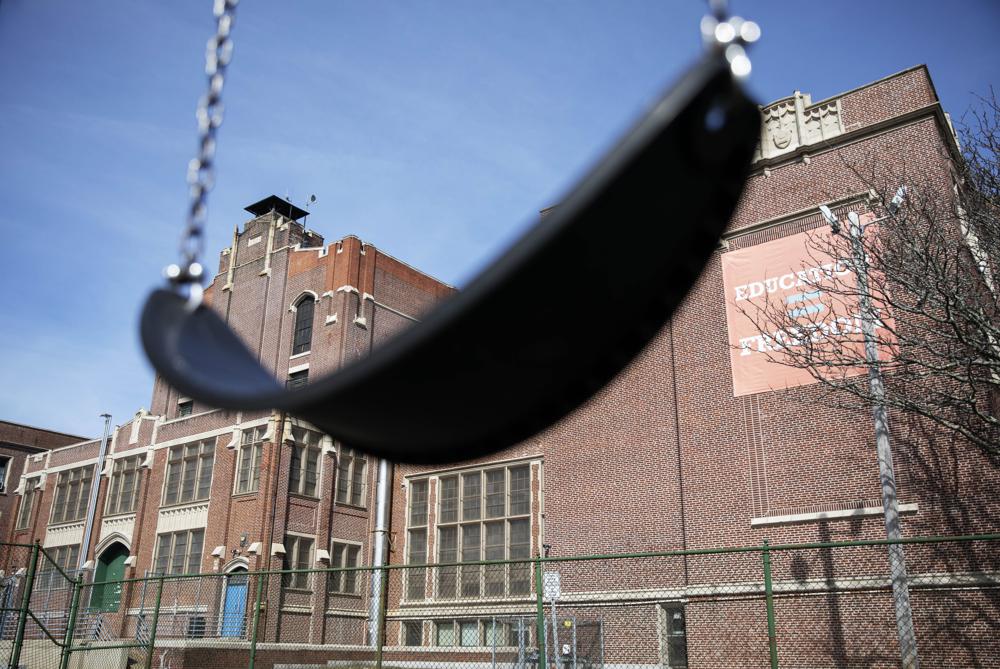
A swing sits empty on a playground outside in Providence, R.I., March 7, 2020. Columbia University’s Center on Poverty and Social Policy estimates that the number of children in poverty grew by 3.7 million from December 2021 to January 2022, a 41% increase, just one month without the expanded child tax credit payments. 
(AP Photo/David Goldman, File)

WASHINGTON (AP) — The number of children in America living in poverty jumped dramatically after just one month without the expanded child tax credit payments, according to a new study. Advocates fear the lapse in payments could unravel what they say were landmark achievements in poverty reduction.

Columbia University’s Center on Poverty and Social Policy estimates 3.7 million more children were living in poverty by January — a 41% increase from December, when families received their last check. The federal aid started last July but ended after President Joe Biden’s Build Back Better bill stalled in the sharply divided Congress. Payments of up to $300 per child were delivered directly to bank accounts on the 15th of each month, and last week marked the second missed deposit of the year.

The Columbia study, which combines annual U.S. Census data with information from the Census Bureau’s monthly Current Population Survey bulletins, found that the monthly child poverty rate increased from 12.1% in December to 17% in January. That’s the highest level since December 2020, when the U.S. was grappling with high unemployment and a resurgence of COVID-19. Black and Latino children experienced the highest percentage point increases in poverty — 5.9% and 7.1% respectively.

Megan Curran, policy director for the Center on Poverty and Social Policy, said the sudden spike shows how quickly the payments became core to household financial stability for millions of families after only six months.

“It really had a huge impact right off the bat,” Curran said. “We saw food insecurity drop almost immediately as soon as the payments started ... all of that progress that we made could now be lost.”

Curran said the increase in children living in poverty could also partially reflect rising prices.

The new numbers represent a serious setback from the original goals of the child tax credit program, which ambitiously sought to cut nationwide child poverty in half. As part of Biden’s $1.9 trillion COVID-19 rescue package last year, the existing child tax credit program was massively reshaped, boosting the amount of the payments, greatly expanding the pool of eligible families and delivering the money in monthly installments designed to be incorporated into day-to-day household budgets.

The program extended payments of $250-per-month for children ages 6 through 17 and $300-per-month for those under 6 to most families in the country, at an annual cost of about $120 billion. The goal was to put discretionary cash in the hands of parents along with the freedom to spend it as they saw fit month-to-month.

Republican lawmakers are generally unified in opposition to the expanded tax credit — describing it as excessive, inflationary and a disincentive to work. But when it was originally passed, many Democrats openly declared their intention to make the payments a permanent anchor of the American social safety net.

The goal for the Democratic-held Congress was to keep the program running, and fight about its future months from now, armed with data and millions of anecdotes about the tax credit’s benefits.

Instead the 50-member Democratic bloc in the Senate collapsed from within, with West Virginia Sen. Joe Manchin holding out on his vote for weeks before finally refusing to endorse Biden’s social spending package. Manchin cited his opposition to the child tax credit’s massive price tag among his reservations with the bill.

Earlier this month, Manchin called negotiations on Biden’s Build Back Better bill “ dead.”

Democratic New Mexico Sen. Martin Heinrich, one of the expanded child tax credit’s strongest advocates, said Wednesday in a statement to The Associated Press that nearly all the children in his state benefited from the credit and that letting it expire was “a moral failure.”

An informal survey conducted of families by the nonprofit advocacy group ParentsTogether Action found a similarly immediate impact to the lapsed child tax credit payments for respondents, with roughly 1 in 5 families surveyed reporting they could no longer afford housing or enough food for their kids.

Allison Johnson, the organization’s campaign director, said the child tax credit payments were designed so parents would “not have to make these really hard choices,” she said.

The end to the deposits makes it nearly impossible for needy families, who may be struggling to pay down debt or cope with major expenses, to develop financial stability or momentum, Johnson said.

“This lack of clarity is super difficult for people. It makes them unable to plan for things,” she said.
HE IS A LON CHANEY BULLY

The real reason Texas is leading the attack on trans kids and parental rights

Elvia Díaz, Arizona Republic
Wed, February 23, 2022

Texas Gov. Greg Abbott has issued a directive penalizing parents who get care for their transgender minor children.

Republican Texas Gov. Greg Abbott has ordered practically everyone in the Lone Star State to become viligantes against transgender kids – or else.

Under his new directive, parents who agree to gender-affirming medical care for minors will be investigated and prosecuted as child abusers.

Plus, doctors, nurses, teachers and anyone who comes into contact with a child is required to report parents or face criminal penalties.

Talk about turning the state into total vigilantism. That should be enough for everyone, especially freedom fighters and parental rights advocates, to rebuke Abbott’s government overreach.
It's no coincidence that Abbott is acting now

But don’t expect any of that from right-wingers hell-bent on prosecuting parents who dare decide what’s best for their child.

Anyone else on the fence about providing gender-affirming surgeries or other medical care, such as puberty blockers, to trans youths should consider Abbott’s political motives and the greater ramifications of government’s infringement on parental rights.

Abbott isn’t trying to protect vulnerable trans kids from their evil parents or the greedy doctors and nurses, as he claims. If he was, he would have done it already, since there are about 14,000 trans youngsters in Texas who could potentially seek such treatments.

He’s doing it now to help the Republican Attorney General Ken Paxton, who’s facing a tough primary on Tuesday.

It’s no coincidence that Paxton just came out with his opinion that providing gender-affirming medical care is child abuse.
Don't use kids, attack parent rights to win votes

Abbott, who’s setting the stage to face Democrat Beto O’Rourke in November’s general election, immediately followed Paxton’s opinion by ordering the Texas Department of Family and Protective Services to act against the parents.

Without directly addressing the trans kids, O’Rourke on Wednesday went after Abbott, saying he’s “cruelly and obsessively bullying children.”

“Foster kids have been forced to sleep on the floor in Abbott’s CPS system where harm to children is ‘overlooked, ignored or forgotten.’ Texas leads the nation in uninsured kids. Now @GregAbbott_TX is cruelly and obsessively bullying children,” O’Rourke said on Twitter.

Other critics called Abbott’s order “trans genocide,” a legal maneuver to “separate kids from their parents” and “unconscionable” political move.

It’s that.

And a blatant attack on parents’ rights and medical freedom just to win votes.

Elvia Díaz is an editorial columnist for The Republic and azcentral.

This article originally appeared on Arizona Republic: Why is Gov. Greg Abbott attacking transgender kids, parental rights?


Related: Trans Kids, Supporters Say New Texas Law Will Keep Them Out of School Sports


Abbott orders state agencies to investigate gender-affirming care for trans kids as child abuse


Erin Doherty
Wed, February 23, 2022

Texas Gov. Greg Abbott (R) on Tuesday ordered state agencies to investigate gender-affirming care for transgender kids as child abuse.

Driving the news: "The Office of the Attorney General has now confirmed in the enclosed opinion that a number of so-called 'sex change' procedures constitute child abuse under existing Texas law," Abbott wrote in a letter to the Texas Department of Family and Protective Services.

The letter said doctors, nurses, teachers and anyone who comes into contact with a child has a requirement to report parents or face "criminal penalties."

Abbott's letter was CC'd to several agencies, including the Health and Human Services Commission, Texas Medical Board and Texas Education Agency, according to The Dallas Morning News.

State of play: The order's immediate impacts on transgender children's access to treatments remain unclear, Kate Murphy, senior policy associate for child protection at Texans Care for Children, told The Dallas Morning News.

"Since this is a nonbinding opinion by the attorney general right now, it’s unclear what will happen next," Murphy said, adding, "right now, we have more questions than answers."

The order comes one day after Attorney General Ken Paxton said that gender-affirming health care for transgender kids is child abuse, per the Morning News.

Zoom out: 2021 saw a record number of anti-trans bills introduced in state legislatures. Medical experts and doctors fear an increase in mental health crises among transgender kids due to the dozens of bills introduced to criminalize gender-affirming health care.

"I see multiple patients daily that are suffering with depression and suicide ideation and suicide attempt and anxiety, and my fear is that if we deny them this evidence-based treatment, we’re only going to see massive more patients come to the emergency room," Jesse Martinez Jr., a doctor of psychiatry at Children’s of Alabama, told Axios last year.

Studies have shown that doctors who give children the ability to socially transitionaccess puberty blockers and gender-affirming hormones encounter lower rates of suicide and mental illness.

Data: UCLA/Williams Institute; Chart: Sara Wise/Axios

Between the lines, via Axios Austin's Asher Price: Some district attorneys in Texas's large urban counties are saying they won't follow the guidance set out by the Texas attorney general that underpins Abbott's new order.


The order could position Abbott favorably among Republicans ahead of a potential primary for president in 2024, but may risk alienating voters ahead of a general election.

What they're saying: "Texas parents who support their trans kids should be applauded, not prosecuted," Amit Paley, CEO of The Trevor Project, which provides crisis intervention and suicide prevention services to LGBTQ youth under 25, said in a statement to Axios.

Paley said The Trevor Project's research shows that "trans youth who feel accepted by the adults in their lives — including family members, teachers, and doctors — are less likely to attempt suicide."

"Further, our research found that gender-affirming hormone therapy has been linked to lower rates of depression and suicide risk among trans youth who wanted it," Paley added.

"The government should not be involved in personal decisions that force doctors and families to act against the medical community's standards of care for transgender young people."

"This smoke & mirrors attempt to place targets on parents who love & support their kids is meant to distract you from the issues that actually impact you," Adri Pèrez, policy and advocacy strategist for LGBTQ equality at the American Civil Liberties Union of Texas, wrote on Twitter about Paxton's opinion.

"Trans kids and their parents are not a threat to you. Politicians that use them to distract you from their failures are," Pèrez said.

Go deeper:

Doctors fear next steps if states ban care for trans youth

2021 sees a record number of bills targeting trans youth

Poll: Most LGBTQ kids' mental health negatively impacted by anti-trans legislation


Texas governor order treats gender-confirming care as abuse

By PAUL J. WEBER

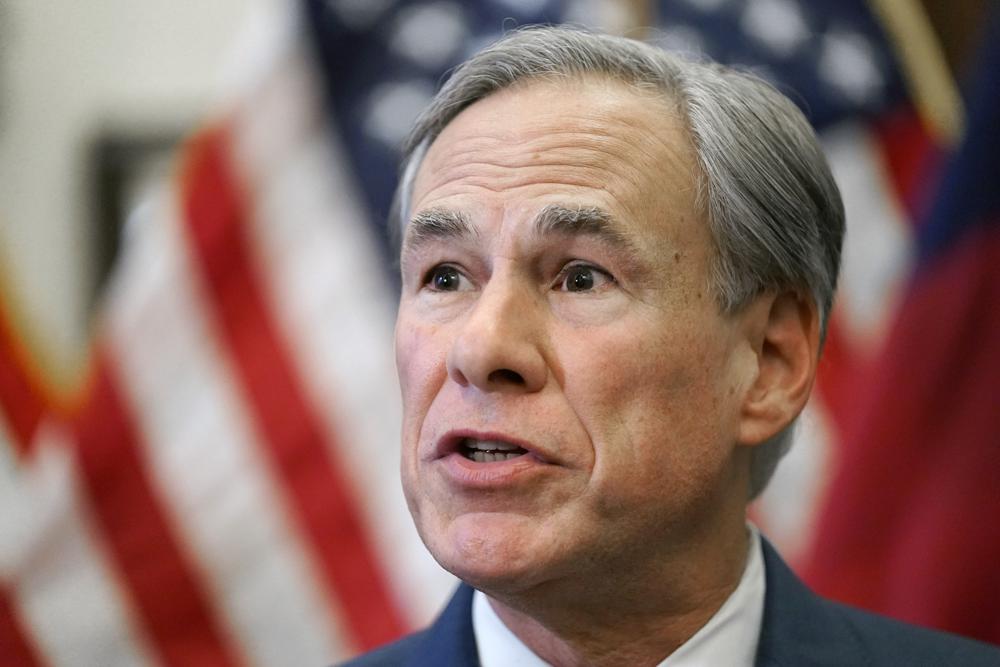
Texas Gov. Greg Abbott speaks at a news conference in Austin, Texas on June 8, 2021. Abbott, has ordered the state's child welfare agency to investigate reports of gender-confirming care for kids as "child abuse" in a directive that opponents say is a first by any governor over GOP efforts to restrict transgender rights. (AP Photo/Eric Gay, File)

AUSTIN, Texas (AP) — Republican Texas Gov. Greg Abbott has ordered the state’s child welfare agency to investigate reports of gender-confirming care for kids as abuse, a directive that opponents say is a first by any governor over GOP efforts to restrict transgender rights.

The immediate impact of the order, which Abbott issued Tuesday, was unclear and a spokesman for the Texas Department of Family and Protective Services said there were no open cases based on the governor’s directive.

Abbott’s letter to state agencies came after Republican Attorney General Ken Paxton this week released a non-binding legal opinion that labeled certain gender-confirming treatments as “child abuse.” That goes against the nation’s largest medical groups, including the American Medical Association, which have opposed Republican-backed restrictions filed in statehouses nationwide.

Both Abbott and Paxton are up for reelection this year, and their actions came a week before they are on the ballot for Republican voters in Texas’s first-in-the-nation primary of 2022.

“I hereby direct your agency to conduct a prompt and thorough investigation of any reported instances of these abusive procedures in the State of Texas,” Abbott said in a letter to the Department of Family and Protective Services.

The uncertainty over the impact is largely due to the fact that attorney general opinions do not carry the weight of law. In Houston, the county office that represents the state in civil child abuse cases said it would not take any actions based on the letter, and Texas’ largest child welfare advocacy group said it was unclear what judges and prosecutors would do with the opinion.

“What is clear is that politicians should not be tearing apart loving families — and sending their kids into the foster care system — when parents provide recommended medical care that they believe is in the best interest of their child,” said Kate Murphy, the senior policy associate for child protection at Texans Care for Children.

The opinion by Paxton is directed at treatments that include puberty blockers and hormone therapy. It comes months after Texas Republican legislators— who filed more anti-LGBTQ proposals last year than in any other statehouse — proposed laws banning such treatments but failed to pass them.

Arkansas became the first state to pass a law prohibiting gender confirming treatments for minors, and Tennessee approved a similar measure.

Numerous states also have enacted laws banning transgender students from competing in scholastic sports on the basis of their gender identity.

Cathryn Oakley, state legislative director and senior counsel for the Human Rights Campaign, said no other governor has taken the same action as Abbott. She called it a “lawless interpretation” and expressed worry for parents.

“The terror that is being struck into their hearts is very real,” Oakley said. “I’m also thinking about the kids who are relying on that care and how frightened the are.”


WHILE STILL IN THE SENATE...
Trudeau revokes emergency powers after Canada blockades end

By ROB GILLIES today

1 of 6
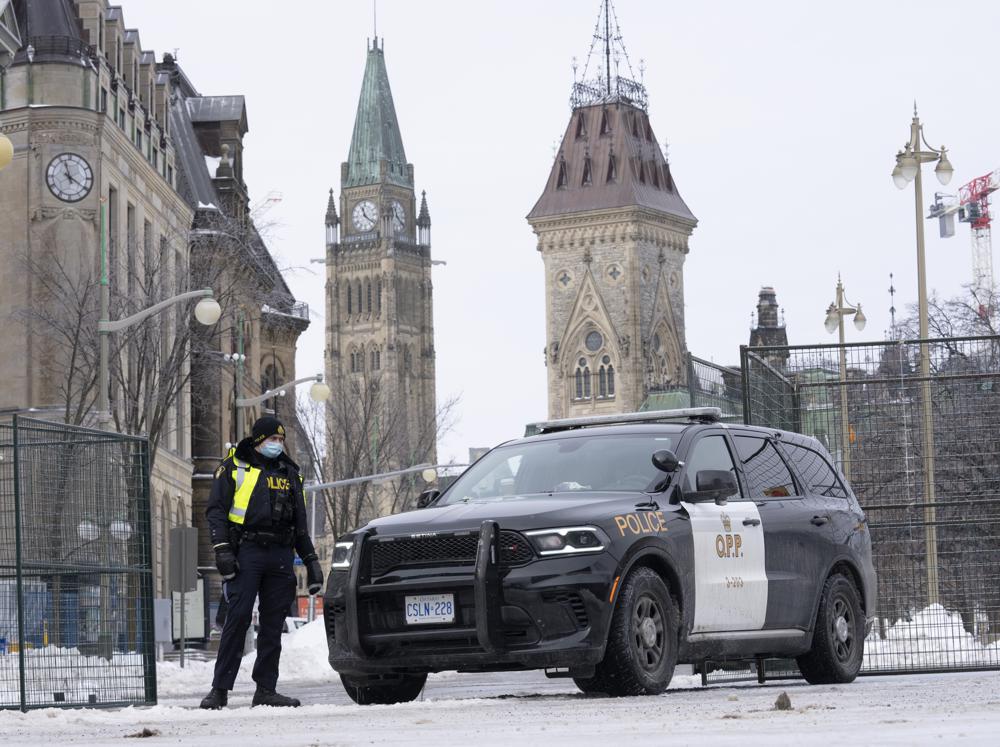
A police officer mans a checkpoint near Parliament Hill, Wednesday, Feb. 23, 2022 in Ottawa. Ottawa protesters who vowed never to give up are largely gone, chased away by police in riot gear in what was the biggest police operation in the nation’s history. (Adrian Wyld /The Canadian Press via AP)


TORONTO (AP) — Canadian Prime Minister Justin Trudeau announced Wednesday he is removing emergency powers police can use after authorities ended the blockades at the borders and the occupation in Ottawa by truckers and others opposed to COVID-19 restrictions.

Trudeau said the “threat continues” but the acute emergency that included entrenched occupations has ended. His government invoked the powers last week and lawmakers affirmed the powers late Monday.

“The situation is no longer an emergency, therefore the federal government will be ending the use of the emergencies act,” Trudeau said. “We are confident that existing laws and bylaws are sufficient.”

The emergencies act allows authorities to declare certain areas as no-go zones. It also allows police to freeze truckers’ personal and corporate bank accounts and compel tow truck companies to haul away vehicles.

The trucker protest grew until it closed a handful of Canada-U.S. border posts and shut down key parts of the capital for more than three weeks. But all border blockades have now ended and the streets around the Canadian Parliament are quiet.

“We were very clear that the use of the emergencies act would be limited in time,” Trudeau said.

Trudeau had warned earlier this week there were some truckers just outside Ottawa who might be planning further blockades or occupations. His public safety minister also said there was an attempt to block a border crossing in British Columbia over the weekend.


The protests, which were first aimed at a COVID-19 vaccine mandate for cross-border truckers but also encompassed fury over the range of COVID-19 restrictions and hatred of Trudeau, reflected the spread of disinformation in Canada and simmering populist and right-wing anger.

The self-styled Freedom Convoy shook Canada’s reputation for civility, inspired convoys in France, New Zealand and the Netherlands and interrupted trade, causing economic damage on both sides of the border. Hundreds of trucks eventually occupied the streets around Parliament, a display that was part protest and part carnival.

For almost a week the busiest U.S.-Canada border crossing, the Ambassador Bridge between Windsor, Ontario and Detroit, was blocked. The crossing sees more than 25% of the trade between the two countries.

Authorities moved to reopen the border posts, but police in Ottawa did little but issue warnings until Friday, even as hundreds and sometimes thousands of protesters clogged the streets of the city and besieged Parliament Hill.

On Friday, authorities launched the largest police operation in Canadian history, arresting a string of Ottawa protesters and increasing that pressure on Saturday until the streets in front of Parliament were clear. Eventually, police arrested at least 191 people and towed away 79 vehicles. Many protesters retreated as the pressure increased.

The Royal Canadian Mounted Police said those who had their bank accounts frozen were “influencers in the illegal protest in Ottawa, and owners and/or drivers of vehicles who did not want to leave the area.”

The province of Ontario also announced it is ending its state of emergency but said the “emergency tools provided to law enforcement will be maintained at this time as police continue to address ongoing activity on the ground.”

Those who block critical infrastructure face up to a year in prison and a maximum fine of $100,000.

A small convoy of truckers demanding an end to coronavirus mandates began a cross-country drive from California to the Washington, D.C., area on Wednesday.

Several hundred people rallied in a parking lot in the cold, windswept Mojave Desert town of Adelanto before about two dozen trucks and a number of other vehicles hit the road. It wasn’t clear how many intended to go all the way.

The Pentagon has approved the deployment of 700 unarmed National Guard troops to the nation’s capital as it prepares for multiple trucker convoys. The troops would be used to assist with traffic control during demonstrations expected in the city in the coming days, the Pentagon said.


US drops name of Trump’s ‘China Initiative’ after criticism
By ERIC TUCKER

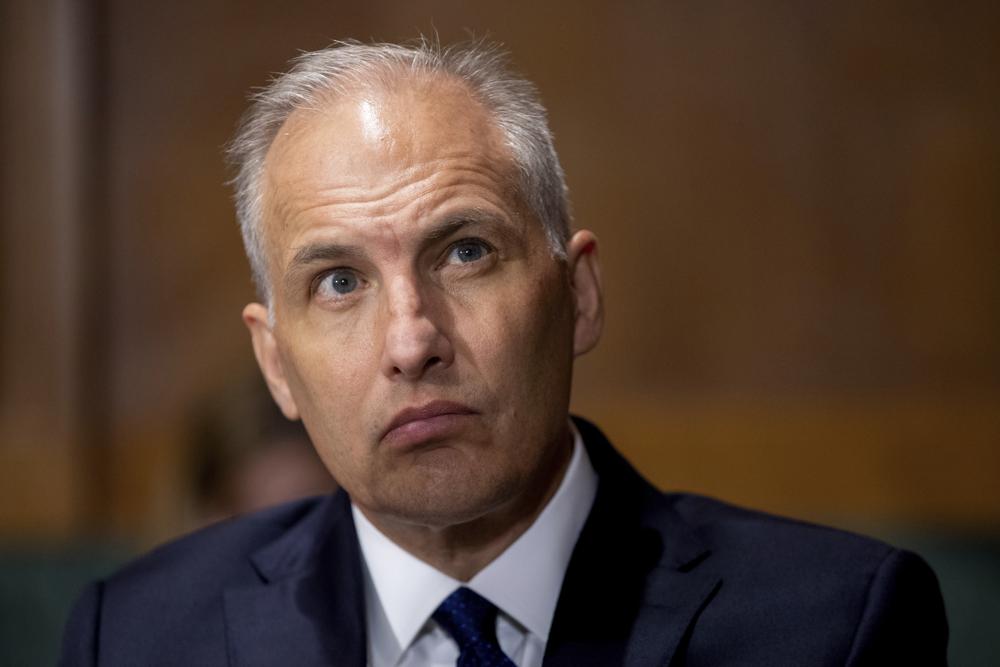
 Matthew G. Olsen, of Maryland, nominee to be an Assistant Attorney General for the Department of Justice, attends a Senate Judiciary Hearing on Capitol Hill in Washington on July 14, 2021. The Justice Department is ending its China Initiative. The move announced Wednesday, Feb. 23, 2022, by Assistant Attorney General Olsen amounts to a rebranding of a Trump-era program that was created to crack down on economic espionage by Beijing but that critics said had unfairly scrutinized Chinese professors on the basis of their ethnicity. (AP Photo/Amanda Andrade-Rhoades, File)

WASHINGTON (AP) — The Justice Department is scrapping the name of a Trump-era initiative that was intended to crack down on economic espionage by Beijing but has been criticized as unfairly targeting Chinese professors at American colleges because of their ethnicity.

The decision to abandon the China Initiative and to impose a higher bar for prosecutions of professors was announced Wednesday by the Justice Department’s top national security official. It follows a monthslong review undertaken after complaints that the program chilled academic collaboration and contributed to anti-Asian bias. The department has also endured high-profile setbacks in individual prosecutions, resulting in the dismissal of multiple criminal cases against academic researchers in the last year.

Assistant Attorney General Matthew Olsen said the department will still “be relentless in defending our country from China,” but no longer will group its investigations and prosecutions under the China Initiative label, in part out of recognition of the threats facing the U.S. from Russia, Iran, North Korea and others.

“I’m convinced that we need a broader approach, one that looks across all of these threats and uses all of our authorities to combat them,” he told reporters before a speech in which he detailed the changes.

The program was established in 2018 under then-Attorney General Jeff Sessions as a way to thwart what officials said were aggressive efforts by China to steal American intellectual property and to spy on American industry and research.

Olsen told reporters he believed the initiative was prompted by genuine national security concerns. He said he did not believe investigators had targeted professors on the basis of ethnicity, but he also said he had to be responsive to concerns he heard, including from Asian American groups.

“Anything that creates the impression that the Department of Justice applies different standards based on race or ethnicity harms the department and our efforts, and it harms the public,” Olsen said.

Speaking later in the day at the National Security Institute at George Mason University’s Antonin Scalia Law School, Olsen said that by “grouping cases under the China Initiative rubric, we helped give rise to a harmful perception that the (Justice Department) applies a lower standard to its investigations and prosecutions of criminal conduct related to that country or that we in some way view people with racial, ethnic or familial ties to China differently.”

Some Asian American groups and officials who had lobbied the department to end the China Initiative cheered the move Wednesday. Rep. Judy Chu, a California Democrat and the chair of the Congressional Asian Pacific American Caucus, said the initiative had ruined careers, discouraged Asian Americans from pursuing academic specialties in science, technology, engineering and math and reinforced “harmful stereotypes.”

“There are serious national security concerns facing our country from all across the world, but our response must be based on evidence, not racism and fear,” Chu said in a statement.

The initiative has resulted in convictions, including of Charles Lieber, a Harvard University professor who was found guilty in December of hiding his ties to a Chinese-run recruitment program.

But its pursuit of professors, including those accused of concealing ties to the Chinese government on applications for federal research grants, hit snags. The department in the last year dismissed multiple cases against researchers or had them thrown out by judges.

In January, the department dropped its case against Gang Chen, a Massachusetts Institute of Technology professor charged in the final days of the Trump administration. Prosecutors concluded that they could no longer meet their burden of proof after they received information from the Department of Energy suggesting he had not been required to disclose certain information on his forms.

A federal judge in September threw out all charges against a University of Tennessee professor accused of hiding his relationship with a Chinese university while receiving research grants from NASA, and the university has since offered to reinstate him.

Olsen said the department continued to stand behind the pending cases it has against academics and researchers, signaling that those prosecutions won’t necessarily be abandoned.

Federal prosecutors are still expected to pursue grant fraud cases against researchers when there is evidence of malicious intent, serious fraud and a connection to economic and national security, with prosecutors from the department’s National Security Division in Washington playing an active supervisory role — though in some cases, prosecutors may opt for civil or administrative solutions instead of criminal charges, Olsen said.

FBI Director Christopher Wray said in a speech last month that the threat from China was “more brazen” than ever, with the FBI opening new cases to counter Chinese intelligence operations every 12 hours or so. And Olsen said he agreed.

“I’m not taking any tools off the table here,” Olsen said. He also noted, “I do not think that there is a reason to step back from that threat, and we will not step back from that threat.”
Uncertain future for islanders who survived Tongan eruption

By NICK PERRY

Survivors Sulaki Kafoika, left, and Sione Vailea pose for a photo in NukuÊ»alofa, Tonga on Feb. 22, 2022. Kafoika and Havea were on Mango Island in Tonga, one of the closest islands to the Jan. 15 volcanic eruption that was so huge it echoed around the world. Every single home on the island was destroyed by the tsunami that followed. 
(Aloma Johansson/Tonga Red Cross/IFRC via AP)

WELLINGTON, New Zealand (AP) — The first two booms from the volcano were scary enough, but the third explosion was immense, sending everyone from the village running from their homes in a reaction that would save all but one of their lives.

Even now, more than five weeks later, the children from Mango Island still often run or cower when they hear a thunderclap or loud noise.

The small island in Tonga was one of the closest places to the Jan. 15 South Pacific volcanic eruption, an event so massive it sent out a sonic boom that could be heard in Alaska and a mushroom plume of ash that was seen in startling images taken from space. On Mango Island, every single home was destroyed by the tsunami that followed.

All 62 survivors were rescued by boat and moved to Tonga’s capital, Nuku’alofa, where they have been living together since in a church hall. Most of that time they’ve been in lockdown after Tonga experienced its first outbreak of the coronavirus.

Two of the survivors described their experiences and uncertain future to The Associated Press in an interview that was translated by an official from the Tonga Red Cross.

Sione Vailea, 52, said Mango Island is the prettiest place he knows and nothing compares to it in all of Tonga. Just 14 families lived on the island, he said, all of them close together in a single village.

Each family owned a small, open-sided boat and each morning the weather was favorable, they would go onto the ocean to catch reef fish, snapper, octopus and lobster.

What they couldn’t eat themselves they would take to the capital to sell, getting enough money to buy food and other necessities. For those fortunate enough to have a decent-sized engine on their boats, it was a six-hour return journey to the capital, but it could take double that time for those puttering along on 15 horsepower.

Mango Island is a little over 20 miles (32 kilometers) from the Hunga Tonga Hunga Ha’apai undersea volcano, which back in late 2014 had rumbled to life, creating a small, new island and briefly disrupting air travel in a series of eruptions.

But those were nothing compared to the scale of eruption that took place on that Saturday evening in January. When the islanders heard the third massive boom, they began running from their low-lying village up a nearby hill, the highest point on Mango Island.

“There was no sign that there was going to be a tsunami, but our gut feeling was we needed to get up to the top, because we weren’t sure what was happening,” Vailea said.

As the island’s appointed town officer, Vailea checked to make sure everybody was gathered. He noticed one family was missing.


Another survivor, 72-year-old Sulaki Kafoika, who goes by the name Halapaini — or talking chief — a title bestowed upon him by Tonga’s king, said that once he got to the top of the hill, he looked back. He could see waves crashing over the tops of their houses. He’d never experienced anything like it in his life.

Vailea scrambled back down the hill and saw the wife, two daughters and son of a 65-year-old man coming up. The man was gone, taken by the waves.

“He was the first victim of the tsunami,” Vailea said. “Because he died right then, as they were trying to get up to the top of the island.”

Two other people elsewhere in Tonga also died from the tsunami, including a British national, and a fourth person died from what authorities described as related trauma. The tsunami crossed the Pacific Ocean to Peru, where it caused an oil spill and two more people drowned.

On Mango Island, night’s darkness quickly followed the tsunami as the villagers remained huddled at the top of the hill. Throughout the night, the men held blankets above the women and children to protect them from the ash and small volcanic rocks that were pelting down. The tsunami had cut off all phone and internet connections, and they were alone and isolated.


In this photo provided by the Australian Defence Force, debris from damaged building and trees are strewn around on Atata Island in Tonga, on Jan. 28, 2022, following the eruption of an underwater volcano and subsequent tsunami. The small Mango Island in Tonga was one of the closest to the Jan. 15 volcanic eruption that was so huge it echoed around the world. Every single home on the island was destroyed by the tsunami that followed. (POIS Christopher Szumlanski/Australian Defence Force via AP, File)

When dawn broke, they walked down the hill and found the body of the drowned man. Amid the wreckage, they found a small shovel and an axe. They dug a grave, a process that took much of the day after they hit rock about 1 meter (3 feet) down.

All of their boats were wrecked and they had almost no food. After searching the village, they found two small bags of rice, which they cooked for the children, Vailea said. The adults ate nothing that day, or the next, as they waited.

Finally on Tuesday morning, a boat arrived from a neighboring island to check on them. Their neighbors had brought with them some cassava, a root vegetable, and a bunch of plantains, which are similar to bananas.

“They cooked it and it was the best meal,” said Vailea. “On a normal day, you wouldn’t call it a good meal. But on that Tuesday, it was very special.”

The next day, they were all transported to the nearby island of Nomuka and then a few days later to Nuku’alofa, the capital, where they have been living since. None of them have been back to Mango Island. Until Sunday, they were in lockdown after the outbreak of the virus, which was likely brought in by foreign military crews delivering vital aid.

The survivors say it has been difficult for them over the past few weeks as they deal with the trauma and the lockdown restrictions, but it has helped immensely that they have all been living together and have been able to comfort one another. They’ve benefited from the clothes, food and money that have been donated by people from around the world.

What happens next remains uncertain. As town officer, Vailea has been meeting regularly with Tongan officials but said the final decision of whether they will be able to return and resettle Mango Island rests with Tonga’s government and the monarch, King Tupou VI. The survivors hope they will get a decision within the coming weeks.

Vailea said the people of Mango Island are split, with some wanting to return and others happy to start life afresh in Nuku’alofa or elsewhere. He said it is his duty to support whatever his people want.

Halapaini said he has mixed feelings. All the good things that he enjoyed in life were on Mango Island, but he also worries that the volcano could erupt again.

Vailea is more emphatic. He wants to return to Mango Island, where life can be hard but where you own your time and share everything with your neighbors. Where you wake up in the morning and jump on your boat to fish.