Wednesday, October 26, 2022

Giorgia Meloni says she's committed to Europe

Issued on: 25/10/2022 
 
02:42
Video by: Seema GUPTA

In her first parliamentary speech, Giorgia Meloni, Italy's new Prime Minister, unveiled her policy priorities. She expressed support to the European Union, NATO and Ukraine, and also vowed to take action on illegal immigration and human trafficking. She also said she rejects her nation's facist history. Our Rome correspondent, Seema Gupta, has more.


Peace talks under way in South Africa to end Ethiopia’s brutal conflict with Tigray

NEWS WIRES - Yesterday 

Peace talks to end Ethiopia’s Tigray conflict have begun in South Africa, a South African government spokesman said Tuesday. It is the highest-level effort yet to end two years of fighting that has killed perhaps hundreds of thousands of people.


Peace talks under way in South Africa to end Ethiopia’s brutal conflict with Tigray© Ben Curtis, AP

The spokesman for South African President Cyril Ramaphosa, Vincent Magwenya, said the African Union-led talks that started Tuesday are expected to continue until Sunday. Delegations from the Ethiopian government and Tigray authorities arrived in South Africa this week.

“Such talks are in line with South Africa’s foreign policy objectives of a secure and conflict-free continent,” Magwenya said. Former Nigerian president and AU envoy Olesegun Obasanjo, former South African deputy president Phumzile Mlambo-Ngcuka and former Kenyan president Uhuru Kenyatta are facilitating the talks with the encouragement of the United States.

Related video: Ethiopia Tigray conflict: warring sides head to South Africa for peace negotiations
Duration 11:53

The conflict has sharply changed the fortunes of Ethiopia’s Nobel Peace Prize-winning Prime Minister Abiy Ahmed, who went to war with his country’s northern Tigray region less than a year after receiving the award for making peace with neighboring Eritrea.

The peace talks begin as Ethiopian and allied forces from Eritrea have taken over some urban areas in Tigray in the past few days.

The Tigray region of more than 5 million people is again cut off from the world by renewed fighting that began in late August following months of a lull in the conflict.

All combatants have committed abuses, according to United Nations human rights investigators who recently singled out the Ethiopian government as using “starvation of civilians” as a weapon of war. Babies in Tigray are dying in their first month of life at four times the rate before the war cut off access to most medical care, according to a yet-unpublished study shared by its authors with The Associated Press this month.

The war since exploding in November 2020 has spilled over into Ethiopia’s neighboring Amhara and Afar regions, putting hundreds of thousands of people there in peril.

Academics and health workers have estimated that hundreds of thousands of people have been killed by conflict and deprivation, and the U.S. has begun warning of a half-million casualties.

(AP)
Saudi blasts release of oil reserves 'to manipulate markets'

Saudi Energy Minister Prince Abdulaziz bin Salman did not single out the US in his comments about emergency stocks -
Fayez Nureldine

by Robbie COREY-BOULET
October 25, 2022 — Riyadh (AFP)


Saudi Arabia's energy minister on Tuesday blasted the release of emergency oil stocks as an attempt to "manipulate markets", the latest apparent salvo in a spat with Washington over oil production.

"People are depleting their emergency stocks, had depleted it, used it as a mechanism to manipulate markets while its profound purpose was to mitigate shortage of supply," Prince Abdulaziz bin Salman told an investor conference in the Saudi capital.

"However, it is my profound duty to make it clear to the world that losing emergency stock may become painful in the months to come."

Prince Abdulaziz did not single out the United States in his comments about emergency stocks, but last week US President Joe Biden announced he was putting the final 15 million barrels on the market from a record release of US strategic reserves.

That tranche was to complete a 180-million-barrel release authorised in the spring, in response to price hikes linked to Russia's invasion of Ukraine.

It also came on the heels of a decision by the OPEC+ oil cartel, which Riyadh co-leads with Moscow, to cut oil production by two million barrels a day from November.

The cartel's decision, weeks ahead of US congressional elections, has drawn intense criticism from the White House, which has said it amounted to "aligning with Russia" in the Ukraine war.

Prince Abdulaziz pushed back against that assessment on Tuesday.

"I keep listening, are you with us or against us? Is there any room for, 'We are for Saudi Arabia and for the people of Saudi Arabia'?" he said to applause.

Asked about getting the decades-old partnership between Riyadh and Washington back on track, he said: "I think we as Saudi Arabia decided to be the maturer guys and let the dice fall."

In Washington, State Department spokesman Ned Price said he would not respond directly to the prince, but that the release from the strategic reserve was part of Biden's effort to meet demand.

"We're going to do everything we can to see to it that supply is adequate for demand," Price told reporters.

Also speaking at the Riyadh conference, Saudi investment minister Khalid al-Falih described the dust-up with the United States as "unwarranted" and temporary.

"If you look at the relationship with the people side, the corporate side, the education system, you look at our institutions working together, we are very close, and we will get over this recent spat that I think was unwarranted," he said.

JPMorgan Chief Executive Jamie Dimon also said he was optimistic that bilateral ties would eventually improve.

"Saudi Arabia and the US have been allies for the last 75 years... They'll work it through," he said.

"These countries will remain allies going forward."

- Davos in the Desert -


Hundreds of CEOs and finance moguls are in Riyadh for the three-day Future Investment Initiative (FII), a Davos-style investment conference that analysts say will highlight Saudi Arabia's geopolitical muscle despite strained ties with Washington.

The FII, often referred to as "Davos in the Desert", was launched in 2017 as an economic coming-out party for the world's largest crude exporter, which is trying to diversify away from oil under Crown Prince Mohammed bin Salman.

The 37-year-old who is first in line to the throne "takes a very hands-on approach" to projects associated with his Vision 2030 reform agenda, said Kristin Diwan of the Arab Gulf States Institute in Washington.

"Ultimately those attending will know that they will need his approval or those of his confidants to work in the kingdom," she said.

Up to 400 American CEOs are expected to participate in the conference, though unlike in previous years there is no representation from the US government.

The event's organiser told AFP last week that American officials had not been invited.

"Saudi Arabia needs to attract American investment, technology, and popular interest to succeed," Diwan said.

"It still remains to be seen if this broader engagement can be maintained if the political mood in the United States turns hostile toward Saudi Arabia."
A 'catastrophe' is coming for the economy, but it's not recession or inflation, says Secretary of Labor Marty Walsh


Eric Rosenbaum - Yesterday 

U.S. Secretary of Labor Marty Walsh said in an interview at the CNBC Work Summit that he does not expect mass layoffs and job growth should continue into next year.

But Walsh said that immigration reform, supported by every business owner he talks to, will be critical to the national workforce and without it, a 'bigger catastrophe' than a recession or inflation is coming.

Walsh also offered views on a federal minimum wage increase, federal childcare support and gig worker rules reform seen as targeting Uber and Lyft.


Secretary of Labor Marty Walsh speaks during a news conference at the White House in Washington, April 2, 2021.© Provided by CNBC

There has been a lot of talk about looming layoffs, and by some recent surveying, as many as half of large employers are thinking about labor cost cuts as the economy slows. But U.S. Department of Labor Secretary Marty Walsh doesn't see the recent job gains reversing, according to an interview at CNBC's Work Summit on Tuesday.

"I still think that we're going to have job gains as we move into the end of this year, early next year. A lot of people are still looking at different jobs," he told CNBC's Kayla Tausche at the virtual event. "We saw a lot of moving around over this last course of the year. People leaving jobs, getting better jobs, and I'm not convinced yet that we're headed towards that."

For the Federal Reserve, some level of higher unemployment is necessary to cool an economy that has been bedeviled by persistent inflation. Unemployment, at 3.5% now, went down in the last monthly nonfarm payrolls report. The Fed is targeting unemployment of 4.4% as a result of its policy and higher interest rates.

"We definitely have to bring down inflationary pressures," Walsh said at the CNBC Work Summit, but he added that the way to do it isn't layoffs.

A House inquiry released on Tuesday found that the 12 largest employers in the nation including Walmart and Disney laid off more than 100,000 workers in the most recent recession during the pandemic.

Walsh said in a slower economy, the federal government's infrastructure act will support job growth in sectors including transportation. "Those monies are there. ... if we did have a downturn in the economy, those jobs will keep people working through a difficult time."

In the battle against inflation, Walsh said moving people up the income ladder is a better way of helping Americans make ends meet than laying them off.

"I think there's a way to do that by creating good opportunities for people so they have opportunities to get into the middle class, and not enough people in America are working in those jobs, quite honestly. ... I think there's a lot of Americans out there right now that have gone through the last two years, a lot of concern in the pandemic, they were working in a job maybe making minimum wage, maybe they had two or three jobs. Really I think the best way to describe what is a middle class job is a job you can work, one job, get good pay, so you don't have to work two and three jobs to support your family."

From a policy perspective, Walsh expressed disbelief that a higher federal minimum wage remains a contentious issue on Capitol Hill.

"It shocks me that there are members in the building behind me, if you can't see the building behind me it's the Capitol, that think that families can raise their family on $7-plus, on the minimum wage in this country," he said.

But Walsh conceded that legislation to increase the minimum wage, which was held up in the Senate, has an uncertain future ahead of the midterm elections.


Here are a few of the other major policy issues the Labor Secretary weighed in on at the CNBC Work Summit.

Lack of immigration reform is a 'catastrophe' in the making

Amid one of the tightest labor markets in history, Walsh said the political parties' approach to immigration — "getting immigration all tied up" — is among the most consequential mistakes the nation can make in labor policy.

"One party is showing pictures of the border and meanwhile if you talk to businesses that support those congressional folks, they're saying we need immigration reform," Walsh said. "Every place I've gone in the country and talked to every major business, every small business, every single one of them is saying we need immigration reform. We need comprehensive immigration reform. They want to create a pathway for citizenship into our country, and they want to create better pathways for visas in our country."

The demographic data on the U.S. working age population is concerning, with baby boomer retirements expected to accelerate in the years ahead, compounded by a peak being reached in high school graduates by 2025, limiting both the total size of the next generation labor pool and the transfer of knowledge between the generations of workers.

"We need a bipartisan fix here," Walsh said. "I'll tell you right now if we don't solve immigration ... we're talking about worrying about recessions, we're talking about inflation. I think we're going to have a bigger catastrophe if we don't get more workers into our society and we do that by immigration."

Won't say whether Uber and Lyft are in crosshairs of new gig economy rulemaking


A proposed DoL rule on independent contractors hit the shares of gig economy companies including Uber and Lyft a few weeks ago. The rulemaking is still in review and seeking public comments, and some Wall Street pundits don't expect it to have a significant impact on the rideshare companies.

Walsh wouldn't even say if they are a target of the rulemaking.

"We haven't necessarily said what companies are affected by it, and what businesses are affected by it. What we're looking at is people that are employees that are working for companies that are being taken advantage of as independent contractors. We want to end that," Walsh said.

FEELS LIKE THE START OF WHAT COULD BE REALLY A PANDORA'S BOX.
Duration 2:23
New gig economy rules look like 'gut punch' for Uber and Lyft, says Dan Ives

He did mention a few of the jobs that would likely be covered, and one of those does overlap with the Uber, Lyft and DoorDash business models. "We have plenty of businesses in this country, like dishwashers and delivery drivers in areas like that, where people are working for a business that other employees in that business are employees, and they're labeling them as independent contractors. So we're going to look at this. We're in the rulemaking process now. We're taking in the comments now, and we'll see when the comments come in what the final rule looks like."

Walsh added that the idea an independent contractor want to retain their flexibility doesn't wash with him. "Flexibility is not an excuse ... pay somebody as an employee. You can't use that as an excuse."

Unionization will finally gain in 2023, 2024

Walsh, a union-book carrier, said that the public support for unions should be matched by actual gains in union ranks in the next two years. The most recent survey available from the Bureau of Labor Statistics showed that labor jobs decreased by more than 240,000 in 2021, even as U.S. public support for unionization has surged and major brands including Apple, Amazon, and Starbucks face a rising tide of unionization at stores and in operations like warehouses, albeit still on the margins as far as total numbers of workers they employ.

"I don't have the number of 2022, but 2021 was a unique year," Walsh said. "The numbers went down in a lot of ways because companies' unions weren't organizing, number one, and number two, we had a pandemic and a lot of people retired, left their business or they retired. Those jobs weren't backfilled by companies. ... It's like 65%, 70% of Americans still looking favorably upon unions ... the highest in 50 years. I don't think you'll see the benefit of that organizing until probably 2023, 2024."

Other recent polling has found that public support for unions is higher than union member support for their own labor organizations.

Biden's broken promise on child care


President Biden promised on the campaign trail to do more on child care; promised to include it in the infrastructure act; promised to include it in a second act after dropping it from the core infrastructure package; and then it was dropped from that back-up plan.

Walsh said the government has to make good on that promise for families and workers in the child-care sector.

"Childcare is a basic necessity to get millions of women back into the workforce on a full-time basis," he said.

The recent Women in the Workplace study from McKinsey and LeanIn.org finds that women are still opting out of the workforce in large numbers, a reversal of labor market gains that began during the pandemic.

"Child care has not been addressed by this country or by most states in this country for the last 50 years. The cost is too high for the average family and we can't retain the workers in those industries. We lost a lot of workers in the childcare industry because they're paying them minimum wage or a little bit above minimum wage," Walsh said, referring to estimates that 100,000 workers left the sector during the pandemic.

"We have to respect them and pay them better wages. Anyone watching today that has kids in child care, you know, you're paying 30%, 40%, 50%, 60% of your salary for child care," he said. "A lot of families have made the decision [that], 'We don't want to have two people working, one person will maybe stay home, work part time and make up those costs,' so that issue has to be resolved. It's not just an economic issue. It's a human rights issue in our country to get good child care," he added.
Key Issues at COP 27


[co-author: Kerry Mackenzie]

October 21, 2022

From November 6 to November 18 of this year, climate leaders will convene in Sharm el Sheikh, Egypt, for the United Nations Framework Convention on Climate Change’s (UNFCCC) 27th Conference of the Parties (COP 27).

COP 27 takes place against a backdrop of global geopolitical and climate crises, underscoring the need for nations to achieve progress at this year’s conference. Although the climate priorities of various international leaders vary—especially between developing and developed countries—experts reserve hope that countries will take key steps towards addressing some of the most pressing climate issues while in Egypt. Here are three key topics to keep an eye on at COP 27:

Topic One: Financing Climate Change Loss and Damage. At COP 26, the Group of 77 (G77) and China proposed a climate loss and damage project, which the United States and the European Union (EU) ultimately sidelined. Now, after a year rife with natural disasters, the former coalition plans to re-propose the creation of a facility for loss and damage at COP 27. While some developed countries have already made significant loss and damage contributions—most recently Denmark—the United States and the EU remain holdouts on a formal program. Countries must agree in the early hours of the conference whether to discuss the topic, or cooperation during the rest of the summit could be severely impaired.

Topic Two: Bolstering Adaptation Projects. Developing countries also have their eye on funding for adaptation projects. At COP 26, developed countries agreed to double their financial commitments towards helping vulnerable communities adjust to climate change—a pledge with a total price tag of around $40 billion per year. At COP 27, the focus will shift to procuring funding and determining how this funding can be allocated to communities that need it the most.

Topic Three: Promoting Accountability Amidst Geopolitical Strain. COP 26 ended with a call for international leaders to review their 2030 Nationally Determined Contributions (NDCs) and ensure they align with the UN’s goal of cutting global temperature rise to 1.5 degrees Celsius. At COP 27, countries will be under pressure to show evidence of progress toward their climate commitments and funding targets. Ahead of COP 27, only 23 nations have proposed updated plans reflecting the UN’s global temperature goal. Worse, Russia’s invasion of Ukraine has destabilized the energy market, causing many major players to increase their reliance on fossil fuels. A key criticism of the Paris Agreement remains: the majority of its commitments are voluntary.

COP 27 comes during a crucial time, especially considering that the Intergovernmental Panel on Climate Change (IPPC) recently found that the impacts of climate change are worsening. In November, climate leaders will need to cooperate to address these three key topics outlined above in order to make vital progress on addressing climate change.

We will continue to provide updates regarding COP 27 as we learn more. For more information, visit the UNFCCC’s COP 27 landing page.

 The COP 27 pre-session agenda is accessible here, while the COP 27 week agenda can be found here.

For COP 27, Egypt cleans up tourist destinations around the Red Sea

Issued on: 25/10/2022

 
01:32
Video by:Catherine VIETTE

The UN's COP 27 conference will start on November 7th in Sharm El Sheikh, Egypt. Ahead of the arrival of delegates to the resort town, authorities have begun cleaning up plastic waste around the Red Sea. The country is intensifying its efforts to go greener before the climate conference in two weeks.


U.S. Groups Urge Kerry To Back Climate Compensation Fund

By Valerie Volcovici
10/24/22 

Over 100 U.S. environmental groups on Monday urged top U.S. climate diplomat John Kerry to support the creation of a fund that would compensate countries that have experienced economic and physical loss from climate change, a key demand of vulnerable countries at the upcoming COP27 climate summit in Egypt.

The letter, signed by groups that include the Sierra Club and Greenpeace USA, says the world's second biggest emitter of greenhouse gas emissions is responsible for nearly a quarter of global cumulative greenhouse gas emissions since the Industrial Revolution and has a responsibility to address loss and damage.

The United States and European Union, the world's third-biggest emitter of greenhouse gases, are facing pressure from lower-income nations to soften their long-standing resistance to compensation for the "loss and damage" wrought by floods, rising seas and other climate change-fueled impacts.

"The U.S.'s negotiating posture on loss and damage has been recalcitrant, creating a major obstacle to meeting the urgent needs of climate vulnerable countries and causing great harm to our nation's reputation on the world stage," the groups wrote in the letter.

A senior Biden administration official told reporters last week that the United States does not necessarily oppose the creation of a new "loss and damage" funding facility but believes that there are existing sources of funding that could potentially be tapped to cover climate losses.

"Would we...rule out talking about proposals for new things? No, of course not," the official said. "We also think you need to examine the existing institutions and see what the what the gaps are."

The official said that the United States rejected a proposal made by climate vulnerable nations in Glasgow last year at the COP26 climate summit because it did not specify whether some countries would be legally liable for climate damages

A draft of the EU's negotiating position for COP27 leaked last week showed the 27-nation bloc would support talks on the topic at the COP27 gathering in Egypt but did not specify whether it supports a funding mechanism.

IBT Fast Start - Let the best of International News come to you
Sign up and stay up to date with our daily newsletter.
You can unsubscribe at any time. By signing up you are agreeing to our Terms of Service and Privacy Policy.

Egypt, host of the United Nations' climate negotiations, has appointed the environment ministers of Chile and Germany to come up with a plan for including the controversial loss and damage topic on the formal summit agenda.
Two Revolutionary Guards members shot dead in Iran amid unrest

Deaths occur in southeastern city of Zahedan; local religious leader says security forces shot at civilians, one fired back amid tensions over alleged rape of teen by cop

By AFP
25 October 2022

Screen capture from video purportedly showing anti-regime protests in the southeastern city of Zahedan, Iran, October 2022. (Twitter; used in accordance with Clause 27a of the Copyright Law)

TEHRAN, Iran — Two members of Iran’s Islamic Revolutionary Guard Corps were killed by unidentified gunmen in the southeastern city of Zahedan on Tuesday, the Tasnim news agency said.

“Colonel Mehdi Molashahi and Javad Kikha, Guards members in Sistan-Baluchistan province, were shot dead by unknown assailants in the city of Zahedan,” the agency said.

The Iranian authorities were investigating those behind the attack, Tasnim added without elaborating.

The attack comes less than a month after clashes left dozens of people dead in Zahedan, the capital of the Sistan-Baluchistan province, which borders Pakistan.

State media characterized the unrest that started on September 30 after Friday prayers as attacks by “extremists” on police stations in the provincial capital.
But a local religious leader — who had warned the community was “inflamed” over the alleged rape of a teenage girl by a police officer — said the force had shot at “civilians” and that one man who had a weapon had fired back.

On Friday, hundreds of people took to the streets of Zahedan and shouted slogans against the authorities, according to videos posted on social media.

The police reported the arrest of 57 “rioters” after this demonstration, according to state news agency IRNA.

Zahedan is one of the few Sunni-majority cities in predominantly Shiite Iran.

Poverty-stricken Sistan-Baluchestan, which also borders Afghanistan, is a flashpoint for clashes with drug smuggling gangs, as well as rebels from the Baluchi minority and Sunni Muslim extremist groups.
Turkey ramps up pressure on Kurdish journalists with further mass detentions

The detentions are part of a campaign against journalists working for outlets that report on rights abuses, particularly in the Kurdish majority southeast.


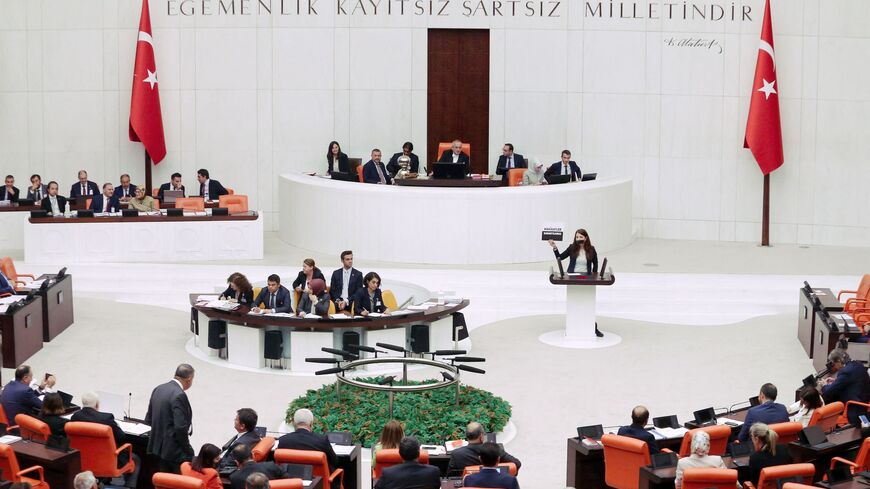
Peoples' Democratic Party's Zuleyha Gulum holds a banner "Truths cannot be obscured" as she stands with a covered mouth at the Turkish Grand National Assembly in Ankara on Oct. 13, 2022, in protest over a new media law that could lead up to three years of jail for spreading "fake news" by reporters and social networks users. - 
ADEM ALTAN/AFP via Getty Images

Amberin Zaman
@amberinzaman
October 25, 2022

Turkish police on Tuesday detained 12 journalists working for various Kurdish news outlets in pre-dawn raids in Ankara, Istanbul and Manisa and the predominantly Kurdish cities of Mardin, Diyarbakir, Urfa and Van.

The detentions are part of an escalating campaign against journalists working for outlets that report on rights abuses particularly in the Kurdish majority southeast, including the Mezopotamya News Agency and the all-female JINNEWS. Diren Yurtsever, editor-in-chief of Mezopotamya, was among seven women who were remanded in custody today. All were brought to Ankara where they are being held at the Ankara Security Directorate’s counterterrorism branch.

Journalists present during the raids described violent scenes. Police with long-range rifles “forced me to lay face down on the floor and sat on top of me as they handcuffed me,” said Dilan Babat, a reporter for JINNEWS, who shared a flat with fellow female reporters in Ankara. Babat told ArtiGercek, an independent online news outlet, that police had seized all their equipment, including their laptops and mobile phones. “There was a lot of cursing and insults,” she said.

Zemo Aggoz, a reporter for Mezopotamya, was allowed to nurse her six-week-old infant only following an outcry on social media.

In June, 16 other journalists working for those and various other dissident publications were detained and remain behind bars. They have yet to be indicted.

The journalists are accused of acting on behalf of the outlawed Kurdistan Workers Party (PKK) — a catch-all charge that can be randomly leveled against anyone who highlights institutionalized impunity against Turkey’s large Kurdish minority. The Ankara Security Directorate said in a statement that the journalists were engaged in illegal “organizational activities” and produced news that “incited hatred and spite among the people” and that they functioned "under the Press Council of the PKK/KCK terrorist organization.” It published footage of the detentions on its official Twitter feed.

“Turkey regularly abuses anti-terror laws to target journalists, who are frequently subject to arbitrary charges and imprisonment. The detentions fit a pattern of serious attacks on press freedom on Turkey,” said the International Press Institute, a Vienna-based watchdog, in a statement today.

Turkey ranks among the world’s top jailer of journalists, and pressure on the media is intensifying in the run-up to parliamentary and presidential elections that are due to be held by June 18. Turkish President Recep Tayyip Erdogan, whose Justice and Development Party (AKP) has ruled the country since 2002, has seen its popularity dip as the country grapples with runaway inflation and growing youth unemployment.

The Coalition for Women in Journalism, an advocacy group, said that Turkey ranked first among countries detaining women journalists with 28 detained since the start of this year, followed by Russia, which has detained 20 of them.

Last week, parliament approved a “censorship” bill that makes “disseminating false information” a criminal offense with prison sentences of between one to three years, just one of a swathe of other draconian amendments targeting free speech and online communication.

Zekeriya Gozupek, a reporter for Mezopotamya who is based in Diyarbakir, detects a link between today’s arrests and calls to investigate allegations by the PKK that the Turkish military is using chemical weapons against it in Iraqi Kurdistan. The allegations, which have yet to be substantiated, have been widely covered by Mezopotamya and other pro-Kurdish news outlets. “It’s clear that the government wants to put the lid on such reporting through its usual intimidation tactics, but we refuse to yield,” Gozupek told Al-Monitor.

Turkey categorically denies the use of any chemical agents. Turkey’s Ministry of National Defense said in an Oct. 20 statement that the claims were “baseless and untruthful” and vowed to pursue its fight against the PKK until the “last terrorist is immobilized.”

Sebnem Korur Financi, president of the Turkish Medical Association and who was among those calling for a probe, is under investigation herself for doing so. Erdogan said he was considering getting “Turkish” removed from the association’s name because he believed the Turkish people were disturbed at having “such an individual” heading an organization whose name began with “Turk.”

Hikmet Adal, a reporter for Bianet, one of Turkey’s oldest independent online news organizations, said the reasons for Kurdish reporters being targeted are multifold.

One is that they relay news from the Kurdish region that would otherwise not be reported, be it on corruption among administrators appointed by the government to replace democratically elected Kurdish mayors, booted out on specious terror charges, or on Turkish military abuses inside northern Syria. “It also reflects the age-old official mindset, one of viewing Kurdish journalists as conveying the views of the enemy, of propagating terrorism,” Adal told Al-Monitor. “The aim is to silence them.”

Reporting on Turkey’s festering Kurdish problem has always been risky business. At the height of the PKK insurgency in the 1990s, dozens of journalists and newspaper distributors in the southeast region were forcibly disappeared or killed. Reporters who traveled to the region would be tailed by police, arbitrarily detained and even prosecuted.

In the early days of AKP rule, pressure on journalists greatly eased as Erdogan embarked on a campaign of democratic reforms aimed at winning full European Union membership for his country. Those days are long gone, says Bianet’s Adal. On a recent trip to Diyarbakir to show solidarity with their detained colleagues, Adal and fellow journalists were followed around by undercover as well as uniformed police. When the group visited JINNEWS’ office, riot police in armored vans stood guard outside. “And when we read out our statement in support of our friends, there were more police than journalists to cover the event,” Adal recalled. “Just imagine what life is like for those of us who live there.”

Climate Activists Smear Cake on King Charles III's Wax Statue at London's Madame Tussauds

AFP
Last Updated: OCTOBER 25, 2022
London, United Kingdom

Just Stop Oil activists stand next to King Charles III’s statue after hurling a chocolate cake at it 
(Image: @mbindwane/Twitter)

The climate activists and two others were arrested. The activists from the Just Stop Oil group says their direct actions are justified

Climate activists on Monday smeared chocolate cake over a waxwork model of Britain’s King Charles III at London’s Madame Tussauds museum. The Just Stop Oil demonstrators said in a statement they were demanding that the government halt “all new oil and gas licences and consents".

Police said four arrests had been made.

“We responded quickly to an incident at Madame Tussauds after two people threw food at a statue at approximately 10:50 hrs. They have both been arrested for criminal damage," the Metropolitan Police said in a tweet.

A later police tweet said an additional two people had also been arrested for criminal damage.

In a statement released afterwards, Just Stop Oil named the protesters as Eilidh McFadden, 20 and Tom Johnson, 29.

It quoted them as saying that they staged the protest to “protect this green and pleasant land which is the inheritance of us all".


Just Stop Oil says climate change poses an existential crisis for humanity and its direct tactics are justified.

Last week, two of the group’s activists scaled a major road bridge over the River Thames, resulting in its closure.

Days earlier others threw tomato soup at Vincent van Gogh’s “Sunflowers" masterpiece in London’s National Gallery.


'Mike’s Midterm Tsunami Truth': Michael Moore dives into his predictions for 2022 midterms

Tiffany Terrell
October 25, 2022

Michael Moore (MSNBC)

During the 2016 presidential election, liberal filmmaker/activist Michael Moore had a prediction that Democratic strategists didn’t like one bit. Moore predicted that New York City real estate mogul turned far-right politician Donald Trump would defeat Democratic nominee Hillary Clinton, winning Pennsylvania, Michigan and Wisconsin — a prediction that proved to be spot on.

Now, in the 2022 midterms, Moore has a prediction that flies in the face of what many pundits have been predicting: He believes that voters, furious because the U.S. Supreme Court overturned Roe v. Wade, will bring about a massive blue “tsunami.”

Watch a clip below:


'Mike’s Midterm Tsunami Truth': Michael Moore dives into his predictions for 2022 midterms | RawStory.TV

During an interview with The Guardian published on October 23, the 68-year-old Moore — famous for documentaries that include 1989’s “Roger and Me,” 2002’s “Bowling for Columbine,” 2004’s “Fahrenheit 9/11” and 2007’s “Sicko” — didn’t back down from his prediction. In fact, he doubled down on it.

Moore believes that liberals and progressives can be conditioned to passively expect the worst when it comes to elections — including the 2022 midterms.

Moore told The Guardian, “The effect of this kind of reporting can be jarring — it can get inside the average American’s head and scramble it. You can start to feel deflated. You want to quit. You start believing that we liberals are a bunch of losers. And by thinking of ourselves this way, if you’re not careful, you begin to manifest the old narrative into existence.”

The activist/filmmaker has addressed a variety of important issues over the years, from the outsourcing of American jobs in “Roger and Me” to the horrors of the U.S. health care system in “Sicko” — which was released three years before the Affordable Care Act of 2010, a.k.a. Obamacare, was passed by Congress and signed into law by then-President Barack Obama. Now, in 2022, Moore is predicting that the 2022 midterms will become “Roevember” when millions of voters express their anger over Roe v. Wade being overturned with the U.S. Supreme Court’s Dobbs v. Jackson Women’s Health Care ruling.

Moore told The Guardian, “If I said to you six months ago, ‘You know Kansas, right? It’s a huge pro-abortion state, and this summer, by a margin of 60 percent, they’re going to keep abortion legal,’ you’d think I had made a crazy statement. If I’d told you at the same time that in the congressional election in Alaska, a hard red state, that it’s not only not going to be won by a Democrat, but a Native Alaskan Democrat, again you’d have to question if I was out of my mind…. I’m 68, and I don’t have time to mess around. I’m deadly serious."

Despite a prediction of a blue wave in 2022, Moore was critical of the Democratic Party during his interview with The Guardian. Moore, who has been discussing the midterms in his series of articles for his website/blog he calls “Mike’s Midterm Tsunami Truth,” believes that millions of Americans will be voting Democratic in November not because of Democratic Party organizers and strategists, but in spite of them.


Moore told The Guardian, “The biggest hurdle to what I’m doing with the series is the Democratic Party…. It’s very disheartening, and it would make even me question how we’re going to pull this off. The Democratic Party consultants are feeding lines that are so lame and weak. They don’t go for the jugular like a Republican would. It doesn’t inspire people at home…. We stand here on the precipice of a very important election, and our greatest enemy could be the Democratic Party itself…. Everyone…. who does care, and feels like our democracy could be hanging on by a thread…. has to do something in these last three weeks”.

Michael Moore predicting blue ‘tsunami’ response to Roe ruling

Julia Mueller - Yesterday - THE HILL

Filmmaker and activist Michael Moore is forecasting Democrats to keep control of Congress with a blue “tsunami” in this year’s midterms.


Michael Moore predicting blue ‘tsunami’ in response to Roe ruling© Provided by The Hill

With Election Day just two weeks away, Moore — who accurately predicted former President Trump’s 2016 win in the face of many pollsters who said otherwise — is anticipating a Democratic wave following the Supreme Court’s decision to overturn the right to abortion established in Roe v. Wade.

“On November 8th, 2022, an unprecedented tsunami of voters will descend upon the polls en masse — and nonviolently, legally, and without mercy remove every last stinking traitor to our Democracy,” reads the intro to Moore’s “Mike’s Midterm Tsunami of Truth” Substack.

The Oscar-winning documentarian calls his daily report a “series to counter the reporting that the Republicans are going to win the House and Senate. They are not.”

Last month, Moore emphatically predicted a “massive turnout of women” in the midterms in the wake of Roe’s fall.

Moore cautioned against the popular presumption that a sitting president’s party always fares poorly in an off-year midterm election, which can “get inside the average American’s head,” he wrote in a recent update.

“20 days til #Roevember & the media is busy pushing the old narrative that the Dems will lose. Don’t believe it. They’re so focused on predicting the odds, they’ve lost sight of the issues—where the majority is on our side,” Moore said on Twitter.

In a recent interview with The Guardian, Moore cited a handful of recent instances in which conventional political narratives didn’t play out, including new Alaska Rep. Mary Sattler Peltola (D), who beat out Republican candidate Sarah Palin to become the first Alaska Native in Congress.

“If I’d told you [six months ago] that in the congressional election in Alaska, a hard red state, that it’s not only going to be won by a Democrat but a Native Alaskan Democrat, again you’d have to question if I was out of my mind,” Moore told The Guardian.

“If you’d just been paying attention in the last six months to Kansas, Idaho and Alaska you’d have seen the red flags going up,” he added.


"MIKE'S MIDTERM TSUNAMI OF TRUTH" CAMPAIGN

Mike’s Midterm Tsunami of Truth #14
If the Mainstream Media Thinks There’s a Chance We May Be Right about Roevember, Watch Out.

Michael Moore
Oct 11


(A daily series to counter the myth that the Republicans are going to win the House and Senate)

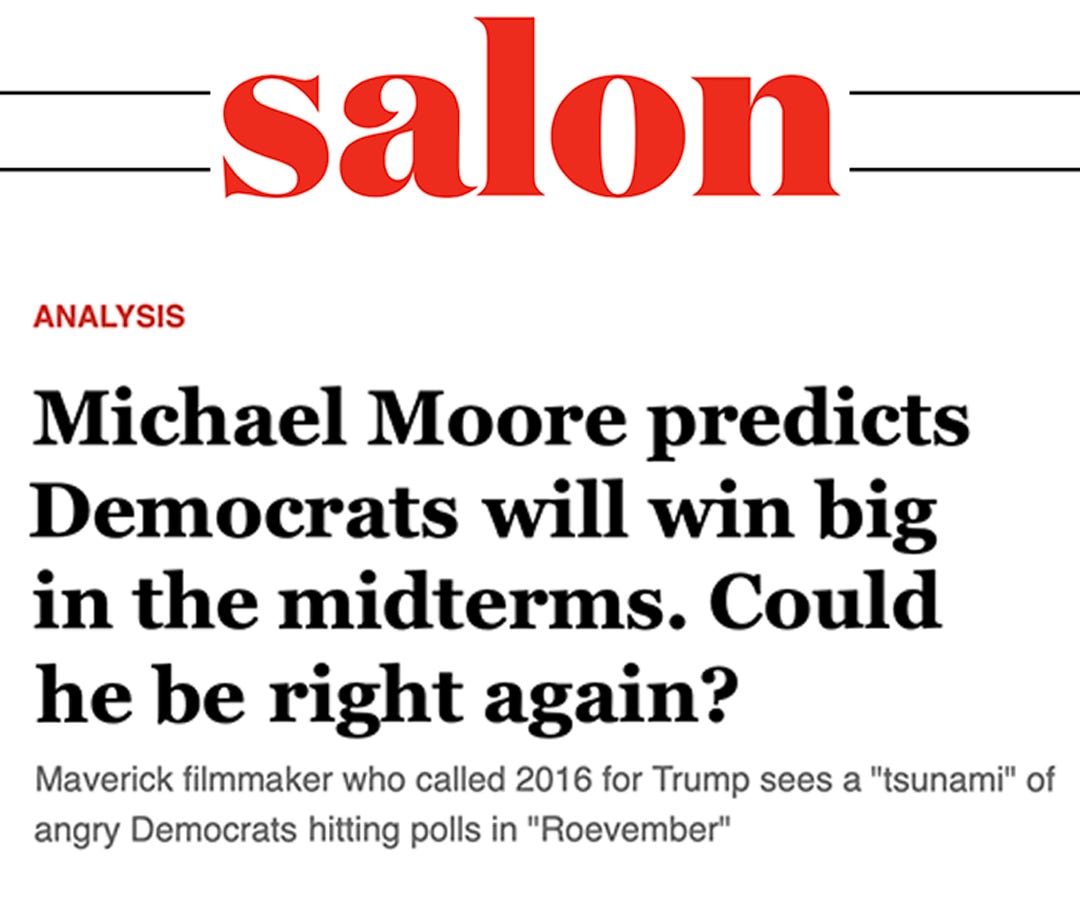
Just 24 hours ago, the award-winning online magazine Salon, became the first nationwide media outlet to tell the world about our Midterm Tsunami of Truth.

The result? Soon the stale, tired media narrative about how “the party in power always loses miserably in the Midterms!” will be put out to pasture in OK Boomerville.

All it takes is one little crack in the journalism dam that blocks fresh thinking…

Read the Salon analysis below, and get ready —

Four weeks from TODAY, MAGA is about to get the whoopin’ of their lives.


By Sophia A. McClennen

October 10, 2022


Remember when everyone thought Hillary Clinton would win the 2016 election? No, I don't just mean win the popular vote: Win it all and win big. FiveThirtyEight, Nate Silver's political projection site, had Clinton's chances of winning at 71.4 percentFrank Luntz tweeted on Election Day, Nov. 8, 2016, "Hillary Clinton will be the next President of the United States." One GOP insider declared that for Trump to win, "it would take video evidence of a smiling Hillary drowning a litter of puppies while terrorists surrounded her with chants of 'Death to America.'" Pundit after pundit, on the left and the right, joined the chorus of mainstream news outlets to declare that the election was Clinton's.

There was, however, one lone voice of dissent: Michael Moore. In July 2016, Moore wrote "Five Reasons Trump Will Be President." That article mostly went unnoticed by mainstream media after the election, when everyone finally realized Moore was right but it was way too late to make a difference.

Fast forward to the 2022 midterms and we find ourselves in a similar scenario, but turned upside down. Now the media is basically repeating again and again that Democrats will lose in November, while Moore is suggesting the opposite. Moore isn't just echoing the widespread notion that Democrats could hold the Senate while losing the House. He is suggesting that voters "are going to descend upon the polls en masse — a literal overwhelming, unprecedented tsunami of voters — and nonviolently, legally, and without mercy remove every last stinking traitor to our Democracy."

That prediction is likely to cause hyperventilation at all points of the political spectrum. Could he really be right?

To make his point, Moore is going beyond armchair punditry and sending out what he is calling a "tsunami of truth," where each day leading up to the election he offers one specific factual reason why he is right and why it makes sense to be optimistic.


In his second installment, he covered the story of the recent election for the Boise Board of Education, in which Republican Steve Schmidt, an incumbent, was up for re-election. Considering that Trump won Idaho's capital city with 73 percent of the vote, it made sense to assume Schmidt would win again. But as Moore explains, Schmidt had been endorsed by a far-right extremist group, the Idaho Liberty Dogs, that led a campaign against the local library, calling their LGBTQ+ and sex ed materials "smut-filled pornography." According to Moore, they even showed up at local Extinction Rebellion climate strikes brandishing AR-15 assault rifles.

So in a surprising turn of events, the Idaho Statesman, Boise's daily news paper, chose not to endorse Schmidt because he refused to denounce the Idaho Liberty Dogs. Instead, the paper endorsed his opponent, an 18-year-old high school senior and progressive activist, Shiva Rajbhandari, who was also co-founder of the Boise chapter of Extinction Rebellion.

Rajbhandari won. A teenager beat a Republican incumbent in a traditionally red city in one of the reddest states. Moore's point is that if these kinds of seismic shifts are happening at the polls in Boise, there's reason to think that this election won't follow traditional patterns. Voters, he believes, have had enough of the power of right-wing extremists and the threat they pose to democratic values.

In his next "tsunami of truth," Moore reminded readers that despite all the ways that the media tends to make the American right seem massively powerful, they're really just a big bunch of losers. Republicans have lost the popular vote in seven of the eight last presidential elections. As Moore explains it, "Only because of the slave states' demand for the Electoral College — and the Republicans' #1 job of gerrymandering and voter suppression — do we even have to still deal with their misogyny, their destruction of Planet Earth, their love of guns and greed, and their laser-focused mission to bury our Democracy."

That leads to the next installment: Republicans will lose because this time around they are "running the biggest batch of nutters nationwide in American electoral history." He then promises to offer a list of the top 10 "biggest whackadoodles on the Republican side of the ballot."

No. 10 on Moore's list is Mathew DePerno, Republican candidate for attorney general in Michigan. Like nine other candidates in the 30 state attorney general races this fall, DePerno is an election denier. But he's not just a common, garden-variety election denier; he was allegedly personally involved in a voting system breach. That's right: the Republican candidate who hopes to become Michigan's top law enforcement official is under investigation by the current attorney general for "unauthorized access to voting equipment."

But that isn't the half of it. DePerno also thinks that the Plan B birth control pill is a "form of murder." Moore explains that DePerno "believes that 'life' doesn't begin at conception — he insists it begins BEFORE conception and it should be against the law for anyone to interrupt a sperm on its way to do its 'job.'" As if that weren't enough to categorize DePerno as batshit extreme, he has attacked his opponent with memes that include the white supremacist symbol of Pepe the Frog while comparing his campaign to delivering Michiganders a "really big red pill." Not a Plan B pill, which he likens to fentanyl.

Confirming Moore's view that DePerno's extremism will only going to appeal to a narrow Trumper base, the twitter replies to DePerno are uniformly critical and sarcastic. Like this: "I did nazi that coming. (actually, I did.)." Or this: "I want what you are smoking." Or this post, from @NeverTrumpTexan, "You could just say you were Nazi. It is much easier than what ever that is." Surveying the 50 most recent replies to his tweet, among which include one from Keith Olbermann, every single one is critical and sarcastic.

Moore's 45-day "tsunami of truth" is a clever way to tap into the energy he has described as "Roevember." Moore coined the term back in August, when a funny thing happened in Kansas. Six weeks after the Supreme Court overturned Roe v. Wade, Kansas held an election, which included proposed amendment to the state constitution that could have allowed the legislature to ban abortion. In a surprising shift from typical voting demographics, turnout for the vote was massive, 60 percent higher than in 2018 — and Kansans overwhelmingly voted to reject the anti-abortion amendment.

And that was Kansas, another consistently red state in recent years.

So if we're seeing a swing away from Trump-style Republicans in Kansas and Idaho, there is reason to believe that the combination of Trump fascist nutters on the ballot, the revelations from the Jan. 6 committee hearings, the various investigations into Trump and, last but definitely not least, the fact that the Supreme Court put abortion back on the ballot could lead to the type of voting tsunami Moore is predicting.

Which leads us to wonder why the media isn't covering that story, but is still offering the same stale script about Biden's low favorability and Republican chances of taking back both the House and the Senate. Even Jen Psaki, Biden's former White House press secretary turned MSNBC commentator, offered the downer view that the president wasn't helping his party win.

Media coverage matters. And the fact that the media is largely sticking to pre-established coverage patterns doesn't just mean that it's missing the story, as Moore claims, it also means it's likely influencing the outcome of the election — and not in a good way.

Scholars of media effects know that when news coverage focuses primarily on negative personality coverage, i.e., the "horse race," turnout is depressed. When media focuses on policy, however, including contentious issues like abortion, turnout improves. So all the attention to Biden's supposed unpopularity is not helping.

Further, if the news media tells you the results are a foregone conclusion, that also depresses turnout. I mean, if you are told over and over again that you are going to lose no matter what you do, why bother voting? Even more important, research shows that if the media suggests an election will be close, turnout increases. Some scholars have speculated that the fact that right-wing news outlets reported that the election was close in 2016 elevated the Trump vote, while smug reporting from more liberal outlets, assuming Clinton would win easily, depressed her vote.

Yet almost all news media in the weeks before a major election focuses on predicting the outcome, rather than debating the issues. What's more, the flurry of attention paid to polling, and all the hand-wringing over whether the polling is accurate, only exacerbate the problem. Obsessing over whether or not a given candidate or party will win does almost nothing to help energize voter turnout and engage citizens.


But there's more. For decades, media scholars have described what they call the "protest paradigm." These are the predictable patterns journalists follow when covering protests. They include, for example, a habit of focusing on "small, inappropriate samples of individual protesters," which leads the audience to misunderstand the true nature of the larger movement. The protest paradigm also refers to the news media's habit of allowing elites to frame the story, which misses the positions of average citizens. Even worse, Indiana University professor Danielle Brown explains that this type of coverage "favors spectacle, conflict, disruption and official narratives over the substance of movements that challenge the status quo."

We can observe many of the same habits when the press covers elections. And given that this election in particular could be understood as a protest vote — protesting the assault on women's rights, LGBTQ rights, immigrants' rights, democratic rights, etc. — it makes sense to think of this election more in terms of a mass movement than as an example of democracy as usual.

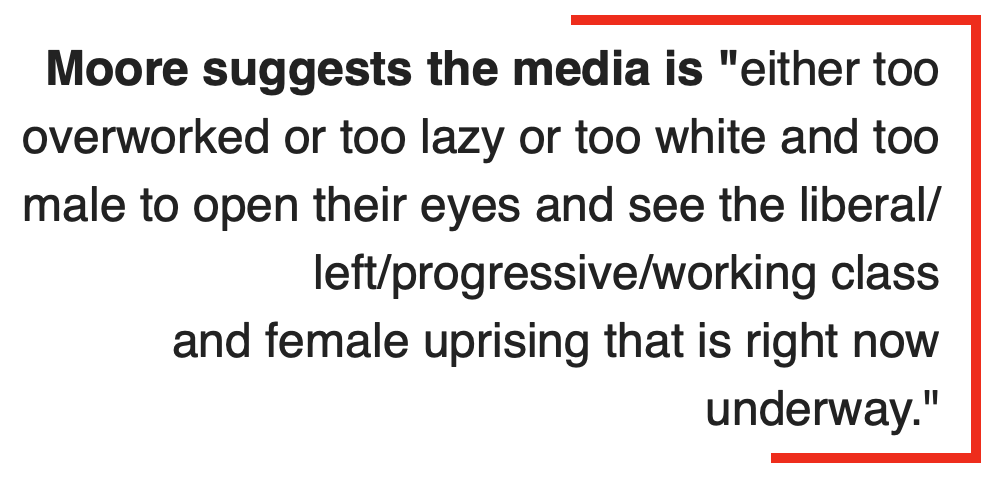
Framing the upcoming vote as a mass uprising of nonviolent civil resistance is exactly Moore's plan. As he explains, his goal isn't just to offer the public another version of the truth; it is also to call out the problems with media coverage. "Much of what many in the media are telling you is patently false and just plain wrong," he writes. "They are simply regurgitating old narratives and stale scripts. They are either too overworked or too lazy or too white and too male to open their eyes and see the liberal/ left/progressive/working class and female uprising that is right now underway."

Moore has a long history of questioning the status quo and bucking conventional thought patterns. Whether getting booed off the Academy Awards stage for opposing the war in Iraq or being the lone voice predicting that Trump would win, Moore has never shied away from disagreeing with the pundit class and political elites. But he doesn't just do it for shock value; he does it because he's paying attention to the political climate in ways the mainstream media tends not to.

Is Moore right that there will be a tsunami of voters determined to defeat the enemies of democracy? The only way to learn the answer is to stop trying to read the tea leaves and focus on making it happen.


ICYMI:

Mike’s Midterm Tsunami of Truths:

Truth #1: The Campaign

Truth #2: Even a kid from 4th hour Trig class can beat this crowd

Truth #3: The Haters, the Bigots and the Supremacists Always Lose in the End

Truth #4: Introducing The Whackadoodle 10

Truth #5: Trump is not the Big Bad Wolf. But he is very afraid of You.

Truth #6: The Easy-to-Digest Republican Party Platform

Truth #7: Biden, Don’t F**k with Me

Truth #8: If you’re not registered, you can’t Roe, Roe, Roe the Vote!

Truth #9: Why will we win? Because the American people hate fascism.

Truth #10: Meet Blake Masters, Whackadoodle No. 9

Truth #11: 147 Reasons We Will Win on November 8th

Truth #12: Biden just gave us a boost and a toke.

Truth #13: Women. That’s it.