Saturday, October 29, 2022

CRIMINAL CAPITALISM
Judge orders Meta to pay USD10.5M in legal fees

October 30, 2022

SEATTLE (AP) – Facebook parent company Meta has been ordered to pay USD10.5 million in legal fees to Washington state atop a nearly USD25-million fine for repeated and intentional violations of campaign finance disclosure laws.

King County Superior Court Judge Douglass North issued the legal-fee order on Friday, two days after he hit the social media giant with what is believed to be the largest campaign finance fine in United States history, The Seattle Times reported.

North ordered the company to pay by wire transfer, cheque or money order within 30 days. The money is to go to the state Public Disclosure Commission, which enforces campaign finance laws.

North imposed the maximum fine allowed for more than 800 violations of Washington’s Fair Campaign Practices Act.

Washington Attorney General Bob Ferguson argued that the maximum was appropriate considering his office previously sued Facebook in 2018 for violating the same law.

Washington’s transparency law requires ad sellers such as Meta to keep and make public the names and addresses of those who buy political ads, the target of such ads, how the ads were paid for and the total number of views of each ad.

Ad sellers must provide the information to anyone who requests it. But Meta has repeatedly objected to the requirements, arguing unsuccessfully in court that the law is unconstitutional because it “unduly burdens political speech” and is “virtually impossible to fully comply with”.
Alaska Village Still Home Despite Climate Threat


By Associated Press
Oct. 29, 2022

Ned Ahgupuk and girlfriend Kelsi Rock, stand for a photo with their 1-year-old son Steve Rock-Ahgupuk while strolling along the beach on the Arctic Ocean in Shishmaref, Alaska, Friday, Sept. 30, 2022. "We've been here all our lives," said Ahgupuk. He said climate change is a concern but he won't leave the island. "Everyone is like a big family caring for each other." 
(AP Photo/Jae C. Hong) THE ASSOCIATED PRESS


By JAE C. HONG and LUIS ANDRES HENAO, Associated Press


SHISHMAREF, Alaska (AP) — “Home sweet home.” That’s how Helen Kakoona calls her Alaska Native village of Shishmaref when asked what it means to live on a remote barrier island near the Arctic Circle.

Her home and the traditional lifestyle kept for thousands of years is in peril, vulnerable to the effects of climate change with rising sea levels, erosion and the loss of protective sea ice.

So much has been lost over time that residents have voted twice to relocate. But Shishmaref remains in the same place. The relocation is too costly. In this Inupiat village of 600 residents live mostly off subsistence hunting of seals, fishing and berry picking. Some fear that if they move, they’d lose that traditional way of life that they’ve carried on from their ancestors.

On a recent day, hunters boarded boats at sunrise in the village’s lagoon and returned in the evening hauling spotted seals. Kakoona and her mother helped skin the seals with an “ulu” or women’s knife and prepared to cure them in a weeks-long process.

“No other place feels like home but here,” said Kakoona, 28. She tried to settle down in different towns, but she ended up returning to Shishmaref to stay with her mother, Mary Kakoona, 63.

“I know we gotta move sometime,” Mary said about a relocation that at times seems inevitable. “Water is rising and this island is getting smaller.”

Shishmaref is located on an island that is a quarter mile wide and about three miles long. It is one of dozens of Alaska villages that are under threat from climate change.

“We’ve been here all of our lives,” said Ned Ahgupuk, a Shishmaref resident, who on a recent day strolled on a beach at sunset with his girlfriend and their one-year-old son. Climate change, is “kind of” a concern, he said, but he won’t leave the island. “Everyone,” he said, “is like a big family caring for each other.”

Sadie McGill and husband Tracy McGill feel the same. On a chilly fall day, they played with puppies bred to be sled dogs in front of the home where she was born and raised. After living abroad, she recently returned to the village to take care of her aging mother. The effects of climate change worry her and she’d be willing to relocate but she’d prefer to remain home.

“It’s really sad to see our native land go and disappear into the ocean,” she said. “I want to stay here where we were raised and born -- and (where) we know how to survive.”
___

Associated Press climate and environmental coverage receives support from several private foundations. See more about AP’s climate initiative here. The AP is solely responsible for all content.
 
REST IN POWER

Mike Davis’s Many Contributions to Building a Better World Will Live On

No leftist writer can compare to Mike Davis — not in clarity, breadth, generosity, or ironclad commitment to the working class. Davis has died, but his ideas will continue to find life in generations of leftist activists and thinkers to come.


Madison Square Garden's interior filled with thousands of striking garment workers in 1958. A banner reads "On with the strike — on to victory!" Mike Davis remained resolute in his belief in labor's collective power. (Bettmann Archive / Getty Images)

BY  BARRY EIDLIN
10.29.2022
 Jacobin 

Our mentors are dying.


At one level, this is a banal statement — an inevitable consequence of the forward march of time. But for those of us on the Left, there are historical and political factors that give it additional weight.

One consequence of the past several decades of defeat and demoralization for the Left has been a lack of generational replacement of leftist leadership and mentorship. Not only have there been fewer people available to serve as potential new leaders and mentors, but those of us who came of age politically between the 1980s and 2000s have had fewer and smaller movements upon which we could cut our teeth and develop as leaders and mentors ourselves.

As a result, it has fallen to veterans of the movements of the 1960s and ’70s to carry much of the weight of keeping the Left alive through difficult decades. That means that, as these veterans inevitably pass from the stage, the loss is that much more painful, their absence that much more deeply felt.

While we can appreciate this sociological observation about generational replacement at an intellectual level, it doesn’t change the fact that each individual death still feels like a gut punch. Knowing the history and sociology does little to soften the blow.

That is certainly the case when speaking of a figure of the caliber of Mike Davis, who died on October 25 at age seventy-six. We all knew this moment was coming after learning that he shifted to palliative care for his cancer a few months ago. But that didn’t prepare us for living in a world deprived of his prolific and penetrating insights.

Reading the tributes and remembrances that have flowed in over the past few days, it is hard not to be awed by the scale and scope of his reach. There is of course his immense body of writing, in which he managed to speak with authority, clarity, and insight on a dizzyingly vast array of matters without slipping into dilettantism.

From droughts and pandemics to urban development and resistance to labor history and politics, socialist strategy, and so much more, few others combined his careful research, clear-eyed analysis, political commitment, and eerie clairvoyance, all wrapped in dense yet riveting prose.

It won him a devoted readership across wide swaths of the US and global left, while also commanding respect in some of the halls of academia and the more mainstream public sphere. Few other thinkers occupy such a central place in graduate seminar syllabi and socialist reading groups while also being influential enough to attract the attention of the MacArthur Foundation and the ire of real-estate developers, along with attempts at exposés from the Los Angeles Times, Salon, and the Economist, among others. (The Los Angeles Times, for its part, shifted to more appreciative profiles of Davis later on).

On its own, Davis’s writing would be more than enough to be remembered as a giant of the Left. But he combined this with a lifetime of activism, organizing, and engagement, from his early years organizing with Students for a Democratic Society to participating in wildcat strikes as a truck driver and meatpacker to mentoring new generations of socialists in recent years. He was also generous as an academic mentor, taking the time to read, comment, and inquire about the work of graduate students and junior scholars just finding their way. Again, I am hard pressed to think of others who combined these qualities to the degree that Davis did.

Unfortunately, I cannot add any personal remembrances of Davis to this piece, as I never had the good fortune of meeting him myself, though I have long been in his orbit. I was first exposed to him as an undergraduate at Oberlin College, where politics professor Chris Howell kept a copy of Prisoners of the American Dream on reserve at the library for his students. Later, when I went to work for Teamsters for a Democratic Union (TDU), Davis’s writings on labor and the Left became a critical part of my political education, which I read alongside those of Kim Moody, Mike Parker, Jane Slaughter, Bob Brenner, and others.

When I made the transition from labor organizer to labor scholar, Davis stayed with me. I assigned his work in my social movements class and my seminar on “Capitalism, Socialism, and Democracy.” This ensured that I would have the privilege of revisiting and reengaging with his writing year after year. I never ceased to be amazed at the new insights I gleaned from each additional rereading and new ideas that would come to me after sitting with his work.

It reinforced for me not just how insightful Davis was as a thinker but how generative he was. He provided a jumping-off point for countless other scholars to take our own deep dives — even if we might never get as deep as he did.

Indeed, as I posted on social media back in 2018, as I was preparing to teach “Why the US Working Class is Different” in my seminar, “I’m amazed at how [Davis] can casually toss off ideas for about five dissertations in a single paragraph.”


Many of my students had similar reactions to his work, consistently mentioning it as a highlight of the course. Likewise, for me, teaching his work has been a highlight of my life as a professor.

I did come very close to meeting Davis this past September. I had wanted to interview him about his time doing rank-and-file organizing as a Teamster and meatpacker in the 1970s for a book I’m working on with Jacobin editor Micah Uetricht about the Left’s “turn to industry” in that period, when members of socialist organizations took jobs in factories for organizing purposes. It’s a part of Davis’s life that was often mentioned in various profiles but rarely explored.

After I learned of his shift to palliative care, I figured that I had missed my opportunity, but seeing several profiles of him based on lengthy interviews published in the following months made me think that I might still have a chance. So I emailed him and was surprised to receive a reply almost immediately. He was happy to talk but could likely only handle an hour-long interview. We made plans for me to travel down to San Diego the following week, with the caveat that I should check with him the day before.

As scheduled, I wrote him the day before and received a reply: “I had a visit from my end-of-life physician this morning and she bluntly told me cancel all interviews or visits from friends. Apologies.”

While we had to cancel the visit, I was at least able to share with him how much his work influenced my own, how much my students get from reading him, and to thank him for his contributions toward building a better world.

Those contributions may now have come to an end, but they will live on in every student and organizer whose world will make a little more sense, and whose path to changing it will be a little clearer, thanks to Mike Davis.

Barry Eidlin is an associate professor of sociology at McGill University and the author of Labor and the Class Idea in the United States and Canada.


SASKATCHEWAN
MOE'S MISOGYNIST MURDERER PAL
'Disgraceful, reprehensible': Readers react to Colin Thatcher's throne speech invite

Opinion by Reader Letters - 
 Leader Post


Former Saskatchewan politician Colin Thatcher who was convicted for the murder of his ex-wife, JoAnn Wilson, speaks to the media after exiting the house chambers after the Throne Speech inside the Saskatchewan Legislative Building on Wednesday, October 26, 2022 in Regina.© 

This is disgraceful and tone deaf behaviour that is perpetrated by both Lyle Stewart and Scott Moe. Mr. Stewart inviting a convicted murderer to the Chamber and then defending his decisions, by saying he is a friend, a constituent and has had a tough life, is reprehensible . And Mr. Moe for allowing this to go ahead while blindly and sadly (and ironically) stating the Sask. Party cares about the protection and safety of Saskatchewan residents.

Colin Thatcher sitting in the Saskatchewan legislature as an invited guest is not only disgusting and shameful, it is also triggering for thousands of women who are victims of domestic violence. It also opens painful wounds of families grieving over their murdered loved ones.

Like JoAnn Wilson.
Susan Thiele, Regina


We both lived in Saskatchewan when the murder of Colin Thatcher’s ex-wife occurred. It was difficult to believe this would take place in peaceful Saskatchewan.

He was convicted, justly so, the court did their job but now the politicians have welcomed Colin back into the legislative circle. Shame on them!

Domestic violence is skyrocketing everywhere especially when looking at the stats in Saskatchewan.

As previous citizens of that lovely province, we can say shame, shame. The standards we hold our elected officials to definitively comes into scrutiny.

Fred and Sandra Turetski, Cranbrook, B.C.


Who is Colin Thatcher? Here's what you need to know about his 1984 murder conviction


Caitlin Brezinski
CTVNewsRegina.ca Digital Content Producer
Published Oct. 29, 2022 

Colin Thatcher was back in the news this week after appearing as an invited guest at the Government of Saskatchewan’s throne speech on Wednesday.

While his appearance sparked heated discussions surrounding domestic violence, some may be wondering who he is exactly and why his appearance shocked so many.

The former Saskatchewan cabinet minister was convicted of first-degree murder in 1984 for the 1983 death of his ex-wife, JoAnn Wilson, following a 15-month investigation into a case that gripped the province.

Thatcher was born in 1938 in Toronto, Ont. to Ross Thatcher, a former MP and Premier of Saskatchewan from 1964 to 1971.


RELATED STORIES


He entered into politics in 1975 as a Liberal MLA then later served as Saskatchewan’s Minister of Energy from 1982 to 1983. He resigned on Jan. 17, 1983, citing family and financial reasons.

THE MURDER AND TRIAL


A 1987 appeal document from the Court of Appeal for Saskatchewan provided details and background on Thatcher’s 1984 murder trial.

On May 7, 1984, Thatcher was arrested and charged with first-degree murder following the lengthy investigation. The trial began in the fall of 1984 and lasted 14 days.

Thatcher and Wilson married in 1962 then divorced in 1980. They engaged in a custody battle over their youngest of three children in the years following, according to the background provided in the appeal document.

Wilson was found beaten and shot to death in the garage of her Regina home in 1983.

“At about 6 p.m. on the evening of Jan. 21, 1983, JoAnn Wilson came home, drove into the garage of her home, and was ferociously beaten and then shot to death. 27 wounds were inflicted on her head, neck, hands, and lower legs. The injuries included a broken arm, a fracture of the wrist and a severed little left finger. A single bullet entered her skull, causing death,” the document read.

The Crown’s position was that Thatcher had murdered Wilson or he got someone else to do it. The trial judge explained to the jury that Thatcher would be considered guilty in either instance.

“If you do not find that he did the act of murder himself, he is equally guilty if you find and are satisfied that he either aided or abetted another or others in its commission,” the judge said.

In court, Mr. Craig Dotson testified that he found Wilson’s body after leaving work at the legislative building. He claimed he saw Wilson driving a green car, which turned into the garage at her house. He said he continued walking for about a block then heard loud screams behind him.

“He turned back to investigate. He heard a single loud sharp noise and then silence. As he approached a lane near the Wilson garage, he saw a man emerge from the garage. He did not pay any particular attention. It was dark. He was 30 to 40 feet from the individual. He walked a little further and saw a body in a pool of blood on the floor of the garage,” read the document.

Dotson testified that the composite sketch prepared by the police with his help did not fit Colin Thatcher.

Thatcher denied any involvement in the killing and the defence’s witnesses backed up his whereabouts at the time of the crime.

At the trial, the case for the Crown rested upon direct and circumstantial evidence, including apparent surveillance of the house by a man in a blue car for three afternoons prior to the killing, phone conversations, and the murder weapon.

Lynn Mendell, a former girlfriend of Thatcher, was called to the stand and detailed conversations the two had in 1980 and early 1981, in which she described the bitterness Thatcher constantly expressed about Wilson, and how he said many times that he wanted to kill her or arrange with someone to do it for him.

“According to Ms. Mendell, Thatcher told her he had met with someone in Saskatchewan whom he wanted to hire to kill JoAnn Wilson. He eventually told her the plan fell through but that he would have to go about it one way or another,” the court documents read.

Mendell also testified that she received two phone calls from Thatcher on the day of the killing.

She recalled what Thatcher said during the first call.

“Well, I'm going out now. This might be the night, stick around,” read the testimony.

During the later call he said, “Oh, my God, I've just been called... Apparently JoAnn has been shot in her home and has been killed,” Mendell said in her testimony.

There were several more testimonies given at the trial which all pointed to Thatcher being involved in the crime.

According to police testimony, Wilson was likely shot in the head with a .38 Special of .357 Magnum Ruger revolver. The owner of a gun shop in Palm Strings, Cali., testified that he sold Thatcher a .357 calibre Ruger revolver on Jan. 19, 1982.

The murder weapon was never found, according to the court documents.

Saskatchewan MLA Colin Thatcher is escourted by police into the Regina Provincial Courthouse June 25, 1984 for the preliminary hearing for the murder charge he faces. Thatcher was arrested May 7 for the murder of his ex-wife Joanne Wilson in 1983. THE CANADIAN PRESS/Lorne McClinton

The jury deliberated from Nov. 2 to Nov. 6, 1984 and found Thatcher guilty of first-degree murder.

He was sentenced to life in prison with no chance of parole for 25 years, which he served in-part at an Edmonton maximum security prison until 1988, then at the Ferndale minimum-security facility near Mission, B.C.

Thatcher, now 84, maintained his innocence all throughout that time and fought to gain early release from prison. He won the right to apply for early parole in 2003 and was released in 2006.

He wrote two books, “A Man’s Grief: Death of a Spouse,” which was released in 2001, and “Final Appeal: Anatomy of a Frame,” which was released in 2009 and outlined his stance that he was framed for the crime.

Thatcher represented himself in 2010 in a fight for profits from his 2009 book, which were ultimately turned over to the Ministry of Justice.

Several books were also written about Thatcher and his case, including “A Canadian Tragedy: JoAnn and Colin Thatcher,” and “Deny, Deny, Deny, The Rise and Fall of Colin Thatcher.”

Dear American Church, You’re Dying

People are rightly walking away, because they refuse to tolerate something that so regularly yields hatred while claiming to be made of love.

October 29, 2022 by John Pavlovitz 


Dear American Church,

I have some good news and some bad news.

The bad news is—you’re slowly dying.

If you’re paying attention, you probably realize that.

Your buildings are slowly clearing, your pews gradually emptying, your congregations visibly aging away, your voice carrying less resonance than it used to.
Play Video

There are many complicated and interconnected reasons for this, but here are a few broad strokes:

You’re dying because of your hypocrisy.

People see the ever-widening chasm between who you say you are and what they regularly experience in your presence.
They see the great disparity between the expansive hospitality of Jesus and the narrow prejudice you are so often marked by.
They see Christ’s deep affection for the poor, hurting, and marginalized—and either your quiet indifference or your open hostility toward them.
They’ve listened to you preach incessantly about the immorality of the world, the dangers of greed, the corrupt nature of power, the poison of untruth, the evils of sexual perversion—and watched you willingly align with politicians embodying all of these.
They see that you are so often the very kind of malevolent ugliness that you forever warned was coming to assail the world.

You’re dying because of your willful ignorance.

People are tired of your war on Science.
They are sick of your arguing with Biology.
They are exhausted by your attacks on women.
They are horrified by your justifications of racism.
They despise your posturing nationalism.
They know the earth is round.
They know it is billions, not thousands of years old.
They know dinosaurs walked it.
They know that it is warming rapidly.
They know people here don’t choose their sexuality.
They know whoever and whatever God is—doesn’t appoint Presidents or hand out weapons or attack people with tornadoes.

You’re dying because of your devotion to cruelty.

People watch you dig in your heels against others because of their gender identity and sexual orientation; the way you continually exact violence upon them, the way you try and blame God and the Bible for your fearful bigotry and your predatory behavior.
They’ve seen your intolerance to other religious traditions: how you vilify anyone who finds spirituality and meaning outside of your precise expression of Christianity, how you so easily disregard the faith stories of those who don’t reflect your own.
They’ve watched you so revel in being the bully to those you were originally called to protect.

You’re dying because of your complicity in violence.

Good people have seen you so often be a safe haven for misogynists, domestic abusers, sexual predators, and white supremacists—who all receive protection in your antiquated words, in your personality cults, and in your enabling culture.
They’ve heard your explicit silence in the face of a brutal and rising flood of anti-Semitism, of open racism, of hostility toward immigrants, of attacks on Asian people and Muslims.
They see your pastors and leaders misuse their positions and leverage their influence to victimize the most vulnerable and to serve as scapegoats for discrimination.
They’ve watched you be the last, hateful holdout in matters of gender equality, racial diversity, sexuality, and theological difference; lagging behind almost everyone in the world in the kind of goodness you say you aspire to.

Because of these things and many more, American Church, people are rightly walking (some running) away, because they refuse to tolerate something that so regularly yields hatred while claiming to be made of love. They are unburdened by habit or obligation to participate in something that feels increasingly incongruent with their values.

They are conscientious objectors in your unending holy wars, choosing to step away from you in order to create loving spiritual communities, grow deeper in personal faith, escape tribal partisan politics, craft a healthier planet, reflect the character of Jesus, and hold onto their souls.

Yes, American Church, the bad news is—you’re slowly but surely dying as you are now.

The good news is that in your passing, something else is being born.

Rising in these days, is a sprawling community of disparate people not bound by geography or denomination or tradition, who want to create something redemptive and life-giving here, who don’t care what it’s called and who gets the credit and what building it happens in. From the outside it may bear some resemblance to who you have been, but it will likely look quite different.

Yes, the bloated, mean-spirited version of religion that has characterized so much of you is slowly and most surely passing away: the hypocrisy and the enmity, all the coercion and posturing—these things are correctly being seen as irrelevant by a watching world who will no longer abide them or participate in them.

These newly-emancipated sojourners are creating something of compassion and generosity and hospitality—a radically-inclusive faith that opens the table, a spirituality that welcomes the world, a religion that does no harm: a working theology of love.

Church, though part of you is dying, the best of you gets to be resurrected differently now.

You get to live on in the lives of open-hearted human beings who want to unearth the beauty buried beneath heavy layers of rigid dogma, ornamental religion, and institutionalized discrimination.

These people are excavating your religion and releasing love from its man-made prison, and in this way—the best, truest parts of you will live on.

You get to be born again in the image of something that does not seek power or bed down with politics or thrive on exclusion, something resembling the Jesus who birthed you.

The bad news, American Church—is that you are dying.

And it’s the very good news, too.

Previously published on johnpavlovitz.com

51ST STATE
US backs up gas deal with Israeli security and economic guarantees

Biden pledged to support Israel's security and economic rights that were established in the deal.


By TOVAH LAZAROFF
Published: OCTOBER 29, 2022
Jerusalem Post

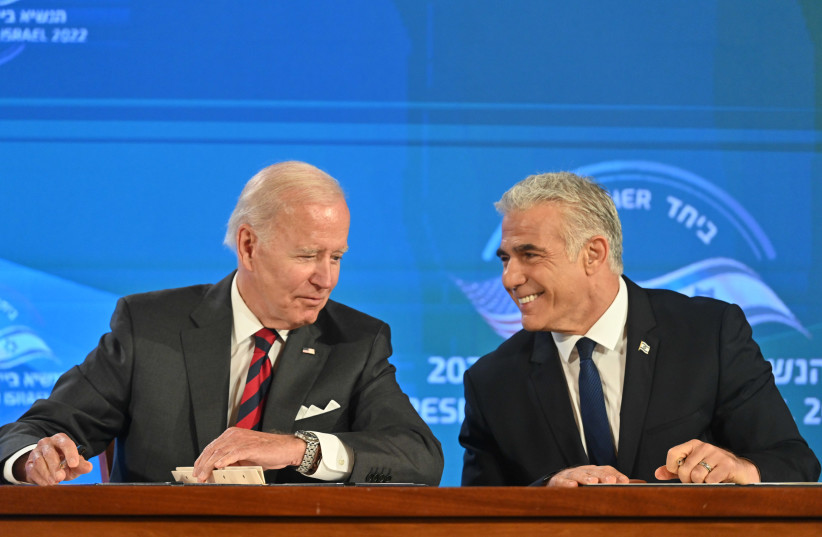
Lapid welcomed US President Joe Biden to Israel in July.
(photo credit: KOBI GIDEON/GPO)


US President Joe Biden pledged to provide Israel with security and economic guarantees, in a letter he is expected to give Prime Minister Yair Lapid in the coming days, in light of the historic maritime agreement the Jewish state reached with Lebanon, according to a diplomatic source.

In the letter, the US reiterates its commitment to support the IDF in defending Israel. This is about strengthening the capacity of the IDF to protect the Jewish state, including against threats against Israeli vessels and energy assets.

The text of the letter was agreed upon Friday and will be signed in the coming days, according to a diplomatic source, who briefed reporters on the content of the document which has not been made public.

Biden clarified in the letter that the US recognizes the maritime boundary set by the agreement as the "status quo" and will oppose any attempt to modify that boundary unless both Israel and Lebanon agree to that change.

Should the agreement be violated, the US would stand with Israel to prevent any such attempt to undermine the deal, Biden promised Lapid in the letter.


PRIME MINISTER Yair Lapid, Defense Minister Benny Gantz and Energy Minister Karin Elharrar hold a press conference on the maritime border deal with Lebanon, at the Prime Minister’s Office in Jerusalem, on Wednesday. (credit: OLIVIER FITOUSSI/FLASH90)

The letter mentioned in specific the US determination to prevent Hezbollah from profiting from the deal, which sets a boundary line between two abutting gas fields — Karish and Kana — so that both countries can peacefully produce natural gas.

What was agreed in the deal?

Under the terms of the maritime agreement signed on Thursday, Israel will receive 17% of the revenues from the Sidon-Kana field. The US will support Israel's receipt of those revenues, the letter explains.

Overall the document exceeds policy statements already made by the US with respect to the agreement as it pledged to back up Israel's security and economic rights.

The letter which is likely to be signed prior to Tuesday's election acknowledges Lapid's role in helping achieve the deal which it explains is a first step to promoting stability between Israel and Lebanon.

Biden in the letter also reaffirms the importance of strong US-Israel relations as defined by the Jerusalem Declaration which both he and Lapid signed in July when the US President visited Israel
.
TURTLE ISLAND


Landless in her own land

In 1954, the Western Oregon Indian Termination Act removed federal recognition of the Confederated Tribes of Grand Ronde, and the tribe spent the next three decades fighting to restore it. Cheryle A. Kennedy, the tribe’s chairwoman, shares her personal experience, as told to Underscore News' Karina Brown, of losing federal status and her support for the Chinook Indian Nation

UNDERSCORE NEWS
1 HOUR AGO

Grand Ronde Tribal Chairwoman Cheryle A. Kennedy stands near Willamette Falls in Oregon. (Photo courtesy of the Confederated Tribes of Grand Ronde)

Editor’s note: This story is part of a series that illuminates the historical context of tribal law in the Pacific Northwest and examines cases where tribes and tribal members have used federal courts to expand their rights under federal law. The series also explores the growing authority of tribal courts and their role in exercising the inherent rights of sovereign Indigenous nations, as well as the way federal and state laws restrict tribal courts’ operation.

This series is supported by the Data-Driven Reporting Project.

Cheryle Kennedy
Underscore News

I was terminated in 1954 as an individual member of the Confederated Tribes of Grand Ronde. I was always an Indian person, my parents, my grandparents, all of us. When we knew that there was the attempt, my father, my mother and others in our family got together. I was a child but I knew this was very serious business that was going on with our tribe. All I knew was that they were saying, "This is bad. They are going to do away with us." As a child, I was thinking, "What does this mean?"

Grand Ronde had a reservation with health and governmental services here and all that was taken away. It was gone. There was no longer the reservation here and many of the homes were lost, because they became taxable. The homes and the land was lost, everything was stripped away and there was no compensation for any of the taking. And they said we were no longer Indian as well. I thought, "How can they do that? What do they mean?" Of course their process was through tribal enrollment and that’s what they meant.

Related:
Part 1: Sovereign justice
Part 2: On an ancient road, tribal elders wage an invisible battle

My father was an engineer and we lived at Warm Springs. But even being full Indian, we couldn’t access any of our services there. We couldn’t go to the clinic, we weren’t eligible for any of the educational opportunities, we were not considered Indian by the federal government and therefore we were not able to receive federal services.


China seeks to loot Apache sacred place for China’s own uses


8 Things You Should Know About Two Spirit People


'Dances With Wolves' 25 Years Later: Has Hollywood Improved on Its Portrayal of Indians?


Being landless in your own country is a horrible thing. There’s no place to really call your home. Our people were buried in our cemeteries. But there was no place to do the ceremonies I grew up with. Subsistence hunting and fishing was gone. Normally, we would travel to the Willamette Falls and gather our eels. We would fish and we would hunt and all of that was gone. So it was a very, very traumatic time for anyone not being recognized as being Indian or having a tribe.

It shakes you to the core, because according to all the sociological norms, to be healthy, identity is critical to your core of who you are and when you experience that — that the U.S. of A, the greatest nation on earth, doesn’t see you, doesn’t recognize who you are — then you aren’t who you are. So that causes a lot of trauma and part of it is your health conditions are worse and you may not achieve all that you could have possibly been because you don’t have a forum to achieve your academic pursuits.

That was a horrible, horrible thing.


Once we knew that there were efforts at restoration and I had been involved in helping my cousins who were the spearheaders of the restoration act, it was with all enthusiasm that we threw in whatever we had. There were no funds — we used our own funds — to travel, to gather together, to put together a little newsletter. Our cemetery was really a focal point that kept us together. We had a big event where we would be able to see all our relatives, because everyone moved away. There was no place to live here. There was a core of people who managed to stay in the area, but it was the cemetery — our ancestors — who really kept us together, and we kept coming back year by year and saying we’re going to do this. This wrong that has been done to us, we will fight it. And in the end, restoration was achieved in 1983.

Even though it’s been 39 years, we are still working at restoration of our culture. Because the language piece, we have people now who have relearned the language and are teaching our young children the ceremonies we had, like giving thanks when you shot your first deer or elk or fish. So now we are returning to those kinds of ceremonies.

You’re talking about your soul has been damaged and now for us it’s been put back together again, and so that is our prayer and our hope for the Chinook tribal people: that this will be a thing of the past as well and they will soon be talking about, "This is what we are doing today and how we are getting well.


Underscore is a nonprofit collaborative reporting team in Portland focused on investigative reporting and Indian Country coverage. We are supported by foundations, corporate sponsors and donor contributions. Follow Underscore on Facebook and Twitter.
AMERIKA
Young Black voters could be essential in future elections, analysis of theGrio/KFF survey shows

In the new Survey of Black Voters from theGrio and KFF, Black voters ages 18-29 are particularly disdainful of President Joe Biden seeking a second term.


Dana Amihere 
Oct 29, 2022

Political candidates are making concerted efforts to appeal to young voters and address social and economic issues that directly affect their generation most. And, with good reason. There’s a generational gap between voters: the diverse youth and aging white adults, the so-called “brown and gray.” Moreover, young people of color are an increasingly important voting bloc.

“What you now have is a brown, a more diverse and a younger voting base,” explained LaTosha Brown, co-founder of the Black Voters Matter Fund, in a statement to theGrio. They’re shaping public policy now, and they’re the new up-and-coming vote that will shape public policy going forward, said Brown.

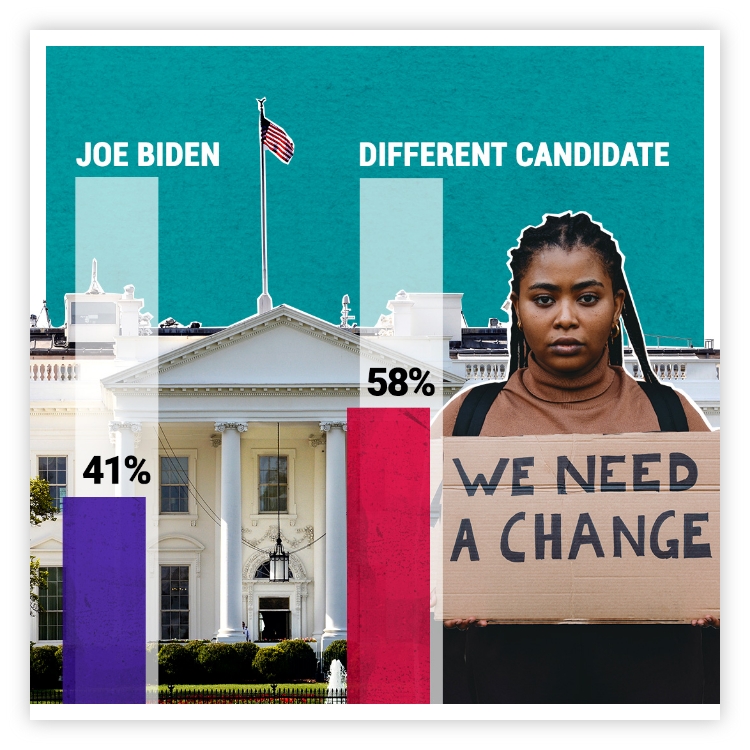
Most Black youth voters say “no” to Joe Biden for 2024. In the new Survey of Black Voters from theGrio and KFF, Black voters ages 18-29 are particularly disdainful of President Biden seeking a second term: 71% said they want the Democratic Party to nominate someone else in the next election. That’s compared to four in 10 Black voters overall who said they think the Democratic Party should renominate Joe Biden in 2024, and 58% of Black voters who think someone else should be nominated.
Do you think the Democratic Party should renominate Joe Biden as the party’s candidate for President in 2024, or do you think the party should nominate a different candidate for President in 2024?

Read full TheGrio/KFF Survey of Black Voters

Eight in ten Black voters ages 18-29 support Congress passing protections for same-sex marriage, and they’re the only age group with more than half (56%) in support of allowing transgender student-athletes to compete on sports teams in alignment with their gender identities.


“I think the Black vote has consistently been a progressive vote. It has been the vote that has always leaned more towards progressive policies,” said Brown.

According to an October report on a survey of Americans ages 18-29 conducted by Data for Progress, a progressive think tank and polling firm, young Americans want to see “bold policy action” taken by Congress to codify abortion rights, strengthen gun laws to curb violence and address climate change. And, they’re willing to band together to make their voices heard loud and clear.


Also Read:
Black voters solidly approve of Biden and Harris, less firm on the president’s reelection in TheGrio/KFF survey

“From the Sunrise Movement to March for Our Lives, young people are already leading movements to push for progressive change. By a +48-point margin, young Americans across party lines support the use of protests to advance causes that they support,” says the report.

Young voters aren’t just vocal, they show up. They aren’t the largest group in the electorate, said the executive director of elections and surveys for CBS News, Anthony Salvanto. But if they show up, it could be a “turnout for the ages,” he said in an Oct. 19 interview on CBS Mornings
.
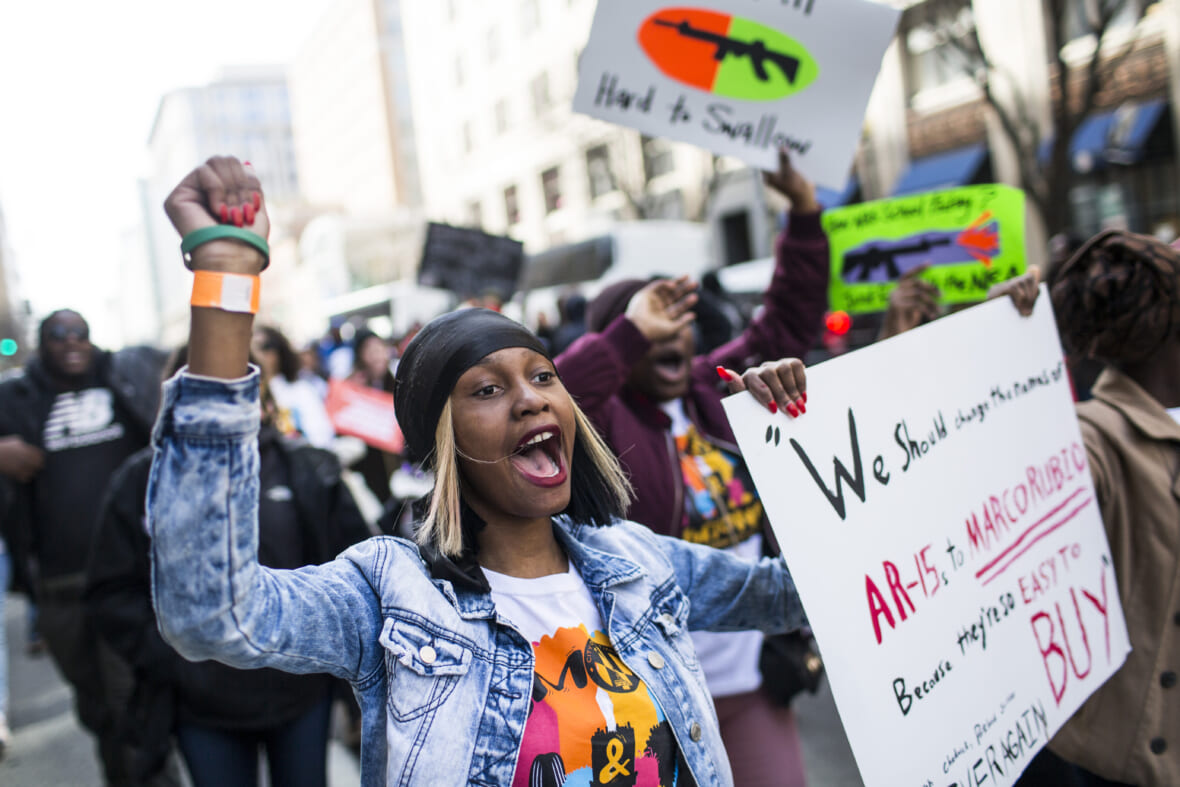
Demonstrators from Baltimore march in the March for Our Lives rally March 24, 2018 in Washington, DC. (Photo by Zach Gibson/Getty Images)

A 2021 study from the nonpartisan Center for Information and Research on Civic Learning & Engagement (CIRCLE) at Tufts University estimates that half of voters ages 18-29 cast a ballot in the 2020 presidential election. Compared to 2016, turnout increased 39%, “likely one of the highest rates of youth electoral participation since the voting age was lowered to 18” in 1971.

Those looking to woo youth voters, especially young voters of color, are taking note: Bold moves from the White House and movements driven by social justice hone in on the interests of this essential demographic.

It may be the midterms, but President Biden, the presumptive Democratic nominee in the next election, is using the opportunity to get a jump on 2024 and cast Democrats who are facing off in November in an admirable light.

“In politics, you’ve got to get the work done, but you’ve also got to let people know that you’re getting the work done,” North Carolina state Representative Terry Brown told Bloomberg in an October report. Brown, a Charlotte Democrat, said Biden’s recent pardon for federal marijuana possession charges and student loan forgiveness program are “tangible steps” that voters can appreciate because they see the effects of them more clearly than broader legislation from Biden. “Sometimes it takes these big splashy announcements to get people’s attention,” he said.

LaTosha Brown’s Black Voters Matter engages HBCU students as part of its Get Out The Vote bus tour. The year’s “We Won’t Black Down” campaign kickoff coincided with National Black Voters Day on Sept. 16 and will continue with stops in key states in the lead-up to Election Day. “Black voters and Black people have always stood [as] a vanguard. I think, once again, we are needed to stand [as a] vanguard, that we will make the difference because I do think that we are the leverage vote.”
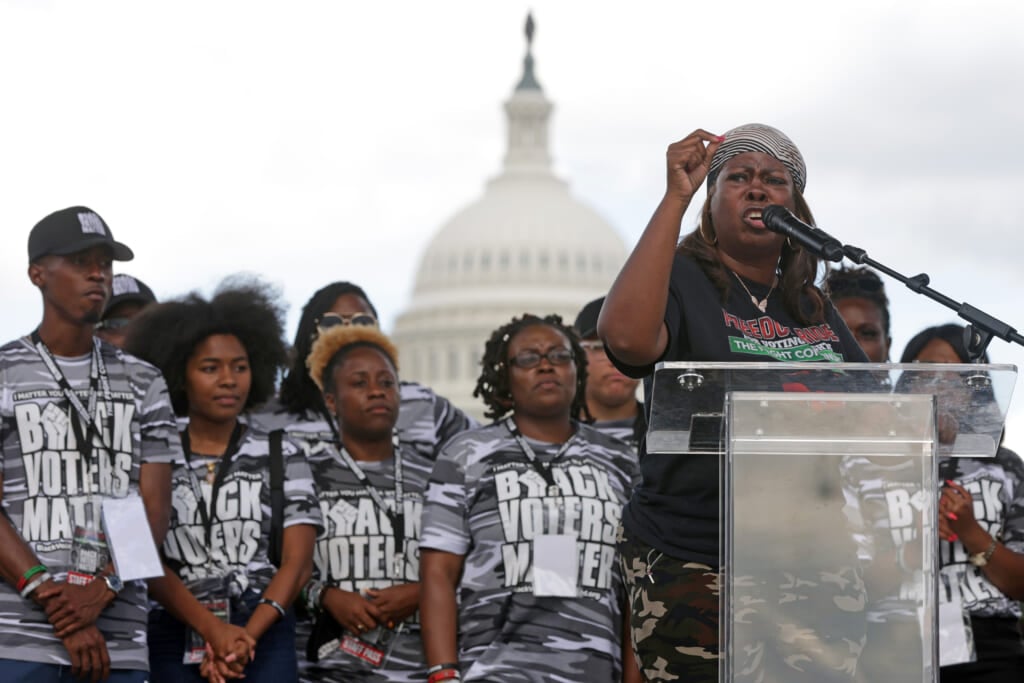
Co-founder Black Voters Matter LaTosha Brown speaks as other voting rights activists listen during a “Rally for D.C. Statehood,” the last stop of BVM’s “Freedom Ride for Voting Rights” bus tour, at the National Mall June 26, 2021 in Washington, DC.
(Photo by Alex Wong/Getty Images)

HBCUs have long been a critical conduit to reach Black students and engage Black young people. Senate Democrats held their annual issues conference at Howard University in March. Biden gave the commencement speech at South Carolina State University last year (albeit amid controversy over a spending bill that proposed $10 billion for HBCUs that eventually passed).

Vice President Kam
ala Harris made visited to SC State and Claflin University in September.


Black voters’ mood ahead of midterms tempered by age, economy and racism, TheGrio/KFF survey finds

“She came down, and she came to socialize with us. She came to take pictures with [us]. She came to speak with us, to know our names,” SC State student Lataye Walker told CBS-affiliate WLTX. HBCUs are increasingly being recognized as more than a prop and more as a stakeholder to engage and work alongside. Harris, a proud Howard grad and member of the historically Black Alpha Kappa Alpha Sorority, Inc., continues outreach to her Divine Nine sisters on voting and abortion rights. After all, “one of [their] own” is in the White House now.

An August episode of MSNBC’s Into America podcast, “The Gen Z Midterm Test,” brought together three Atlanta HBCU students together in conversation with host Trymaine Lee.

William Morris, from Morehouse, emphasized the importance of HBCU students’ vote—especially in a swing state like Georgia. “I think people often know that the road to election goes through the Atlanta University Center,” a hub of HBCUs Morehouse College, Spelman College and Clark Atlanta University.

(Photo: Spelman College)

Spelman political science student Monique Vaz said, “I think that a lot of the people in the Democratic Party are playing very moderate because of how Trump polarized the nation into ‘You’re either this or that.’ But, I think that, personally, we need more liberal solutions to fix” what’s happening in this country, said Vaz.

Despite the far-reaching impacts of student debt relief and drug pardons, many critics say that it’s a good start, but these efforts don’t push far enough.

Fifty-eight percent of students receiving federal Pell grants are Black, and 94% come from families that have incomes less than $60,000 per year. A 2021 Urban Institute study analyzes the outcomes of several different student loan forgiveness program variations. A “Pell-based approach would target borrowers from lower-income backgrounds” and “disproportionately benefit Black borrowers.”

Researchers posited that the cost of forgiving the cumulative amount of Pell dollars received by a student while in college is roughly the same as forgiving up to $10,000 for all borrowers. Under Biden’s plan, Pell recipients have $20,000 in student loans forgiven and low- to middle-income borrowers have $10,000 forgiven.

But, does this plan, which Biden’s Administration said will “help narrow the racial wealth gap,” actually work toward that end in a meaningful way?

Black college graduates owe an average of $25,000 more in student loan debt than their white counterparts. And, more than 50% of Black student borrowers report their net worth is less than what they owe in student loan debt. Ten thousand dollars, even $20,000 in loan forgiveness, covers only a small fraction of what some Black borrowers owe

.
U.S. President Joe Biden speaks on the student debt relief plan as Secretary of Education Miguel Cardona (R) listens in the South Court Auditorium at the Eisenhower Executive Office Building on October 17, 2022 in Washington, DC. President Biden gave an update on the student debt relief portal beta test. (Photo by Alex Wong/Getty Images)

A May report prepared for Sen. Elizabeth Warren, chair of a congressional economic growth subcommittee, said $50,000 in student loan debt forgiveness was optimal from a fiscal and racial equity perspective. Thirty million people, 76% of borrowers, would have the debt zeroed out. The number of poorest borrowers would shrink from 15% to 2%. According to the report, Biden’s $10,000 cancellation plan still leaves 83% of Black borrowers in debt. Under the alternative $50,000 cancellation plan, 33% of Black borrowers would remain in debt, a 50% difference.

Biden’s executive pardon for all prior offenses of “simple possession” of marijuana is also viewed as problematic by some. For one, the change only applies to federal possession charges, which impact about 6,500 people. And, most of these people are also serving time for more serious offenses like trafficking or drug distribution.


Black voters surveyed by theGrio/KFF want Biden to address inflation; only 12% named student debt as top economic issue

Pardons for state charges would open doors for many more people (likely with lesser charges), allowing them to better access housing, employment and other opportunities post-conviction. And, the pardon doesn’t address marijuana’s drug classification. Biden did tap the attorney general to begin the review process to reschedule marijuana, currently classified as a Schedule I drug in the same group as heroin and ecstasy. But, Biden’s past reluctance toward decriminalization, which a record-high 68% of Americans support, may be a factor in youth voters’ perceptions of his willingness to support their progressive agenda.

Black voters, youth especially, want Democrats to move from the safety of being moderate and centrist to more liberal, progressive policies to ameliorate the country’s sociopolitical division.

Vaz, the Spelman student, thinks certain Democrats are trying to “push the envelope” toward change while others are content being quiet and complacent. “I think that they ran on these platforms, so they need to really be acting on them. If not, they will see what happens in November,” she said.

About the Survey

The Survey of Black Voters is the first partnership survey between theGrio and KFF, a nonprofit organization focused on research and analysis of health and other national issues. Teams from KFF and theGrio worked together to develop the questionnaire and analyze the data, and both organizations contributed financing for the survey. Each organization is solely responsible for its content.

The survey was conducted Aug. 24–Sept. 5 with a nationally representative, probability-based sample of 1,000 adults who identify as Black or African American and are registered to vote. The sample includes all voters who identify as Black or African American, including those who also identify as Hispanic or multi-racial. The sampling design includes Black registered voters reached online through the SSRS Opinion Panel and the Ipsos KnowledgePanel; to reach Black voters who do not use the internet, additional interviews were conducted by calling back respondents who previously participated in an SSRS Omnibus poll and identified as Black and said they did not use the internet. The combined telephone and panel samples were weighted to match the sample’s demographics to the national U.S. population of Black voters using data from the Census Bureau’s 2020 Current Population Survey (CPS) Voting and Registration supplement. Sampling, data collection, weighting and tabulation were managed by SSRS of Glen Mills, Pennsylvania, in close collaboration with KFF researchers.

The results have a margin of sampling error of plus or minus 4 percentage points for results based on the full sample of Black voters. The full methodology and question-wording are available here.


Dana Amihere is a data journalist, designer and developer. She is the founder/executive director of AfroLA, a new nonprofit newsroom that covers greater Los Angeles through the lens of the Black community.
Russia Suspends Deal That Allowed Safe Passage of Ukraine Grain Exports

The ministry cited an alleged Ukrainian drone attack against Russia’s Black Sea Fleet ships moored off the coast of occupied Crimea, which Russia says took place in early Saturday, as the reason for the move


By Andrew Meldrum • AP 

Ukrainian Presidential Press Office via AP
In this photo provided by the Ukrainian Presidential Press Office, a Turkish Polarnet cargo ship is loading Ukrainian grain in a port in Odesa region, Ukraine, Friday, July 29, 2022.


Russia announced Saturday that it will move to suspend its implementation of a U.N.-brokered grain deal that has seen more than 9 million tons of grain exported from Ukraine during the war and has brought down soaring global food prices.

The Russian Defense Ministry cited an alleged Ukrainian drone attack against Russia’s Black Sea Fleet ships moored off the coast of occupied Crimea, which Russia says took place early Saturday, as the reason for the move. Ukraine has denied the attack, saying that the Russians mishandled their own weapons.

The Russian declaration came one day after U.N. chief Antonio Guterres urged Russia and Ukraine to renew the grain export deal. Guterres also urged other countries, mainly in the West, to expedite the removal of obstacles blocking Russian grain and fertilizer exports.

The U.N. chief said the grain deal — brokered by the United Nations and Turkey in July and which expires on Nov. 19 — helps "to cushion the suffering that this global cost-of-living crisis is inflicting on billions of people,” his spokesman said.

A Guterres spokesman said U.N. officials were in touch with Russian authorities over the announced suspension.

“It is vital that all parties refrain from any action that would imperil the Black Sea Grain Initiative, which is a critical humanitarian effort that is clearly having a positive impact on access to food for millions of people,” said the spokesman, Stephane Dujarric.

Russia's Foreign Ministry on Saturday accused British specialists of being involved in the alleged attack by drones on Russian ships in Crimea.

“In connection with the actions of Ukrainian armed forces, led by British specialists, directed, among other things, against Russian ships that ensure the functioning of the humanitarian corridor in question (which cannot be qualified otherwise than as a terrorist attack), the Russian side cannot guarantee the safety of civilian dry cargo ships participating in the Black Sea initiative, and suspends its implementation from today for an indefinite period,'' the Russian statement said.

Britain's Defense Ministry had no immediate comment.

Ukraine’s Foreign Minister, Dmytro Kuleba, accused Russia of playing “hunger games” by imperiling global food shipments.

“We warned about Russia’s plans to destroy the (grain agreement). Now, under false pretenses, Moscow is blocking the grain corridor that ensures food security for millions of people,” he tweeted Saturday.

The head of the Ukrainian presidential office, Andriy Yermak, denounced the suspension as “primitive blackmail.”

Turkish officials said they haven't received any official notice of the deal's suspension.

Russia's agriculture minister said Moscow stands ready to “fully replace Ukrainian grain and deliver supplies at affordable prices to all interested countries.” In remarks carried by the state Rossiya 24 TV channel, Dmitry Patrushev said Moscow was prepared to “supply up to 500,000 tons of grain to the poorest countries free of charge in the next four months,” with the help of Turkey.

Patrushev also reiterated the Kremlin’s earlier allegations that a disproportionate volume of grain exported from Ukraine’s Black Sea ports was bound for European destinations.

Earlier Saturday, Ukraine and Russia offered differing versions on the Crimea drone attack in which at least one Russian ship suffered damage in the port on the Ukrainian peninsula annexed by Moscow in 2014.

The Russian Defense Ministry said a minesweeper had “minor damage” during an alleged pre-dawn Ukrainian attack on navy and civilian vessels docked in Sevastopol, which hosts the headquarters of Russia’s Black Sea Fleet. The ministry claimed Russian forces had “repelled” 16 attacking drones.

The governor of the Sevastopol region, Mikhail Razvozhaev, said the port saw “probably the most massive attack” by air and sea drones. He provided no evidence, saying all video from the area would be held back for security reasons.

But an adviser to Ukraine’s Interior Ministry claimed that “careless handling of explosives” had caused blasts on four warships in Russia’s Black Sea Fleet. Anton Gerashchenko wrote on Telegram that the vessels included a frigate, a landing ship and a ship that carried cruise missiles used in a deadly July attack on a western Ukrainian city.

In other developments on Saturday, Russian troops moved large numbers of sick and wounded comrades from hospitals in Ukraine's southern Kherson region and stripped the facilities of medical equipment, Ukrainian officials said as their forces fought to retake the province.

Countries that relied on Ukraine for crops like wheat and beets are seeing shortages after months of war. Egypt and other nations on the African continent are going to see food costs "skyrocket" as a result. Donor nations should step up to provide relief, says Lester Munson, principal international and trade consultant at BGR Group.

Kremlin-installed authorities in the mostly Russian-occupied region had previously urged civilians to leave the city of Kherson, the region's capital — and reportedly joined the tens of thousands who fled to other Russia-held areas.

“The so-called evacuation of invaders from the temporarily occupied territory of the Kherson region, including from medical institutions, continues," the General Staff of the Armed Forces of Ukraine said.

Ukrainian President Volodymyr Zelenskyy said the Russians were “dismantling the entire health care system” in Kherson and other occupied areas.

“The occupiers have decided to close medical institutions in the cities, take away equipment, ambulances. just everything," Zelenskyy said.

Kherson is one of four regions in Ukraine that Russian President Vladimir Putin illegally annexed last month and where he subsequently declared martial law. The others are Donetsk, Luhansk and Zaporizhzhia.

As Kyiv's forces sought gains in the south, Russia kept up its shelling and missile attacks in the country's east, Ukrainian authorities said Saturday. Three more civilians died and eight more were wounded in the Donetsk region, which has again become a front-line hotspot as Russian soldiers try to capture the city of Bakhmut, an important target in Russia's stalled eastern offensive.

Russian shelling also an industrial building in Ukraine’s southern Zaporizhzhia region. Around a quarter of the region — including its capital, also called Zaporizhzhia — remains under Ukrainian military control.

In the latest prisoner exchange, 52 Ukrainians, including two former defenders of the Azovstal steel plant in Mariupol, were released Saturday as part of a swap with Russia, according to Yermak. The steelworks in that bombed-out port city now symbolize Ukrainian resistance.

Also released, he said, was a sailor who defended Ukraine’s Snake Island, a strategic Black Sea outpost seized by Russia in the opening hours of the war. Others coming home were Ukrainian soldiers captured by Moscow near the Chernobyl nuclear power plant — the site of the world’s worst nuclear disaster in 1986 — which Russian forces briefly occupied from February to March.
Copyright AP - Associated Press
Jobs and Saudi arms sales: The real story

BY MIRIAM PEMBERTON, OPINION CONTRIBUTOR - 10/29/22 
THE HILL
In this Jan. 18, 2016 file photo, an oil pump works at sunset, in the desert oil fields of Sakhir, Bahrain. The global energy transition is perhaps nowhere more perplexing than in the Arabian Peninsula. The political stability of the six Gulf states — Saudi Arabia, the United Arab Emirates, Qatar, Kuwait, Bahrain and Oman — is rooted in profits from fossil fuels. They are privately and publicly advocating for carbon capture technologies rather than a rapid phasing out of burning fossil fuels. 
(AP Photo/Hasan Jamali)

Since World War II, U.S. dependence on oil has led every American president to cut quiet deals with one of our major sources, Saudi Arabia, to keep the flow coming. The key deal sweetener has been arms sales, billions of dollars’ worth of sophisticated U.S. weapons to the kingdom year after year. Periodically these deals erupt into public consciousness and become controversial. But never more so than now.

In recent years, American consciences have had to contend with stories of the Saudis killing innocent civilians in Yemen with American-made precision strike weapons. In 2018, for example, a Lockheed Martin-made bomb hit a Yemeni school bus, dealing death to 40 children. Such stories have sometimes made it to the front pages. Stories about the millions more suffering from the war’s ongoing famine usually don’t.

But now the linkage of oil and war is hitting home. The Saudis’ (and OPEC’s) decision to cut production is not good news for Americans heading to the gas pump. It is good news for Russia in its struggle to finance its war in Ukraine and weaken the resolve of Ukraine’s supporters.

In response, Sen. Robert Menendez (D-N.J.), announced that he was putting a hold on U.S. arms sales to Saudi Arabia. While his position as chair of the Senate Foreign Relations Committee gives him a great deal of power to do this, making it stick will almost certainly require presidential approval.

So far, it isn’t coming. The Biden administration’s near-term response is focusing on using the U.S. strategic oil reserve to make up some of the difference. And its longer-term response involves trying to make up for lost time in creating an economy running on clean domestic energy sources rather than oil from the likes of Saudi Arabia.

A NPR reporter put her finger on one reason the administration hasn’t yet embraced cutting the flow of arms to Saudi Arabia: “[T]hose [sales] represent a lot of American jobs.”

So here we are, with our foreign policy choices hamstrung by our failure to cut that tie between oil and arms sales.

The cutting task requires putting the connection between arms sales and jobs in perspective. It is true that U.S. weapons, including those going to foreign markets, sustain a lot of jobs, but the number is often overstated. The Trump administration got in the habit of inflating the number of jobs tied to Saudi arms sales by a factor of 10 or 20 times.

Beyond Trump’s wanton habits of exaggeration, arms sales job estimates often ignore the side deals that frequently accompany them: requirements that the recipient country manufacture parts of the system or secure offsetting U.S. investments in that country’s economy.

Moreover studies have repeatedly shown that far more jobs would be created from federal investment in things other than weaponry: 40 percent more from spending on infrastructure or clean energy, for example, and nearly 100 percent more from education spending.Is the ‘secret majority’ about to make a powerful statement on Nov. 8?How to win Latino voters: protect health care and lower health costs

In my visits to defense-dependent locations around the country for my new book, I frequently found that economic dependency on weapons manufacturing was a far less reliable strategy for community prosperity than we’ve been led to expect. For example, while Forbes magazine routinely puts Los Alamos County, home of a key piece of our nuclear weapons complex, on its top ten list for per-capita income, the adjoining county, Rio Arriba, hovers near the bottom of the income scale nationwide. Beyond such anecdotal evidence, I compared the top 60 most defense-dependent locations in the country with their poverty rates. My finding: Nearly half of the communities awash in military money had poverty rates at or above the national average.

For too long our foreign policy has been under the thumb of the Saudis’ oil and their wars. Getting out from under will require putting inflated claims about jobs and arms sales in their place.

Miriam Pemberton is a research fellow at the Institute for Policy Studies. Her new book is “Six Stops on the National Security Tour: Rethinking Warfare Economies” (Routledge, 2022).