Saturday, October 29, 2022

Everything You Need To Know About 'The Thing' For Its 40th Anniversary

By Brian Richards | Film | October 29, 2022 | PAJIBA


thing-40th.png
REV. LOVEJOY: “I remember another gentle visitor from the heavens. He came in peace, and then died, only to come back to life. And his name was…E.T., the extra-terrestrial. (sniffles) I loved that little guy.”

The Simpsons, “The Springfield Files,” a.k.a. the one where Mulder and Scully and even Leonard Nimoy show up

When E.T. the Extra-Terrestrial arrived in theaters in 1982, it won the hearts of critics and audiences worldwide. It made Steven Spielberg into an even bigger success story after his previous hits JawsClose Encounters of the Third Kind, and Indiana Jones and the Raiders of the Lost Ark. It made people of all ages, especially children, fall in love with the character of E.T., and filled them with thoughts of what it would be like to meet aliens from outer space just like E.T. It was a movie that not only became a beloved classic, but whose impact would go on to spread like wildfire. (Granted, this didn’t stop the Atari video game adaptation of E.T. the Extra-Terrestrial from being a massive disappointment that not only contributed to the Video Game Crash of 1983, but also resulted in thousands of unsold copies being taken to a landfill, buried underground, and then having that burial site covered with concrete.)

Unfortunately for John Carpenter’s The Thing, which opened in theaters two weeks after E.T. the Extra-Terrestrial on June 25, 1982, that impact practically ruined any chances the film may have had for box-office success. Because after seeing a kind-hearted alien befriend a lonely young boy in the suburbs of California, nobody wanted to see a mysterious alien organism murdering humans and animals in the freezing cold landscape of Antarctica.

At a scientific research station located in Antarctica, the twelve men who are assigned there notice an Alaskan Malamute running for its life while being chased by a helicopter, which is carrying both the pilot and a man armed with a rifle and hand grenades who has every intention of trying to kill the dog for reasons unknown. The helicopter ends up exploding right next to the pilot, and the rifle-toting man is shot to death due to his refusal to lower his weapon while yelling at the other men in Norwegian, which none of them are fluent in. The dog is taken inside to safety, and once it becomes acquainted with its surroundings, it soon reveals that it is not really an ordinary dog. It is an ancient alien lifeform that can perfectly imitate any human or animal that it comes into contact with, and it has every intention of possessing whoever crosses its path and killing anyone who threatens its survival. The twelve men, including helicopter pilot MacReady (Kurt Russell); senior biologist Blair (A. Wilford Brimley); chief mechanic Childs (Keith David); dog handler Clark (Richard Masur), and station commander Garry (the late Donald Moffat) discover who and what they’re dealing with, and are forced to accept that not only is this Thing willing and able to kill every single one of them, it is also capable of changing its appearance to look, act, and sound like each and every one of them. Which forces each of them to ask: Who can be trusted? And will they survive?

thing-one.jpg

John Carpenter was first approached to write and direct his own re-telling of director Howard Hawks’ Christian Nyby’s The Thing from Another World in 1976 before he grabbed Hollywood’s attention with Halloween two years later. But he was reluctant to take the job, as he held that film in very high regard (For further proof, the scary movie that Tommy Doyle and Lindsey Wallace choose to watch while they’re being looked after by their babysitters is none other than The Thing from Another World), and had doubts as to whether his own version of the story would measure up or even surpass it. But once he took another look at Who Goes There?, John W. Campbell’s 1938 novella that inspired The Thing from Another World, and realized that the story’s themes could be just as powerful and terrifying in the present day as they were when Nyby made his film, he decided to go for it. Carpenter later decided to cast Kurt Russell in the lead role of MacReady, as they had worked well together on both Elvis and Escape From New York. And before he became more well-known due to his commercials for Quaker Oats and diabeetus Liberty Medical, and that inexplicable Cajun accent he used in Hard Target, Wilford Brimley was cast in one of his very first roles as Blair, who quickly deduces what the Thing has planned for his colleagues and for the rest of civilization, and none of it is good.

file-20171011-9757-1b3a8ri.jpg

Carpenter’s brilliant directing, Bill Lancaster’s superb screenplay, Drew Struzan’s iconic poster, and an impressive ensemble cast whose performances make you care whether they will live or die, while also wondering which one of them is actually hunter or prey. They all contribute to how incredible and frightening The Thing is, and why it’s a film that is still worth watching and discussing four decades after its theatrical release. But if there’s one person whose work deserves praise, and who is largely responsible for scaring the living sh-t out of most audiences who watch it for the first time, it’s special make-up effects designer Rob Bottin. He was able to make the effects for the Thing itself look convincingly horrifying and gruesome as it unleashed its warpath on MacReady and company. It also helped to maintain the mysterious and unknown nature of the Thing, as we never do see what it really looks like, due to each one of its metamorphoses that causes it to resemble its previous inhabitant. But the damage that it is able to inflict whenever it makes its presence felt, whether it’s absorbing all of the surrounding sled dogs while locked in the research station’s kennel, or turning its own chest into a giant mouth in order to bite someone’s arms off, is truly unforgettable. It’s what convinces both the characters in the film, and the people in the audience, that this Thing is a serious threat that needs to be found and destroyed before it’s too late. (Legendary special-effects creator Stan Winston provided some assistance to Bottin, but he insisted on remaining uncredited so that attention wouldn’t be taken away from Bottin’s own accomplishments. Hence why he is given “Special Thanks” in the film’s closing credits.)

H54aPg6.gif

And this article wouldn’t be complete without a shout-out to the late, great composer Ennio Morricone, whose score and usage of synthesizers is not only reminiscent of Carpenter’s own music from Assault on Precinct 13, but is perfect in setting the mood for what’s to come and putting the audience on edge.

As the primary setting, U.S. Outpost 31 is immersed in bitter Antarctic cold while also located thousands of miles away from the rest of civilization, which leaves the research team members to rely only on each other for companionship. Despite that reality, one quickly gets the impression that they’re really not the closest of friends, but they work well together in order to carry out their respective duties and get the job done. Even MacReady mostly wants to be left alone in his shack to play chess on his computer, get drunk, and get some much-needed sleep. The paranoia that suddenly kicks into high gear when the Thing arrives and launches its bloodbath soon results in the men being at each other’s throats, to the point where it’s almost a greater danger to them than the actual Thing itself.

One man ends up dying from a bullet to the head, another comes this close to blowing up everyone else with dynamite when they accuse him of being the Thing and attempt to bum-rush him, and it even reaches the point where the men are tied up and held at gunpoint until they each forcibly take a blood test that proves if they’re for real or if they’ve been infected by the Thing. (The blood test scene occurring in a film that was released in theaters just as the AIDS crisis started getting serious attention from the medical community is naturally hard to ignore.) Much like the classic Twilight Zone episode, “The Monsters Are Due on Maple Street,” the Thing doesn’t really need to do much in order to wear the men down, and make them turn against each other out of fear and exhaustion and distrust. It simply needs to stand back and watch as they do the majority of the work all by themselves.

giphy-9.gif

The Thing was not a box-office success when it opened in theaters. Besides the fact that it was a dark, scary, and violent film that was released in the same month as the heartwarming and family-friendly E.T., it has been said that The Thing not only dealt with poor marketing but also suffered from bad timing all around. Not just because of E.T., but because the film opened when many other sci-fi/fantasy films such as Conan the Barbarian, Blade Runner, Poltergeist, Tron, and The Road Warrior were all playing on the big screen as well that same year, and audiences possibly reached their limit with how much sci-fi and fantasy they were willing to buy tickets for. It also didn’t help that critics were incredibly harsh with their reviews of The Thing, as many of them described it as boring, nihilistic, disgusting, and simply unbelievable. But as the years went on, the general opinion of the film had greatly improved, with more people renting it on home video and realizing that what they had ignored in movie theaters was actually a terrifying and beautifully-crafted work of art. It soon went from being a widely loathed disappointment to a beloved classic now considered one of the greatest and most influential sci-fi films of all time.

This is something that John Carpenter is grateful to hear whenever he’s interviewed and his legendary career is discussed, especially since he has said that The Thing is probably the film he is most proud of. But considering that his career and his confidence both took massive hits as a result of The Thing’s critical and commercial failure, and that he lost several career opportunities because of it (he was originally hired to direct the film adaptation of Stephen King’s novel Firestarter, but Universal Pictures later rescinded their offer), he has a right to be bitter and talk sh-t in his most recent interviews, and to possibly even wonder where all of this adoration and support was when he needed it most back in 1982.

2011 saw the release of The Thing, which was a prequel to Carpenter’s film, and showed the events at the Norwegian research station that led to the Thing being chased to U.S. Outpost 31 by a helicopter and shot at in the first place. It starred Mary Elizabeth Winstead, Joel Edgerton, and Adewale Akinnuoye-Agbaje.

In 2010, Clarkesworld Magazine published the short story The Things, which was written by Peter Watts, and was told from the perspective of the actual Thing during the events of Carpenter’s film.

It also became known back in 2018 that the scientists who work at the Amundsen-Scott South Pole Station have a yearly tradition they partake in to signify the changeover when the summer crew of scientists leave the station, and the winter crew arrives. The winter scientists get together and watch all three versions of The Thing to prepare themselves for the eight months of darkness and isolation they will death with as part of their work, even after the very last flight from their station has departed.

As The Thing arrives at its conclusion, MacReady makes it clear to his fellow survivors that the Thing is willing to kill them all before slipping into hibernation until a rescue crew arrives with the possibility of escape and further assimilation, and how that cannot be allowed to happen, even at the cost of their own lives. John Carpenter has said more than once when interviewed that he considers this to be a rather hopeful and inspirational ending for the film, and that it isn’t nearly as bleak and hopeless as most critics and audiences would think. When you look back at these last couple of years, it’s easy to remember how there are far too many humans who used the COVID-19 pandemic as an excuse to be as cruel, reckless, and selfish as possible, while caring only about their own comfort and satisfaction.

And yet, watching the final scene that shows two men accepting their terrible fate and refusing to put the rest of the world in jeopardy, even as they both wonder if the other has been infected by the Thing? Maybe Carpenter has a point.

Conservation groups sue over Montana wolf harvest SLAUGHTER rules

HELENA, Mont. (AP) — Two conservation groups have filed a lawsuit against the state of Montana and its wildlife management agency alleging it illegally set hunting and trapping policies and quotas intended to reduce the gray wolf population by making it easier to kill the predators.

WildEarth Guardians and Project Coyote filed the lawsuit Thursday in District Court in Helena asking for the new laws and resulting increased quotas to be overturned.

Montana’s Republican-controlled Legislature in 2021 passed bills that allowed the state to reduce the wolf population, authorize additional hunting methods, allow extended hunting seasons, allow an individual to kill up to 20 wolves and allow private parties to offer bounties for hunting or trapping wolves.

The conservation groups allege management decisions are being made based on a wolf plan that was created in 2002 and was amended to use a new wolf population model without following state rulemaking procedures and without public participation.

The state Department of Fish, Wildlife and Parks does not comment on pending litigation, spokesperson Greg Lemon said Friday.

Montana officials authorized the killing of 450 wolves during the winter of 2021-22, but ended up shutting down hunting near Yellowstone National Park after 23 wolves from the park were killed in Montana, Wyoming and Idaho. All but five of them were killed in Montana.

A total of 273 wolves were reported killed in Montana last winter. This year, Montana’s Fish and Wildlife Commission authorized the killing of 456 wolves, including just six in an area north of Yellowstone park. Hunters can take up to 20 wolves — 10 by hunting and 10 by trapping.

The conservation groups argue this year’s quota constitutes up to 40% of the state’s wolf population.

Montana and Idaho changed their wolf hunting rules in 2021 urged by hunters and ranchers who wanted fewer wolves on the landscape. The changes included allowing night hunting with spotlights on private land, higher harvest limits, the use of snares and the use of bait.


LETS NOT FORGET WHEN SHE WAS IN BC

Miley Cyrus Gets Cuddly With A Pitbull

Miley Cyrus is showing a massive heart as she reminds fans that she's a giant animal lover.
The former Hannah Montana star featured on Instagram last week with a super cute shot of herself snuggling up to a Pitbull, also using her post to shout out her non-profit. The Slide Away hitmaker updated via her Happy Hippie Foundation's social media - fans know to check both the main feed and this one. Fans have left over 12,000 likes for a shot of Miley with a total of three dogs, plus a reminder not to stigmatize against certain breeds of canine.

Cute With Her Pooches

The photo showed the pop star lying down amid loud monochrome cushions in an ordinary setting. Miley was smiling while resting on a Pitbull seen next to her. The love was written all over the Midnight Sky singer's face as she gazed towards her pooch and sent out happy vibes. Miley wore a simple gray tank top, flaunting her arm tattoos as she added a little silver wrist jewelry.

The Gucci ambassador styled her blonde locks away from her face and in a bun. A video, meanwhile, was offered with a swipe.

It's Awareness Month

In a caption, Miley's foundation tagged her, writing:

"October is #PitBullAwarenessMonth! Our friends at Frankie, Lola & Friends Rescue brought one very special pit bull, Angel, into the life of our founder @mileycyrus." 

It continued:
"Pit bulls are often stigmatized as a violent breed, but with the right care and training, they can be sweet, kind and loving. Just like Angel, who's on her way to her official "good girl" certification, which will allow her to visit those in need of a smile!


A kid's wrong answer to this riddle went viral. It shows a lot about how we process death.

This article originally appeared on 01.12.18


Teacher Bret Turner thought he'd kick off the morning with his first-grade students using a little riddle.

On the whiteboard in the front of the class, he scrawled it out in black marker:

"I am the beginning of everything, the end of everywhere. I'm the beginning of eternity, the end of time & space."

One student raised their hand, the first to venture a guess.

Now, the answer, of course, is the letter "E." (Get it!?) But the student had a different idea.

"Death?"

Turner later described the incident on Twitter in a post that's now gone massively viral. "Such an awed, somber, reflective hush fell over the class that I didn't want to tell them that actually the answer is the letter 'E', which just seemed so banal in the moment," he wrote.

People on Twitter got a huge kick out of the somewhat dark, existential moment. But there might just be an important lesson buried in this story somewhere about how to process "the end."

Many users who replied to the Tweet were impressed by the unnamed kid's thoughtfulness and ability to understand the concept of death at such a young age. (How many first graders would peg death as "the beginning of eternity?")

But it turns out that kids are much more perceptive than we give them credit for.

An article in National Geographic breaks down the three key truths that children must eventually learn about death. First, that it's irreversible (people who die aren't just on vacation). Second, it makes your body non-functional (people who are dead aren't just asleep). And third, it's universal (everything and everybody dies eventually).

Some studies have shown that kids start to understand the concept as young as 3 years old and gradually learn to accept the many layers of it in the years that follow.

It takes time for anyone to fully grasp the gravity and foreverness of death. But we ought to learn to appreciate the whimsical, partial understanding that young children have.

Some Twitter users who read Turner's account of the riddle accused the student in question of having a morbid personality or an unusual fascination with the macabre. After all, few adults would be brave enough to blurt out something so dark.

It's a lot more likely the kid just hasn't been conditioned to fear death yet, to speak about it in hushed tones — if at all. This might be the same kind of kid who finds out his grandma has died and says, casually, "Oh, OK. Bye, grandma! See you soon!"

When you think about it, that's actually a pretty sweet and remarkably peaceful way of thinking about death. So let's stop rushing kids into having adult-sized worries about the world and let them discover it at their own pace.

As long as it gives us funny moments like this one, anyway.

‘Jamie Oliver of Iran’ beaten to death after arrest at hijab protests


Daily Telegraph UK
By: Verity Bowman and Ahmed Vahdat
29 Oct, 2022 

19-year-old Iranian chef Mehrshad Shahidi. Photo / Twitter

19-year-old Iranian chef Mehrshad Shahidi. Photo / Twitter

Iran’s answer to Jamie Oliver was beaten to death by security forces after anti-regime protests, triggering a fresh wave of unrest.

Thousands marched during the funeral for Mehrshad Shahidi, who was killed the day before his 20th birthday.

Dr Reza Taghizadeh, an Iranian affairs commentator, claimed that his death was causing a “second and even greater wave of national protests against the regime in the same way Mahsa Amini’s death did a month ago”.

Protests over the death of Mahsa Amini, a 22-year-old who died while in custody after being arrested in Tehran for an alleged breach of Iran’s strict dress rules for women, have entered their seventh week.


More than 253 have been killed by security forces during the demonstrations, according to human rights organisations.

Shahidi was killed on Wednesday, the 40th day of the protests, after reportedly receiving blows to his skull while in the custody of the intelligence unit of the Revolutionary Guard’s base in the city of Arak.

His family claim that officials had pushed them to tell the public that the 19-year-old’s cause of death was a heart attack.

“Our son lost his life as a result of receiving baton blows to his head after his arrest, but we have been under pressure by the regime to say that he has died of a heart attack”, a relative of Mehrshad told Iran International TV in London.

The head of the justice department for the Province of Tehran, cleric Abdolmehdi Mousavi dismissed the family’s comments.

Shahidi had 25,000 followers on Instagram and was known for videos of him cooking shared widely on social media.

Students at the University of Arak, where he worked as head chef, described him as a “popular man” who was “energetic and handsome”.

Security forces are struggling to contain the protests that are evolving into a broader campaign to end the Islamic republic founded in 1979.


“Death to the dictator,” said activists on Saturday at a ceremony to mark 40 days of protests, using a slogan aimed at supreme leader Ayatollah Ali Khamenei.

Mourners gathered on Saturday in the southern city of Shiraz to bury the victims of a deadly assault on a shrine after at least 15 people were killed on Wednesday in the attack claimed by the Islamic State group.

Remarks made Thursday by Iran’s President Ebrahim Raisi appeared to link the Shiraz attack, one of the country’s deadliest in years, with the protests and “riots” following Ms Amini’s death.

“The intention of the enemy is to disrupt the country’s progress, and then these riots pave the ground for terrorist acts,” he said in televised remarks.

During Saturday’s funeral processions, the crowd also chanted slogans condemning the United States, Israel and Britain for allegedly being “behind the riots”, according to live footage broadcast on state television.

They could be heard chanting “Death to America, to Israel, to England” and “The vigilant revolutionary people hates the rioters”.

During the ceremony, the head of the Revolutionary Guards, the ideological arm of Iran’s military, urged “a limited number of youth deceived” by the Islamic republic’s enemies to put an end to the “riots”.

“Today is when the riots end,” warned Major General Hossein Salami, calling on students “not to become chess pieces for the enemy”.

Students in several universities in Tehran and other Iranian cities have been protesting in the weeks since Ms Amini’s death.

Security forces fired upon a nearby student dormitory at the Kurdistan University of Medical Sciences, the Hengaw rights group claimed.

They can be seen arriving on more than a dozen motorbikes before shooting up into the dormitory building in footage recorded at the scene.

British Iranian doctors and nurses who work for the NHS gathered at Trafalgar Square on Saturday to express their support for the protests and demonstrate against the regime’s clampdown.

Coldplay’s Chris Martin made a rare political statement on Friday supporting the protestors, singing an Iranian song at the River Plate Stadium in Buenos Aries.

“You see on the news right now that there are so many places where people are not able to gather like this and be free to be themselves,” he said.

“We would like to do something to show that we support all the women and everybody fighting for freedom in Iran.”

CLIMATE CRISIS IS CRISIS OF CAPITALI$M
US Fishermen Face Shutdowns as Warming Hurts Species

October 29, 2022 3:39 PM
Associated Press


 Clam digger Scott Lavers paddles his canoe on his way to work on a mudflat exposed by the receding tide, Sept. 4, 2020, in Freeport, Maine.

Fishing regulators and the seafood industry are grappling with the possibility that some once-profitable species that have declined with climate change might not come back.

Several marketable species harvested by U.S. fishermen are the subject of quota cuts, seasonal closures and other restrictions as populations have fallen and waters have warmed. In some instances, such as the groundfishing industry for species like flounder in the Northeast, the changing environment has made it harder for fish to recover from years of overfishing that already taxed the population.

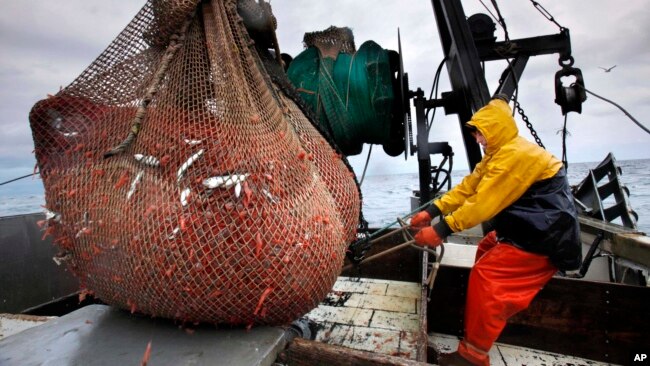
 James Rich maneuvers a bulging net full of northern shrimp caught in the Gulf of Maine, Jan. 6, 2012.

Officials in Alaska have canceled the fall Bristol Bay red king crab harvest and winter snow crab harvest, dealing a blow to the Bering Sea crab industry that is sometimes worth more than $200 million a year, as populations have declined in the face of warming waters. The Atlantic cod fishery, once the lifeblood industry of New England, is now essentially shuttered. But even with depleted populations imperiled by climate change, it's rare for regulators to completely shut down a fishery, as they're considering doing for New England shrimp.

The Northern shrimp, once a seafood delicacy, has been subject to a fishing moratorium since 2014. Scientists believe warming waters are wiping out their populations and they won't be coming back. So the regulatory Atlantic States Marine Fisheries Commission is now considering making that moratorium permanent, essentially ending the centuries-old harvest of the shrimp.

It's a stark siren for several species caught by U.S. fishermen that regulators say are on the brink. Others include softshell clams, winter flounder, Alaskan snow crabs and Chinook salmon.

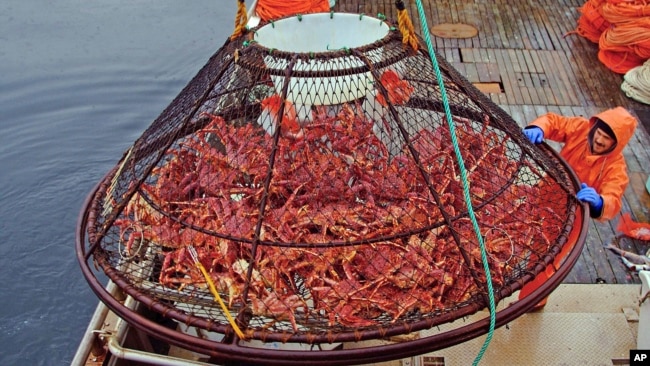
Ralph Strickland guides a crab pot full of red king crabs onto the deck of fishing vessel off of Juneau, Alaska, Nov. 6, 2005.

Exactly how many fisheries are threatened principally by warming waters is difficult to say, but additional cutbacks and closures are likely in the future as climate change intensifies, said Malin Pinsky, director of the graduate program in ecology and evolution at Rutgers University.

"This pattern of climate change and how it ripples throughout communities and coastal economies is something we need to get used to," Pinsky said. "Many years are pushing us outside of what we have experienced historically, and we are going to continue to observe these further novel conditions as years go by."

While it's unclear whether climate change has ever been the dominant factor in permanently shutting down a U.S. fishery, global warming is a key reason several once-robust fisheries are in increasingly poor shape and subject to more aggressive regulation in recent years. Warming temperatures introduce new predators, cause species to shift their center of population northward, or make it harder for them to grow to maturity, scientists said.

In the case of the Northern shrimp, scientists and regulators said at a meeting in August that the population has not rebounded after nearly a decade of no commercial fishing. Regulators will revisit the possibility of a permanent moratorium this winter, said Dustin Colson Leaning, a fishery management plan coordinator with the Atlantic States commission. Another approach could be for the commission to relinquish control of the fishery, he said.

The shrimp prefer cold temperatures, yet the Gulf of Maine is warming faster than most of the world's oceans. Scientists say warming waters have also moved new predators into the gulf.

But in Maine, where the cold-water shrimp fishery is based, fishermen have tried to make the case that abundance of the shrimp is cyclical and any move to shutter the fishery for good is premature.

"I want to look into the future of this. It's not unprecedented to have a loss of shrimp. We went through it in the '50s, we went through it in the '70s, we had a tough time in the '90s," said Vincent Balzano, a shrimp fisherman from Portland. "They came back."

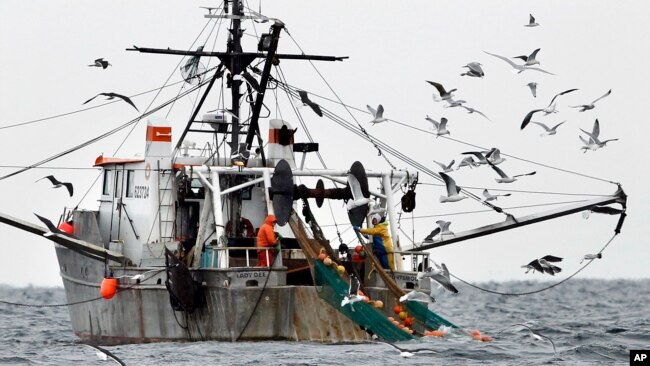
Gulls follow a shrimp fishing boat as crewmen haul in their catch in the Gulf of Maine, Jan. 6, 2012.

Another jeopardized species is winter flounder, once highly sought by southern New England fishermen. The National Oceanic and Atmospheric Administration has described the fish as "significantly below target population levels" on Georges Bank, a key fishing ground. Scientists with University of Rhode Island and Rhode Island Department of Environmental Management wrote that the fish have struggled to reach maturity "due to increased predation related to warming winters" in a report last year.

On the West Coast, Chinook salmon face an extinction risk due to climate change, NOAA has reported. Drought has worsened the fish's prospects in California, at the southern end of its range, scientists have said.

Fishermen on the East Coast, from Virginia to Maine, have dug softshell clams from tidal mud for centuries, and they're a staple of seafood restaurants. They're used for chowder and fried clam dishes and are sometimes called "steamers."

But the clam harvest fell from about 3.5 million pounds (1.6 million kilograms) in 2010 to 2.1 million pounds (950,000 kilograms) in 2020 as the industry has contended with an aging workforce and increasing competition from predators such as crabs and worms. Scientists have linked the growing predator threat to warming waters.

The 2020 haul in Maine, which harvests the most clams, was the smallest in more than 90 years. And the 2021 catch still lagged behind typical hauls from the 2000s, which were consistently close to 2 million pounds (907,000 kilograms) or more.

Predicting what the clam harvest will look like in 2022 is difficult, but the industry remains threatened by the growing presence of invasive green crabs, said Brian Beal a professor of marine ecology at the University of Maine at Machias. The crabs, which eat clams, are native to Europe and arrived in the U.S. about 200 years ago and have grown in population as waters have warmed.

"There seem to have been, relative to 2020, a ton more green crabs that settled," Beal said. "That's not a good omen."

One challenge of managing fisheries that are declining due to warming waters is that regulators rely on historical data to set quotas and other regulations, said Lisa Kerr, a senior research scientist with the Gulf of Maine Research Institute in Portland, Maine. Scientists and regulators are learning that some fish stocks just aren't capable of returning to the productivity level of 40 years ago, she said.

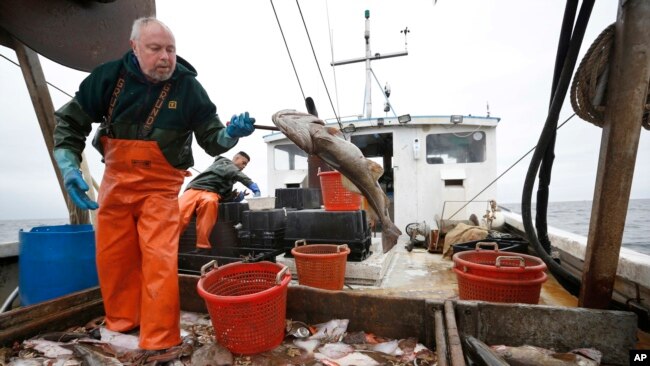
David Goethel flips a cod while sorting ground fish caught off the coast of New Hampshire, on April 23, 2016.

Back then, U.S. fishermen typically caught more than 100 million pounds (45.4 million kilograms) of Atlantic cod per year. Now, they usually catch less than 2 million pounds (907,000 kilograms), as overfishing and environmental changes have prevented the population from returning to historical levels.

The future of managing species that are in such bad shape might require accepting the possibility that fully rebuilding them is impossible, Kerr said.

"It's really a resetting of the expectations," she said. "We're starting to see targets that are more in line, but under a lower overall target."
THIRD WORLD U$A
Food Pantries Anticipate Record Demand This Thanksgiving. 
They’ll Need Record Donations to Meet It.


Written By CHRISTINA LOREY
Originally Published OCTOBER 29, 2022


Nearly three years since the pandemic began, high grocery prices are now driving thousands of Wisconsin families to their local pantries for the first time.

You’ve probably noticed the price of just about everything–from a carton of eggs to a gallon of gas– is significantly higher than this time last year. Costs are up an average of 8%, according to the Consumer Price Index, a 40-year high.

For many families, the rising price of food is the first thing they notice. In 2020, Americans spent 9% of their income on food, according to the US Dept. of Agriculture. Every day, more families are realizing they simply can’t afford that anymore. Many are using food pantries for the very first time.

Wisconsin’s food pantries are still frequently stigmatized, seen as something used by people who are homeless. Or addicts. Or lazy. That couldn’t be further from the truth.

Heading into two of the most food-focused months of the year, we sat down with Feeding Wisconsin’s Executive Director to find out who’s really using them, what they need, and how you can help.

Christina Lorey, UpNorthNews Editor: What is the need for food like right now in Wisconsin compared to when the pandemic started [spring 2020]?

Stephanie Jong Dorfman, Executive Director of Feeding Wisconsin: Our network [of local food pantries] is once again seeing peak-COVID demand. We’re experiencing anywhere from a 28-43% increase in visitors depending on what part of the state you’re in.

Why are the numbers so high?

COVID-era policies and programs worked! However, we’re starting to see that food hardship is once again on the rise, in part because those programs and policies are dropping off. When either the federal or state Public Health Emergency orders end, Wisconsinites will lose an estimated $71,000,000 per month in emergency allotments (this number has been increasing).

Can you explain what food insecurity is?

Food insecurity is the USDA’s measure of lack of access to enough food for an active, healthy life for all household members. Food-insecure households are not necessarily food insecure all the time. Food insecurity may reflect a household’s need to make trade-offs between important basic needs, like paying housing or medical bills and purchasing nutritionally-adequate food.


How much of a problem was food insecurity before the pandemic?

In 2019, Feeding America estimated more than 530,000 Wisconsinites–or 9% of the population–were food insecure. That included nearly 184,000, or 14.5%, of Wisconsin’s children. We also know that food insecurity disproportionately impacts different communities:27% Black Wisconsinites experienced food insecurity
21% Latino Wisconsinites experienced food insecurity
7% White Wisconsinites experienced food insecurity

Food security for white Wisconsinites actually improved during the pandemic–to 5%. The other groups stay the same.

Let’s talk about your organization. How many people does Feeding Wisconsin help?

I don’t have an up-to-date estimate because we’re currently pulling data from the past year. I can share that Feeding Wisconsin operates the state’s six regional Feeding America-affiliated food banks that provide food to almost 1,000 local food programs in all 72 counties. Together, Feeding Wisconsin’s network provided 86 million pounds of food to Wisconsinites in every corner of our state in 2021, an increase of 75% over 2019.


Is there a “busiest time of year” for Wisconsin pantries?

In times that are not impacted by a pandemic or other economic recession-fueled reasons, the busiest times are often holidays and out-of-school times–when families might have to try harder to put food on their tables and have more competing financial obligations than usual. Weekends, summer, and holiday breaks usually place an additional financial burden on families.


If people are able to help, what would you say are the five best items they can bring to a pantry?Peanut Butter
Canned Proteins (beans, chicken, tuna)
Low-Sodium and Low-Sugar Canned Veggies and Fruits
Pasta
Low-Sugar Cereals


What’s better: donating time, food, or money?

All of the above! Our food banks rely on food, funds, and friends.

Let’s address each of those. What do volunteers do and when do you need them most?

Food banks rely on volunteer power to sort, repack, and distribute food. Food banks and partnering community food distribution organizations need volunteers year round, but we often see a lull in volunteering after the winter holidays.


And what about food and money?

Donating food is always helpful, but donating money enables food banks to purchase exactly the foods their communities are requesting. Funds help provide fresh, nutritious foods like produce, dairy, and protein that are harder for individuals to donate. We can also purchase items more efficiently at scale [so your donation stretches farther].


What can $5 cover?

Our food banks estimate that $1 can support an estimated 3 meals. So $5 supports 15 meals, $20 supports 60 meals, and $50 supports 150 meals.


What do you think is still the biggest misconception about people who get help from a food pantry?


That they’re not like us
. Unfortunately, the pandemic brought to light the normalizing experience of food insecurity. Folks seeking resources from a pantry, nutrition benefits, or other resources are our friends, family and neighbors. Everyone needs help from time to time, and everyone deserves support to have their basic needs met.

Click here to GET INVOLVED with Feeding Wisconsin.

Click here to find a pantry near you and GET HELP today.

Feeding Wisconsin’s mission is to support and empower food banks, partners, and the general public in all 72 counties to end hunger, improve health and strengthen local communities. Through our food banks and food pantries, we work to ensure that everybody has access to the food and benefits they need to work, learn, play and live healthy lives.


Christina Lorey A former producer, reporter, and anchor for TV stations in Madison and Moline, Illinois, Christina has been a coach and mentor for Girls on the Run and has organized events for the Pancreatic Cancer Action Network and the Susan G. Komen Foundation.
As Wildfires Grow, so Does California’s Housing and Homelessness Crisis. Here Are Some Solutions


Wildfires and the destruction they cause have become a societal problem, and like all societal problems, those with more resources are better equipped to recover.


October 29, 2022 by California Health Report 


LONG READ


By Claudia Boyd-Barrett
This story was produced as part of a collaboration with the Center for Public Integrity, Columbia Journalism Investigations and Type Investigations.

At an assistance center for wildfire survivors in Quincy, Californians lined up to speak with Matt Plotkin and other relief staff. One after another, they told the stories of how their homes had burned to the ground.

A couple stepped forward. They had lost it all too, they explained.

But it wasn’t the first time.

Their rental housing burned in the 2018 Camp Fire, which destroyed their hometown of Paradise. Then they moved to the small community of Berry Creek, only to be displaced two years later in the 2020 North Complex Fire. The following year, after settling in nearby Plumas County, the Dixie Fire left them homeless again.

The couple, who had lost three houses in three separate fires over the course of four years, became, for Plotkin, the faces of the coming crisis for California — where annual wildfires leave more people without homes in a state already squeezed dry of affordable places to live.

“What do you tell these people?” said Plotkin, who works for United Way of Northern California. “It’s just so heartbreaking when you hear they tried to restore and recover themselves in a new community and then that community gets wiped out, and then they go to another one and that gets wiped out.”

A disaster services manager, Plotkin helps wildfire survivors find housing and resources. But bigger and more frequent wildfires are making his job harder.

With each loss, Plotkin said, the trauma “just magnifies.”

As climate change increases the frequency and intensity of wildfires in California and throughout the West, more people are losing their homes and facing long-term displacement and instability, including homelessness. This week, the massive McKinney fire is swallowing homes and forest land indiscriminately in Siskiyou County, forcing thousands to evacuate. Some, like the families Plotkin regularly encounters, are reliving the trauma of losing a home to wildfires multiple times. Those with fewer assets and resources are most at risk of losing housing due to wildfires, particularly renters, people without adequate property insurance and those with informal living arrangements (who live in trailers on someone else’s property or live with multiple families, for example). These individual struggles exacerbate the confluence of three statewide crises: destruction wrought by climate change, a severe lack of affordable housing and the many Californians experiencing homelessness.

Researchers and those who work with disaster victims said there is insufficient government assistance to help the most vulnerable wildfire survivors find long-term, stable housing. There also isn’t enough housing to accommodate California’s swelling population of wildfire refugees. Solutions, experts said, must tackle both of these problems.

Wildfires and the destruction they cause have become a societal problem, and like all societal problems, those with more resources are better equipped to recover. Californians who are dealing with other pressing needs, such as putting food on the table or paying rent, do not always have the ability to plan for catastrophic fires, or the financial resources to withstand disruptions to their housing arrangements. The result is that low-wage workers, seniors on fixed incomes, people of color, immigrants, those with disabilities and many other Californians — who are already impacted by the legacy of social, economic and environmental inequities — are being further left behind. California is, in many ways, becoming a state where the wealthy can weather climate change while the rest struggle to survive.

More than 3,600 structures, including homes, burned in California wildfires during 2021. Between 2005 and 2020, nearly 60,000 structures were lost to fire in the state, according to the research firm Headwaters Economics. Some of these are rentals, which landlords may choose not to rebuild. Others are uninsured or underinsured homes that property owners can’t afford to reconstruct. Even property owners who get insurance payouts may decide to find a home elsewhere. Others can face a years-long wait for permit approvals and construction completion. The result is thousands of more Californians looking for housing in an already strained market.

In rural Trinity County, large wildfires have displaced hundreds of residents since 2017, said Sheri White, executive director of Human Response Network, a nonprofit organization in Weaverville. Many of those without the means to rebuild or find a new rental have moved in with family or left the area altogether. Others are living in travel trailers her organization provided as a temporary solution because they have been unable to find a permanent place to live.

“If they want to stay in Trinity County, it’s extremely difficult to find a place to stay,” she said. “Renting up here can be expensive. We have rentals that are $1,600 a month, and that’s kind of expensive if you are working a minimum wage job or living on social security or retirement alone and you don’t have a larger retirement.”

Elsewhere in the state, especially in the larger cities and coastal areas, rent can easily cost double that amount. The cost of housing is astronomical for many Californians. Median rent for a two-bedroom apartment in the Los Angeles, San Francisco and San Diego areas, for example, is $3,500 monthly or more.

Housing and rent prices have risen in communities where people have fled after losing their homes to wildfires. This happened in Chico in Butte County following the Camp Fire in 2018, which destroyed the town of Paradise and killed 85 people. The city has witnessed an increase in poverty and long-term homelessness, straining social services.

Yet while communities face enormous long-term repercussions after a wildfire, state and federal government funding mostly tackles short-term fire suppression and cleanup costs, according to a report by Headwater Economics. Almost half of all wildfire costs — including home reconstruction — are borne by local people, municipal agencies, businesses and nonprofits, the report found.

In Trinity County after the Helena Fire, for example, White’s organization raised donations from individuals and businesses to cover the cost of the travel trailers and other support for fire victims. But more funding is needed to help people long term.

“It would be really helpful to get some federal funding to assist people in finding housing, assist people with some of the cleanup for their property so they can start the rebuilding process,” she said.

Whether federal help is available for fire victims also depends on if a fire is large and destructive enough to be declared a federal disaster. Even then, renters and people without home insurance receive a limited amount of help from the Federal Emergency Management Agency (FEMA). Uninsured homeowners whose properties are destroyed can get a maximum of $34,900 — generally not enough to buy another home in California. Renters, especially those who did not have formal rental contracts or arrangements, often struggle to get any FEMA money at all, Plotkin said. Those who are undocumented are ineligible to receive FEMA aid.

Finding solutions

So far, community and government responses to wildfires have focused on rebuilding in the same location, “hardening” homes to increase fire resistance and creating “defensible space” around fire-prone homes and neighborhoods by removing flammable materials. But in an age of runaway climate change, some experts believe that’s no longer enough. Instead, they said some Californians will need to retreat entirely from wildfire prone areas.

Families like the one Plotkin described are already leaving, albeit involuntarily and without sufficient support or housing alternatives. Some others who are still living in areas impacted by wildfires want to move. A 2021 Yahoo News/YouGov poll found that about 1 in 6 Americans who reported noticing more extreme weather in their areas are considering moving.

To avoid further wildfire-induced homelessness and destabilization of the housing market, policymakers must figure out how to better manage this retreat, experts said. Suggestions include using federal disaster funds to pay for voluntary relocation, building denser and more affordable housing in urban centers largely protected from wildfires, and using insurance or tax incentives to encourage reconstruction and new housing development in safer locations.

“In many of these places we can’t really manage our way out of wildfires,” said Emily Schlickman, an assistant professor of landscape architecture at the University of California, Davis, who has studied the impacts of fires on Butte County’s housing supply, including in Chico where homelessness has ballooned since the Camp Fire.

“I think what’s happening in Butte County is kind of a glimpse of what’s to come in the rest of the state,” Schlickman said.

Some of this managed relocation could be accomplished using FEMA dollars, Schlickman said. The agency could offer voluntary buyouts for homes destroyed or at severe risk for wildfires, just as it has in some coastal areas of the state prone to flooding. In some cases, it may be necessary to relocate entire communities.

At the same time, California must invest more in building affordable and dense housing in urban centers, said Robert B. Olshansky, an expert in urban planning and lead author on a report by the UC Berkeley Center for Community Innovation, commissioned by the nonprofit advocacy group Next 10.

“Providing more housing units … and more affordable units in central places accessible to services will not only help us continue to meet the well-known housing goals for the state, but also actually help us to address the fire problem,” he said.

His report also suggests using property tax and fire insurance surcharges to discourage people from building or buying property in fire prone areas, although Olshansky said this must include caveats to ensure low-income residents in those areas are not further disadvantaged.

Meanwhile, Californians continue to move into wildfire-prone areas for a variety of reasons, including to find a lower-cost housing or to live closer to nature. The state has issued moratoriums to prohibit insurance companies from dropping coverage for homes in areas impacted by wildfires. And the state has been slow to build more homes that people can afford.

What’s more, while a data analysis by Columbia Journalism Investigations shows
California received over $1.55 billion in FEMA funds to mitigate disaster risks between 1991 and 2021, none of this money has been used to move people out of the way of wildfires through property buyouts (although $56 million in federal funds has been used to acquire properties impacted by other types of disasters such as river and coastal flooding), FEMA did fund $66.6 million in wildfire mitigation projects in California during that time period, with the vast majority of funds spent on reducing fire risks, such as by clearing vegetation around properties and retrofitting buildings.

In an email, Rosa C. Norman with FEMA’s Communications Division said agency funding can be used to acquire properties endangered by wildfires, but this requires an application from the state, tribe, or territory in which the property is located, the consent of each property owner, and FEMA approval. No one can be forced to take a buyout for their property, she noted.

Brian Ferguson, deputy director for crisis communication and public affairs with the California Governor’s Office of Emergency Services said the state has led the nation in recent years by creating a disaster preparedness outreach and education program, and through investments in hardening homes and communities against wildfires. However, the state is not looking at moving people out of wildfire zones through property buyouts as it poses both moral and practical challenges, he said.

“Our government has a long history of displacing people, particularly vulnerable populations, people of color in the name of progress, whether that be for placing our freeways or for other sorts of governmental initiatives,” he said. “I think we would be very thoughtful or cautious before engaging in any sort of program of moving individuals out of their historic community.”

At the same time, the number of people living in areas at risk for wildfires is enormous. Between 8 and 10 million Californians live in the “wildland urban interface” – the areas between forests and urban centers. Moving that number of people away from their homes isn’t practical, Ferguson said. Additionally, many Californians want to live in these areas despite the fire risk, he added.

That said, counties and other local jurisdictions can still choose to apply to FEMA for grants that fund property acquisitions if they choose.

Schlickman said she’s hopeful governments will invest more in moving people out of harm’s way. In Paradise, a pilot program managed by the city’s recreation department and funded largely by nonprofit grants and donations is experimenting with offering voluntary buyouts. Chico is coming up with ways to expand affordable housing, including by creating tiny home communities.

“There’s a big push for us to get really creative,” Schlickman said. “I think the wheels are turning.”

Meanwhile, the United Way of Northern California continues to pour resources into helping fire survivors, such as the couple in Quincy. Last year alone the organization provided more than $1.6 million in financial assistance to over 1,000 families affected by the Camp fire, North Complex fire and 2021 wildfires, including the couple in Quincy. But it’s not enough to help everyone who needs it, Plotkin said. And with the threat of more wildfires looming in the heat-and-drought-stricken state, he worries it could get increasingly challenging for philanthropic organizations to raise funds after each new disaster.

“We’re getting to a place in our society where disaster fatigue is real,” Plotkin said.


This article first appeared on California Health Report and is republished here under a Creative Commons license.
AOC says the US is 'truly facing an environment of fascism' where voter intimidation 'brings us to Jim Crow'
Katie Balevic
U.S. Rep. Alexandria Ocasio-Cortez (D-NY). Kevin Dietsch/Getty Images

AOC said the US is experiencing fascism and voter intimidation that mimics the Jim Crow era.
As the midterms approach, Rep. Ocasio-Cortez said Americans must "strongly defend democracy" in the US.

Federal officials warned that threats of violence may rise due to "perceptions of election-related fraud."

Rep. Alexandria Ocasio-Cortez said the US is experiencing "an environment of fascism" as some states are facing concerns of voter intimidation amid early voting.

Ocasio-Cortez's comments on Friday come as a federal judge ruled it is acceptable for activists to watch ballot drop boxes following reports of armed and masked individuals monitoring a ballot drop in Mesa, Arizona last week.

"We are really truly facing an environment of fascism in the United States of America. This type of intimidation at the polls brings us to Jim Crow," Ocasio-Cortez said on MSNBC's "All in with Chris Hayes" on Friday in a conversation with Hayes and Rep. Jamie Raskin.

"It brings us back and harkens back to a very unique form of American apartheid that is not that long past ago, and we have never fully healed from it," she added. "Those wounds threaten to rip right back open if we do not strongly defend democracy in the United States of America."

On Friday, federal officials from the Department of Homeland Security, FBI, US Capitol Police, and National Counterterrorism Center warned that the midterm elections will likely see an increase in threats, though the officials did not list specific threats, per CNN.

"Following the 2022 midterm election, perceptions of election-related fraud and dissatisfaction with electoral outcomes likely will result in heightened threats of violence against a broad range of targets―such as ideological opponents and election workers," the bulletin from the federal officials said, per CNN.

Ocasio-Cortez echoed the sentiment on MSNBC, citing her experience listening to testimonies while on the Civil Rights and Civil Liberties Subcommittee of the House Committee on Oversight and Reform.

"There is absolutely no doubt that the data shows that the vast majority of incidents of domestic terror come from white nationalism," Ocasio-Cortez said while acknowledging that "political violence can come from all different parts of the political spectrum."

In Arizona, two nonprofits filed a lawsuit arguing that a group called Clean Elections USA was encouraging violence and intimidation after the group organized efforts to watch ballot drop boxes across the country in their attempt to prevent voter fraud, echoing similar claims that were rampant yet vastly disproven following the 2020 election, per The New York Times.

Judge Michael T. Liburdi argued that while "many voters are legitimately alarmed by the observers filming" near drop boxes, there was no evidence that the group had encouraged violence, per the Times. The judge did, however, opt to leave the case open and agreed to hear new evidence.

On MSNBC alongside Ocasio-Cortez, Rep. Raskin said it is imperative that voters "show no fear."

"You've got to view the guy showing up in cammo gear and masks as part of that history as an attempt to discourage people from going out to vote," Raskin said. "It's really critical in this election that every voter understand all of the different ways that they can vote in their state and that they do vote and they show no fear."


Rep. Alexandria Ocasio-Cortez says the stakes of the midterms are 'incredibly high,' with abortion access, Social Security, and Medicare on the line
AOCVoter IntimidationArizona
.
'Yawn': Catholic 'chief exorcist' criticizes southern Protestant Halloween 'Hell Houses'

Bob Brigham
October 29, 2022

Hell (Shutterstock)

The Southern evangelical "Hell Houses" put on during Halloween are not an effective mechanism of scaring people into believing in Christianity, according to the "chief exorcist" for the Archdiocese of Washington, D.C.

"This October some churches and ministries in the United States are once again hosting Christian versions of haunted houses, and nonbelievers and believers alike are lining up for some rather existential spine-tingling for the first time since the pandemic," the Catholic News Agency reported. "Popular among evangelical Protestant churches in the South, these 'judgment houses' typically stage dramatic representations depicting what happens after people die, leaving visitors to ponder whether they themselves are headed for heaven or hell, and presumably, to act accordingly."

The Catholic News Agency says televangelist Jerry Falwell, Sr. began the trend in 1972 when he started "Scaremare" at Liberty University in Virginia.

"While judgment houses can function as memento mori, efficacious reminders of the inevitability of death, some judgment houses, also known as 'Hell Houses,' have become controversial for taking the idea to an extreme," the Catholic News Agency reported. "Graphic scenes such as abortions, extramarital sex, and drug use are sometimes depicted along with the consequence of these actions as the sinners are shown condemned to spend eternity in hell."

The report says the judgment houses have not spread among Catholic churches.

Monsignor Stephen Rossetti, the DC exorcist, says the threat of hell is not an effective way to proselytize.

“People today are not convinced or influenced by threats of hell. The Church just really stopped doing that because it just doesn't work. You know, you can do all the hellfire and damnation sermons you want, but people just kind of yawn, “ Rossetti said.

“We're trying to emphasize God's love and God's mercy, which I think is much more to the point, frankly," he explained. “This is what attracts people, and this is sort of the core of our message. God loves us and God has saved us out of his love and compassion in Jesus."