Tuesday, April 18, 2023

US Supreme Court to deliver answer in religious mailman’s case
ITS CALLED DUTY TO ACCOMODATE IN
CANADA

By JESSICA GRESKO
yesterday

Gerald Groff, a former postal worker whose case will be argued before the Supreme Court, speaks during a television interview with the Associated Press at a chapel at the Hilton DoubleTree Resort in Lancaster, Pa., Wednesday, March 8, 2023.
 (AP Photo/Carolyn Kaster)

LANCASTER, Pa. (AP) — Gerald Groff liked his work as a postal employee in Pennsylvania’s Amish Country. For years, he delivered mail and all manner of packages: a car bumper, a mini refrigerator, a 70-pound box of horseshoes for a blacksmith. But when an Amazon.com contract with the United States Postal Service required carriers to start delivering packages on Sundays, Groff balked. A Christian, he told his employers that he couldn’t deliver packages on the Lord’s Day.

Now Groff’s dispute with the Postal Service has reached the U.S. Supreme Court, which will consider his case Tuesday. Lower courts have sided with the Postal Service, which says Groff’s demand for Sundays off meant extra work for other employees and caused tension. Groff, for his part, argues employers can too easily reject employees’ requests for religious accommodations, and if he wins, that could change.

“We really can’t go back and change what happened to me,” said Groff, who ultimately quit his job over the Sunday shifts. But he says that other people “shouldn’t have to choose between their job and their faith.”

Groff’s case involves Title VII of the Civil Rights Act of 1964, which prohibits religious discrimination in employment. The law requires employers to accommodate employees’ religious practices unless doing so would be an “undue hardship” for the business.


Groff grew up in Lancaster County, where he attended Mennonite schools and lived in a home across the street from his grandparents’ farm. His grandfather’s death around the time he graduated from high school was a turning point for him, he said, and helped motivate him to work as a missionary. While he has a college degree in biology, over the years he has gone on eight mission trips lasting anywhere from two months to two years that took him to Asia, Africa and Latin America.

He did different jobs in between but in 2012 he found a job at the Postal Service, regularly filling in as a mail carrier when other carriers were off or sick.

“I just really enjoyed the job from the very beginning. You get to be out in the countryside, in the fresh air ... It’s a beautiful place to live and work and I just really enjoyed it and planned to make a career of it unless God called me back to the mission field somewhere,” said Groff of his job as a rural carrier associate.

As a fill-in mail carrier he ultimately learned 22 different routes, which he would drive in his Honda CR-V, hitting 500 to 800 mailboxes a day. Eventually, he hoped to become a regular mail carrier, with a set route of his own.

Soon after Groff joined the Postal Service, however, it signed a contract with Amazon to deliver packages on Sundays. And about four years into the job Groff was told he’d have to start working his share of Sunday shifts. Groff said no. Sunday, he says, is “a day we come together as Christian believers and we honor the Lord’s Day.”

“And so to give that up, to deliver Amazon packages would be to give up everything that we believe in,” Groff said.

To avoid Sunday work, Groff gave up his seniority at the post office in rural Quarryville, Pennsylvania, where the parking lot includes two spaces labeled “HORSE AND CARRIAGE ONLY.” He transferred to a smaller office in nearby Holtwood, which was not yet doing Sunday deliveries. Eventually, however, Sunday deliveries were required there too.

Groff told his supervisor he’d work extra shifts and holidays to avoid Sundays. The supervisor tried to find other carriers for Groff’s Sunday shifts, even though finding substitutes was time consuming and not always possible. Groff’s absences, meanwhile, created a tense environment, led to resentment toward management and contributed to morale problems, officials said. It also meant other carriers had to work more Sundays or sometimes deliver more Sunday mail than they otherwise would. One carrier transferred and another resigned in part because of the situation, Groff’s supervisor said.

Eventually, however, Groff missed enough Sundays that he was disciplined. He resigned in 2019 rather than wait to be fired, he said, and then filed a religious discrimination lawsuit.

Groff says that under a 1977 Supreme Court case, Trans World Airlines v. Hardison, employers don’t have to show much to prove an undue hardship and can deny religious accommodations to employees when they impose “more than a de minimis cost” on the business. The case was 7-2 in favor of TWA with both liberals and conservatives in the majority.

But Groff’s lawyer Hiram Sasser of the First Liberty Institute says the Hardison case “sort of stacked the deck against employees and the common folk.” “They’ve got to climb Mount Kilimanjaro to try to win one of their cases, and, I mean, that’s not right,” he said.

Groff wants the Supreme Court to say that employers must show “significant difficulty or expense” if they want to reject a religious accommodation.

Biden administration lawyers representing the Postal Service say Hardison should be clarified to make clear it gives substantial protection for religious observance. But the administration also says that when accommodating the religious practices of one employee negatively impacts other employees, that can be an undue hardship on a business.

Groff would seem to have the upper hand. Three current justices — Clarence Thomas, Samuel Alito and Neil Gorsuch — have said the court should reconsider Hardison. And in recent years the court’s conservative majority has been particularly sympathetic to the concerns of religious plaintiffs.

Last year, for example, the court sided with another one of First Liberty’s clients, a football coach at a public high school who wanted to be able to kneel and pray on the field after games.

Groff, for his part, has found other work since leaving the Postal Service. These days, he’s essentially the postmaster for a retirement community with several thousand residents. He oversees a staff of volunteer residents that sorts mail and puts it in mailboxes every day except Sunday.

There are no Sunday deliveries to Groff’s home either. He says he went in and disabled them on Amazon.

“I can wait for that stuff,” he said. “And if I need it that bad, I’ll go to the store and get it.”
Rail CEO to testify in Ohio Senate about fiery derailment

By SAMANTHA HENDRICKSON
TODAY

A black plume rises over East Palestine, Ohio, as a result of a controlled detonation of a portion of the derailed Norfolk Southern trains, on Feb. 6, 2023. Norfolk Southern CEO Alan Shaw is set to testify before an Ohio Senate rail safety panel on Tuesday, April 18, more than two months after the fiery train derailment rocked the village of East Palestine.
 (AP Photo/Gene J. Puskar, File)

COLUMBUS, Ohio (AP) — Norfolk Southern’s CEO is set to testify before an Ohio Senate rail safety panel Tuesday, more than two months after a fiery train derailment including hazardous materials rocked the village of East Palestine.

Alan Shaw has promised millions of dollars to help the Ohio-Pennsylvania border community recover, but also faces a lawsuit from Ohio’s Attorney General Dave Yost over costs for the toxic chemical spill cleanup and environmental damage. The federal government has also sued the railroad.

Shaw previously testified before the Pennsylvania legislature as well as Congress over the derailment, but now faces Ohio lawmakers, who recently passed a state transportation budget that would impose new rail safety measures on Norfolk Southern and other railroads traveling through their state.

Whether they’re allowed to do so, however, remains a point of debate. The Ohio Railroad Association, a trade group, has argued that several of the measures are preempted by federal law. Legislators say the General Assembly can put statewide safeguards in place to help protect constituents.

No one was injured during the Feb. 3 derailment, but half of the nearly 5,000 East Palestine residents were evacuated for days. Many say they continue to suffer from health problems because of an intentional toxic chemical release and burn, which was conducted to prevent uncontrolled explosions after the derailment.

___

Samantha Hendrickson is a corps member for the Associated Press/Report for America Statehouse News Initiative. Report for America is a nonprofit national service program that places journalists in local newsrooms to report on undercovered issues.
MORAL MONDAY PROTEST
Gun safety demonstrators carry caskets to Tennessee Capitol

By GEORGE WALKER IV
TODAY

1 of 19
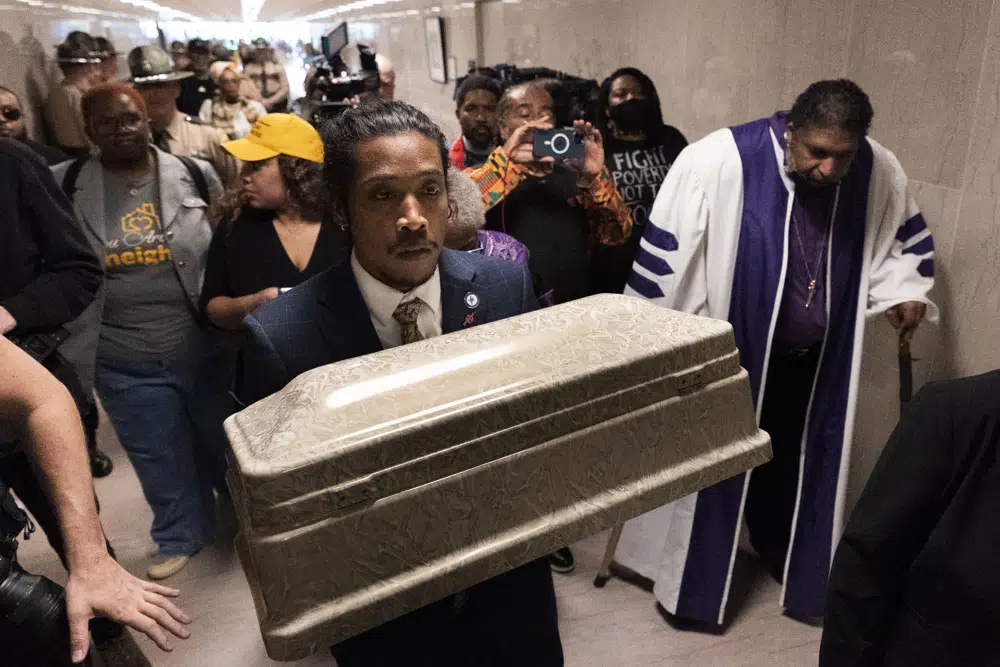
Rep. Justin Jones, D-Nashville, carries a casket through the halls of the state Capitol with Rev. William J. Barber, right, Monday, April 17, 2023, in Nashville, Tenn. (AP Photo/George Walker IV)

NASHVILLE, Tenn. (AP) — Protesters calling for gun safety legislation were blocked from bringing caskets inside Tennessee’s Capitol, but a recently reinstated legislator escorted an infant-sized casket inside before he was barred from carrying it onto the House floor.

Protesters led by Bishop William Barber II marched in Nashville, demanding that lawmakers pass the legislation and stop using their authority to trample democracy. They carried several caskets symbolizing those lost to gun violence on Monday.

“The legislators are back, but returning duly elected lawmakers to their seat does not solve the problem,” Barber said, demanding that lawmakers “stop committing policy murder.”

The fatal shooting of six people at a Nashville private school last month kicked off a stream of calls for changes to Tennessee’s gun laws, including a ban on assault weapons, tougher background checks and a “red flag” law. Republican Gov. Bill Lee has urged lawmakers to pass legislation that would keep firearms away from people who could harm themselves or others. So far, the Republican supermajority has refused.

Reps. Justin Jones and Justin Pearson, both Democrats, returned to the GOP-dominated General Assembly last week after being ousted for their role in a pro-gun control demonstration from the House floor. The episode has turned Tennessee into a new front in the battle for the future of American democracy and pressured lawmakers to address gun control in a state known for its lax firearm regulations.

On Monday, when protesters were blocked from bringing caskets inside, Jones carried an infant-sized casket past troopers and security, but the sergeant-at-arms stopped him from bringing it onto the floor. As Jones entered the chamber after the session and tried unsuccessfully to get the attention of Republican House Speaker Cameron Sexton, Pearson held the casket at the door. As Sexton left, he stopped for a moment to speak to a few protesters.
TV and film writers authorize strike over pay, other issues

today

Striking film and television writers picket outside Paramount Studios on Jan. 23, 2008, in Los Angeles. In an email to members Monday, April 17, 2023, leaders of the Writers Guild of America said nearly 98% of voters said yes to a strike authorization if a new contract agreement is not reached with producers. The guild last went on strike in 2007.
(AP Photo/Kevork Djansezian, File)


LOS ANGELES (AP) — Unionized film and television writers have voted overwhelmingly to give their leaders the authority to call a strike if they’re unable to reach an agreement on a new contract.

In an email to members Monday, the negotiating committee of the Writers Guild of America said nearly 98% of the 9,218 votes were cast to authorize the strike, with nearly 79% of guild members voting. The guild is currently negotiating with the Alliance of Motion Picture and Television Producers on a deal aimed at addressing pay and other changes brought on by the dominance of streaming services.

“Our membership has spoken,” the email said. “You have expressed your collective strength, solidarity, and the demand for meaningful change in overwhelming numbers.”

The writers’ three-year contract expires May 1, and leaders could call for a walkout the following day, but could extend the deadline if the two sides are close to a deal.

Issues in negotiations include pay, writers’ ability to work for different shows during downtime from other projects, and, according to Variety, the use of artificial intelligence in the script process.

The Alliance of Motion Picture and Television Producers, which negotiates for studios, streaming services and production companies, said in a statement Monday that a “strike authorization vote has always been part of the WGA’s plan, announced before the parties even exchanged proposals. Its inevitable ratification should come as no surprise to anyone.”

“Our goal is, and continues to be, to reach a fair and reasonable agreement,” the statement said.

The writers’ voted for a similar strike authorization in nearly the same numbers in 2017, but a deal was reached before a strike was called. The guild last went on strike in 2007.
‘The Phantom of the Opera’ closes on Broadway after 35 years

By MARK KENNEDY
yesterday

1 of 15
"The Phantom of the Opera" cast appear at the curtain call following the final Broadway performance at the Majestic Theatre on Sunday, April 16, 2023, in New York. 
(Photo by Charles Sykes/Invision/AP)

NEW YORK (AP) — The final curtain came down Sunday on New York’s production of “The Phantom of the Opera,” ending Broadway’s longest-running show with thunderous standing ovations, champagne toasts and gold and silver confetti bursting from its famous chandelier.

It was show No. 13,981 at the Majestic Theatre and it ended with a reprise of “The Music of the Night” performed by the current cast, previous actors in the show — including original star Sarah Brightman — and crew members in street clothes.

Andrew Lloyd Webber took to the stage last in a black suit and black tie and dedicated the final show to his son, Nick, who died last month after a protracted battle with gastric cancer and pneumonia. He was 43.

Andrew Lloyd Webber and the cast of "The Phantom of the Opera" (Photo by Charles Sykes/Invision/AP)

“When he was a little boy, he heard some of this music,” Lloyd Webber said. Brightman, holding his hand, agreed: “When Andrew was writing it, he was right there. So his son is with us. Nick, we love you very much.”

Producer Cameron Mackintosh gave some in the crowd hope they would see the Phantom again, and perhaps sooner than they think.

“The one question I keep getting asked again and again — will the Phantom return? Having been a producer for over 55 years, I’ve seen all the great musicals return, and ‘Phantom’ is one of the greatest,” he said. “So it’s only a matter of time.”

The musical — a fixture on Broadway since opening on Jan. 26, 1988 — has weathered recessions, war, terrorism and cultural shifts. But the prolonged pandemic may have been the last straw: It’s a costly musical to sustain, with elaborate sets and costumes as well as a large cast and orchestra. The curtain call Sunday showed how out of step “Phantom” is with the rest of Broadway but also how glorious a big, splashy musical can be.

“If there ever was a bang, we’re going out with a bang. It’s going to be a great night,” said John Riddle just before dashing inside to play Raoul for the final time.

A fan dressed as the Phantom (Photo by Charles Sykes/Invision/AP)

Based on a novel by Gaston Leroux, “Phantom” tells the story of a deformed composer who haunts the Paris Opera House and falls madly in love with an innocent young soprano, Christine. Webber’s lavish songs include “Masquerade,” ″Angel of Music” and ″All I Ask of You.”

In addition to Riddle, the New York production said goodbye with Emilie Kouatchou as Christine and Laird Mackintosh stepping in for Ben Crawford as the Phantom. Crawford was unable to sing because of a bacterial infection but was cheered at the curtain call, stepping to the side of the stage. The Phantom waved him over to stand beside him, Riddle and Kouatchou.

There was a video presentation of many of the actors who had played key roles in the show over the years, and the orchestra seats were crowded with Christines, Raouls and Phantoms. The late director Hal Prince, choreographer Gillian Lynne and set and costume designer Maria Björnson were also honored.

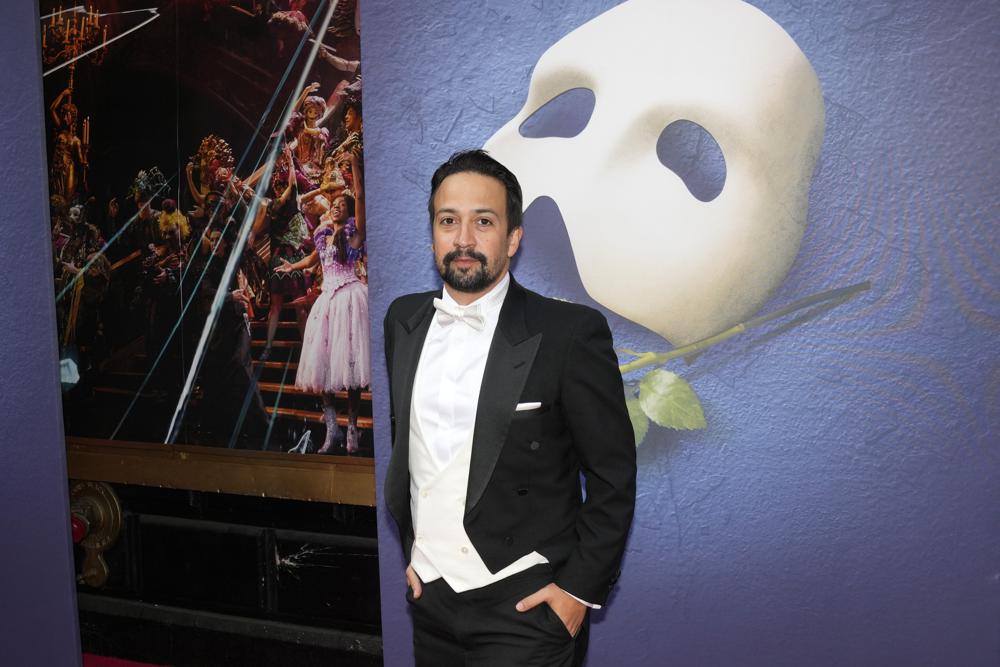
Lin-Manuel Miranda (Photo by Charles Sykes/Invision/AP)

Lin-Manuel Miranda attended, as did Glenn Close, who performed in two separate Broadway productions of Lloyd Webber’s “Sunset Boulevard.” Free champagne was offered at intermission and flutes of it were handed out onstage at the curtain call.

Riddle first saw “The Phantom of the Opera” in Toronto as a 4-year-old child. “It was the first musical I ever saw. I didn’t know what a musical was,” he said. “Now, 30-some odd years later, I’m closing the show on Broadway. So it’s incredible.”

Kouatchou, who became the first Black woman in the role in New York, didn’t think the show would ever stop. “I was like, ’OK, I’m going to do my run, ‘Phantom’ is going to continue on and they’ll be more Christines of color,′ ” she said. “But this is it.”

The first production opened in London in 1986 and since then the show has been seen by more than 145 million people in 183 cities and performed in 17 languages over 70,000 performances. On Broadway alone, it has grossed more than $1.3 billion.

When “Phantom” opened in New York, “Die Hard” was in movie theaters, Adele was born, and floppy discs were at the cutting edge of technology. A postage stamp cost 25 cents, and the year’s most popular songs were “Roll With It” by Steve Winwood, “Faith” by George Michael and Rick Astley’s “Never Gonna Give You Up.”

Sarah Brightman (Photo by Charles Sykes/Invision/AP)

Critics were positive, with the New York Post calling it “a piece of impeccably crafted musical theater,” the Daily News describing it as “spectacular entertainment,” and The New York Times saying it “wants nothing more than to shower the audience with fantasy and fun.”

Lloyd Webber’s other musicals include “Cats,” “Jesus Christ Superstar,” “Evita,” “Sunset Boulevard” and “School of Rock.” The closing of “Phantom” means the composer is left with one show on Broadway, the critically mauled “Bad Cinderella.”

The closing of “Phantom,” originally scheduled for February, was pushed to mid-April after a flood of revived interest and ticket sales that pushed weekly grosses past $3 million. The closing means the longest-running show crown now goes to “Chicago,” which started in 1996. “The Lion King” is next, having begun performances in 1997.

Broadway took a pounding during the pandemic, with all theaters closed for more than 18 months. Some of the most popular shows — “Hamilton,” “The Lion King” and “Wicked” — rebounded well, but other shows have struggled.

Breaking even usually requires a steady stream of tourists, especially for “Phantom,” and visitors to the city haven’t returned to pre-pandemic levels. The pandemic also pushed up expenses for all shows, including routine COVID-19 testing and safety officers on staff. The Phantom became a poster boy for Broadway’s return — after all, he is partially masked.

Andrew Lloyd Webber and the cast of "The Phantom of the Opera" (Photo by Charles Sykes/Invision/AP)

Fans can always catch the Phantom elsewhere. The flagship London production celebrated its 36th anniversary in October, and there are productions in Japan, Greece, Australia, Sweden, Italy, South Korea and the Czech Republic. One is about to open in Bucharest, and another will open in Vienna in 2024.

Kouatchou, who walked the red carpet before the final show in a hot pink clinging gown with a sweetheart neckline and a cut out, said the bitterness was undercut by the big send-off. Most Broadway shows that close slink into the darkness uncelebrated.

“It kind of sweetens it, right?” she said. “We get to celebrate at the end of this. We get to all come together and drink and laugh and talk about the show and all the highs and lows. It’s ending on a big note.”

___

Mark Kennedy is at http://twitter.com/KennedyTwits


POSTMODERN FORDISM
China auto show highlights intense electric car competition

By JOE McDONALD
April 15, 2023

THE CAR SALESMAN LOOKS THE SAME ACROSS THE GLOBE

1 of 9
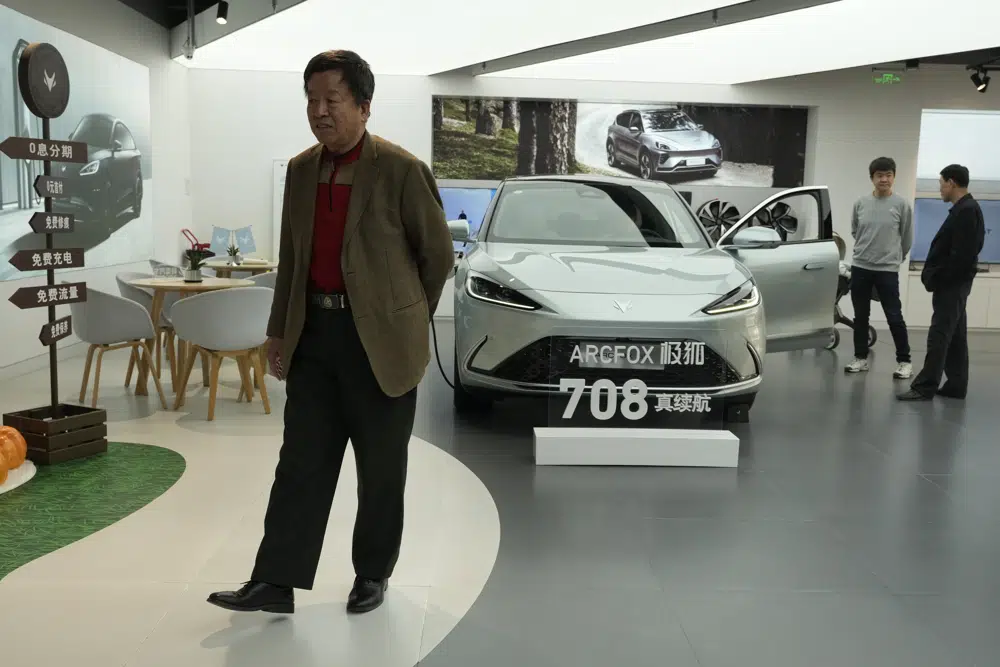
Visitors look at the Arcfox a-S, an all electric car from Chinese automaker BAIC which claims to have a 708km range on a single charge, at a show room in Beijing, Thursday, April 13, 2023. Global and Chinese automakers plan to unveil more than a dozen new electric SUVs, sedans and muscle cars this week at the Shanghai auto show, their first full-scale sales event in four years in a market that has become a workshop for developing electrics, self-driving cars and other technology. (AP Photo/Ng Han Guan)

SHANGHAI (AP) — Global and Chinese automakers plan to unveil more than a dozen new electric SUVs, sedans and muscle cars this week at the Shanghai auto show, their first full-scale sales event in four years in a market that has become a workshop for developing electrics, self-driving cars and other technology.

Automakers are competing to roll out faster, more luxurious, more feature-drenched electric vehicles in the technology’s biggest, most crowded market. The ruling Communist Party has invested billions of dollars in subsidies to buy an early lead in an emerging industry. Established global brands face intense competition from Chinese rivals.

For the first time since 2019, executives are flying in from the United States, Europe and Japan for the world’s biggest auto show after anti-virus curbs that blocked most travel into China were lifted in December. Auto shows in the industry’s biggest market went ahead during the pandemic, but on a smaller scale. Global brands were represented by employees of their China operations.


Drivers in the world’s biggest auto market bought 5.4 million pure-electric vehicles last year, or about two-thirds of the global total of 8 million, plus 1.5 million gasoline-electric hybrids. That was more than one-quarter of total auto sales of 23.6 million. This year’s EV sales are forecast to rise another 30%.

“Consumers lost interest in gasoline cars. That is the biggest challenge for foreign brands to compete in China,” said industry analyst John Zeng of LMC Automotive. “They are going to have to show their best EV products.”

Beijing is winding down government support and shifting the burden to automakers by requiring them to earn credits for EV sales. Manufacturers are pouring billions of dollars into developing models that can compete on price and features without subsidies. Many are forming partnerships to share soaring costs.

Auto Shanghai 2023 fills the cavernous Shanghai exhibition center, a 1.5 million-square-meter (16 million-square-foot) subcontinent of a building that is among the world’s biggest.

Volkswagen AG, the country’s top-selling brand, says it plans to display 28 models, half of them electrified. VW says it will debut its ID.7 limousine, which promises a 700-kilometer (435-mile) range on one charge.

China’s BYD Auto, which competes with Tesla Inc. for the title of world’s biggest-selling electric automaker, says it will display for the first time its U9 supercar from its luxury Yangwang brand. The automaker says the U9, with a 1 million yuan ($145,000) sticker price, can accelerate from zero to 100 kph (60 mph) in two neck-straining seconds.

China’s auto sales peaked in 2017 at 24.7 million but collapsed in 2020 to 20.2 million after dealerships closed as part of efforts to contain COVID-19. They are recovering but are yet to return to the pre-pandemic level.

The ruling party’s support for EV development is part of plans to gain wealth and global influence by transforming China into a creator of profitable technologies.

That campaign has strained relations with Washington and other trading partners, which are cutting off access to advanced processor chips used by makers of smartphones, electric cars and other high-tech products. China’s own foundries can supply low-end chips used in many cars but not processors for artificial intelligence and other advanced functions.

Sales of gasoline-electric hybrids and pure-electric vehicles rose 26.2% over a year ago in the first three months of 2023 to 1.6 million, according to the China Association of Auto Manufacturers. Sales of pure electrics rose 14.4% to 1.2 million while hybrids increased 75.1% to 433,000.

Tesla and some other brands cut prices by 5% to 15% starting in January after sales growth slowed, though to still-robust levels compared with the slack U.S. and European markets. That prompted warnings the squeeze on an industry with dozens of fledgling brands might force smaller automakers into mergers or out of business.

China also is, along with the United States, a leader in development of self-driving taxis and trucks.

Baidu Inc., best known as a search engine operator, is the most prominent among developers that also include Pony.ai. Geely Group, owner of Volvo Cars, Lotus and Polestar, has announced plans for satellite-linked autonomous vehicles. Network equipment maker Huawei Technologies Ltd. is working on self-driving mining and industrial vehicles.

Baidu and Pony.ai received China’s first licenses to offer autonomous ride-hailing services in Beijing with a safety driver aboard to take over in the event of an emergency in 2022. That came 18 months after Alphabet Inc.’s Waymo started driverless ride-hailing service in Phoenix, Arizona.

“We see very strong support from the government,” said Jason Low of Canalys.

At the auto show, Chinese brand Aito plans to display its new M5 SUV with autonomous technology developed in an alliance with Huawei Technologies Ltd. The telecom equipment maker is expanding into the auto and other industries after U.S. sanctions imposed in a feud with Beijing over technology crushed Huawei’s smartphone business.

China’s market is so huge that even brands whose strongest selling point is roaring, gasoline-powered engines are embracing electrics.

BMW AG says its whole vehicle lineup at Auto Shanghai will be electrified. The German sport luxury brand says it will unveil two new models, the i7 M70L and XM Red Label, and show its M760Le in China for the first time.

Italy’s Maserati, a Stellantis unit known for using high-performance Ferrari engines, plans to unveil its first electric SUV and says its electric sports car will get an Asia premiere.

Chinese luxury EV brand NIO Inc., which competes with Tesla at the premium end of the market, plans to display its latest SUV, the ES6. It promises a 610-kilometer (380-mile) range on one charge.

Mercedes Benz plans to unveil an electric SUV under its luxury Maybach brand and two SUVs. The company also has EV joint ventures with BYD Auto and Geely Group.

Toyota says it plans to unveil two new models in its bZ line of zero-emissions vehicles. Nissan plans to display its Max-Out electric convertible concept car. Honda is debuting a new prototype for its China-focused e:N electric brand.

Despite such investments, Western and Japanese brands need to be more aggressive about EV development to keep up with China’s rapid evolution, said LMC’s Zeng. He said many take too long to create models abroad without Chinese input.

“The model they bring to China lags behind Chinese models by three or four years in driving range and equipment,” Zeng said. “They have to learn to design and test cars in China for China.”


Volkswagen unveils electric luxury sedan at China auto show

By JOE McDONALD
TODAY

1 of 23
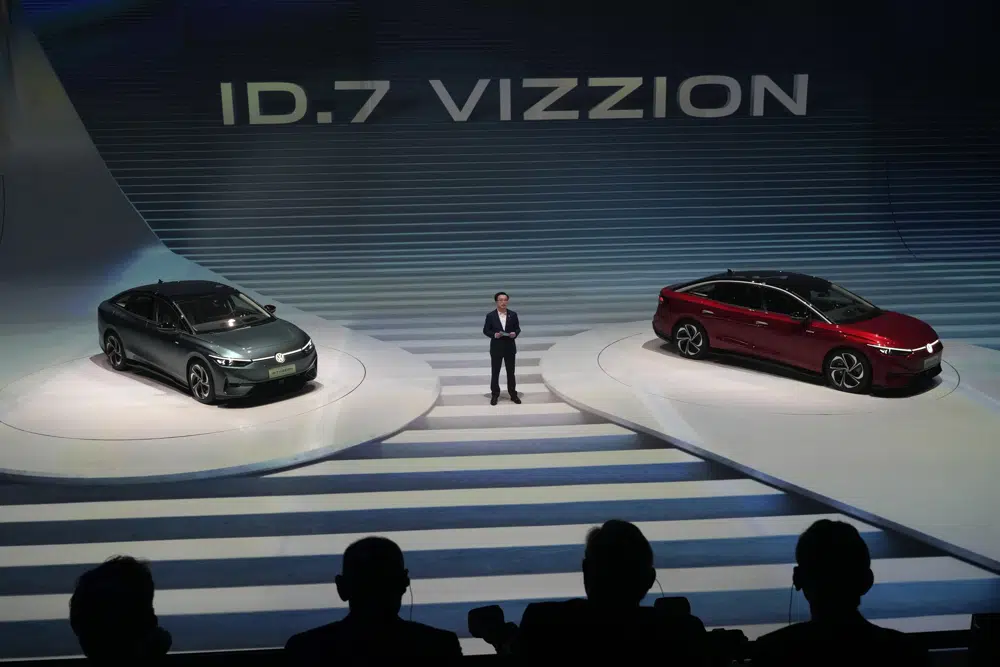
Volkswagen's ID.7 Vizzion, its new electric flagship sedan, is unveiled in a world premiere on the eve of the Auto Shanghai 2023 show in Shanghai, China, Monday, April 17, 2023. Global and Chinese automakers plan to unveil more than a dozen new electric SUVs, sedans and muscle cars this week at the Shanghai auto show, their first full-scale sales event in four years in a market that has become a workshop for developing electrics, self-driving cars and other technology. (AP Photo/Ng Han Guan)

SHANGHAI (AP) — Volkswagen unveiled an electric luxury sedan that promises a 700-kilometer (435-mile) battery range as global and Chinese automakers displayed their latest SUVs, sedans and muscle cars at the world’s biggest auto show Tuesday.

Auto Shanghai 2023 reflects the intense competition in China’s fast-growing electric vehicle market after the ruling Communist Party poured billions of dollars into promoting the technology. China accounted for two-thirds of global electrics sales last year.

Brands including General Motors, BMW and Nissan and Chinese rivals BYD Auto and NIO unveiled dozens of new EVs in the cavernous Shanghai exhibition center. Brands touted faster charging, satellite-linked navigation and entertainment, and the future possibility of self-driving technology.

Volkswagen’s ID.7 sedan, the new flagship model for its electric vehicles, was one of 28 models displayed by the German automaker, half of them electrified.

“We are turbo-charging our electric campaign,” said the CEO of VW’s passenger car brand, Thomas Schaefer, who rode onto the stage aboard an electric minibus. Schaefer said VW plans to release another 10 electric models in the next three years.

The show is the auto industry’s first full-scale sales event in its biggest market since 2019 following the end of anti-virus controls in December that blocked most travel into and out of China.

Automakers are looking to China to drive sales growth at a time of slack American and European demand, but that requires then to pour money into creating competitive models that can appeal to Chinese buyers in a crowded market.

Established global brands face pressure from ambitious Chinese newcomers and to meet government sales quotas for electrics. Many are forming partnerships to split soaring development costs.

China is “playing a leading role in the industry’s electric and digital transformation,” said Ford Motor Co. CEO Jim Farley in a recorded message played on a video screen.

Electrics accounted for just over a quarter of the 23.6 million SUVs, sedans and minivans sold last year in China while sales of traditional gasoline-powered vehicles declined.

GM debuted an electric SUV, the Buick Electra E5, ahead of the auto show. Toyota Motor Co. unveiled two new models for its bZ line of zero-emissions vehicles. Honda Motor Co. premiered a new prototype for its China-focused electric brand, e:N.

Toyota also displayed a prototype self-driving taxi developed with China’s Pony.ai, a leading competitor in the country’s fast-evolving autonomous vehicle industry.

Chinese luxury electric brand NIO Inc., which competes with Tesla Inc. at the premium end of the market, unveiled its latest SUV, the ES6, and an update of its flagship sedan, the ET7. Both have digital cockpits and an onboard computer with connections for tablet computers and other devices.

BMW AG showed an all-electric lineup including two new models, the i7 M70L and XM Label Red. The German sport luxury brand’s M760Le had its China debut.

Automakers also highlighted China’s growing role as a source of exports and innovation, especially EVs.

NIO and BYD Auto are among a growing group of Chinese EV brands that are starting to sell in foreign markets. BYD Auto exports to Europe and opened a dealership in Japan this year. NIO started selling in Europe in 2021 and says it plans to serve 25 countries by 2025.

Global brands all have design centers in China and increasingly are drawing on Chinese talent for engineering, software and other development.

VW is adding as many as 2,000 employees to a research and development center in the eastern city of Anhui to work on “intelligent connected vehicles,” Schaefer said. He said a separate software unit would add up to 1,200 employees this year.

“We are gaining innovative strength by taking on local R&D responsibility,” Schaefer said. “Our guiding principle: Developing in China for China.”

The organizers said automakers would debut 100 new models, 70 of them electric, according to Chinese media.

Drivers in China bought 5.4 million all-electric vehicles last year — about two-thirds of the global total of 8 million — plus 1.5 million gasoline-electric hybrids. This year’s EV sales are forecast to rise another 30%.

Beijing is winding down government support and shifting the burden to automakers by requiring them to earn credits for EV sales.

China’s BYD Auto, which competes with Tesla for the title of world’s biggest-selling EV brand, displayed the U9 supercar from its luxury Yangwang brand and an SUV, the U8. The automaker says the U9, with a 1-million-yuan ($145,000) sticker price, can accelerate from zero to 100 kph (60 mph) in two seconds.

Another Chinese EV brand, Aion, part of state-owned GAC, announced rapid charging technology it said needs as little as five minutes to power up a battery to go 200 kilometers (120 miles).

Aion also unveiled a system it said can remove a drained battery and install a fresh one in as little as two minutes. The company said that would be quicker than filling a gasoline tank, eliminating a drawback to EV ownership.

China’s auto sales peaked in 2017 at 24.7 million but collapsed in 2020 to 20.2 million after dealerships closed as part of efforts to contain COVID-19. They are recovering but have yet to return to the pre-pandemic level.

For drivers who aren’t ready to give up fossil fuels, state-owned BAIC unveiled a hulking, American-style pickup truck, the Mars, with a 6.8-liter diesel engine. The company boasted that with its flaring wheel wells, the Mars is 2.1 meters (6.9 feet) wide.

The ruling party’s support for EV development is part of plans to gain wealth and global influence by transforming China into a creator of profitable technologies.

That campaign has strained relations with Washington and other trading partners, which are cutting off access to advanced processor chips used by makers of smartphones, electric cars and other high-tech products. China’s own foundries can supply low-end chips used in many cars but not processors for artificial intelligence and other advanced functions.

Sales of gasoline-electric hybrids and all-electric vehicles rose 26.2% over a year ago in the first three months of 2023 to 1.6 million, according to the China Association of Auto Manufacturers. Sales of purely electric vehicles rose 14.4% to 1.2 million while hybrids increased 75.1% to 433,000.

Tesla and some other brands cut prices by 5% to 15% starting in January after sales growth slowed, though to still-robust levels compared with the U.S. and European markets. That prompted warnings that the squeeze on an industry with dozens of fledgling brands might force smaller automakers into mergers or out of business.
US Progressives focus on local-level wins to counter setbacks

By WILL WEISSERT and SARA BURNETT
yesterday

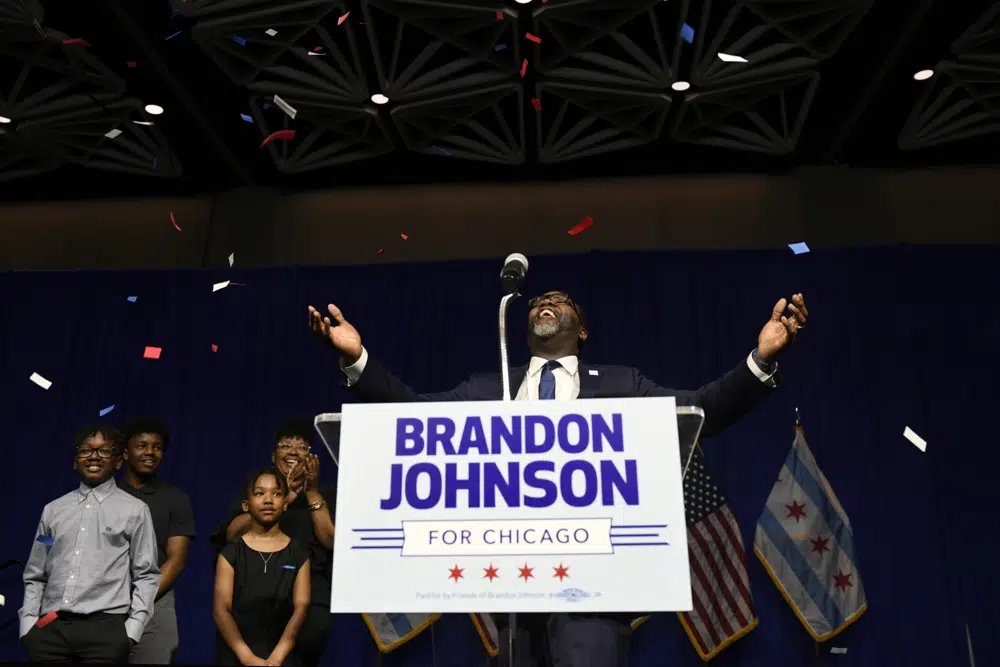
Chicago Mayor-elect Brandon Johnson celebrates with supporters after defeating Paul Vallas after the mayoral runoff election late Tuesday, April 4, 2023, in Chicago. For many progressives, the past decade has been littered with disappointments. But recent down-ballot victories are providing hope of reshaping the Democratic Party from the bottom up, rather than from Washington. 
(AP Photo/Paul Beaty, File)

CHICAGO (AP) — For many progressives, the past decade has been littered with disappointments. But recent down-ballot victories are providing hope of reshaping the Democratic Party from the bottom up, rather than from Washington.

In Chicago earlier this month, a former teacher’s union organizer unexpectedly won the mayor’s race. In St. Louis, progressives secured a majority on the municipal board. The next opportunities could lie in Philadelphia and Houston, which also hold mayoral elections this year.

The focus on lower-level contests already has helped progressives gain power and influence policy at a local level, organizers say, shaping issues such as the minimum wage. It also may help the movement find future stars, with today’s city and county officials becoming tomorrow’s breakout members of Congress and only moving further up the political ladder.

“Progressives have taken a look at how to be strategic and how to build power,” said Sara Nelson, president of the Association of Flight Attendants who was a leading national voice for Vermont Sen. Bernie Sanders ’ 2016 and 2020 presidential bids. “If you look around and you say, ‘Who is ready to run for president?’ If your field is shallow, what do you have to do? You’ve got to build the bench.”

This year’s focus on state and local races follows years of incremental progress and some stinging setbacks. Sanders electrified the left with 2016 and 2020 presidential campaigns that centered on bold calls for universal, government-funded health care. But he lost each time to rivals aligned with the Democratic establishment who advocated for a more cautious approach.

On Capitol Hill, progressive candidates successfully defeated several high-profile incumbents during the 2018 midterms and the election of candidates like New York Rep. Alexandria Ocasio-Cortez. But from New York to Michigan and Ohio and Texas, prominent progressives were defeated during primary campaigns last year. And, as President Joe Biden now gears up for reelection, he faces no serious challenge from the left.

Still, Sanders and others have left their mark, pushing mainstream Democrats to the left on key issues like combating climate change and forgiveness of student loan debt while inspiring some of those at the forefront of today’s movement.

That includes Chicago Mayor-elect Brandon Johnson, who appealed to a diverse and young electorate as he campaigned with Sanders and other top congressional progressives.

“Let’s take this bold progressive movement around these United States of America,” Johnson said in his victory speech.

Our Revolution, an activist group which grew out of Sanders’ 2016 White House bid, endorsed Johnson and progressive candidates who recently won three of four seats on the St. Louis City Board of Aldermen. That gave progressives a slim majority in a city where the mayor, Tishaura Jones, is also a self-described progressive.

Our Revolution said it activated its 90,000 members in Chicago an average of three times each to urge them to vote for Johnson, and made 100,000 phone calls in St. Louis. The group is also backing Helen Gym, a progressive former Philadelphia City Council member who is among roughly a dozen candidates competing in next month’s Democratic mayoral primary.

“When we win on the ground in our cities, that’s actually the blueprint, because we cannot wait for Congress,” Gym said during a recent call with Our Revolution volunteers.

Our Revolution’s executive director, Joseph Geevarghese, said local progressive organizing, including for races like school board, is more effective now than it has been in decades.

“We’re building power, bottom up, city by city,” Geevarghese said, adding that ”in major metropolitan areas you’ve got credible progressive slates vying for power against the Democratic establishment.”

Randi Weingarten, president of the American Federation of Teachers and a Democratic National Committee member, countered that there doesn’t have to be tension between the party’s left and moderate wings. She said Johnson called for addressing “quality of life issues” such as homelessness through consensus-building, rather than ideological confrontation.

“Every one of these cities are complicated places and you have to work together to get things done,” Weingarten said. “You have to work with people you don’t always agree with. And that is a strength and not a weakness.”

It hasn’t all been rosy for progressives. Moderate candidates topped progressive alternatives in last week’s Denver City Council races.

But there are more opportunities ahead. In the nation’s fourth-largest city of Houston, Democratic Rep. Sheila Jackson Lee, who has been an outspoken progressive in Congress since she got there in 1995, is running for mayor.

And the left isn’t abandoning congressional races.

Progressive champion Rep. Barbara Lee and fellow Democratic Rep. Katie Porter, who was a vocal supporter of Massachusetts Sen. Elizabeth Warren ’s progressive campaign for president in 2020, are among those running to replace retiring California Sen. Dianne Feinstein next year.

In Arizona, Democratic Rep. Ruben Gallego, a progressive 43-year-old Iraq war veteran and Spanish speaker who represents much of downtown Phoenix, is trying to unseat Sen. Kyrsten Sinema. She left the Democratic Party last year and, if she seeks reelection, would run as an independent.

“Working-class Democrats are getting elected, and corporate Democrats are not,” said Chuck Rocha, a key architect of Sanders’ 2016 campaign who heads Nuestro PAC, which has endorsed Gallego. But Rocha was quick to caution that Gallego isn’t running as “a progressive or liberal savior.”

“He’s going to run as ‘I was an enlisted Marine who had to sleep on my mama’s couch until I got a bed in college’ and has been a champion of working-class folks in the state of Arizona,” Rocha said.

Questions about a resurgent Democratic left come as Biden prepares to formally kickoff his reelection campaign and will have to decide how to frame his political vision and ideology to appeal to swing voters. After besting Sanders and Warren in the 2020 primary, Biden embraced major progressive goals, promoting expanding social programs and climate-change fighting green energy.

Biden eventually oversaw passage of dramatic federal spending increases, including on health care and green technology. He tried to forgive student loans for millions of Americans, but saw the plan challenged in court.

On other issues, however, Biden has been more moderate. After major legislation to curb police brutality and institutional racism stalled in Congress, the president signed an executive order to make modest reforms. He also has said repeatedly that, rather than heed calls by some progressives to cut funding for law enforcement, the answer should be more police funding.

More recently, the president angered liberal Democrats by failing to veto Republican-championed legislation reversing new, local crime regulations in the nation’s capital and approving a major oil drilling project in Alaska.

Biden campaign aides say he’s shown flexibility to best respond to ongoing political and policy challenges. And Rocha said that Gallego will benefit from Biden’s 2024 campaign, which should rely heavily on promoting his administration’s legislative accomplishments and how they benefited working-class families in swing states like Arizona.

But some progressives say the White House should take notice of the movement’s down-ballot wins.

“I hope he’s paying attention,” said Hannah Riddle, director of candidate services for the activist group the Progressive Change Campaign Committee. “Running on economic populism is a winning strategy. And that model can be replicated all over the country.”

___ Weissert reported from Washington.
RIGHT TO LIFE MEANS ABOLISH THE DEATH PENALTY
Inmate stuck on US death row despite vacated death sentence


By MICHAEL TARM
April 16, 2023
 
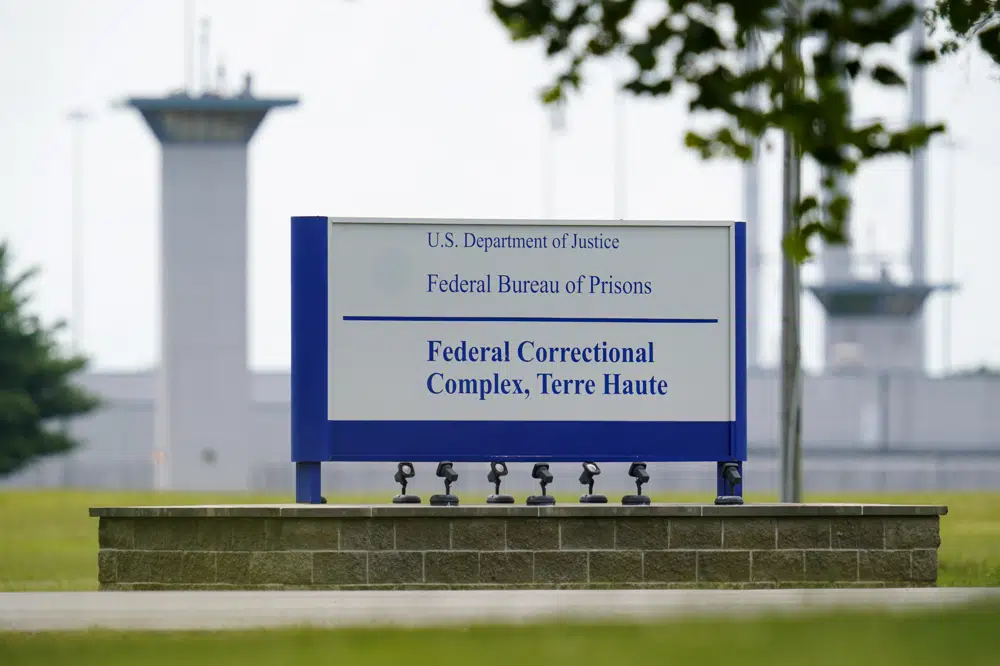
A sign is displayed at the federal prison complex in Terre Haute, Ind., on Aug. 28, 2020. A judge tossed 49-year-old Bruce Webster's death sentence in accordance with a 2002 Supreme Court decision that executing anyone with an intellectual disability violated Eight Amendment protections against “cruel and unusual” punishment. But Justice Department still hasn’t authorized his transfer to a less restrictive unit.
 (AP Photo/Michael Conroy, File)

CHICAGO (AP) — When the U.S. prisons director visited the penitentiary in Terre Haute, Indiana, this past week, she stopped by the federal death row where Bruce Webster is in a solitary, 12-by-7 foot cell, 23 hours a day.

Webster’s not supposed to be there. A federal judge in Indiana ruled in 2019 that the 49-year-old has an IQ in the range of severe intellectual disability and so cannot be put to death.

But four years on, the Justice Department and the Federal Bureau of Prisons haven’t moved him to a less restrictive unit or different prison.

Why? His own lawyer, who secured a rare legal win in persuading a court to vacate Webster’s 1996 death sentence in the kidnapping, rape and killing of a 16-year-old Texas girl, says she’s baffled.

“How can I not get this guy off death row?,” an exasperated Monica Foster said in a recent interview. “Well, I did get him off death row. But why can’t I physically get him off death row?”

Asked about Webster’s continued placement on death row, a Justice Department official said only that “the Bureau of Prisons is considering Mr. Webster’s designation determination.”

Webster’s case illustrates chronic bureaucracy in the prisons system and the difficulties in getting anyone off death row. There’s sometimes additional reluctance to act in death row cases given the nature of inmates’ crimes.

In Webster’s case, he and three accomplices kidnapped a sister of a rival drug trafficker in 1994, kicking their way into an Arlington, Texas, apartment as Lisa Rene frantically dialed 911. They raped her over two days, then stripped her, bludgeoned her with a shovel and buried her alive.

Bureau of Prisons Director Colette Peters has said she’s committed to reforms. Her visit to Terre Haute was part of regular inspections of U.S. prisons. It came months after a lawsuit filed by the American Civil Liberties Union of Indiana seeking to end the solitary confinement of federal death row inmates, saying that practice results in severe psychological damage.

Several death row inmates told The Associated Press by email that Peters came through their unit on Tuesday and spoke to some prisoners. It’s not known whether she saw Webster or discussed his case.

The Biden administration should see moving Webster as an uncontroversial if modest step toward fulfilling President Joe Biden’s campaign pledge to stop federal executions for good, Foster argued

“This case is a no brainer,” the Indianapolis-based federal defender said. “There is zero political liability for doing the right thing here and moving him off death row.”

Webster, who wants to be transferred to a prison near his hometown of Pine Bluff, Arkansas, must be resentenced. It’s supposed to be a formality because life in prison is the only available sentence.

When his lawyers and the Justice Department asked in joint 2021 motion for U.S. judge in Texas where Webster was tried in 1996 to resentence him, the judge refused, saying he lacked jurisdiction.

Judge Terry Means also chided his Indiana counterpart, Judge William Lawrence, for tossing Webster’s death sentence, saying Lawrence had “brushed aside” jurors’ finding, including that most rejected Webster’s intellectual disability claims.

“That judgment is final,” the government said about Means’ ruling, adding that it is the department’s position “that Mr. Webster is not currently subject to a valid death sentence.”

Responsibility to get Webster off death row lies squarely with the Justice Department, Foster said.

The Justice Department executed 13 U.S. death row inmates, some of them Webster’s friends, in the last months of Donald Trump’s presidency. While Biden’s Justice Department paused the executions and reversed decisions to seek death sentences in some cases, it continues to seek them in others.

Lawrence based his Webster ruling on Atkins v. Virginia, a landmark Supreme Court decision in 2002 ruling that executing those with intellectual disabilities violated Eighth Amendment protections against “cruel and unusual” punishment.

That decision hasn’t prevented some inmates with such disabilities from being executed, according to the Death Penalty Information Center. It identifies 25 cases where that’s happened since that ruling, including two federal inmates executed under Trump, Alfred Bourgeois and Corey Johnson.

Whether Webster qualified as intellectually disabled centered on three questions: Was his IQ significantly below average, did he show an inability to learn basic skills and was the onset of the disability apparent before age 18?

In his ruling, Lawrence cited tests putting Webster’s IQ between 50 and 65, below the benchmark score for intellectual disability of 70. The average is 100.

During arguments, Webster’s lawyers said he relied on others to tie his shoes late into childhood, and, as a teenager, had trouble playing card games because he couldn’t distinguish between clubs and spades.

Prosecutors accused Webster of playing dumb. They said he intentionally answered IQ questions incorrectly to avoid the death penalty. They said proof of his aptitude included how, during a jail stint, he figured out how to pick locks on a food chute to slip into a women’s section.

“Webster also has been able to hold a job, albeit it criminal in nature,” a government filing added. “Being a successful drug dealer is no less demanding than holding any number of legitimate jobs.”

The decisive evidence, however, were newly obtained Social Security records from before the killing indicating Webster’s IQ was within the intellectually disabled range. That evidence, despite requests for it, wasn’t made available at his trial.

Foster worries what could happen if Webster doesn’t get off death row soon. Even though past rulings should prevent it, she fears that if Trump wins the presidency, his administration could seek to restore the death sentence.

If that happens, she said, “I’m concerned it could be carried out.”

__

Follow Michael Tarm on Twitter at @mtarm.
HE AIN'T DEAD YET
Jimmy Carter and Playboy: How ‘the weirdo factor’ rocked ’76


By BILL BARROW
April 16, 2023
 
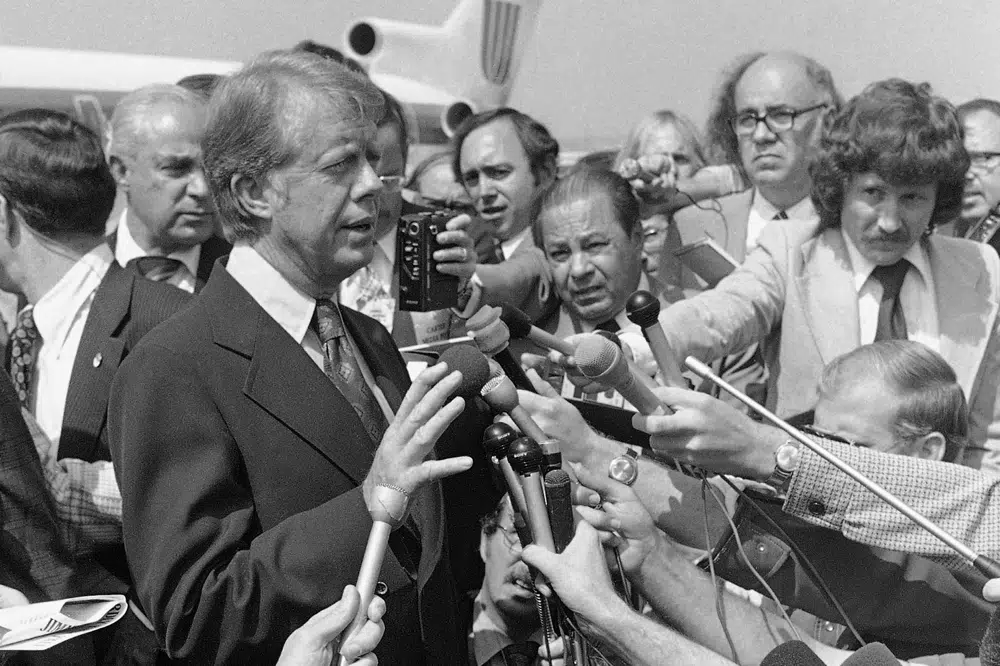
Democratic presidential nominee Jimmy Carter speaks to reporters on his arrival at Hobby International Airport in Houston on Friday, Sept. 24, 1976. He explained how his remarks in a Playboy magazine interview about the late President Lyndon Johnson were misinterpreted, and that he did not mean to put Johnson and Richard Nixon in the same class. 
(AP Photo/Jack Thornell, File)

PLAINS, Ga. (AP) — Jimmy Carter already had drawn months of media scrutiny as a devout Southern Baptist running for president. Then the 1976 Democratic nominee brought up sex and sin as he explained his religious faith to Playboy magazine.

Carter was not misquoted. But he was certainly misunderstood, as his thoughts in the wide-ranging interview were reduced in the popular imagination to utterances about “lust” and “adultery.”

Nearly a half-century later, as the 98-year-old Carter receives hospice care in the same south-Georgia home where he once spoke with Playboy journalists, interviewer Robert Scheer still believes Carter was treated unfairly. He recalls the former president as a “real” and “serious” figure whose intent was smothered by the intensity of a campaign’s closing stretch.

“Jimmy Carter was a thoughtful guy,” Scheer, now 87, told The Associated Press. “But that got lost here. I’ve never seen a story like it. It was worldwide. ... It just never went away.”

Political disaster ensued. Rosalynn Carter was suddenly being asked whether she trusted her husband. The fallout, in Carter’s words, “nearly cost me the election.”

Carter spent five-plus hours with Playboy across several months — “more time with you than with Time, Newsweek and all the others combined,” the nominee told Scheer and Playboy editor Barry Golson.

The resulting Q&A spanned 12,000 words, and Scheer added thousands more in an accompanying story. Carter discussed military and foreign policy, racism and civil rights, political journalism and his reputation as a “vague” candidate.

“They weren’t interested in sensationalized stuff,” Scheer said of Playboy.

Hugh Hefner’s iconic publication reached an estimated 20 million-plus readers each month with its pictorials of nude women. But the magazine chronicled American culture as well, with its branded “Playboy Interview” featuring such power players as the Rev. Martin Luther King Jr., John Lennon, Malcom X and leading newsman Walter Cronkite.

Carter, unafraid of nuance, proved he belonged among them, Scheer said.

The nominee’s most-remembered comments came at the end of their final session. Standing outside Carter’s front door, Golson pressed Carter on whether his piety would make him a “rigid, unbending president” unable to represent all Americans.

The Baptist deacon responded with an 823-word soliloquy on human imperfection, pride and God’s forgiveness. He said he believed in “absolute and total separation of church and state” and explained his faith as rooted in humility, not judgment of others.

Quoting Matthew 5:27-28, Carter explained that Jesus Christ considered an offending thought equivalent to consummated adultery, and by that standard, he was in no position to judge a man who “shacks up” and “screws lots of women,” because he had “looked on many women with lust” and, thus, “committed adultery many times in my heart.”

Scheer called it a “sensible statement,” reflecting Carter’s Baptist tradition: “He was saying, look, I’m not going to be some fanatic. ... I’m not this perfect guy.”

Playboy realized Carter provided explosive material — and not just about sex. Citing President Lyndon Johnson’s handling of Vietnam, Carter included the last Democratic president alongside disgraced Republican Richard Nixon as guilty of “lying, cheating and distorting the truth.”

The magazine decided to send the full Q&A text to about 1,000 media outlets in late September, ahead of the usual October publication date for the November edition.

The idea, Scheer explained, was to allow time for fair coverage rather than drop bombshells days before the election.

Headline writers, satirists and late-night television pounced anyway, labeling it Carter’s “lust in my heart” interview. “Saturday Night Live,” then a fledgling NBC sketch comedy show, had a field day. One political cartoonist depicted Carter lusting after the Statue of Liberty.

He lamented to NPR in 1993 that the Playboy interview morphed into “the No. 1 story of the entire 1976 campaign.”

“I was explaining Jesus’ Sermon on the Mount,” Carter wrote wistfully in a 2015 memoir.

As a candidate, Carter’s faith had endeared him to many fellow white evangelicals and cultural conservatives. That made him a difficult foil for Republicans, who wanted to cast Democrats as out-of-step with most of America. The flip side, Scheer noted, was the many young voters and urban liberals — key Democratic constituencies — who “wondered if he was this Southern square.”

“Hamilton Jordan (Carter’s campaign manager) had always called Carter’s faith ‘the weirdo factor,’” said media historian Amber Roessner, a University of Tennessee professor who has written extensively on Carter. “Talking to Playboy was their way to prove he wasn’t some kind of prude.”

Scheer, who was with Carter as part of his traveling press corps, said Playboy’s early text release sparked a frenzy.

“Reporters were scrambling, asking me, ’Bob, what is this?” he recalled.

Traveling press focused initially on Carter’s criticism of Johnson, who had died in 1973. It was a juicy detail because Carter was headed Texas to campaign with Johnson’s widow.

Carter initially told reporters he was taken out of context. Scheer “ran back to the plane to get the tapes,” and effectively caught the nominee violating his pledge never to make a “misleading statement.”

Lady Bird Johnson skipped Carter’s Texas events, Scheer said. Carter apologized to her by telephone.

When his commentary on adultery ballooned, Carter insisted the exchange had been off-the-record, throwaway banter as Scheer and Golson prepared to leave.

“He was still wearing the mic!” Scheer told AP.

The way the story morphed “ended up making Carter seem like a creep,” Roessner said.

Rosalynn Carter fashioned a pat response: “Jimmy talks too much, but at least people know he’s honest and doesn’t mind answering questions.” And, no, she never worried about his fidelity.

“The only lust I worried about was that of the press,” she wrote in 1984, recounting how her discipline finally cracked when a reporter asked whether she ever committed adultery.

“If I had,” she replied, “I wouldn’t tell you.”

Ford, who had been gaining on Carter but still trailed badly, leveraged the story. The Republican president was an Episcopalian, soft-spoken about religion, but he invited leading evangelical pastors to the White House the day after the interview’s release, including the Rev. W.S. Criswell of Dallas First Baptist Church.

Criswell later declared from his pulpit that he had asked Ford: “Mr. President, if Playboy magazine were to ask you for an interview, what would you do?” Ford’s reply, according to Criswell: “I was asked by Playboy magazine for an interview — and I declined with an emphatic ‘No’!”

Thousands of his parishioners roared.

The Rev. Billy Graham, the nation’s top evangelist, and the Rev. Jerry Falwell, the rising leader of the so-called Religious Right, also blitzed Carter. National media, including The AP, highlighted criticism from Christian pastors from around the country.

Roessner, the daughter of a Protestant pastor, said Carter’s Playboy comments were clumsy, “but if anyone should have understood the context ... it should have been the ministers.”

She recalled Carter’s resentment during a 2014 interview she conducted with him. Decades of global humanitarian work had by that time afforded the former president a profile above politics, yet “almost 40 years later, it was clearly something he held on to,” she said. He was “still incredibly frustrated by what he felt was unfair coverage and response.”

The 1976 campaign was the first after Nixon’s resignation, driven by reporting from The Washington Post, and many journalists were demonstrating a new level of distrust of politicians, especially one Scheer described as “wearing his religion on his sleeve.”

Those same news organizations largely ignored what the soon-to-be president said about them, Roessner noted.

“The traveling press have zero interest in any issue unless it’s a matter of making a mistake,” Carter told Playboy. “There’s nobody in the back of this plane who would ask an issue question unless he thought he could trick me into some crazy statement.”

Scheer, at least, asked plenty of policy questions, and, looking back, he pointed to Carter’s narrow victory just weeks later.

“Whatever they said, I think it did exactly what they wanted to accomplish,” Scheer said. “That doesn’t mean they weren’t nervous.”
US tax breaks lure European clean tech companies as EU lags

By KELVIN CHAN
yesterday

 Wind turbines operate in Livermore, Calif., on Wednesday, Aug. 10, 2022. Across Europe companies are weighing up the U.S. Inflation Reduction Act's $375 billion in benefits for renewable industries against the European Union's fragmented response.
(AP Photo/Godofredo A. Vásquez, File)

LONDON (AP) — Norwegian startup Freyr will first build batteries to power electric vehicles and store clean energy in a remote town near the Arctic Circle. Up next? An Atlanta suburb.

That’s because a new U.S. clean energy law offers generous tax credits — up to 40% of costs — in what is a “massive, massive incentive” for producing in America, CEO Tom Einar Jensen said.

Across Europe, companies seeking to invest in the green energy boom — churning out everything from solar panels to windmills and EV batteries — are making similar calculations, weighing up the U.S. Inflation Reduction Act’s $375 billion in benefits for renewable industries against a fragmented response that European leaders have been scrambling to patch together for months.

The law aims to kick-start the U.S. transition away from climate-changing fossil fuels with tax credits and rebates that favor clean technology made in North America.

It blindsided Europe when it became law in August, putting the U.S. on course to eclipse the continent in the global push to reduce carbon emissions and leaving European leaders fuming over rules that favor American products, threatening to suck green investment from Europe and spark a subsidy race.

The European Union’s executive branch responded with plans aimed at ensuring least 40% of clean technology is produced in Europe by 2030 and limiting the amount of strategic raw materials from any single third country — typically China — to 65%. It also opened negotiations with President Joe Biden on making Europe-sourced minerals for EV battery manufacturing eligible for U.S. tax credits.

Executives, simply looking for the most money they can get to boost their businesses, are hailing the U.S. program’s simplicity. Some complain that the EU plan is underwhelming, confusing and bureaucratic, putting Europe at risk of falling behind in the green energy transition, notably as the auto industry moves to EVs.

“While the United States are catching up thanks to the Inflation Reduction Act, Europe is more and more lagging behind,” Volkswagen’s board member overseeing technology, Thomas Schmall, posted on LinkedIn. “The conditions of the IRA are so attractive that Europe risks to lose the race for billions of investments that will be decided in the coming months and years.”

Volkswagen said last month that its new PowerCo battery business would build its first gigafactory for EV battery cells outside Europe in St. Thomas, Ontario — following two others under construction in Germany and Spain. The Canadian plant, set to open in 2027, is expected to benefit from the IRA because of provisions for U.S. neighbors and free-trade partners Canada and Mexico.

Meanwhile, the German auto giant has reportedly put on hold a decision for a battery plant in Eastern Europe while it waits for more information on the EU’s plan. Volkswagen didn’t respond to a request for comment.

Another Scandinavian battery startup, Sweden’s Northvolt, was poised to build a third gigafactory, and the first outside its home country, in northern Germany. The U.S. law led it to hit pause, and it’s looking over the new EU proposals before deciding next month where to put that facility.

The EU keeps a tight rein on state aid for businesses to avoid distorting competition in the 27-nation bloc’s single market, where some countries — like Germany and France — are much larger and richer than others. But to compete with the U.S., the EU relaxed those restrictions for clean industries, marking a fundamental change for Brussels from its long-held view that government should take a hands-off approach to free markets.

European business leaders say the U.S. incentives could upend the global ways of producing technology.

“We’re building cars in the U.S. but sometimes the engine or other parts come from Europe. The IRA puts this model in question because it requires manufacturing to take place in the U.S.,” said Luisa Santos, deputy director general of BusinessEurope, a Brussels-based lobbying group.

“You might have more proximity, but the cost will be much higher” if global supply lines disappear, she warned. “Will the consumer be willing to pay?”

Italian energy giant Enel credited the IRA when it announced plans in November to build a massive solar panel factory in the U.S.

Enel’s factory initially will be able to churn out 3 gigawatts of solar panels and cells, ultimately expanding to 6 gigawatts. The plant is expected to be operating by the end of 2024.

It’s not just Europe. Companies in Asia also want a piece of the IRA.

South Korean tech giant LG last month unveiled plans to build a $5.5 billion battery manufacturing complex in Arizona, which it called the biggest single investment ever for a standalone battery manufacturing facility in North America.

By setting up manufacturing in the U.S., LG “aims to respond to the fast-growing needs for locally manufactured batteries on the back of the IRA,” the company said.

The factory is scheduled to start making electric car batteries by 2025 and batteries for energy storage systems a year later.

For its part, Freyr is expanding its footprint from its first battery gigafactory being built in Mo i Rana in northern Norway to a second in Coweta County, Georgia, each costing $1.7 billion.

“It’s important for us to produce batteries on both sides of the Atlantic because our customers and our supply chain partners want us to be present in both places,” CEO Jensen said at an opening ceremony for a pilot plant in Mo i Rana.

He said in an interview that the IRA provides up to $45 in tax credits toward the typical cost of making a battery, which is $110 to $115 per kilowatt hour.

The IRA has stoked so much demand for standalone energy storage systems like the ones that Freyr makes — big banks of batteries that utility companies use to store renewably generated electricity — that the company moved the U.S. completion date up by a year to 2025, Jensen said.

Freyr is now trying to figure out “how we can fast-track it even further” because “our customers are really screaming for locally produced” batteries, which, Jensen said, allow them to get their own incentives.

“That, of course, increases demand for our product,” he said.