Tuesday, April 18, 2023

Rutgers, unions announce agreement, classes to resume

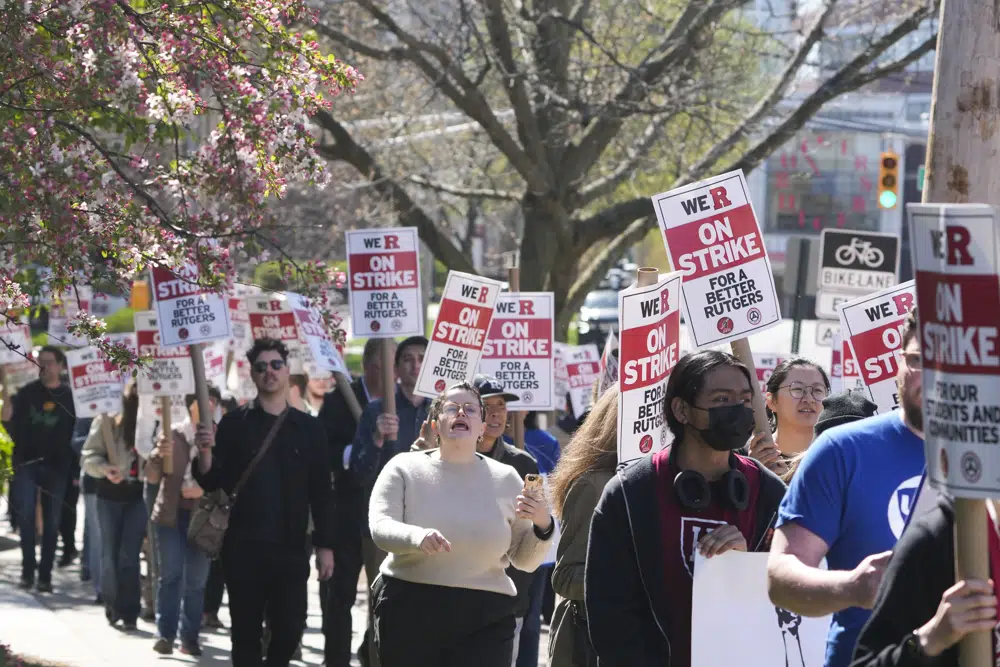
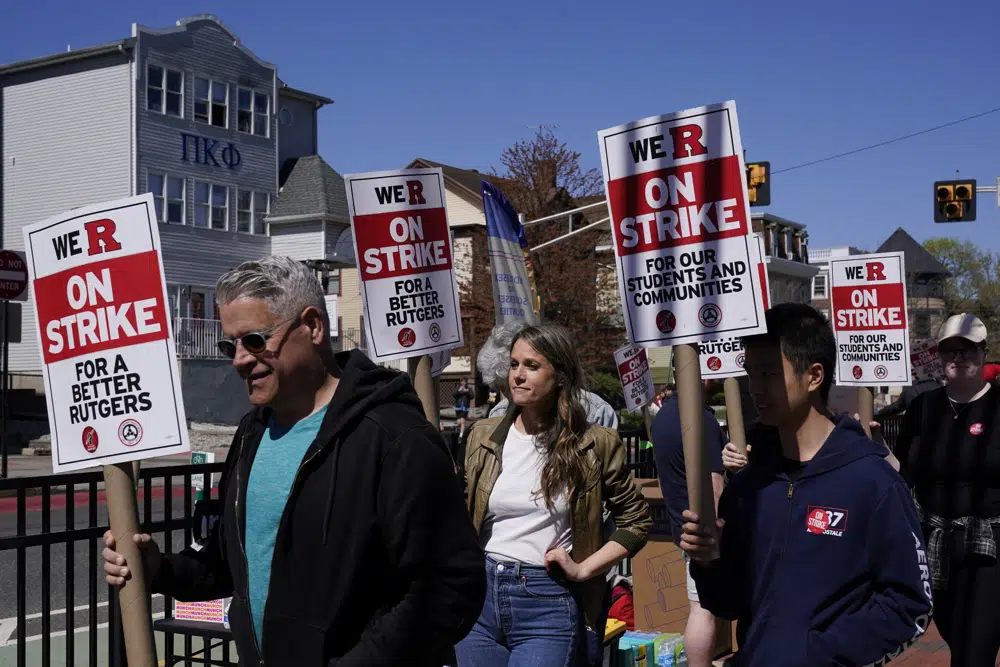
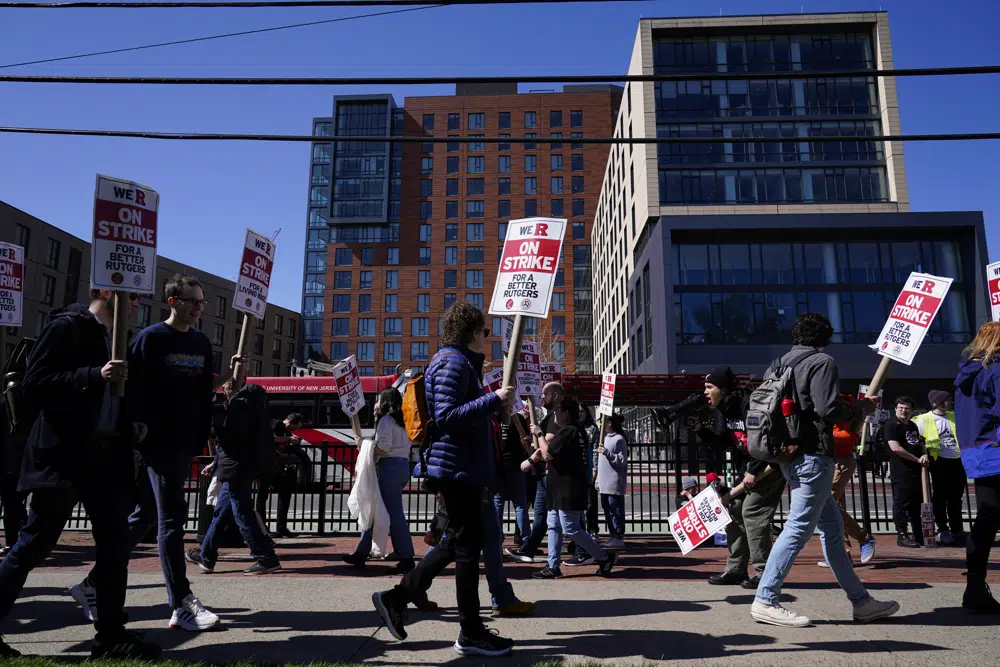
Strikers march in front of Rutgers' buildings in New Brunswick, N.J., Monday, April 10, 2023. Thousands of professors, part-time lecturers and graduate student workers at New Jersey's flagship university have gone on strike — the first such job action in the school's 257-year history. 
(AP Photo/Seth Wenig)


April 15, 2023

NEW BRUNSWICK, N.J. (AP) — Rutgers University and union representatives have announced an agreement on a framework for new contracts with several faculty unions, allowing a halt to a five-day strike that was the first such job action in the 257-year history of New Jersey’s flagship university,

Rutgers said early Saturday that the agreement on the framework on economic issues was reached late Friday night with the aid of Gov. Phil Murphy, and closure on that framework “will allow our 67,000 students to resume their studies and pursue their academic degrees.”

“Nothing we do is as important as living up to the expectations that our students and their families have of us to be fully supportive of them and nurturing of their academic ambitions and dreams,” the school said in a statement.

The unions representing professors, part-time lecturers and graduate student workers told members that they had agreed to suspend the strike and return to work, but more issues need to be resolved before members would have a tentative agreement to vote on.

“Our historic strike got us to this point. And let us be clear, a suspension of our strike is not a cancellation. If we do not secure the gains we need on the open issues through bargaining in the coming days, we can and will resume our work stoppage,” they said, also vowing informational pickets as classes resume next week.

Three unions, which represent about 9,000 Rutgers staff members, have been involved in the strike: the Rutgers AAUP-AFT, which represents full-time faculty, graduate workers, postdoctoral associates and some counselors; the Rutgers Adjunct Faculty Union, which represents part-time lecturers; and the AAUP-BHSNJ, which includes faculty in the biomedical and health sciences at Rutgers’ medical, dental, nursing and public health schools.

The unions said the framework included “significant” pay increases for adjuncts and substantial raises for graduate student workers, as well as more job security for adjunct and nontenure-track faculty, union representation for graduate fellows, and other improvements.

Rutgers said the pact, retroactive to July, will increase salaries across the board for full-time faculty and EOF counselors by at least 14 percent by July 2025. It will also provide a 43.8 percent increase in the per-credit salary rate for part-time lecturers and strengthen their job security, increase minimum salaries for postdoctoral fellows and associates and substantially increase wages and other support for teaching assistants and graduate assistants.

Picket lines went up Monday at the New Brunswick, Piscataway, Newark and Camden campuses as students were finishing their spring semester and preparing for finals and commencement. NJ.com reports that some said they went to classes as usual because some professors were still teaching or handing out assignments, while others said classes were called off or they decided to stay away or even walk picket lines in support of the walkout.
Report finds democracy for Black Americans is under attack

By GARY FIELDS
April 15, 2023

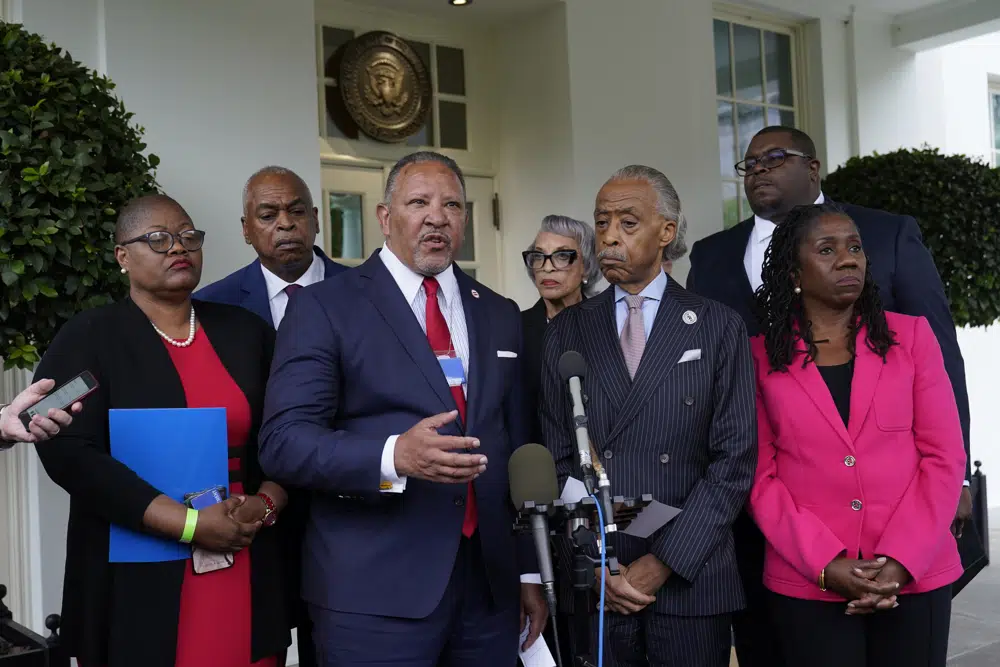
Marc Morial, center, President and Chief Executive Officer of the National Urban League, talks with reporters outside the West Wing of the White House in Washington, July 8, 2021, following a meeting with President Joe Biden and leadership of top civil rights organizations. Extreme views adopted by some local, state and federal political leaders who try to limit what history can be taught and undermine how Black leaders perform their jobs are among the leading threats to democracy for Black Americans, according to a National Urban League report to be released Saturday, April 15. 
(AP Photo/Susan Walsh, File)

WASHINGTON (AP) — Extreme views adopted by some local, state and federal political leaders who try to limit what history can be taught in schools and seek to undermine how Black officials perform their jobs are among the top threats to democracy for Black Americans, the National Urban League says.

Marc Morial, the former New Orleans mayor who leads the civil rights and urban advocacy organization, cited the most recent example: the vote this month by the Republican-controlled Tennessee House to oust two Black representatives for violating a legislative rule. The pair had participated in a gun control protest inside the chamber after the shooting that killed three students and three staff members at a Nashville school.

“We have censorship and Black history suppression, and now this,” Morial said in an interview. “It’s another piece of fruit of the same poisonous tree, the effort to suppress and contain.”

Both Tennessee lawmakers were quickly reinstated by leaders in their districts and were back at work in the House after an uproar that spread well beyond the state.

The Urban League’s annual State of Black America report released Saturday draws on data and surveys from a number of organizations, including the UCLA Law School, the Southern Poverty Law Center and the Anti-Defamation League. The collective findings reveal an increase in recent years in hate crimes and efforts to change classroom curriculums, attempts to make voting more difficult and extremist views being normalized in politics, the military and law enforcement.

One of the most prominent areas examined is so-called critical race theory. Scholars developed it as an academic framework during the 1970s and 1980s in response to what they viewed as a lack of racial progress following the civil rights legislation of the 1960s. The theory centers on the idea that racism is systemic in the nation’s institutions and that they function to maintain the dominance of white people in society.

Director Taifha Alexander said the Forward Tracking Project, part of the UCLA Law School, began in response to the backlash that followed the protests of the George Floyd killing in 2020 and an executive order that year from then-President Donald Trump restricting diversity training.

The project’s website shows that 209 local, state and federal government entities have introduced more than 670 bills, resolutions, executive orders, opinion letters, statements and other measures against critical race theory since September 2020.

Anti-critical race theory is “a living organism in and of itself. It’s always evolving. There are always new targets of attack,” Alexander said.

She said the expanded scope of some of those laws, which are having a chilling effect on teaching certain aspects of the country’s racial conflicts, will lead to major gaps in understanding history and social justice.

“This anti-CRT campaign is going to frustrate our ability to reach our full potential as a multiracial democracy” because future leaders will be missing information they could use to tackle problems, Alexander said.

She said one example is the rewriting of Florida elementary school material about civil rights figure Rosa Parks and her refusal to give up her seat to a white rider on a Montgomery, Alabama, bus in 1955 — an incident that sparked the bus boycott there. Mention of race was omitted entirely in one revision, a change first reported by The New York Times.

Florida has been the epicenter of many of the steps, including opposing AP African American studies, but it’s not alone.

“The things that have been happening in Florida have been replicated, or governors in similarly situated states have claimed they will do the same thing,” Alexander said.

In Alabama, a proposal to ban “divisive” concepts passed out of legislative committee this past week. Last year, the administration of Virginia Gov. Glenn Youngkin, a Republican, rescinded a series of policies, memos and other resources related to diversity, equity and inclusion that it characterized as “discriminatory and divisive concepts” in the state’s public education system.

Oklahoma public school teachers are prohibited from teaching certain concepts of race and racism under a bill Republican Gov. Kevin Stitt signed into law in 2021.

On Thursday, the Llano County Commissioners Court in Texas held a special meeting to consider shutting down the entire public library system rather than follow a federal judge’s order to return a slate of books to the shelves on topics ranging from teenage sexuality to bigotry.

After listening to public comments in favor and against the shutdown, the commissioners decided to remove the item from the agenda.

“We will suppress your books. We will suppress the conversation about race and racism, and we will suppress your history, your AP course,” Morial said. “It is singular in its effort to suppress Blacks.”

Other issues in his group’s report address extremism in the military and law enforcement, energy and climate change, and how current attitudes can affect public policy. Predominantly white legislatures in Missouri and Mississippi have proposals that would shift certain government authority from some majority Black cities to the states.

In many ways, the report mirrors concerns evident in recent years in a country deeply divided over everything from how much K-12 students should be taught about racism and sexuality to the legitimacy of the 2020 election.

Forty percent of voters in last year’s elections said their local K-12 public schools were not teaching enough about racism in the United States, while 34% said it already was too much, according to AP VoteCast, an expansive survey of the American electorate. Twenty-three percent said the current curriculum was about right.

About two-thirds of Black voters said more should be taught on the subject, compared with about half of Latino voters and about one-third of white voters.

Violence is one of the major areas of concern covered in the Urban League report, especially in light of the 2022 mass shooting at a grocery store in Buffalo, New York. The accused shooter left a manifesto raising the “great replacement theory ” as a motive in the killings.

Data released this year by the FBI indicated that hate crimes rose between 2020 and 2021. African Americans were disproportionately represented, accounting for 30% of the incidents in which the bias was known.

By comparison, the second largest racial group targeted in the single incident category was white victims, who made up 10%.

Rachel Carroll Rivas, deputy director of research with the Southern Poverty Law Center’s Intelligence Project, said when all the activities are tabulated, including hate crimes, rhetoric, incidents of discrimination and online disinformation, “we see a very clear and concerning threat to America and a disproportionate impact on Black Americans.”

___

Associated Press writers Julie Wright in Kansas City, Missouri, and Hannah Fingerhut in Washington contributed to this report.
UGANDA'S NEIGHBOUR
Anglican conservatives meet in Rwanda amid rift over LGBTQ

By IGNATIUS SSUUNA
TODAY

KIGALI, Rwanda (AP) — Hundreds of Anglican conservative leaders from 52 countries are meeting in Rwanda amid a rift over support within the church for same-sex unions.

The conference in Kigali, the Rwandan capital, has been convened under the auspices of the Global Fellowship of Confessing Anglicans, or GAFCON, a group formed in 2008 that advocates orthodoxy in the global Anglican communion.

The meeting comes two months after the decision of the Church of England to bless civil marriages of same-sex couples. Clerics from Africa are among those who continue to express concern.

“We are here to bring the Bible to be at the center of everything,” Archbishop Laurent Mbanda of Rwanda told the AP Tuesday.

The decision by the Church of England to bless same-sex unions created “enormous confusion” and could be the “final nail in the coffin in the already divided legacy of the Anglican Church,” Mbanda said.

The divisions have widened in recent years as conservative bishops, notably from Africa and Asia, affirmed their opposition to LGBTQ inclusion and demanded “repentance” by the more liberal provinces with inclusive policies.

The general secretary of GAFCON, Archbishop Ben Kwashi of Nigeria, said in a statement that the Church of England’s new stance on civil marriages is “troubling for many Anglicans.”

“We do not seek division, but rather we want to move the mission of God in the world,” the statement said.

The GAFCON conference, which features Bible studies and other seminars, will end on April 21.

GAFCON’s chairman, American primate Foley Beach, said during Monday’s opening that his group “can no longer recognize” Justin Welby, the archbishop of Canterbury, as the spiritual leader of the Anglican Communion.

“Will you join us in praying for Justin Welby and the bishops he leads?” he said. “You and I must repent and we become Christians again and we follow Jesus Christ.”

Welby has previously acknowledged “deep disagreement” among the provinces, while urging them to try to “walk together.”


Swiss charge Gambia ex-minister with crimes against humanity

BERLIN (AP) — Swiss prosecutors said Tuesday they have charged a former interior minister of Gambia with crimes against humanity for his alleged role in years of repression by the west African country’s security forces against opponents of its longtime dictator.

Ousman Sonko was Gambia’s interior minister from 2006 to 2016 under then-President Yahya Jammeh. He applied for asylum in Switzerland in November 2016 and was arrested in January 2017.

The attorney general’s office said the indictment, which was filed Monday in Switzerland’s Federal Criminal Court in Bellinzona, covers alleged crimes between 2000 and 2016.

Sonko “is accused, in his various capacities and positions, of having supported, participated in and failed to prevent systematic and generalized attacks as part of the repression carried out by the Gambian security forces against all opponents of the regime,” the office said in a statement.

Jammeh, who seized control in a 1994 coup, lost Gambia’s 2016 presidential election but refused to concede defeat to Adama Barrow. He ultimately fled amid threats of a regional military intervention to force him from power.

Barrow’s government last year announced that it was setting up a special prosecutor’s office to investigate for severe human rights violations and potentially charge Jammeh. The investigation came in response to recommendations from a truth, reconciliation and reparations commission, which said Jammeh should face prosecution for murder, torture and sexual violence under his rule.

Sonko, who joined the Gambian military in 1988, was appointed as commander of the State Guard in 2003, a position in which he was responsible for Jammeh’s security, Swiss prosecutors said. He was made inspector general of the Gambian police in 2005.

Sonko was removed as interior minister in September 2016, a few months before the end of Jammeh’s government, and left Gambia for Europe to seek asylum.

Swiss prosecutors said they conducted numerous interviews with the suspect, as well with about 40 interviews with plaintiffs, witnesses and others providing information, and made six trips to Gambia during their investigation.

The attorney general’s office said it “accuses the defendant in particular of having, in the context of five events between 2000 and 2016, participated, ordered, facilitated and/or failed to prevent killings, acts of torture, acts of rape and numerous unlawful detentions.”
For Palestinians, holiest Ramadan night starts at checkpoint

By ISABEL DEBRE
TODAY

1 of 18
Israeli border police officers check identification cards of Palestinians while they try to cross from the occupied West Bank into Jerusalem, to pray during the holiest night of Ramadan, Laylat al-Qadr, or the "Night of Destiny," when Muslims believe that the Quran was revealed to the Prophet Mohammad, in the Al Aqsa mosque compound, at the Israeli military Qalandiya checkpoint, near Ramallah, Monday, April 17, 2023. Hundreds of thousands of Palestinians are barred from legally crossing into the contested capital, with most men under 55 years old turned away at checkpoints, and compelled to resort to other, perilous means to get to Al-Aqsa.
 (AP Photo/Nasser Nasser)

QALANDIYA CHECKPOINT, West Bank (AP) — For many Palestinians, the journey to one of Islam’s most sacred sites on the holiest night of Ramadan begins in a dust-choked, garbage-strewn maelstrom.

Tens of thousands of Palestinian worshippers from across the occupied West Bank on Monday crammed through a military checkpoint leading to Jerusalem to pray at the Al-Aqsa Mosque for Laylat al-Qadr, or the “Night of Destiny,” when Muslims believe that the Quran was revealed to the Prophet Mohammad centuries ago.

The noisy, sweaty crowds at Qalandiya checkpoint seem chaotic — but there was a system: women to the right; men to the left. Jerusalem residents here, disabled people there. And the grim-looking men stranded at the corner had endured the long wait only to be turned back altogether.

“I’m not political, I’m just devout, so I thought maybe tonight, because of Laylat al-Qadr, they’d let me in,” said Deia Jamil, a 40-year-old Arabic teacher from the West Bank city of Ramallah.

“But no. ‘Forbidden,’” he said, sinking onto his knees to pray in the dirt lot.

For Palestinian worshippers, praying at the third-holiest site in Islam is a centerpiece of Ramadan. But hundreds of thousands are barred from legally crossing into Jerusalem, with most men under 55 turned away at checkpoints due to Israeli security restrictions. They often resort to perilous means to get to the holy compound during the fasting month of Ramadan.

This year, as in the past, Israel has eased some restrictions, allowing women and young children from the West Bank to enter Jerusalem without a permit. Those between the ages of 45 and 55 who have a valid permit can pray at the Al-Aqsa Mosque compound — one of the most bitterly disputed holy sites on Earth.

Jews revere it as the Temple Mount, home to the biblical Temples, and consider it the holiest site in Judaism. The competing claims are at the heart of the Israeli-Palestinian conflict and often spill over into violence.

Israel says it is committed to protecting freedom of worship for all faiths and describes the controls on Palestinian worshippers as an essential security measure that keeps attackers out of Israel. Last month, a Palestinian who crossed into Israel from the West Bank village of Nilin opened fire on a crowded street in Tel Aviv, killing one Israeli and wounding two others.

But for Palestinians, the restrictions take a toll.

“I feel completely lost,” said 53-year-old Noureddine Odeh, his backpack sagging off one shoulder. His wife and teenage daughters made it through the checkpoint, leaving him behind. This year — a period of surging violence in the occupied West Bank — Israel raised the age limit for male worshippers and he was no longer eligible. “You’re tugged around, like they’re playing God.”

Israeli authorities did not answer questions about how many Palestinian applications they’d rejected from the West Bank and Gaza. But they said that so far this month, some 289,000 Palestinians — the majority from the West Bank and a few hundred from the Gaza Strip — had visited Jerusalem for prayers.

Earlier this month, Israel announced the start of special Ramadan flights for West Bank Palestinians from the Ramon Airport in southern Israel. In normal times, Palestinians would have to fly from neighboring Jordan. But Monday, days before the end of Ramadan, the Israeli defense agency that handles Palestinian civilian affairs said only that Palestinians “will soon have the option.”

The crowds squeezing through Qalandiya during Laylat al-Qadr — one of the most important nights of the year, when Muslims seek to have their prayers answered — were so overwhelming that Israeli forces repeatedly shut the barrier. The sudden closures created bottlenecks of people, most of whom had abstained from food and water all day. Medics from the Palestinian Red Crescent said at least 30 people collapse at the checkpoint on a busy Ramadan day.

Their elbows pressed into strangers’ torsos and heads squeezed under armpits, five women studying to be midwives who had never before left the West Bank entertained themselves with fantasies of Jerusalem. “We’ll buy meat and sweets,” squealed 20-year-old Sondos Warasna. “And picnic in the Al-Aqsa courtyard.”

The limestone courtyard, which teems with Palestinian families breaking fast each night after sunset, became roiled by violence earlier this month, when Ramadan overlapped with the Jewish holiday of Passover. Israeli police raided the compound, firing stun grenades and arresting hundreds of Palestinian worshippers who had barricaded themselves inside the mosque with fireworks and stones. The raid, which Israel said was necessary to prevent further violence, outraged Muslims across the world and prompted militants in Lebanon and the Gaza Strip to fire rockets at Israel.

Anger over access to the contested compound was undimmed at Qalandiya. Throngs of Palestinian girls and older men ostensibly permitted to pass were turned back and told they had security bans they never knew about that barred them from Jerusalem. The secretive system — which Palestinians consider a key tool in Israel’s 55-year-old military occupation — left them reeling, struggling to understand why.

A 16-year-old girl from the northern city of Jenin frantically called her parents who had entered Jerusalem without her. A 19-year-old from Ramallah changed her coat and put on sunglasses and lipstick before trying again.

Others found riskier ways to get to the holy compound — scrambling over Israel’s hulking separation barrier or sliding under razor wire.

Abdallah, a young medical student from the southern city of Hebron, clambered up a rickety ladder with six of his friends in the pre-dawn darkness Monday — then slid down a rope on the wall’s other side — so he could make it to Al-Aqsa for Laylat al-Qadr. They paid a smuggler some $70 each to help them scale the barrier.

“My heart was beating so loud. I was sure soldiers would hear it,” Abdallah said, giving only his first name for fear of reprisals.

The Israeli military has picked up hundreds of Palestinians who sneaked through holes in the separation barrier during Ramadan, it said, adding that forces would “continue to act against the security risk arising from the destruction of the security fence and illegal entry.”

Abdallah said the experience of Jerusalem’s Old City brought him great joy. But soon anxiety set in. Israeli police were everywhere — occasionally stopping young men and asking to see their IDs. He tried to blend in, wearing counterfeit athleisure like many Jerusalemites and smiling to look relaxed.

“It’s a mixed feeling. At any moment I know I could be arrested,” he said from the entrance to the sacred compound. “But our mosque, it makes me feel free.”
Holocaust survivors, descendants join forces on social media

By KIRSTEN GRIESHABER
today


1 of 8
Holocaust survivor Assia Gorban, left, and her granddaughter Ruth Gorban pose during an interview with The Associated Press in Berlin, Germany, Monday, April 3, 2023. Assia Gorman and her granddaughter, 19-year-old Ruth Gorban, are taking part in the new digital campaign Our Holocaust Story: A Pledge to Remember. The campaign launched by the New York-based Conference on Jewish Material Claims Against Germany, also referred to as the Claims Conference, features survivors and their descendants from around the world and illustrates the importance of passing on the testimonies of Holocaust survivors to younger family members as the number of survivors dwindles. (AP Photo/Michele Tantussi)


BERLIN (AP) — Assia Gorban was 7 years old when the Germans occupied her hometown of Mogilev-Podolsky in Ukraine. The Jewish girl and her family were first imprisoned in a ghetto on the outskirts of town and later forced onto a cattle car that took them to the Pechora concentration camp in 1941.

After a few failed attempts, Gorban, her mother, and younger brother managed to escape in 1942, and spent the rest of World War II living under false identities until they were liberated in 1944.

Sitting in her apartment in Berlin, where she still lives on her own at age 89, Gorban vividly remembers the horrendous details of her time in the camp and during hiding from the Nazis who wanted to kill her only because she was Jewish.

She likes to share her memories with her granddaughter, 19-year-old Ruth Gorban, a university student, who also lives in Berlin and visits her frequently at home.

“My grandmother is amazing,” said Ruth, sitting next to Gorban on the couch. “I even invited her to my school, so that everyone in my class could hear from her personally about the Holocaust.”

Both Assia and Ruth also participated in the new digital campaign called “Our Holocaust Story: A Pledge to Remember,” which was launched Tuesday by the New York-based Conference on Jewish Material Claims Against Germany, also referred to as the Claims Conference.

Six million Jews and people from other groups were murdered by the Nazis and their henchmen during the Holocaust and people worldwide commemorate the victims on Tuesday — which is Holocaust Remembrance Day, or Yom HaShoah as it is called in Israel.

Today, approximately 240,000 survivors are still alive, living in Europe, Israel, the U.S. and elsewhere.

The campaign by the Claims Conference features survivors and their descendants from around the globe and illustrates the importance of passing on the Holocaust survivors’ testimonies to younger family members as the number of survivors dwindles.

“We are doing this new social media campaign because survivors are dying,” said Greg Schneider, the executive vice president of the Claims Conference.

“The stories that they hold, the wisdom and knowledge that they can share is too important, too vital for society, particularly in these challenging times, to let it die with them,” Schneider said in a phone interview from New York with The Associated Press.

More than 100 Holocaust survivors and their families are participating in the campaign, all of whom will be featured in posts across the Claims Conference’s social media platforms every week throughout the year. Survivor stories will be shared on Facebook, Instagram, Twitter, and TikTok, using the hashtag #OurHolocaustStory.

“When we see a Holocaust survivor with their family members, it sends a powerful message — they didn’t just survive the Holocaust, they went on to live, to build a family, a family that would not exist if they had not survived,” Schneider added.

Assia Gorban was liberated by the Soviet Union’s Red Army in 1944. She later moved to Moscow, where she became a school teacher. While she loved the Russian capital, especially for its vivid cultural scene, she and her husband decided to emigrate to Germany in 1992, looking for more financial stability and following her son, who had moved there earlier.

Even at her old age, Gorban is still an active member of Berlin’s Jewish community, volunteering weekly at the Jewish nursing home and talking to high school students about her life.

“I enjoy speaking in school and helping old people at the nursing home — it keeps me fit,” Gorban said with a cheeky smile and in blissful ignorance of the fact that she’s turning 90 in August.

One reason why Ruth Gorban decided to participate in the campaign with her grandmother was her concern about the reemergence of antisemitism in Germany and elsewhere.

Pulling her necklace with a Star of David pendant from underneath her sweater, the young woman with the long dark hair explained that she prefers to hide it when she’s in public.

“Berlin has a reputation for tolerance and diversity — but when it comes to the acceptance of Jews, that’s unfortunately not true,” she said.

Still, hearing from her grandmother about the Holocaust, made Ruth Gorban very much aware of her own Jewishness.

“I’m proud to be Jewish,” she said. “It’s a beautiful religion and I will definitely pass it on to my children when I’m a mother one day.”
CBC ‘pausing’ Twitter after ‘government-funded media’ label
A sign at Twitter headquarters is shown in San Francisco, on Dec. 8, 2022
(AP Photo/Jeff Chiu, File)

By ROB GILLIES
today

TORONTO (AP) — The Canadian Broadcasting Corporation paused its use of Twitter on Monday after the social media platform owned by Elon Musk stamped CBC’s account with a label the public broadcaster says is intended to undermine its credibility.

Twitter labelled CBC/Radio-Canada “government-funded media” — the same label that prompted National Public Radio in the U.S. to similarly quit Twitter last Wednesday.

“Twitter can be a powerful tool for our journalists to communicate with Canadians, but it undermines the accuracy and professionalism of the work they do to allow our independence to be falsely described in this way,” CBC spokesman Leon Mar said in a statement announcing the change Monday afternoon.

“Consequently, we will be pausing our activity on our corporate Twitter account and all CBC and Radio-Canada news-related accounts,” the statement said.

CBC has sent a letter to Twitter asking the company to re-examine the designation. Musk later tweeted about it and changed it to “69 percent Government-funded media.”

CBC does not meet those criteria, Mar argued, because it is publicly funded through a parliamentary appropriation that is voted upon by all members of Parliament, and its editorial independence is protected in law in the Broadcasting Act.

The CBC’s board of directors determines how the funding it receives is spent. In 2021-22, the CBC received more than $1.2 billion Canadian (US$900 million) in government funding.

Opposition Conservative Party of Canada Pierre Poilievre had urged Twitter to label CBC. Canadian Prime Minister Justin Trudeau criticized Poilievre for what he called an “attack on a foundational Canadian institution.”

Twitter initially had labelled NPR’s main account as “state-affiliated media, ” a term also used to identify media outlets controlled or heavily influenced by authoritarian governments, such as Russia and China. Twitter later changed the label to “government-funded media,” but to NPR — which relies on the government for a tiny fraction of its funding — it’s still misleading.

Twitter earlier responded to a request for comment about why the label was applied and whether it would be removed or changed with an auto-generated email bearing a poop emoji.

Twitter, more than any of its rivals, has said its users come to it to keep track of current events. That made it an attractive place for news outlets to share their stories and reinforced Twitter’s moves to combat the spread of misinformation. But Musk has long expressed disdain for professional journalists and said he wants to elevate the views and expertise of the “average citizen.”

Musk has also abruptly suspended the accounts of individual journalists who wrote about Twitter late last year, claiming some were trying to reveal his location.

Twitter earlier in April removed the verification check mark on the main account of The New York Times, singling out the newspaper and disparaging its reporting after it said it would not pay Twitter for verification of its institutional accounts.

Twitter also used to tag journalists and other high-profile accounts with blue check marks to verify their identity and distinguish them from impostors. But Musk has derided the marks as an undeserved status symbol and plans to take them away from anyone not buying a premium subscription.

Sweden public radio exits Twitter, says audience already has

Sweden’s public radio said Tuesday April 18, 2023 that it would stop being active on Twitter, but it did not blame new labels that Elon Musk’s social media platform has slapped on public broadcasters and led major North American outlets to quit tweeting.

HELSINKI (AP) — Sweden’s public radio said Tuesday that it would stop being active on Twitter, but it did not blame new labels that Elon Musk ’s social media platform has slapped on public broadcasters, leading some major North American outlets to quit tweeting.

Sveriges Radio said on its blog that Twitter has lost its relevance to Swedish audiences. National Public Radio and Canadian Broadcasting Corporation, meanwhile, have pointed to Twitter’s new policy of labeling them as government-funded instititutions, saying it undermines their credibility.

“For a long time, Sveriges Radio has de-prioritised its presence on Twitter and has now made the decision to completely stop being active on the platform, at the same time that we are shutting down a number of accounts,” said Christian Gillinger, head of the broadcaster’s social media activities.

He cited a recent study showing only some 7% of Swedes are on Twitter daily and said the platform “has simply changed over the years and become less important for us.”

“The audience has simply chosen other places to be. And therefore Sveriges Radio now chooses to deactivate or delete the last remaining accounts,” Gillinger said.

The broadcaster’s news service, SR Ekot, which has been labeled “publicly funded media,” will remain on Twitter but has been marked inactive.

Sveriges Radio, which has been active on Twitter since 2009, also noted the “recent turbulence” around Twitter’s operations and said it was worrying that the social media platform has reduced its workforce “dramatically.”

“We believe that it may in the long run affect the company’s capacity to handle, for example, fake accounts, bots and disinformation but also hate messages and threats,” Gillinger said.

The labels for public broadcasters have unleashed a new battle between reporters and Musk, who has long expressed disdain for professional journalists and said he wants to elevate the views and expertise of the “average citizen.”

Canada’s CBC said Monday that it would pause its activities on Twitter after it was labeled as “government-funded” because it “undermines the accuracy and professionalism” of its journalists’ work “to allow our independence to be falsely described in this way.”

U.S. broadcasters NPR and Public Broadcasting Service made similar decisions earlier this month for related reasons.
'Mangrove Man' in India fights to salvage sinking shores


By GAURAV SAINI, 
Press Trust of India
April 18, 2023

VYPIN ISLAND, India (AP) — On the receding shorelines of low-lying Vypin Island off India’s western coast, T. P. Murukesan fixed his eyes on the white paint peeling off the damp walls of his raised home and recounted the most recent floods.

“The floods are occurring more frequently and lasting longer,” he said. The last flood was chest-height for his young grandson. “Every flood brings waters this high, we just deal with it.”

Sea level rise and severe tidal floods have forced many families in Murukesan’s neighborhood to relocate to higher grounds over the years. But the retired fisherman has almost singlehandedly been buffering the impacts of the rising waters on his home and in his community.

Known locally as “Mangrove Man,” Murukesan has turned to planting the trees along the shores of Vypin and the surrounding areas in the Kochi region of Kerala state to counter the impacts of rising waters on his home.

Tidal flooding occurs when sea level rise combines with local factors to push water levels above the normal levels. Mangroves can provide natural coastal defenses against sea level rise, tides and storm surges, but over the course of his life forest cover in the state has dwindled.

Murukesan said he grew up surrounded by beautiful, abundant mangroves that separated islands from the sea. Now, only fragmented patches of mangroves can be seen in Kochi, the state’s financial capital.

“They protected our houses against floods, sea erosion, and storms, used to be an inseparable part of our life, our ecosystem,” he said. “Only these can save us.”


Murukesan said he has planted over 100,000 mangroves. He plants saplings on alternate days and does most of the work himself. Some help comes in the form of saplings from the M S Swaminathan Research Foundation, a non-government organization based in Chennai, India.

His efforts come up against a strong trend in the opposite direction.

Ernakulam district, which includes Kochi, has lost nearly 42% of its mangrove ecosystems, including major decreases in the southern Puthuvypeen area in Vypin, according to a study released last year by the Indian Space Research Organization and the Kerala University of Fisheries and Ocean Studies.

Mangrove cover in the state has reduced from 700 square kilometers (435 square miles) to just 24 square kilometers (15 square miles) since 1975, according to the Kerala Forest department.

“The construction of coastal roads and highways has severely damaged mangrove ecosystems in the state,” said K K Ramachandran, former member secretary of the Kerala Coastal Zone Management Authority, a government body mandated to protect the coastal environment. “There should be an incentive for people who are making efforts to protect them.”

Murukesan’s dedication to the cause has won him praise, awards and the audience of senior politicians but not incentives beyond the immediate benefits to his home.

He said the mangroves he planted in and around the area in 2014 have grown into a dense thicket and are helping reduce the intensity of tidal flooding, but he’s nevertheless continuing his efforts.

Despite the thousands of new mangrove trees, other factors like climate change mean tidal floods have become more frequent and severe, sometimes keeping children from going to school and people from getting to work. It’s all mentally exhausting, Murukesan and his wife, Geetha, said.

“I have to travel a lot to collect seeds. My wife helps me in the nursery as much as she can. I am tired but I cannot stop,” he said.

Geetha said they do the tough work “for our children,” preserving the forest for decades to come.

“It keeps us going,” she said.

Vypin is at high-risk for tidal flooding, said Abhilash S, director of the Advanced Centre for Atmospheric Radar Research at the Cochin University of Science and Technology.

“The sea level has risen and has damaged freshwater supplies. Sea erosion and spring tides have worsened. Coastal flooding is a common occurrence now,” he said. “The carrying capacity of the backwaters has reduced due to sediment deposition and encroachment, and the rainwater enters residential areas during the monsoon season.”

Backwaters in the state of Kerala are networks of canals, lagoons and lakes parallel to coastal areas, unique ecosystems that help provide a buffer to rising sea levels.

According to the World Meteorological Organization, global mean sea level rose by 4.5 millimeters per year between 2013 and 2022. It’s a major threat for countries like India, China, the Netherlands and Bangladesh, which comprise large coastal populations.

NASA projections show that Kochi might experience a sea level rise of 0.22 meters (8.7 inches) by 2050, and over half a meter (nearly 20 inches) by 2100 in a middle-of-the-road climate warming scenario.

“Many families have left,” Murukesan said.

Fishing families living within 50 meters (55 yards) of the shore get a financial assistance of 10 lakh rupees ($12,000) through a rehabilitation scheme run by the Kerala government. Only few of those not covered under it have means to relocate to safer places.

Some fishing families shift to government shelters in the monsoon season and return after it ends. A few have built stilt houses that stand on columns to fight tidal floods.

Murukesan knows the sea is rising, but it’s the backwaters that make him more anxious. The backwaters have become shallow due to the silt deposited by heavy floods. During heavy rain events, the water inundates the island.

“We are caught between the sea and the backwaters. They are likely to swallow the island in some years, but I am not going anywhere,” he said. “I was born here, and I will die here.”

Report: Climate change, disease imperil North American bats

By JOHN FLESHER
Monday, April 17, 2023

This undated photo provided by the Wisconsin Department of Natural Resources shows a northern long-eared bat. More than half of North America's bat species are likely to diminish significantly as climate change, disease and habitat loss take their toll, scientists warned Monday, April 17, 2023.
 (Wisconsin Department of Natural Resources via AP, File)


TRAVERSE CITY, Mich. (AP) —

More than half of North America’s bat species are likely to diminish significantly as climate change, disease and habitat loss take their toll, scientists warned Monday.

A report by experts from the U.S., Canada and Mexico said 81 of the continent’s 154 known bat types “are at risk of severe population decline” in the next 15 years.

The “state of the bats” report was published by the North American Bat Conservation Alliance, a consortium of government agencies and private organizations.

“They need our help to survive,” said Winifred Frick, chief scientist at Bat Conservation International, one of the participating groups. “We face a biodiversity crisis globally and bats play a very important role in healthy ecosystems needed to protect our planet.”

Bats give U.S. agriculture a $3.7 billion annual boost by gobbling crop-destroying insects, according to the U.S. Geological Survey. Some are plant pollinators. Bats also serve as prey for other animals, including hawks, owls and weasels.

Millions have died since 2006 from a fungal disease called white-nose syndrome, which attacks bats when hibernating and creates fuzzy spots on their muzzles and wings. It causes them to wake early from hibernation and sometimes fly outside. They can burn up winter fat stores and eventually starve.

Eight U.S. bat species are listed as endangered, or on the brink of extinction.


The federal Fish and Wildlife Service designated the northern long-eared bat as endangered last year and has proposed listing for the tricolored bat. The little brown bat is being evaluated for potential listing. White-nose syndrome is the primary killer for each of the species.

More than 150 agencies, nonprofits and universities are collaborating in the fight against the disease, said Jeremy Coleman, a wildlife biologist who coordinates the service’s participation and a co-author of the report.

Among methods under development are vaccines, anti-fungal sprays and ultraviolet light treatments for hibernation spots.

“We have a number of tools that are showing great promise,” Coleman said. “There are very few precedents for managing a wildlife disease, particularly one so devastating and pervasive.”

The report said the bats also are imperiled by forest fragmentation — logging and urban sprawl in Canada, wildfire suppression in the U.S. and livestock ranching in Mexico. Many bats live in older trees during summer.

People sometimes disturb hibernating bats in winter by exploring caves and abandoned mines.

Climate change is expected to intensify the challenges, causing more extreme storms and temperature swings. The report said 82% of the continent’s species are at risk from global warming’s effects.

More than 1,500 bats were rescued in December after going into hypothermic shock during a sudden freeze in Houston, where they lost their grip and fell from roosting spots beneath bridges.

Drought and increasingly arid conditions will leave bats with less drinking water, killing some and preventing others from reproducing, the report said. As surface waters dry up, there are fewer places to fly over in search of aquatic insects.

Ironically, wind turbines — a leading source of renewable energy that can help slow climate change — pose another problem for bats. An estimated 500,000, representing 45 species, die each year in collisions with the structures, the report said.

But those figures were based on 2021 calculations, said Frick, an associate research professor in ecology at the University of California at Santa Cruz in addition to her position with Bat Conservation International. So many turbines have been constructed since then that the latest estimate is 880,000 deaths.

Her organization is collaborating with manufacturers and others in searching for solutions, including acoustic devices that would cause bats to steer clear of turbines. Reducing blade rotation speeds — particularly during fall mating season, when bats are particularly active — would help, Frick said.

Cori Lausen, director of bat conservation with Wildlife Conservation Society Canada, who did not participate in compiling the report, said it provided a solid overview of North American bats’ plight. But some types it described as “apparently secure” based on their current status have grim prospects, she said.

“The government process is a slow one, deciding when to list a species and when not to. If anything, this report is a little conservative,” Lausen said. “Many of these bats should not be listed as OK.”

___

Follow John Flesher on Twitter: www.twitter.com/JohnFlesher.

___

Associated Press climate and environmental coverage receives support from several private foundations. See more about AP’s climate initiative here. The AP is solely responsible for all content.
German climate activists pledge new wave of blockades
today

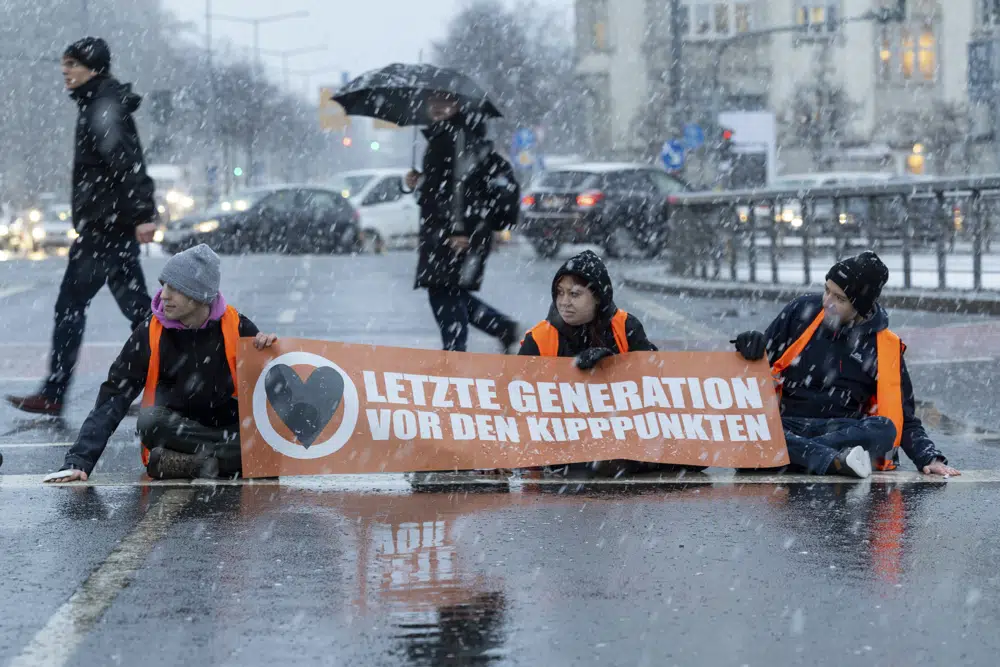
Activists of the "Last Generation" stick themselves on a street during snowfall in Dresden, Germany, and want to draw attention to the compliance with the climate targets, Friday, Jan. 20, 2023. Climate activists say that they will stage further protests in the German capital in an effort to force the government into doing more to curb global warming. Tuesday April 18, 2023's announcement came as courts are taking a tougher line against members of the group Last Generation who have repeatedly blocked roads across the country in the past year. 
(Daniel Schaefer/dpa via AP, File)

BERLIN (AP) — Climate activists said Tuesday that they will stage further protests in Berlin in an effort to force the German government into doing more to curb global warming.

The announcement came as courts are taking a tougher stance against members of the group Last Generation who have repeatedly blocked roads across Germany in the past year.

The group said at a news conference in Berlin that it would begin to stage open-ended protests Wednesday in the government district. From Monday onward, members will try to “peacefully bring the city to a standstill,” it said.

Last Generation accuses the German government of breaching the country’s constitution, citing a supreme court verdict two years ago that found too much of the burden for climate change was being placed on younger generations. The government under then Chancellor Angela Merkel subsequently raised its targets for cutting greenhouse gas emissions, but activists say the measures aren’t consistent with the Paris climate accord.


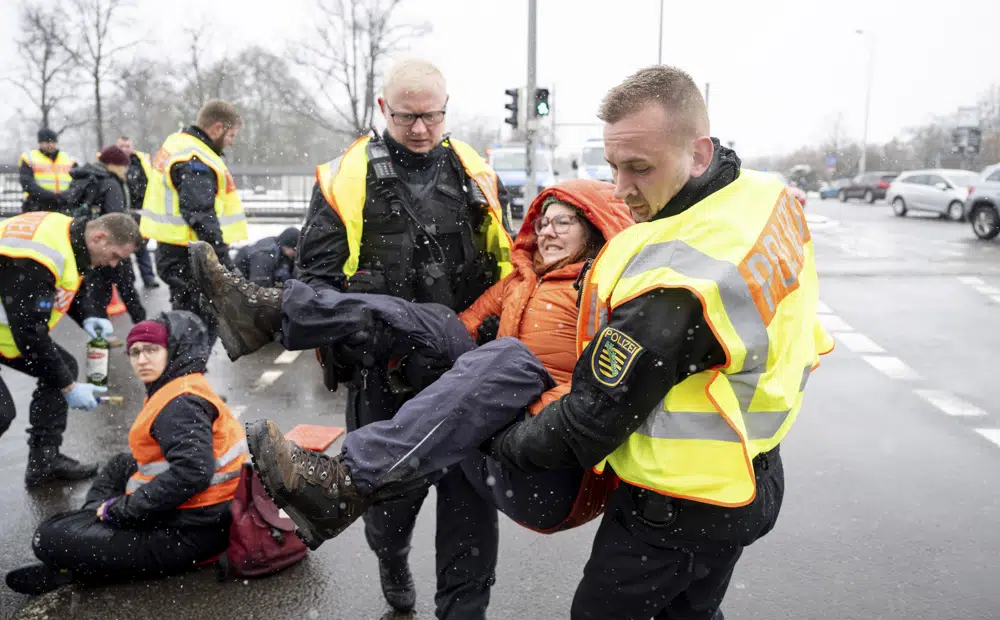
 Police officers carry a Last Generation activist off the roadway of Jahnallee in Leipzig, where she had previously been stuck in Leipzig, Germany, Wednesday, March 8, 2023. Climate activists say that they will stage further protests in the German capital in an effort to force the government into doing more to curb global warming. Tuesday April 18, 2023's announcement came as courts are taking a tougher line against members of the group Last Generation who have repeatedly blocked roads across the country in the past year.
 (Hendrik Schmidt/dpa via AP, File)

“As long as there’s no plan we can trust to protect our lives and future, and that’s based on the constitution, we are obliged to demand such a plan with all peaceful means,” said Carla Hinrichs, a spokesperson for Last Generation.

The group wants Germany to end the use of all fossil fuels by 2030, a step that would be extremely ambitious to achieve. The country switched off its last three nuclear plants over the weekend, increasing its reliance on coal and gas-fired power plants until sufficient renewable energy capacity is available.

Last Generation’s protests have drawn sharp criticism from across much of the political spectrum, though there has also been support for their underlying aims.

Three activists were sentenced to between three and five months imprisonment by a court in the southwestern city of Heilbronn on Monday. The judge noted that they had joined a blockade in March hours after being sentenced in a previous case.

One of the protesters, Daniel Eckert, defended his actions after the verdict, saying: “As long as the true criminals aren’t brought before a court but instead continue to destroy the basis of our existence and profit from it, I can’t do anything other than stand in the way of this destruction.”


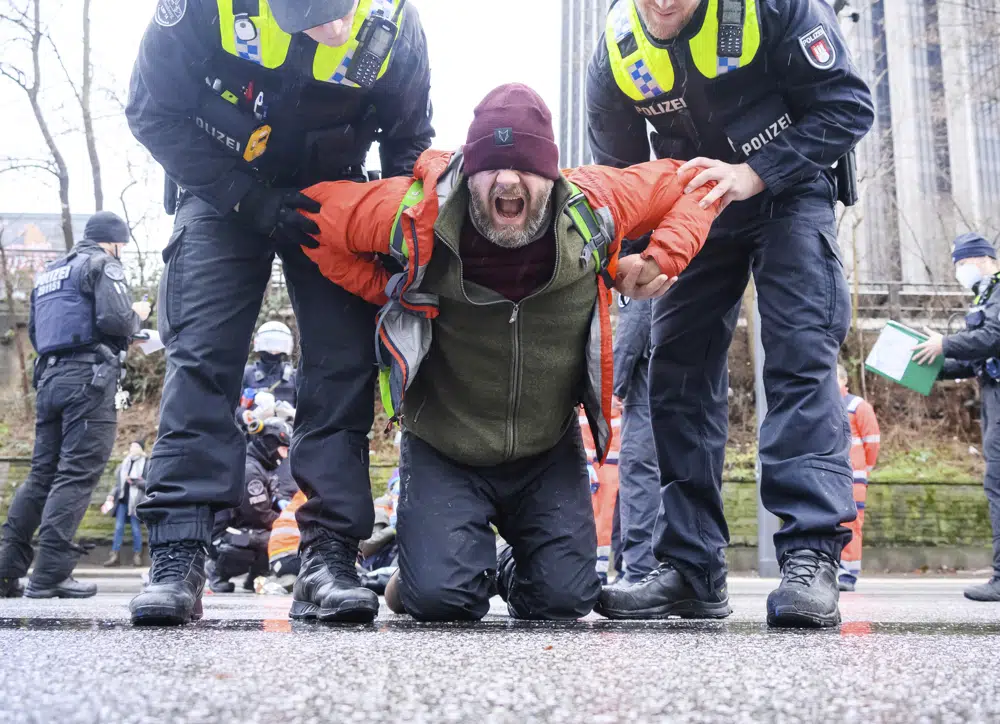
- An activist is held by police on the street as members of the climate group Last Generation block a busy street at Hamburg's Dammtor train station, in Hamburg, Germany, Wednesday, Jan. 4, 2023
(Jonas Walzberg/dpa via AP, File)

Protestors force play to be stopped at world snooker champs

By STEVE DOUGLAS
yesterday

A 'Just Stop Oil' protester jumps on the table and throws orange powder during the match between Robert Milkins against Joe Perry as part of day three of the Cazoo World Snooker Championship at the Crucible Theatre, Sheffield, Britain, Monday, April 17, 2023. (Mike Egerton/PA via AP)

The Crucible Theatre’s famous green baize turned orange at the world snooker championship on Monday when a protestor interrupted a match by jumping on the table and releasing a packet of powder, causing play to be suspended.

Two “Just Stop Oil” protesters invaded snooker’s most famous arena shortly after play began in two matches in the evening session.

On one table, where Robert Milkins and Joe Perry were playing, a man leapt onto the table — scattering the balls — and threw orange dye over one half of the baize as boos and jeers came from the audience.

On the other table, featuring a match between Mark Allen and Fan Zhengyi, a woman was stopped from getting onto the table by the quick-thinking response of referee Olivier Marteel.

Both protestors were taken away by security, but the incident forced a stoppage in play while the mess was cleaned up.

Play resumed in the Allen-Zhengyi match about 45 minutes later but the affected table in the Milkins-Perry match was covered and will be re-clothed overnight. A decision was to be made later Monday regarding whether the Milkins-Perry match would resume following the conclusion of Allen-Zhengyi.

Former world champion Stephen Hendry, who was on commentary duties for the BBC, said it was a “scary” incident and feared the cloth on the table might not be able to be used again.

“For me,” Hendry said, “straight away as a snooker player I am thinking, ‘Is the table recoverable?’ We don’t know what that is on the table.”

Just Stop Oil issued a statement saying the protestors were removed from the Crucible and arrested.

“They are demanding that the government immediately stop all new UK fossil fuel projects and are calling on UK sporting institutions to step into civil resistance against the government’s genocidal policies,” the group said.