Wednesday, April 19, 2023


Trudeau urges caution to ensure foreign influence registry doesn't target diasporas


The Canadian Press
Mon, April 17, 2023


Prime Minister Justin Trudeau cited the internment of Japanese- and Italian-Canadians during the Second World War on Monday as he urged caution in the face of growing calls for Canada to adopt a registry to track foreign influence efforts.  
HE FORGOT UKRAINIAN INTERNMENT IN WWI

The comments came as authorities in the United States launched criminal proceedings against dozens of alleged Chinese government agents operating in that country.

Speaking at a news conference in the Ottawa suburb of Kanata, Trudeau acknowledged the federal government must find better ways to protect Canadians following reports of alleged interference by China in recent Canadian elections.

But the prime minister insisted a balance must be struck to ensure any new measures are not too broad and do not target certain diaspora groups such as Chinese-Canadians or others whose governments are at odds with Canada.

"Canada has had difficult historical experiences that we need to learn from when it comes to creating foreign-agent registries or registries of foreigners in Canada," he added.

"One has to only think of the internment of Japanese citizens, or Japanese-Canadians or Italian-Canadians during the past world wars to know that we must be very, very careful with these things."

Some 22,000 Japanese-Canadians were stripped of their belongings, forced from their homes and relocated into internment camps starting in early 1942, even though the vast majority of them were Canadian citizens.

About 600 Italian-Canadians faced similar treatment and another 31,000 were declared "enemy aliens" after Italy joined Nazi Germany during the Second World War. The federal government has since apologized to both communities.

The issue of foreign interference has been under debate amid media reports citing unnamed security sources and classified documents that allege China tried to interfere in the last two federal elections, as well as the recent municipal election in Vancouver.

On Monday, Trudeau said Chinese-Canadians are often the "first targets" of interference efforts by Beijing, and that any measure adopted by Canada must ensure vulnerable diaspora communities are not unduly hurt or affected.

He added that other groups, such as Iranian-Canadians, have been similarly targeted.

"That's why we're taking the time to consult appropriately on the foreign agent registry, and making sure that we're using it in the right ways."

Public Safety Minister Marco Mendicino announced last month that the Liberal government was beginning consultations on setting up a registry as part of its response to allegations of Chinese interference in recent Canadian elections.

The registry would require people who act on behalf of a foreign state to advance its goals to disclose their ties to the government employing them. It would be another tool, Mendicino said, to prevent other countries from meddling in Canada's affairs.

The idea of a registry, which exists in Australia and the United States, is to make those dealings more transparent, with the possibility of fines or even prison time for failing to comply.

The consultations run until May 9, including through a virtual portal on the Department of Public Safety's website.

In an interview with The Canadian Press last week, Mendicino said he met with a "robust cross-section'' of Chinese-Canadian community members who reinforced the need for a registry of agents acting on behalf of foreign governments in Canada.

Trudeau would not say whether it could be in place before the next federal election. The timing of that vote depends in part on the minority government's supply and confidence agreement with the federal New Democrats.

Canada isn't the only country grappling with allegations of Chinese interference.

Prosecutors in New York City took a big swing Monday at what they described as "audacious and illegal" efforts by Chinese government operatives to harass and threaten dissidents and suppress free speech on U.S. soil.

In three newly unsealed criminal complaints, Justice Department officials levelled charges against a total of 46 defendants, two of whom were living in the U.S. and operating a secret police station in lower Manhattan.

Lu Jianwang, 61, of the Bronx, and Chen Jinping, 59, of Manhattan, were to appear in court later Monday. They are charged with conspiring to act as agents of the government of the People’s Republic of China, and with obstructing justice — allegedly for destroying evidence of communications with officials in China's Ministry of Public Security, or MPS.

On at least one occasion, the police station was behind an effort to locate a pro-democracy activist of Chinese descent who was living in California, said Breon Peace, the U.S. attorney for New York’s Eastern District.

"The Chinese national police appear to have been using the station to track a U.S. resident on U.S. soil," Peace told a news conference.

"The defendants' actions under the direction of the Chinese government are flagrant violations of American sovereignty. ... And the MPS is on notice that we will not tolerate similar threats to our national sovereignty."

Comparable Chinese police operations have been identified in dozens of countries around the world, including in Canada, where RCMP investigators are looking at two community groups in Quebec that are alleged to be MPS outposts.

Those groups have denied the allegations, vowed to co-operate with police and insisted they stand opposed to all forms of intimidation and harassment.

The other two U.S. cases are focused on alleged efforts by Chinese operatives living overseas to harass Chinese nationals living in the U.S. whose political views and actions were "disfavoured" by the government in Beijing.

A "task force" of 34 MPS officers operated as an internet troll farm, Peace said, using fake online profiles and official PRC disinformation to "harass, disparage and threaten" dissidents and activists living all over the world.

"The official PRC disinformation suggested the weakness of U.S. democracy and foreign policy, sought to sow political divisions in U.S. national elections and convey conspiracy theories regarding the U.S. government’s alleged responsibility for the origins of the COVID-19 pandemic."

This report by The Canadian Press was first published April 17, 2023.

Lee Berthiaume and James McCarten, The Canadian Press
It's not the end of privacy yet in Canada, but the threat remains

Robert Diab, Professor, Faculty of Law, Thompson Rivers University
THE CONVERSATION
Mon, April 17, 2023 

Changes to Canadian law will affect how data can be collected and distributed
. (Shutterstock)

Despite early predictions that the internet would spell the end of privacy, it continues to be vital to who we are. Without privacy, we couldn’t sustain relationships or maintain our dignity or sense of self.

Yet our privacy is constantly threatened by ubiquitous surveillance and data collection by tech platforms, retailers, the police and other state agencies, as well as hackers and criminals.

Does privacy law in Canada do enough to protect us from these threats?

To help you decide, it may help to clarify the main features of the legal landscape — when public and private entities can infringe your privacy and what happens when they do.

A constitutional right to privacy


Canadians receive protection from police and other government institutions under the Charter of Rights and Freedoms. And while the word “privacy” appears nowhere in the document, Section 8 still gives Canadians the right to be “secure against unreasonable search or seizure.”

Our highest court drew upon the Fourth Amendment case law in the United States to hold that police engage Section 8 when they search or seize something over which we have “a reasonable expectation of privacy.”

Courts have held that we have a privacy interest in anything that reveals intimate information about us, our lifestyle choices or our “biographical core.” This includes obvious things, like the content of our pockets, homes and digital devices – but it also includes less obvious things like our DNA, breath samples or subscriber information attached to our internet service provider accounts.

Where we do have a reasonable expectation of privacy in a place or thing, police generally need a warrant to search or seize it. In many cases, however, they don’t. They need only be authorized by law to carry out the search. The law, in turn, must be reasonable in striking an appropriate balance between law enforcement interests and personal privacy.

When police obtain evidence without a warrant, or act without authority, a court can exclude the evidence at that person’s criminal trial — though, in some cases, it may decline to do so.

Privacy in the private sphere


The Charter sets limits on what government officials and agencies can do to infringe on our privacy, but more often our privacy is threatened by private entities that gather data or information from us. What are the guardrails in place here and what are the consequences for violating them?

We have federal and provincial statutes to deal with privacy incursions by commercial entities. In some cases, we can sue civilians or businesses in court for breach of privacy.

Read more: Explainer: what is surveillance capitalism and how does it shape our economy?

The most important of these tools is the federal Personal Information Protection and Electronic Documents Act (PIPEDA), which contains rules about collecting, using and disclosing personal information by private sector entities in Canada.

PIPEDA applies to a wide range of commercial activity across all provinces, from large retailers to online platforms. British ColumbiaAlberta and Québec have their own privacy laws that cover matters to which PIPEDA does not apply.

The main obligation in PIPEDA is that a company may not collect, use or disclose information about us unless they have our informed consent and use, or share it, for an identified purpose. The act empowers individuals to access information about themselves and to correct inaccuracies.

The Privacy Commissioner of Canada enforces the act, but has often complained of the weak tools at their disposal for doing so.

A better future for personal privacy?

Currently, parliament is debating the passage of Bill C-27, which would largely replace PIPEDA with the Consumer Privacy Protection Act (CPPA).


The new act will impose more stringent penalties for breaches and give authorities more enforcement tools. But it may also expand the scope of what private entities can do with our data by permitting with benefits “proportionate to” the impact on, or loss of, privacy.

At least one commentator believes the Privacy Commissioner of Canada will continue to permit data collection by social media companies and search engines for advertising purposes under the CPPA. But the act will require companies to be more explicit with us about how they intend to use our data.

The CPPA also includes a novel “right of deletion” for information obtained in violation of the act or where consent is withdrawn. Yet this would not amount to a “right to be forgotten,” given an exception in the act for search engines acting with a legitimate interest.

This covers only some of the many tools in Canadian law for protecting personal privacy. But if this survey makes one thing clear, it’s that for Canadians, privacy is far from dead.

This article is republished from The Conversation, an independent nonprofit news site dedicated to sharing ideas from academic experts. 

It was written by: Robert DiabThompson Rivers University.


Read more:

'Done and dusted': Liberals' controversial online streaming bill back before Senate

Story by The Canadian Press • Yesterday 

OTTAWA — The Liberal government's controversial online-streaming bill was back in the upper chamber on Tuesday, with one senator who had earlier opposed it saying she expected it to pass.


After more than a year of debate and revisions, Alberta Sen. Paula Simons said she would really like to see Bill C-11 "done and dusted" this week, and not because she wants to ram it through.

"For all the cynicism about the Senate, I think the Senate showed its merits with this bill," Simons said in a recent interview. "And I think we did a really good job of debating and discussing it."

Quebec Sen. Marc Gold, the Liberal government's representative in the Senate, said "the finish line is in sight" after he introduced a motion Tuesday that asked the Senate to adopt the bill so that it can become law.

"For Canada’s cultural sector, it has been a long road and a long wait, but the finish line is in sight," Gold said.

"For many in the industry, an important source of their income is inextricably linked to the passage of this bill."

If passed, Bill C-11 would update broadcasting rules to include online streaming and require tech giants such as YouTube, Netflix and Spotify to make Canadian content available to users in Canada — or face steep penalties.

Last month, the House of Commons adopted most of the Senate's amendments, which included measures to highlight the promotion of Indigenous languages and Black content creators and a change that sought to "reaffirm" the independence and freedom of expression of creators.

Senators also tweaked the bill to ensure that funds collected from tech giants would go toward promoting diversity, equity and inclusion.

The bill was subject to especially lengthy debate in the Senate and has sparked criticism from special-interest groups and content creators who feared the bill would cause the government to over-regulate the internet.

"All the debate about this bill has been completely polluted and very well-organized by bot campaigns," said Simons, adding that she still gets hundreds of emails weekly from automated campaigns that spread false information about the bill.

"People are being sold that this is a censorship bill, or that it's like 1984. It's like Stalin. It's like Hitler. It's like the Chinese government. It's all silly," she said.

"There were significant flaws in this bill, and we've made them better."

The Liberal bill is supported by the NDP and Bloc Québécois, but the Conservatives have called it a "censorship" bill, with Conservative Leader Pierre Poilievre even holding up George Orwell's "1984" science-fiction novel about Big Brother in the House while discussing the bill.

Simons, who said she sought to quiet the firestorm of disinformation surrounding the bill, had endorsed an amendment that would have added further protections for individuals who post content online, from comedy acts to instructional videos.

She said she wanted Canadians to actually talk about what's in the bill, as opposed to giving in to "fear-mongering."

Ultimately, the House of Commons rejected the amendment, which was also endorsed by YouTube, because MPs felt it would create a loophole for tech giants to avoid contributing to Canadian content.

"Bill C-11 does not and will not apply to user-generated content because, simply put, using a social-media service does not make you a broadcaster," Gold said Tuesday.

"Rest assured, the legislation will not interfere with or stifle the expression of Canadian voices."

While the bill isn't something she agrees with, Simons said she will support its passage.

"At the end of the day, the government ran on this bill. It was part of their election platform," Simons said — the Liberals had promised similar legislation during their previous minority-government mandate.

"I think there's also an understanding that there are limits to how much the Senate can push back if this is a hill to die on, or if this is profound public-policy disagreement. And the government at the end of the day has to be responsible for its choices."

When the bill is passed, a policy directive will be issued to the Canadian Radio-television and Telecommunications Commission, which will be tasked with enforcing the bill's provisions.

The CRTC is also required to consult with the public, and its reports must be made public, thanks to another Senate amendment that was accepted by the House.

This report by The Canadian Press was first published April 18, 2023.

Mickey Djuric, The Canadian Press

Note to readers: This is a corrected story. A previous version misspelled the first name of Sen. Paula Simons.


Federal Court sides with Facebook in privacy case tied to Cambridge Analytica affair

The Canadian Press
Mon, April 17, 2023 


OTTAWA — A judge has dismissed the federal privacy watchdog's bid for a declaration that Facebook broke the law governing the use of personal information in a case flowing from the Cambridge Analytica affair.

In his ruling, Justice Michael Manson said the privacy commissioner had not shown that the social media giant, now known as Meta, failed to obtain meaningful consent from Facebook users or neglected to adequately safeguard their information.

A 2019 investigation report from Daniel Therrien, federal privacy commissioner at the time, and his British Columbia counterpart cited major shortcomings in Facebook's procedures and called for stronger laws to protect Canadians.

The probe followed reports that Facebook let an outside organization use a digital app to access users' personal information, and that data was then passed to others.

The app, at one point known as "This is Your Digital Life," encouraged users to complete a personality quiz but collected much more information about the people who installed the app as well as data about their Facebook friends.

Recipients of the information included British consulting firm Cambridge Analytica, which was involved in U.S. political campaigns and targeted messaging.

About 300,000 Facebook users worldwide added the app, leading to the potential disclosure of the personal information of approximately 87 million others, including more than 600,000 Canadians, the commissioners' report said.

The commissioners concluded that Facebook violated Canada's privacy law by failing to obtain valid and meaningful consent of installing users and their friends, and that it had "inadequate safeguards" to protect user information.

Facebook disputed the findings of the investigation and refused to implement its recommendations.

The company has said it tried to work with the privacy commissioner's office and take measures that would go above and beyond what other companies do.

In early 2020, Therrien asked the Federal Court to declare Facebook broke the law governing how the private sector can use personal information, the Personal Information Protection and Electronic Documents Act, known as PIPEDA.

In turn, Facebook filed its own action, asking the court to toss out the privacy watchdog's finding that the social media giant's lax practices allowed personal data to be used for political purposes.

Facebook said the commissioner's office improperly embarked on a broad audit of the company's privacy practices in the guise of an investigation into complaints about a specific breach of the law.

In a companion ruling, Manson dismissed Facebook's application.

But the judge also rejected the privacy commissioner's arguments about the social media company's practices.

The commissioner had contended that Facebook failed to obtain meaningful consent from users before disclosing their information to the "This is Your Digital Life" app.

The watchdog said while Facebook verified the existence of privacy policies, and its Platform Policy and Terms of Service required third-party applications to disclose the purposes for which information would be used, it did not manually verify the content of these third-party policies.

The commissioner also said that Facebook provided no evidence of what users were told upon installing the "This is Your Digital Life" app.

Facebook argued that its network-wide policies, user controls and educational resources amounted to reasonable efforts under PIPEDA. It also criticized the commissioner's suggestion that it manually review each app's privacy policy as impractical, as it would require legal staff to examine millions of documents.

Manson said the court was left to "speculate and draw unsupported inferences from pictures of Facebook's various policies and resources as to what a user would or would not read; what they may find discouraging; and what they would or would not understand."

As a result, the commissioner failed to meet the burden of establishing that Facebook breached the law concerning meaningful consent, he wrote.

Manson also agreed with Facebook's argument that once a user authorizes it to disclose information to an app, the social media company's safeguarding duties under PIPEDA come to an end.

Meta said in a statement Monday it was pleased with the ruling. "In the last few years, we have transformed privacy at Meta and built one of the most comprehensive privacy programs in the world."

Vito Pilieci, a spokesman for the privacy commissioner, said the office initiated the court application to protect Canadians' privacy. "With this in mind, we are reviewing the court's decision to determine the next steps."

This report by The Canadian Press was first published April 17, 2023.

———

Meta funds a limited number of fellowships that support emerging journalists at The Canadian Press.

Jim Bronskill, The Canadian Press
Antisemitism festers in current US political and social climate, report says

Kanishka Singh
Mon, April 17, 2023 

Turning Point USA’s Student Action Summit in Tampa, Florida


By Kanishka Singh

WASHINGTON (Reuters) - The social and political climate in the United States has become fertile ground for antisemitism in recent years, according to a report released on Monday by advocacy group Anti-Defamation League and the Tel Aviv University.

Expressions of hatred against Jews have become "mainstreamed and normalized," and incidents of violence, vandalism, and harassment of Jews have increased, the report said.

The report linked the rise of antisemitism to trends such as growing populism, political polarization and an increase in hate crimes nationwide.

It said that conspiracy theories and hate that were once relegated to the fringes of the far-right "have seeped into the mainstream of the political right."

A version of the "great replacement theory" cloaked in "more moderate and not overtly antisemitic language" has broadly spread in segments of the Republican Party, the report said, adding that Fox News host Tucker Carlson also gave voice to the conspiracy theory on his show.

The conspiracy theory fosters the belief that leftist and Jewish elites are engineering the ethnic and cultural replacement of white populations with non-white immigrants. According to this belief, the cabal of political and business elite would be kept in power by the masses of indebted non-whites.

Carlson has denied being antisemitic, and the Republican National Committee passed a resolution earlier this year condemning antisemitism.

The report released Monday also mentions recent events such as former President Donald Trump hosting white supremacist Nick Fuentes at his private club in Florida late last year.

Trump, who is running for president again in 2024, said the encounter with Fuentes happened inadvertently while he was having dinner with Ye, the musician formerly known as Kanye West. Ye was banned from social media last year for antisemitic remarks.

RIGHT WING CONSERVATIVE & ZIONIST BOTH SIDES TROPE
The report also said that the political left wing has pushed antisemitism as well by falsely stating Jews have too much power and wealth to face racism and discrimination. 

More than 3,600 antisemitic incidents were recorded in the United States in 2022, more than in any year since the Anti-Defamation League began tracking the issue in 1979.

(Reporting by Kanishka Singh in Washington; Editing by Frank McGurty and Lisa Shumaker)


NEW DELHI/JAUNPUR: As he crosses the mud houses and wheat fields around his village to catch a train to distant Mumbai, Sujeet Kumar says he is thinking about the better life that awaits him in India’s city of dreams.

The 21-year-old from Jaunpur district, in India’s most populous state of Uttar Pradesh, was headed for the country’s financial capital, saying he moved out of “compulsion”, like hundreds of millions of others before him.

“Mumbai is a city of the rich…whoever goes to Mumbai, their luck changes,” Kumar said. “I hope luck smiles on me also there, and I will also make progress.”

This internal migration is bound to intensify as India becomes the world’s most populous nation, throwing up enormous challenges for the government - managing the strains on urban infrastructure as well as creating 8 million to 10 million jobs every year to absorb its army of young unemployed.

IMF trims India’s growth forecast to 5.9% for current fiscal year

According to 2011 figures, the latest available, India’s then population of 1.21 billion people included 456 million internal migrants.

The United Nations had projected India’s population would reach over 1.42 billion last week, overtaking China.

Nearly two-thirds of India’s people are under 35 and many of those in the countryside flock to the cities to take whatever job they can - becoming labourers, drivers or helpers in shops and homes. Many are from Uttar Pradesh and neighbouring Bihar state, where populations are rising faster than elsewhere in the country.

“Migrants are always concentrated in more precarious work. Better jobs are not available to migrants and they have very little political power to negotiate wages,” said Mukta Naik, an expert on migration at New Delhi’s Centre for Policy Research.

“There are not enough jobs, and they are not good enough to attract people for the long term, not good enough wages to invest in housing, to get their children to the cities to study.”

Besides the low-paid and difficult-to-get jobs, those arriving in the cities are faced with prohibitive costs of living and a struggle to find a place to live. They are unable to access social welfare benefits and many fall victim to the crime rampant in urban slums.

India economy likely to grow 6.5%-7% next fiscal year

Abdul Nur, a 37-year-old security guard in Bengaluru, said he left his village in the northeastern state of Assam when he was 17, and has since lived and worked in Chennai, Hyderabad and Mumbai cities.

“When I was in Mumbai, there was too much tension. It was hot, there was crime,” he said.

He was in India’s financial capital a decade ago, where, he said, it was very tough to live on the 14,000 rupees ($171) he earned a month, with high rents and cost of food.

But even Bengaluru, India’s tech capital which is attracting huge numbers of migrants, has become too expensive, Nur said.

“I am sending my wife and child back to the village,” he said. “In my salary it is very tough to educate him here. I will live alone now.”

Going back

Some of the migrants have become so disheartened they are returning home.

Bhikhari Manjhi, 30, left his village in Odisha state and moved to Bengaluru where he was promised a job as a construction worker with a salary of 10,000 rupees a month. For two months, his contractor paid him 100 rupees every week, promised to pay the rest later, but never did.

India may peg nominal GDP growth at about 11% in 2023/24 budget

“When we demanded our money, we were beaten up,” Manjhi said.

Earlier this month, Manjhi walked for about 1,000 km (620 miles) for over seven days with two fellow villagers to return home.

Now, he said: “We live in the forest area, and can earn about 15,000 rupees in a year.”

In cities like Bengaluru, more than that can be made in a month. But Manjhi said: “I don’t want to go back”.

A 2020 International Labour Organization report said migrant workers contribute 10% of India’s GDP and serve as the backbone of several sectors. The money they send back reduces poverty at home and improves the well-being of their families, it said.

Experts say the government needs to help create more jobs and ensure they are distributed across the country, especially in the poorly-developed and predominantly rural north and the east.

“Rural India (only) provides jobs in the form of disguised unemployment,” said Mahesh Vyas, who heads the Centre for Monitoring Indian Economy.

This meant, he said, that even if more jobs are created in agriculture, they do not add to output. And apart from agriculture, the only investment in the hinterlands is in temporary infrastructure projects, which produce short-lived jobs.

The cities, with all their shortcomings, will continue to attract migrants as they remain the best places to offer jobs, he said.

Kumar from Jaunpur echoes that.

Sporting a new haircut and a pair of sunglasses, he shot videos and photos for his social media accounts during a visit to Mumbai’s tourist spots.

“I am really liking it here…so much better than my village,” he said.

HSBC investor Ping An says bank's management has failed on strategy

LONDON, April 18 (Reuters) - HSBC's management has "fundamentally failed to address key business model challenges", the bank's biggest shareholder Ping An said on Tuesday, in an escalation of a spat between Europe's biggest bank and the Chinese insurer.

HSBC should separate its Asia business into a Hong Kong-listed entity, Ping An said, in an update to proposals it began urging last November calling for the bank to spin off its Asia business.

The renewed salvo from Ping An comes as shareholder advisory group Glass Lewis urged investors to vote against proposals calling for a strategic review and dividend policy revamp, deepening divisions between factions of the bank's ownership ahead of its annual meeting on May 5.

"We believe that a structural solution which creates a separately listed Asia business headquartered in Hong Kong will crystallize multiple benefits to all HSBC Group shareholders," Ping An said.

HSBC reiterated its stance that the proposals lack merit.

"It is our judgment, supported by third-party financial and legal advice, and with third-party assurance, that alternative structural options will not deliver increased value for shareholders," a spokesperson for the bank said.

Glass Lewis said the strategic review proposal, filed by individual shareholder Ken Lui in Hong Kong and backed by Ping An, was "not in shareholders' interest".

Lui's resolutions demand HSBC restore dividends to 51 cents per share and provide regular updates on strategy, including the possibility of spinning off its Asia business.

"In our view, the board's strategy and plans appear valid and are likely to result in greater returns and value, on a risk and cost-adjusted basis, than the overly prescriptive and, in our opinion, unnecessary proposals submitted by the proponent," Glass Lewis said in a note to clients seen by Reuters on Tuesday.

The contrasting positions among HSBC shareholders reflect a deep divide over the direction of Europe's biggest bank, which has struggled in recent years to deliver on long-term profit targets and lift its share price.

Since Ping An began pushing for the Asia spin-off last November, the bank has tried to accelerate plans to exit retail banking in underperforming Western markets such as France and Canada, seeking to deliver on a promise to 'pivot' to Asia.

The Chinese insurer, with an 8% shareholding in the bank, would not be able to force a break-up on its own and has so far shown little evidence that it has convinced other large institutional backers of HSBC that its plan has merit.

Reporting By Sinead Cruise, editing by Lawrence White

HSBC’s top shareholder calls for breakup, expressing ‘deep concern’

By Hanna Ziady, CNN
 Wed April 19, 2023

HSBC may have to choose between China and the West

London CNN —

HSBC’s biggest shareholder has called on the bank to create a separately listed Asian business headquartered in Hong Kong to fix what it sees as a lack of competitiveness.

In a strongly worded statement Tuesday, the CEO of Ping An (PIAIF) Asset Management said that despite improvements, the insurer remained “deeply concerned” about HSBC’s financial performance relative to rivals.

“It is necessary for HSBC to push for structural reform to fundamentally address HSBC’s underlying market competitiveness issues, improve performance, enhance value and accelerate growth opportunities in Asia,” Michael Huang wrote.

“The HK-listed business would be able to focus on investing resources in Asia and being more attuned to local Asia market dynamics,” he added. Ping An Asset Management holds just over 8% of HSBC’s shares.

Europe’s biggest bank is facing growing calls to spin off its Asia business. The latest demand comes just weeks before shareholders are due to vote on a resolution at the bank’s annual meeting that could force it to come up with a plan to split off or reorganize its Asian business — HSBC’s main source of profits.


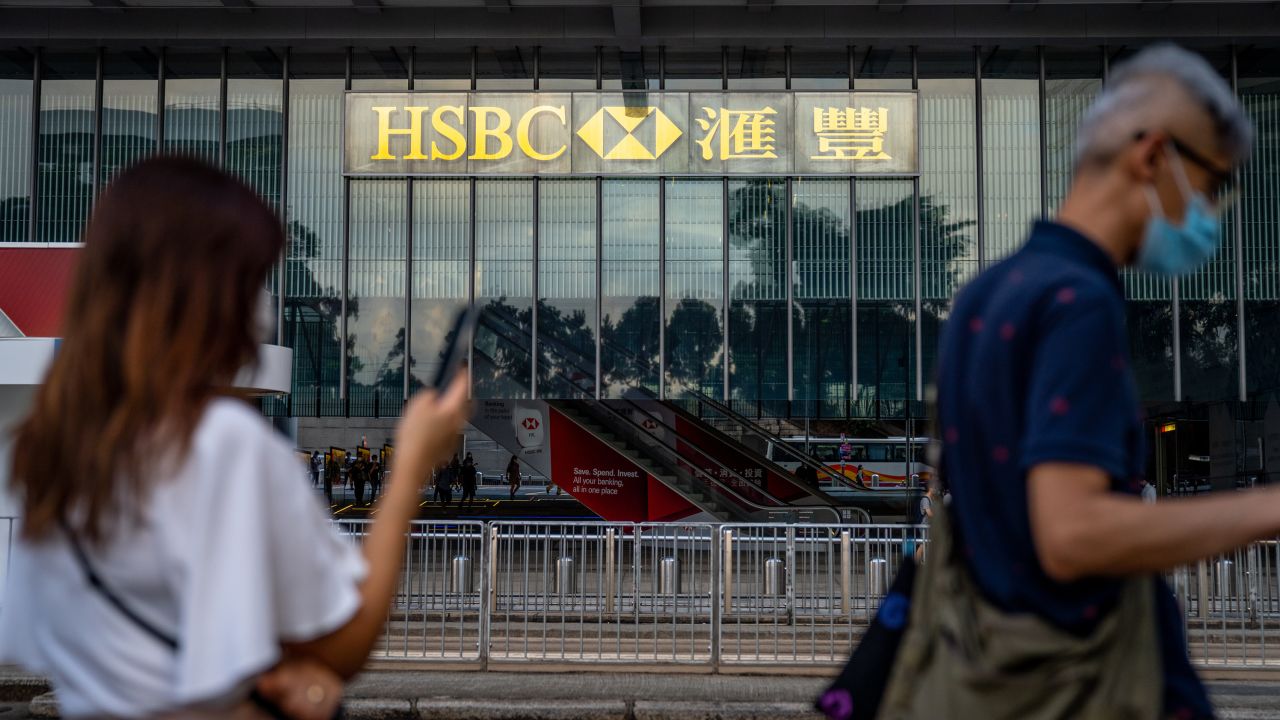
HSBC's Hong Kong headquarters, photographed in September 2021
Katherine Cheng/SOPA Images/LightRocket/Getty Images

At an informal meeting of shareholders last month, HSBC (HBCYF) CEO Noel Quinn said a breakup of the bank would result in “significant revenue loss” because much of its business relied on cross-border transactions. Alongside chairman Mark Tucker, he defended HSBC (HBCYF)’s strategy and said splitting the bank would not be in shareholders’ interests.

HSBC reiterated this position Tuesday.

“It is our judgment, supported by third-party financial and legal advice, and with third-party assurance, that alternative structural options will not deliver increased value for shareholders. Rather, they would have a material negative impact on value,” a spokesperson for the bank said in a statement.

“We remain clear that our current strategy is the fastest, safest and most value-enhancing way to deliver returns.”


HSBC's top execs face tense shareholders calling for a breakup


But in his letter, Huang said the lender’s management had “exaggerated many of the costs and risks” of a breakup. “Despite sharing multiple suggestions with HSBC, we have been extremely disappointed by HSBC management’s consistent closed-minded attitude to all solutions,” Huang wrote.

“We believe that both the HSBC team and its appointed paid external advisers have an adamantly preconceived view against reviewing any structural options, despite our continued request for an open dialogue and the demands of other shareholders.”

Under Ping An’s proposals, HSBC Group would remain the controlling shareholder of a separately listed bank headquartered in Asia, giving it “great influence” over “commercial arrangements,” according to Huang.

He argued that the spinoff would improve HSBC’s financial returns, saying they currently lagged those of rivals. For example, HSBC delivered a return on equity — a measure of a bank’s profitability — of 9.9% in 2022 versus the average of 12.5% for its peers, Huang noted.


HSBC buys SVB's UK business, ending 'nightmare' for British tech


HSBC Asia “will be the most valuable and unique bank in Asia with the strongest growth potential within the HSBC system, and also the only local bank with global competitiveness,” he added.

Ken Lui, the activist shareholder who submitted the resolution that would force HSBC to devise a plan to potentially restructure its Asian unit, cheered news of Ping An’s support and said he had hired a consultant to help lobby HSBC’s “top 50 institutional investors tirelessly” on the issue.

Lui has proposed increasing HSBC’s value “by structural reforms including but not limited to spinning off, strategic reorganisation and restructuring” of its Asia business.

Meanwhile, Glass Lewis, an advisory firm, recommended that HSBC investors vote against the proposal. “We do not believe that realizing improvements in returns and value necessitates a breakup or spinoff of HSBC’s Asian business at this time,” it said in a report to clients this week.

HSBC will hold its annual shareholder meeting on May 5.

— Michelle Toh in Hong Kong contributed reporting.

IT TOOK THIS LONG TO FIGURE OUT

Porn on Amazon’s Kindle app prompts warnings from Apple’s App Store

After learning that sexually explicit porn could be accessed by children on the popular Kindle app, Apple has raised concerns with Amazon calling on the company to strengthen its content moderation.

Greg Bensinger for Reuters:

The warnings were sparked by questions posed by Reuters to spokespeople at the three companies about users’ ability, via the Kindle app, to access and view online volumes of photographs of naked women, with titles such as “75 hot fully nude photos of a young blonde” and “Real Erotica: Amateur Naked Girls – Vol. 4″. Some appeared to show women and men engaging in sexual acts.

Reuters learned of the issue when two families told Reuters their pre-teen sons downloaded the explicit material via Amazon’s Kindle Unlimited e-book subscription service and viewed the full-color photographs on the Kindle iPhone app. Pornography also is available through Amazon’s Kindle online store and viewable on versions of the Kindle app.

The parents, who declined to be named, told Reuters they were initially attracted to the $10-per-month service because it offered access to age-appropriate book series that would otherwise be expensive to purchase and were not available on Amazon’s Kids+ subscription service.

The adult material at issue is primarily self-published through Amazon’s Kindle Direct Publishing arm. Authors can self-publish their books nearly instantaneously through Amazon and may designate the content as available for the Kindle Unlimited service… After Reuters alerted Apple of the availability of pornography in the Kindle app, Amazon earlier this month changed the age rating in the app store to 12 years or older from 4 years or older.

There are no parental controls available for the Kindle Unlimited service.

MacDailyNews Take: Sounds like the Kindle Unlimited service should offer parental controls.

Real Erotica: Amateur Naked Girls - Vol 4 Kindle Edition
Real Erotica: Amateur Naked Girls – Vol 4 Kindle Edition


WORKERS DEBT DRIVES US CAPITALI$M
More US consumers are falling behind on payments


Apr 18, 2023 
By Tatiana Bautzer

NEW YORK, April 18 (Reuters) -Consumers are starting to fall behind on their credit card and loan payments as the economy softens, according to executives atthe biggest U.S. banks, although they said delinquency levels were still modest.

Profits at Bank of America Corp BAC.N,JPMorgan Chase & Co JPM.N, Wells Fargo & Co WFC.N and Citigroup Inc C.N beat analyst forecasts as lending giants earned a windfall from rising interest rates. But industry chiefs warned that the strength would tail off this year as a recession looms and customer delinquencies climb.

"We've seen some consumer financial health trends gradually weakening from a year ago," Wells Fargo Chief Financial Officer Mike Santomassimo said on a conference call Friday to discuss its first quarter results.

While delinquencies and net charge-offs - debt owed to a bank that is unlikely to be recovered - have slowly risen as expected, consumers and businesses generally remain strong, the bank's CEO Charlie Scharf said.

The company set aside $1.2 billion in the first quarter to cover potential soured loans.

Citigroup also made larger provisions for credit losses even as it brought in more revenue from clients' interest payments on credit cards.

Delinquency rates were rising as anticipated, but still stood below normal levels in the bank's "very high quality" loan portfolio, said Mark Mason, the bank's finance chief.

"We have tightened credit standards specifically as a result of the current market environment in cards, we continue to calibrate our credit underwriting based on what we're seeing based on macroeconomic trends," Mason said.

Delinquency rates will probably return to "normal" levels of 3% to 3.5% for branded cards and 5% to 5.5% for retail services by early 2024, Mason said. Current delinquency rates are 2.8% for branded cards and 4% for retail services, according to Citi's presentation on its earnings.

Bank of America provisioned $931 million for credit losses in the quarter, much higher than the $30 million a year prior, but below fourth quarter $1.1 billion provision. Total net charge-offs with credit reached $807 million, increasing from the former quarter but still below pre-pandemic levels, the bank said in its earnings release.

"The consumer's in great shape in terms of credit quality by any historical standards. Employment remains good, wages remain good, and we haven't seen any cracks in that portfolio yet", Bank of America Chief Financial Officer Alastair Borthwick told reporters.

Some of JPMorgan's customers were starting to fall behind on payments, but delinquency levels were still modest, said Jeremy Barnum, finance chief at the largest U.S. lender.

“We are not seeing a lot there to indicate a problem,” he said.

The bank more than doubled the amount it set aside for credit losses in the first quarter from a year earlier, to $2.3 billion, reflecting net charge-offs of $1.1 billion.

Worsening economic conditions would lead to "credit deterioration throughout 2023 and 2024 with losses eventually surpassing pre-pandemic levels given an oncoming recession," predicted UBS analysts led by Erika Najarian. Still, loan defaults are forecast to stay "below the peaks experienced in prior downturns," they said.

As large and medium-sized lenders become more conservative in underwriting, their net charge offs will probably to peak in several quarters, wrote Morgan Stanley analyst Betsy Graseck. "This means slower loan growth" 2023 and 2024, she wrote.

American Express said in a filing on Tuesday its card loans net write-offs grew slightly in March to 1.7% from 1.4% at the end of February. Volumes of past due loans were stable from February to March.

Reporting by Tatiana Bautzer; additional reporting by Saeed Azhar; Editing by Lananh Nguyen and Nick Zieminski