Wednesday, July 05, 2023

U$A
Number of People Exposed to Wildfires Has Doubled Since 2000

The Daily Beast
Mon, July 3, 2023 

Josh Edelson / AFP via Getty

Over the past two decades, a staggering 21.8 million Americans found themselves living within 3 miles of a large wildfire. Most of those residents would have had to evacuate, and many would have been exposed to smoke and emotional trauma from the fire.

Nearly 600,000 of them were directly exposed to the fire, with their homes inside the wildfire perimeter.

Those statistics reflect how the number of people directly exposed to wildfires more than doubled from 2000 to 2019, my team’s new research shows.

But while commentators often blame the rising risk on homebuilders pushing deeper into the wildland areas, we found that the population growth in these high-risk areas explained only a small part of the increase in the number of people who were exposed to wildfires.

Instead, three-quarters of this trend was driven by intense fires growing out of control and encroaching on existing communities.

That knowledge has implications for how communities prepare to fight wildfires in the future, how they respond to population growth and whether policy changes such as increasing insurance premiums to reduce losses will be effective. It’s also a reminder of what’s at risk from human activities, such as fireworks on July 4, a day when wildfire ignitions spike.
Where wildfire exposure was highest

I am a climate scientist who studies the wildfire-climate relationship and its socioenvironmental impacts. For the new study, colleagues and I analyzed the annual boundaries of more than 15,000 large wildfires across the lower 48 states and annual population distribution data to estimate the number of people exposed to those fires.

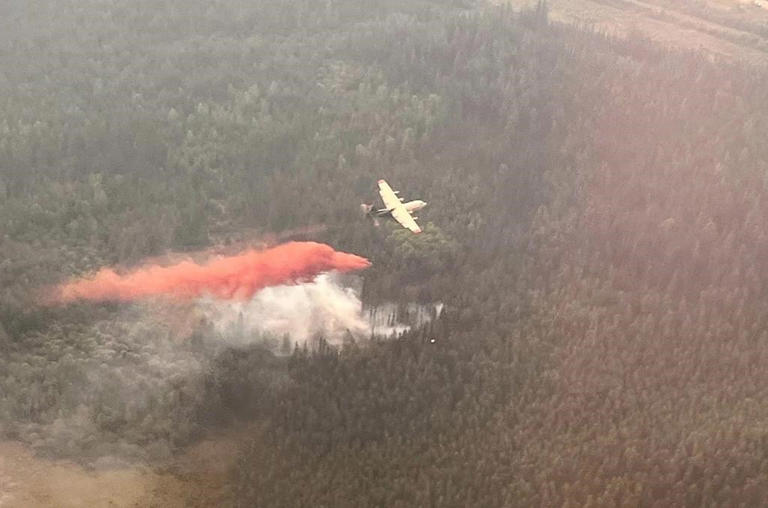
Not every home within a wildfire boundary burns. If you picture wildfire photos taken from a plane, fires generally burn in patches rather than as a wall of flame, and pockets of homes survive.


Mojtaba Sadegh/The Conversation


We found that 80 percent of the human exposure to wildfires—involving people living within a wildfire boundary from 2000 to 2019—was in Western states.

California stood out in our analysis. More than 70 percent of Americans directly exposed to wildfires were in California, but only 15 percent of the area burned was there.
What climate change has to do with wildfires

Hot, dry weather pulls moisture from plants and soil, leaving dry fuel that can easily burn. On a windy day—such as California often sees during its hottest, driest months—a spark, for example from a power line, campfire or lightning, can start a wildfire that quickly spreads.

Recent research published in June 2023 shows that almost all of the increase in California’s burned area in recent decades has been due to anthropogenic climate change – meaning climate change caused by humans.

Our new research looked beyond just the area burned and asked: Where were people exposed to wildfires, and why?

We found that while the population has grown in the wildland-urban interface, where houses intermingle with forests, shrublands or grasslands, that accounted for only about one-quarter of the increase in the number of humans directly exposed to wildfires across the lower 48 states from 2000 to 2019.

Three-quarters of that 125 percent increase in exposure was due to fires’ increasingly encroaching on existing communities. The total burned area increased only 38 percent, but the locations of intense fires near towns and cities put lives at risk.

In California, which was in drought during much of that period, several wildfire catastrophes hit communities that had existed long before 2000. Almost all these catastrophes occurred during dry, hot, windy conditions that have become increasingly frequent because of climate change.


The Conversation

Wildfires in the high mountains in recent decades provide another way to look at the role that rising temperatures play in increasing fire activity.

High mountain forests have few cars, homes and power lines that could spark fires, and humans have historically done little to clear brush there or fight fires that could interfere with natural fire regimes. These regions were long considered too wet and cool to regularly burn. Yet my team’s past research showed fires have been burning there at unprecedented rates in recent years, mainly because of warming and drying trends in the Western U.S.

What can communities do to lower the risk?


Wildfire risk isn’t slowing. Studies have shown that even in conservative scenarios, the amount of area that burns in Western wildfires is projected to grow in the next few decades.

How much these fires grow and how intense they become depends largely on warming trends. Reducing emissions will help slow warming, but the risk is already high. Communities will have to both adapt to more wildfires and take steps to mitigate their impacts.

Developing community-level wildfire response plans, reducing human ignitions of wildfires, and improving zoning and building codes can help prevent fires from becoming destructive. Building wildfire shelters in remote communities and ensuring resources are available to the most vulnerable people are also necessary to lessen the adverse societal impacts of wildfires.

Mojtaba Sadegh is an associate professor of civil engineering at Boise State University
Ten years after Lac-Megantic rail disaster, fish not biting 'like they used to'

Story by The Canadian Press

© Provided by The Canadian Press

LAC-MÉGANTIC, Que. — Pierre Grenier says that ever since the 2013 train derailment in Lac-Megantic, Que., spilled 100,000 litres of crude oil into the Chaudière River, the fishing hasn't been the same.

Anglers like him are catching fewer fish, and their catches are increasingly adult fish, a sign that fewer fish are being born. The fish, Grenier said, "don't bite like they used to."

Experts with Quebec's Environment Department will be deployed in the coming weeks to study the rehabilitation of the river since a runaway train carrying crude oil derailed and exploded 10 years ago, killing 47 people and destroying parts of downtown. The department says it will analyze levels of hydrocarbons in river sediments, the health of animals that live on the riverbed and the overall state of fish populations.

Grenier, president of Lac-Megantic's association of hunters and anglers, says his group has helped the province maintain the health of the region's fish stocks, including by introducing new species into Lake Megantic, which feeds the Chaudière River. But, he said, stocking the lake hasn't had the desired effect.

"We stocked brown trout four years after the disaster, but anglers aren't catching them," he said. "Is the water suitable for the feeding and reproduction of fish? If it's contaminated, we need to know."

Grenier pointed to the location of the spill, where the lake drains into the river. "Right here, the water was full of oil, and it was flowing down into the Chaudière River. Have any toxins remained throughout the lake?" he asked, adding that he hopes the upcoming studies by the Environment Department will answer the question.

In 2015, a summary report from the Environment Department concluded that fish caught at multiple stations along the river showed more deformities and other anomalies than in any other river in the province.


The last study by the provincial government on the effects of the oil spill in the waterway dates back to 2017. Government experts offered at that time a "reassuring" assessment of the health of the fish stock, despite the persistently high rate of anomalies.

"The fish integrity index has not improved, and the percentage of fish exhibiting anomalies (deformities, fin erosion, injuries, and tumours) which was very high in 2014, remained equally high in 2016," the researchers said in the 2017 study, adding that there was "no comparison" between these elevated rates of anomalies and what existed before the spill.

But the study also said sediments in the lake and river had low concentrations of pollutants and "did not warrant decontamination efforts." Oil-contaminated sediments "do not accumulate in the flesh of fish," which are safe to eat, the researchers said.

It was recommended that new studies be conducted before 2022, but for various reasons, including the COVID-19 pandemic, they have been delayed, government spokesman Frédérick Fournier said. Results from this summer's studies on the lake and the river should be published next year, he added.

Back in July 2013, it took 30,000 litres of fire-retardant foam to extinguish the flames caused by the explosion of oil-laden train cars. The foam contained perfluoroalkyl and polyfluoroalkyl substances — known as PFAS or "forever chemicals." Knowledge about these chemicals has significantly evolved in recent years, and they are now under scrutiny by Environment Canada. A draft report by the federal department, published in May, proposes concluding that "all substances in the class of PFAS have the potential to cause harm to both the environment and human health."

Studies by the provincial Environment Department immediately after the Lac-Megantic derailment concluded that there was no evidence the disaster led to a rise in the levels of PFAS in fish.

But Céline Guéguen, a Université de Sherbrooke chemistry professor, says the presence of those chemicals should be re-evaluated in the lake and in the river. "Ten years ago, we knew that forever chemicals existed, but we may not have had the technology to measure them accurately," she said.

Guéguen belongs to a group of researchers seeking funding to assess the contamination of the water 10 years after the spill. "We aim to contribute to improving knowledge about the health of the lake," she said. "If multiple experts delve into these questions, it can only be beneficial for the environment."

This report by The Canadian Press was first published July 5, 2023.

Stéphane Blais, The Canadian Press
Alberta one of the riskiest provinces to live in: Insurance Bureau of Canada

Story by Sarah Komadina • Yesterday 

Airtankers work on a wildfire near Edson, Alta., in a Friday, June 9, 2023, handout photo. A town in northwestern Alberta is being evacuated due to an out-of-control wildfire. An evacuation order has been issued for the town of Edson and parts of Yellowhead County.
THE CANADIAN PRESS/HO-Government of Alberta Fire Service.© JFJ

Alberta hasn't been able to catch a break since wildfires burned through the province in May and June. Since then, there have been floods — some even in the same places affected by wildfires.

This year has also seen one of the strongest tornadoes in Alberta's history — it touched downtown between Didsbury and Carstairs Saturday.

The province is still adding up totals of all the natural disasters, but said so far this year wildfires alone have cost $700 million. Public safety minister Mike Ellis stressed the Alberta government is not focused on cost, but just getting through the season.

"We know that it's the worst alberta wildfire event in Alberta's history we are closing in on 1.5 million hectares burnt," Ellis said.

"We will do whatever it takes to keep Alberta safe."

The Insurance Bureau of Canada's Craig Stewart said natural disasters have been on the rise. He points to 15-years-ago when payouts averaged $400 million across the country. In the last five years, it's grown to five times that amount.

"Last year was $3 billion," he said. "We are going to be in that range again of $2 to 3 billion."

Stewart said these trends have led insurance premiums across the country to jump by 14 per cent — a hit that's been felt more in western provinces.

"Alberta and British Columbia are the two riskiest places in the country based on natural disasters that we've seen in recent years. So unfortunately premiums are going to go up more," Stewart said.


He added no single event makes premiums rise, rather, extreme weather events over time create trends and as it gets worseit will cost taxpayers, homeowners and governments more combined.

This is echoed by the Canadian Climate Institute's Dave Sawyer.

"In the long run taxes have to rise to cover the damages that government are backing. There are hits on productivity (in industry) so there are direct hits on households and there's these indirect impacts," Sawyer said.

He said the government can help by climate-proofing housing and working with homeowners to install equipment to help reduce floods and help with fire breaks in communities.

"There's income hits for people and then supply chain disruptions. Costs rise, inventories are hard to get, so it has this ripple impact through the economy," Stewart said.

Stewart said Alberta has been prone to natural disasters dating back to data bases from the 1970s. He said Alberta accounts for 50 per cent of insured losses associated with an extreme weather event like floods, hail storm and the like.

"Alberta gets the lion's share of economic damage in the country."
Why the Canadian wildfires are still burning — and sending smoke across the U.S.


Ben Adler
·Senior Editor
Mon, July 3, 2023 

A wildfire burns near Fort St. John, British Columbia, Canada. July 2 on Monday. 
(Noah Berger/AP)

With hundreds of Canadian wildfires sending smoke across the northern United States, many Americans are wondering how long the bad air quality will continue and whether Prime Minister Justin Trudeau’s government can do more to put out the flames.

While Canada does have a policy of letting fires in some remote areas burn out on their own, the government has also simply been overmatched by this year’s record-breaking fire season, which has so far burned more than 32,000 square miles.

Canada is also contending with other limitations and challenges — some of which are of its own making. Here’s a rundown:

The fires are incredibly widespread and constantly starting anew


Smoke rises from the Big Creek wildfire, about 110 kilometres (68 miles) northwest of Mackenzie, British Columbia, Canada June 29, 2023
(BC Wildfire Service/Handout via Reuters)

As of Monday, there are 584 active fires in Canada, including three that started today, up from 501 last Thursday, according to the Canadian Interagency Forest Fire Center. Of those, 285 are considered “out of control,” 195 and are “under control,” and 104 are “being held.”

As fires get put out, new ones keep starting. The country has seen a total of 3,255 fires so far this year, and have burned an area roughly as large as the state of South Carolina — making this already the worst fire season in Canadian history — and summer has just begun.

Some of the fires hard to reach, and resources are limited


Trees scorched by the Donnie Creek wildfire in British Columbia. 
(Noah Berger/AP)

With a landmass second only to Russia, but with a population just one-ninth that of the U.S., Canada finds itself short of the manpower, money and equipment needed to effectively counter the extent of this summer’s wildfires.

“Massive fires burning in remote areas — like some of those currently burning in northwestern Quebec — are often too out of control to do anything about,” CNN reported on Saturday.

“With so many fires across the whole country, resources are scarce,” Dustan Mueller, a U.S. Forest Service deputy fire chief who has been in Canada assisting with its firefighting effort, told the Guardian.

“If you have limited resources, and you have a lot of fires, what you do is you protect human life and property first,” Robert Gray, a Canadian wildland fire ecologist, told CNN. “You protect people, infrastructure, watersheds, so there’s a prioritization system.”
The weather, and climate change, are a factor


French firefighters battle fires north of Chibugamau, Quebec.
 (Quentin Tyberghien/AFP via Getty Images)

“Scientists say that climate change is making weather conditions like heat and drought that lead to wildfires more likely,” the BBC reported in June. “Spring in Canada has been much warmer and drier than usual, creating a tinder-dry environment for these vast fires.”

“Given how much energy these fires have while they burn, it is pretty much impossible for them to stop unless large swaths of heavy rains come their way,” Apostolos Voulgarakis, a professor of climate change at Imperial College London, told Newsweek.

Unfortunately, the forecast for the rest of the summer in Canada “is for hot and mostly dry” weather, Canadian fire scientist Mike Flannigan told the Associated Press last Thursday. “It’s a crazy year and I’m not sure where it’s going to end.”
Lack of federal coordination

Each Canadian province is responsible for fighting wildfires within its borders, so, for example, the neighboring provinces of Quebec and Ontario have no coordination to their responses to fires that may even span their border.

“It has been an issue because we don’t have a strong federal government and it’s left us in this mess right now,” Gray told ABC News.

The good news


Firefighters from the organization Working On Fire in Mbombela, South Africa train in preparation for being sent to Alberta, Canada, June 13
(Shiraaz Mohamed/AFP via Getty Images)

Canada is getting a little help from its friends. “U.S., Australian, New Zealand, South African, French, Spanish, Portuguese, Mexican, Chilean and Costa Rican firefighters have joined the struggle in Canada,” the Guardian reported last Thursday. “But Canadian policies, determined by each individual province, required some shifts in strategy.”

American firefighters were surprised to find that in Canada they are expected to stop after a 12-hour shift, and that protecting timber on private land is not considered a priority north of the border, given limited resources.

Doing better next time


Smoke billows upwards from a planned ignition by firefighters tackling the Donnie Creek Complex wildfire south of Fort Nelson, British Columbia, Canada June 3, 2023.
 (B.C. Wildfire Service/Handout via Reuters)

Experts say that eastern Canadian provinces such as Quebec should start imitating their western counterparts and start deliberately burning out the underbrush every year before fire season starts, as Indigenous communities did for millennia.

“In the wildlands of the Quebec forests there is no prescribed program to clean up the forest floor,” John Gradek, a lecturer at McGill University in Montreal, told ABC News.
New record set for world's hottest day - as scientist warns milestone is a 'death sentence'


Sky News
Tue, July 4, 2023


The world has experienced its hottest day on record, according to meteorologists.

The average global temperature reached 17.01C (62.62F) on Monday, according to the US National Centres for Environmental Prediction.

The figure surpasses the previous record of 16.92C (62.46F) - set back in August 2016.

It comes as the southern US and China have been hit by heatwaves, while temperatures in North Africa have neared 50C (122F).

Experts have blamed a combination of climate change and an emerging El Nino weather pattern.

"This is not a milestone we should be celebrating," said climate scientist Friederike Otto of the Grantham Institute for Climate Change and the Environment at Britain's Imperial College London.

"It's a death sentence for people and ecosystems."

Earlier this year, the United Nations warned of higher global temperatures and new heat records due to climate change and the return of El Nino.

El Nino is a rotating weather pattern associated with warmer than normal ocean surface temperatures in the central and eastern tropical Pacific and rainier, cooler conditions in the south and warmer conditions in parts of the north.

Read more:
El Nino: What is it and how does it impact the weather?

Workplace dress codes 'should be relaxed during hot weather'

For three years, the opposite of El Nino - the cooling La Nina weather pattern - has been dominant in the Pacific Ocean.

This has lowered global temperatures slightly - but 2023 has seen the return of the warmer counterpart.

The southern US has been suffering under an intense heat dome in recent weeks, while in China, an enduring heatwave has seen temperatures rise above 35C (95F).

Even Antarctica, currently in its winter, has registered anomalously high temperatures.

Click to subscribe to ClimateCast with Tom Heap wherever you get your podcasts

In the UK, the Met Office recorded June as the warmest since records began in 1884, with a mean average temperature of 15.8C.

The temperature - an average daytime and nighttime temperature from across the UK in June - surpassed the previous record of 14.9C, set in both 1940 and 1976.

Zeke Hausfather, a research scientist at Berkeley Earth, warned more records could be broken this year, due to an increase in emissions and El Nino.

Video shows terrifying moment sea creature emerged in front of angler off Australia


Mark Price 

Tue, July 4, 2023 

Video screengrab

A whale with a sense of humor gave a professional fisherman a jump scare off Queensland, Australia, and video of the incident is equal parts terrifying and hilarious.

It happened about 5:30 p.m. June 27 to Sammy Hitzke, as he was out alone “having a relaxing troll” near Moreton Island.

The video, watched more than 80,000 times on social media, shows Hitzke was busy rigging bait when heard a splash and looked up to see something large and black emerge from the water just feet away.

It just as quickly disappeared back into the water — headed straight for him.

The boat then begins bouncing in the creature’s wake, and Hitzke is seen gripping the back of a seat, looking in all directions to see where it will pop up next.

Hitzke utters only two words in the 56-second video, the first being “holy.”

“So close I could almost smell its breath! Thankfully it wasn’t a grumpy one and it dived under the boat to continued on it’s way,” he wrote on Facebook. “For those wondering, yes the spare undies got put on shortly after!”

Hitzke noted in an Instagram post that the whale was “probably still laughing about it with his whale mates.”

The encounter definitely scared him, and Hitzke told McClatchy News he was worried the whale’s tail might slap the boat — or it would swim through his trolling lines. Either could have been dangerous.

He’s not sure of the whale’s species, but waters off Queensland are home to humpback whales, dwarf minke whales, orcas (killer whales) and southern right whales, experts say.

As for the size, Hitzke can only say “it was pretty bloody big.”

The video was shared June 29 on Facebook and Instagram, where it has gotten more than 2,300 reactions and comments. Most agreed it was a terrifying encounter.

“Bet that made you feel small,” Cynthia Kite Snook wrote.

“I like whales but not when they swim just under the boat,” Adam Hodges posted.

Nobel laureate Paul Krugman cites the 'misery index' as proof of the US's economic strength


Zinya Salfiti
Tue, July 4, 2023 

Nobel Prize-winning economist Paul Krugman.

Paul Krugman praised the US economy, citing a remarkable pullback in the so-called 'misery index.'


US inflation has started to cool in recent months, while the labor market still looks resilient.


"By most measures the economy is doing quite well," Krugman said Monday.

The falling "misery index" is another sign that President Joe Biden has succeeded in reviving the US economy, top economist Paul Krugman said Monday.

The Nobel laureate once again praised Biden's track record, citing the fact that the index – an economic indicator that measures both inflation and unemployment – has fallen to the level it was at when Biden took office in January 2021.

"The plunge in the misery index reflects both what didn't happen and what did," Krugman wrote in a New York Times op-ed. "What didn't happen, despite a drumbeat of dire warnings in the news media, was a recession. The U.S. economy added four million jobs over the past year, and the unemployment rate has remained near a 50-year low."

"What did happen was a rapid decline in inflation," he added.

The misery index, created in the 1970s by Lyndon B. Johnson's policy advisor Arthur Okun, gauges the strength of the economy by adding up the inflation and unemployment rates.

The economic indicator climbed as prices soared in 2021 and 2022, but has fallen over the past year in what Krugman called a "remarkable turnaround".

US inflation has started to cool in recent months, falling from its mid-2022 highs of over 9% to just 4% in May.

Meanwhile, the labor market has remained resilient in the face of the Federal Reserve's aggressive interest-rate hikes, with the US economy adding 339,000 jobs in May and unemployment holding steady at 3.7%.

"By most measures the economy is doing quite well," Krugman wrote.

The Nobel laureate has been optimistic about the US economy recently and said last month that he doesn't think a recession will come, even though America's GDP growth shrank to just 1.1% last quarter.

He has also repeatedly praised Biden's economic track record, noting that inflation has fallen much faster in the US than in other western countries.
This Ohio museum shows that TV is older than you might think

AP
Mon, July 3, 2023 


The history of television began long before millions of people gathered in front of their black-and-white sets and fiddled with the antenna and horizontal hold to watch Lucy, Uncle Miltie and Howdy Doodie.

“Everybody thinks TV started in the ‘50s or the late ’40s. Almost nobody knows it existed before World War II and even goes back to the '20s,” said Steve McVoy, 80, the founder and president of the Early Television Museum in Hilliard, Ohio, a suburb of Columbus.

The museum holds a large collection of televisions from the 1920s and 1930s, and scores of the much-improved, post-World War II, black-and-white sets that changed the entertainment landscape. There are also several of the first-generation color sets developed in the early 1950s.

“The original idea for the museum was to deal with the earliest television technology,” McVoy said. “The sets got pretty boring after 1960, just these big things in plastic cabinets.”

The collection is one of the world’s largest, rivaled in North America only by the MZTV Museum of Toronto. About 180 television sets are on exhibit, arranged in chronological order, with another 50 in storage.

“So many of the sets were incredible to see in their original form,” said Doron Galili, a research fellow in media studies at Stockholm University and author of “Seeing by Electricity: The Emergence of Television, 1878 – 1939” (Duke University Press).

He visited in 2016, and said the museum gives visitors "a better sense not only of the technological aspects of television history but also of its place within popular culture, and modern design and material culture.”

THE BACKSTORY

McVoy’s personal history with television also goes back many years. When he was 10 and living in Gainesville, Florida, he was fascinated by his family’s first set. “I tinkered with it, much to my parent’s dismay,” he said.

He pulled a little red wagon around the neighborhood with a sign that advertised free television repairs.

“Nobody accepted my offer,” McVoy said, adding it was unlikely he could have repaired a set if anyone had asked.

A few years later, he began working in a television repair shop and learned those skills. He opened his own shop, Freedom TV, in the mid-1960s, repairing sets and installing antennas atop apartment buildings and motels. Soon after, he formed his first cable-television business, Micanopy Cable TV, followed by Coaxial Communications and Telecinema. McVoy sold his cable holdings in 1999 and, looking for something to do, decided to start collecting old television sets.

“I never collected anything before,” he said.

The first set he bought, on eBay, was an RCA TRK 12, which was introduced at the 1939 World’s Fair and retailed at $600, a princely sum at the time.

“I think I paid about a thousand bucks for it,” McVoy said, adding that it was in disrepair and missing several parts. “A complete one would have cost five or six thousand; the pre-war sets are very valuable.”

He refurbished the TRK 12, and began collecting more old sets and visiting other collectors who shared his growing passion.

“All their collections were in their basements and attics,” McVoy said. This, plus his wife’s annoyance at all the old sets cluttering up their living room, hatched the idea to start a museum.

The Early Television Museum opened in 2002 as a non-profit foundation. It’s housed in a large former warehouse. Each room features an audio guide, narrated by McVoy. Press another button on some of the sets and and a few old shows appear.

Until a few years ago, McVoy helped restore many of the museum’s televisions himself. “My eyesight and the stability of my hands makes it difficult now,” he said.

HOW TV BEGAN

The idea for transmitting pictures goes back to the 1880s. “The problem of television … has not yet been solved,” The New York Times reported on Nov. 24, 1907.

The first crude mechanical televisions were developed in the mid 1920s by John Logie Baird in England and Charles Jenkins in the United States, and relied on rotating discs to transmit pictures. According to the museum, by 1930, “television was being broadcast from over a dozen stations in the U.S., not only in the major cities such as New York and Boston, but also from Iowa and Kansas. Several manufacturers were selling sets and kits.”

The screens were small and the picture quality extremely poor, with lots of “fading and ghosting.” Programming was limited.

Television made what McVoy calls its “formal debut” on April 30, 1939, at that World’s Fair in New York. President Roosevelt’s speech to open the fair was broadcast live, as an NBC mobile unit sent signals to a transmitter atop the Empire State Building. From there, the signals “went out to visual receivers within a fifty-mile radius in the metropolitan area,” reported the New York Daily News.

RCA and General Electric introduced television models at the World’s Fair. A total of about 7,000 sets were made in the United States in 1939 and 1940, and only about 350 still exist, according to the museum.

World War II halted the production of TV sets in the United States. Engineers who learned about radar and aircraft communications then applied that knowledge to TV technology after the war, when a boom in sales and programming began.

There were about 200,000 sets in the U.S. in 1947, and 18 million by the end of 1953, according to McVoy’s research. Audiences loved “I Love Lucy” (which began airing in 1951) and “The Honeymooners” (began 1955).

The color revolution came in 1954. Sales were initially slow, due in part to cost. It wasn’t until the early 1970s that color sets outsold black-and-white ones.

“We have (an example of) virtually every set that is available,” McVoy said.

SEEKING PHILO FARNSWORTH


At the top of his wish list? A set made by electronic-television pioneer Philo Farnsworth in the late 1920s or early 1930s.

“Only three still survive as far as we know and they’re all already in other museums," McVoy said. "If a fourth ever shows up, we’d go to our donors and would be able to get it.”

—-

For more AP Travel stories, go to https://apnews.com/lifestyle.

Steve Wartenberg, The Associated Press
Wimbledon: Apartheid policy denied junior star shot at tennis showpiece

Isaac Fanin and Nigel Bidmead - BBC Sport Africa
Mon, July 3, 2023 


Hoosen Bobat still has more questions than answers about what happened 52 years ago.

Bobat was a promising 18-year-old tennis player from South Africa. He had won his national junior championship and been accepted to compete in the Wimbledon junior championships.

But there was one problem - the colour of his skin.

"About two weeks before Wimbledon was about to start, I received a telegram from the ILTF (International Lawn Tennis Federation) requesting a meeting at the head office in London," said Bobat.

"I was told to bring my captain. I still vividly recall this meeting.

"As we entered the office of LTA secretary Basil Reay we noticed another person sitting in the office, who was vaguely familiar to me, but my captain instantly recognised him as Alfred Chambers, the head of the white racist tennis body in South Africa at the time.

"He was there to object to my entry into junior Wimbledon."

Bobat recalled Chambers saying that he was not South Africa's number one and that he was not affiliated with a recognized body.

As a man of colour Bobat pointed out that he was not allowed to play against the number and that, when he came to the UK, he had joined a tennis club in north London and had competed in many tournaments.

"After about an hour of the meeting Basil Reay got up and said he was going to instruct the All England Club to remove my name from the draw," said Bobat.

"And for me, just like that, it was all over. Game, set and match."

'How different would my life have been?'

The story of Bobat's exclusion from Wimbledon in 1971 may never have reached a wider audience but for Saleem Badat, a professor of history who served as the first black vice-chancellor of Rhodes University in Grahamstown, South Africa.

Badat, who has been friends with Bobat for 48 years and has written a book about non-racial tennis in South Africa during the apartheid era, wrote to the All England Lawn Tennis Association chief executive Sally Bolton in search of an apology.

"She replied that she was too busy to meet and that the (club) historian was looking into the entry process in 1971," said Bobat.

"How different would my life have been if had played at Junior Wimbledon? Wow, it's a dream of every kid to play Wimbledon.

"And, for me, it would have been a gateway to my future tennis career.

"For every black kid back in South Africa it would have been an inspiration. Despite all the struggles and hardships of the apartheid regime it would have been a chance to show that anyone can make it to the top."

Bobat says the book has brought some catharsis but not closure.

"Who decided? Was it one man that decided? Was there a committee meeting? And on what basis did they remove me from the draw? There are many more questions than answers that have come up," he added.

Bolton has since told the BBC: "We are aware of it. Prof Badat has brought it to our attention. It's an important issue and we are spending time investigating what we know about the entries for the Junior Championships in 1971.

"We've reached out and offered to speak to Mr Bobat - we'd be very keen to do that - and now we are focused on trying to best understand, as much as we can from our archives, what exactly happened."
Wimbledon: Stars call on championships to end Barclays sponsorship


Jemma Dempsey - BBC News
Mon, July 3, 2023 

Emma Thompson is among the signatories of the letter to the AELTC

Film stars and celebrities are calling on Wimbledon to end its new sponsorship deal with Barclays over the bank's support for fossil fuel projects.

Actress Emma Thompson and film director Richard Curtis are two of the campaigners who said Barclays was "profiting from climate chaos".

Wimbledon said Barclays was committed to creating access to sport for all.

Barclays said it was one of the first banks to set an ambition to become net zero by 2050.

The All England Lawn Tennis Club (AELTC) announced Barclays as an official banking partner of the Championships in November last year.

As the 2023 Championships get under way on Monday, Thompson and Curtis are among those to sign an open letter to the AELTC.

The letter is from Make My Money Matter, a campaign group co-founded by Curtis that seeks to transform the financial system to put "people and planet on a par with profit".

It also has the backing of retail guru Mary Portas, entrepreneur and Dragons' Den star Deborah Meaden, Green Party MP Caroline Lucas and musician Brian Eno, among others.

Four Weddings and a Funeral screenwriter Curtis said: "With the great respect and love for Wimbledon - and all the magic from Billie Jean King to Andy Murray - the decision of the AELTC to partner with Barclays is a very bad line call."


Writer and director Richard Curtis co-founded campaign group Make My Money Matter


Addressed to the chief executive of the AELTC Sally Bolton, it states: "Barclays is Europe's largest fossil fuel funder, providing over $190 billion to the industry since the Paris Climate Agreement was struck in 2016.

"Put simply, Barclays is financing and profiting from climate chaos, and accepting a sponsorship deal from them is an endorsement of these actions," the letter said.

The campaign group claims the AELTC's decision to team up with Barclays is "not only bad for the environment, but also inconsistent with Wimbledon's cultural legacy and environmental policies".

"As outlined in your 2023 climate strategy, your intent is to: 'Sustain… The Championships in a way that ensures we have… positive impact on our environment. We will be honest, transparent and act with integrity in what we can and cannot do.'

"We do not believe sponsorship from Europe's largest funder of fossil fuels is consistent with this approach," the letter states.
'Creating access'

In a statement the All England Club said it welcomed Barclays as "the latest addition to our family of official partners".

"Barclays' commitment to creating access to sport for all is something that we are passionate about... our ambition to have a positive impact on the environment is central to our day-to-day operations and is a core part of putting on a successful Championships.

"We know this is one of the defining challenges of our times and we are fully committed to playing our part. From using 100% renewable electricity and offering low carbon options on our menus, to sending zero waste to landfill and promoting a culture of reuse, we're working hard to achieve a positive environmental impact across all of our operations."

Barclays said it believed it could "make the greatest difference as a bank by working with customers and clients as they transition to a low-carbon business model, focusing on facilitating the finance needed to change business practices and scale new green technologies".