Wednesday, July 05, 2023

More than 900 Ryanair flights cancelled in June amid French strike action

Holly Williams, PA Business Editor
Tue, July 4, 2023 


About 160,000 passengers were impacted after Ryanair cancelled more than 900 flights last month amid disruption from air traffic control strikes across France, the low cost carrier has said.

French air traffic controllers staged a series of strikes last month, with the latest – a 34-hour walkout ending on June 30 – marking their 60th day of strike action this year.

The Dublin-based airline was among the most heavily impacted by the industrial action, with flights cancelled across a number of airports and other routes also disrupted by aircraft or crew in the wrong locations.

It said it operated more than 96,250 flights last month but that “regrettably” more than 900 flights were cancelled, “mainly due to ATC (air traffic control) strikes”.

The last French strikes in June were in response to President Emmanuel Macron’s plan to raise the country’s pension age from 62 to 64 and come as part of industrial action across a raft of sectors that has crippled the country since the start of the year.

The former boss of British Airways, Willie Walsh, recently called for a change in the rules to allow flights over France during air traffic control strikes.

He said their action was threatening to wreak havoc for British holidaymakers and impact travel to other European countries.

The law in France dictates that domestic flights must be able to continue during industrial action, but international flights are banned from flying over the country while air traffic controllers are on strike.

In its latest update, Ryanair said overall it carried 17.4 million passengers in June, up 9% year-on-year.

Rival low-cost airline Wizz Air said, in a separate traffic update also out on Tuesday, that it carried 22.5% more passengers year-on-year last month, at 5.3 million.

Wizz Air expanded its network in Albania with 10 new routes in June.
WORKERS CAPITAL
Chicago Pension Debt Rises to $35 Billion as Mayor Hunts for Fix

Shruti Date Singh
Mon, July 3, 2023


(Bloomberg) -- Chicago’s pension burden climbed last year after the city’s retirement funds lost money due to volatile markets, deepening the long-standing fiscal woes for new Mayor Brandon Johnson.

The net pension liability across the city’s four retirement funds rose about 5% to $35.4 billion as of Dec. 31 from $33.7 billion a year earlier, according to Chicago’s annual financial report posted to the city’s website.

The amount the city owes to its four pensions that pay benefits to retired firefighters, police officers, municipal workers and laborers increased “due to the short-term impact of the global market volatility on recognized investment income,” the report said. The city’s four funds range from about 19% to about 40% funded, according to the report. That’s far short of other municipal plans: around the US, funding ratios for the largest public pensions average above 70%.


“While the city still faces several long-term structural challenges, we are charting a better path forward for the city’s finances,” Johnson said in a June 30 letter attached to the report, “that will protect working families and develop actionable solutions to meet the city’s obligations to workers, retirees, and taxpayers.”

Decades of chronic underfunding helped balloon Chicago’s pension liability, weighing on the city’s budget and credit ratings. Recent state-mandated contribution increases helped the city earn rating upgrades in the last year, including one from Moody’s Investors Service in November that allowed it to shed its one junk rating.

Johnson, who took office in May, has set up a pension working group that is charged with finding sustainable solutions to the long-term challenge.

Spokespeople for the city didn’t respond to a request for comment.

Bloomberg Businessweek


Australia’s Top Pension Looks to Spend Cash Pile as Rates Bite

Amy Bainbridge
Tue, July 4, 2023


(Bloomberg) -- AustralianSuper, the nation’s largest pension fund, is preparing for an “opportunity rich” environment in global markets as high interest rates weigh heavier on asset prices.

The fund, which has seen assets under management surge to A$300 billion ($200 billion) thanks to rising inflows, has “a very large amount of money” to spend, Chief Investment Officer Mark Delaney said in an interview. Around 20% of its holdings are in cash and fixed income, one of the highest combined allocations yet, he said.

“We’re hopeful that there’ll be good opportunities emerging over the next two to three years as the effective high interest rates feed through to the economy,” said Delaney. “And we’ve got funding available to take advantage of it.”

AustralianSuper has started to redeploy some its cash into fixed interest, said Delaney, who told Bloomberg in March that he favored buying more bonds as a ballast against the coming economic downturn. The investment chief said on Wednesday that he’d be eyeing other opportunities in fixed interest, stocks, private equity, infrastructure and property “as they arise”.

The fund recently embarked on a hiring spree in New York and London, with a focus on recruiting staff across its private equity, private debt and infrastructure units.

A $185 Billion Australian Fund Ramps Up New York, London Hiring

AustralianSuper on Wednesday posted an 8.2% return for its main balanced fund for the fiscal year through June, largely thanks to strong growth in global equity markets. One of the rare weak performers was property, which has suffered from writedowns of up to 10% mainly in office towers, said Delaney. That included the fund’s stake in the massive King’s Cross redevelopment in London.

The fund’s closest rival, A$240 billion Australian Retirement Trust, this week told Blooomberg its office valuations were down as much as 20%, while A$73 billion pension fund Cbus has written down some real estate by as much as 10%, according to press reports last week.

Delaney said the fund’s core outlook was that the impact of high interest rates will “slow economic activity materially.”

“We’re starting to warehouse or build up cash with the idea that we can deploy that into other investments as pricing gets better over the next two to three years,” said Delaney.

NO BACK TO WORK ORDER
Strike at B.C. ports remains hinged on 'one sentence,' union says

Story by Naimul Karim • July 5,2023
 Financial Post
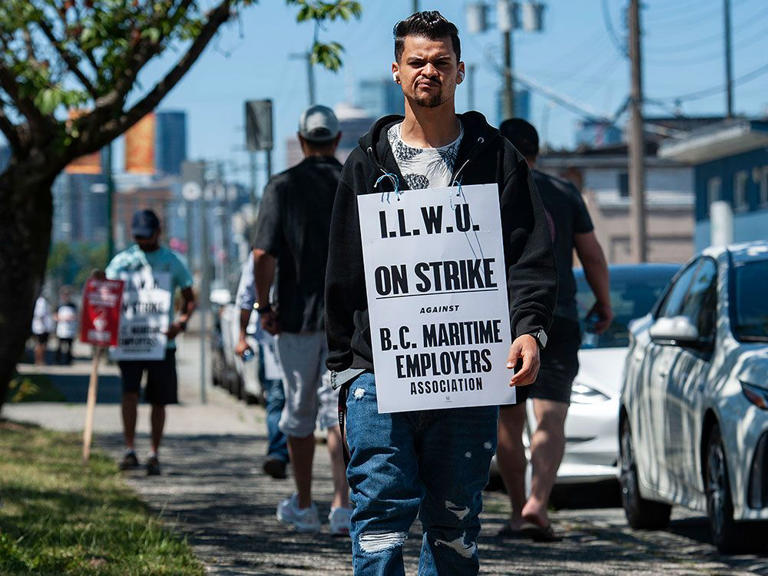
Striking port workers belonging to the International Longshore and Warehouse Union Canada walk the picket line near the Port of Vancouver’s entrance in Vancouver. 

The key issue that’s prolonging a workers’ strike at the ports of British Columbia is linked to a document that details the use of contractual workers and is complete except for one sentence, the union representing the workers said.

The International Longshore and Warehouse Union (ILWU), which represents thousands of workers who stopped working at the B.C. ports on July 1, said its authority over work that involves maintenance has been “aggressively eroded” by employers using third-party contractors.

“This is not an issue of cost for the direct employers because they already pay for this work to be done by maintenance contracting companies,” ILWU president Rob Ashton said in a statement on July 4. “Using ILWU skilled trades employees will be more cost effective and will result in a higher quality of work because of their industry experience and competency.”

But the British Columbia Maritime Employers Association (BCMEA), which represents 49 of B.C.’s private-sector waterfront employers, said the union is looking to “aggressively expand” its scope far beyond what is set out in the industry-wide agreement that has been in place for decades.

The association also said the ports experience significant labour shortages on a regular basis and that while the ILWU has the authority to exclusively supply workers in the current agreement, it has consistently been “unable to fulfill the trades work they have jurisdiction over.”

For example, the BCMEA said that, on average, 17 per cent of the jobs that needed to be filled through the ILWU were unfilled last year.

“This lack of labour supply has immediate impacts on terminal productivity,” BCMEA said in a statement on July 4.

In response, the ILWU said it has enough registered trade workers to meet employers’ demands, but BCMEA members refuse to use or train them as required.

The union’s other demands include higher pay to compensate for rising costs. The median salary for unionized port workers in B.C. last year was $136,000.

BCMEA members are collectively responsible for handling about 16 per cent of Canada’s total traded goods annually, so the strike at the ports has raised concerns among businesses about rising costs.

On July 3, Canada’s largest railway company, Canadian National Railway Co., said the damage inflicted could take months to correct.

The Retail Council of Canada warned that any delays caused by the strike could increase consumer prices since shipping companies charge for the time that goods are on ships, trains, trucks or in container terminals. It added that the impact could be North America-wide since many imported consumer goods enter Canada through B.C. ports.

The Canadian Federation of Agriculture, which represents about 190,000 farmers, said the longer the strike lasts, the worse the impacts will be because companies with vessels delayed in port charge demurrage fees and other penalties that are passed down to farmers.

Canada’s largest mining group, the Mining Association of Canada , said the port shutdowns have put the country’s reputation as a trusted producer of minerals in question.

Devin Dreeshen, Alberta’s minister of transportation and economic corridors, said he wants the federal government to recall Parliament to consider back-to-work legislation to end the strike.

But so far, the federal government hasn’t shown any such intention. Seamus O’ Regan, minister of labour, in a tweet on July 4 urged both parties to “immediately return to the bargaining table and remain there until a deal is reached.”

A quick look at the ongoing strike by British Columbia port workers

The Canadian Press
Tue, July 4, 2023 


VANCOUVER — About 7,400 workers have been on strike at ports along British Columbia's coast since Saturday morning.

Contract talks between the International Longshore and Warehouse Union Canada and the BC Maritime Employers Association broke down Monday.

Here are some key facts in the dispute:

— The union represents workers who load and unload cargo at terminals at more than 30 B.C. ports, including Canada's busiest, the Port of Vancouver.

— The association represents 49 private-sector employers and its website says the industry contributes $2.7 billion to Canada's GDP while handling roughly 16 per cent of the country's total traded goods.

— The union's previous contract expired at the end of March after negotiations aimed at reaching a new deal began in February.

— In early June, union members voted 99.24 per cent in favour of authorizing strike action if required.

— Workers walked off the job Saturday and contract talks stalled Monday, with the union saying the employers had changed their position on a key issue.

— A statement from the union on Tuesday said the key issue holding up a deal is the contracting out of maintenance work by employers. It said the employers' association and its member companies had refused to agree on a regular maintenance document that is complete except for one sentence.

— The employers' association said Monday that it didn't believe more bargaining would produce a deal and said the union was being unreasonable when it came to compensation.

— The union has previously said contracting out, port automation and the cost of living are key issues in the dispute.

This report by The Canadian Press was first published July 4, 2023.

B.C. port strike talks are deadlocked over maintenance, both sides say


The Canadian Press
Tue, July 4, 2023


VANCOUVER — Talks between maritime employers and the union involved in British Columbia's port strike are deadlocked over maintenance work, both sides say.

The union blamed the employers association for failing to agree on "one sentence" in a maintenance deal, while the association said the union was trying to "aggressively expand" control over work it was already unable to fulfil.

More than 7,000 workers at 30 ports across B.C. have been on strike since Saturday morning, leading business organizations as well as officials in both Alberta and Saskatchewan to call on Ottawa to step in.

In a statement issued Tuesday, a day after talks stalled, the International Longshore and Warehouse Union Canada said its jurisdiction over maintenance has been eroded by employers in the BC Maritime Employers Association who were using contractors.

"The key issue that is holding up getting a deal is contracting out of ILWU maintenance work by member employers of the BCMEA and the refusal of the association and its member companies to agree on a regular maintenance document that is all but complete — except for one sentence."

The employers association, meanwhile, said it had hoped Monday's pause "would act as a reset in negotiations" but "regrettably" the union had shown no willingness to modify its position.

"ILWU Canada is attempting to aggressively expand their scope and redefine regular maintenance work far beyond what is set out in the industry-wide agreement, which has been legally well established for decades," it said Tuesday.

It said the union exclusively supplies maintenance labour under the current collective agreement but "it has been consistently unable to fulfil the trades work they have jurisdiction over."

The union has previously said contracting out, port automation and the cost of living are key issues in the dispute.

Devin Dreeshen, Alberta's minister of transportation and economic corridors, said he wants the federal government to recall Parliament to consider back-to-work legislation to end the strike.

Dreeshen said he's frustrated the strike has continued, particularly because Ottawa used legislation in 2021 to end a walkout by Port of Montreal dock workers after one day.

"They used Parliament to resolve it. And that same amount of urgency is something that we're hoping that the federal government has in this case as well," he said.

Dreeshen said Tuesday that Alberta has asked federal Labour Minister Seamus O'Regan for daily updates on negotiations between the BC Maritime Employers Association and the International Longshore and Warehouse Union Canada.

"It's vitally important that the supply chain, this being a main critical component of it, remains open," he said.

O'Regan said Tuesday that federal mediators continue to support both sides in their negotiations.

"We encourage both parties to immediately return to the bargaining table and remain there until a deal is reached," he said on Twitter.

"Collective bargaining is hard work but it's how the best, most resilient deals are made."

In a separate statement responding to calls for back-to-work legislation, O'Regan's office said that it's "not looking past the bargaining table, because the best deals are made at the table."

Hartley Witten, a spokesman for the minister's office, said the primary difference between the situation in Montreal and the current strike is that there was an eight-month truce between the parties in Montreal before the strike.

"Here we had federal mediators that were involved for a number of months before, but I think to suggest there was the same sort of lead-up and we were caught flat-footed, is incorrect."

He said every collective bargaining situation has unique circumstances and B.C.'s case involves significantly more ports than the single location in Montreal.

Dreeshen said western ports, particularly the Port of Vancouver, are "incredibly important" to Alberta's economy. He said 80 per cent of exports that travel through the Port of Vancouver comes from the Prairies.

Jeremy Harrison, Saskatchewan's minister of trade and export development, said Tuesday that shippers in that province have warned the strike is already slowing down the flow of goods, and the current work stoppage will have long-lasting effects on the supply chain.

"It may take weeks or even months to fully recover from these disruptions. Strain on the supply chain leads to additional costs that end up being passed along to consumers, including those in Saskatchewan," he said.

"We encourage the government of Canada to do everything within its power to facilitate a resolution in the best interests of all Canadians.”

Dreeshen said Alberta has yet to see shortages of perishable goods on grocery shelves but that could come "very soon."

Groups representing Canadian businesses also want the federal government to intervene, with one organization calling for legal changes that would discourage future disruptions.

On Tuesday, Canadian Manufacturers & Exporters said designating ports and rail lines as essential infrastructure and limiting when and where labour and other disruptions can occur would provide manufacturers the stability they need.

"A strike of this magnitude not only disrupts the Canadian economy but damages our global trading reputation, hurts already fragile supply chains, and puts jobs at risk," the group said in a statement.

"Given that the federal government understands what is at stake, (Canadian Manufacturers & Exporters) urges them to intervene now to reassure manufacturers that they will not bear the brunt of a labour dispute that is beyond their control."

The group, which says its members account for about 82 per cent of total manufacturing production and 90 per cent of Canada's exports, estimates that the movement of $500 million worth of goods is being disrupted every day.

The Greater Vancouver Board of Trade is meanwhile asking Ottawa to "use every tool at its disposal" to ensure a deal is struck to resume activity at the city's port, including back-to-work legislation, if necessary.

This report by The Canadian Press was first published July 4, 2023.

Ashley Joannou, The Canadian Press

Further negotiations won't bring end to B.C. port workers strike, employers say

The Canadian Press
Mon, July 3, 2023 at 5:49 p.m. MDT·2 min read


VANCOUVER — The association representing employers in an ongoing strike at British Columbia ports says it doesn't think more bargaining is going to produce a collective agreement.

The BC Maritime Employers Association released a statement Monday afternoon saying it had gone as far as possible on core issues.

The International Longshore and Warehouse Union Canada, representing thousands of workers who load and unload cargo at terminals at more than 30 B.C. ports, walked off the job Saturday morning.

Both sides negotiated over the weekend and were at the table earlier in the day on Monday.

The association said it has advanced "reasonable proposals and positions in good faith" but said the union refuses to budge.

"ILWU Canada went on strike over demands that were and continue to be outside any reasonable framework for settlement. Given the foregoing mentioned, the BCMEA is of the view that a continuation of bargaining at this time is not going to produce a collective agreement," the statement read.

"ILWU Canada needs to decide if they are going to continue this strike with no hope of settlement, or significantly modify their position so a fair and balanced deal can be reached."

Union representatives could not immediately be reached for comment, but had previously accused the employers association of demanding "major concessions" despite amassing what the union described as record profits during the COVID-19 pandemic.

The strike led businesses organizations to issue warnings about wide-reaching implications across the country, with some pushing for the federal government to step in with back-to-work legislation.

The union, meanwhile, warned Ottawa not to interfere.

On Sunday, union president Rob Ashton suggested the employers association wanted Ottawa to step in. He said if that happened "there will never be labour peace on the waterfront."


That same day, federal Labour Minister Seamus O'Regan said the focus of negotiations "needs to be on the table."

The association represents 49 private sector employers operating in B.C. ports, and its website says the industry contributes $2.7 billion to Canada's GDP while handling roughly 16 per cent of the country's total traded goods -- amounting to $180 billion in 2020.

This report by The Canadian Press was first published July 3, 2023.
Canada’s West Coast Port Strike Seen Putting Country’s Reputation at Risk

Curtis Heinzl
Tue, July 4, 2023 


(Bloomberg) -- A strike by dockworkers on Canada’s west coast stretched into a fourth day, causing business groups to warn of a growing risk to the country’s economy and reputation.

An extended strike will primarily hurt Canada’s exports of steelmaking coal, copper concentrates and potash, Mining Association of Canada President Pierre Gratton said.

The bulk of Canada’s steelmaking coal is produced in British Columbia, mostly by Teck Resources Ltd., and shipped through Vancouver to countries including Japan and Korea, Gratton said. Teck said it can divert shipments through other terminals to mitigate the impact of the strikes, but Gratton said a disruption longer than a week would have “severe” consequences for Canada’s economy.

“Our reputation as a trading country that can be relied upon is at stake,” said Matthew Holmes, a senior vice president of the Canadian Chamber of Commerce. The chamber wants Parliament, which began its summer recess last month, to return and pass legislation bring the workers back, Holmes said.

Labor Minister Seamus O’Regan said federal mediators were still at work, and the government wants to see a negotiated deal.

About C$800 million ($605 million) of goods — a quarter of Canada’s imports and exports — pass through the affected ports each day. A strike means most of these goods must either wait in the port or be re-routed through the US.

Grain shipments have continued amid the strike as required by the Canada Labour Code.

A slowdown in exports could affect global supply chains, Fertilizer Canada Chief Executive Officer Karen Proud said. Canada is the world’s largest producer of potash — a group of potassium compounds used in fertilizer. The war in Ukraine has already complicated fertilizer availability from Russia and Belarus — which also are major producers — and a reduction in Canadian exports would further strain the supply, Proud said.

Canadian import and export infrastructure has been obstructed several times in the last few years, including during a railway strike in 2019, the blockage of a major trucking bridge in 2022 and interference by public-service workers at the Port of Montreal earlier this year.

“If these events continue to occur, it makes people think twice whether Canada is the place to move your product from,” said Brian Kingston, CEO of the Canadian Vehicle Manufacturers’ Association.

--With assistance from Jacob Lorinc.


Forest fires and industry are devastating last remaining caribou habitat


Local Journalism Initiative
Tue, July 4, 2023

On June 15, Ottawa announced Quebec will be granted “limited additional time” to devise a caribou protection plan due to a wildfire season that has burned over one million hectares of forest so far.

Ontario signed a similar agreement last year with the feds. In March, David Piccini, Ontario’s minister of environment, announced $29 million over five years to support habitat restoration, protection and monitoring of caribou.

Protection is more important than ever. Cumulative impacts of forestry in Quebec and forestry and mining exploration in Ontario are exacerbating the steady decline of caribou populations, a designated federal species at risk, Dave Pearce, senior forest conservation manager at the conservation organization Wildlands League, said.

Now, as wildland fire seasons lengthen and worsen in severity, the disturbance to caribou that thrive in dense, undisturbed forests is compounded with the effects of logging and mining, Pearce explained.

“[Caribou’s] superpower is that they can live in dense, large patches of dense forests that don't have a lot of food for other animals,” he said, pointing to the caribou’s love for lichen as a food source.

Caribou have lived with wildland fire for years, but mining exploration and logging roads create vulnerable conditions for the animals by making corridors for predators like bears and wolves. Caribou are not as fast as deer and are much weaker than moose, making them more vulnerable in younger forests that emerge from logged areas or the ashes of wildland fires.

Deer and moose also prefer younger, less dense forests that provide more food sources, which leads them into caribou territory after fires to compete for food, Pearce said.

Although wolves are often painted as the caribou’s greatest enemy, Pearce doesn’t see it that way. Instead, he sees forestry practices that don’t consider the needs of caribou and don’t recognize the importance of conserving dense brush that can mitigate threats to caribou.

However, it’s unclear how Ontario and Quebec protection efforts will materialize given the risk of damaging a northern economy dependent on forestry, and more recently, mining exploration. However, to protect caribou, a baseline of 65 per cent of undisturbed habitat is needed. It’s a target that might threaten historic forestry towns with mills that are sometimes several decades old.

The protection plans raise questions about current forestry practices that are criticized for unsustainability by researchers, as well as the risk to communities that rely on logging for their local economies. Those small towns could become casualties of the strategy, but it’s clear current forestry practices are not sustainable for caribou, prompting federal Environment Minister Steven Guilbeault to threaten both Quebec and Ontario with invoking a critical habitat protection order through the Species at Risk Act to take over the situation for both provinces.

Two Innu First Nations in Québec who saw an early draft of the agreement last month called out the National Assembly for its proposed caribou protection plan dubbing it a “strategy for extinction,” La Presse reports.

“For the current government, the issue is not the protection of caribou, [it’s] the economy,” Gilbert Dominique, chief of Pekuakamiulnuatsh First Nation, told La Presse in French.

The caribou hold cultural and spiritual importance for the Innu, with feasts and hunts revolving around caribou harvests.

The caribou is seen as a marker for the biodiversity and health of the boreal forest, said biologist Pier-Olivier Boudreault with the Canadian Parks and Wilderness Society Quebec.

Both Pearce and Boudreault agree that the more undisturbed protected areas each province can set aside, the better the chance caribou will have to recover and thrive.

“That’s why environmental organizations are putting so much effort on the species,” he explained. “It’s an iconic animal, but it’s really the idea that if we protect the species, we’re protecting this ecosystem.”

Natasha Bulowski, Local Journalism Initiative Reporter, Canada's National Observer


Gelatinous creatures with ‘bite of a lion’ wash up on beach in Ireland, officials say

Aspen Pflughoeft
Tue, July 4, 2023 

Photo from the Cork County Council Beachguards

Stranded on the wet sand of the beach in southern Ireland sat a reddish pink gelatinous sea creature. Dead or alive, as long as it sat in the sand, the doomed animal posed a danger to beachgoers.

The gelatinous sea creatures were spotted on beaches in County Cork and identified as lion’s mane jellyfish, the Irish news outlet CorkBeo reported.

Lion’s mane jellyfish are “one of the largest jelly species in the world,” according to Oceana. Their bodies can reach 6.5 feet in size while their tentacles can stretch up to 120 feet.

The jellyfish got its name from its tentacles, which appear to form a “mane” and deliver the “bite of a lion,” according to The Wildlife Trusts. These tentacles pack a “very nasty sting” — “even if they’re no longer attached to the jellyfish.”

“The lion’s mane is known as the most dangerous jellyfish that can appear in Irish waters,” CorkBeo reported.

The animal’s sting is “not usually” fatal but can cause “nausea, sweating, cramps, headaches and other symptoms,” the Irish Examiner reported.

Because of the danger the animals pose, sightings of lion’s mane jellyfish prompted a beach closure on July 3, the Cork County Council Beachguards said.

These jellyfish “are normally found in the northern half of Ireland,” the Big Jellyfish Hunt, a wildlife group from University College Cork dedicated to the animal, said. County Cork is along a harbor on the southern coast, about 160 miles southwest of Dublin.

“Recently we have had many reports of lion’s mane in County Cork,” wildlife experts said. “It is very unusual to see so many lion’s mane jellyfish stranding in Cork and sometimes up to 10 observed together at sea.”

The Big Jellyfish Hunt suggested that the recent lion’s mane jellyfish sightings are occurring because the animals “were swept out of their normal home range” in Dublin Bay as babies.

Beachgoers were encouraged to report sightings of the sea creature, wildlife experts said.


Vibrant creature found near Thailand is perplexing — and a new species. Take a look


Moira Ritter
Mon, July 3, 2023

More than 15 years ago, a group of nature lovers were on their way to the Thungyai Naresuan Wildlife Sanctuary in Thailand when something strange caught their eye: a rock-licking fish with a bright red tail.

After arriving at their camp, the visitors went diving and discovered the fish, which was determined to be a new species and was named the Garra Red tail — because it is a member of the diverse Garra genus and because of its coloring, according to a post from the Facebook page Freshwater Fishes of Thailand by Dr. Nonn Panitvong.

This is the sixth species of Garra discovered in the area, according to the study.

Since then, the fish has been known throughout the aquarium trade as the Redtail Garra. Now, for the first time, experts have scientifically identified the creature as an official new species.

Co-authors Weerapongse Tangjitjaroen, Zachary S. Randall, Sampan Tongnunui, David A. Boyd and Lawrence M. Page, describe the fish and identify it as Garra panitvongi in a new study published June 30 in Zootaxa.

Here’s what to know about the creature.

Garra: a diverse genus

Researchers said they collected samples of the new species from the Salween River basin in southeastern Myanmar and western Thailand. The discovery of Garra panitvongi marks the sixth species of Garra discovered in the river basin, according to the study.

There are 189 species of Garra — making it one of the most diverse genera of fish in the world — ranging “from western Africa to China, north to Turkey and Afghanistan, and south to Borneo,” researchers said. Five of those species have been previously identified in the Salween river basin.

The samples were specifically collected from Kasat River in the Kayin State of Myanmar and the Kanchanaburi Province of Thailand.
A distinctive appearance

The newest species of Garra is distinguished by its vibrant coloring and uniquely shaped proboscis, experts said.

The fish’s caudal fin, or tail, and the back quarter of its body is a “red-orange color,” photos show.


The creature’s distinctive red-orange tail made it stand out from other similar species, experts said.

Researchers also noted its pointy proboscis, which is a long and thin tube positioned at about the same height as the fish’s eye. The proboscis is also significant because of the blue stripe that originates at its tip and extends in a V-shape towards the creature’s eye.

Researchers also noted the unique blue, v-shaped stripes on the creature’s proboscis.

Aside from its brightly colored tail, the fish has a dark greenish body and head, the study said. It has six to seven black stripes on its sides before it transitions to its red-orange coloration.

Experts said the fish lacks black spots on its proboscis and bands on its tail that other similar species in the area have.

The fish are an average of about 3.6 inches long, the study said.

Google Translate was used to translate the Facebook post from Freshwater Fishes of Thailand by Dr. Nonn Panitvong.

Deep-sea creature — a new species with eye-catching snout — discovered near Madagascar

New striped creature — with orange groin and unique mating call — found in Australia

Dark purple creature hidden beneath rocks on Thai island discovered as new species
Europe is facing drought with more groundwater being lost than replaced by rain

Sky News
Tue, July 4, 2023 


Europe has a water problem.

Rising temperatures mean its snow is melting, rivers are dwindling, canals are drying up and punishing droughts persist.

It is having a huge impact.

According to the European Drought Observatory, more than a third of the continent is currently under a drought warning, with 10% experiencing severe drought.

This has been going on in various forms since 2018 and it has been estimated that the total water loss across Europe is about 84 billion tonnes per year.

And a recent major study by a university in Austria suggested that Europe is now regularly losing much more groundwater than is being replaced by rainfall.

Torsten Mayer-Gürr, who is one of the study authors, said: "A few years ago, I would never have imagined that water would be a problem here in Europe …. Now it looks like we could face problems."

Read more: Households urged to save water now over summer droughts fear

In parts of France and much of Spain, water restrictions are in place.

Leaders of both countries have said that a lack of fresh water is a critical national issue.

In April when temperatures in southern Spain reached a record breaking 40c, Prime Minister Pedro Sanchez told parliament: "The government of Spain and I are aware that the debate surrounding drought is going to be one of the central political and territorial debates of our country over the coming years."

France's President Emanuel Macron has launched a water crisis plan this year to conserve the precious resource after an unusually dry winter following the country's worst drought on record left its reservoirs 80% below normal levels at the beginning of March.

In a speech he warned that climate change threatened the "end of the abundance of land and materials including water".

The situation is causing conflict, with French environmentalists recently clashing with police over plans to build huge reservoirs to help commercial agriculture businesses keep crops alive.

In Portugal, drought has spread over 90% of the mainland, prompting the government to request EU aid for struggling farmers.

And in Germany the government is so worried about water security for Europe's largest economy it has developed a national water strategy for the first time.

"The consequences of the climate crisis for people and nature are forcing us to act," Environment Minister Steffi Lemke said in a statement.

Read more: Europe could see repeat of last summer's severe droughts, scientists warn

Why is this happening?

Drought is a complicated thing.

Water mismanagement is a big problem.

EurEau, the European federation of national drinking water service providers, has estimated that the continent loses about 20-25% of its drinking water just because of leaks from pipes.

Overconsumption and illegal water use is a major problem too.

In Spain there have been concerns about strawberry farmers in the south of the country impacting the Donana wetlands, which is an important and fragile eco-system.

Consumption as the world heats up is likely to grow.

In England and Wales for example we use about 14bn litres of water a day.

The National Audit Office has predicted that we will need an extra 4bn per day by 2050 to counter the growing risk of drought from climate change.

The role of climate change in all of this is significant.

Lots of parts of Europe have always experienced natural cycles of drought, but climate change is a force that is making things much worse.

That's for a few reasons.

Generally higher temperatures mean there is more evaporation from the ground, rivers and lakes, reducing available water.

On top of that scientists say climate change is making extreme events like heatwaves more likely, more intense, and longer in duration.

This bakes the ground hard, so water from intense rainfall flows over it rather than soaks in - which can increase the risk of flash flooding

Another issue is ice, or lack of it.

Europe's glaciers are shrinking at an unprecedented rate, depriving major rivers and reservoirs of replenishment over time.

The Rhine river in Germany is a good example of this - it got so low in 2022 - Europe's hottest ever summer - that cargo ships could not use it.

The impact of drought can be profound, even in relatively wealthy economies.

A major consequence is food production.

In Spain, farmers are warning of crop failures and irreversible losses, especially to cereal growers.

Dry ground and vegetation means wildfire seasons are starting earlier and burning more intensely, as was observed in Spain, Portugal and France last year.

Ecosystems and habitats also really start to suffer without enough water.

Rivers and wetlands are particularly vulnerable, with knock on impacts for fish and bird life.

Drought can even impact energy security.

Last year a lack of rainfall affected Norway's hydropower production and in France they had to reduce nuclear power output because there wasn't enough river water to cool the stations.

Reduced rain and snowfall impacts tourism too.

Last winter the Alps received less than half their normal snowfall.

Earlier in 2023, a lack of rain contributed to the canals in Venice running dry.

In some parts of France it is now illegal to refill swimming pools and in the south of the country sales of above ground garden swimming pools have been banned.

The UK and large parts of Europe have always enjoyed abundant fresh water, but we are starting to see how climate change threatens a precious resource that we often take for granted.
Earth Keeps Breaking Temperature Records Due to Global Warming

Will Mathis and Aaron Clark
Wed, July 5, 2023 

Earth Keeps Breaking Temperature Records Due to Global Warming

(Bloomberg) -- Global temperatures have smashed through records this week, underscoring the dangers of ever-increasing greenhouse gas emissions generated from burning fossil fuels.

The average worldwide temperature reached 17C (63F) on Monday, just above the previous record of 16.9C in August 2016, according to data from the National Centers for Environmental Prediction. The threshold only lasted a day. On Tuesday, the average temperature hit 17.2C.


The new highs illustrate the extremity of 2023’s summer in the northern hemisphere, and bring into focus the slow pace of global progress on curbing emissions.

“It's a death sentence for people and ecosystems,” said Friederike Otto, a senior lecturer at the Grantham Institute for Climate Change and the Environment. The El Niño weather phenomenon is set to push global temperatures higher, she said.

The heat this summer has already put millions of people around the world at risk. China is experiencing a scorching new heat wave less than two weeks after temperatures broke records in Beijing. Extreme heat in India last month has been linked to deaths in some of its poorest regions. Last week saw a dangerous heat dome cover Texas and northern Mexico, while the UK baked in its hottest June on record.

El Niño conditions have developed in the tropical Pacific for the first time in seven years and will trigger a surge in temperatures, according to the World Meteorological Organization. “The onset of El Niño will greatly increase the likelihood of breaking temperature records,” WMO Secretary-General Petteri Taalas said in a Tuesday statement.

It’s likely the world will exceed 1.5C of warming “in the near term,” with efforts on climate action still insufficient, the Intergovernmental Panel on Climate Change said in March in a report summarizing five years of its own research. Global greenhouse gas emissions need to be cut to 60% below 2019 levels by 2035, according to the report, and climate-related risks are rising with every increment of warming.

“Our world needs climate action on all fronts — everything, everywhere, all at once,” UN Secretary General António Guterres said in a statement at the time. Guterres has urged nations to rapidly accelerate plans to phase out the use of fossil fuels.

Attention will focus on the state of efforts to limit global warming as nations gather for the COP28 annual UN climate summit in Dubai later this year, with expectations already low on the potential outcomes.

Diplomats left a two-week preparatory meeting from COP28 held in Germany last month disappointed by inter-country bickering and what some described as a lack of ambition from the United Arab Emirates, this year’s host nation.

Any failure to achieve progress that significantly boosts the prospects for holding the global average temperature below 1.5 degrees of warming could see some countries, particularly vulnerable small island states, start to question the multilateral climate process.

--With assistance from David Stringer, Emily Cadman and Ben Sharples.

(Updates with new record hit on Tuesday in headline, first and second paragraphs.)

Most Read from Bloomberg Businessweek
The oceans are unusually hot and on track to get hotter. That's not good.

Dinah Voyles Pulver, USA TODAY
Tue, July 4, 2023

Maps of unusually warm sea surface temperatures are awash in reds and oranges this summer, illustrating a series of marine heat waves across much of the globe and raising fears for what the rest of the year could bring as the heat persists and even intensifies.

Roughly 40% of the world’s oceans are experiencing marine heat waves, the most since satellite tracking started in 1991, according to the National Oceanographic and Atmospheric Administration.

By September, that number is projected to climb to 50%, a number that is "kind of scary," said Dillon Amaya, a research scientist with NOAA's Physical Sciences Laboratory. The heat waves could linger through the end of the year.

The spike in ocean temperatures – fueled in part by global climate change – has set off alarms among scientists because of the devastating impact marine heat waves can have on ocean ecosystems, including fish and other marine life. The warmth could help usher in the hottest year on record this year or next and spin up more tropical cyclones than originally forecast in the Atlantic hurricane basin.


The dark oranges and reds on this map illustrate areas where sea surface temperatures are above the long-term average. The map is prepared by the Climate Change Institute at the University of Maine.

In the Antarctic meanwhile, sea ice coverage reached a record low for early winter in the Southern Hemisphere in June, international organizations including NOAA reported. Sea ice extent on June 27 was nearly 1 million square miles lower than the 1981-2010 average and nearly a half-million square miles below the previous lowest extent for the month, set in June 2022.
How hot is the ocean?

Sea surface temperatures in many areas outside the polar regions have been warmer than normal since March. In April and May, they were highest on record for those months in a series of data dating back to 1850, said the United Kingdom’s Met Office.

Anomalies in sea surface temperatures – the difference between the actual temperature and the average temperature – were a record high in May. In the eastern Atlantic, temperatures have been about 1.8 degrees higher than the 1961-1990 average, said Phil Klotzbach, a senior research scientist at Colorado State University.

World sea surface temperatures have been running above previous records since March, according to this chart by the Climate Change Institute at the University of Maine.
What is a marine heat wave and why are they a concern?

A spike in a region's ocean surface temperatures that ranks among the top 10% warmest for that time period in that region when compared with the 1991-2020 average. It could last from several days to months.

Normally, only about 10% of the world's oceans would be warm enough to meet the criteria for a marine heat wave, Amaya said.

NOAA and the United Nations Intergovernmental Panel on Climate Change say marine heat waves have increased in frequency and become more severe in recent decades.

"We know that marine heat waves are getting warmer and warmer as a result of global warming," Amaya said.

Heat waves can disrupt ecosystems, kill fish and other marine life and bleach corals. A massive heat wave off the U.S. West Coast – from Alaska to Mexico’s Baja California Peninsula – in 2014-2016, dubbed “the blob,” caused:

Harmful algal blooms and kelp forest losses that led to shellfishery closures, at an estimated economic cost of $185 million.

The loss of an estimated one million seabirds.

A decline of up to 70% of the cod in the Gulf of Alaska.

What is NOAA's marine heat wave forecast and what does it show?

NOAA developed a system to forecast marine heat waves based on 30 years of satellite data, and is releasing a monthly experimental forecast. In the tropical Atlantic, the forecast shows marine heat wave conditions are likely to linger through August and could linger through the end of the year.

Heat wave conditions are forecast to persist through November in the Northeast Pacific. The forecast projects, with medium confidence, that marine heat wave conditions will form by next spring along the U.S. West Coast, a region where the forecast has the best skill at predicting long-term conditions, Amaya said. Along the equator in the Pacific, where El Niño is developing, heat wave conditions are forecast to persist and intensify.
What’s driving the heat wave in the Atlantic and what does it mean for hurricanes?

Overall, the world's oceans are warming because they've absorbed the majority of the excess warming caused by an increase in greenhouse gas emissions over decades, according to NOAA. Global ocean temperatures were a record high in April and May.

However, natural climate patterns also influence temperatures. The record heat in the Atlantic this spring and summer may be attributed to a weakening in a high pressure system that expands and contracts over the North Atlantic, known as the Bermuda high or the Azores high, said Klotzbach and Amaya.

The high pressure controls the strength of the trade winds. When weaker winds blow over the ocean, it decreases evaporation at the surface and allows ocean temperatures to warm rapidly, Amaya said.

Also partly to blame may be a decrease in seasonal Saharan dust blowing over the Atlantic, which has allowed more sunlight to reach the water, said Albert Klein Tank, head of the Met Office's Hadley Centre.

Sea surface temperatures in the Eastern Atlantic, where hurricanes are often born, are tracking well ahead of previous hyperactive hurricane seasons, Klotzbach said. And typically, warmer ocean temperatures in the Atlantic more fuel hurricanes.

However, El Niño usually creates vertical wind shear over the Atlantic, preventing hurricanes from building the tall, cloud formations that help give them their structure and wind speeds.

"It's certainly a tug-of-war this year between a likely moderate/strong El Nino and the warmest Atlantic on record," Klotzbach said.
What’s happening in the Antarctic and what does it mean?

It’s not unusual for sea ice extent to vary, but the current low in the Antarctic is unusual, NOAA said. Sea ice has set record lows since April.

While scientists know a lot about sea ice in the Arctic and its link to the warming climate, trends in Antarctic sea ice are more difficult to decipher, said Zach Labe, a postdoctoral research associate at Princeton University and NOAA’s geophysical fluid dynamics laboratory.

“It's likely the current record low sea ice (in the Antarctic) is related to feedbacks from the atmosphere and ocean,” Lalbe said. For example, strong winds associated with storm systems can reduce sea ice growth, but areas of unusual ocean heat in the Southern Ocean also can reduce the formation of sea ice.

The yellow line shows the median extent of sea ice around Antarctica from 1981-2010. Areas of blue and white show the current extent of sea ice.

From the time satellite observations of the Antarctic started in 1979, until 2015, the observations showed sea ice extent increasing very slightly. A rapid change started in 2016, and since then sea ice has been mostly below the 1981-2010 average, NOAA reported.

The sea ice reached a record low at the end of the Southern Hemisphere’s summer in 2022, Labe said. That record was broken again in February 2023. Now, with winter just beginning, sea ice is expanding at a much slower rate than normal.


This NOAA graph shows the monthly extent of Antarctic sea ice, dating back to 1979. Summer in the Southern hemisphere

This article originally appeared on USA TODAY: Worrying heat waves in Atlantic, other oceans fueled by climate change
The 1936 North American heat wave hit Toronto hard — temperatures reach 40 °C

Randi Mann
Wed, July 5, 2023 

The 1936 North American heat wave hit Toronto hard — temperatures reach 40 °C

This Day In Weather History is a daily podcast by Chris Mei from The Weather Network, featuring stories about people, communities and events and how weather impacted them.

On Sunday, July 5, 1936, one of Canada's deadliest heat waves hit Manitoba and Ontario. It was part of the 1936 North American heat wave. It took place during the Great Depression and Dust Bowl.


City of Toronto Archives

In North America, the heat wave killed more than 5,000 people and destroyed a vast number of crops. The weather event set many record highs that held until the 2012 North American heat wave. The 1936 heat wave was also followed by one of the continent's coldest winters.


City of Toronto Archives


In late June, the temperatures started to exceed 38 °C across the United States. The Midwest was faced with some of their hottest temperatures on record. In the Northeast, the temperatures reached approximately 35 °C.

In July, North Dakota reached a record 49 °C; still the hottest temperature in the state's history. Many other states set record highs during the month.

In Canada, Ontario and Manitoba reached 43 °C, tying previous heat records. By July 5, Ontario was in a drought. Areas from what is now the QEW corridor, from Hamilton to Niagara and Lake Erie was described as “parched waste,” in the Toronto Daily Star.


July 9, 1936 - The Toronto Daily Star
Courtesy of The Toronto Daily Star

By July 9, temperatures surpassed 40 °C. Areas in Toronto were referred to as “downtown slums” and “districts of torture.” Drivers were lined up on Fleet Street in hopes of getting some lake breeze.


City of Toronto Archives

By July 15, the temperatures finally made it out of the 40s and 30s and sat in the high 20s. By then, the heatwave killed more than 200 people in Toronto. The overall death toll in Canada was around 1,180.

To learn more about the 1936 heatwave, listen to today's episode of "This Day In Weather History."

Subscribe to 'This Day in Weather History': Apple Podcasts | Amazon Alexa | Google Assistant | Spotify | Google Podcasts | iHeartRadio | Overcast'

Thumbnail: Courtesy of City of Toronto Archives
Israel withdraws troops from West Bank militant stronghold
CIVILIAN REFUGEE CAMP and warns 2-day raid is not a one-off

The Canadian Press
Wed, July 5, 2023 


JENIN, West Bank (AP) — The Israeli military withdrew its troops from a militant stronghold in the occupied West Bank on Wednesday, ending an intense two-day operation that killed at least 12 Palestinians, drove thousands of people from their homes and left a wide swath of damage in its wake. One Israeli soldier was also killed.

The army claimed to have inflicted heavy damage on militant groups in the Jenin refugee camp in an operation that included a series of airstrikes and hundreds of ground troops.

But it remained unclear whether there would be any long-lasting effect after nearly a year and a half of heavy fighting in the West Bank.

Ahead of the withdrawal, Israeli Prime Minister Benjamin Netanyahu vowed to carry out similar operations if needed.

“At these moments we are completing the mission, and I can say that our extensive operation in Jenin is not a one-off,” he said during a visit to a military post on the outskirts of Jenin. “We will eradicate terrorism wherever we see it and we will strike at it.”

The Jenin raid was one of the most intense Israeli military operations in the West Bank since an armed Palestinian uprising against Israel's open-ended occupation ended two decades ago.

Since early 2022, Israel has been carrying out near daily raids in the West Bank in response to a series of deadly Palestinian attacks. It says the raids are meant to crack down on Palestinians militants and said they are necessary because the Palestinian Authority is too weak.

The Palestinians say such violence is the inevitable result of 56 years of occupation and the absence of any political process with Israel. They also point to increased West Bank settlement construction and violence by extremist settlers.

Israel struck the camp, known as a long-time bastion of Palestinian militants, early Monday in an operation it said was aimed at destroying and confiscating weapons.

Big military bulldozers tore through alleyways, leaving heavy damage to roads and buildings, and thousands of residents fled the camp to seek safety with relatives or in shelters. People said electricity and water were knocked out. The army said the bulldozers were necessary because roads were booby-trapped with explosives.

After troops left Wednesday morning, residents began emerging from their homes. They found streets lined by scorched and flattened cars and piles of rubble.

The military said it had confiscated thousands of weapons, bomb-making materials and caches of money. Weapons were found in militant hideouts and civilian areas alike, in one case beneath a mosque, the military said.

The withdrawal came hours after a Hamas militant rammed his car into a crowded Tel Aviv bus stop and began stabbing people, wounding eight, including a pregnant woman who reportedly lost her baby. The attacker was killed by an armed bystander. Hamas said the attack was revenge for the Israeli offensive.

Early Wednesday, militants from Hamas-ruled Gaza also fired five rockets toward Israel, which Israel said were intercepted. Israeli jets struck several sites in Gaza.

In Jenin, fighting continued until shortly before the withdrawal Wednesday morning.

The Israeli military said it carried out an airstrike late Tuesday targeting a group of militants in a Jenin cemetery. It said the gunmen threatened forces moving out of the camp. Israeli and Palestinian officials also reported fighting near a hospital in Jenin late Tuesday. An Associated Press reporter on the ground could hear explosions and the sound of gunfire.

Palestinian health officials said 12 Palestinians were killed during the Israeli raid and dozens were wounded. Another Palestinian man was killed by Israeli forces in an unrelated incident near the West Bank city of Ramallah. The Israeli military has claimed it killed only militants, but it has not provided details.

The large-scale raid comes amid a more than yearlong spike in violence that has created a challenge for Netanyahu’s far-right government, which is dominated by ultranationalists who have called for tougher action against Palestinian militants only to see the fighting worsen.

Over 140 Palestinians have been killed this year in the West Bank, and Palestinian attacks targeting Israelis have killed at least 25 people, including a shooting last month that killed four settlers.

The sustained operation has raised warnings from humanitarian groups of a deteriorating situation.

Doctors Without Borders accused the army of firing tear gas into a hospital, filling the emergency room with smoke and forcing emergency patients to be treated in a main hall.

The U.N.’s human rights chief said the scale of the operation “raises a host of serious issues with respect to international human rights norms and standards, including protecting and respecting the right to life.”

Kefah Ja’ayyasah, a camp resident, said soldiers forcibly entered her home and locked the family inside.

“They took the young men of my family to the upper floor, and they left the women and children trapped in the apartment at the first floor,” she said.

She claimed soldiers would not let her take food to the children and blocked an ambulance crew from entering the home when she yelled for help, before eventually allowing the family passage to a hospital.

Across the West Bank, Palestinians observed a general strike to protest the Israeli raid.

With airstrikes and a large presence of ground troops, the raid bore hallmarks of Israeli military tactics during the second Palestinian uprising in the early 2000s. But there are also differences, including its limited scope.

Israel captured the West Bank, east Jerusalem and the Gaza Strip in the 1967 Mideast war. The Palestinians seek those territories for their hoped-for independent state.

___

Majdi Mohammed And Imad Isseid, The Associated Press