Wednesday, July 05, 2023

Martian dunes eroded by a shift in prevailing winds after the planet's last ice age


Peer-Reviewed Publication

CHINESE ACADEMY OF SCIENCES HEADQUARTERS

The Martian dune formation and Martian climate in the Zhurong rover exploration zone 

IMAGE: THE MARTIAN DUNE FORMATION AND MARTIAN CLIMATE IN THE ZHURONG ROVER EXPLORATION ZONE view more 

CREDIT: NAOC


Detailed analysis of data obtained by the Zhurong rover of dunes located on the southern Utopian Plain of Mars suggests the planet underwent a major shift in climate that accompanied changes in prevailing winds. This shift likely occurred about 400,000 years ago, which coincides with the end of the last glacial period on Mars.

Researchers from the National Astronomical Observatories, Institute of Geology and Geophysics and Institute of Tibetan Plateau Research of the Chinese Academy of Sciences, in collaboration with colleagues from Brown University, assessed the surface structure and chemical composition of Martian dunes to determine the age of sand structures and prevailing wind directions at different locations near the Zhurong rover landing site.

The team found that the prevailing wind direction on the southern Utopian Plain shifted nearly 70° from northeast to northwest, eroding crescent-shaped dunes formed during the last glacial period into dark, longitudinal ridges after the last Martian ice age.

The study was published in Nature on July 5, 2023.

"The exploration and research on the climate evolution of Mars has been of great concern for a long time. Mars is the most similar planet to Earth in the Solar System. Understanding Martian climate processes promises to uncover details of the evolution and history of Earth and other planets in our Solar System," said Prof. LI Chunlai from the National Astronomical Observatories of the Chinese Academy of Sciences (NAOC), principal investigator of the study.

Prior research suggested that the Martian climate has changed over time, but the inability to directly measure and sample geological formations on Mars limited scientists' ability to validate and better characterize the planet's climate processes. LI's team used high-resolution orbital cameras and the Zhurong rover's terrain and multispectral cameras, surface composition analyzers and meteorological measuring instruments to finally obtain in situ data directly from the Martian surface.

The research team estimated that a change in the angle of the rotational axis of Mars caused the planet to exit its most recent ice age. The effects of this change were subsequently captured by the morphology, orientation, physical properties and stratigraphy, or layering, of dunes on the southern Utopian Plain of Mars, where the Zhurong rover landed.

The study was designed to integrate rover-scale data of dune formations and weather conditions to not only confirm a change in prevailing wind direction with the close of the last ice age, but also improve general circulation models used to predict finer-scale changes in seasonal wind direction. Importantly, prevailing wind data and dune stratigraphy at the rover landing area were consistent with the presence of ice and dust layers found at middle and higher latitudes of the planet.

A great deal of effort is being invested in characterizing the ancient climate of Mars over the course of the Amazonian epoch, which began between 3.55 and 1.8 billion years ago and continues to this day.

"Understanding the Amazonian climate is essential to explain the current Martian landscape, volatile matter reservoirs and atmospheric state, and to relate these current observations and active processes to models of the ancient climate of Mars. Observations of the current climate of Mars can help refine physical models of Martian climate and landscape evolution, and even form new paradigms," said LI.

In situ studies on the Martian surface have enormous scientific value, and the Zhurong rover will be busy collecting data for some time. "We will continue to study both Amazonian and present-day climate to promote the knowledge regarding the last two billion years of Martian climate history, including its environment and processes," said LI.

Similar to humans, elephants also vary what they eat for dinner every night


Peer-Reviewed Publication

BROWN UNIVERSITY


PROVIDENCE, R.I. [Brown University] — Elephants eat plants. That’s common knowledge to biologists and animal-loving schoolchildren alike. Yet figuring out exactly what kind of plants the iconic herbivores eat is more complicated.

A new study from a global team that included Brown conservation biologists used innovative methods to efficiently and precisely analyze the dietary habits of two groups of elephants in Kenya, down to the specific types of plants eaten by which animals in the group. Their findings on the habits of individual elephants help answer important questions about the foraging behaviors of groups, and aid biologists in understanding the conservation approaches that best keep elephants not only sated but satisfied.

The study was published in the journal Royal Society Open Science.

“It’s really important for conservationists to keep in mind that when animals don’t get enough of the foods that they need, they may survive — but they may not prosper,” said study author Tyler Kartzinel, an assistant professor of environmental studies and of ecology, evolution and organismal biology at Brown. “By better understanding what each individual eats, we can better manage iconic species like elephants, rhinos and bison to ensure their populations can grow in sustainable ways.”

One of the main tools that the scientists used to conduct their study is called DNA metabarcoding, a cutting-edge genetic technique that allows researchers to identify the composition of biological samples by matching the extracted DNA fragments representing an elephant’s food to a library of plant DNA barcodes.

Brown has been developing applications for this technology, said Kartzinel, and bringing together researchers from molecular biology and the computational side to solve problems faced by conservationists in the field.

This is the first use of DNA metabarcoding to answer a long-term question about social foraging ecology, which is how members of a social group — such as a family — decide what foods to eat, Kartzinel said.

“When I talk to non-ecologists, they are stunned to learn that we have never really had a clear picture of what all of these charismatic large mammals actually eat in nature,” Kartzinel said. “The reason is that these animals are difficult and dangerous to observe from up-close, they move long distances, they feed at night and in thick bush and a lot of the plants they feed on are quite small.”

Not only are the elephants hard to monitor, but their food can be nearly impossible to identify by eye, even for an expert botanist, according to Kartzinel, who has conducted field research in Kenya.

Understanding an elephant’s favorite foods

The research group compared the new genetic technique to a method called stable isotope analysis, which involves a chemical analysis of animal hair. Two of the study authors, George Wittemyer at Colorado State University and Thure Cerling at the University of Utah, had previously shown that elephants switch from eating fresh grasses when it rains to eating trees during the long dry season. While this advanced study by allowing researchers to identify broad-scale dietary patterns, they still couldn’t discern the different types of plants in the elephant’s diet.

The scientists had saved fecal samples that had been collected in partnership with the non-profit organization Save the Elephants when Wittemyer and Cerling were conducting the stable isotopes analyses almost 20 years ago. Study author Brian Gill, then a Brown post-doctoral associate, determined that the samples were still usable even after many years in storage.

The team coupled combined analyses of carbon stable isotopes from the feces and hair of elephants with dietary DNA metabarcoding, GPS-tracking and remote-sensing data to evaluate the dietary variation of individual elephants in two groups. They matched each unique DNA sequence in the sample to a collection of reference plants — developed with the botanical expertise of Paul Musili, director of the East Africa Herbarium at the National Museums of Kenya — and compared the diets of individual elephants through time.

In their analysis, they showed that dietary differences among individuals were often far greater than had been previously assumed, even among family members that foraged together on a given day.

This study helps address a classic paradox in wildlife ecology, Kartzinel said: “How do social bonds hold family groups together in a world of limited resources?”In other words, given that elephants all seemingly eat the same plants, it’s not obvious why competition for food doesn’t push them apart and force them to forage independently.

The simple answer is that elephants vary their diets based not only on what’s available but also their preferences and physiological needs, said Kartzinel. A pregnant elephant, for example, may have different cravings and requirements at various times in her pregnancy.

While the study wasn’t designed to explain social behavior, these findings help inform theories of why a group of elephants may forage together: The individual elephants don’t always eat exactly the same plants at the same time, so there will usually be enough plants to go around.

These findings may offer valuable insights for conservation biologists. To protect elephants and other major species and create environments in which they can successfully reproduce and grow their populations, they need a variety of plants to eat. This may also decrease the chances of inter-species competition and prevent the animals from poaching human food sources, such as crops.

“Wildlife populations need access to diverse dietary resources to prosper,” Kartzinel said. “Each elephant needs variety, a little bit of spice — not literally in their food, but in their dietary habits.”

This work was supported by the National Science Foundation (DEB-1930820, DEB-2026294, DEB-2046797, and OIA-2033823).

France's Supreme Court rejects groups' request for slavery reparations in case from Martinique


PARIS (AP) — France’s highest court has rejected a request by three groups seeking reparations for slavery in a case that originated on the French Caribbean island of Martinique.

The court’s decision on Wednesday said that no one produced evidence showing they had “suffered individually” any damage from the crimes that their ancestors had been subjected to.

One of the lawyers pursuing the case, Alain Manville, called it a “political decision” and said he believed the large amount of money that France would have to pay in reparations was a major consideration for the court. He expressed hope for making the case more global, bringing in “all Afro-descendants” in a move that he believes would lead French judges to see the case differently.

“We will succeed in this process,” Manville said. “I don't know when.”

Slavery was abolished in France in 1848, but before that had a significant slave trade, shipping more than 1 million Africans to colonies in the Americas. The International Movement for Reparations and two other groups launched efforts in pursuit of reparations in 2005. French courts have repeatedly rejected their request, but the European Court of Human Rights kept their efforts alive by making their claims admissible.

Another lawyer pursuing the case for reparations, Patrice Spinosi, in an emailed statement said the groups would approach the European Court of Human Rights for a new appeal.

The issue of reparations is widely debated across the Caribbean, where an estimated 5 million slaves were brought over by colonial powers, including Britain and France, and forced to toil on sugar plantations and other fields under brutal conditions.

In 2022, an appeals court in Martinique, which is an overseas department of France, rejected the groups’ request, noting that there’s a statute of limitations for those crimes and that a French law already allows the implementation of certain measures meant to “bring a memorial contribution to the recognition of slavery and the slave trade” and that it is not for the judiciary to decide if those measures are sufficient.

Another lawyer pursuing the case, Georges Emmanuel Germany, said France's highest court was “outside the post-colonial reality” and asserted that it doesn't recognize slavery as a crime against humanity.

Cara Anna, The Associated Press
India Unseen War
Armed mobs rampage through villages and push remote Indian region to the brink of civil war

India Unseen War
Kim Neineng, 43, a tribal Kuki, cries as she narrates the killing of her husband, at a relief camp in Churachandpur, in the northeastern Indian state of Manipur, Tuesday, June 20, 2023. Neineng escaped with her four children to a nearby relief camp when a Meitei mob descended on their village. Her husband was killed by the mob — beaten with iron bars, his legs chopped off and then picked and tossed in the raging fire that had already engulfed his home. The deadly conflict between the two ethnic communities has killed at least 120 people.
 (AP Photo/Altaf Qadri)

India Unseen War
Members of Meira Paibis, powerful vigilante group of Hindu majority Meitei women, block traffic as they check vehicles for the presence of members from rival Christian tribal Kuki community, in Imphal, capital of the northeastern Indian state of Manipur, Monday, June 19, 2023. Manipur is caught in a deadly conflict between the two ethnic communities that have armed themselves and launched brutal attacks against one another. At least 120 people have been killed since May.
 (AP Photo/Altaf Qadri)


SHEIKH SAALIQ
Tue, July 4, 2023

KANGVAI, India (AP) — Zuan Vaiphei is armed and prepared to kill. He is also ready to die.

Vaiphei spends most of his days behind the sandbag walls of a makeshift bunker, his fingers resting on the trigger of a 12-gauge shotgun. Some 1,000 yards ahead of him, between a field of tall green grass and wildflowers, is the enemy, peering from parapets of similar sandbag fortifications, armed and ready.

“The only thing that crosses our mind is will they approach us; will they come and kill us? So, if they happen to come with weapons, we have to forget everything and protect ourselves,” the 32-year-old says, his voice barely audible amid an earsplitting drone of cicadas in Kangvai village that rests along the foothills of India’s remote northeastern Manipur state.

Dozens of such fortifications mark one of the many front lines that don’t exist on any map and yet dissect Manipur in two ethnic zones – between people from hill tribes and those from the plains below. There, amid endless groves of bamboo and oak, young men walk by with rifles slinging from their shoulders.

“Our mothers, our sisters, they fast for us, praying to God,” Vaiphei says, standing at the mouth of his bunker where he keeps a copy of the Bible alongside him.

Two months ago, Vaiphei was teaching economics to students when the simmering tensions between the two communities exploded in a bloodletting so horrific that thousands of Indian troops who were sent to quell the unrest remain near paralyzed by it.

The two warring factions have formed armed militias, laying bare the ethnonationalist fissures that have long threatened to worsen instability in India’s restive northeastern region.

Tucked in the mountains on the border with Myanmar, Manipur was once ruled by a patchwork of kings and tribal confederations. It appears to be a different world from the rest of India, a culture that borrows heavily from East Asia. Manipur is also a state that has never been fully reconciled to central rule and some guerrilla groups still pursue an effort to break away from India.

Ethnic clashes between different groups have occasionally erupted in the past, mostly pitting the minority Christian Kukis against mostly Hindu Meiteis, who form a narrow majority in the state. But no one was prepared for the killings, arson and a rampage of hate that followed in May, after Meiteis had demanded a special status that would allow them to buy land in the hills populated by Kukis and other tribal groups, as well as a share of government jobs.

Police armories were looted. Within days, both sides were armed to unleash havoc.

Witnesses interviewed by The Associated Press described how angry mobs and armed gangs swept into villages and towns, burning down houses, massacring civilians, and driving tens of thousands from their homes. More than 50,000 people have fled to packed relief camps. Those who fought back were killed, sometimes bludgeoned to death or beheaded, and the injured tossed into raging fires, according to witnesses and others with first-hand knowledge of the events.

The deadly clashes, which have left at least 120 dead by the authorities' conservative estimates, persist despite the army’s presence. Isolated villages are still raked with gunfire. Wide swathes have turned into ghost towns, scorched by fire so fierce that it left tin roofs melted and twisted. Burnt buildings and churches stare out at the narrow dirt roads. In front-line neighborhoods, women join night patrols with flaming torches.

Manipur is India’s unseen war – barely visible on the country’s countless TV news channels and newspapers, a conflict hidden behind the blanket shutdown of the internet that the government said was used to fuel the violence by spreading disinformation and rumors. The internet ban has severed communications in Manipur, locked out reporters and left the state’s 3.7 million people scrambling for a sliver of information.

“It is as close to civil war as any state in independent India has ever been,” said Sushant Singh, a senior fellow at the Centre for Policy Research in India and an Indian army veteran. He said the armed civilians were not organized as militant or terrorist groups, but ”these are local people, people of one ethnicity, fighting against other ethnicity."

The conflict has also divided state forces, with many defecting to their communities along with their arms and in some cases more sophisticated weaponry like snipers, light machine guns and mortars. A number of former army soldiers and policemen have been shot dead by either faction.

The unrest has been met with nearly two months of silence from Prime Minister Narendra Modi, whose Bharatiya Janata Party rules Manipur. Modi’s powerful home minister, Amit Shah, visited the state in May and tried to make peace between the two sides. Since then, state lawmakers — many of whom escaped after their homes were torched by mobs — have huddled in New Delhi to try to find a solution.

The state government, nonetheless, has assured Manipur is returning to normalcy. On June 25, Chief Minister N. Biren Singh said that the government and armed forces had been “able to control the violence to a great extent in the past week.” However, Singh’s visit on Sunday to a front line coincided with fresh clashes that left three people dead, officials said.

In some ways, the bitter fight between the two factions is driven by deeply rooted problems that have festered for years.

Meiteis have long blamed minority Kukis for the state’s rampant drug problems and accused them of harboring migrants from Myanmar. The administration, mostly made up of Meiteis, also appears to be coming down heavily on Kukis after Singh alleged that some of those involved in the latest clashes were “terrorists.”

However, India's top military officer, Gen. Anil Chauhan, who visited the state in May, had a different view, saying “this particular situation in Manipur has nothing to do with counter-insurgency and is primarily a clash between two ethnicities.”

Some Meiteis fear that the hill tribes are using illegal drugs to finance a war to finish them off. On the other side, Kukis worry for their safety and now seek federal rule over the state and administrative autonomy for the community.

Such concerns gave way to violence on May 3, when clashes first erupted in Manipur’s Churachandpur district and soon spread to other parts of the state as frenzy mobs attacked one village after another.

It reached A. Ramesh Singh’s home on May 4 in Phayeng, a predominantly Meitei village some 17 kilometers (10 miles) from the state capital Imphal.

The previous day, Singh had kept a vigil outside his village whose residents, more than 200 of them, were expecting mobs of Kukis to descend from an adjacent hill. A former soldier, Singh carried a licensed gun with him, his son, Robert Singh, said.

The night of the raid, Singh fired shots, some in the air and some at the mobs, but was hit in his leg. Wounded and unable to walk, he watched his village being ransacked, before he was abducted with four other people and dragged up the hills, his son said.

The entire village gathered in a nearby open area, praying for the return of their neighbors.

“We didn’t know if he was dead, but we prayed. We prayed he would return,” Robert, 26, said on a recent afternoon at his house.

Robert joined the search for his father, shouting his name as they hiked up the hill. No one answered.

The next day, Robert was told his father’s body was found in a grove. He was shot in the head.

“Please save us. This is our last word to the world,” Robert pleaded, folding his hands, his head shaved in a sign of bereavement.

Singh’s body was burned according to Hindu rituals and the remains were buried in a grave nearby. On a recent afternoon, his wife, Lilapati Devi, and Robert trudged towards it to pay their respects. As Singh’s grave became visible from a distance, Devi began to howl and called her husband’s name. “Are you at peace, my love?” she wailed.

The anguish of victims also resonates quietly through hundreds of relief camps where displaced Kukis – who have suffered most deaths and destruction of homes and churches – are taking shelter.

Kim Neineng, 43, and her husband had enjoyed years of peace in Lailampat village. He farmed the fields. She sold the produce in the market. They were welded to each other by love.

On the afternoon of May 5, Neineng went outside her house to check on noise. Out of breath, she rushed inside and told her husband what she had seen: a Meitei mob, many of them armed, had descended on their village, screaming and hurling abuses.

Neineng’s husband knew what it meant. He asked her to escape with their four children and not look back, promising he would take care of the cattle and their home. She quickly packed her belongings and ran to a nearby relief camp.

A day later, more of her neighbors reached the shelter and told Neineng what had happened to her husband.

When the mob reached their house, the husband tried to reason with them, but they wouldn’t listen. Soon, they started beating him with iron bars. More armed men arrived and chopped off his legs. Then they picked him up and tossed him in the raging fire that had already engulfed his home.

Neighbors found his charred body on the scorched floor.

“They tortured and treated him like an animal, without any humanity. When I think of his last moments, I can’t comprehend what he must have felt,” Neineng said, barely choking out words.

No one in Neineng’s relief camp wants to return home. But she says she would still like to go one last time and visit the place where her husband was killed.

“Maybe I will just go to feel his presence. So that his soul is at peace,” she said.

Manipur’s war and its ugliness spell horror for the victims and signify something deeper: This remote region is slowly cracking apart.

Two months since the conflict began, hundreds of roadblocks and sandbag bunkers dot highways across the torn Manipur lands. Most of these imaginary borders are controlled by the warring communities. Those left unattended have been taken over by Indian forces who peep from binoculars into each side where armed bands in camouflage rev motorcycles.

Surveillance drones sometimes circle high overhead over the checkpoints. Those who belong to the wrong ethnic group cannot pass through. Convoys with food and other essential supplies are escorted by the army. There is a curfew in place.

Some villagers have set up fortifications made of bamboo around their houses, chiseling its edges in the shape of spears to keep mobs away. Others have painted their ethnicity on doors of their homes in fears that they could be burned due to mistaken identity.

Bursts of gunfire are followed by long lulls in which the armed opponents take smoke breaks and drink beer.

Yet, there are signs it could get worse as each side is vying for control of villages or seizing them back – a guerrilla tactic that sometimes leads to deadly gunfights, use of mortar shells and in one instance a car bombing that left three people critically injured.

Both Kukis and Meiteis are asking questions they thought they would never ask: Should they also pick up arms and fight?

Vaiphei, the economics teacher who has taken up arms, is certain it will be a long-drawn fight. For each one who is killed, another will take his place, he says.

___

Associated Press journalists Altaf Qadri and Shonal Ganguly contributed to this report.
Many assumed average Russians would sour on war in Ukraine. That hasn't happened

Story by Briar Stewart • CBC - July 5,2023


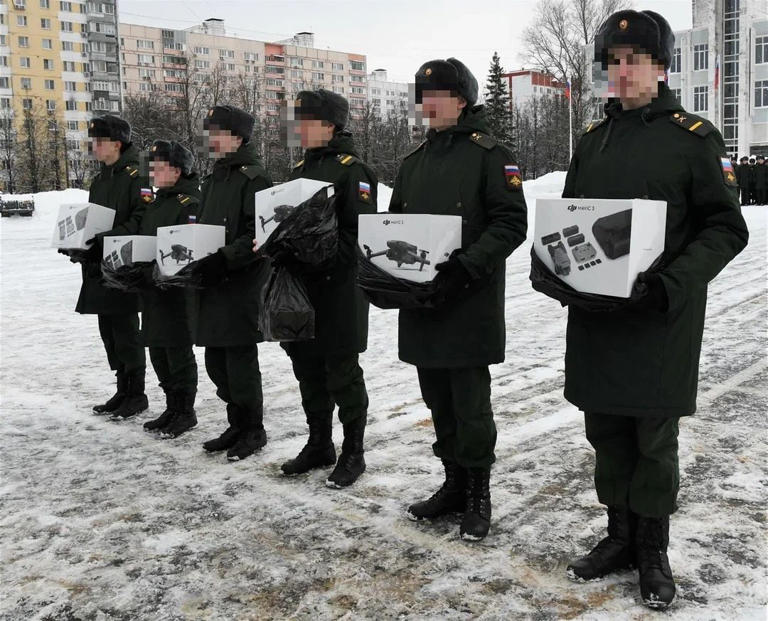
At the end of November, four students dressed in military uniforms from Moscow's Higher School of Economics, a prestigious and traditionally liberal leaning university, arrived in the city of Nizhny Novgorod with a special care package for Russian troops.

There were handing over three drones, and other accessories from the school's White Raven student group, a pro-military association which was created one month after Russia launched its full scale invasion of Ukraine.

"When you feel that you and your government and your country are standing for one mission, then you will achieve success," Maxim Lukyanenko, one of White Raven's co-founders, said in an interview with CBC News.

The 20-year-old who studies cross-cultural communication admits the group has sparked protests on campus, but insists the controversy has only driven more students to join its ranks and take part in the sporting events and fundraisers they organize.

"I see it with my own eyes… a crucial increase in patriotism," Lukyanenko said.


Members of the White Raven patriotic group display drones and accessories which they donated to a Russian brigade in November 2022. This picture was taken from one of the group's social media acc
ounts, and it included the pixelation of the faces.
 (Submitted by the White Raven group)
© Provided by cbc.ca


'New patriots'

Nearly a year and a half into the war, Russian President Vladimir Putin maintains the country is more united than ever. A group of Russian researchers say they are seeing an increase in patriotism among citizens who might have disagreed with the war in the beginning but support the country's military because they want it to emerge victorious.

Despite a counteroffensive launched by Ukraine and what some have called an attempted coup against Putin by the Wagner mercenary outfit, the research suggests that patriotism is actually increasing among ordinary Russians.

The study was conducted by researchers with the Public Sociology Lab, which includes academics from various universities along with independent researchers who study Russian politics and society.

The team conducted two waves of in-depth interviews with Russian citizens. The first set of interviews were done shortly after the war began, and they launched a second round in the fall after Russia announced a partial mobilization of civilians to join the armed forces.

Part of their findings included identifying a group they have dubbed "new patriots," who are rooting for Russia and in some cases justifying the war, even if they didn't initially agree with it.

"They do not really believe that Russia's victory will bring real positive change in Russian society, they just feel that if Russia loses, it will be much, much worse," said Svetlana Erpyleva, a post-doctoral research fellow at the University of Bremen in Germany.


Svetlana Erpyleva was part of a group of 16 researchers who conducted interviews with Russian citizens in order to hear their opinions about the war and Russian politics. Many who were once skeptical of the invasion now want to see Russia win, the researchers found. 
(Briar Stewart/CBC)© Provided by cbc.ca

Erpyleva said the goal was to gauge the attitudes of regular Russians, who were often hesitant to engage with the researchers and frequently turned their video off during the interviews, which lasted between an hour and a half and two hours.

"It's kind of like talking to a priest. You talk to a black screen, and it feels really safe and anonymous," Erpyleva said.

'Ordinary Russians'


Erpyleva said it was a challenge to find their respondents because they wanted to speak to "ordinary Russians," and those who initially replied to their advertisements on social media were either vocal opponents of the war or strong supporters of it.

Instead, they used their own social networks to reach out to former classmates and friends of friends to eventually find enough people with more nuanced views to participate.

During the second round of interviews, they spoke with 88 people, including 40 whom they spoke to earlier, at the start of the war. While it isn't a large enough sample size to fully represent public opinion, the research offers a window into the attitudes of average Russian citizens.


Spectators listen to Russian President Vladimir Putin on Sept. 30, 2022. That day, concert was held in Moscow's Red Square to celebrate its declared annexation of four Ukrainian regions. 
(Reuters)© Provided by cbc.ca

Erpyleva said researchers assumed that after the mobilization some would shift to being firmly against the war, but no one in the group expressed that perspective.

Instead, she said, their views were "inconsistent." They didn't like the mobilization but still supported Putin and what the government is doing.

Erpyleva said among those who have embraced a stronger sense of patriotism since last year, some said that while they aren't getting the full truth about the conflict, they would rather support Russia than a country it is fighting.

Others said they feel average Russians are being blamed and mistreated for something they feel they have no control over, and that's shifted some opinion around the conflict.

"I didn't really agree with what's going on in the beginning," said Maria Gritsenko, a second-year sociology student at the Russian State University for the Humanities.

Gritsenko, who spoke to CBC news via Zoom from her apartment in Moscow, says she has become more patriotic in the past year after reading what she calls hateful comments online directed at Russians.

She pointed to a story that circulated online last month about a 23-year-old Russian man who was eaten by a shark while swimming off the coast of Egypt.

In response, a petition was posted online that called for a monument to the shark for its commitment to fighting against the Russians.

"I know lots of people, and I see lots of people on the internet who are saying, 'Well, I used to support Ukraine, but I see that they truly hate us,'" Gritsenko said.


Maria Gritsenko, 21, has always been interested in Russian culture, but said she has grown more patriotic in the past year
. (submitted/Gritsenko)
© Provided by cbc.ca

A sense of 'duty'

Gritsenko, 21, said while she doesn't have "blind support" for the Russian government, she believes that as an Orthodox Christian, she has a responsibility to do her part and help those in need, including Russian soldiers.

She is head of a campus association that oversees a number of student groups including a patriotic society that was created three years ago.

Before the invasion, she said, the society's members would hold lectures on Russian culture, volunteer and organize blood drives. But now, they are more active, and many of their events are geared to helping those connected to what Russian officials call the "special military operation."

While they don't raise funds for weapons, she said her group did assist a soldier who asked for a helmet and other protective gear.


Maxim Lukayanenko is a co-founder of the White Raven patriotic group at the National Research University Higher School of Economics in Moscow.
 (Submitted by Maxim Luyanenko)© Provided by cbc.ca

She said they have also provided humanitarian aid to people who fled from Ukraine's occupied territories to Russia.

"I see people who maybe do not fully agree on what's going on, but they still agree that they should kind of unite and do some stuff that is right or helpful."

That is a message Maxim Lukyanenko trumpets on his campus.

Members of his White Raven group frequently wear camouflage and other military attire, but he insists that isn't a requirement and his group isn't militaristic.

Instead he said it's about bringing people together to build the "perfect Russia of the future."

He spoke to CBC news a few days after Wagner leader Yevgeny Prigozhin launched a rebellion against Russia's military leaders, but said he doubts it will erode Putin's popularity.

In contrast, he believes that people's trust in Putin is actually growing.

When asked about those who oppose his group and instead call for young people to protest the war, he dismisses that suggestion.

"The situation with all this protest will be even worse," he said. "Better to consolidate with the government and simply to feel united."
After Wagner's mutiny, Russia's military is now fighting with war bloggers because they won't celebrate its few wins the way they want

Jake Epstein
Mon, July 3, 2023 

Russian Defence Minister Sergei Shoigu attends the Shanghai Cooperation Organisation (SCO) meet in New Delhi, India, April 28, 2023.
REUTERS/Adnan Abidi

Russia's claims of a small battlefield victory have drawn criticism from military bloggers.


The milbloggers won't celebrate with Moscow, causing the defense ministry to clash with the writers.


A US think tank wrote that the conflict may indicate a lack of success to report to Putin.


Still grappling with the fallout of the paramilitary Wagner Group's armed rebellion, Russia's defense ministry is looking to celebrate its few battlefield victories in Ukraine, but it's run into a problem and is now clashing with a community of military bloggers, influential voices in discussions of the war.

Ukrainian forces have made small territorial gains during their month-long counteroffensive in the eastern and southern regions, though they have also met considerable resistance by Russian troops dug in along defensive lines.

Russia's defense ministry claimed in a series of statements on Telegram over the weekend that in one particular incident, its military successfully prevented a group of Ukrainian soldiers from attempting to land boats near the Antonivsky Bridge, which is located over the Dnipro River in the Kherson region.

Russian military bloggers, or milbloggers, have disputed some of the defense ministry's claims, according to a Sunday assessment by the Institute for the Study of War (ISW), a Washington-based think tank. The milbloggers, said Ukrainian forces had managed to establish positions and that fighting was ongoing.

These writers then became targets of the ministry's ire and were accused of distributing false information and undermining Moscow's claims.

"It is likely that the Russian MoD seeks to censor some Kremlin-affiliated milbloggers out of a concern that these ultranationalists may expose Russian military failures" to Russian President Vladimir Putin, ISW experts wrote in their analysis. "The Russian MoD's conflict with the milblogger community over a trivial combat operation may indicate that the Russian military command does not think it has any other successes to report to Putin amidst the ongoing Ukrainian counteroffensive."

The Russian milblogger community plays an important role in online pro-war ultranationalist spaces, and some of its members have even met with Putin personally.

"One milblogger noted that Russian defense officials worry that milbloggers' coverage of the war endangers their official positions and implied that the Russian MoD may be attempting to recover from the Wagner Group's rebellion," the ISW analysis noted. While that may be the case, exaggerating Ukraine's battlefield losses is not a new tactic from Russian military leadership, which has consistently propagated unreliable information about the 16-month-long war and continues to do so in the wake of a recent mutiny.

A still image from video, released by Russia's Defence Ministry, shows Defence Minister
Sergei Shoigu during what it said to be an inspection of a storage base of the country's Western Military District at an unknown location in the course of Russia-Ukraine conflict, in this image taken from footage released June 8, 2023.
Russian Defence Ministry/Handout via REUTERS

Wagner Group mercenaries, led by the organization's founder and chief Yevgeny Prigozhin, carried out their short-lived rebellion against Russia's defense ministry in late June after months of rising tensions between the two factions. After quickly capturing the southern city of Rostov-on-Don, Wagner traveled toward Moscow, nearly reaching the city, before Belarus President Alexander Lukashenko brokered negotiations between the Kremlin and Prigozhin.

As part of the deal, Prigozhin was cast into exile in Belarus, and Wagner fighters were given the options of returning to their homes in Russia, signing contracts with Russia's defense ministry, or joining their boss in Belarus. Pentagon Press Secretary Air Force Brig. Gen. Pat Ryder said last week that the US has observed Wagner "elements" in the Russian-occupied territories of Ukraine.

Ukrainian forces, meanwhile, continue to make use of their huge inventory of heavy Western armor — including advanced tanks and infantry fighting vehicles from the US and its NATO allies — to liberate territory in eastern and southern Ukraine.

The General Staff of the Armed Forces of Ukraine said in a Monday Facebook update that in the Zaporizhzhia and Kherson regions — where Moscow claimed its successes over the weekend — Russian forces "are on the defensive" and concentrating "their main efforts on preventing the advance of Ukrainian troops."

"Last week was difficult on the frontline. But we are making progress. We are moving forward, step by step!" Ukrainian President Volodymyr Zelenskyy wrote Monday on Twitter in a post that included a video showing intense combat footage. "I thank everyone who is defending Ukraine, everyone who is leading this war to Ukraine's victory!"
Music containing AI-generated elements could win a Grammy as long as a human contributes in 'a meaningful way,' Recording Academy CEO says


Dominick Reuter
Tue, July 4, 2023 

"As long as the human is contributing in a more than de minimis amount, which to us means a meaningful way, they are and will always be considered for a nomination or a win," Recording Academy CEO Harvey Mason Jr told the AP.
GABRIEL BOUYS/AFP/Getty

Music containing AI-generated elements is eligible to win a Grammy, the Recording Academy CEO said.


While the award will only be given to "human creators," those artists can use AI in their work.


New rules last month prohibit work that contains "no human authorship."


In order to win a Grammy, you need a great song, excellent distribution — and a pulse.

New rules announced last month by the Recording Academy specify that the music industry's highest award is for "only human creators," and flatly rejected any works that contain "no human authorship."

But that doesn't mean a human can't use AI to create an award-worthy single or album, so long as they're careful about crediting their respective contributions, Academy CEO Harvey Mason Jr. said in an interview with the Associated Press.

"Music that contains AI-created elements is absolutely eligible for entry and for consideration for Grammy nomination. Period," Mason said. "What's not going to happen is we are not going to give a Grammy or Grammy nomination to the AI portion."

Like most awards, the Grammys recognize the various creative contributions that go into making great music within and across genres — songwriting, composition, production, and performance.

In other words, if a singer performs words written by AI, they won't get credit for songwriting. If the AI does the performing, the human might be credited as a producer.

"As long as the human is contributing in a more than de minimis amount, which to us means a meaningful way, they are and will always be considered for a nomination or a win," Mason said. "We don't want to see technology replace human creativity. We want to make sure technology is enhancing, embellishing, or additive to human creativity."

The news comes on the heels of guidance from a consortium of 24 leading colleges in the UK, including Oxford and Cambridge, that permits students and staff to use generative AI in their academic work, so long as they use it ethically.

Mason said the process for determining the rules for this award cycle took about six months to really nail down, and that he expects more than a few entries to include AI elements.

"We'll see if some of them get nominated or not, but I'm sure there'll be some that will be submitted," he said.

The CEO of the company behind AI chatbot ChatGPT says the worst-case scenario for artificial intelligence is 'lights out for all of us'

Sarah Jackson
Tue, July 4, 2023 

OpenAI CEO Sam Altman has said he thinks artificial intelligence at its best could have "unbelievably good" effects, or at its worst mean "lights out for all of us."
Brian Ach/Getty Images for TechCrunch

Chances are, you've heard of ChatGPT, the viral AI chatbot sweeping the internet.


Some say it helps with work. Others fear ChatGPT can create problems like misinformation or scams.


The CEO of ChatGPT's maker said AI could be "unbelievably good" or make it "lights out for all."


ChatGPT has been making the rounds online, and as with any type of artificial intelligence, it's raising questions about its benefits — and how it could be abused.

In a January interview, Sam Altman, the CEO of OpenAI, the company behind ChatGPT, offered his take on the pros and cons of artificial intelligence.

In the interview, StrictlyVC's Connie Loizos asked Altman what he viewed as the best- and worst-case scenarios for AI.

As for the best, "I think the best case is so unbelievably good that it's hard for me to even imagine," he said.

He added: "I can sort of imagine what it's like when we have just, like, unbelievable abundance and systems that can help us resolve deadlocks and improve all aspects of reality and let us all live our best lives. But I can't quite. I think the good case is just so unbelievably good that you sound like a really crazy person to start talking about it."

His thoughts on the worst-case scenario, though, were pretty bleak.

"The bad case — and I think this is important to say — is, like, lights out for all of us," Altman said. "I'm more worried about an accidental misuse case in the short term."

He added: "So I think it's like impossible to overstate the importance of AI safety and alignment work. I would like to see much, much more happening."

Experts have said ChatGPT could be abused for purposes like carrying out scams, conducting cyberattacksspreading misinformation, and enabling plagiarism.

In more recent interviews, Altman has said he understands why some people are concerned about AI.

"I think it's weird when people think it's like a big dunk that I say, I'm a little bit afraid," Altman said on tech researcher Lex Fridman's podcast in March. "And I think it'd be crazy not to be a little bit afraid, and I empathize with people who are a lot afraid."

In June, he told Satyan Gajwani, the vice chairman of Times Internet, "What I lose the most sleep over is the hypothetical idea that we already have done something really bad by launching ChatGPT."

At the same time, Altman has said he believes the development of AI will spell the "most tremendous leap forward" for people's quality of life, but "regulation will be critical."

Brazil’s Lula Vows to Grow Mercosur Amid Uruguay Flak, Argentina Crisis

Martha Beck
Tue, July 4, 2023 


(Bloomberg) -- Brazil’s plans to strengthen and expand the Mercosur trading bloc are running into growing disagreement among its members over several topics, including Venezuela and free trade agreements with other markets.

President Luiz Inacio Lula da Silva assumed the rotating presidency of the South American customs union Tuesday, promising to reduce dissent in the group founded by Brazil, Argentina, Uruguay and Paraguay. His push for Mercosur to resume talks with Venezuela, suspended from the bloc in 2017 for breaching its democratic clauses, faced immediate backlash.

Uruguay’s Luis Lacalle Pou and Paraguay’s Mario Abdo Benitez criticized the Venezuelan government’s decision to bar opposition leader Maria Corina Machado from running in upcoming presidential elections, putting Lula on the defensive.

“I follow the events in Venezuela with great concern,” Benitez said during a Mercosur summit in the Argentine city of Puerto Iguazu. “Erasing the opposition with the disqualification of Maria Corina Machado collides with human rights.”

Lacalle Pou echoed him: “It is clear that Venezuela will not have a healthy democracy if, when there is an election possibility, a candidate like Maria Corina Machado, who has enormous potential, is disqualified for political reasons.”

Lula, a longtime ally of Venezuela’s Nicolas Maduro, said he still didn’t have a full picture of Machado’s situation in Venezuela, but called on his colleagues to remain open to dialogue: “When we have problems, we don’t hide from them, we face them,” he said.

Argentina’s Alberto Fernandez also adopted a more diplomatic tone, saying he wants “democracy to be full and institutionality to be maintained in Venezuela,” but that he first needs to “see exactly what the size of the problem” is in the country.

Machado’s ban, like those slapped on other leading opposition figures including former governor and twice presidential candidate Henrique Capriles, is an attempt by the Maduro administration to keep her out of next year’s race. In practice, however, she and other candidates are ignoring the bans and continuing their campaigns, betting the government will eventually be forced to reverse its decision.

EU-Mercosur Deal


Lula also said he seeks to include Bolivia in the while working for the conclusion this year of a long-awaited free trade deal with the European Union, which was reached in 2019 but has never been finalized.

Earlier, Lacalle Pou complained about Mercosur’s inability to strike trade deals with other markets, especially the European Union, while it blocks his country’s plan to sign a bilateral agreement with China.

“Uruguay has struggled to get market access as our economy’s share of Mercosur trade has decreased,” he said. “We must keep negotiating as a bloc and, if not as a bloc, unilaterally.”

Accessing the Argentine consumer market is among the main complaints voiced by Uruguay, as the second-largest economy in South America raises obstacles to imports in a bid to protect its dwindling international reserves.

Uruguay did not sign onto the statement released by the bloc of countries at the end of the summit, the fourth time it has left its name off the declaration.

“We’re going to have to make a huge effort to try to reduce complaints among us,” Lula said. “If it lasts a long time, a complaint becomes bitter, unpleasant. I will try to resolve the main disagreements in Mercosur, as together we are stronger and we have more negotiating power.”
The pain is just starting for commercial real estate - and plunging prices could reignite the banking crisis and choke the US economy, Columbia professor says


Theron Mohamed
Tue, July 4, 2023 


A Columbia professor has issued a bleak outlook for commercial real estate in the US.

Office values are plunging and threaten to cause an "urban doom loop," Stijn Van Nieuwerburgh said.

The sector's challenges could spill into the banking sector and hurt the wider economy, he said.

The pain is just beginning for commercial real estate (CRE), and the fallout could hit the banking sector and wider US economy, a leading academic has warned.

Stijn Van Nieuwerburgh, a real estate and finance professor at Columbia Business School, sounded the alarm on an "urban doom loop" for CRE in a recent RealVision interview.

He explained that soaring interest rates and the shift to remote working have slashed the value of office space in cities. He expects that to translate into lower property-tax revenues, and the budget shortfall to force urban authorities to raise taxes or spend less on education, transportation, sanitation, and other public services. If cities become more expensive and less appealing, people are likely to move out, cutting real estate values even more and causing a downward spiral, he said.

"We are in the early phases of this doom loop," Van Nieuwerburgh said, noting his calculations suggest that property values have further to fall.

The professor pointed to data indicating that office usage, lease revenues, and the number of new leases being signed remain well below pre-pandemic levels. Vacancy rates have also surged to their highest level in about four decades, he noted.

"We haven't seen a crash like this since at least the early 1980s," he said, adding that lower-quality offices could drop in value by as much as 45% over time, and the overall office sector is set to suffer a $500 billion decline in value.

Van Nieuwerburgh emphasized that many Americans are exposed to that slump. Pension funds, real estate investment trusts (REITS), and other entities have invested significant sums in CRE, and the office segment specifically.

He also underscored that regional banks are key sources of financing for CRE, meaning they could run into the same kinds of problems that toppled Silicon Valley Bank and Signature Bank earlier this year.

"I do worry that there is potential for a spillover here, that we haven't seen the end of the banking crisis yet," Van Nieuwerburgh said. He cautioned that if smaller banks suffer losses in their CRE portfolios, they might pull back on lending to small businesses, which could crimp economic growth.

"The worst case scenario is a pretty bad event," he said. "The most likely scenario is one of slow burn, the train wreck in slow motion, where banks will have to provision for several years, or will have to take losses for several years."

"It's not going to be supportive for the economy, we will have a modest credit crunch," he added. "That's the best-case scenario."


CRIMINAL CAPITALI$M
Over half a million silver coins just vanished – now the metals dealer behind the 'fraudulent' scheme must pay $146 million


Joseph Wilkins
Tue, July 4, 2023 

A Susan B. Anthony dollar coin.Wikimedia

A precious metals dealer has been asked to pay up $146 million in damages after over half a million silver coins went missing.


Robert Higgins ran a "fraudulent and deceptive scheme" linked to the purchase and sale of precious metals, the CFTC said.


From 2014 to 2022, Higgins led a 'fraudulent silver leasing program' that took deposits from almost 200 customers.

It's a plot that wouldn't look out of place in the Ocean's trilogy.

The vault where precious metals dealer Robert Higgins claimed to be storing over half a million of his clients' silver coins was found by investigators to be empty – except for little boxes of paper IOUs.

Now, the 68-year old has been ordered by a Delaware court to pay $146 million in damages as punishment for leading an elaborate scam that misappropriated almost $115 million of his customers' money over a period of eight years, the Commodities Futures Trading Commission (CFTC) said in a statement.

From 2014 to 2022, Higgins convinced almost 200 unsuspecting investors to buy and store their American Eagle Silver coins through his two companies, Argent Asset Group LLC and First State Depository Company LLC, according to the CFTC.

The coins are made of 99.9% silver and minted by the US Treasury – making them a popular alternative investment among Americans. But clients who bought coins through Higgins's firms may not have owned any at all – as it remains unclear whether they ever existed in the first place.

Furthermore, First State Depository distributed false monthly account statements to customers, according to court filings.

Higgins ran a "fraudulent and deceptive scheme", and was ordered to pay $113 million to clients and $33 million in penalties, according to the CFTC. His two companies must cease trading and he is banned from the industry for life.

The precious metals industry has seen a series of scams in recent times. In March, the London Metal Exchange was rocked when investigators found bags of stones in a Rotterdam warehouse, instead of the nickel that underpinned some of the bourse's contracts.

Just a few weeks before that, Trafigura, a trading house based out of Singapore, accused metals tycoon Prateek Gupta of faking $500 million of nickel shipping cargoes.