Sunday, October 01, 2023

Sexy Instagram images can affect body image


Influencers set bar high for followers

Peer-Reviewed Publication

FLINDERS UNIVERSITY


Viewing sexualised Instagram posts by online influencers increases the negative mood and body dissatisfaction of young female adults who view them, and promotes negative effects among viewers beyond striving for thinness and attractiveness. 

A new study by Flinders University researchers highlights the negative impact of sexualised images on social media and the need for enhanced regulation in relation to influencer advertising. 

“Some Influencers endorse lingerie and bikini products, and there is growing concern about the overtly sexualised nature of the imagery they post to social media,” says body image expert Associate Professor Prichard, who leads the Embrace Impact Lab at Flinders University. 

“This problem is amplified by the popularity of Instagram among young adults aged 18-34 years, with more than two billion active users monthly.” 

The study investigated the effect of viewing both standard fashion and sexualized imagery (in lingerie/bikini garments and posed in a suggestive manner) posted by the same female influencers on young women’s mood and body dissatisfaction.  

Females aged 17–25 years were recruited online and completed pre- and post-viewing measurements of mood and body dissatisfaction, as well as measures of appearance comparison and self-objectification. 

“Exposure to influencer imagery led to greater negative mood, body dissatisfaction, appearance comparison and self-objectification than exposure to control images,” says Associate Professor Prichard. 

“Furthermore, exposure to sexualised images led to an even greater negative mood, body dissatisfaction and appearance comparison than exposure to standard fashion images of influencers – and this was with images chosen as being only moderately sexualised (for ethical reasons) rather than hypersexualised, which depict more lewd poses. 

“The most obvious implication is that women should be advised to limit their exposure to such images and to unfollow the accounts of influencers who post this type of material. There is growing evidence that even a short break from Instagram can have considerable benefit.” 

At a policy level, a new code of ethics for Australian advertisers that came into effect on February 1, 2021, prohibits the use of overtly sexualised images in advertising. However, this does not apply to user-generated material, and therefore does not apply to images posted by Influencers on Instagram.  

Associate Professor Prichard says it could be argued that Influencers, who gain considerable financial benefit from their endorsements, should be held to the same standards as other advertisers. 

“Our study findings highlight the detrimental impact of exposure to sexualised imagery, which is an increasingly common part of contemporary social media, and the role of social comparisons to such imagery,” she says. 

“We have clearly shown that the effects of sexualisation extend beyond those of attractiveness. These findings illustrate the need for more research and enhanced regulation regarding advertising by influencers on social media.” 

The research – “Comparing and self-objectifying: The effect of sexualised imagery posted by Instagram influencers on women’s body image,” by Ivanka Prichard, Brydie Taylor and Marika Tiggemann – has been published by Body Image journal. https://doi.org/10.1016/j.bodyim.2023.07.002 

Standing on the shoulders of punk: the early years of dance


Reports and Proceedings

UNIVERSITEIT VAN AMSTERDAM

Rise of dance, fall of punk 

IMAGE: RISE OF DANCE, FALL OF PUNK view more 

CREDIT: RENS WILDEROM


The pre-existing network of labels, record stores, venues and organisers related to the declining punk scene gave dance music a solid base from which to break through in the United Kingdom, and later in the Netherlands. In the United States, the cradle of house music, the lack of those important network relationships was the reason that dance only became popular years later. These were among the conclusions of Rens Wilderom’s investigation into why house, techno and other dance genres became enormously popular in the UK and Netherlands in the late 1980s, but did not in the US. Wilderom defended his PhD at the University of Amsterdam (UvA) on 27 September.

In the late 1980s, many dance enthusiasts lived it up every weekend in clubs such as the Roxy in Amsterdam, Shoom in London or the Hacienda in Manchester. House and techno paved the way , other dance genres would soon follow them up the charts. But while the Netherlands and the UK fell in love with dance, its popularity in the US lagged behind. The first mainstream house hit - Love Can't Turn Around by two American producers - was a hit in Europe, but not in the US.

‘I conduct research into the development of new genres in art and culture,’ says Wilderom. 'Dance has a relatively short, but very interesting history. An important factor in a music genre becoming popular is the (decreasing) popularity of related, existing genres within music. In addition, the media and even the government are important for the institutionalisation of a new genre, helping it become a part of society.'

In his research, Wilderom analysed data on the establishment of dance labels, the commercial success of dance records, and reporting by traditional newspapers and the specialised music press, among other things.

From beginnings in the US to mainstream in the UK

Dance music originally comes from the US. In the 1980s, certain disco scenes were experimenting with drum machines. One of those scenes was in Chicago, at a club called The Warehouse (from which house music allegedly takes its name). While early dance genres such as house and techno thrived in these scenes, they did not achieve much in the way of mainstream success.

Wilderom: 'It was different in the UK. The popularity of (post-)punk declined in the early 1980s. However, the infrastructure of punk labels, punk record stores, punk venues was still there. A number of cultural entrepreneurs in the punk scene wanted something new, something that was still 'authentic' and untouched, and they saw this new scene in the US that met that requirement.'

In the UK, people invested in creating value from the new genre. House was seen as the new punk. In its early days, house attracted a large number of people who had previously been active in punk. Influential people within the music field such as BBC Radio DJs were also involved right from the beginning.

'One reason why dance was able to break through in the UK was the proactive search for the undiscovered, and the benefit of having those labels, shops and stages still existing from the days of punk. Switching to a new genre allowed the former (post-)punk-affiliates to survive in the market,' says Wilderom.

Trance benefits from hardcore's downfall

The developments surrounding dance in the UK were probably also important for the rise and popularity of dance in the Netherlands. For example, a significant number of the first dance hits in the Netherlands were released by British record labels such as 4AD and a number of Britons such as Maz Weston and Paul Jay were involved in organising the first dance parties in Amsterdam. Almost from the beginning, dance (then mainly house) was picked up in the Netherlands by mainstream media. This was a marked difference from the US, where that kind of attention was lacking.

'The theory of genres - that the relationship with existing genres and other facets from the environment are important for the development of a new genre - can also be applied within clusters of related genres. Here in the Netherlands, for example, you see that trance could quickly become popular due to the demise of hardcore,' says Wilderom.

'Trance made use of the existing network and infrastructure of hardcore, in a similar way to how house had made use of the punk network. When hardcore declined in popularity, some of the artists, labels and festival organisers converted from hardcore to trance. It is not a coincidence that famous trance DJs such as Ferry Corsten and Tiƫsto also have a history in hardcore.'


Quarterly number of hits

CREDIT

Rens Wilderom


University of Cincinnati research shows widespread naloxone distribution not enough to impact overdose death rate


UC researchers hope study helps reduce the stigma of opioid use disorder


Peer-Reviewed Publication

UNIVERSITY OF CINCINNATI


The highest ever number of opioid-related overdose deaths in the United States was recorded in 2020 at 68,630, a 68% increase in just two years. Naloxone is a medicine that can rapidly reverse an opioid overdose, but a new study out of the University of Cincinnati finds that widespread community distribution of naloxone through a take-home naloxone (THN) program did not significantly impact the median monthly opioid overdose rates.

The study was published in PLOS ONE.

The Naloxone Distribution Collaborative (NDC) was facilitated from October 2017 through December 2019 by Hamilton County Public Health (HCPH). Opioid overdose mortality was compared between the period before (Oct. 2015-Sep. 2017) and during (Oct. 2017-Sep. 2019) the program. Prior to the start of the program, there was little distribution of THN to individuals in Hamilton County.

“Our goal with the naloxone distribution collaborative was to see what happens if we could saturate an entire community and see what impact that might have on the opioid overdose rates,” says Caroline Freiermuth, MD, Endowed Chair to Benefit the Acute Treatment of Mental Health and Substance Use Disorder in the Department of Emergency Medicine at the UC College of Medicine. “We looked to see what impact broad distribution of naloxone had on the community and what we found that it held opioid overdose death rates steady.”

HCPH managed naloxone inventory, recruited distribution sites and distributed cartons directly through community events and health department service locations such as a syringe service program or local jail. Partnering sites were chosen based on their interactions with persons at risk for opioid overdose, people who may interact with those at risk for opioid overdose, community involvement and willingness to participate. To be included in the study, naloxone cartons had to have documentation of either distribution to an individual from a site in Hamilton County, or distribution to an individual with a reported residence within Hamilton County.

Freiermuth says after seeing the study results showing no significant change in the opioid overdose death rate, they went back and modeled what would have happened had that level of naloxone supply been available to the community to predict the opioid death rate to be.

“If you do that prediction modeling, we would have thought the opioid death rate would keep climbing,” she says. “We saw that throughout the country and throughout Ohio, whereas here in Hamilton County we pretty much held steady. Granted there were many other things going on in our county that probably contributed to that, but we like to think that at least a piece of that was naloxone was more broadly available.”

The THN effort in Hamilton County ended at the conclusion of 2019, and Freiermuth says the availability of naloxone has been evolving since then. Project DAWN (Deaths Avoided with Naloxone) is a network of opioid overdose education and naloxone distribution programs through the Ohio Department of Health that attempts to get naloxone out in the community as widely as possible by distributing it to community agencies who then distribute it to individuals. Plus, she says, naloxone is being made available over the counter, so that is another way people who want to have it on hand can obtain it.

The NDC was a successful effort to increase access to Narcan in the community, according to Darci Smith, director of harm reduction for HCPH.

“Increasing the amount of Narcan available in the community increases opportunities to save lives and helps reduce the stigma associated with substance use disorder and carrying Narcan,” she says. “The NDC helped lay the foundation for our current naloxone education and distribution efforts.”

With the backdrop of September being National Recovery Month, Freiermuth says one of the biggest hopes with the study is that it continues to help combat the stigma.

“There is still a lot of stigma around opioid use disorder and people who use drugs,” she says. “If you talk to people who use drugs, they don’t want to carry naloxone because there’s a stigma associated with that. It’s interesting because people will recognize that they are at risk for overdose yet still not always carry the medication because of that external symbol. We hope for people to ask for this medication, for people to be more aware that they may need to use it and that it’s not just homeless people or those with mental health disease who are using drugs.”

The greatest secret of the Soviet Union


What we can learn about today’s most secretive states


Book Announcement

UNIVERSITY OF WARWICK


Twenty-five years ago, after the fall of the Soviet Union, an academic at the University of Warwick began work in the Russian archives to map the sophisticated regime that made the Soviet Union the most secretive state that ever existed.

A new book, based on decades of research, describes the complex layers of secrecy within the Soviet Union, what secrecy hid, what the state gained and lost because of it, and what we can learn about how secrecy is used in Russia today.

Emeritus Professor of Economics Mark Harrison at the University of Warwick and author of Secret Leviathan: Secrecy and State Capacity under Soviet Communism says: “The Soviet Union’s archives hold many millions of secret documents. Their volume is far greater than the government information that was released into the public sphere. But the biggest secret was the huge gap between the appearance and reality of the communist party dictatorship. To all appearances, the Soviet state was decisive, all-knowing, and all-powerful. Behind the scenes, the state was ruled by procrastination, indecision, groupthink, mistrust, fear, and disinformation. This gap was hidden by secrecy.

“The communists were the most diligent state-builders of the twentieth century. The political leaders valued secrecy because it bought them security of tenure. But secrecy was extremely costly. The price they paid was in a state machine that was far less capable than the one they pretended to deploy. There was a secrecy/capacity trade-off.”

“Ordinary people who had no direct connection to power also paid the price of secrecy. Not only were they denied the freedoms of an open society. In addition, they knew that the secret police held information about their background and lives. You didn’t know what that information was or how it affected your life. A promotion might be mysteriously blocked, or an application to travel abroad that was refused without reason. You would never know why. You could only suspect that there was something in your past that the state knew about. And there was no appeal process.”

A measure of the scale of the Soviet Union’s secret state compares the number of US and Soviet  secret informants at the height of the Cold War:

“In 1976 the FBI had around 1500 undercover informants. In a slightly earlier year, 1968, the KGB had 165,000 informants. Given that the Soviet population was slightly larger than the American population at the time, the difference was 1:100.”

What we can learn about Russia’s secrecy today

The digital age we are now living in is more adapted to disinformation than to censorship. Yet, the secrecy /capacity trade-off continues to operate, explains Professor Harrison:

“President Putin chose to plan and launch the invasion of Ukraine in complete secrecy, to preserve his freedom of action and achieve surprise. But in doing so he sacrificed a large part of his invasion force. With more transparent decision making, Russia’s soldiers would not have invaded Ukraine thinking they were on an exercise, and President Putin would not have sent them into battle believing that he could win the war in three days.”

Secret Leviathan: Secrecy and State Capacity under Soviet Communism by Mark Harrison, published by Stanford University Press (2023), is out now.

ENDS

Salt water creeping up Mississippi could cause health concerns and more

Denise Chow
Fri, September 29, 2023 

Mario Tama

The steady push of salt water upstream in the drought-hit Mississippi River could have serious health and economic consequences across southern Louisiana, where many communities rely on the river for drinking water, irrigation and shipping.

Persistent drought in the region has dropped water levels in the Mississippi River to near-historic lows, allowing salt water from the Gulf of Mexico to creep upriver and much farther inland than normal.

Drinking water across most of the state is still considered safe at the moment, but it’s projected that salt water could reach water intake facilities in Belle Chasse by Oct. 13, St. Bernard by around Oct. 19 and facilities in New Orleans later in October. In Plaquemines Parish, south of New Orleans, residents have already been relying on bottled water since the summer after the area's water system became inundated.

President Joe Biden on Wednesday declared the unfolding saltwater intrusion a federal emergency, freeing up funds to support state and local relief efforts. The U.S. Army Corps of Engineers was working this week to expand an underwater barrier to help delay the seawater’s movement upstream, but officials say they expect the “sill” to be overtopped again in the coming weeks.

The health impacts from excess salinity in drinking water are top of mind for those in southeastern Louisiana, but experts say saltwater intrusion can also endanger crops, animal stock and infrastructure in the region.

Salt in the drinking water supply is a major concern because it can cause sodium to spike to unsafe levels in the human body, which increases blood pressure.

Stephen Murphy, an assistant professor at Tulane University’s School of Public Health and Tropical Medicine, said those most at risk are infants, pregnant women and people who already need to closely monitor their sodium intake.

“Members of the population who are on no-salt or low-salt diets will be susceptible because those individuals need to be extremely careful about high blood pressure,” he said.

Officials in Louisiana said millions of gallons of water are being barged in to dilute local water supplies, if needed, and reverse osmosis equipment may also be used at some treatment facilities.

Gov. John Bel Edwards said the Louisiana Department of Health will work with parish officials to test municipal drinking water and issue public health guidance.

Murphy said people can prepare by stocking up on bottled water, but added that there’s no reason to panic.

“Just like we would during hurricane season, go out and buy what you need and maybe a little more in case something goes wrong,” he said. “But you don’t need to go out and buy every pallet of water you can find.”

Still, saltwater intrusion can have other serious effects on people and animals, particularly because of its corrosive nature.

There are concerns, for instance, that seawater could corrode pipes and leach heavy metals into the water supply, said Holly Michael, a hydrogeologist at the University of Delaware and director of the Delaware Environmental Institute.

“If you introduce water with different chemistry into a water distribution system, that can create all sorts of problems,” she said. “Depending on what pipes are made of, saltwater intrusion could release heavy metals, it could change the chemistry in water treatment, it could corrode appliances in people’s homes.”

Agriculture in the region will likely be affected by salt water creeping upstream, particularly farmers who rely on river water for irrigation. Michael’s own research in Delaware found that saltwater intrusion often caused farmers to unknowingly irrigate their fields with saltier-than-normal water, causing crops to die.

Low water levels in the Mississippi River, a key shipping corridor, could also affect commercial operations, exacerbating existing issues from lingering drought conditions.

Michael said the developing situation highlights how climate change and drought are affecting people’s lives and livelihoods — and how far-reaching the consequences can be.

“It’s important that people understand how fragile our systems are, especially at the coast,” she said. “We need to really think about what we’re doing to our systems and also how they’re responding to change, and then be proactive about understanding how that might affect our lives and infrastructure.”

This article was originally published on NBCNews.com

5 things to know about the saltwater intrusion threatening Louisiana’s water supplies

Rachel Frazin
Fri, September 29, 2023


Saltwater is making its way up the Mississippi River in Louisiana and threatening drinking water supplies in the state — and it could soon reach New Orleans.

Here’s what you should know about the situation.
It’s being caused by low water levels

The Mississippi River’s flow has declined due to drought that is impacting the river and the water that flows into it from the Ohio River. As a result, saltwater from the Gulf of Mexico is able to push its way toward Louisianans.

Louisiana state climatologist Barry Keim said this happens because saltwater is denser than freshwater, so the salt creeps up because “the flow in the river isn’t strong enough to … hold it at bay.”

“That saltwater basically works its way … up the channel where eventually it starts to reach the intake for some of the water supply,” said Keim, who is also a professor at Louisiana State University.

While Louisiana itself is facing serious drought, Keim said that the current conditions are likely being caused by what’s happening in the upper parts of the river — which runs all the way up through Minnesota and Wisconsin — and conditions in the Ohio River Valley.

He added that both climate change and El NiƱo, a weather pattern that occurs when westward winds along the equator weaken, pushing warm water east toward the western U.S., are likely contributing factors.

“I would argue what we’re seeing has El NiƱo’s fingerprints on it; it certainly changes the storm tracks,” Keim said. “Climate change has probably got its fingerprints on it.”
Salt could get into drinking water supplies as a result

Some parts of southern Louisiana are already facing saltwater contamination in their water supplies due to its intrusion in the river, including Plaquemines Parish. Residents there have been under a drinking water advisory, though the parish, Louisiana’s equivalent of a county, has ordered reverse osmosis filters to help treat the water.

Salt getting into drinking water can be a health concern, said Stephen Murphy, who leads Tulane University’s disaster management program. But he said most people will easily be able to tell if they’re drinking elevated levels of it.

“You and I will certainly taste the saltiness in the water long before it’s a health concern,” Murphy said. “We don’t want people to think that they’re just going to consume a lot of water one day and then wake up the next day with health consequences.”

He said that people who are already on low-sodium diets should start to consider alternatives to tap water, however.

“Depending on your situation, maybe there’s some water that can be delivered by the city. Maybe there’s water that you can start to cobble together,” he said.

Murphy said that people with high blood pressure and kidney disease, people who are pregnant or have infants, and people who are on dialysis should pay especially close attention to the situation. He particularly warned against feeding infants formula made with salty water.
Officials are working to mitigate the impacts

State, local and national officials are all working to mitigate the issue.

At the national level, President Biden declared an emergency in Louisiana, authorizing the Federal Emergency Management Agency to mobilize resources and direct federal funding toward water treatment issues in the state.

Last week, the Army Corps of Engineers said it would bring 36 million gallons of fresh water into the New Orleans area each day via barge.

The city of New Orleans said it is weighing several options to help it deal with the issue.

These include blending freshwater from an alternative source in with the saltwater to reduce its salt content, filtering out the salt content or getting water for the city from another source upriver.

The Louisiana Department of Health is also expected to test the water to monitor for changes.
Salt-caused corrosion could cause a ‘worst-case-scenario’ with lead exposure

Salt doesn’t just impact people. At extremely high levels, it may also impact pipes.

If salt is at particularly high concentrations in the water flowing through pipes, it may corrode them. This could both damage the vessels themselves and, if they contain heavy metals, cause them to leach those potentially toxic materials into the water.

One such metal is lead, which can cause brain damage in children.

“I think that’s the worst case and the fear there,” Murphy said.

He noted that New Orleans does still have some lead pipes and acknowledged that water with high salt levels has the potential to cause corrosion, but he said people still may not end up drinking water that comes through those pipes if it does.

If it is salty enough to cause heavy metals to leach, Murphy said, people probably will have already switched water sources.

“A lower concentration for a shorter duration’s probably not going to do much,” he said, referring to salt concentration. “A higher concentration for an extended period of time would probably lead to that, but at that point we might not be consuming that water.”
It may not just be a one-time occurrence

“I do see that this could happen more often in the future,” said Matthew Hiatt, assistant professor in Louisiana State University’s department of oceanography and coastal sciences.

Hiatt said some climate projections indicate future rainfall could be increasingly sporadic, beyond the already naturally low levels in the late summer and early fall.

And if there are more dry summer months, he said, “we could see consistently low water levels and we might have to deal with saline intrusion.”

The possibility of a future intrusion could mean tough choices for policymakers, as they may want to look to long-term solutions.

“There’s large infrastructure works that are going on right now to try to mitigate the progression of saltwater,” Hiatt said, pointing to an underwater dam being built by the Army Corps.

“Having to construct that and deconstruct that on a regular basis is cost-prohibitive, so it’s probably not a good long-term solution,” he said.

US Army engineers are dredging the dwindling Mississippi River 24/7 and battling seawater creeping upstream toward New Orleans' drinking water

Maiya Focht,Morgan McFall-Johnsen
Sat, September 30, 2023 

Here in New Orleans, Choppers, dropped, thousands of trees

Scroll back up to restore default view.


The Mississippi River is incredibly low for the second year in a row.

This threatens both the country's international supply chain and national drinking water access.

Authorities are battling against Mother Nature to try to keep the freshwater flowing.


A long stretch of drought in the Midwest has caused the Mississippi River to drop to abnormally low levels. It's the second year in a row the river has dipped so low.

The low river threatens cargo ships that carry 60% of all grains produced in the US. It also jeopardizes access to drinking water for many Louisiana residents.


Louisiana citrus farmers are seeing a mass influx of salt water that could threaten seedlings

SARA CLINE
Thu, September 28, 2023 


1 / 12

Salt Water Citrus Farms LouisianaOrange groves at Ben & Ben Becnel, Inc. are seen along the Mississippi River in Plaquemines Parish, La., Thursday, Sept. 28, 2023. Citrus farmers in the southeast corner of Louisiana are scrambling to protect and save their crops from salt water, which for months has polluted the fresh water they use for irrigation. A mass flow of salt water from the Gulf of Mexico continues to creep up the Mississippi River and threaten Louisiana communities water used for drinking, cooking and agriculture.
 (AP Photo/Stephen Smith)

BATON ROUGE, La. (AP) — Commercial citrus growers have dwindled over the past few decades in south Louisiana, where farmers have had to battle hurricanes, flooding, invasive insects, freezes and drought to keep their groves alive.

The latest hurdle comes from a slow-moving threat — a mass influx of salt water from the Gulf of Mexico that is creeping up the drought-stricken Mississippi River. Not only is the saltwater intrusion threatening drinking water supplies for communities, but it can also kill citrus seedlings.

The issue is forcing farmers to brainstorm other ways to irrigate their crops with fresh water — including storing the little rain water they’ve gotten this summer, hauling in fresh water and establishing makeshift salination treatment facilities. Some are looking into whether they can afford, let alone get their hands on, an expensive reverse-osmosis machine.

“They’re going to have something up their sleeve. They know how to survive, but there’s no getting around how dire the situation is,” said Joey Breaux, the assistant commissioner of soil and water for the state’s agricultural department, about the farmers. “Unless they have another source of irrigation water, or a way to pretreat irrigation water, it doesn’t look too good.”

Many communities in south Louisiana rely on the Mississippi’s fresh water, with their intake facilities located along the river. Typically, the mighty flow of the Mississippi is enough to keep mass amounts of salt water from reaching too far inland. But hot and dry conditions across the country this summer triggered drought conditions that slowed the Mississippi’s velocity and lowered its water levels. As a result, for the second year in a row, Louisiana is hastily working to avoid the disaster of a slow-moving salt water intrusion.

The Army Corps of Engineers is busy raising the height of an underwater levee used to block or slow the salt water, and 15 million gallons (57 million liters) of fresh water is barged in to treatment facilities.

Additionally, earlier this week Gov. John Bel Edwards wrote to President Joe Biden, saying federal assistance is “necessary to save lives and to protect property, public health and safety or to lessen or avert the threat of a disaster.” Biden granted the request.

And while many are focused on the possible impacts of the salt water influx on Louisiana’s most well-known city, 15 miles (24 kilometers) down the river is Belle Chasse — a community of about 11,000 people that sits on the west bank of the Mississippi.

If the rows of citrus trees and farm stands advertising satsumas don't make it evident that the small community is Louisiana’s unofficial citrus capital then perhaps one can look to the area’s annual Orange Festival. The event has commemorated the harvest season for more than 70 years.

While Plaquemines Parish, home to Belle Chasse, may not be Florida or California, its microclimate — southerly latitude and nearness to warm Gulf waters — has made it possible for citrus to be a unique part of the area’s economy. For more than 300 years, farmers in south Louisiana have grown a variety of oranges that are available today in grocery stores and at farmers markets statewide.

At its peak, in 1946, Louisiana’s prized citrus industry produced 410,000 boxes of fruit, said Anna Timmerman, a horticultural agent at Louisiana State University AgCenter who works closely with Belle Chasse farmers. But the vibrant citrus industry has suffered in the wake of hurricanes, with Hurricane Katrina damaging more than half of the trees. Since then it has continued to face challenges and the industry has dwindled. Timmerman estimates that there are about 800 acres (324 hectares) of citrus groves left in the state, most in Plaquemines Parish.

Unlike disasters that can have devastating effects overnight, such as hurricanes and freezes, saltwater intrusion is slow-moving. Timmerman said that the issue is estimated to reach Belle Chasse in a week or two and would only escalate to become a significant problem if it persists for several months.

“I know (citrus farmers) are scrambling to explore options, but the beauty of this is that we have some time,” Timmerman said.

While the saltwater intrusion on the Mississippi hasn’t yet impacted orchards, it is something that state officials and local farmers are diligently watching and making contingency plans for — with people looking at desalination units, reverse-osmosis machines and more affordable makeshift options.

“It’s kind of just a wait-and-see situation for us,” said Kim Dillon, the manager of Ben & Ben Becnel, Inc, a farmer’s market owned by citrus growers who produce a variety of other crops as well.

While officials believe adult citrus trees will be okay, seedlings are much more sensitive to salt water.

Over the years some citrus farmers have focused on seedlings — shipping them to garden centers across the country and as far north as Canada. Nursery stock production is now a multimillion-dollar industry in Plaquemines Parish, Timmerman said.

For now many are monitoring the situation and seeing if state efforts will mitigate the issue. Most of all though, they’re praying for rain — and lots of it.

When will the saltwater wedge reach New Orleans?

Andrew Wulfeck
Sat, September 30, 2023 

NEW ORLEANS – Salt water making its way up the Mississippi River could reach areas outside of New Orleans by the end of October, according to estimates by the U.S. Army Corps of Engineers.

A combination of drought, leading to low water levels, and high tides has helped allow seawater from the Gulf of Mexico to flow northward and impact drinking water supplies for communities in southeastern Louisiana.

"Sodium cannot be easily removed from drinking water and cannot be removed through boiling or conventional filtration like Brita filters or other common household store-bought water filters," the Louisiana Department of Health stated.

At last report, the saltwater wedge has made it through much of the river that runs through Plaquemines Parish and could reach water facilities that service St. Bernard Parish by mid-October.

BIDEN APPROVES LOUISIANA EMERGENCY AS MISSISSIPPI RIVER SALTWATER INTRUSION THREATENS DRINKING WATER

Based on estimates, salt water could reach water treatment facilities that service New Orleans on Oct. 28 if efforts to slow the wedge do not prevail.

The U.S. Army Corps of Engineers is working to elevate a barrier on the bottom of the river, called a sill, that the agency said could slow the salt water’s spread northward by a couple of weeks.

"Our modeling indicates that by augmenting the existing sill, we can support state and local preparedness and response efforts by delaying further upriver progression of the salt water by approximately 10 to 15 days," said Col. Cullen Jones, USACE New Orleans District commander.

Additionally, significant rainfall in the lower Mississippi Valley would cause river levels to rise, which would slow or possibly even stop the intrusion.

Widespread rainfall events along the Mississippi River drainage basin do not appear to be in the cards as the U.S. transitions from the typical stormy summer weather pattern to the more docile fall.

WHY HISTORICALLY LOW WATER LEVELS OF THE MISSISSIPPI RIVER MAY AFFECT WHAT YOU PAY AT THE GROCERY STORE

President Joe Biden approved a federal emergency declaration for the state, as stores and government facilities stocked up on bottled water and other resources.

The Sewerage and Water Board of New Orleans has maintained that water in the city remains safe and residents do not need to adjust usage.

"The most important thing for residents at this time is to stay informed and remain calm," New Orleans Mayor LaToya Cantrell stated. "As we continue monitoring this situation, we will communicate all necessary information to residents as it becomes available."

Original article source: When will the saltwater wedge reach New Orleans?


When will saltwater arrive in New Orleans? Here’s what to know

Eric Zerkel and Angela Fritz, CNN
Fri, September 29, 2023 

As drought tightens its grip in the Central US and water levels on the Mississippi River plummet to near-record lows, a surge of saltwater from the Gulf of Mexico is pushing upstream, polluting drinking water for thousands of residents south of New Orleans.

With little prospect of rain in the future, officials are working to find solutions before the saltwater infiltrates treatment plants that serve tens of thousands more residents, including New Orleans.

Read the latest: New Orleans officials seek to build a freshwater pipeline

President Joe Biden on Wednesday approved an emergency declaration request from Louisiana Gov. John Bel Edwards for four parishes: Plaquemines, St. Bernard, Jefferson and Orleans.

“With the current projections, it should be noted that almost 20% of the state could be impacted by this event,” Edwards said in the request, predicting saltwater could impact the state until January.

Here’s what to know about the saltwater intrusion.

What is the saltwater wedge, and where is it located?

The Mississippi River’s enormous flow rate is usually enough to keep water from the Gulf of Mexico out. But when the river is running low, saltwater can creep into it.

The saltwater wedge starts at the mouth of the river and moves upstream. Because saltwater is more dense than freshwater, it takes the shape of a wedge: The leading edge is at the bottom of the riverbed — the so-called toe of the wedge — and extends back toward the ocean.

The US Army Corps of Engineers has been tracking the location of the wedge toe, which as of September 27 was at river mile 69.4, around six miles downstream from Belle Chasse, and 26 miles downstream from the Algiers water treatment plant in New Orleans.

Anywhere from 15 to 25 miles downstream from the toe, water at the surface of the river has been inundated with saltwater — the salt content in the surface water is higher than the Environmental Protection Agency public water supply standard.

Why is this happening?

In short, there’s not enough freshwater flowing down the Mississippi River after months of extreme heat and low rainfall.

Exceptional drought – the worst category – has spread across parts of Louisiana and Mississippi. This year has so far been the hottest on record for both states, according to recent figures from NOAA dating through August.

Extreme drought is also present upstream, where a lot of the river’s water originates: Minnesota, Wisconsin, Iowa and Missouri, according to the US Drought Monitor.


Barges float in the Mississippi River as a portion of the riverbed is exposed on September 15 in St. Louis. - Jeff Roberson/AP

What happens upstream affects the flow rate at the mouth of the Mississippi River. The flow rate there needs to be above 300,000 cubic feet per second to keep the saltwater at bay, said Col. Cullen Jones, commander of the Corps’ New Orleans office. Recently, the flow rate at Belle Chasse, Louisiana — just south of New Orleans — has been just half that, at around 150,000 cubic feet per second, according to data from the US Geological Survey.

How far up the river will the saltwater get, and when?

Current estimates from the Army Corps predict unsafe, salty water could travel another 50 miles upstream through the end of October, potentially affecting the water supply of four parishes and more than 800,000 people.

Three water intakes serving Plaquemines Parish are already inundated and two more are threatened in the coming weeks: the Belle Chase facility on October 13 and the Dalcour facility on October 15.

Together, these facilities produce 11.5 million gallons of water a day and serve over 23,000 people, according to information released by Plaquemines Parish.

Water could become inundated with salt in St. Bernard Parish on October 19, parts of Orleans Parish on October 22 and in parts of Jefferson Parish on October 25, according to the Army Corps.

The estimated inundation date for any given point doesn’t necessarily mean the water coming out of the tap will be unsafe to drink or use on that date. Notices on water safety would come from local officials.

The timeline could change based on a number of hard-to-predict factors, including delays in construction of a higher underwater levee to slow the saltwater wedge, or river-boosting rain upstream.

State officials believe the saltwater intrusion could last until January 2024, according to Edwards’ federal emergency request. It’s unclear how far up the river the saltwater wedge could travel during that time.

Is New Orleans drinking water at risk?

Water in the city of New Orleans is currently safe to drink.

“Water in Orleans Parish remains safe to drink and use for all purposes,” a recent city news release said. “The most important thing for residents at this time is to stay informed and remain calm. As we continue monitoring this situation, we will communicate all necessary information to residents as it becomes available.”

The city’s water is at risk in mid-to-late October, which is when the Army Corps expects the New Orleans Algiers water treatment facility serving the city’s West Bank to be inundated. The New Orleans Carrollton facility, which produces 135 million gallons of water a day and serves the majority of the city, could be at risk in late October.

Water is also currently safe to drink in St. Bernard and Jefferson parishes, parish officials said.
What is the risk of pipe corrosion and lead contamination?

Saltwater isn’t just unsafe to drink, it would also have an insidious corrosive effect on the region’s water infrastructure, where lead pipes are common.

If saltwater lingers in these pipes, lead contamination can occur – a significant health risk.

Lead consumption can affect the heart, kidneys and nerves, CNN has previously reported. Health effects of lead exposure in children include impaired cognition, behavioral disorders, hearing problems and delayed puberty.

This is one of the major concerns for New Orleans, which has around 50,000 lead pipes in its drinking water infrastructure, said Robert Miller, a coastal hydrologist and professor at the University of Louisiana at Lafayette.

“The general concern is you have water intakes that bring water into a purification or treatment facility that’s not a desalination facility,” Miller told CNN. “If saltwater gets into the system now, potentially you could accelerate corrosion of pipes.”
What is being done to solve the problem?

An underwater levee

1,500 foot wide underwater levee, or sill, was constructed on the riverbed by the Army Corps in July after saltwater began affecting drinking water in southern Plaquemines Parish. The 55-foot barrier, which was intended to prevent saltwater from moving farther upstream, was installed around 10 miles downstream from Belle Chasse.

But saltwater overtopped the levee on September 20 and continued to move upstream.

The Army Corps is now making the levee 25 feet taller, which it says will slow the saltwater’s advance. Its timeline for saltwater inundation assumes the higher levee is complete.

Colonel Cullen Jones speaks to media about the low river levels on September 15. - Chris Granger/AP

It will take roughly two weeks to complete construction on the underwater levee, which will have a notch in it to allow large ships to pass through.

“This isn’t something that happens frequently, certainly not to this extent,” Sarah Stone, a civil engineer with the Army Corps told CNN. “Historically, the sill is built every 10 years. We’re doing it twice in eight months.”

Reverse osmosis units

Plaquemines Parish has relied heavily on bottled water to replace disruptions to drinking water since June.

More help is coming soon to the parish in the form of salt-filtering reverse osmosis water purification units that can filter saltwater and produce safe drinking water. The parish has secured units for all of five of its water treatment plants and hopes to have three operational by next week, parish president Keith Hinkley told CNN.

The Boothville, Pot Sulphur and Pointe a la Hache facilities should be operational next week, Hinkley said, with a unit operational at the Dalcour facility as soon as October 15 and Belle Chase to follow.

Units have also been requested for St. Bernard, Orleans and Jefferson Parishes, according the governor’s disaster request.

Barging millions of gallons of freshwater

Given the scarcity of the reverse osmosis machines – and their limited ability to filter high volumes of water – the Army Corps announced plans to distribute up to 36 million gallons of freshwater a day with a fleet of barges. It will be delivered to treatment facilities between Boothville and Gretna and mixed with the salty water to reduce the salt content to safe drinking levels, officials with the state and Army Corps told CNN.

State and Army Corps officials told CNN that the 36 million gallon number could change as osmosis units and other methods help reduce demand or as salinity increases in the water over time, requiring more water to mix.

Barges will range in volume from 250,000 gallons to 1,000,000 gallons, Army Corps spokespeople told CNN.

The barging has not begun, Army Corps and state officials told CNN. The Army Corps has identified a contractor to distribute the water and is working to distribute an initial batch of 15 millions gallons of water a day, Matt Roe, Army Corps spokesperson told CNN.

The Army Corps “fully anticipates the capability to meet the need of up to 36 million gallons per day that could be required,” Roe told CNN. “Details about the execution of this process are still ongoing and will be available when finalized.”

A freshwater pipeline proposal

Water barges and reverse osmosis will not be enough to prevent saltwater from contaminating New Orleans’ largest water facility, officials said at a meeting on Wednesday. Barring significant rainfall, a pipeline will be needed to deliver freshwater from upstream — not just for New Orleans, but likely for neighboring Jefferson Parish, too.

New Orleans’ Carrollton water treatment facility alone produces 135 million gallons per day for the east bank of Orleans Parish, according to the New Orleans Sewerage and Water Board website – an amount officials said is too large to cover with reverse osmosis and water barging.

The estimated cost to build a pipeline could be between $100 million and $250 million, said Collin Arnold, director of homeland security and emergency preparedness for the city of New Orleans.

New Orleans Sewerage and Water Board officials indicated that they’ve exhausted other avenues to mitigate the issue and have homed in on a few options, including the pipeline. They did not yet have an estimate for when work could begin on such a pipeline.

This story has been updated with new information.

CNN’s Ella Nilsen contributed to this report.

New Orleans Faces Water Supply Crisis Over Salt — But 'This Is Not a Time to Panic,' Governor Warns
David Chiu
Fri, September 29, 2023

The problem could make the water supply undrinkable until January, according to Collin Arnold, New Orleans' homeland security chief


Gerald Herbert/AP PhotoA tanker ship moves upriver in Plaquemines Parish, La., on Sept. 26 as sediment and mixed river water is visible.

The worst of the saltwater intrusion for New Orleans is expected in late October and could threaten the city’s water supply for three month.

Based on projections from the U.S. Army Corps of Engineers, salt could make the water undrinkable until at least January, said Collin Arnold, New Orleans' homeland security chief, per NOLA.com.

According to a Sept. 25 news release from Louisiana Gov. John Bel Edwards' office, the saltwater intrusion has already affected Plaquemines Parish, while other parishes are expected to be impacted over the next month. Among them are St. Bernard Parish, Jefferson Parish and Orleans Parish.

In a typical year, the Mississippi River's volume of water flow is enough to prevent salt water from the Gulf of Mexico from intruding upstream into the Mississippi River above Head of Passes, according to the Army Corps of Engineers website.

But “when the river's flow falls below a certain level, salt water may begin to move upriver from the gulf," per the post. "The intrusion of salt water upstream into the Mississippi River is a naturally occurring periodic condition.”

Related: Louisiana Braces for Category 4 Hurricane as Ida Makes Landfall: 'A Life-Threatening Situation'

The governor’s office noted in its news release that “the rate of freshwater flowing down the Mississippi River has been low due to extended drought conditions in Louisiana and across the Mississippi River Valley.”

“Unfortunately, without any relief from the dry weather we are starting to see the saltwater intrusion creep further up the river despite efforts to mitigate the problems by the Army Corps of Engineers,” said Gov. Edwards on Sept. 22. “Our team at GOHSEP [ Governor's Office of Homeland Security & Emergency Preparedness] is working with all of our local, state and federal partners to determine what additional support will be needed and what steps can be taken to protect water systems and water intake points.

"Most importantly, this is not a time to panic or listen to misinformation. We have been through this situation before in 1988, and we are monitoring this situation very closely and applying the lessons learned. It is extremely important for the public to stay informed and only rely on credible sources for updates during this event.”

The Army Corps of Engineers said that because salt water has a greater density than fresh water, it moves upstream in the form of a wedge. They added that the upriver travel can affect municipal drinking water and industrial water supplies.


Gerald Herbert/AP PhotoThis Sept. 26 news photo shows dredging operations to build an underwater sill in Plaquemines Parish, La.

According to the Louisiana Department of Health, in addition to making the drinking water unsafe, saltwater intrusion poses a health risk, especially for people with kidney disease or high blood pressure, people on a low-sodium diet, dialysis patients, infants and pregnant women.

“The health effects of drinking saltwater have been found to be associated with cardiovascular diseases, diarrhea and abdominal pain,” the department added.

As of Friday afternoon, New Orleans’ drinking water is safe, according to a news release issued by the city.

“We have been and will remain in daily, close coordination with local, regional and state agencies to actively monitor the saltwater wedge moving up the Mississippi River and establish unified, collaborative efforts, strategies and public engagement,” New Orleans Mayor LaToya Cantrell said. “The most important thing for residents at this time is to stay informed and remain calm. As we continue monitoring this situation, we will communicate all necessary information to residents as it becomes available.”

Never miss a story — sign up for PEOPLE's free daily newsletter to stay up-to-date on the best of what PEOPLE has to offer, from celebrity news to compelling human interest stories.

In July, the Army Corps of Engineers built an underwater barrier sill to create an artificial basin to help delay the intrusion. However, said the governor’s office, the intrusion recently overtopped the sill’s existing elevation. The Wall Street Journal reported that the Corps is planning on extending the height of the sill by 25 feet.

Related: Louisiana Braces for Possible Hurricane After Floods Strike New Orleans: 'Water Was Everywhere'

Other mitigation efforts include reverse osmosis water purification units that can remove the salt water and produce fresh drinking water; a plan to distribute as much as 36 million gallons of fresh water daily via barges; and a proposal to construct a freshwater pipeline, the cost of which is estimated between $100 million and $250 million, Arnold said, per CNN.

Arnold also told NOLA.com that he hopes the construction of the pipeline will commence in about seven to 10 days.

Meanwhile, bottles of water have reportedly been quickly snapped up at stores, The New York Times reported. Joseph Zuppardo, an owner of a grocery store in a suburb northwest of New Orleans, told the paper that for a time they were selling about 2,000 bottles a day.

Related: 10 Hurricane Katrina Survivors Reveal Storm's Impact on Their Lives & New Orleans 15 Years Later

On Wednesday, President Joe Biden approved an emergency declaration in Louisiana in response to the saltwater intrusion. The action “authorizes the Department of Homeland Security, Federal Emergency Management Agency (FEMA), to coordinate all disaster relief efforts which have the purpose of alleviating the hardship and suffering caused by the emergency on the local population.”

“Efforts to mitigate the impact of the saltwater intrusion are currently underway and other projects are being considered based on the projections being received from the United States Army Corps of Engineers (USACE),” Bel Edwards said in a statement Wednesday in response to the president’s order. “This 90-day approval of our Emergency Declaration will help our state and local partners with the costs of any mitigation efforts and protective measures. As this event unfolds, we will continue to analyze the emergency efforts and impacts to determine if further requests will be necessary.”


Terrebonne, Lafourche officials monitor saltwater incursion for possible impact on water

Colin Campo, Houma Courier-Thibodaux Daily Comet
Fri, September 29, 2023


Low water flow in the Mississippi River is allowing saltwater to move its way up the river and threaten drinking water. FEMA has been called in to help out.

President Joe Biden signed an approval for an emergency declaration authorizing the Federal Emergency Management Agency to step in and assist Plaquemines, St. Bernard, Jefferson and Orleans parishes. Plaquemines already is feeling the effects of the incursion, and the other parishes are projected to be affected in the next month as the saltwater continues to flow up the river.


Bayou Lafourche, which provides drinking water to roughly 300,000 residents of Lafourche and Terrebonne, is in no immediate threat, but this is a historic event, scientists and water officials say.

The immediate threat the saltwater poses is to drinking water, but also the U.S. economy. The Mississippi River is the heart of trade and commerce for much of the nation. The low flow means lighter loads for barges, and necessary measures to protect drinking water could further impede traffic.

"Because we have such low flow levels in the Mississippi River, of course that is threatening several things for us… one primarily is drinking water that we are hearing a lot about, the other is also navigation - that's going to threaten us locally, but also the whole economy of the United States," Senior Barataria-Terrebonne National Estuary Program Scientist Andrew Barron said. "Because that's what drives the whole economy of the whole interior of the United States. Those ships have to get in and out of the river into the ocean to transport their goods."

Saltwater incursion into the Mississippi River is not new. The U.S. Army Corps of Engineers has built a sill south of Belle Chasse to block the yearly encroachment, Barron said. The sill is like a small wall at the bottom of the river that halts the saltwater. Because saltwater is heavier than freshwater, it travels at the bottom of the river in the shape of a wedge. Typically saltwater doesn't peak the sill because the river's flow continuously pushes it back.

What has happened this year is a multitude of factors, Barron said, but in the simplest terms, the Mississippi River has historically low water flow.

"This is a product of climate change," Barron said. "You get more extremes outside of the range we are accustomed to."

Because the planet maintains yearlong higher temperatures, weather patterns are thrown off to more extremes. Louisiana has faced a lengthy drought, and that drought means less rainfall entering the Mississippi River. That runoff would increase outflow and help push back the saltwater.

Another issue he said is lack of runoff from the northern states. Again, because of the higher temperatures, ice caps that would form on mountaintops do not form nearly as large. When summer hits, less ice means less melting, and less of that freshwater enters the river.

Bayou Lafourche


The Lafourche Bayou provides drinking water for nearly all of Terrebonne and Lafourche. The water is pumped into the bayou from four large pumps in Donaldsonville. That water comes from the Mississippi River.

Lafourche is safe from a saltwater incursion moving up the bayou because the water treatment facilities are north of Lockport, and Lockport has a gate that can be shut to keep the saltwater out. Terrebonne Parish receives 80% of its freshwater from Bayou Lafourche, and it is also protected by the gate, Terrebonne Parish Consolidated Waterworks Plant Superintendent Brennan Leblanc said.

Both parishes are keeping their eyes on Donaldsonville.

"We have no cause for concern at this time," Executive Director of Bayou Lafourche Freshwater District Dustin Rabalais said. "It appears as though their projections have been pretty accurate, and they are going out to Oct. 29. So if this does become an issue that we must address, we will have ample time to do all that we can do."

The threat is a long way away, and Leblanc said barring some unforeseen event, the Army Corps of Engineers model doesn't have the incursion anywhere near Donaldsonville at least until late November. Both officials said there are just too many variables to know if it will ever even get close to Donaldsonville.

According to Rabalais, there's no current cause for concern, but nearby parishes are in communications to work together if the threat does get closer. Those parishes include Ascension, Assumption, Lafourche and Terrebonne. The City of Thibodaux is also part of the discussions.

This article originally appeared on The Courier: Terrebonne, Lafourche officials monitor saltwater incursion for impact
The water cycle is intensifying as the climate warms, IPCC report warns – that means more intense storms and flooding

Mathew Barlow, Professor of Climate Science, UMass Lowell
Fri, September 29, 2023 
THE CONVERSATION

Extreme downpours and flooding like northern England experienced in 2015 can put lives at risk.
Ian Forsyth/Getty Images


The world watched in July 2021 as extreme rainfall became floods that washed away centuries-old homes in Europe, triggered landslides in Asia and inundated subways in China. More than 900 people died in the destruction. In North America, the West was battling fires amid an intense drought that is affecting water and power supplies.

Water-related hazards can be exceptionally destructive, and the impact of climate change on extreme water-related events like these is increasingly evident.

In a new international climate assessment published Aug. 9, 2021, the Intergovernmental Panel on Climate Change warns that the water cycle has been intensifying and will continue to intensify as the planet warms.


The report, which I worked on as a lead author, documents an increase in both wet extremes, including more intense rainfall over most regions, and dry extremes, including drying in the Mediterranean, southwestern Australia, southwestern South America, South Africa and western North America. It also shows that both wet and dry extremes will continue to increase with future warming.

Why is the water cycle intensifying?

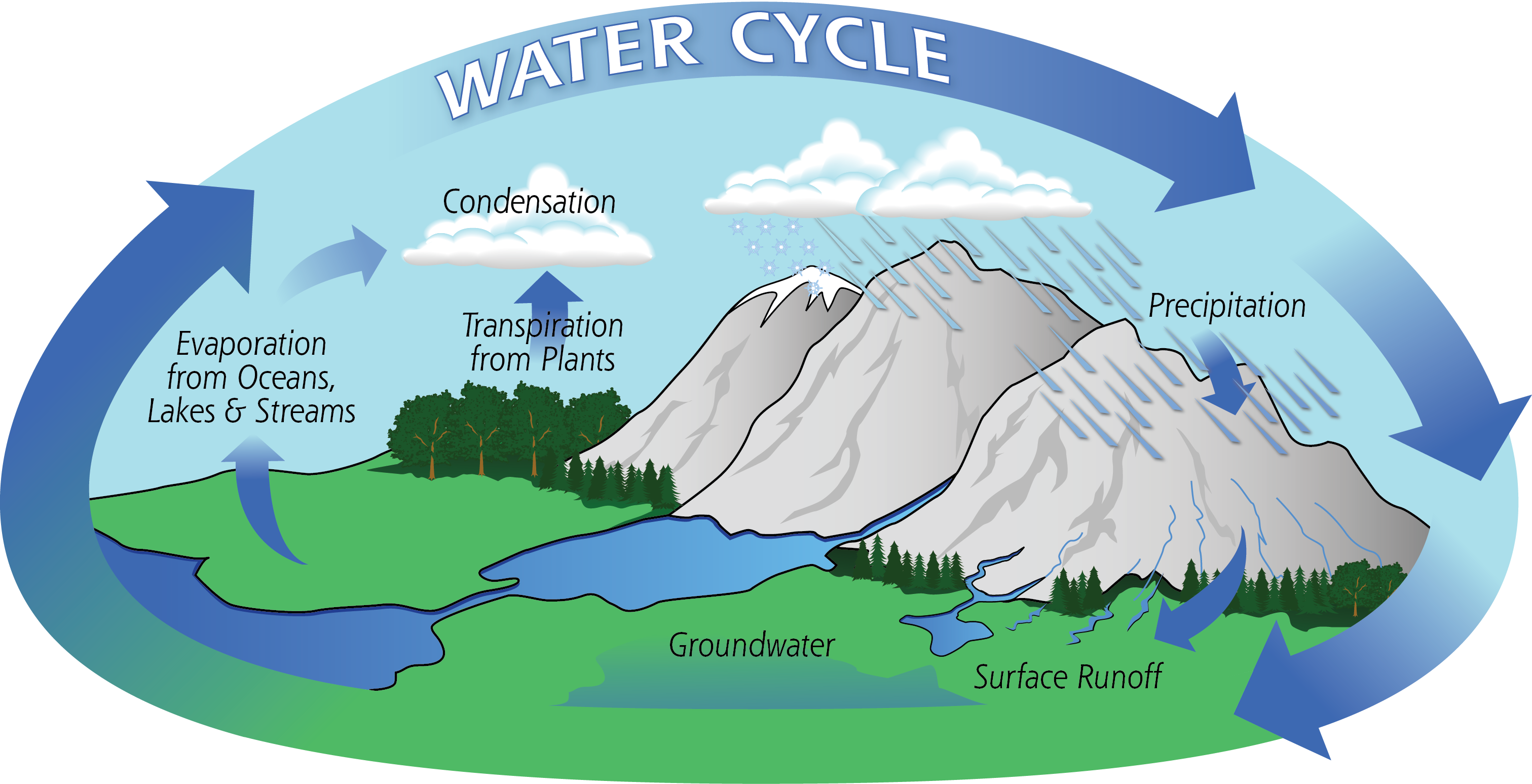
Water cycles through the environment, moving between the atmosphere, ocean, land and reservoirs of frozen water. It might fall as rain or snow, seep into the ground, run into a waterway, join the ocean, freeze or evaporate back into the atmosphere. Plants also take up water from the ground and release it through transpiration from their leaves. In recent decades, there has been an overall increase in the rates of precipitation and evaporation.


Some key points in the water cycle. NASA

A number of factors are intensifying the water cycle, but one of the most important is that warming temperatures raise the upper limit on the amount of moisture in the air. That increases the potential for more rain.

This aspect of climate change is confirmed across all of our lines of evidence: It is expected from basic physics, projected by computer models, and it already shows up in the observational data as a general increase of rainfall intensity with warming temperatures.

Understanding this and other changes in the water cycle is important for more than preparing for disasters. Water is an essential resource for all ecosystems and human societies, and particularly agriculture.

Read more: IPCC climate report: Profound changes are underway in Earth's oceans and ice – a lead author explains what the warnings mean
What does this mean for the future?

An intensifying water cycle means that both wet and dry extremes and the general variability of the water cycle will increase, although not uniformly around the globe.

Rainfall intensity is expected to increase for most land areas, but the largest increases in dryness are expected in the Mediterranean, southwestern South America and western North America.

Annual average precipitation is projected to increase in many areas as the planet warms, particularly in the higher latitudes. IPCC Sixth Assessment Report

Globally, daily extreme precipitation events will likely intensify by about 7% for every 1 degree Celsius (1.8 degrees Fahrenheit) that global temperatures rise.

Many other important aspects of the water cycle will also change in addition to extremes as global temperatures increase, the report shows, including reductions in mountain glaciers, decreasing duration of seasonal snow cover, earlier snowmelt and contrasting changes in monsoon rains across different regions, which will impact the water resources of billions of people.
What can be done?

One common theme across these aspects of the water cycle is that higher greenhouse gas emissions lead to bigger impacts.

The IPCC does not make policy recommendations. Instead, it provides the scientific information needed to carefully evaluate policy choices. The results show what the implications of different choices are likely to be.

One thing the scientific evidence in the report clearly tells world leaders is that limiting global warming to the Paris Agreement target of 1.5 C (2.7 F) will require immediate, rapid and large-scale reductions in greenhouse gas emissions.

Regardless of any specific target, it is clear that the severity of climate change impacts are closely linked to greenhouse gas emissions: Reducing emissions will reduce impacts. Every fraction of a degree matters.

[Understand new developments in science, health and technology, each week. Subscribe to The Conversation’s science newsletter.]

This article is republished from The Conversation, a nonprofit news site dedicated to sharing ideas from academic experts. 

Atmospheric river storms can drive costly flooding – and climate change is making them stronger

Mathew Barlow received travel funding from the US government to attend three IPCC lead author meetings.