Sunday, January 26, 2025

Trump’s Vision For a “Golden Age of America”: Oligarchy Plus Ultranationalism

January 24, 2025
Source: Truthout


Screenshot from NBC News

Donald Trump’s inauguration as the 47th president of the United States put on display fascism’s 21st-century iteration — a combination of oligarchic power and ultranationalism unlike anything in recent memory.

It was a shameful spectacle for a country that deems itself to be the world’s greatest democracy and the leader of the so-called free world. Trump was flanked by billionaire tech moguls and far right leaders from Italy, Germany, Argentina, France, the U.K., and other countries around the globe. His inauguration speech promised a “golden age of America” by making the country “greater, stronger, and far more exceptional than ever before.”

It was an inauguration speech dripping with authoritarianism and jingoism in which Trump cast himself as the savior of the country. “Our sovereignty will be reclaimed. Our safety will be restored. The scales of justice will be rebalanced,” he said, and described the leadership of the past four years as incompetent and corrupt, without specifying Joe Biden or other Democrats by name.

The speech left little doubt about its ideological character. Indeed, the political message behind Trump’s return to the White House was best captured by Elon Musk’s Nazi-like salute during the inauguration celebrations (though, in this case, predictably, the Anti-Defamation League rushed immediately to Musk’s defense by downplaying the significance of the gesture). The South African billionaire has appointed himself as leader of the West’s far right movement and has been fomenting fascism since he helped Trump win reelection. For Musk and his ilk, who expect to be the biggest beneficiaries of the new administration’s much anticipated anti-regulation blitz, Trump’s return to office promises a new “Golden Age” of U.S. world dominance and prosperity for the super-rich.

Acting like an authoritarian from day one, Trump signed dozens of executive orders that pose a direct threat to democracy and make a mockery of human rights and the rule of law. He ordered a crackdown on immigration, withdrew the U.S. from the Paris Agreement and the World Health Organization, and pardoned about 1,500 of his supporters who attacked the U.S. Capitol four years ago. He signed executive orders that seek to end birthright citizenship, which the U.S. Constitution has guaranteed for more than 150 years; terminate federal diversity, equity and inclusion guidelines; and roll back protections for transgender people.

Trump also signed an executive order that aims to weaken federal employee protections by reinstituting Schedule F in the excepted service, which Biden had rescinded when he took office. This move is intended to help Trump replace federal employees with loyalists faithful to his agenda. The architects of Project 2025 advocated the revival of Schedule F as part of their aim to “bend or break the bureaucracy to the presidential will.” And Trump announced that he will fire over 1,000 appointees from the Biden administration.

History never repeats itself exactly, but there are deeply troubling ideological and political parallels between European fascism in the 1930s and Trump’s MAGA vision. To start with, ultranationalism is a key foundation of fascism. Mussolini came to power with a promise to make a “clean sweep” of Italy and to restore Rome to its “golden age.” (Hitler had a similar vision for Germany, and a major difference between Italian fascism and Nazism is that the former did not prioritize biological determinism.)

Under Trump and his MAGA movement, ultranationalism has been given a new lease on life as the U.S. has had a long-standing tradition in ethnic nationalism and extreme chauvinism. The Alien and Sedition Acts, four internal security laws passed by the U.S. Congress in 1798 during the administration of President John Adams, called for the deportation of people from “hostile” nations and made it a crime to criticize the government. The slogan “America First,” fused with the idea of “100 percent Americanism,” was dominant between the World Wars. And as Adam Smith, director of the Rothermere American Institute at Oxford University, said, in “1930s America, fascism was on the march.

Trump’s second term promises to turn ultranationalism into state ideology — and the blizzard of executive orders that took place on his first day in office signify in no uncertain terms that his administration will make good on its campaign vow to get rid of “the enemy from within” by any means necessary. If the latter materializes, the fusion between ultranationalism and the authoritarian state will produce a full-fledged neofascist government cohabiting with violent neoliberalism as the economic regime.

And it will materialize, starting with the sweeping action on immigration and border control, which will enable Trump to carry out his monstrous deportation plan. Having echoed Nazi language by dehumanizing immigrants of color as “animals” and “poisoning the blood” of the nation, Trump is bent on executing the most massive deportation in U.S. history. This plan isn’t merely a “disgrace,” as Pope Francis labelled it, but the apotheosis of cruelty.

In his last major essay, “Nine Theses on the Philosophy of History,” Marxist philosopher and critic Walter Benjamin describes in the ninth thesis Paul Klee’s painting named “Angelus Novus,” which Benjamin had purchased in the spring of 1921, as the Angel of History. He writes:


A Klee painting named Angelus Novus shows an angel looking as though he is about to move away from something he is fixedly contemplating. … This is how one pictures the angel of history must look. His face is turned toward the past. Where we perceive a chain of events, he sees one single catastrophe which keeps piling wreckage upon wreckage and hurls it in front of his feet. The angel would like to stay, awaken the dead, and make whole what has been smashed. But a storm is blowing from Paradise; it has got caught in his wings with such violence that the angel can no longer close them. The storm irresistibly propels him into the future to which his back is turned, while the pile of debris before him grows skyward. That which we call progress, is this storm.

Klee’s “Angelus Novus” is used by Benjamin, who at the time was fleeing from the gestapo, as a metaphor for the illusion behind the capitalist idea of progress. In the end, like this notion of progress, Trump’s pursuit of a “Golden Age” can only lead to disaster and ruin, to catastrophe for the U.S. and the rest of the world.


CJ Polychroniou is a political scientist/political economist, author, and journalist who has taught and worked in numerous universities and research centers in Europe and the United States. Currently, his main research interests are in U.S. politics and the political economy of the United States, European economic integration, globalization, climate change and environmental economics, and the deconstruction of neoliberalism’s politico-economic project. He has published scores of books and over one thousand articles which have appeared in a variety of journals, magazines, newspapers and popular news websites. His latest books are Optimism Over Despair: Noam Chomsky On Capitalism, Empire, and Social Change (2017); Climate Crisis and the Global Green New Deal: The Political Economy of Saving the Planet (with Noam Chomsky and Robert Pollin as primary authors, 2020); The Precipice: Neoliberalism, the Pandemic, and the Urgent Need for Radical Change (an anthology of interviews with Noam Chomsky, 2021); and Economics and the Left: Interviews with Progressive Economists (2021).
Building Solidarity in 2025: Bernard Regan, Palestine Solidarity Campaign


By Bryn Griffiths

The first episode of the Labour Left Podcast in 2025 takes a deep dive into the subject of Gaza with Bernard Regan of the Palestinian Solidarity Campaign.  We ask the big question: how do we build the broadest possible solidarity with the Palestinian people in 2025? We could not be asking the question at a better time as the Palestinian Solidarity Campaign AGM takes place on Saturday 1st February.

As we publish this episode, it is good news to learn that, at last, we have a ceasefire in Gaza.  Donald Trump is seeking to make the ceasefire about himself and is claiming all the credit. However, Trump is already telling us that he’s not confident that the ceasefire will hold! We will find out the truth in the coming weeks.  What is absolutely certain is that in 2025 we must continue our support for the Palestinian people and to do that we need to deepen our understanding of their struggle.  We must also redouble our solidarity activities in 2025.  That is the subject matter of this podcast. Listen to it and use it. 

Our guest on the Labour Hub podcast spin-off, to consider the tasks ahead, is Bernard Regan a leading member of the Palestinian Solidarity Campaign.  Bernard served for twenty-five years on the National Executive Committee of the National Education Union (NEU) where he received the Steve Sinnott Award in recognition of his contribution to international solidarity.  In 2006 he was instrumental in a teachers’ union pro-Palestinian motion which carried the TUC.

We all know that the current crisis in Gaza did not begin on 7th October 2023, so we start by considering the long history of the Palestinian struggle. To do this we spoke about Bernard’s excellent book The Balfour Declaration – Empire, the Mandate and Resistance in Palestine.

To set the solidarity tasks ahead, we need to understand Israel’s role in the Middle East.  So, the podcast considers why to this day the United States cares so much about Israel and why Keir Starmer and David Lammy are so firmly wedded to their pro-Israel stance.

In the second half, we consider what we must do against the current backdrop of the terrible Hamas massacre?  As Trump takes office, we ask what we can do to support the Palestinians?  How can we broaden the international campaign and at home how can we put as much pressure as possible on Keir Starmer’s Labour Government? Bernard answers these fundamental questions against the backdrop of a British Government that is becoming increasingly authoritarian in its response to Palestinian protests.

Since the last episode the Labour Left Podcast has had some generous coverage in the Morning Star.  The newspaper published a feature on the show by the journalist Solomon Hughes under the hilarious title In a sea of centrist dross, try the Labour Left PodcastSolomon went on to say “It’s a podcast which manages to combine the grit of the grassroots with the surprising, entertaining and informative.” Thanks to Solomon.

If you’re new to the Labour Left Podcast, please take a look at our back catalogue.  Previous episodes have included Prof Harvey J Kaye on the legacy of the Communist Historians; Prof Corinne Fowler, talking about her book Our Island Stories: Country Walks Through Colonial Britain; Andrew Fisher telling the story behind For the Many Not the Few, Labour’s 2017 manifesto; Jeremy Gilbert, a Professor of Cultural and Political Theory, a champion of Gramsci, talking about Thatcherism; episodes with Mish Rahman, Rachel Godfrey Wood and Hilary Schan on the contemporary Labour left; Mike Phipps, author of Don’t Stop Thinking About Tomorrow, taking a long-term look at the Labour Left;  Mike Jackson, co-founder of Lesbians and Gays Support the Miners, on the Great 1984-85 Miners’ Strike; political activist Liz Davies telling her story as the dissenter within Blair’s New Labour; Rachel Garnham, a current co-Chair of the Campaign for Labour Party Democracy looking back at the history of the fight for democracy in the British Labour Party; and finally myself telling the story of Brighton Labour Briefing, a local Bennite magazine of the 1980s.

If you are enjoying the podcast please subscribe on YouTube or your favourite podcast platform so you never miss a future episode.  If you like what the Labour Left Podcast is trying to achieve, please help us to get the podcast in front of more people by sharing, following, liking, rating and commenting on every episode you watch.

You can watch the podcast on YouTube, Apple Podcasts here, Audible here and listen to it on Spotify here  If your favourite podcast site isn’t listed, just search for the Labour Left Podcast

Bryn Griffiths is an activist in Colchester Labour Party and North Essex World Transformed. He is the Vice-Chair of Momentum and sits on the Campaign for Labour Party Democracy’s Executive. 

Bryn hosts Labour Hub’s spin-off – the Labour Left Podcast.  You can find all the episodes of the podcast here  or if you prefer audio platforms (for example Amazon, Audible Spotify, Apple etc.,) go to your favourite podcast provider and just search for the Labour Left Podcast.


UK Gaza Protest

What happened to policing by consent?

JANUARY 25, 2025

Nadine Finch raises questions about the way the Met dealt with a peaceful protest on Palestine in London a week ago.

The chaotic nature of the policing of the peaceful static public assembly that took place in Whitehall on 18th January 2025 indicates the urgency of repealing and amending parts of the Public Order Act 1986. It also underlines that the Labour Government is prepared to continue its authoritarian and discriminatory attitude to dissent in office, as well as within the Labour Party itself.  

Climate change protesters and those who have been taking action against businesses connected with the arms trade, have already experienced the rough, and sometimes random, police response to their direct actions. But since 2003, public processions and assemblies against wars have generally been able to rely on governments having respect for the rights to protest and express an opinion, enshrined in the Human Rights Act 1998.

Huge Stop the War and CND marches have taken place with both the organisers and the police understanding that events, that have been well planned with sufficient entry and exit routes and respect for those who are less mobile due to age and physical ability, will be both safe and human rights-compliant.

But the manner in which the public assembly was policed on 18th January indicated a radical departure from the policing by consent measures to be expected in a democracy that respects the diversity of the views of its citizens.

The narrative being spun by senior officers at the Met and repeated by the few media outlets that bothered to report events is that multiple arrests were required because activists broke through police lines in an attempt to leave the agreed public assembly area, cross Trafalgar Square and proceed to a synagogue close to the BBC in Portland Place.

But, just as in Gaza, the first-hand reports of citizen journalists and photographers exposed that those spinning this narrative have been economic with the truth, to say the least.

In retrospect, the actions of those taking political and operational decisions leading up to, and on the day of, the public assembly should have signalled that the safety of the wider community and the maintenance of their rights was not going to be respected by the police and those responsible for their management.  

As had been the case throughout a long series of marches triggered by events in Gaza, Stop the War and other organisers had negotiated with the Met police well in advance of 18th January, as required by law and common sense. It was the Met that reneged on a previous agreement on a route from the BBC building in Portland Place to Central London. They then publicised a route, that had not been agreed and which would have started from Russell Square.

Very late in the day, an agreement was reached for a public assembly in Whitehall. In reaching this agreement, the Met will have been well aware that, to arrive and exit from the assembly by underground, bus or foot, protesters would have to leave Whitehall and enter other areas of Central London. Yet instead of addressing this issue and establishing coherent and continuous lines of communication with the organisers and protestors during the assembly, the police seemed to exercise powers to impose conditions in a manner designed to confuse and provoke protestors.

At different times during the afternoon, police officers were forming lines across Whitehall at seemingly random times and locations. This had the effect of giving some protesters the feeling of being kettled and anxious for their own well-being.  This was particularly significant, as there were a number of elderly people and children in the crowd.   

It was also clear that the police were preparing for confrontation fairly early in the afternoon. A significant number of vans, containing Territorial Support Group officers, started to form up at the top of Whitehall and in side streets around Trafalgar Square and Charing Cross. Ambulances also appeared and parked. But it was local Met officers that remained the first line of contact between protesters and their routes of exit to the north of Whitehall and groups of protesters, such as Jewish Voice for Labour, and numerous other individuals were stopped from leaving by these officers.  

The Met had relied on Section 12 of the Public Order Act to ban a public procession and insist on a public assembly. They had done so on the basis that the Commissioner of Police had asserted that he reasonably believed that the planned procession/march may result in serious disruption to the life of part of the Jewish community, who may wish to attend the Central Synagogue, close to Portland Place that Saturday. The evidence that such a disturbance may occur was negligible. But a previous Tory Secretary of State for the Home Department had used a regulation to redefine “serious disruption” as “more than a minor disturbance”, even though this redefinition had already been debated and rejected by Parliament. This was designed to significantly reduce the evidential burden that fell on the police. The current Secretary of State for the Home Department is bringing an appeal to the Court of Appeal, which would maintain this redefinition.

It is unlikely that the Met’s reasoning was understood by many protesters as, in their view, the significance of the proposed starting point in Portland Place related to the widespread allegations of bias that have been brought against the BBC for its coverage of the war in Gaza.

But this framing of the narrative was important, as it supported the Government’s persistent characterisations of the protestors as antisemitic. It is noteworthy, that social media was subsequently alive with criticism of the manner in which events that afternoon were policed. But the only comment on X by the current Secretary of State for the Home Department was one that stated that “everyone should be able to worship in peace. Met Police have my support in ensuring that synagogues were not disrupted today.”  

She and her advisers, as users of X, cannot have failed to have seen the multitude of photographs and comments, which attested to lack of coherent policing that afternoon. Police lines were being drawn up and then withdrawn. Protesters were not being given the instructions on the varying conditions being imposed by the senior police officer at the event, as required under section 14 of the Public Order Act 1986. Many were not aware of any conditions. Others, both in Whitehall and later in Trafalgar Square, were just told by individual officers that they would be arrested if they did not move. Some of these were women in their 70s, who were given a countdown of seconds and minutes to comply with these directions.

Many other people and tourists were not told anything and were expected to have been keeping a close and regular watch on the Metropolitan social media site. This did not comply with the requirement to make those involved aware of conditions that were being imposed on them and the fact that to justify an arrest, breaches of conditions had to be intentional.  

It was also very unclear whether the regular police officers who had formed lines within and at the top of Whitehall were being informed of the intentions of the Territorial Support Groups officers, sitting in their vans and later arresting organisers and others in Trafalgar Square. There are plenty of photographs and videos of the former officers consenting to a delegation of MPs, actors and activists entering Trafalgar Square from the north end of Whitehall. The members of the delegation were clearly on the older side, including an 86 year old holocaust survivor. There were also two MPs and a number of well-known actors. They were all carrying flowers and it was made clear that when their progress across the square was stopped by officers, they would lay down their flowers and disperse.  

The officers also failed to stop or issue conditions or instructions to the protestors who were permitted by the same police officers to follow the delegation into Trafalgar Square. It may be that these officers had been told to let the delegation in so that they could be later accused to breaching previous conditions imposed on the organisers of the assembly. Or it may be it was just a further example of poor and incoherent policing. Either way, it put a large number of protestors and members of the public at risk of harm. It also led to a number of arrests of dubious legality.

Whatever criminal cases, and no doubt subsequent civil actions against the police reveal, the consensus and trust that had been built up over decades between thousands of activists and the Met Police has been put in doubt.  

Those with long memories will recall scenes from the Miners’ Strike, the Poll Tax demonstration and the policing of the Irish Community. The key question is whether events on Saturday mark a return to policing without consent, where officers are permitted to round up the usual suspects.

The manner in which the Vice Chair of the Stops the War Coalition was arrested, while responding to a request by a senior police officer for a discussion, and the subsequent charges brought against the Director of the Palestine Solidarity Campaign suggest that they do. As does the presence of dedicated public order officers, in their distinctive baseball caps, at the location and point at which most arrests were made, but not earlier.

It is also still unclear which elected representatives were involved in events on Saturday. The Greater London Authority is not directly responsible for operational decisions made by the Met Police. But it does have a Police and Crime Committee, which examines the work of the Mayor’s Office for Policing and Crime, which in turn oversees the Metropolitan Police. The Mayor has also very recently appointed a new salaried Deputy Mayor for Policing and Crime. The Mayor himself is no stranger to issues of policing, as this was his primary area of work when he was previously a solicitor. Furthermore, although Trafalgar Square is owned by the King, it is managed by the Greater London Authority.

Yet it did not appear that the GLA had taken any part in the planning of the assembly in the days leading up to the event or that it had any officers, representatives or observers present on the day.

The Home Office does have responsibility for national aspects of the Met’s policing but again it has been silent about events to date. This leaves a political vacuum at a time when many of the Government’s new policies are highly contested. The Government would do well to remember that the manner in which so-called Poll Tax riots were policed led in part to the fall of an earlier Prime Minister. It is also arguable that the heavy-handed policing of the Miners’ Strike caused rifts in communities that have never been healed. London has a relatively young population and is home to a wide range of communities, many of whom share different views on events in Gaza to that espoused by the Government. Policing by consent may never have been more necessary.

Nadine Finch is a former barrister who specialised in human rights law and is the author of several books on family, immigration and comparative law. She writes in a personal capacity.

Photo: Banner on the static protest in Whitehall on Saturday 18th January – c/o Labour Hub.


Gaza Protest: How Starmer And The Met Have Joined Forces To Quash All Dissent

Dozens of people were arrested on the weekend at a peaceful demonstration aiming to highlight British complicity in Israel's slaughter
January 25, 2025
Source: Middle East Eye


The decision by the Metropolitan Police to interview “under caution” former Labour leader Jeremy Corbyn and leftwing MP John McDonnell for attending a peaceful protest in London against Israel’s mass slaughter in Gaza is a decisive turning point.

It marks a new escalation by the British state in its campaign to repress dissent – and specifically the demonstrations against what the International Court of Justice (ICJ) determined a year ago was a “plausible” genocide in Gaza.

It marks, too, a new low in the mendacity of police, and senior government figures like Home secretary, who insinuated that protesters engaged in violent, illegal behaviour or posed a threat to Jews in London.

I was at the rally on Saturday, and I saw what happened with my own eyes. From what I observed, it appeared that police wilfully engineered a situation to entrap Corbyn and McDonnell, the march’s figureheads, and then cynically present them as lawbreakers. At the same time, it arrested dozens of protesters and has subsequently charged the main organisers with public order offences.

It is not true that protesters forcefully “broke through” a police cordon at the top of Whitehall, as the Met claimed, to enter Trafalgar Square and thereby breached police “conditions” and posed some kind of undefined threat to a synagogue more than a mile away and not on the march route.

And the media is being thoroughly irresponsible in allowing police to advance these falsehoods without serious challenge. Social media is full of videos showing that Corbyn and McDonnell were correct in saying that they were ushered through the cordon.

This week more than 40 leading lawyers and academics wrote to the Home Secretary, Yvette Cooper, warning that the Met’s actions were “a disproportionate, unwarranted and dangerous assault on the right to assembly and protest” and that a raft of anti-protest laws were being exploited to target “anti-war and pro-Palestine protests in particular”.

In a statement, the Met maintains it acted “without fear or favour … motivated only by the need to ensure groups can exercise their right to peaceful protest, while also ensuring the wider community can go about their lives without serious disruption”.
Political goals

The Met’s false assertions aren’t random or purposeless; rather, they seek to advance specific political goals. They help the government of Prime Minister Keir Starmer – which is deeply implicated in Israel’s genocide – smear the marchers as violent, antisemitic troublemakers. They create a pretext to shut down protests that have caused huge discomfort to Starmer.

What we are witnessing is a continuation of the British state’s war on the ethical left. It is using opposition to Israel – and now to genocide – as its yardstick for measuring political illegitimacy and deviancy.

Starmer’s first job as opposition leader was to purge the Labour Party of Corbyn and the grassroots movement he inspired – one that hoped to reverse 40 years of growing social injustice at home, and end Britain’s investment in colonial forever wars abroad, including its lock-step support for Israel’s oppression of the Palestinian people.

Now Starmer’s job as prime minister is to rid the streets of those for whom Israel’s slaughter of children has served as a rallying point; those who understand that both our major political parties are complicit in genocide; and those despairing that we are no longer offered meaningful political choices on the biggest issues facing us.

For years when he was Labour leader, Corbyn and his supporters were fitted up as antisemites without a shred of evidence for the allegation, aside from his all-too-justified criticisms of Israel.

Now, the very same establishment is again fitting up him, as well as the cause he represents – this time for being proved so presciently right in his warnings that Israel was a rogue state.

There have been regular, peaceful marches through London since Israel began its indiscriminate slaughter of Gaza’s men, women and children in October 2023, following Hamas’s attack on Israel. But the longer the genocide has continued, the harder it has been for the British government to justify its active collusion.

Largely unmentioned by Britain’s pliant media, the UK has been supplying vital components to Israel that have allowed its fleet of F-35 jets to continue bombing Gaza and killing civilians. Britain has organised hundreds of flights that have shipped US and German munitions to Israel, including from a Royal Air Force base in Cyprus.

The UK has supplied Israel with intelligence gained from surveillance flights over Gaza, and it has provided diplomatic cover for Israel at international bodies such as the United Nations.

Starmer has been particularly embarrassed by the decision of the International Criminal Court, the ICJ’s sister court, last November to issue arrest warrants against Israeli Prime Minister Benjamin Netanyahu and his former defence minister, Yoav Gallant, for crimes against humanity.

The Israeli government’s policy to starve the population of Gaza of food, water and power was publicly supported by Starmer from the outset.
Ignoring genocide

Like his predecessor, the British prime minister has been relying chiefly on the BBC – the state broadcaster and main news source for most Britons – to keep the public largely ignorant, both of the fact that a genocide is taking place in Gaza and of his complicity in it.

The BBC’s role has been to normalise genocide by recharacterising it as a “war” between Israel and Hamas. Israel’s carpet bombing of Gaza, the mass slaughter of Palestinians, and the starvation of the entire population have been implicitly treated as a “counter-terrorism” operation.

The aim has been to gradually dissipate interest in the Gaza protests, shrinking the size of the demonstrations and leaving only a hard core of committed activists out on the streets.

Initially, the BBC kept the focus on the suffering of Israelis in the aftermath of the Hamas attack, and on the plight of Israeli hostages held in Gaza – even as tens of thousands of Palestinians in the enclave were killed and maimed, and its hospitals, schools, universities, libraries, mosques, churches and bakeries were levelled.

Then, as the genocide rolled on and selling it became harder, the BBC largely drew a veil over what was taking place. It minimised its reporting to the point where the horrors unfolding in Gaza were excluded from the main TV news for days or even weeks at a time.

A growing number of BBC journalists have come forward as whistleblowers. They have cited severe top-down pressure at the corporation to slant reporting in Israel’s favour.

Even now, as the first stage of a shaky ceasefire was implemented on Sunday, the BBC’s focus once again reverted to the Israeli hostages, and the release of three to their families. Each has been humanised by the western media, their stories and photographs shared widely.

Meanwhile, the Palestinian women and children they have been “swapped” for are barely visible. They are referred to prejudicially as “prisoners”. But like thousands of other Palestinians held in Israeli “prisons”, many were seized from their homes in the middle of the night by armed soldiers enforcing an illegal occupation. Many have been held for lengthy periods without charge or trial.

Even as the exchanges were taking place, Israel was abducting more Palestinians, including children, to fill its “prisons”, which Israeli human rights groups describe as “torture camps”.
The iron fist

All of this was reason enough for protest organisers to select the BBC as the site for last weekend’s demonstration. The point was to protest its coverage and editorial complicity in Israel’s genocide.

The media’s biased reporting has given licence to the British government to back Israel’s genocide. And the same flawed coverage will give Israel licence to violate the ceasefire, as it is already doing, or to reimpose the inhuman, 16-year siege of Gaza that preceded the genocide and led to Hamas’ attack on 7 October 2023.

But as the demonstrations have shown no signs of abating, the Starmer government has grown more desperate. The BBC has failed to normalise the genocide, and British complicity has not been completely shrouded.

Starmer thus needed a new strategy for bringing to an end the rallies that have been embarrassing him. If the British public can’t be brainwashed into accepting genocide, then they will have to be scared off the streets. The velvet glove of the BBC has been swapped for the Met’s iron first.

Until Saturday, more than 20 protest marches had taken place in London without meaningful incident. Although hundreds of thousands of people regularly attended, arrests were lower than at the annual Glastonbury music festival.

The obviously peaceful nature of the marches, and the attendance by a large and visible bloc of Jews, including Holocaust survivors, had long infuriated the right and Israel’s lobbyists, who wanted them banned.

On Saturday, police decided to take the gloves off.

They arrested dozens of demonstrators, charged at least of two of the main organisers with public order offences, and called Corbyn and McDonnell in for interviews.
Demented narrative

The demented narrative that Starmer and the media have crafted over the past 15 months, and that the Met is now relying on to justify its repression, goes like this:


Israel was the victim of a massive, unprovoked antisemitic hate crime by Hamas on 7 October 2023 (even though Israel had besieged Gaza for the preceding 16 years and brutally occupied the enclave for more than seven decades). Hamas’s attack gave Israel the right to “defend itself” on any terms it thought necessary. Because Israel believed the entire population of Gaza was implicated in Hamas’s hate crime, it justifiably punished them all collectively through carpet bombing and an aid blockade.

With this preposterous, human rights-violating narrative serving as the unexamined origin story for Israel’s genocide, anyone protesting Israel’s destruction of Gaza could be characterised as sympathising with Hamas and its 7 October “hate crime”.

The previous government forged just such a narrative.

Former Home Secretary Suella Braverman termed as “hate marches” the protests against what the ICJ calls a “plausible” genocide. But the smear was so patently ludicrous that it never gained much traction beyond the Conservative Party, the Israel-worshipping far right, and the more unhinged parts of the billionaire-owned media.

It appears that the police have now cooked up some corroborative evidence to help the current Labour government. They appear to have set a trap to ensnare protesters, including Corbyn and McDonell, so they could be recast as violent lawbreakers and antisemites.

The Met did not respond to questions by the time of publication.
BBC no-go zone

Starmer’s government and London police have spent months preparing the right conditions to demonise protesters.

The Met’s subterfuge has worked only because the establishment media has served once again as a willing conduit for police disinformation about the march.

As Ben Jamal of the Palestine Solidarity Campaign has explained, the Met approved a mass protest outside the BBC headquarters back in November. However, it requested the event be delayed to avoid causing disruption in the run-up to Christmas for London’s nearby commercial streets.After reaching a compromise with police on timing, organisers announced that the rally outside the BBC would take place on 18 January. But as the date neared, police started furiously backtracking.

The pretext they settled on was that a local synagogue would be disturbed by the demonstration. The claim was made even though the synagogue was not near the march route, there have been no examples of a synagogue being threatened or any Jews being targeted in 15 months of similar protests, and the march is always attended by a large and highly visible bloc of Jews opposed to the Gaza genocide.

Objections to the march by the synagogue’s rabbi looked entirely political, and unrelated to security. But march organisers accommodated the rabbi’s professed concerns and the demands of police by reversing the march route. It would start in Whitehall and end at the BBC late in the afternoon, long after the synagogue’s Sabbath service was finished.

Police revealed their true hand at this point. They rejected the organisers’ compromise, even though the rabbi’s concerns had been addressed. Instead, the Met appear to have declared what amounts to a large and permanent no-go zone around the BBC – effectively banning any pro-Palestine demonstrations from taking place on a Saturday, the only day in the week when mass protests can realistically happen.

In other words, police – the state’s coercive arm – were threatening anyone critical of Israel’s genocide with arrest if they went near the BBC, the state’s propaganda arm.

The BBC might be funded by taxpayers. Its licence fee might be compulsory. But the British public apparently now has no right to protest against the disinformation they are compelled to pay for.
Sleight of hand

By the time Saturday’s march arrived, all the pieces were in place for the Met’s sleight of hand.

Police had at the last minute insisted on what they termed a “static” rally in Whitehall. Organisers had said they would try to march as far as they were allowed by police; when their path was blocked, they would lay flowers on the road in memory of the slaughtered children of Gaza, and in protest at the silencing of their demonstration against the BBC.

At the end of the speeches, the march formed at the top of Whitehall, led by Corbyn, McDonnell and Jamal. I stood nearby. Police had cordoned off the road – but then, as I saw for myself and video footage confirms, the police line separated and the marchers were released into Trafalgar Square.

As the demonstrators soon found, all routes out of Trafalgar Square had been blocked off by police. The square was effectively a giant “kettle” – a police tactic used to enclose protesters so they cannot easily leave a public space. They can then be selectively arrested.

As Corbyn and McDonnell reached the northwest corner of Trafalgar Square, they were greeted by another police cordon. This time, police refused to budge.

When the march’s chief steward, Chris Nineham, requested that the delegation be allowed to proceed further, he was rushed by a squad of police officers and violently dragged off.

Jamal urged everyone to sit down to avoid further attacks by police. The flowers were laid, and the march dispersed. Nonetheless, police massed in large numbers in Trafalgar Square and arrested dozens of demonstrators.

At all times, despite the impression created by the Met and Yvette Cooper, the marchers were at least a mile from the BBC and the synagogue.

Notably, on the day before the rally, more than 1,000 Jews, including leading cultural figures, lawyers and academics, called on the police to overturn the ban on marching to the BBC, stating: “As Jews we are shocked at this brazen attempt to interfere with hard-won political freedoms by conjuring up an imaginary threat to Jewish freedom of worship.”
Flimsiest of pretexts

The BBC and the rest of the media have gleefully reported on Corbyn and McDonnell being called for police interviews. They have been equally enthusiastic in giving the impression of a connection between that investigation and a statement from Commander Adam Slonecki, who led the policing operation, that the march represented “a serious escalation in criminality”.

Notably, the media has largely avoided mentioning the context, or the BBC’s conflict of interest: that protesters were seeking to expose the corporation’s complicity in the Gaza genocide, and that police were acting to shield it – and Starmer’s government – from accountability.

The Met is framing the march’s leaders and figureheads as criminals. This should be understood for what it is: police meddling deeply in political matters on behalf of the government, and eroding fundamental democratic rights to assemble and peacefully protest.

Nineham, a veteran founder of Stop the War and one of the march organisers, was charged this week under the Public Order Act. As part of his bail conditions, he has been banned from participating in future anti-genocide rallies.

Jamal, director of the Palestine Solidarity Campaign, has been similarly charged. There is a real danger that police will level the same charges against Corbyn and McDonnell.

The transparent aim here – one that benefits Starmer’s government, as well as Israel – is to silence dissent against the genocide and British collusion in it.

Police have built a mendacious case that the home secretary can exploit to outlaw the protests. She shows signs of being ready to grasp this, the flimsiest of pretexts that she is being offered.

But even in the event the marches aren’t banned, the damage is already done. The unwarranted and violent arrests of demonstrators, and the smearing of organisers, will have a predictable effect. It will dissuade all but the hardiest activists from turning out to protest against British complicity in the slaughter in Gaza, the biggest crime of our age.

Some will credulously swallow the police disinformation. Others will believe police are gunning to criminalise participation in the demonstrations. Either way, the marches will have been successfully stigmatised.
Stoking disorder

Recall that the Met has form. In 2023, an official inquiry found the force to be institutionally racist, misogynistic, homophobic and corrupt. Its author concluded that the Met could “no longer presume that it has the permission of the people of London to police them”.

The idea that it is dispassionately maintaining order between those protesting Israel’s genocide and those so attached to a foreign country that they find such protests offensive is laughable.

The head of the Met, Mark Rowley, celebrated the fact that he had placed unprecedented restrictions on Saturday’s rally in an address the following day. He said: “We’ve used conditions on the protests more than we ever have done before in terms of times, constraints, routes.”

Where did he make these comments? At an event held by the Board of Deputies of British Jews, which has been vocal in supporting Israel through 15 months of genocide and objected strenuously to arms sales restrictions by the Starmer government, even though it has allowed more than 90 percent of British weapons to continue flowing to Israel.

Rowley, meanwhile, ignored an appeal from more than 1,000 British Jews, including prominent cultural and legal figures, urging him to allow the BBC protest on Saturday to go ahead.

The truth is that Rowley and the Met are not the ones upholding public order. They are the ones threatening it.

They have declared war on one of the most cherished and fundamental rights in a democracy. They have criminalised peaceful, lawful protest. And they have openly politicised their policing role.

Millions of Britons are learning that their opposition to the UK’s active support for the slaughter of children in Gaza not only counts for nothing, because the government refuses to listen, but that police also consider their protests, however peaceful, as criminal behaviour.

Police – and Starmer’s government hiding behind them – are further tearing apart Britain’s fragile social fabric. They are stoking disorder. And we will all pay a heavy price.


Jonathan Cook is a British independent journalist, who has covered issues of Palestine and Israel for much of his over 20-year career. He formerly wrote for the Guardian and Observer newspapers and is a winner of the Martha Gellhorn Special Prize for Journalism.


Biden’s Legacy Is Written In Blood


 January 24, 2025
Facebook

Kamal Adwan Hospital workers, doctors, and staff are being forcibly evicted from the grounds of the hospital by IDF soldiers. (Screengrab from a video posted to X.)

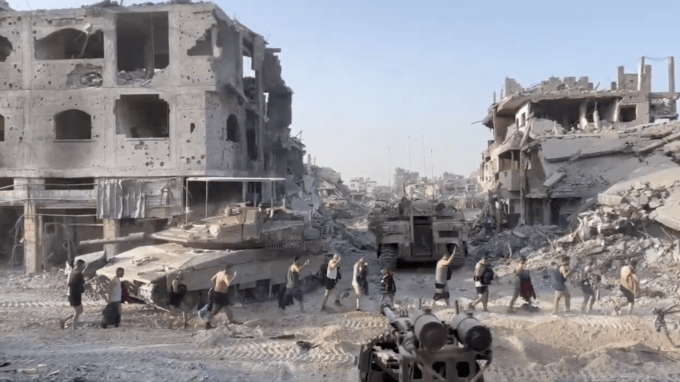
Last week, aerial photos from Los Angeles with blocks of homes reduced to ash hit social media timelines, leading people to understandably draw comparisons to Gaza. Destruction of entire neighborhoods is always heartbreaking. Home, where most of us spend a great deal of our time, shapes who we are. The memories and love a home can hold are much larger than whatever the square footage may be. Behind all the devastation are all the people in power that make all of this tragedy and grief possible in the first place.

Joe Biden’s term as president ended on Monday, and the world doesn’t have to guess what his legacy will be. The crimes he is responsible for are written into history with the blood of hundreds of thousands of Palestinians, each one coming from a neighborhood his administration helped turn to ash. The drone images from Gaza and Los Angeles share the same hues of grey and heartache, and originate from the same flavors of greed and contempt for human dignity. And now, all of a sudden we have a ceasefire, with no thanks to Biden. When I think of Joe Biden, I will think of every child I’ve seen dismembered and every home I’ve seen destroyed while I scrolled through social media for the last fifteen months. And I will remember that none of it needed to happen, he greenlighted and funded the genocide of the Palestinian people. He, and powerful people like him, let insurance companies back out of insuring homes and fueled the climate crisis for decades to come.

Another clear demonstration of his inaction occurred last week, when he suddenly removed Cuba from the State Sponsor of Terrorism list, a demand we’ve been making to his administration for four years. The designation, along with the US embargo, has caused levels of deprivation the country hasn’t seen since the Soviet collapse. People in Cuba were starving because of Joe Biden’s decision to keep them on the SSOT list, and he only removed them on his way out the door.

A small part of accountability for Biden and his partners in genocide like Antony Blinken, Kamala Harris, Lloyd Austin, Matt Miller, and others will be remembering the people that were killed in Gaza with their weapons shipments or because of their lies. Like George W. Bush, the man responsible for the death of a million Iraqis and the country’s destruction, who took up painting in his old age to make people forget what he had done in their name – Biden has time to change what people may think of him. We owe it to the Palestinian people to not develop amnesia while bombs could still rain over their heads. Biden could have ended the genocide at any moment, and he chose not to. And because of that, tens of thousands of children are dead, the only reason being that they were born in the largest open air prison in the world.

It’s hard to speak of legacies when the dust from the bombs dropped on Iraq hasn’t even settled. Babies are still being born in Fallujah with life-threatening deformities and diseases. For over a year, Israel continued to drop US-made bombs and, on multiple occasions, chemical weapons on the people of Gaza. From the environmental impact of the nonstop bombardment to the public health outcomes of living without proper shelter for so long, the extent of Biden’s crimes in Gaza won’t be understood entirely for decades.

It’s also hard to speak of legacies when next week a new President who has promised to stay the course of genocide takes office. In reality, the genocide of Palestinians will be several US president’s legacies – even before Biden.

Evaluating Biden’s legacy on the domestic and international stages shouldn’t be done separately. In fact, the struggles faced by regular people all over the world and across the country make a whole lot more sense when you realize our issues are inseparable. As homelessness reached an all time high in the United States, Biden and Congress sent billions of dollars in “aid” to Israel and Ukraine. As homeless encampments were swept in Los Angeles as the city burned, Biden notified Congress of another $8 billion in weapons to Netanyahu’s military. People are anxious every day about whether or not they will be able to pay rent, afford groceries or their children’s medicine. While the people suffer, there only seems to be one thing that the people in power (no matter who it is) care about – maintaining global hegemony no matter the human cost. Every year of his presidency, just like every other president, Biden signed a Pentagon budget that allocated more money to war than ever before and failed to improve the lives of the masses. Biden’s legacy as a whole is a disdain for Palestinian life, and to some lesser degree, American life.

I spend a lot of my time thinking about what people like myself, in the belly of the beast, ought to do to take responsibility for all the suffering our government, regardless of the president, has caused. I think of Che Guevara, who once said, “I envy you. You North Americans are very lucky. You are fighting the most important fight of all—you live in the belly of the beast.” As Trump returns to office to build his own legacy, and as Biden leaves behind four years and decades of consequences, I try very hard to remember that to be in this struggle is a privilege of mine. If I abhor the suffering forced on the Palestinians in Gaza, then I realize I live in the perfect place to do something about it. Trump and his new agenda are obstacles, but we’ve confronted plenty of obstacles under this system, which mobilizes all of its resources against the movement for peace. When we finally win, I hope people remember our movement as one that took responsibility for our situation and found power when we thought we couldn’t. I hope our impact eventually defines the legacies of the warmongers like Biden and Trump, so that the world cannot forget who they are or what they did. Remember: it’s the people who can really define a president’s legacy. Let that propel you to take action and organize. Let that give you a glimmer of hope.