It’s possible that I shall make an ass of myself. But in that case one can always get out of it with a little dialectic. I have, of course, so worded my proposition as to be right either way (K.Marx, Letter to F.Engels on the Indian Mutiny)
Tuesday, February 04, 2025
Hybrid SOV Design Lowers Costs Supporting More Wind Farms
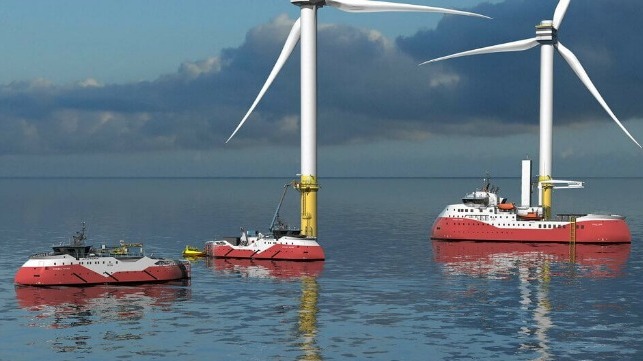
Ulstein's concept is a smaller SOV with lower costs for smaller wind farms or to work with the larger vessels (Ulstein)
As the offshore wind energy sector continues to evolve, operators especially in the maintenance and operations phase are faced with the challenges of lowering costs and increasing efficiency. Norway’s Ulstein has developed a new hybrid design for a smaller service vessel that they believe fills a critical gap in the market and reduces costs for the operations of the wind farms.
While the world needs more renewable energy sources, costs continue to be a significant challenge for offshore wind. To achieve financial viability, developers have been looking to larger projects, but Ulstein focused on an approach with could lower CAPEX by 50 percent, operating costs, and contribute to making smaller, closer-to-shore wind farms more economical for the developers.
Currently, they point out the walk-to-work sector relies mostly on the larger Service Operation Vessels (SOV) which can stay onsite for an extended period and typically accommodate up to 100 people. Day projects are supported by the crew transfer vessels.
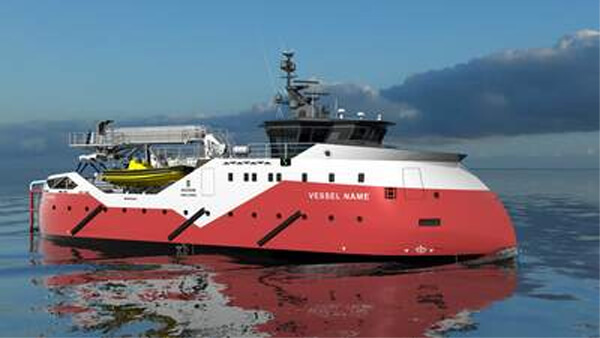
Smaller SOV fills a gap in the market and offers 50 percent lower CAPEX and OPEX (Ulstein)
Ulstein’s proposal for the SX250 is a vessel that can bridge the gap between CTVs and the current large SOVs. Its smaller vessel would measure approximately 47 meters (154 feet) and provide accommodations for 32 to 40 individuals. It would have a top operating speed of 10 knots and use the designer’s Twin X-Stern to enhance seakeeping capabilities.
According to the company, the vessel would be suited for sea conditions up to 2 meters (6.5 feet) and best for small to mid-sized wind farms located in areas with calm or moderate sea states. These could be closer or shore or in shallow waters.
Another concept is for the smaller SOVs to work in unison with the larger vessels. According to Ulstein, two of three of the SX250 could be managing smaller jobs at the wind farm while the traditional, larger SOV focuses on the larger tasks.
The new vessel concept Ulstein says relies on existing off-the-shelf hardware and technology to ensure effective walk-to-work operations while reducing CAPEX and OPEX. The vessel can be customized with different arrangements and topside equipment and depending on the operational needs, various setups such as a gangway system, a daughter craft, deck storage, or a work or observation ROV.
Filling the perceived gap in the market Ulstein says provides a unique opportunity to lower CAPEX and OPEX by up to 50 percent versus the current vessels. As a smaller vessel, it also contributed toward the push toward sustainable operations and presents a unique new solution to support the broader building out of the offshore wind sector.
Dominion’s Offshore Wind Farm Reaches 50% Mark as Costs Soar Past $10B
Dominion Energy highlights continued progress on the installation of its offshore wind farm (Dominion Energy)
Dominion Energy reports its offshore wind farm project remains on schedule and is making good progress. Known as Coastal Virginia Offshore Wind, the 2.6 GW project will be the largest in the United States when it is completed at the end of 2026.
Offshore work for the wind farm began in 2024 and the company says it has now approached the 50 percent mark with milestones in the installation. After completing the installation of 78 monopole foundations and four offshore substation foundations during the first season which ended in November 2024, Dominion highlights that the first 16 transition pieces are now in place. The completed project will have 176 wind turbines. The company continues to stage materials at the Portsmouth Marine Terminal with the next phase of monopole installations due to start in the spring.
The first three of the 4,300-ton offshore substations arrived in late January in Virginia. Among the next steps, Dominion reports that wind turbine tower and blade fabrication is now underway and nacelle fabrication is scheduled to begin later this quarter.
Substations arrived as materials are staged onshore in Virginia (Port of Virginia)
While the project is making good progress on the installation, Dominion also revealed costs are up approximately nine percent from the November 2021 budget submitted to the Virginia State Corporation Commission. They noted that the increase, which is due to higher onshore network upgrade costs assigned by grid operator PJM, has driven the total budget to $10.7 billion up from the original estimate of $9.8 billion.
The company emphasized that the costs are controlled with robust cost-sharing mechanisms and an unused contingency that stands at $222 million. Dominion Energy last year sold a 50 percent stake in the project to investors Stonepeak which will cover half the costs up to $11.3 billion. Above that there is a cost-sharing mechanism. While costs are up, they also said it is only for the grid portion with other project costs including offshore having remained in line with the original budget. The company reports the project will cost the average customer 43 cents per month over the life of the project.
As part of the project, Dominion Energy is building the first U.S. wind turbine installation vessel at Seatrium’s shipyard in Texas. Named Charybis, they report the vessel is now 96 percent complete. It has commenced sea trials. Its first project will be the installations for Coastal Virginia Offshore Wind.
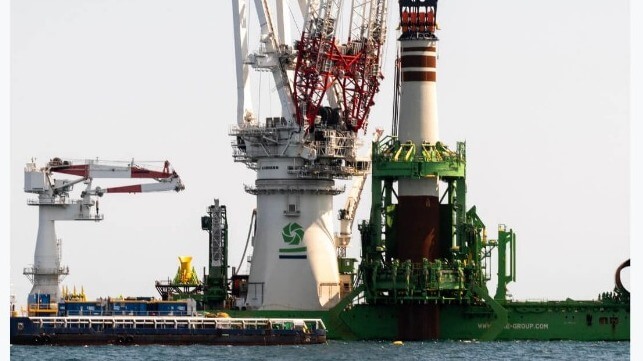
The company has been successful in managing the project to keep it on track and avoid some of the challenges that other projects are experiencing. It retrained DEME for the first phase of the installation using DEME’s large install vessel Orion.
Dominion’s long-term plan calls for expanding its offshore wind energy presence. In 2024, Dominion acquired an adjoining property from Avangrid which is said could provide an additional 800 MW of power. In August 2024, Dominion also won a lease from the Bureau of Ocean Energy Management for a site 35 nautical miles from the mouth of the Chesapeake Bay. The company has said the lease area could support between 2.1 gigawatts and 4.0 gigawatts of offshore wind energy generation according to BOEM’s preliminary estimates. These additional projects require planning and eventually permitting which would likely be delayed under the Trump administration’s energy policy.
New Jersey’s Fourth Offshore Wind Solicitation Ends Without Award
Opponents want to protect the New Jersey shore line from the installation of offshore wind turbines (file photo)
Regulators for New Jersey’s offshore wind energy sector announced today that they will not be proceeding with an award for the fourth round wind solicitation due to “uncertainty driven by federal actions and permitting.” It makes the latest setback for the state which has seen multiple projects delayed and withdrawn despite a strong commitment by the state’s governor to renewable energy.
The New Jersey Board of Public Utilities reported it will not be proceeding with an award but that it is committed to working with Governor Phil Murphy to “build a successful offshore wind industry in New Jersey.” It reported that two of the three bidders in this round withdrew and that only the Atlantic Shores project proceeded to submit a best and final offer.
Last week, Shell reported it would be pausing its involvement in the Atlantic Shores project saying it did not meet the company’s financial criteria. Previously in 2024 Shell also sold its portion of a New England wind farm project as it says it is reevaluating its participation in the sector.
Shell is a 50-50 joint venture partner with EDF Renewables in Atlantic Shores. The project calls for a two-stage project that would provide 2.8 MW of energy to New Jersey with up to nearly 200 turbines. It would be about 9 miles off the New Jersey shore near Atlantic City and Sea Girt. The project gained approval from the Bureau of Ocean Energy Management (BOEM) in October 2024 for its construction and operations plan,
“A number of reasons led to this decision, notably Shell backing out as an equity partner in the Atlantic Shores project and backing away from the American clean energy market, as well as uncertainty driven by federal actions and permitting. The Board concluded that an award in New Jersey's fourth offshore wind solicitation, despite the manifold benefits the industry offers to the state, would not be a responsible decision at this time,” said Christine Guhl-Sadovy, President, New Jersey Board of Public Utilities.
The state’s fourth solicitation called for 1.2 to 4 gigawatts of offshore wind generation capacity. The application window closed on July 10, 2024. Reports indicate the Corio-Total-Rise joint venture Attentive Energy and RWE-National Grid venture Community Offshore Wind also submitted initially but later withdrew from the process.
Governor Murphy had also announced in May 2024 that the state would be accelerating its schedule for future offshore wind solicitations. The fifth round he reported would be brought forward to the second quarter of 2025. It was previously scheduled for the third quarter of 2026.
New Jersey has struggled to get its offshore wind industry going. Ørsted had the two most advanced projects, Ocean Wind, but canceled them in 2023. The state awarded additional projects in January 2024 with 1,342 MW to Attentive Wind Two and 2,400 MW to Leading Light Wind. Problems with securing a turbine supplier however prompted Leading Light Wind to twice delay its application with the NJBPU. In December 2024, it asked for a delay till May 2025.
The New Jersey projects have faced strong local opposition. Donald Trump supported the efforts using New Jersey to highlight his opposition to offshore wind energy. Last week he posted on social media that he hoped the Atlantic Shores project would be “dead and gone.” The new Trump administration has imposed a moratorium on new leases in federal waters and is expected to delay the review of pending permit applications.
Atlantic Shores issued a brief statement last week on January 30 saying it was still committed to New Jersey and delivering the state’s first offshore wind project.
Based on these developments, the New Jersey Economic Development Authority reported today it is accelerating strategic review of options and alternatives for the New Jersey Wind Port. The state was planning the development of a large port facility to support the construction operations for offshore wind. The port facility was to be located in Salem, New Jersey.
NTSB: Wake From Passing Ships Pushed Barge Tow Into Algiers Lock Gate
The National Transportation Safety Board has released its final report on the allision of the towing vessel Kitty (and its tow) with the Algiers Lock in New Orleans. A deluge of water coming into the lock from the wake of passing vessels likely caused the tow to surge forward and strike the lock gate, NTSB concluded.
On the evening of July 4, 2023, the 68-foot towboat Kitty was pushing two tank barges into the Algiers Lock during low water conditions, from the Mississippi River side. The river stage at that point in the summer was 1.7 feet at Algiers Lock, an "extremely low" water level. A severe-wake warning was in effect because of the amplified risk of wave action in the shallows on either side of the shipping channel, but there were no specific speed restrictions in place. River pilots maintained standard transit speeds (full ahead) through the area.
At 1752-1802, just before the Kitty entered the lock, three deep draft ships passed by on the river at ordinary transit speeds of 10-14 knots. At 1804, the tow suddenly accelerated ahead in the lock chamber. Despite the master putting all engines full astern, Kitty and her barge tow were pushed forward. The momentum parted two mooring lines, and the lead barge struck one of the lock gates. No injuries or pollution occurred, but the lock gate sustained about $2 million in damage.
After the casualty, the crew of the Kitty reported that the water level had risen by three feet or more while transiting the lock. NTSB examined video footage from the accident and concluded that the wakes of the passing vessels caused the surge of water into the lock, and raised the water level by at least 3.4 feet.
Lock operators told NTSB that they had never seen anything like this before, though smaller surges of up to a foot had occurred previously. It was the lowest water level that they could recall as well; NTSB suggested that the extremely low water in the lock forebay could have amplified the effect of the wake, creating the unusual surge that pushed the towboat forward.
ReCAAP Sounds Alarm About Tripling of Robberies in Singapore Strait in 2025
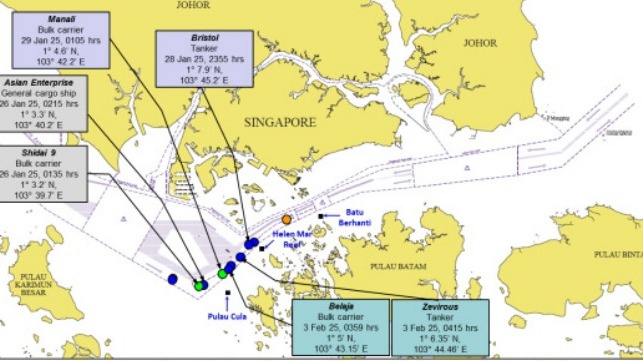
Incidents have tripled so far in 2025 versus 2024 (ReCAAP)
The monitoring and coordination operation for piracy and criminal activity against shipping in Asia, ReCAAP ISC, issued a new alert on February 3 highlighting that the number of robberies has nearly tripled in the Singapore Strait this year. They report that just over a month into 2025, there have now been 11 incidents all in a specific area near the western terminus and often grouped in a short interval of time.
“ReCaap ISC alerts the maritime community on the continued occurrence of incidents of sea robbery onboard ships while underway in the Singapore Strait, and warns of a possibility of further incidents,” is emboldened at the top of the new alert.
This comes after reports that two more vessels were boarded overnight on February 3. Ambrey Analytics says a tanker and bulker were each boarded approximately 15 minutes apart from each other. Four individuals were seen on a bulker with what appeared to be knives and guns. Shortly thereafter, there was a second report of six individuals on a product tanker armed with knives.
ReCaap notes that the incidents have occurred within short intervals, with two reports each in the early morning hours on January 26 and February 3 and two other reports overnight between January 28 to 29. All of them took place in the eastbound lane and were near the western end of the Singapore Strait near Indonesia.
Of note is that the perpetrators now appear to be armed with knives or possibly guns whereas in the past they were often unarmed. ReCAAP highlights of the 11 reports this year, four times there were indications of guns or gun-like objects, five reports of perpetrators with knives, and two reports did not specify if there were weapons involved.
In one case a chief engineer’s hands were tied by the perpetrators but no one was injured. In the past, the boarders most often fled when they were spotted and rarely came in direct contact with a vessel’s crew.
Most of the crimes continue to be robberies. Engine spare parts were reported stolen in seven of the current incidents.
ReCAAP notes that in 2024 there were only four incidents reported between January 1 and February 3. Based on the persistence and common nature of the incidents they warn that there may be further incidents in the future.
They are urging littoral states to increase patrols and surveillance in the respective waters and to respond promptly to reports coming from the ships. They also recommend coordination and information sharing to aid in the arrest of the criminal groups conducting these robberies. For ships, they note there is particular concern during the hours of darkness. They recommend adopting preventive measures and intensifying vigilance and look-outs while transiting the areas of concern.
Security consultants and ReCAAP warned in 2024 that robberies were increasing in the Singapore Strait. The current wave however is of particular concern due to the number of incidents and the more aggressive nature of the perpetrators.
South Asian Scrapyards Maintained Market Lead in 2024, Despite Injuries & FATALITIES
Shipbreaking plots along the waterfront at Alang (NASA file image)
South Asia's shipbreaking sector may have seen a lull in activity last year, but it maintained its leading position in the global vessel recycling industry - and its reputation for risk. According to NGO Shipbreaking Platform, 45 workers were injured breaking ships in Pakistan, Bangladesh and India last year, and nine were killed.
By the NGO's count, 80 percent of all scrapped tonnage was demolished in South Asia last year, and Bangladesh led the way with 2.4 million gross tons of capacity (130 ships). India was a distant second at 1.5 million, and Pakistan brought up the rear with 0.6 million - barely more than Turkey, the primary option outside of South Asia.
Accidents and fatalities are common enough in yards that use the beaching method, standard in South Asia (with variations and improvements at some facilities). NGO Shipbreaking Platform identified nine men who were killed during operations at these yards in 2024, including six who died in one explosion at an SN Corporation facility.
On September 7, an explosion occurred aboard the former SCI vessel Suvarna Swarajya at SN Corporation Plot 2 in Chittagong. Six workers were killed, four were left in critical condition and two others were injured.
The NGO noted that a few months before the blast, SN Corporation Unit 2 had received its certificate of Hong Kong Convention compliance from a major class society, an industry-favored certification of yard safety and quality. After the blast, Bangladeshi authorities revoked SN Corporation's environmental permit, but the company has retained its IMO HKC certification.
By the NGO's tally, the blast brought SN Corporation's total fatality count to 20 deaths since 2010, just over one a year on a long-term average.
"That a facility such as SN Corporation – and the more than 100 beaching yards that have similarly obtained [HKC] Statements of Compliance – supposedly fulfils the requirements of the Hong Kong Convention says much about the low standards set by the IMO," said Ingvild Jenssen, the executive director and founder of NGO Shipbreaking Platform. "Now, even yards that are not licensed to operate nationally maintain their Statement of Compliance. Clearly, the upcoming entry into force of the Hong Kong Convention does not provide the solutions needed to shift the sector towards sustainable ship recycling."
Scrapping activity is pointing up in 2025, according to leading cash buyer GMS. Container carriers are expected to be oversupplied with tonnage when the Red Sea crisis fully subsides, and owners will likely send older boxships to buyers at Alang, Gadani and Chittagong in larger numbers than in 2024, an unusually quiet year for demolition sales.
Crews Operating Tugs for UK’s Royal Navy Taking Strike Vote
Tugs assisting the UK's pride of fleet carrier Prince of Wales (Royal Navy photo)
Around 300 crewmembers who staff tugboats operated to support the UK’s Royal Navy and provide marine services are taking a strike vote. The move comes as their union, Unite, is complaining they have been locked out of ongoing negotiations between the Ministry of Defense and service provider Serco Marine regarding the renewal of a 10-year contract valued at £1.2 billion ($1.5 million).
Unite reports it represents approximately half the tugboat captains, crewmembers, and workers employed by Serco to provide services to the Royal Navy. In addition to navigational support for everything from the pride of the fleet aircraft carriers and nuclear subs to all other naval vessels, Serco Marine is responsible for delivering fuel, water, and munitions at all Royal Navy ports, tank cleaning, and passenger transportation. Serco took over these critical roles in 2008 as part of the government’s move to privatize the Royal Maritime Auxiliary Service. Union members transferred to Serco.
According to the leadership of Unite, the Ministry of Defense and Serco are involved in negotiations for the renewal of the contract. They assert the government is looking to reduce the contract by £250 million ($310 million) which Unite says is putting nearly 100 jobs at risk.
Unite contends among the steps being discussed is a proposal to reduce the number of tugs used to move nuclear submarines. They said the proposal would see the number reduced to four tugboats from the current six to save costs. Unite’s workplace reps have informed Serco Marine that it would be in “contravention of unclear safety regulation.”
Serco confirmed to the BBC that negotiations regarding the in-port contract are ongoing. It said it was committed to keeping union members updated on any proposed changes. Serco is a government services provider with its operations in the UK focusing on defense, space, healthcare, justice and migration, transport, and citizen services.
“Both Serco and the MoD need to listen to these workers. They are not deskbound managers or bureaucrats: They are seafarers with decades of experience. Knowing how to tow an aircraft carrier or nuclear submarine according to wind, tide, and topography is just one facet of their expertise,” said Unite General Secretary Sharon Graham. “Without their input, the proposed contract risks losing vital jobs and the invaluable working knowledge that comes with them, seriously endangering the fleet’s ability to function safely.”
The voting for the possible strike action began today, February 3. It is running for two weeks. Under UK labor law, the union would have to file a notice of its intent to strike after gaining authorization. Job actions would involve Royal Navy operations at Portsmouth, Devonport, Faslane, Great Harbour Greenock, and Kyle of Lochalsh.
A spokesperson for the Ministry of Defense told the BBC it is a matter between the contractor and its workforce. They said it would not affect Royal Navy operations if the proposed strike proceeds.
It marks the second contentious situation the unions have been locked in with the Ministry of Defense related to services for the Royal Navy. In 2024, Nautilus and RMT (National Union of Rail, Maritime and Transport Workers) each staged a series of work slowdowns and strikes during prolonged contract negotiations for the Royal Fleet Auxiliary officers and crew. They finally agreed to the terms of the 2024 labor contract for wages and benefits at the beginning of 2025.
Juicing may harm your health in just three days, new study finds
Fiber-freejuice diets may increase inflammation-linked bacteria in the gut and mouth
Most people think of juicing as a healthy cleanse, but this study offers a reality check”
CHICAGO --- Think your juice cleanse is making you healthier? A new Northwestern University study suggests it might be doing the opposite. The study, recently published in Nutrients, found that a vegetable and fruit juice-only diet — even for just three days — can trigger shifts in gut and oral bacteria linked to inflammation and cognitive decline.
How was the study conducted?
Northwestern scientists studied three groups of healthy adults. One group consumed only juice, another had juice with whole foods and a third ate only whole plant-based foods. Scientists collected saliva, cheek swabs and stool samples before, during and after the diets to analyze bacterial changes using gene-sequencing techniques.
What the scientists found
The juice-only group showed the most significant increase in bacteria associated with inflammation and gut permeability, while the plant-based whole food group saw more favorable microbial changes. The juice plus food group had some bacterial shifts but less severe than the juice-only group. These findings suggest that juicing without fiber may disrupt the microbiome, potentially leading to long-term health consequences.
“Most people think of juicing as a healthy cleanse, but this study offers a reality check,” said senior author Dr. Melinda Ring, director of the Osher Center for Integrative Health at Northwestern University Feinberg School of Medicine and a Northwestern Medicine physician.
“Consuming large amounts of juice with little fiber may lead to microbiome imbalances that could have negative consequences, such as inflammation and reduced gut health,” Ring said.
Why fiber matters
Juicing strips away much of the fiber in whole fruits and vegetables, which feeds beneficial bacteria that produce anti-inflammatory compounds such as butyrate. Without fiber, sugar-loving bacteria can multiply. The high sugar content in juice further fuels these harmful bacteria, disrupting the gut and oral microbiome. The study also suggests that reduced fiber intake may impact metabolism, immunity and even mental health.
The oral microbiome responds quickly
Unlike the gut microbiota, which remained relatively stable, the oral microbiome showed dramatic changes during the juice-only diet. Scientists found a reduction in beneficial Firmicutes bacteria and an increase in Proteobacteria, a bacterial group associated with inflammation.
“This highlights how quickly dietary choices can influence health-related bacterial populations,” said Ring. “The oral microbiome appears to be a rapid barometer of dietary impact.”
Next steps
The findings underscore the need for more research on how juice and other diets impact the microbiome, especially in children, who often consume juice as a fruit substitute.
“The nutritional composition of juice diets — specifically their sugar and carbohydrate levels — plays a key role in shaping microbial dynamics in both the gut and oral cavity and should be carefully considered,” said first author Maria Luisa Savo Sardaro, a research associate in the Amato Lab at the department of anthropology at Northwestern University and a professor of food microbiology at San Raffaele University in Rome.
This study also highlights the importance of prioritizing fiber in dietary guidelines and food production. For now, Ring says, “If you love juicing, consider blending instead to keep the fiber intact, or pair juices with whole foods to balance the impact on your microbiome.”
URBANA, Ill. – Many U.S. forests are privately owned, particularly in the Eastern and North Central part of the country. This makes control of invasive plants and pests challenging because efforts must be coordinated across landowners. A new study from the University of Illinois Urbana-Champaign explores how differences in ownership motivation affects willingness to control, and how economic incentives can be implemented most efficiently.
“Some own the land for recreational purposes, some own it because they want to produce timber, and some are a combination of both. If one landowner controls invasive species but their neighbor does not for some reason, that could be problematic because the bioinvasion will spread over space and time,” said study author Shadi Atallah, associate professor in the Department of Agricultural and Consumer Economics, part of the College of Agricultural, Consumer and Environmental Sciences at Illinois.
Currently, conservation cost-share programs reimburse forest landowners for up to 75% of the cost of controlling invasive species. However, this is not necessarily the most efficient use of funds, Atallah noted.
“When you're incentivizing someone to do something, you would like to know they weren't going to do it without the incentive, or you have wasted your money. Would it make sense to change who qualifies for these payments in a way that optimizes the effect?”
Atallah employed game theory to explore these questions, using the example of glossy buckthorn in U.S. Eastern white pine forests. Glossy buckthorn is a fast-growing shrub that is exotic and invasive in North America. It can form a dense, persistent layer in forest understories, interfering with the growth of young pine trees and affecting wildlife habitat.
In a previous study, Atallah surveyed Maine and New Hampshire family forest landowners to understand how their willingness to control glossy buckthorn was motivated by the shrub’s effects on timber, trail recreation, and wildlife viewing. For the current study, he developed a theoretical modeling framework that estimated how each type of landowner would act and how their neighbor would respond, given various circumstances over a period of time.
“The model focuses on two cases: one is the recreationist, who likes to hike and enjoy the land, but they don't like that the invasive shrub will block their path and interfere with wildlife viewing. The other is the timber producer, who gets a reduced amount of timber if the invasive shrub prevents white pine from growing to maturity,” he explained.
Atallah also considered the connectivity between forests and how the bioinvasion spreads to surrounding areas.
“Some invasive species are mostly spread by short distance dispersal, such as squirrels or other small mammals, while other species are spread through long-distance dispersal, such as birds and waterfowl, and the spread can be either fast or slow. Another factor is where the bioinvasion first appears and whether it makes sense to prioritize control at the starting point,” he said.
He found that in most scenarios, the recreationist would not control the invasive shrub without cost-share payment, while the timber owner would choose to control regardless of subsidies.
“Only in the case of fast long-distance dispersal does control get so expensive that nobody can do it without support. This is consistent with what we are currently doing; everybody qualifies for it. However, in all other cases – slow long-distance dispersal, and slow or fast short-distance dispersal – it would make sense to pay only the recreationists, who act as sources of bioinvasion spread when they refrain from control.”
Atallah noted that this may not seem fair; however, the timber landowners would still benefit even if only the recreationists are subsidized, because the spread is contained earlier and to a larger extent.
“We find the cost of control for the timber producers becomes lower once you have cleaned up the neighboring forestlands. Instead of partially reimbursing both types of landowners, the money could be used to cover 75% of control for the recreationist, and as a result, the timber owner would have less invasive species to deal with and control would be less expensive.”
The study provides one example of different landowner motivations, but this doesn’t mean the same dynamic always plays out, Atallah stated.
“My conclusion is that we should provide the subsidy to the weakest link, which is the entity that wouldn’t act otherwise and ends up acting as the source of the externality. In this case it’s the recreationist, but you could imagine a situation where it was the other way around. The model is adaptable to any given scenario,” he said.
“The idea is to consider any two different motivations to own the resource and how that could lead to different decisions in terms of controlling bioinvasion spread, and thinking about prioritizing those who would not control without subsidies.”
The paper, “Spatial Bioinvasion Externalities with Heterogeneous Landowner Preferences. A two-agent bioeconomic model,” is published in Land Economics [DOI: 10.3368/le.101.2.112024-0209].
Spatial Bioinvasion Externalities with Heterogeneous Landowner Preferences. A two-agent bioeconomic model
DEI
Women health sector leaders good for a nation’s wealth, health, innovation, ethics
But major underused resource despite their unique and positive impact, say researchers More and sustained investment needed to maximize their potential and reap benefits
Women health sector leaders are good for a nation’s wealth, health, innovation, and ethics, among other things, finds a review of the available evidence, published in the open access journal BMJ Global Health.
Yet despite their unique and positive impact, they are a major underused resource, particularly in low and middle income countries, say the researchers, who call for more and sustained investment to maximise women’s potential and reap the benefits of their contribution.
Despite making up 70% of the healthcare workforce, as a whole, and 90% of the nursing and midwifery workforce, they hold just 25% of leadership roles, point out the researchers.
While good evidence is beginning to emerge that women leaders make a positive difference to maternal and healthcare policies, and to the reduction of health inequalities, it’s not yet clear what their impact might be on global health, they add.
To find out, the researchers carried out a scoping review of peer reviewed research to map evidence on the impact of women’s leadership in organisations in low and middle income countries, focusing in particular on global health.
In all,137 relevant articles met the eligibility criteria and were included in the review. A study was tagged positive if it reported an improvement, increase, or benefit of the assessed outcome as a result of women’s leadership. It was tagged negative if it reported a decrease, weakening, or worsening of the assessed outcome. Null results didn’t report any change.
Most of the included studies reported a positive impact of women’s leadership: 119 (97%) were positive and statistically significant; 12 (9%) were positive and statistically insignificant.
Some 35 (26%) studies reported negative and statistically significant results for particular outcomes while 13 (9%) reported negative and statistically insignificant results. And 33 (24%) reported null results. Around reported some combination of positive, negative, or null results.
The review identified women leaders’ positive influence on six areas of impact. These were: financial performance, risk, and stability; innovation; engagement with ethical and sustainability initiatives; health outcomes; organisational culture and climate, including reputation, employee retention, and team cohesion and communication; and influence on other women’s careers and aspirations.
Even those studies reporting mixed findings still largely pointed to positive results, particularly when modified by other factors, such as better education, greater levels of experience, and opportunities to work with other women across an organisation.
“What is less clear is why women leaders have this impact, particularly in the face of overt and covert biases, discrimination, harassment, patriarchal norms, etc,” note the researchers.
The answer, they suggest, may lie in women’s more effective transformational leadership behaviours and their tendency to use more democratic and participative styles.
“In all sectors, across leadership roles, and across geographies, women’s leadership can produce positive results. Women leaders’ success, however, cannot be separated from the contexts in which they work, and unsupportive environments can affect the extent to which women leaders can have an impact,” write the researchers.
And they conclude: “Increased and sustained investment in women’s leadership within the health sector can lead to improved outcomes for organisations and their clients.
“Such investments must not only target individual women, but also seek to foster organisational cultures that promote and retain women leaders and support their independent decision making.”
A linked editorial by Dr Jocalyn Clark, The BMJ’s international editor, argues that men’s monopoly on global health leadership is at odds with the scientific evidence. And in the current context of the backlash against rights and equity, diversity, and inclusion efforts, it’s even more important to advocate for gender equality, she says.
“Change is the responsibility of everyone—not just women. But clearly more women appointed to leadership positions could drive transformative change in these biased systems,” she argues.



 Damage to the lock after the allision (NTSB)