It’s possible that I shall make an ass of myself. But in that case one can always get out of it with a little dialectic. I have, of course, so worded my proposition as to be right either way (K.Marx, Letter to F.Engels on the Indian Mutiny)
Tuesday, February 04, 2025
Trump Plans to Restore "Maximum Pressure" Sanctions on Iranian Oil
On Tuesday, the Trump administration announced plans to strengthen restrictions on Iranian oil exports, which have been sanctioned by the United States since President Trump's first term (with varying degrees of enforcement since). An official told Reuters that Trump will soon sign a memorandum instructing the Department of the Treasury to maximize pressure on Iran's energy exports.
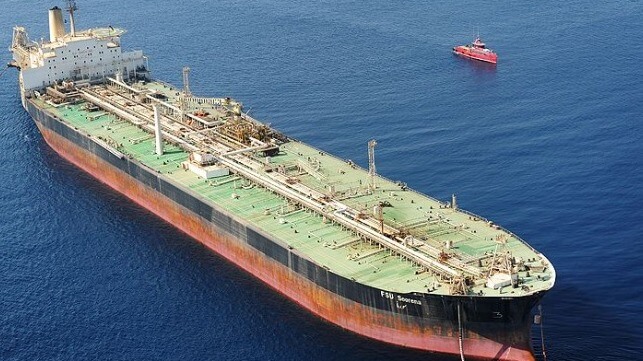
An estimated 150 tankers are engaged in the "dark fleet" trade of Iranian oil, which is almost exclusively sold to Chinese customers. Much of the cargo is transshipped between tankers at anchorages in Southeast Asia, putting a veneer on its origins before final-mile delivery. The trade is tracked in detail by commodity market intelligence firms and vetting agencies like TankerTrackers.com, along with the advocacy group United for a Nuclear Iran (UANI), and has been well documented in the media.
Despite occasional high-profile accidents, Iran has had little difficulty in evading U.S. sanctions and arranging tonnage for its export sales. In November it sold an estimated 1.8 million barrels per day - two percent of all global production, shipped almost exclusively to Chinese buyers. Its output is higher now than at any point since the imposition of "snap back" sanctions in 2018, and brought in more than $50 billion in sales last year.
Oil and gas account for an estimated 25 percent of Iran's government revenue, and the funding is essential to Iranian military ambitions. Iran is the primary backer of Yemen's Houthi rebel group, which repeatedly attacked foreign shipping in the Red Sea last year, and Tehran also provides critical support to Lebanese Islamist militia Hezbollah.
Trump's National Security Advisor Mike Walz has advocated encouraging Beijing to shut down Iranian oil imports, clamping down on the trade on the demand side. On the supply side, a U.S. official told Reuters on Tuesday that the Trump White House wants to reinstitute "maximum pressure" on Iran's oil trade to drive its energy exports down to zero.
The White House is focused on impeding Iran's nuclear program. After Israel's retaliatory airstrikes destroyed Iranian air defense and missile production sites last October, the Iranian government quickly ramped up its uranium enrichment program to make more 60-percent-purity uranium-235. This grade has few civilian uses, and is considered a jumping-off point for manufacturing weapons grade uranium-235. Iran denies any interest in procuring nuclear weapons, though it has invested heavily in nuclear-capable ballistic missiles.
Crude oil prices immediately jumped in response to news that the globally-traded oil supply could drop. WTI rallied by $2 to reverse an earlier slide, and Brent gained 0.6 percent. U.S. export-grade Louisiana Light - which could serve Chinese refiners as a substitute for sanctioned Iranian Light - rose by 1.4 percent.
RBOB wholesale gasoline futures (an index of investor expectations for future gas prices) rose about two percent following the news of tightened sanctions enforcement.
Oil prices took a sharp turn today as traders weighed President Trump’s latest “maximum pressure” push against Iran. Brent crude rose to $76.34 per barrel (+0.50%), while WTI’s loss from early in the day shrunk to just a 0.31% dropoff at $72.93 per barrel.
While a quick glance at today’s oil prices could suggest traders aren’t convinced just yet that the Iran situation could have a profound effect, oil prices are indeed on the rise from their earlier downward trend—a rather quick turn, in fact.
Trump’s plan? Squeeze Iran’s oil exports down to zero—a bold move considering Iran still ships as much as 1.3 million barrels per day, mostly to China. The White House’s playbook includes fresh sanctions, tighter enforcement, and rolling back existing waivers. Translation: If the administration makes good on these threats, global supply could tighten overnight.
The last time Trump went all-in on Iranian sanctions, oil prices spiked north of $80. The market remembers. This time, with Middle East tensions already simmering and OPEC+ struggling to maintain discipline, the upside risk is real.
Of course, oil traders are a cynical bunch. They’ve seen this movie before. Crude flows tend to find a way—whether through shady ship-to-ship transfers or creative bookkeeping in Beijing. But if Washington actually gets aggressive with enforcement (hello, secondary sanctions), even China’s appetite for cheap Iranian crude might take a hit. That’s when Brent could break out.
For now, the market is playing it cool. But don’t be surprised if crude traders wake up tomorrow and suddenly decide that cutting off a key OPEC producer is, in fact, a big deal.
Crude prices were trading down prior to the announcement after China responded to US tariffs on China. WTI was down nearly 3% earlier in the day, with Brent down almost 2%.
By Julianne Geiger for Oilprice.com
Changes in Oil Trading Raise Doubts About SPOT Terminal
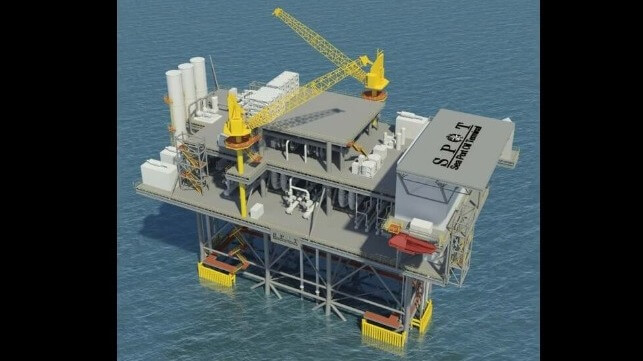
The proposed SPOT platform (illustration courtesy Enterprise Products Partners)
A lack of customer interest and a delay in permitting have created doubt about the future of Enterprise Products Partners' Sea Port Oil Terminal (SPOT), a deepwater tanker loading facility off the Texas coast.
If built, Enterprise's SPOT would be the largest offshore terminal in the United States, bigger even than the Louisiana Offshore Oil Port (LOOP). It would add two million barrels per day to U.S. export capacity, an increase of about 50 percent.
Last year, Enterprise had positive news to report about SPOT. After years of effort it received an operating license from the Maritime Administration, the only one of its kind in years. However, in an earnings call Tuesday, CEO Jim Teague said that it had encountered commercial and regulatory headwinds.
"I believe that SPOT should be the poster child for the need for permit reform. It took five years to get the SPOT license, including four years to get the record of decision," Teague said. "The process we went through due to federal bureaucracy pushed us beyond the drop-dead date. It allowed our anchor customer to opt out of their contract, which they did."
He added that the permit application totaled 30,000 pages, and that Enterprise had to answer 80,000 questions during two public comment periods, primarily from NGOs.
SPOT was designed in 2019, when all forecasts suggested that the U.S. would soon be exporting millions of barrels a day to customers in Asia. That long-haul trade favors VLCCs for economies of scale, and SPOT was specifically intended to allow full VLCC loading in one step - a capability not found elsewhere on the U.S. Gulf Coast (except at LOOP). However, because of the Russian invasion of Ukraine, a larger share of U.S. oil is going to Europe to make up for sanctioned Russian volumes. That shorter transatlantic trip can be done with a smaller Suezmax or Aframax, he said, reducing the demand for VLCC loadings.
"We have not gotten enough traction in commercializing SPOT," Teague said. "If we cannot achieve [commercial terms] within a reasonable amount of time, we will move on. This is not a 'build it and they will come' project."
Noble Sells Off Two Relatively Young Drillships for Possible Scrapping
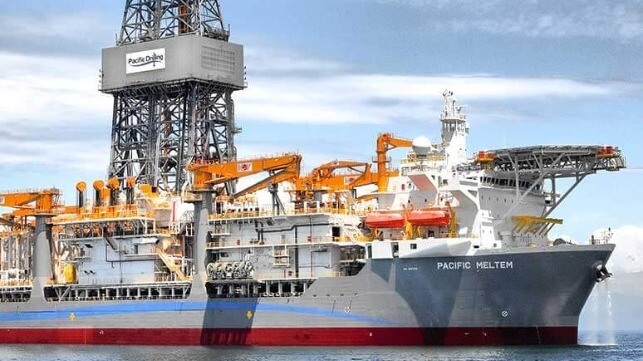
Noble Drilling has decided to decommission two relatively young, cold-stacked drillships, remnants of the idle fleet that accumulated in the Canary Islands during the offshore downturn of the mid-2010s.
The vessels named for possible demolition sale are Pacific Meltem (built 2014) and Pacific Scirocco (built 2011), both constructed by Samsung for the former Pacific Drilling fleet. They are rated to 12,000 feet of water depth, and both are anchored at Las Palmas.
Noble acquired Pacific Drilling in 2021, followed by Diamond Drilling in 2024. The wave of consolidation left Noble with 28 floaters, including 14 7th-generation drillships. While Meltem and Scirocco are comparatively young in ship years (11 and 14 respectively), they have been in storage for a long time; Noble has decided to divest of both in order to eliminate the cost of upkeep.
The sale will ensure the retirement of both ships from the drilling market, including the possibility of scrapping.
"Our decision to retire these non-contributing assets is based on a continuous cost-benefit evaluation of idle capacity. These retirements will be immediately cash flow accretive and result in a leaner, fitter fleet composition for Noble going forward," said Robert W. Eifler, President and CEO of Noble.
Tanker Targeted by Houthis Returns to Suez as Canal Seeks More Traffic
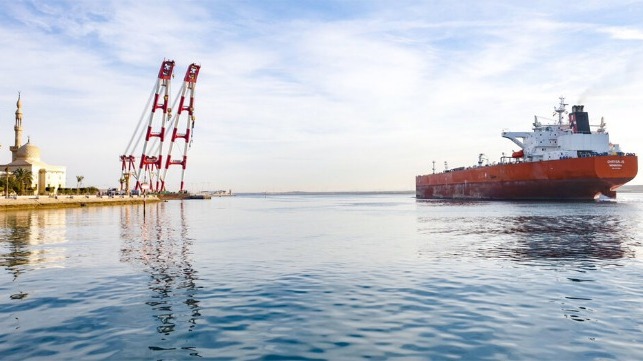
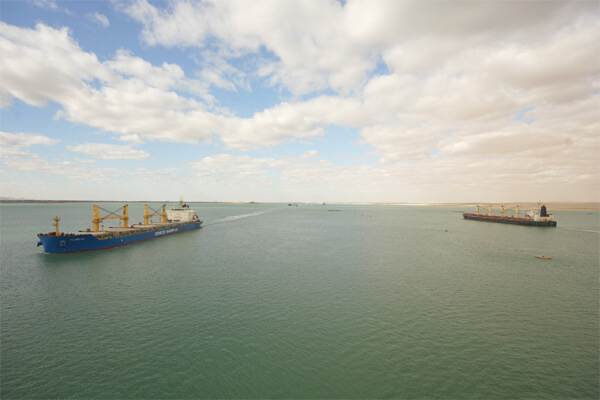
Chrysalis returned to the Suez Canal eight months after being attacked by the Houthis (SCA)
The Suez Canal Authority is increasing its efforts to rebuild traffic through the canal highlighting the return to stability in the region. Yesterday, February 3, a tanker targeted by the Houthis eight months ago made its first transit reports the authority as part of its marketing campaign.
The Houthis announced they would honor the Gaza cease-fire reached last month and suspended their attacks on commercial shipping in the Red Sea. While many of the major shipping lines have taken a wait-and-see attitude stressing their focus on security the Suez Canal Authority is anxious to restore traffic.
The Suez Canal is a major source of revenue for Egypt. Reuters is citing a comment from Egyptian President Abdel Fattah al-Sisi saying the diversions of ships from the canal cost Egypt around $7 billion in revenues in 2024.
The tanker Chrysalis (115,867 dwt) made the transit only with ballast on February 3 traveling from Seka, India to the Sidi Kerir oil terminal in Alexandria, Egypt. It was an important moment for the Suez Canal Authority as in July 2024 the Houthis had claimed to heavily damaged the vessel due to its association with Israel. The tanker built in 2010 in South Korea is registered in Liberia and reported to be owned by Turkish interests.
The Houthis claimed to have launched missiles targeting the tanker on July 12, 2024, while it was entering the Red Sea. Later as it transited the Bab el-Mandeb, they reportedly launched drones for a second attack on the tanker.
Additional lanes for two-way traffic recently opened in the southern reaches of the Suez Canal (SCA)
The Suez Canal Authority used the transit to emphasize its messages of the higher cost and increased fuel use to divert around the Cape of Good Hope. They also pointed to the lack of necessary navigation support services for vessels on the route around Africa.
The messages were also part of the authority’s presentation during a conference in Oman and last week when the Chairman and Managing Director of the Suez Canal Authority Admiral Ossama Rabiee met with representatives of the major shipping companies and agencies in Egypt. The authority highlighted that 23 companies participated in the meeting to discuss “the impact of the return of relative stability in the Red Sea and Bab el-Mandab.”
The authority emphasized that it has continued to pursue enhancements while vessels were diverting. This includes the recent opening of the additional two-lane traffic in the southern sections of the canal as well as deepening sections of the waterway from 66 to 72 feet. The additional sections of the canal they report will permit six to eight additional vessels to make the transit each day while the improvements to the waterway are increasing navigation safety and reducing the impact of water and air currents.
Rabiee told the shipping company representatives that the authority was “keen on keeping its flexibility by maintaining its pre-crisis transit pricing policies.” He said it would be extending its rebate programs to support shipping’s return to the Suez Canal. They also highlighted the addition of new services to support shipping. This includes salvage services, water ambulances, pollution control, and expanding the maintenance and bunkering services.
Japanese Captain Faces Prosecution for Ferry Grounding
The captain of a K Line-operated ferry has been referred for prosecution in connection with a grounding on the island of Hokkaido last year.
In the early hours of July 2, 2024, the ferry Silver Breeze was arriving at Tomakomai, Hokkaido when it struck a breakwater. No injuries were reported among the 140 passengers and crewmembers, but the vessel sustained significant damage at the bow.
The Japan Coast Guard investigated the accident and determined that it was caused by human error - an "insufficient confirmation of the ship's position and course." The captain was aware of the breakwater, but allegedly did not confirm the ship's position on the radar or the electronic chart.
During questioning, the master admitted to causing the accident "due to my own steering error," according to NHK. The Japan Coast Guard has referred the case to a prosecutor, and the master stands accused of professional negligence resulting in danger to traffic.
Silver Breeze is a 2022-built ro/pax ferry, the last in a series of five. She was built by Naikai Zosen for shipowner Tsugaru Kaikyo Ferry, and is operated under charter by K Line's Silver Ferry division. In regular rotation, she connects Honshu's northeasternmost province with the island of Hokkaido.
Gibraltar Calls for Use of Pilots Saying OS 35 Master Misjudged Departure
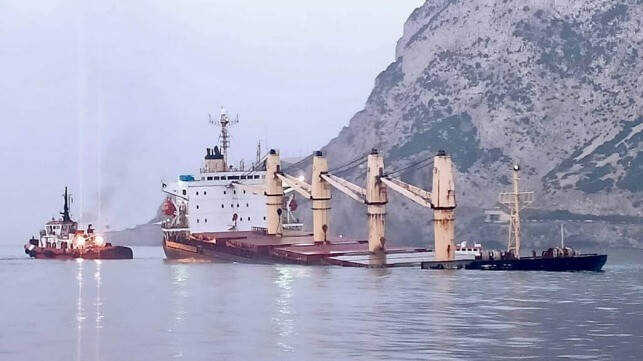
Bulker OS 35 was a total loss due to a misjudgment and a lack of pilot to oversee the departure (GPA)
Two and a half years after the accident which caused the loss of the bulker OS 35, Gibraltar’s maritime authority issued its report finding poor planning and that the captain misjudged the maneuver resulting in the casualty. The report calls for considering the compulsory use of pilots for vessels in the anchorage concluding a pilot very likely would have prevented the incident.
The bulker OS 35 was in the Western Anchorage at Gibraltar on August 29, 2022, taking on bunkers as is the common practice at the port. About two hours after the OS 35 arrived, the gas carrier Adam LNG also arrived in the Western Anchorage for a layover. She was traveling in ballast without a cargo aboard. The OS 35 completed her bunkering around 20:30 and made ready to get back underway bound for the Netherlands with a load of steel rebar.
Based on the analysis, the investigators concluded that environmental conditions were not a major factor. The OS 35 recorded the winds as light and that there was good visibility and clear skies in her log. Based on videos and other data the report concludes the current was at 0.2 knots from the west and wind speeds 12 knots from the east-north east.
Gibraltar’s regulations only require pilots for berthing and unberthing and not for departing the anchorage. The report notes incidents are rare but concludes planning for the departure was weak and not well monitored by the crew and harbor controllers. The controllers did inquire about how the OS35 planned to pass the anchored gas carrier and got a vague answer of going around. The report notes the departure was not plotted, the passage plan was not amended for the actual anchor position, and not discussed on the bridge.
After OS 35 raised her anchor, the master had ordered dead slow astern increasing the speed to 2.6 knots, but became concerned they were closing on Adam LNG due to the effects of the maneuver, tidal flow, and wind. The main engine was stopped. The master then ordered dead slow and then slow ahead and the rudder was placed hard to port. The master later telephoned the chief engineer asking for increased ahead power to maximum but the report notes it was limited by the rudder being hard over.
With OS 35 closing on Adam LNG, the speed was up to 1.3 knots when it clipped the bulbous bow of the LNG carrier holing two cargo holds. That set off the series of events with the port ordering the bulker to ground and becoming a total loss. There were additional communications problems during these subsequent maneuvers.
“The master of OS 35 made an error of judgment, which was not detected by the bridge team,” concludes the report. “Had a pilot been embarked, it is considered very likely that an alternative maneuver would have been used to depart the anchorage, which would not have included the prolonged astern maneuver. Had a pilot been aboard, it is considered very likely that the collision would have been prevented.”
Exploring the incident in further detail, the investigators also highlight that the OS 35’s procedures did not require a discussion with the bridge team, and they concluded that had the master or second officer effectively monitored the track of OS 35 they might have observed the vessel’s continued swing and taken action. The master’s revised plan for full ahead propulsion and the rudder hard over was not effectively challenged by the second officer who had not been consulted for the maneuver and change in plans.
Some of the analysis of the incident was hampered by the fact that OS 35’s VDR was not fully functioning. It is unclear if it was switched off, but later testing showed it was functional. There was no data retrieved first when they attempted in Gibraltar or when it was sent to the UK’s Marine Accident Investigation Branch for forensic analysis.
Without the requirement for a pilot, they report the master never considered using a pilot. Further, there were no requirements for the master to advise Gibraltar’s VTS of the intended plan so the VTS could not realize the vessel was off-plan. The VTS only called the vessel when it became concerned.
The report highlights that the Gibraltar Port Authority should consider introducing compulsory pilotage for vessels departing the Western Anchorage. Short of that, they also recommend the VTS provide clear advice to vessels prior to giving departure permissions. The pilots should also make clear their availability and the procedures for requesting a departure pilot. The report also recommends that the operator of OS 35 review bridge team training and procedures for arrival and departure from ports without pilots.
What should have been a simple maneuver became one of the most significant accidents Gibraltar has experienced. It took over a year to clear the wreck of the OS 35 and there was oil pollution impacting the shores of Gibraltar and Spain.
ALT. FUELS
Hanwha and Baker Hughes Partner for New Carbon-Free Ammonia Gas Turbines
Project plans to develop ammonia gas turbines for zero carbon emissions in shipping and other applications (Baker Hughes)
Hanwha Group through its shipbuilding and power systems divisions is partnering with energy technology company Baker Hughes to develop a new generation of small-size ammonia gas turbine engines. By using the proven design of gas turbines, the companies believe it will be possible to develop a new engine that can unlock the benefits of ammonia to provide carbon-free emissions in new applications including shipping.
Baker Hughes offers a broad line of gas turbines ranging from 5.7MW to 130MW which it highlights cover virtually every application across the oil and gas value chain, and in other industries. Power plants, LNG, and pipeline transmission, the company reports have widely adopted its gas turbine products and now it looks to develop the new small-size ammonia turbine which will be suitable for marine applications as well as for onshore and offshore applications and electric generation and mechanical drive. Gas turbines were explored for several ships including cruise ships starting about 20 years ago, but many cruise lines moved away from them saying they are costly to operate.
Under the new partnership, Baker Hughes will work with the shipbuilding group Hanwha Ocean and Hanwha Power Systems. They look to combine expertise for a new small-size turbine for ammonia applications that will leverage Baker Hughes’ small-size gas turbine technology and Hanwha’s ammonia combustion system.
Hanwha reports it has already tested successfully a proof-of-concept of the combustor, with 100 percent ammonia as the fuel gas, and Baker Hughes completed its initial turbine feasibility studies in 2024. The two companies target to complete the full engine test with ammonia by the end of 2027, after which the turbine (~16MW power range) will be commercially available for orders.
"This collaborative development of a low-carbon ammonia gas turbine will be a significant turning point in the global shipbuilding and shipping industry, accelerating the transition to eco-friendly fuel propulsion for ships," said Son Young-chang, vice president and head of Hanwha Ocean's Product Strategy Technology Institute.
The ammonia gas turbine to be developed through this collaboration will be based upon the proven, small-size turbine technology of Baker Hughes, and a newly-developed ammonia combustion system created by PSM, a US-based Hanwha subsidiary. The gas turbine will be capable of 100 percent ammonia combustion, and dual fuel operation with a natural gas and ammonia blend.
“It is expected to be a game-changing technology for large ship owners, enabling a completely carbon-free mode of propulsion,” predicts Hanwha. The shipbuilding group looks to incorporate the ammonia gas turbine into its designs for LNG gas carriers and containerships which it expects to have available by 2028. Hanwha Power Systems and Hanwha Ocean obtained in September 2023 approval in principle from the American Bureau of Shipping (ABS) to apply ammonia gas turbines to LNG carriers.
Baker Hughes reports that it is currently exploring how its small-size gas turbines can accelerate the transition from diesel motors to turbines powered by ammonia and hydrogen. In January 2024, the company announced the completion of the successful testing of the world’s first 100 percent hydrogen turbine, which is now commercially available and with orders under execution
Project to Develop High-Power Methanol Fuel Cells Targeting Cruise Ships
The research project seeks to use methanol to develop high-power fuel cells to support cruise ship operations (Meyer Werft)
A new project uniting leaders in German industry and funded by the German government looks to develop a new generation of fuel cells using methanol to provide power for cruise ships. In the zero4cruise project, the German Aerospace Centre (DLR), will be working with Meyer Werft and the Freudenberg Fuel Cell e-Power Systems, to further develop PEM fuel cell technology for large-scale maritime systems.
The partners highlight that the project is designed to tackle one of the maritime industry’s most pressing challenges, the development of sustainable and low-emission energy solutions for cruise ships. Several smaller-scale projects are working on fuel cells for cruise ships and demonstration projects, but the challenge is the amount of power required to sustain the operations of a large cruise ship. The project looks to build on existing technology to create large-scale fuel cell stacks.
Meyer, which is well-known for its large cruise ship constructions including the first LNG dual-fuel ships, notes the focus of this project is on retrofitting existing ships. In addition to extending the lifespan of current ships, they note it can accelerate the decarbonization process in the cruise sector. They are particularly focusing on sustainable operations in ports and coastal areas.
A key focus of the project is the further development of PEM (Proton Exchange Membrane) fuel cell systems for large-scale maritime applications. They note by combining with methanol as an energy carrier, this technology offers great potential for supplying ships with electricity, heat, and cooling - efficiently and with low emissions.
The DLR Institute of Engineering Thermodynamics is responsible for the pre-development of fuel cell stacks on a scale relevant to the maritime market. This includes the consistent implementation of innovative technology approaches in the field of both LT-PEM and HT-PEM. The aim is to build prototype fuel cell stacks with 250 kW (LT-PEM) and 120 kW (HT-PEM), including performance verification in the laboratory.
The DLR Institute of Maritime Energy Systems is carrying out long-term tests on a 500 kW maritime fuel cell system. The aim is to simulate the real load cycles of a cruise ship to prove the long-term suitability of the system. In addition, newly developed LT and HT PEM fuel cell stacks will be tested in the Maritime Energy Laboratory to ensure development to the system level.
The German Federal Ministry of Economics and Technology funded the project with a total of €18.7 million ($193 million). The research project kicked off in January with a team meeting in Munich.
Growing adoption of Wind-Assisted Ship Propulsion for sustainable shipping
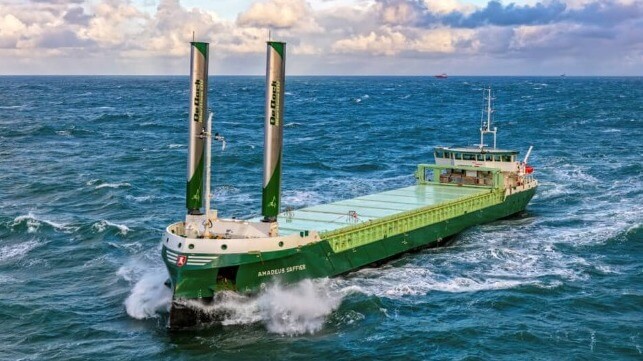
Econowind has surpassed 100 VentoFoil units sold, marking a major milestone in the shipping industry’s shift towards Wind-Assisted Ship Propulsion. The increasing adoption of the VentoFoil system reflects shipowners’ drive to cut fuel consumption, reduce CO? emissions, and comply with tightening global regulations.
Since the first two units were installed on MV Ankie in 2018, Econowind has steadily expanded its reach. Today, 32 VentoFoil units are in operation, 33 are currently in production or ready for installation, and another 37 are set for delivery in 2025. The VentoFoil technology has been successfully deployed on bulk carriers, tankers, RoRo, and container vessels.
“Surpassing 100 VentoFoil units sold is a clear sign that Wind-Assisted Ship Propulsion is gaining real momentum,” said Chiel de Leeuw, CCO of Econowind. “With rising fuel costs and increasingly strict environmental regulations, shipowners are embracing wind power as a proven solution. As we scale up production, we’re eager to help even more vessels transition to greener shipping. The low weight and tiltable VentoFoils are ideal for ship owners who value flexibility.”
Ramping up production in Zeewolde
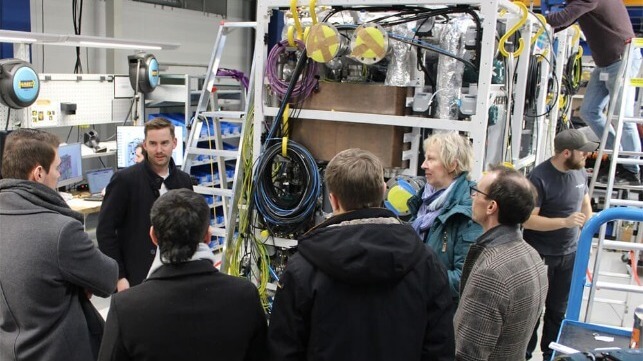
To meet growing demand, Econowind is scaling up production at its facility in Zeewolde. The expanded space and optimized processes allow for higher output and shorter lead times, ensuring more shipowners can benefit from VentoFoil technology. This strategic move positions Econowind to ramp up manufacturing as the industry accelerates its shift toward low-carbon shipping solutions.
The VentoFoil Family
The VentoFoil range offers flexible solutions with 10m, 16m, 24m, and 30m versions, catering to various vessel sizes and operational needs. Next to the fixed mounts Econowind offers containerized and Flatrack VentoFoil units. These can be easily transferred between vessels, making it a practical, scalable solution for shipowners looking to enhance efficiency and reduce carbon emissions while maintaining operational flexibility.
A solution for compliance: The Wind Reward Factor
From 2025, FuelEU Maritime will tighten CO? reduction targets, rising from 2% to 80% by 2050. Shipowners using VentoFoil technology benefit from the Wind Reward Factor (WRF), which lowers their vessel’s reported emissions, making compliance with FuelEU Maritime, CII, and ETS regulations easier and more cost-effective. By integrating VentoFoils, they reduce fuel costs, cut carbon allowance expenses, and improve
The products and services herein described in this press release are not endorsed by The Maritime Executive.
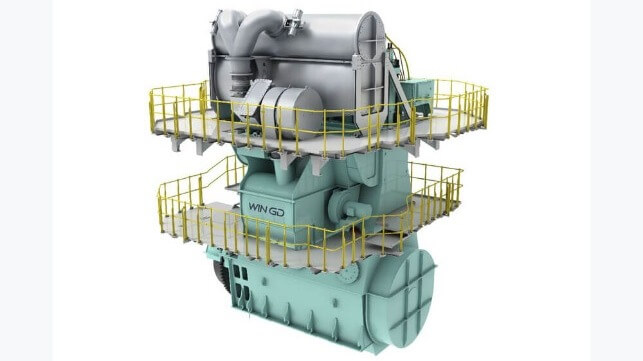
WinGD On-Engine NOx Abatement Solution to Make Commercial Debut
The only on-engine NOx reduction solution for marine two-stroke engines, designed by Swiss marine power company WinGD, will be deployed for the first time on commercial engines after securing type approval. The integrated Selective Catalytic Reduction (iSCR) solution was tested at Mitsui E&S DU (MESDU) Co’s factory in Aioi, Japan, where three WinGD 5X52-S2.0 engines are being built for bulk carriers under construction at a Japanese shipyard.
The type approval follows more than two years of service experience with a prototype version. The latest iteration features reduced material and production costs, a heating unit to enable operation with heavy fuel oil and design changes to deliver further reductions in ammonia slip.
WinGD Vice President Product Centre, Peter Krähenbühl, said: “WinGD’s unique on-engine NOx abatement solution secures IMO Tier III compliance while giving operators greater flexibility in engine room configuration and ship design. This new iteration further reduces the cost impact of NOx abatement and improves the efficiency of treatment with both existing and emerging fuels.”
As well as reducing the footprint of off-engine equipment, iSCR also simplifies piping requirements compared to either low- or high-pressure SCR off-engine units. Testing and commissioning are simplified as the engine and NOx abatement system can be tested together prior to installation. Optimised exhaust flow management and waste heat from the engine contribute to favourable conditions for treatment.
The test was held on January 16th and was witnessed by representatives from eight leading classification societies: ABS, BV, CCS, DNV, KR, LR, ClassNK and RINA.
The iSCR technology is available as an option for WinGD’s 52- and 62-bore engines, including short-stroke variants, using fuel oil, ammonia or methanol. Extension to further engines will be evaluated based on market demand.
The products and services herein described in this press release are not endorsed by The Maritime Executive.
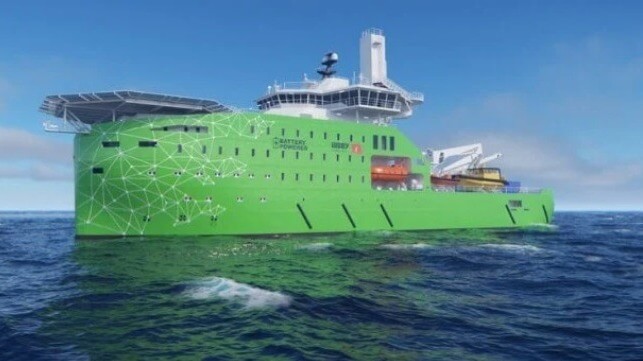
Corvus ESS Will Power the World’s First Fully Electric Offshore Vessel
Corvus Energy, the leading supplier of zero emission solutions for the offshore and marine industry, is proud to announce that it will deliver a mega-size battery system for the first fully electric offshore vessel ever to be built.
The vessel is an electric Commissioning Service Operation Vessel (eCSOV) that will be constructed by Armon shipyard in Spain for the UK-based shipowner Bibby Marine Ltd.
World`s first of its kind
Corvus Energy will supply its Blue Whale Battery Energy Storage System (BESS) delivering close to 25MWh of power for the vessel. It will be the largest LFP (Lithium Iron Phosphate) battery system ever delivered to a maritime project.
“A fully electric offshore vessel is something the industry has been working towards for a long time and marks a major milestone in offshore vessel operations," said Pål Ove Husoy, VP Sales at Corvus Energy.
“This eCSOV will be the first offshore vessel that can operate fully electric for a full day and will set a new standard for future offshore vessels. The unique system design incorporating both battery power and dual-fuel methanol engines will significantly reduce carbon emissions and increase energy efficiency while providing the reliability and performance needed for demanding offshore wind and renewable operations.”
Unique and optimized power distribution system
Corvus Energy has been cooperating closely with the shipowner, designer and integrator to dimension and optimize the system design. Unlike conventional hybrid systems, the vessel will utilize its large battery pack as the primary power source, with engines running solely for charging at a constant, optimized load that maximizes efficiency, extends battery lifespan and significantly reduces emissions. The innovative DC grid architecture further enhances overall system performance by minimizing energy losses and ensuring seamless power distribution. Additionally, offshore charging capabilities will enable simultaneous battery charging while maintaining DP for station-keeping, representing an industry first in the SOV market.
Accelerating the path to net zero
Gavin Forward, New Build Director at Bibby Marine, commented: “We are excited to collaborate with Corvus on this pioneering eCSOV project, setting a new benchmark for sustainable offshore operations and driving the future of zero-emission vessel technology."
He added that Bibby Marine selected Corvus Energy "for its proven track record in delivering complex vessel projects, while the LFP battery chemistry was chosen for its alignment with our eCSOV’s operational profile, offering enhanced safety, longevity and reliability for a project that promises to accelerate the path to net-zero for the maritime sector."
Equipment from Corvus Energy will be delivered to the shipyard in 2026, and the vessel is scheduled for operation in 2027 supporting the commissioning and operation of windfarms.
The products and services herein described in this press release are not endorsed by The Maritime Executive.
Tech Enhancements Bring Smoother Sailing to International Commerce
The difficulties facing global trade and the global supply chains have been widely documented over the past few years. The outlook for global trade remains murky in 2025 with the threat of tariffs and ongoing shifts in geopolitics. Despite headwinds, the World Trade Organization is projecting world merchandise trade growth to increase three percent this year.
With growth in the market, however, comes an even greater influx of information. This is especially true for businesses engaged in maritime transport, as a projected oversupply of available shipping space will likely lead to more options for businesses to parse through. This increase in options comes at a time of increasingly complex supply chains, which only adds to the information that businesses must evaluate and can decrease the visibility businesses have into the process from start to finish. How businesses handle the influx of information that comes with more options can make all the difference between profit and loss, and visibility into the process is key to making informed decisions.
Digital Transformation of Maritime Finance
As globalization and international trade have expanded in recent decades, innovation has been a critical part of the process nearly every step of the way. Maritime trade in particular has evolved tremendously, from large wooden ships to steamer ships to the massive container ships we see on the waters today. Other innovations, such as the magnetic compass and the Panama Canal, have helped to simplify navigation and shipping routes along the way.
Today, maritime trade is experiencing a technological renaissance as businesses look for increased transparency and flexibility along with decreased costs. According to a report from PwC, the maritime software market is expected to reach $2.9 billion by 2028. While some innovations, such as autonomous ships, are still in the final stages of testing and early stages of use, other technologies are already changing the game. For example, e-documents are currently being used to save as much as $5.5 billion. Like many industries, artificial intelligence is also revolutionizing maritime trade through cost negotiations, negotiating purchasing terms, compliance checks, freight audits, and route optimization.
Similar to the physical processes of maritime trade, the financing aspect is always evolving. On the one hand tariffs and other fees associated with cross-border trade are always in flux. A recent development worth noting is the number of parties that can be involved in trade financing has increased. Initially, banks, importers, and exporters dominated maritime trade finance. Today, however, trade financing companies, insurers, and export credit agencies have entered the fold to increase options for businesses. The drawback to this development is that maritime trade financing has become somewhat fragmented, and many businesses do not have end-to-end transparency into the process.
For all the investment in navigational and tracking technology across the maritime trade landscape, there is also tremendous opportunity to deliver digital payments innovations to streamline the financial side of maritime trade and increase transparency—and banks are the perfect candidate to lead this charge.
Accelerate Trade: A New Way to Bank
One example of banking technology designed to help revolutionize maritime trade financing is AccelerateTM Trade, an advanced, automated, digital trade finance portal from Synovus Bank.
As global trade—and maritime trade in particular—became increasingly digitalized, Synovus recognized the need to digitalize the payments process to help bring the entire trade operation online. Accelerate Trade does just that by allowing banks to initiate and monitor transactions 24/7 without having to call the bank or submit paperwork. Through this product, businesses can maximize efficiency, optimize processing and reduce risk for commercial letters of credit (import and export), standby letters of credit, guarantees, bankers’ acceptances, documentary collections, financing, and more. Accelerate Trade users can also leverage features such as user-driven reporting, alerts and calendaring to track their trade financing process.
For maritime trade specifically, Accelerate Trade can be combined with another Synovus offering, AccelerateTM FX, to conduct foreign exchange and trade activities securely.
By bundling all of these services into one solution, Synovus offers businesses a high degree of visibility into their trade financing activities from start to finish. Accelerate Trade also helps businesses see the entire picture of their trade financing operation by consolidating key information for multiple transactions into one view. Access to all of this information gives business decision-makers the insights they need to improve operational efficiency and enter the new era of maritime trade.
In spite of economic and geopolitical headwinds, global trade, driven by maritime trade, appears poised to continue its steady growth. Automation and emerging technology have begun to revolutionize maritime trade operations throughout the process. Through products like Accelerate Trade, banks are making sure that the financing for these operations evolves to meet the needs of the modern market, too.