Scheme envisions establishing ‘secure areas’ where Palestinians can live, and an administration not aligned with either Hamas or PA to oversee territory during reconstruction
By AP and ToI Staff
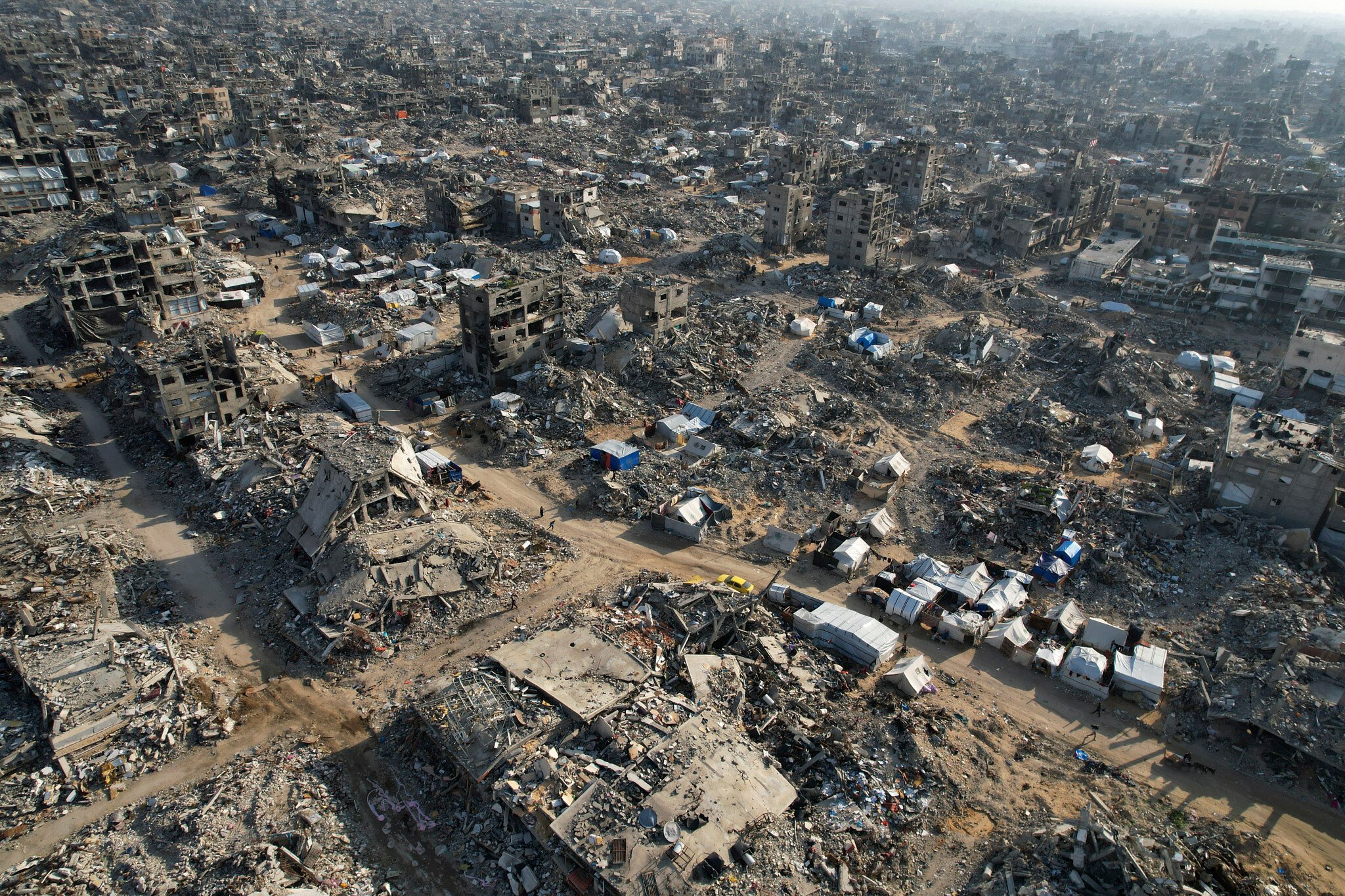
An aerial photograph taken by a drone shows tents amidst the destruction from war in Beit Lahiya, northern Gaza Strip, on February 17, 2025. (Mohammad Abu Samra/AP)
CAIRO — Egypt is developing a plan to rebuild Gaza without forcing Palestinians out of the Strip, in a counter to US President Donald Trump’s proposal to depopulate the territory and for Washington to take it over.
Egypt’s state-run Al-Ahram newspaper said the proposal calls for establishing “secure areas” within Gaza where Palestinians can live initially while Egyptian and international construction firms remove and rehabilitate the strip’s infrastructure.
Egyptian officials have been discussing the plan with European diplomats as well as with Saudi Arabia, Qatar and the United Arab Emirates, according to two Egyptian officials and Arab and Western diplomats. They are also discussing ways to fund the reconstruction, including an international conference on Gaza reconstruction, said one of the Egyptian officials and an Arab diplomat.
The officials and diplomats spoke on condition of anonymity because the proposal is still being negotiated.
The plan comes after an international uproar over Trump’s call for the removal of Gaza’s population of some 2 million Palestinians. Trump suggested the United States would take over the Gaza Strip and rebuild it into a “Riviera of the Middle East,” though Palestinians would not be allowed back.
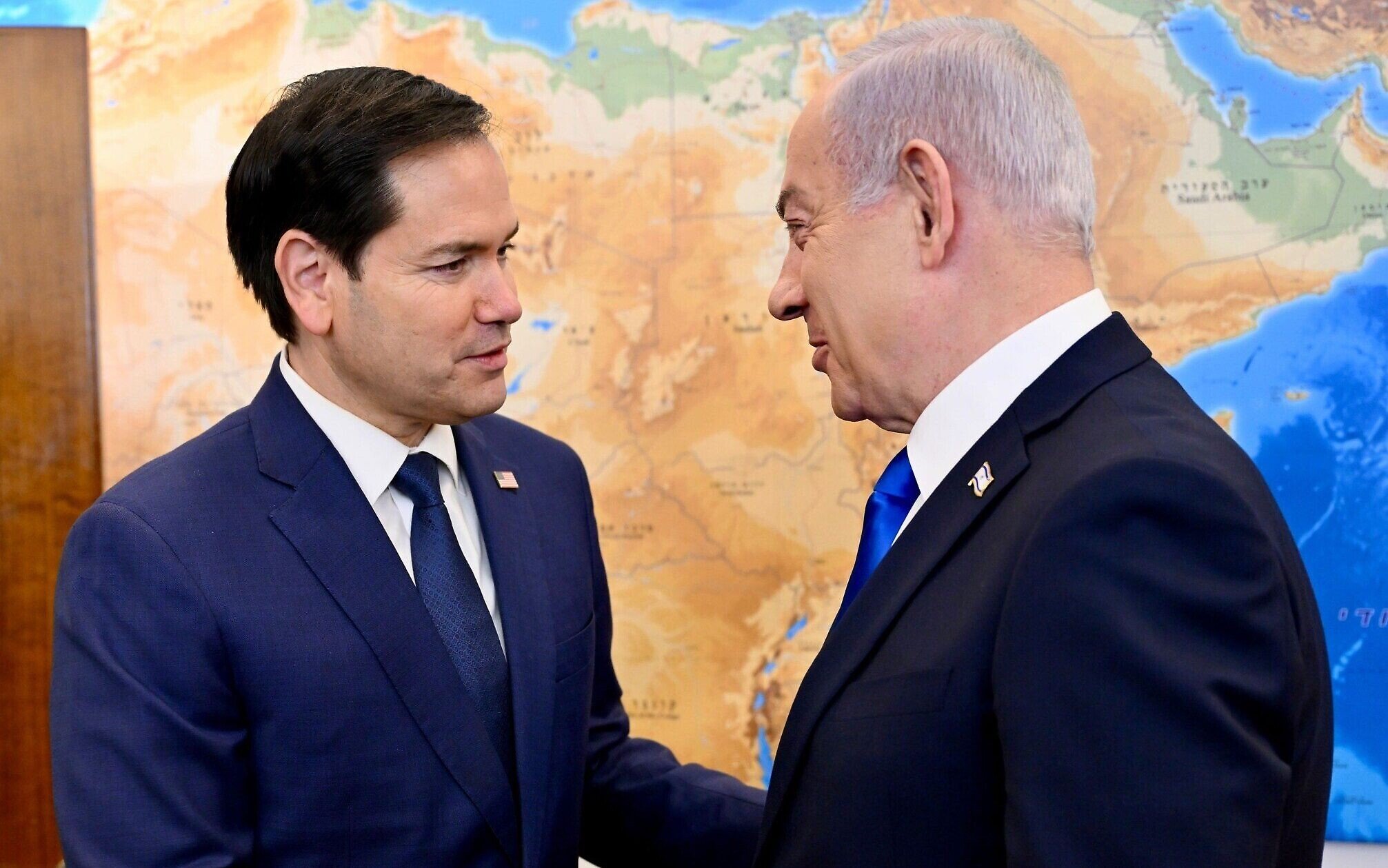
(L) US Secretary of State Marco Rubio meets Prime Minister Benjamin Netanyahu in Jerusalem on February 16, 2025 (David Azagury/US Embassy Jerusalem)
US Secretary of State Marco Rubio, who was in Saudi Arabia on Monday in a tour of the region, has said the United States was up to hearing alternative proposals.
“If the Arab countries have a better plan, then that’s great,” Rubio said Thursday on the US radio program “Clay and Buck Show.”
Advertisement
Ad Feedback
Egypt’s Al-Ahram said the proposal is designed to “refute American President Trump’s logic” and counter “any other visions or plans that aim to change the geographic and demographic structure of the Gaza Strip.”
Gaza is nearing a critical juncture, with the first phase of a ceasefire with Israel due to run out in early March. Israel and Hamas must still negotiate a second phase meant to bring a release of all remaining hostages held by the terrorists, a full Israeli withdrawal from Gaza, and a long-term halt to the war.
The three-stage ceasefire agreement, reached last month, halted some 15 months of fighting triggered by the group’s October 7, 2023, invasion of Israel, when Hamas-led terrorists killed some 1,200 people and took 251 hostages.
The deal requires Hamas to release all its hostages, Israel to release thousands of Palestinian security prisoners — including hundreds serving life sentences — and a halt to fighting in the Strip, followed by negotiations for a “sustainable calm” and IDF withdrawal from the enclave.
Any reconstruction plan will be impossible to implement without a deal on the second phase, including an agreement on who will govern Gaza in the long term. Israel demands the elimination of Hamas as a political or military force in the territory, and international donors are unlikely to contribute to any rebuilding if Hamas is in charge.
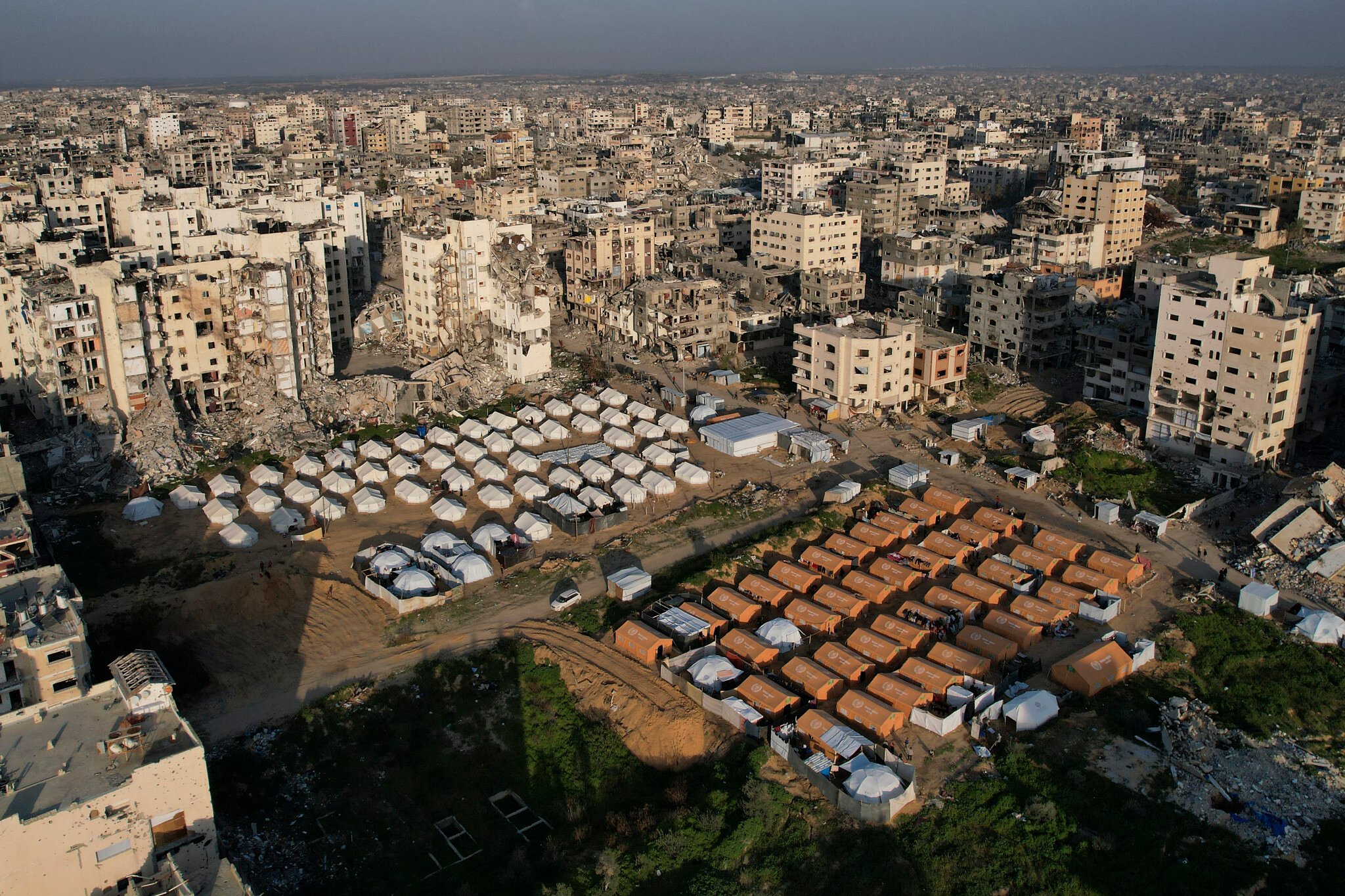
An aerial photograph taken by a drone shows a tent camp for displaced Palestinians amidst the destruction caused by war in Beit Lahiya, northern Gaza Strip, February 17, 2025. (Mohammad Abu Samra/AP)
Central to Egypt’s proposal is the establishment of a Palestinian administration that is not aligned with either Hamas or the Palestinian Authority to run the strip and oversee the reconstruction efforts, according to the two Egyptian officials involved in the efforts.
It also calls for a Palestinian police force mainly made up of former Palestinian Authority policemen who remained in Gaza after Hamas took over the enclave in 2007, with reinforcement from Egyptian- and Western-trained forces.
Asked about the possibility of deploying an outside Arab force in Gaza, one Egyptian official and the Arab diplomat said Arab countries would only agree if there were a “clear path” for the establishment of an independent Palestinian state. Netanyahu has rejected any Palestinian state as well as any role for Hamas or the Western-backed Palestinian Authority in governing Gaza, though he has not put forward any clear alternative.
Hamas has indicated it is willing to give up power in Gaza. Hamas spokesman Abdul Latif al-Qanou told The Associated Press on Sunday that the group has accepted either a Palestinian unity government without Hamas’s participation or a committee of technocrats to run the territory. The Palestinian Authority, which governs pockets of the West Bank, has so far opposed any plans for Gaza that exclude it.
The Western diplomat said France and Germany have backed the idea of Arab countries developing a counterproposal to Trump’s plan, and that Egyptian President Abdel Fattah el-Sissi discussed his government’s efforts with the French president in a phone call earlier this month. Egyptian Foreign Minister Badr Abdelatty also briefed the German foreign minister and other EU officials on the sidelines of last week’s Munich security conference, one of the Egyptian officials said.
Officials from Egypt, Saudi Arabia, Qatar, the United Arab Emirates and Jordan will discuss Egypt’s proposal at a gathering in Riyadh this week, before introducing it to the Arab summit later this month, according to the two Egyptian officials and the Arab diplomat.
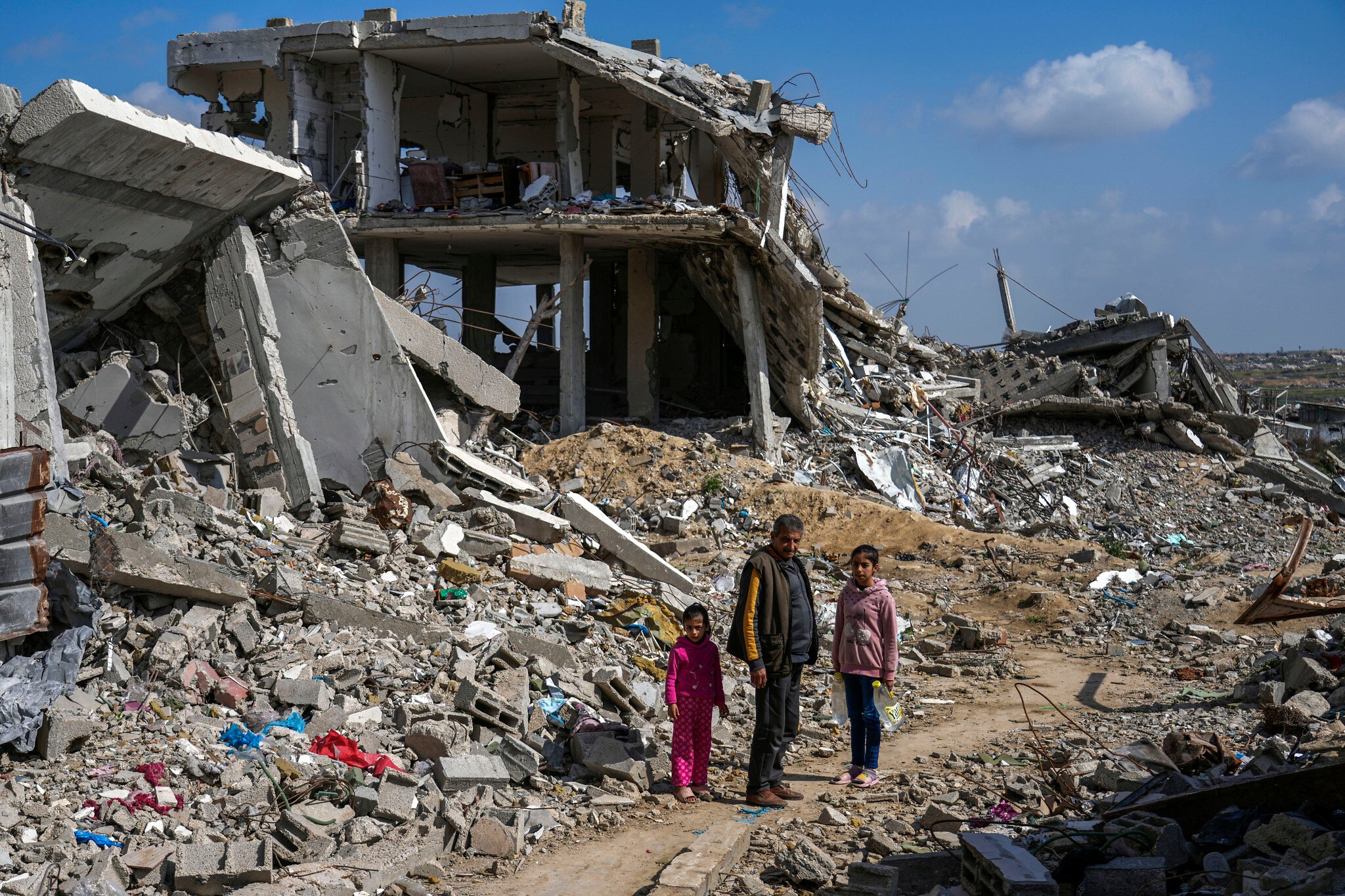
A Palestinian man and two girls stand a mid of the rubble of homes, destroyed during the war between Israel and Hamas in the Bureij refugee camp, central Gaza Strip, February 17, 2025. (Abdel Kareem Hana/AP)
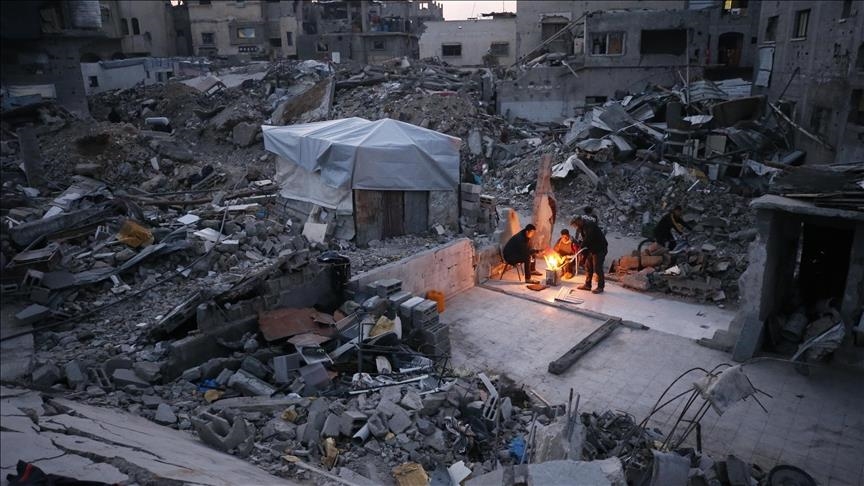
The 16 months of war in Gaza devastated the territory.
Around a quarter million housing units have been destroyed or damaged, according to UN estimates. More than 90 percent of the roads and more than 80% of health facilities have been damaged or destroyed. Damage to infrastructure has been estimated at some $30 billion, along with an estimated $16 billion in damage to housing.
Egypt’s plan calls for a three-phase reconstruction process that will take up to five years, without removing Palestinians from Gaza, the Egyptian officials said.
More than two dozen Egyptian and international firms would take part in removing the rubble and rebuilding the strip’s infrastructure. The reconstruction would provide tens of thousands of jobs to Gaza’s population, the officials said.
The plan is largely the same as that which Arab countries have been working on for the past year, but Israel has long rejected the idea of giving any role to the PA, leaving many of those proposals dead on arrival.
Most critical will be Egypt’s effort to convince Trump to get behind the plan, because if Washington does, it will be easier to get Israel on board as well.
Al Arabiya reported that the Egyptian plan will also include a clause requiring various stakeholders to serve as guarantors that Israel will not resume fighting in Gaza for at least 10 years.
Jerusalem is likely to resist any limits to its ability to use military force against future threats from Gaza.
Egypt reaffirms commitment to sovereign Palestinian state
Ibrahim Khazen and Mohammad Sio
CAIRO
The fourth meeting of the Global Alliance for the Implementation of the Two-State Solution took place Monday in the Egyptian capital Cairo, with strong opposition to the displacement of Palestinians dominating discussions.
Hosted by Egyptian Foreign Minister Badr Abdelatty, it brought together senior diplomats, including UN agency for Palestinian refugees (UNRWA) Commissioner-General Philippe Lazzarini, UN humanitarian coordinator for Gaza Sigrid Kaag and representatives from more than 35 countries and international organizations, according to a ministry statement.
Saudi Arabia launched the coalition in September 2024, with its first meeting held in Riyadh the following month.
In his opening remarks, Abdelatty reaffirmed Egypt’s full commitment to the two-state solution, advocating for a Palestinian state along the 1967 borders, with East Jerusalem as its capital. He emphasized that this is the only viable path to lasting regional peace.
He praised Saudi Arabia’s initiative in establishing the coalition and underscored the importance of collaborative efforts to implement it.
Egypt firmly opposes any forced displacement of Palestinians, a stance echoed by other Arab states and the broader international community, he said.
Recently, US President Donald Trump proposed “taking over” Gaza, resettling Palestinians in neighboring countries and turning the enclave into “the Riviera of the Middle East,” which was met with widespread condemnation from the Arab world and beyond.
Abdelatty also highlighted Egypt’s efforts to develop a phased plan for early recovery and Gaza’s reconstruction. He underscored the urgent need to support UNRWA’s humanitarian role, condemning recent Israeli legislation aimed at obstructing the agency’s operations.
He further emphasized the humanitarian crisis in the occupied Palestinian territories, stressing the need for continued support for UNRWA, which he described as “indispensable and irreplaceable.” He also condemned the Israeli parliament’s recent passage of two laws aimed at obstructing the agency’s work.
UNRWA has provided vital relief, health and educational services to Palestinian refugees across five areas of operation: the West Bank, including East Jerusalem, Gaza, Syria, Lebanon and Jordan.
Lazzarini highlighted the agency’s central role in delivering essential services to Palestinians while also detailing the challenges posed by Israeli restrictions.
Kaag expressed hope for stabilizing the ceasefire agreement and easing humanitarian access to Gaza. She also presented preliminary estimates of the cost of rebuilding the Gaza Strip, the statement added, without specifying a figure.
Egypt and Qatar continue intensive mediation efforts to sustain the agreement amid Israeli violations and logistical challenges preventing the full implementation of its first phase.
Trump ally Lindsey Graham among US legislators to meet Netanyahu in Tel Aviv on Monday
The National
February 18, 2025
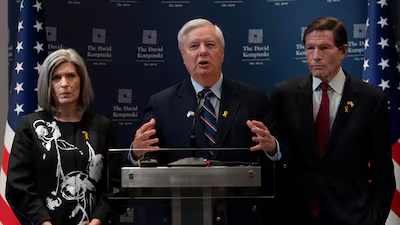
A top US Republican and longtime ally of President Donald Trump has said after meeting Israeli Prime Minister Benjamin Netanyahu in Tel Aviv that there is not much support in the US Senate for any American involvement in taking over Gaza.
“One thing I will say, there’s very little appetite that I’ve seen in the United States Senate for America to take over Gaza in any way, shape or form,” Senator Lindsey Graham said.
Mr Graham was part of a bipartisan group of US legislators who met the Israeli leader in Tel Aviv on Monday. Mr Netanyahu has expressed support for Mr Trump’s disputed proposal to permanently resettle Palestinians from Gaza abroad, and for the US to take over the war-ravaged enclave.
The US senator added that, while working on solutions to the Palestinian issue, there is no expectation for Israel to accept a deal that could lead to another October 7 attack or allow Hamas to remain in power. He said the Palestinian Authority, in its current form, is not considered to be a viable solution.
Mr Trump first floated the idea of displacing Palestinians from Gaza earlier this month during an official visit by Mr Netanyahu to Washington. He proposed turning the enclave into the “Riviera of the Middle East” and then suggested that the two million Palestinians who would be displaced under his plan for the US to “own” Gaza would not have the right to return after reconstruction.
“The one thing that President Trump has done, he started a discussion that was long overdue,” said Mr Graham, adding that Arab states had “woken up” to the need for an alternative solution for Gaza.
Mr Trump’s statements sparked strong condemnation across the Arab world and much of Europe, with some critics saying the plan would amount to ethnic cleansing. In response, Arab leaders are set to convene a mini-summit in Riyadh on February 21 to discuss alternatives to Mr Trump’s plan. The summit will include leaders from the six Gulf Co-operation Council nations, along with Egypt and Jordan, according to AFP.
Senator Richard Blumenthal, a Democrat, who also attended the Tel Aviv meeting, said he expected Arab states to put forward a “workable alternative.” He said a possible regional plan could include normalised relations with Israel and a clear path towards Palestinian self-determination.
Mr Blumenthal said Jordan's King Abdullah had convinced him that Arab states would present a plan that covers normalising ties with Israel, self-determination for the Palestinians, and regional defence arrangements and security for Israel.
“If those components are part of a realistic plan, it could be a game-changer for the region,” he said.
Hamas cultural advisor told MNA;
Plan to displace Palestinians is an old conspiracy
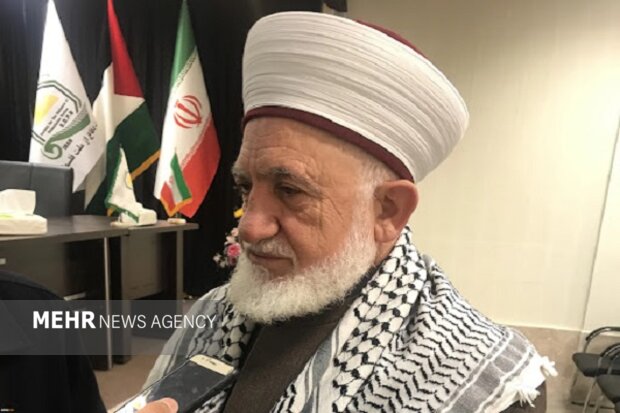
TEHRAN, Feb. 18 (MNA) – The cultural advisor of Hamas emphasized that the plan to displace Palestinians is not a new issue but rather an old scheme, with conspiracies in Palestine originating from the time of the British occupation in 1917.
Donald Trump used the destruction caused by Zionist attacks on the Gaza Strip as a pretext to call for the complete evacuation of Gaza, proposing the forced migration of its residents to neighboring Arab countries such as Egypt and Jordan while advocating for US control over the 365-kilometer-long strip.
The US president claimed that the goal of this plan is to ensure the safety and well-being of Palestinians, away from violence and unrest, and Egypt and Jordan must accept this American proposal. However, Trump’s claim of seeking security and peace for Palestinians is contradicted by the fact that he has played a major role in the genocide of the Palestinian people, and the Zionist regime has been armed with the deadliest weapons by the US to carry out massacres in Gaza.
Trump’s statements have faced widespread rejection from various countries, particularly Egypt and Jordan, while Palestinians have condemned the proposal as a dangerous plan and an invitation to ethnic cleansing. Notably, redrawing the region’s map according to the American vision and annexing Gaza to occupied Zionist territories are among Trump’s underlying objectives.
The Islamic Resistance Movement Hamas, the United Kingdom, the United Nations, the King of Jordan, a former Saudi intelligence chief, China, the Palestinian Authority's head Mahmoud Abbas, and the preacher of Al-Aqsa Mosque have all reacted to Trump’s proposal for the forced displacement of Gazans, rejecting it outright. These statements are seen as a dangerous move aimed at expanding the Zionist occupiers’ territory, to the detriment of Islamic nations and the forced displacement of Gaza’s residents.
Recently, a Hamas delegation led by Muhammed Ismail Darwish, head of the movement’s council, visited Iran and met with Iranian officials. During this visit, Sheikh Hussein Qassem, Hamas’ cultural advisor, elaborated on the forced displacement plan and the role of the Islamic Republic of Iran in supporting Palestine. Below is his text of the interview with Mehr News Agency:
Conspiracies in Palestine began with the British occupation in 1917 and have continued to this day. The project to displace Palestinians started after 1948 and continued in 1956, targeting the remaining Palestinians, he said.
"The Palestinian people are a resilient nation. The West Bank is under a more severe siege than Gaza, yet it continues to resist with whatever means it has."
Qassem emphasized, "With the support of our brothers in the resistance axis—in Iran, Lebanon, Yemen, and Iraq—we will, God willing, eliminate the Zionist regime. The Islamic Revolution of Iran is a unique model for all liberation movements."
MP/6379154

Israeli tanks are seen in Gaza Monday. (Reuters)
Ramallah: Kifah Zboun
18 February 2025
Israeli Prime Minister Benjamin Netanyahu on Monday blocked Arab efforts to develop a plan for “the next day” in Gaza after the war ends, saying neither Hamas nor the Palestinian Authority, led by President Mahmoud Abbas, will control the Strip in any future plan.
“As I promised, the day after the war in Gaza, neither Hamas nor the Palestinian Authority will be there,” according to a statement from the PM’s office.
His comments came in response to Arab efforts seeking to pressure Hamas to hand over Gaza to the PA and foil a US plan to take ownership of the territory and rebuild it into a “Riviera of the Middle East.”
They also came ahead of an Israeli Security Cabinet meeting to discuss the second phase of the Gaza ceasefire and prisoner exchange deal with Hamas.
Netanyahu had tried to prevent negotiations for the second phase. But following a meeting with US Secretary of State Marco Rubio last week, the PM agree to send a delegation to Egypt on Monday to resume talks with Hamas. But according to Israeli reports, the delegation had not been given a mandate to discuss anything substantive.
A senior Israeli security official familiar with the negotiations told Ynet news on Sunday that Netanyahu is working to prevent the implementation of the second phase of the hostage deal in order to achieve political goals at the expense of hostages’ lives.
The senior Israeli security official maintained that this amounts to a violation of the deal, which stipulates that the parties begin holding negotiations over phase two no later than the 16th day of the first phase, which was on February 3 — nearly two weeks ago.
Israel’s decision to send a delegation to Egypt followed a phone call between Netanyahu and US President Donald Trump’s Middle East envoy Steve Witkoff.
Witkoff told Fox News on Sunday that he also spoke with Qatari Prime Minister Mohammed bin Abdulrahman bin Jassim Al Thani and head of the Egyptian intelligence agency Hassan Mahmoud Rashad and agreed with them on the progression of the second phase of the hostage deal.
‘Them or us’
While Netanyahu faces mounting US pressure to move forward with the talks, he is under similar pressure from far-right members of his coalition to resume the war after the end of the first phase.
Far-right Finance Minister Bezalel Smotrich threatened to quit Netanyahu’s ruling coalition if the war is not resumed after the end of the first stage.
Smotrich in a video statement said he “will demand a vote” by ministers on Trump’s plan and that Israel must “issue a clear ultimatum to Hamas — immediately release all hostages, leave Gaza for other countries and lay down your arms.”
“If Hamas refuses this ultimatum, Israel will open the gates of hell,” he warned.
“I call on the prime minister to declare that once the war resumes after phase one, Israel will, from the first day, seize 10% of Gaza’s territory, establish full sovereignty there and immediately apply Israeli law,” he said.
“It’s them or us. Either we crush Hamas, or God forbid, Hamas will crush us,” Smotrich said.
In return, other Israeli opposition leaders urged the government to complete the deal with Hamas and return all the hostages.
National Unity chairman Benny Gantz said: “We need to harness all the levers of pressure, all the means, and also be prepared for painful concessions and bring them home – down to the last hostage.”
February 17, 2025

United States Senator Marco Rubio testifies before a Senate Foreign Relations Committee hearing on his nomination to be Secretary of State at the Dirksen Senate Building, in Washington D.C., United States on January 15, 2025 [Celal Güneş – Anadolu Agency]
US Secretary of State Marco Rubio underscored the importance of an “arrangement for Gaza that contributes to regional security” during his meeting with Saudi Crown Prince Mohammed bin Salman in Riyadh, the State Department said Monday.
Rubio and bin Salman reaffirmed their commitment to implementing a ceasefire in Gaza and securing the release of all hostages, including American citizens, according to a readout from State Department Spokesperson Tammy Bruce.
The Secretary also highlighted the 80th anniversary of the 1945 meeting between then-President Franklin Roosevelt and Saudi King Abdulaziz aboard the USS Quincy and expressed a commitment to deepening US-Saudi economic and defense cooperation, she added.
The discussions between Rubio and bin Salman covered regional issues, including Syria, Lebanon, and Red Sea security, with both sides emphasizing the need to ensure freedom of navigation.
Rubio also held talks with Saudi Foreign Minister Prince Faisal bin Farhan Al Saud during his visit.
The US top diplomat arrived in Saudi Arabia early Monday from Israel, where he met with senior officials, including Prime Minister Benjamin Netanyahu.
It was the first visit by Rubio to the Middle East since he became a secretary of state in the administration of President Donald Trump last month.
He is also scheduled to visit the United Arab Emirates as part of his ongoing regional tour.
Rubio’s visit comes as US President Donald Trump has proposed to “take over” the Gaza Strip, relocate Palestinians there to Egypt, Jordan and other countries, and transform it into the “Riviera of the Middle East.” The idea has been widely rejected by the Arab and Muslim world and many other nations, who say it amounts to ethnic cleaning.
The proposal emerged after the truce agreement took effect in Gaza on 19 January, pausing Israel’s 15-month onslaught, which has killed more than 48,000 people and left the enclave in ruins.