U.S. Releases Video of Attack on Semi-Submersible and Sends Survivors Home
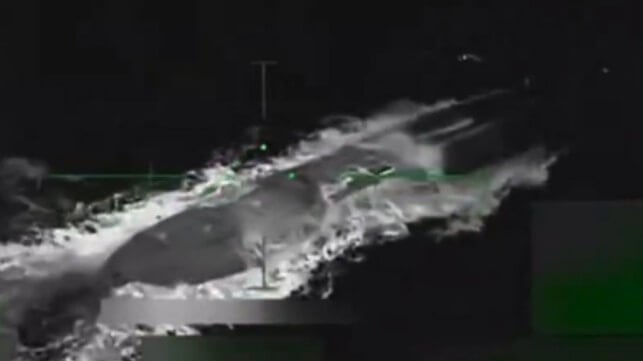
The White House released a video of the latest attack on a semi-submersible in the Caribbean as controversy continues to surround the ongoing deadly assaults on the boats. It is the sixth attack reported by U.S. officials, but unlike the others, there were survivors.
Donald Trump had spoken out on the situation on Thursday, October 16, telling reporters that they had destroyed a submarine, and followed up two days later, today, with the video. A typical semi-submersible developed by the drug cartels is seen battling the waves before it is hit by the United States.
In the posting, Trump says they “destroyed a very large drug-carrying submarine that was navigating towards the United States on a well-known nacotrafficing transit route.” He says U.S. intelligence confirmed it was “loaded up mostly with Fentanyl, and other illegal narcotics.” He says four people were aboard, with two killed, and confirmed the previous reports that two other “terrorists” survived.
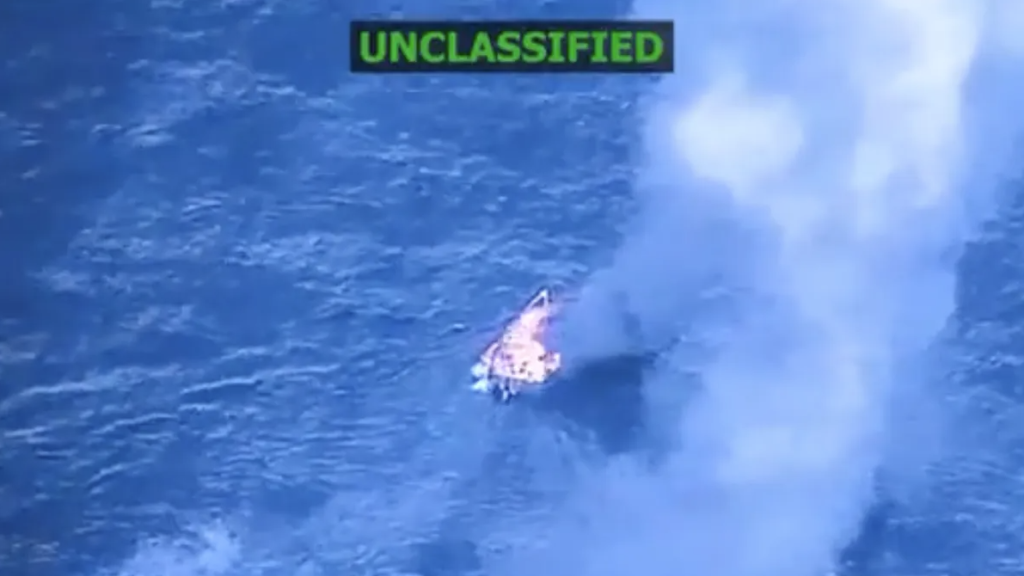
The New York Times is reporting that a Special Operations aircraft fired on the vessel in the southern Caribbean. It says minutes later, analysts watching an unreleased video observed what appeared to be at least two survivors in the water near the smoldering wreckage. They said there were also “several floating bales” in the water.
The U.S. Navy and Coast Guard dispatched helicopters and rescued two individuals. They were brought to the amphibious assault ship USS Iwo Jima for medical attention.
“The two surviving ‘terrorists’ are being returned to their countries of origin, Ecuador and Colombia, for detention and prosecution,” Trump wrote in the social media posting.
The New York Times reports the two individuals have been transferred from the custody of the Pentagon to the U.S. State Department for their repatriation. They note that the U.S. has handed individuals in the past over to friendly countries when they were intercepted outside the country. The Coast Guard, in the past in the Caribbean, however, after stopping drug trafficking boats, has also arrested the individuals and brought them to the U.S. for prosecution.
Unlike the previous strikes, the administration did not link this boat to Venezuela. It has been attacking boats over the past few weeks, using the president’s declaration of the drug cartels as terrorists and combatants. The New York Times speculates that the administration might have decided not to try the individuals to test the legality of the strikes. The administration has advised Congress of its actions after the previous attacks, using language including “armed attacks” and “unlawful combatants.”
The White House reported to Congress in September that the U.S. is engaged in an armed conflict with the drug cartels. Trump wrote today that the United States will not tolerate narcoterrorists trafficking illegal drugs, by land or by sea.
Murder in the Caribbean: How should we interpret the dramatic escalation in US policy towards Venezuela?
First published at NLR Sidecar.
‘We blew it up. And we’ll do it again’. ‘I don’t give a shit what you call it.’ These words, of US Secretary of State Marco Rubio and Vice President J.D. Vance, respectively, refer to the first of five US bombings of boats in international waters near Venezuela in the last month, which have reportedly killed twenty-seven people overall. Washington claims the boats were carrying drugs destined for US shores but has offered no proof; evidence indicates those killed in the first bombing, on 2 September, may have been fishermen. The operation has been accompanied by a buildup of US military force in the Caribbean, including eight surface warships, a squadron of F-35s, a nuclear attack submarine and over 10,000 troops. Trump has labelled Maduro’s government a ‘narco-terror cartel’, and reports indicate that attempts to reach a diplomatic agreement were cut off by the US administration a week ago. On 9 October, the Venezuelan government requested an emergency session of the UN National Security Council, citing ‘mounting threats’ and the expectation of an imminent ‘armed attack’ on the country. How should we interpret this dramatic escalation in US policy?
Washington has long viewed Latin America as its ‘backyard’, as famously articulated in the 1823 Monroe doctrine, which warned European powers to leave the region to the US — not, of course, to Latin Americans themselves. Over the course of the nineteenth and twentieth centuries the US repeatedly interfered in Latin American affairs. Amongst the most notorious recent instances — where US involvement ran the gamut from behind-the-scenes support and political backing to direct intervention — are the 1954 coup against Guatemala’s Jacobo Arbenz, the 1973 coup against Chile’s Salvador Allende, the 1989 invasion of Panama (which, as many have noted, has striking parallels with Trump’s current actions against Venezuela), the overthrow of Haitian President Jean-Bertrand Aristide in 1991 and 2004, and the 2009 coup in Honduras.
Venezuela, however, has faced more US attempts to engineer regime change than any other Latin American country in the last twenty-five years. Washington’s obsession with this goal began a few years after Hugo Chávez’s 1998 election — it supported numerous efforts to remove him from office, including a 2002 military coup and the 2002-2003 oil lock-out hitting the country’s most important industry. Both the Bush and Obama administrations funnelled millions to the opposition, including the recent Nobel Peace Prize winner, María Corina Machado; the prize committee ignored Machado’s decades-long advocacy for the violent removal of Venezuela’s leaders, as well as support for the recent assassinations. Washington’s support for the opposition continued after Chávez’s death in 2013 and the election of his chosen successor, Nicolás Maduro. Obama backed an often-violent protest wave in 2014 that left an estimated 43 dead, and Maduro faced another wave of at-times violent US-backed opposition protest in 2017.
In 2015 Obama declared Venezuela to be an ‘extraordinary and unusual threat to US national security’, a charge so ludicrous it was rejected by Venezuelan opposition leaders when it was initially announced. Yet this was used to justify the imposition of US sanctions, which contributed decisively to the decimation of Venezuela’s economy. As Francisco Rodriguez shows in The Collapse of Venezuela, though government policies were a major reason for Venezuela’s economic collapse, it was the sanctions that made recovery all but impossible. Antipathy to the regime then rose to a new level during the first Trump administration, which applied a policy of ‘maximum pressure’ to topple Maduro. In addition to punishing sanctions — which were now applied to Venezuela’s oil industry — Trump backed Juan Guaidó’s farcical self-declaration as president in January 2019. Over the next few years Guaidó’s supporters called for a US-led humanitarian intervention, vocally supported US economic coercion (as did most of the opposition leadership), exhorted the military to rise up against Maduro, and financed Operation Gideon, a spectacularly inept maritime invasion of Venezuela in May 2020 by US-backed mercenaries, who survived only after being rescued by Venezuelan fishermen and then turned over to the state.
Trump’s recent actions should therefore be understood as part of a longstanding pattern of US aggression towards the Bolivarian-socialist regime. Yet there are also notable distinctions. For one, the administration has effectively discarded the rhetorical cover of ‘democracy’ and ‘human rights’, long employed — even during Trump’s first term – as a fig leaf for belligerence against Venezuela. Along with this, there was a greater emphasis on the appearance of multilateralism — Guaidó’s ‘interim presidency’ for instance was supported by dozens of countries around the world. Though Argentina, Paraguay and Peru are all aligned behind the US, and Abinader’s Dominican Republic has participated in joint operations in the Caribbean, the current administration appears to view international backing more as an afterthought. Washington’s supervision of the region has always been exercised on a spectrum of force and consent, and so far, the Trump administration is clearly inclined more towards the former — the direction of travel may be towards what Ranajit Guha referred to as ‘dominance without hegemony’.
Trump’s second term has been marked by an undisguised penchant for brute power. This can be seen in the way he has sought to use trade policy to compel countries to bend to his will, as in the case of the 50% tariffs levied against Brazil for the offence of putting Bolsonaro on trial. See too, inter alia, his renaming of the Department of Defense as the Department of War, his deployment of the national guard, his pursuit of political enemies through the courts, his refusal to feign unity following Charlie Kirk’s murder (with Trump responding to Erica Kirk’s statement that she forgives her husband’s killer: ‘I hate my enemies’). The bombing of Venezuelan boats fits this pattern. The only justification provided for the extra-judicial killings is the need to combat the ill-defined bogeyman of the narco-terrorist, a category conjoining the war on drugs and war on terror, but the Trump administration has not provided any evidence to support the accusation. As Miguel Tinker-Salas argues, it has acted as judge, jury, and executioner. The message conveyed by the administration’s murder of non-combatants is ‘we will do whatever we want, whenever we want and we have no need to explain or justify ourselves to anyone’.
The operation appears to be in line with the new National Security Strategy, soon to be published, which is said to call for a refocusing on hemispheric security — with an emphasis on relations with Latin America, migration and drug cartels. The idea that the boat bombings will have any significant impact on the flow of drugs to the US however is far-fetched, for the simple reason that the vast majority of drugs arriving from Latin America come through the Eastern Pacific corridor, not the Caribbean. It should also be noted that while Venezuela is a transit route for an estimated 10-13% of global cocaine (per US agencies), it provides none of the fentanyl that accounts for 70% of US drug deaths. The Trump administration’s claim that Maduro is the head of the Cartel de los Soles, is equally implausible; experts on organized crime in Venezuela deny such a cartel even exists.
If the US is not bombing Venezuelan boats to stop drugs, then why is it doing so? One factor is Rubio’s attempt to assert himself vis-à-vis other members of Trump’s inner circle. The Secretary of State’s obsession with removing Maduro can be traced to his background in South Florida politics, and the crucial role hard-right anti-communist Venezuelan and Cuban exiles have played there for decades. There are other significant figures within Trump’s inner circle who share his position, including CIA director John Ratcliffe and Stephen Miller. As Greg Grandin notes, Rubio’s hawkish stance towards Venezuela contrasts with that of Trump’s special envoy Richard Grenell, who has advocated striking deals with Maduro. According to a recent New York Times article, Grenell succeeded in securing extraordinary concessions, including an arrangement that would have given US corporations significant control over Venezuela’s resources, including its oil. Trump, however, has rejected the deal, and by all accounts Rubio’s hard-line position is currently favoured.
There may also be a range of domestic incentives in play. Conflict with Venezuela would provide a rationale for use of the 1798 Alien Enemies Act to deport Venezuelans, as the administration has been attempting to do. If a military back-and-forth were to take place, the courts would likely take a more favourable view, thus allowing Venezuelans to be deported on the grounds that they pose a national security threat. Such a conflict would also divert attention from other areas where Trump is vulnerable, such as the Epstein files, which have bedevilled him for months, and look likely to explode in the wake of Adelita Grijalva’s victory in Arizona’s special election. This gives Democrats in the House of Representatives enough votes to force the Trump administration to release the remaining files; though so far Republican Speaker of the House Mike Johnson has refused to swear Grijalva into her seat (Grijalva has threatened legal action).
Maduro maintains that the offensive in the Caribbean is part of a renewed effort for regime change. Trump has publicly denied this, but there are signs he is taking the idea seriously. Reports indicate US plans for military action within Venezuela are underway. Airstrikes on mainland targets — a major escalation — could ostensibly begin within weeks, and Trump has authorized the CIA to undertake covert action in the country. The possibility that the President will suddenly reverse course cannot be ruled out, given his history of capriciousness, and of washing his hands of operations that aren’t proceeding smoothly. Whether or not there is a coherent plan to topple Maduro, it seems clear that the administration hopes to provoke him into a response. Thus far, he has not taken the bait. Beyond a mobilization of popular militias, Venezuela’s military response has been restricted to the flight of two armed F-16s over a US Navy ship in the Southern Caribbean. With the threat of a US intervention, questions about Venezuela’s military preparedness have grown. Much is unknown, but recent articles in military-focused US outlets suggest Venezuela’s defences, while uneven, nevertheless pose a significant obstacle. To date, it appears that US aggression has strengthened Maduro domestically. Consider, for instance, the statement by Venezuela’s Communist Party, fiercely critical of Maduro — viewing his government as authoritarian, illegitimate and anti-worker — which states that in the event of a US invasion the party’s stance would undergo a ‘radical shift’ in the name of defending Venezuela’s sovereignty.
For now, the Trump administration looks set to continue with its policy of blowing up Venezuelan boats. Congressional attempts to obstruct this have thus far proved unsuccessful: a vote was forced on Ilhan Omar’s War Powers Resolution to End Unauthorized Hostilities in Venezuela, but lost by three votes. For the most part opposition from the Democrats has been on procedural grounds, encapsulated by Michigan Senator Ellisa Slotkin, who complained that ‘if the Trump administration wants to be at war against a terrorist organization, they should come to Congress, notify us, and seek our approval’, adding that ‘ I actually have no real problem going against cartels’. Internationally, leftist Colombian President Gustavo Petro called the boat bombings an ‘act of tyranny’, and at the UN Security Council meeting on 10 October, Russia and China strongly condemned Trump’s actions; other diplomats, from Europe and Africa, were careful not to express criticism. Whether war is on the horizon remains an open question, but Caracas has good reason to fear the worst.
Venezuelan socialist groups: Stop imperialist aggression against Venezuela! Trump’s troops out of the Caribbean and Latin America!
First published in Spanish at Laclase.info. Translation from Venezuelan Voices.
The US has deployed warships, surveillance aircraft, helicopters, and special operations troops in the southern Caribbean Sea and openly targeted our country under the pretext of the “war on drugs.” This is a military deployment that opens the door to possible armed intervention by the US.
The goal of this military deployment is to reaffirm that Latin America is the “backyard” of US capitalism, to renew its dominance in the region in the face of competition from other capitalist powers such as Russia and, above all, China. Through militaristic threat, Donald Trump is bringing back “gunboat diplomacy” to subdue our peoples, and this is what looms over Venezuela and other countries on our continent.
Trump is not only responsible for imposing sanctions to pursue his goals of imperialist domination in our country, but also for the most brutal contempt and criminal treatment of Venezuelan immigrant working families in the US, in addition to the recent murder of several people in attacks on boats in the Caribbean Sea.
Sectors of the right-wing opposition, such as that led by Trump supporter María Corina Machado, support this new imperialist aggression against Venezuela, just as they have supported economic sanctions and constantly called for the US to invade our country.
Confronting the external aggression of a government as reactionary as Trump’s is in the interests of the working class and the vast popular majority in our country. We, the signatories of this statement, conceive of the defense of our national interests in an active, organized manner, independent of the Maduro government and the bosses’ opposition, which allows us to understand the role that the US plays globally and what its predatory interests are.
For the left-wing organizations that call for the repudiation of this aggression by the US, this in no way implies endorsing the Maduro government; on the contrary, we reject it and openly confront it. We believe that in the face of the repressive and anti-worker policies that Maduro brutally unleashes against the working and poor people, only the Venezuelan working people have the duty of settling accounts with him, not any imperialist power.
But state repression and the violation of the fundamental rights of workers and the popular sectors is not the best way to stand up to a possible foreign invasion. With wages below a dollar a month and the imprisonment of critical voices and those who protest, we believe that this actually facilitates the work of US imperialism. To confront imperialism, workers and the people need the fullest freedom of action and organization.
While the government engages in supposedly anti-imperialist propaganda, it continues to do business with Chevron and Sunergon Oil, a US company that has just begun operating in the Orinoco Oil Belt. That is why we say that confronting imperialism is not only a military problem, but also involves taking a series of basic measures against imperialist economic interests and their mechanisms of domination, such as eliminating joint venture contracts in the oil sector, ensuring that oil is managed by PDVSA workers and professionals without transnationals or joint ventures; to cease recognition of the usurious foreign debt; nationalizing without compensation the multiple properties owned by US capitals in the country, to place them under the control of the workers and the people, not the state bureaucracy, which only knows how to impose control over the workers and is a source of all kinds of embezzlement of public property, as has been demonstrated numerous times.
Moreover, it is the government itself that guarantees imperialist capital, including that of the US, shameful conditions for the plundering of natural resources and the exploitation of the national workforce, guaranteeing one of the cheapest labor forces in the world, through the destruction of labor rights and repression.
The fight against imperialist ambitions must also be a fight against the destruction of the economic and political rights of the working majorities.
Unleashing a force capable of confronting any imperialist military adventure to the end requires the deployment of workers’ and popular initiative, creativity, and energy, as well as the ability to fight against all enemies and for all rights. That is what we are committed to, from our anti-imperialist and anti-capitalist position.
Furthermore, we propose that it is necessary for the people and workers to mobilize to impose a workers’ and popular emergency plan for wages and pensions equal to the basic basket of goods, in defense of collective contracts, for greater investment in health, education, and public services, in defense of democratic freedoms, and for the full freedom of political prisoners.
Signed:
Homeland for All/Popular Revolutionary Alliance (PPT/APR)
Socialism and Freedom Party (PSL)
League of Workers for Socialism (LTS)
Socialist Tide (MS)
Communist Revolution (RC)
Caracas, October 3, 2025.
President Trump Goes to War!
“My proudest legacy will be that of a peacemaker,” U.S. President Donald Trump said in his inaugural address. He promised to “measure our success… most importantly [by] the wars we never get into.” Trump has proudly boasted that he is “the first President in decades who has started no new wars.”
Fast forward a few months, and everything has changed. The “president of peace” is thundering for war.
All signs are pointing to U.S. military action in Venezuela. The U.S. has flooded the region with three Aegis guided-missile destroyers, a nuclear-powered fast track submarine, F-35B jet fighters, MQ-9 Reaper drones, P-8 Poseidon spy planes, assault ships and a secretive special-operations ship. So far, there are over 10,000 troops. It is the largest military buildup in the region in over three decades. That is a force that is much too large for its stated purpose of confronting a few drug carrying speed boats.
The Trump administration has stipulated that “Maduro is not the President of Venezuela and his regime is not the legitimate government” and that Maduro is the leader of the designated narco-terrorist organization Cartel de Los Soles.” It has notified Congress that the U.S. is now in formal “armed conflict” with the cartels, and Trump has terminated all diplomatic outreach to Venezuela. On October 14, U.S. Secretary of War Pete Hegseth, under the authority of Trump, ordered a lethal strike on the fifth small Venezuelan speed boat.
On October 15, The New York Times reported that Trump has secretly authorized the CIA to conduct covert operations inside Venezuela. The authorization allows the CIA “to carry out lethal operations in Venezuela,” including “covert action against Mr. Maduro or his government.”
While couched in the language of fighting drug trafficking into the United States, the Trump administration has made no secret of its desire for regime change in Venezuela. Under the leadership of Secretary of State Marco Rubio, with the support of CIA Director John Ratcliffe and Trump’s chief domestic policy advisor, Stephen Miller, Trump’s team has pushed for the removal of Maduro from power. A Trump administration official familiar with policy discussions on the approach to Venezuela told Axios that, though the military build up is “about narco-terrorism… if Maduro winds up no longer in power, no one will be crying.” Another, by comparing it to the American operation against Panama’s Manuel Noriega in 1989, implied that a coup was higher on the agenda.
Speaking to reporters at the White House, Trump confirmed the authorization, an unusual move for a president that seemingly makes the covert action less covert. Asked by a reporter whether he had authorized the CIA to “take out” Maduro, Trump answered that, though that’s “not really a ridiculous question,” it would be “a ridiculous question for me to answer.”
The idea of regime change is not one that arose unexpectedly on the Trump administration’s agenda. Even before taking office, Trump’s incoming administration made it known that it sought regime change in Venezuela.
And it was not a new idea then. It is an old idea. A very old idea. The U.S. first became involved in coups in Venezuela in 1908 when they helped Juan Vicente Gómez to oust Cipriano Castro in a coup. Nearly a hundred years later, the U.S. would be deeply involved in the unsuccessful 2002 coup that briefly removed Hugo Chávez from power. Bush officials acknowledged that “they had discussed the removal of Venezuelan President Hugo Chávez for months with military and civilian leaders from Venezuela.” Officials of the Organization of American States confirmed that the Bush administration “was not only aware the coup was about to take place, but had sanctioned it.” Eventually, the State Department would admit that the Bush administration “provided training, institution building, and other support to individuals and organizations understood to be actively involved in the military coup.”
The coup attempts would continue. In 2019, top Trump officials took part in a secret meeting to plan a Venezuelan coup. On the same day, Vice President Mike Pence brazenly announced to the U.N. Security Council that “the Trump administration is determined to remove President Nicolás Maduro from power in Venezuela.” Days later, the U.S. attempted a coup to remove Maduro from power with the full knowledge of Trump.
The latest adventure into war and regime change destabilizes, not only the region, but what little remains of the architecture of international law. The Trump administration is threatening war and regime change against a sovereign country who has not even whispered a threat to the United States or anyone else. But the world quietly watches while no one dares to say no to the United States.
Once upon a time, the world was governed by international law, a codified law that had the United Nations as its firm foundation and that applied universally and impartially to all nations. That law has been usurped by the U.S.-led rules-based order that is based on the principle that when the rule benefits America it is applied, and when it does not benefit America, it is not.
On October 10, the Security Council met to discuss the U.S. strikes on Venezuelan speed boats. But, while China and Russia criticized the United States, the rest of the Council “crafted their words carefully, avoiding direct denunciation of the Trump administration,” speaking only vaguely about the need for diplomacy and respect for the boundaries of international law. Imagine what the U.S. would say if China was bombing boats off the coast of Taiwan or Russia was bombing non-military Ukrainian boats.
It is time for the United Nations and the world to reassert themselves and say no to American recklessness, arrogance and exceptionalism and stop another illegal American war.