It’s possible that I shall make an ass of myself. But in that case one can always get out of it with a little dialectic. I have, of course, so worded my proposition as to be right either way (K.Marx, Letter to F.Engels on the Indian Mutiny)
Monday, November 10, 2025
Chance to win cash doubled medication use, yet led to similar blood pressure reductions
American Heart Association Scientific Sessions 2025, late-breaking science abstract 4391838
A study of 400 adults with high blood pressure found that participants were twice as likely to take their blood pressure medication (measured by electronic pill bottles that recorded when bottles were opened) when they could win a daily cash reward compared to people who were not offered a potential reward.
Despite taking their blood pressure medication more consistently, participants who were eligible for cash rewards had similar blood pressure reductions compared to the people who were not offered rewards.
When the rewards program ended after six months, participants in the rewards group returned to their previous habits of not taking medication as prescribed.
Note: This trial is simultaneously published today as a full manuscript in the peer-reviewed scientific journal JACC.
Embargoed until 3:45 p.m. CT/4:45 p.m. ET, Sunday, Nov. 9, 2025
Thisnews release contains updated information from the research authors that was not in the abstract.
NEW ORLEANS, Nov. 9, 2025 — People with high blood pressure were twice as likely to take their blood pressure medication regularly when offered daily chances to win cash rewards, yet they did not achieve better blood pressure measurements compared to people who were not offered financial rewards, according to a preliminary late-breaking science presentation today at the American Heart Association’s Scientific Sessions 2025. The meeting, Nov. 7-10, in New Orleans, is a premier global exchange of the latest scientific advancements, research and evidence-based clinical practice updates in cardiovascular science.
The Behavioral Economics Trial To Enhance Regulation of Blood Pressure (BETTER-BP) study included 400 adults with high blood pressure who received care at three community health clinics in New York City. These clinics provide health care mainly to people with Medicaid coverage (who are low-income or disabled) and people without health insurance. Both groups often have higher rates of uncontrolled blood pressure and are less likely to consistently take their blood pressure medication, according to prior studies. Not taking blood pressure medication as directed can increase the risk of heart attack and stroke, according to the American Heart Association.
The participants were randomly assigned to one of two groups: 1) two-thirds were eligible to win cash rewards for taking their blood pressure medication, and 2) one-third were in a control group that was not offered the chance to win cash for taking their blood pressure medication. All of the participants self-reported that they did not take their blood pressure medication as prescribed before the study began. Researchers used electronic pill bottles to monitor how often participants opened their medication bottles during the study period (as a measure of daily medication use), rather than relying on patients self-reporting this information. The average systolic blood pressure (the top number) among all participants was 139 mm Hg at the time of enrollment in the study. (Normal systolic blood pressure is less than 120 mm Hg, according to the American Heart Association’s 2025 High Blood Pressure Guideline.)
“We’re always looking for ways to improve medication adherence among our patients with heart disease, and high blood pressure is one of the most preventable risk factors for heart disease,” said John Dodson, M.D., principal investigator of the study and associate professor of medicine and population health at the NYU Grossman School of Medicine in New York City.
Participants in the rewards group were entered into a daily drawing for a cash reward ranging from $5-$50 if they had opened their pill bottle the previous day (indicating that they had taken their blood pressure medication). They received daily text messages informing them if they had won any money. In addition, people who did not open their medication bottle (indicating they had skipped their previous day’s dose) received a text message from the study app reminding them they could have potentially won a cash reward if they had taken their medication the previous day. People in the control group did not receive any text messages and were not eligible to win any cash rewards.
The study monitored participants for 12 months total: six months of the rewards program followed by six months of additional monitoring without rewards to look for changes in medication-taking habits after the financial incentives ended.
The study’s key findings include:
Financial incentives doubled consistent medication use, with 71% of participants in the rewards group opening their medication regularly (at least 80% of the time over the six-month study period), compared to 34% of people in the control group who were not given the opportunity to receive cash rewards.
People in both groups experienced similar reductions in systolic blood pressure at six months. People in the rewards group had an average 6.7 mm Hg reduction compared to an average 5.8 mm Hg reduction in the control group.
After the cash rewards ended, the study found that those participants reverted to their previous behavior of not consistently taking their medication as prescribed.
“Financial incentives clearly worked to change behavior during the study period because people in the rewards group took their medication much more consistently. However, we were surprised that the behavior change didn’t translate to significantly better blood pressure control,” Dodson said. “It is unclear if there was no change because they opened the bottles but didn’t take the medication tracked, or if a different medication or lifestyle behavior not tracked in the study impacted their blood pressure.”
“We were also surprised that people did not keep taking their medication as prescribed after the rewards program ended. This shows that improving medication adherence is more complex than we thought. There are still many unknown factors we need to understand in order to help people adopt long-term behavior changes,” he added.
The study had several limitations. The electronic pill bottles only monitored whether the bottles were opened, not whether the participants actually took the medication. Researchers monitored only one blood pressure medication per participant, even though many participants were prescribed multiple medications for high blood pressure. The study also used standardized office blood pressure measurements taken at three points during the trial (at enrollment, after six months and at 12 months, six months after the end of the rewards program), rather than more frequent home monitoring, which may have yielded different results.
Study details, background and design:
The study included 400 adults with a diagnosis of high blood pressure who were prescribed at least one blood pressure medication and had at least one systolic blood pressure measurement of over 140 mm Hg in the past year.
There were 265 people in the rewards group and 135 in the control (no rewards) group.
Participants were a median age of 57 years old; 60.5% were women; 61.5% of participants self-identified as Hispanic, 20.3% as Black, 3.3% as non-Hispanic white, 2.8% as Asian and 12.3% as other.
In addition to having high blood pressure, 54.5% of participants had obesity (BMI ≥30), and 46.5% had Type 2 diabetes.
More than 70% of participants were covered by Medicaid (due to having low income or a disability) or they had no health insurance.
Co-authors, disclosures and funding sources are listed in the manuscript.
Statements and conclusions of studies that are presented at the American Heart Association’s scientific meetings are solely those of the study authors and do not necessarily reflect the Association’s policy or position. The Association makes no representation or guarantee as to their accuracy or reliability. Abstracts presented at the Association’s scientific meetings are not peer-reviewed, rather, they are curated by independent review panels and are considered based on the potential to add to the diversity of scientific issues and views discussed at the meeting. The findings are considered preliminary until published as a full manuscript in a peer-reviewed scientific journal.
The Association receives more than 85% of its revenue from sources other than corporations. These sources include contributions from individuals, foundations and estates, as well as investment earnings and revenue from the sale of our educational materials. Corporations (including pharmaceutical, device manufacturers and other companies) also make donations to the Association. The Association has strict policies to prevent any donations from influencing its science content and policy positions. Overall financial information is available here.
Additional Resources:
Multimedia is available on the right column of the release link.
For more news at AHA Scientific Sessions 2025, follow us on X @HeartNews,#AHA25
###
About the American Heart Association
The American Heart Association is a relentless force for a world of longer, healthier lives. Dedicated to ensuring equitable health in all communities, the organization has been a leading source of health information for more than one hundred years. Supported by more than 35 million volunteers globally, we fund groundbreaking research, advocate for the public’s health, and provide critical resources to save and improve lives affected by cardiovascular disease and stroke. By driving breakthroughs and implementing proven solutions in science, policy, and care, we work tirelessly to advance health and transform lives every day. Connect with us on heart.org, Facebook, X or by calling 1-800-AHA-USA1.
NUKE NEWZ
Swedish Industrial Giants Bet Big on Small Modular Nuclear Reactors
Sweden’s biggest industrial firms have signed an agreement with Vattenfall to become shareholders in the power giant’s new company, Videberg Kraft AB, which plans to build small modular reactors (SMRs) in the country.
One of Europe’s top electric utilities, Vattenfall, created Videberg Kraft AB in April this year as a separate entity to be able to apply for government support.
Now the company and the industry organization, Industrikraft, plan joint investment and collaboration enabling the development of new nuclear power in Sweden.
Industrikraft, whose members include Volvo Group, Saab, Alfa Laval, and Hitachi Energy, will become a shareholder in Videberg Kraft with a 20-percent stake.
The government has previously announced that the state also intends to become a shareholder in the new company.
Industrikraft will invest $42 million (400 million Swedish crowns) in Videberg Kraft. In addition to co-financing the project, the industry contributes with resources and capabilities in project execution and selection of technologies.
The Swedish government moved to phase out nuclear power completely in 1980, but that decision was reversed by Parliament in 2010. Five years later, four aging reactors were shut down. Six of 12 reactors remain in operation in Sweden today.
The country is now betting on SMRs to expand its nuclear fleet as Stockholm seeks to further reduce emissions with low-carbon 24/7 energy.
Sweden has tweaked its renewable energy policy, which had called for 100% renewable electricity by 2040, changing the terminology to “100% fossil-free” electricity, paving the way for the construction of more nuclear power plants.
The Parliament of Sweden approved in late 2023 a new energy bill, paving the way for the construction of additional nuclear reactors beyond the 10 originally approved.
Vattenfall in August shortlisted U.S. firm GE Vernova and British company Rolls-Royce SMR as potential suppliers of SMRs. Both suppliers could deliver within a reasonable timeframe and budget, taking into account the conditions of the Värö Peninsula along the Swedish west coast, Vattenfall said in August, adding that the process now continues towards selecting a final supplier.
Fusion Fuel Cycles Inc has officially begun construction at the Chalk River Laboratories in Ontario of the Unique Integrated Testing Facility - the world's first integrated tritium fuel cycle system test facility capable of full-loop operations.
UNITY-2 (Image: Kyoto Fusioneering)
Fusion Fuel Cycles (FFC) was established as a joint venture between Canadian Nuclear Laboratories (CNL) and Japan's Kyoto Fusioneering (KF) to develop and deploy deuterium-tritium (D-T) fusion fuel cycle technologies. The first project under this initiative is UNITY-2, a groundbreaking integrated and flexible fuel cycle test facility. This facility will pioneer the full D-T fuel cycle from fuel discharge to purification and supply, demonstrating efficient tritium processing technology in relevant conditions and at relevant rates to enable a risk-reduced path to a fusion power plant on a decadal timeframe.
Construction crews have now mobilised to begin dismantling legacy equipment, clearing space for facility upgrades and the installation of UNITY-2 process systems.
Designed to support the practical realisation of fusion energy, UNITY-2 will enable continuous circulation of up to 30 grams of tritium in a 24-hour operational cycle, with the ability to expand to 100 grams under the existing building license. The facility will integrate and demonstrate all key fuel cycle technologies - from fuel injection and exhaust to impurity removal, isotope separation, and tritium storage - under prototypic fusion-relevant conditions.
"UNITY-2 represents a critical step toward realising fusion pilot plants and fusion-powered electricity demonstration facilities," Kyoto Fusioneering said. "As countries including the US, UK, Germany, and Japan accelerate efforts to construct such plants from the late 2020s into the early 2030s, the ability to safely and efficiently operate integrated tritium fuel cycle systems becomes indispensable. Without facilities like UNITY-2, the transition from experimental fusion reactors to electricity-producing systems would face insurmountable risks and delays.
"FFC, KF and CNL - together with their partners - are proactively addressing this global bottleneck, delivering essential infrastructure and system-level validation that will underpin the success of commercial fusion energy. UNITY-2 is not only a technology demonstration - it is an enabling platform that bridges today's R&D and tomorrow's fusion-powered energy systems."
Commissioning of the UNITY-2 is anticipated in late 2026 with hiring for the project expected to begin shortly after to support commissioning and eventual operational activities in late 2026 and early 2027, CNL said.
In August, Fusion Fuel Cycles reached an agreement with California-based General Atomics to finalise a USD20 million, ten-year strategic investment into the UNITY-2 project.
Potential sites identified for Helsinki SMR plant
Finnish energy firm Helen has announced that three potential sites in Helsinki have been identified for further assessment for locating a small nuclear power plant.
(Image: Helen)
Helen - which currently produces heat, electricity and cooling in power plants and heating plants in different parts of Helsinki - is aiming for carbon-neutral energy production during the 2030s. In September 2024, the company launched the first phase of its nuclear programme, aimed at constructing a small nuclear power plant for producing heat for Helsinki city. Its nuclear energy programme will evaluate small modular reactors (SMRs) based on proven solutions, which can be used to produce just heat or both electricity and heat. During the initial phase of its nuclear programme, Helen said it will negotiate with potential partner shareholders, evaluate plant suppliers and determine potential plant sites. The first phase of the programme is due to be completed in 2026.
Helen has now selected three potential power plant sites for further assessment. The sites in question are the Vuosaari and Salmisaari power plant areas and the Norrberget area in western Östersundom. With the exception of Norrberget, the sites are already being used for energy production operations and are managed by Helen.
"Helen's potential sites for the power plant are located close to the district heating network," the company noted. "The potential sites were chosen on the basis of a multifaceted process involving the assessment of environmental, economic and safety considerations, among others."
The next step of the nuclear energy programme is to launch an environmental impact assessment procedure for the potential power plant sites. The City of Helsinki is also preparing to launch related land use planning. Residents will have the opportunity to participate and be heard during both the land use planning process and the environmental impact assessment.
"The actual decisions on the site of the power plant will be made in the coming years on the basis of the environmental impact assessment and other studies," Helen said. "The land use planning of the power plant site will be handled by the City of Helsinki, in addition to which the site will need to be approved by the Radiation and Nuclear Safety Authority."
"The new Helsinki City Strategy states that we are preparing for the possible placement of a small-scale nuclear production plant in Helsinki," said Helsinki’s Land Use Director Rikhard Manninen. "The land use requirements of the project will be assessed thoroughly and in a way that builds trust."
"Our studies have shown that small-scale nuclear power is the best way to achieve carbon-free, cost-effective, environmentally friendly, non-combustible, stable and reliable energy production," said Helen CEO Olli Sirkka. "The more detailed assessments that are now being launched will determine the suitability of the selected potential sites for the plant, and as part of the process we want to hear the views of Helsinki residents on the project and the site options."
The options selected by Helen for further assessment are plant types that generate heat only and electricity alongside heat, which can be built in the district heating network area with moderate area requirements
"Electricity production in Helsinki would balance the entire Finnish energy system and the strong fluctuation in electricity prices by generating stable, weather-independent electricity for the southern part of the country, where coal-based electricity production has been phased out in recent years and where the demand for energy is also expected to grow significantly in the coming years," Sirkka added.
In October 2023, Helen became the first energy company to engage in cooperation with Steady Energy by signing a letter of intent aimed at enabling an investment in a small-scale nuclear power plant for the production of district heating. Valid until 2027, the agreement includes promoting the reform of the Finnish Nuclear Energy Act, applying for a siting licence and a technological permit, and fixing the contract price of the plant. It would also enable Helen to procure up to ten reactor units with an output of 50 MW from Steady Energy.
In November 2022, Helen announced a joint study with Finnish utility Fortum - operator of the Loviisa nuclear power plant - to explore possible collaboration in new nuclear power, especially SMRs. The companies formed a study group to explore possible synergy benefits for the two firms.
French-Italian industrial partnership for Nuward SMR development
Italian technology and engineering group Maire SpA and its sustainable technology subsidiary NextChem have signed a memorandum of understanding with EDF and its Nuward subsidiary to jointly explore opportunities for cooperation in the development and deployment of the Nuward small modular reactor programme.
(Image: Maire)
Maire said the MoU - signed last week during World Nuclear Exhibition in Paris - "aligns with Maire Group and NextChem's strategic objective to collaborate with nuclear technology providers developing small and advanced modular nuclear technologies (SMR/AMR) by delivering affordable, reliable and sustainable energy. The collaboration supports NextChem's vision for its 'E-Factory for Low-Carbon Chemistry and Data Centres', promoting the integration of low-carbon energy sources into industrial processes and digital infrastructure to enable electrification and decarbonisation".
In line with this vision, NextChem recently launched NEXT-N, a joint venture with France-based innovative reactor developer Newcleo dedicated to developing new intellectual property for the conventional island and providing highly qualified technical services for next-generation nuclear power plants. The initiative leverages Maire's capabilities, including those of its sister company Tecnimont, known for its project delivery expertise and state-of-the-art modularisation approach, which optimises construction and planning, reducing both time and costs.
"We are proud to partner with leading players to support the production of nuclear electrons through SMRs to develop efficient energy for the downstream industrial and digital needs, in line with our vision of the E-Factory," said Nextchem Managing Director Fabio Fritelli. "Our goal is also to foster a highly qualified European supply chain which is essential to truly industrialise the new energy transition paradigm."
The Nuward project was launched in September 2019 by the French Alternative Energies and Atomic Energy Commission, EDF, Naval Group and TechnicAtome. The Nuward - consisting of a 340 MWe SMR plant with two pressurised water reactors (PWRs) of 170 MWe each - has been jointly developed using France's experience in PWRs. The technology is intended to replace old high CO2-emitting coal, oil and gas plants around the world and support other applications such as hydrogen production, urban and district heating or desalination.
According to Nuward's previously announced small modular reactor (SMR) roadmap, the detailed design and formal application for a new nuclear facility was scheduled to begin in 2026, followed by first concrete in France in 2030 with the construction of that first unit anticipated to take about three years.
However, in July 2024, EDF said that in response to feedback from potential European customers it planned to optimise the Nuward design, focusing on existing and proven technologies, in order to guarantee that project deadlines and budgets are met.
In January this year. Nuward said: "The studies conducted in recent months have been decisive: Nuward has refined its SMR strategy to fully meet the expectations of the utilities and industry. The Nuward SMR will deliver 400 MW of power and offer an option for cogeneration, up to approximately 100 MWt. It will rely on well-known and perfectly mastered technological building blocks within the nuclear sector to offer a safe product adapted to market needs."
The company said the aim now is to finalise the conceptual design of the reactor by mid-2026 and "market a product for the 2030s", with a first-of-a-kind reactor built in France.
Westinghouse to supply fuel to Hungary’s Paks nuclear plant
Hungary’s MVM Group and Westinghouse have signed a contract for the American firm’s VVER-440 fuel from 2028 as part of measures to diversify supply for the Paks Nuclear Power Plant.
(Image: White House)
The announcement of the USD114 million deal came as Hungary's Prime Minister Viktor Orbán and US President Donald Trump held talks in which, Orbán said, they "did not find a single essential issue on which our countries disagreed".
A memorandum of understanding, the White House said, "signals our intent to start negotiations to facilitate cooperation across the civil nuclear industry, including small modular reactors and spent fuel storage.The United States and Hungary are collaborating to make Budapest a hub of the emerging Central European SMR market, deploying market-leading US nuclear innovation to jumpstart a new transatlantic industry. Hungary signaled it intends to support construction of up to 10 SMRs with a potential value of up to USD20 billion".
Károly Mátrai, CEO of MVM Group, said: "Our agreement with Westinghouse is a clear response to today's energy challenges … will make the operation of Paks Nuclear Power Plant safer and more flexible. The diversified fuel procurement reduces external exposures, provides predictability and affordable energy for families and corporate customers."
Tarik Choho, Westinghouse Nuclear Fuel President, said: "We look forward to delivering Westinghouse VVER fuel to Paks and to work with Hungary on its fuel diversification goals. With this contract, we now serve all VVER operators in Europe and Ukraine, helping them increase their security of supply."
In the past, fuel for the VVER reactors has been supplied by Russia. However Westinghouse has been increasing its customer base for VVER fuel, including in Ukraine, the Czech Republic, Bulgaria and Finland. As part of its diversification strategy Hungary is also due to get VVER-440 fuel supplies from France's Framatome from 2027.
According to the official government About Hungary news service the US also agreed to exempt Hungary from any energy-related Russian sanctions affecting, or potentially affecting, the Paks II nuclear power plant project.
The Paks plant, 100 kilometres south of Budapest, currently comprises four Russian-supplied VVER-440 pressurised water reactors, which started up between 1982 and 1987.
That plant is set to be expanded with the Paks II project - an inter-governmental agreement was signed in early 2014 for Russian enterprises and their international subcontractors to supply two VVER-1200 reactors at Paks as well as a Russian state loan of up to EUR10.0 billion (USD10.5 billion) to finance 80% of the project. First concrete on the first new unit is expected to be poured in February 2026.
Russia and India discuss potential new nuclear energy projects
Developing new large and small-scale nuclear power plant projects and wider nuclear fuel cycle cooperation were discussed during talks between Rosatom and India’s Department of Atomic Energy.
(Image: Rosatom)
According to the Russian state corporation, the technical specifications for the construction of a new Russian-designed nuclear power plant in India with VVER-1200 reactor units are currently being prepared and new areas of cooperation are also being discussed, including the construction of small nuclear power plants of Russian design, with floating power units one possible option.
The talks included a review of progress at the Kudankulam Nuclear Power Plant construction project.
The Kudankulam site, about 100 kilometres from the port city of Tuticorin at the southern tip of India, is already home to two operating Russian VVER 1000 pressurised water reactors which have been in commercial operation since 2014 (Kudankulam unit 1) and 2017 (unit 2).
Rosatom said: "Unit 3 is currently undergoing pre-startup operations and preparing for one of the most important milestones - the testing of the safety systems for the open reactor. In parallel, construction and installation work and the delivery of equipment to power unit 4 continues, and construction of the third stage - power units 5 and 6 - is also actively under way."
Two further units - Kudankulam 7 and 8, with larger VVER-1200 reactors - have been previously proposed as a fourth phase of the plant.
In its report of the talks, which were led in Mumbai by Rosatom Director General Alexei Likhachev and Ajit Kumar Mohanty, Director General of the Department of Atomic Energy of India, Rosatom said: "The discussion covered expanding the partnership, including developing large and small nuclear power plant projects and cooperation in the nuclear fuel cycle. Particular attention was paid to the potential for localising equipment manufacturing. Meeting participants noted the valuable experience gained during the Kudankulam NPP project and emphasised their readiness to implement new major nuclear energy initiatives in India."
Likhachev said: "The Kudankulam project laid the foundation for our partnership and paved the way for new joint initiatives and technology exchange. We have built an effective system of cooperation and a reliable supply chain, which has become the foundation for the further development of new projects - whether large or small-scale nuclear power plants."
According to World Nuclear Association information, India currently has 24 operable nuclear reactors totalling 7,943 MW of capacity, with six reactors - 4,768 MW - under construction. (The Indian government often classes two units at Gorakhpur where site works have begun as being under construction, although the first concrete for the reactor buildings has not yet been poured.) A further 10 units - some 7 GW of capacity - are in pre-project stages.
India has a target to expand its nuclear energy capacity to 100 GW by 2047. It plans to achieve this by a two-pronged approach, with the deployment of large-capacity reactors as well as small modular reactors (SMRs). In August Minister of State Jitendra Singh outlined to the country's Parliament the three types of SMR that are being designed and developed by the Bhabha Atomic Research Centre for demonstration: the 200 MWe Bharat Small Modular Reactor (sometimes referred to as BSMR-200); a 55 MWe small modular reactor (SMR); and a 5 MWt high temperature gas cooled reactor for hydrogen production by coupling with suitable thermochemical process for hydrogen production.
Zaporizhzhia’s backup power line restored
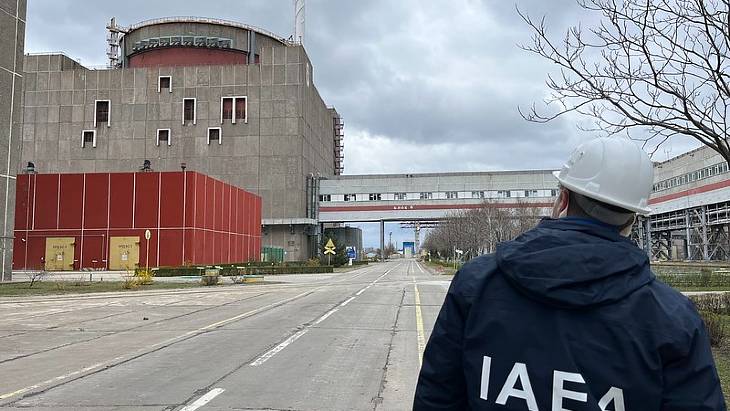
The International Atomic Energy Agency says the backup external power line for Zaporizhzhia Nuclear Power Plant has been reconnected after six months, with the necessary repair work taking place during a temporary truce.
(Image: IAEA)
The agency’s Director General Rafael Mariano Grossi said: "As the damaged sections of the power lines were located in an active combat zone, this required complex negotiations with both sides to establish carefully coordinated temporary truce arrangements so that their technicians could work without risking their own lives. It took several weeks to get to this point, with the plant once again having access to two power lines. It is a good day for nuclear safety and security, although the overall situation remains highly precarious and our important mission in Ukraine is far from over."
The 330 kV Ferosplavna-1 power line was reconnected on Saturday evening, two weeks after the main 750 kV Dnisprovska line was reconnected. When both lines were down, the six-unit plant had had to rely on emergency backup diesel generators for the power it requires to power pumps used for cooling its reactor cores and usedt fuel.
The International Atomic Energy Agency said: "The repairs of the remaining damaged section of Ferosplavna-1 got under way on Saturday morning around three kilometres from the ZNPP's site perimeter after the area had been demined the day before. Technicians repaired a damaged cable between two pylons, with an IAEA team monitoring their work. The line - which had been cut since 7 May 2025 - was finally re-connected to the plant this evening."
The Zaporizhzhia nuclear power plant is on the frontline of Ukrainian and Russian forces and has been under Russian military control since early March 2022. Before the conflict it was connected to the grid through 10 power lines, but that number has fallen since then and the site has lost all external electricity supplies on 10 occasions.
US lab begins TRISO fuel irradiation test
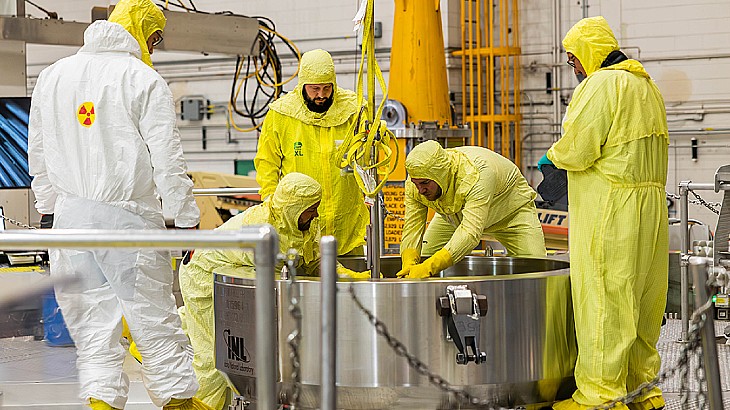
Pebbles of X-energy's TRISO-X fuel have begun 13 months of irradiation testing at Idaho National Laboratory to evaluate fuel performance across operating scenarios and qualify them for commercial use.
One of 16 TRISO-X fuel pebbles that are undergoing testing (Image: INL)
TRISO-X is a specialised version of TRISO (tri-structural isotropic) fuel, fabricated into billiard ball-sized spheres - or pebbles - that will be used to power high temperature gas-cooled reactors, such as X-energy's Xe-100 small modular reactor (SMR). The TRISO particles from which the pebbles are made consist of a uranium, carbon and oxygen fuel kernel encapsulated by three layers of carbon- and ceramic-based materials that prevent the release of radioactive fission products. This novel structure means that the fuel cannot melt in a commercial high-temperature reactor and can withstand extreme radiation and temperatures that are well beyond the threshold of the nuclear fuels that are in use today, according to the US Department of Energy (DOE).
The X-energy Pebble Reactor Test - dubbed XPeRT - will see the fuel undergo irradiation testing in INL's Advanced Test Reactor (ATR), a pressurised water reactor which produces neutrons, rather than heat, to evaluate how TRISO-X fuel performs under various power levels, temperatures, and burnup conditions relevant to the Xe-100 SMR design. Post-irradiation examination at INL and Oak Ridge National Laboratory will measure the fuel's fission product retention and structural stability under the full range of expected commercial operating conditions.
Dan Wachs, the National Technical Director for DOE's Advanced Fuels Campaign, said the experiment cycle at ATR is "a huge one" for advanced nuclear. "The test marks INL's first irradiations of TRISO fuel for advanced reactors since 2020 and the first use a new lead-out test capability at ATR that makes these advanced fuel tests possible," he said.
Loading the TRISO-X experiment into the ATR (Image: INL)
TRISO-X has operated a pilot nuclear fuel fabrication facility at Oak Ridge National Laboratory since 2016. It is planning to build two further facilities at Oak Ridge to manufacture its proprietary fuel for commercial deployment of the Xe-100, which is one of two advanced reactor demonstration projects receiving support through the DOE's Advanced Reactor Demonstration Program. The first of those facilities, TX-1, is already under construction. TRISO-X is also participating in the DOE's Fuel Line Pilot Program, established earlier this year to establish a domestic nuclear fuel supply chain for testing new reactors.
"What began in Oak Ridge as a pioneering effort to advance TRISO manufacturing is now leading the way in qualifying the fuel that will power the next generation of reactors," X-energy CEO Clay Sell said. "TRISO-X embodies decades of US innovation in fuel design and this testing programme brings us one step closer to redefining the standard for safety and reliability in nuclear energy."
The first deployment of the Xe-100 is planned for Dow’s Seadrift site on the Texas Gulf Coast, to supply both power and high-temperature heat to industrial-scale operations. X-energy and Amazon have also committed to the goal of more than 5 GW of new nuclear by 2039, starting with a joint plan with Washington state utility Energy Northwest to build up to 12 SMRs near Energy Northwest's Columbia Generating Station.
China Car Sales Fall as Government Incentives Dry Up
Total passenger car sales in China declined in October from a year earlier for the first time in months as trade-in incentives and subsidies for new vehicle purchases are being phased out.
China’s retail sales of passenger cars fell by 0.8% last month from October 2024, per data by the China Passenger Car Association (CPCA) cited by Bloomberg. Compared to September, car sales also dropped, by 0.1%.
Although the declines seem small, they were the first in many months in the Chinese car market. Excluding the effect of the Lunar New Year in January 2025, which typically sees lower sales, China’s passenger vehicle sales fell for the first time since August 2024.
Some densely-populated provinces and cities, including Shanghai, have begun to phase out the trade-in subsidies rewarding consumers for buying new and more efficient cars.
If these subsidies were to be halted, total car sales in mainland China in 2026 are set for the first decline in six years, Nick Lai, head of auto research in Asia-Pacific at JPMorgan, told the South China Morning Post last month.
Incentives have brought demand forward, so car sales next year could be at zero growth in the best-case scenario, while the most bearish one would see a 5% drop in sales if it pans out, according to JPMorgan.
“We expect retail [car] sales to see flat growth next year in a bullish scenario,” Lai told South China Morning Post in an interview last month.
“The market has more than a 50 per cent chance of seeing year-on-year slippage as meaningful demand may have been brought forward.”
Overall Chinese car sales have been supported by incentives this year, but the underlying weakness persists as the government is trying to tackle the overcapacity in the vehicle manufacturing sector, which has led to price wars and losses for many automakers.
Despite the weakness in total car sales, Chinese demand for electric vehicles continues to support global EV sales.


_67282.jpg)
_45542.jpg)
_92623.jpg)


_62981.jpg)