Monday, November 17, 2025

Trump’s Golden Dome Will Fail at Everything But Enriching Arms Contractors

Job number one in rolling back the Golden Dome boondoggle is simply making it clear that no missile defense system will protect us in the event of a nuclear attack.
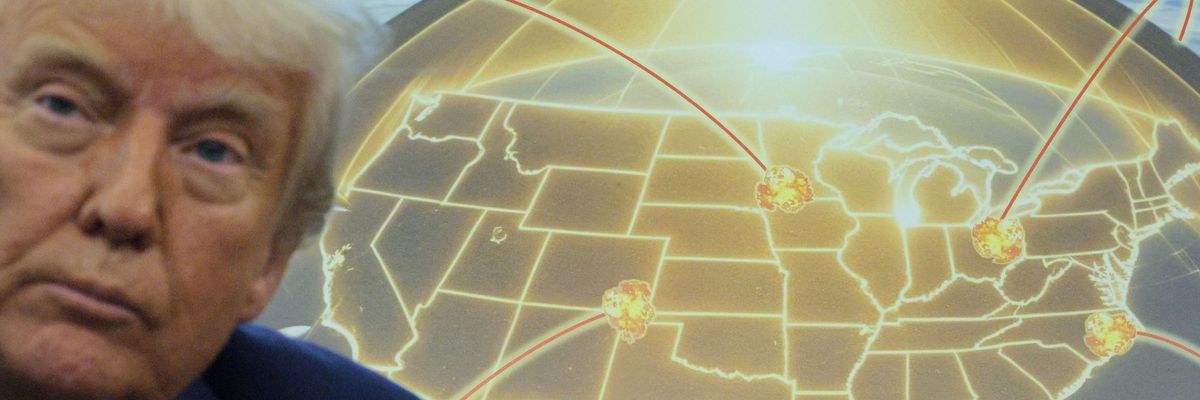

US President Donald Trump speaks in front of a map of Trump’s proposed “Golden Dome” missile defense system in the Oval Office at the White House on May 20, 2025 in Washington, DC.
(Photo by Chip Somodevilla/Getty Images)
William Hartung
Nov 17, 2025
TomDispatch


Kathryn Bigelow’s new nuclear thriller, A House of Dynamite, has been criticized by some experts for being unrealistic, most notably because it portrays an unlikely scenario in which an adversary chooses to attack the United States with just a single nuclear-armed missile. Such a move would, of course, leave the vast American nuclear arsenal largely intact and so invite a devastating response that would undoubtedly largely destroy the attacker’s nation. But the film is strikingly on target when it comes to one thing: its portrayal of the way one US missile interceptor after another misses its target, despite the confidence of most American war planners that they would be able to destroy any incoming nuclear warhead and save the day.

At one point in the film, a junior official points out that US interceptors have failed almost half their tests, and the secretary of defense responds by bellowing: “That’s what $50 billion buys us?”
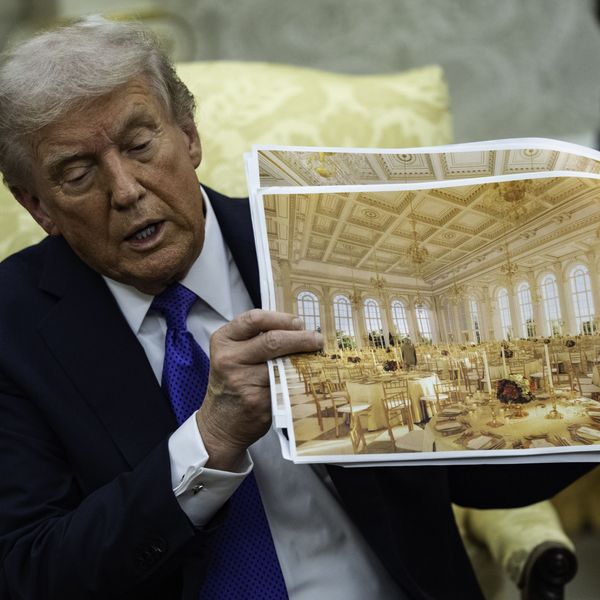


Who’s Financing Trump’s Gilded Ballroom? Weapons Makers, Tech Giants, Private Equity, and More


In fact, the situation is far worse than that. We taxpayers, whether we know it or not, are betting on a house of dynamite, gambling on the idea that technology will save us in the event of a nuclear attack. The United States has, in fact, spent more than $350 billion on missile defenses since, more than four decades ago, President Ronald Reagan promised to create a leak-proof defense against incoming intercontinental ballistic missiles (ICBMs). Believe it or not, the Pentagon has yet to even conduct a realistic test of the system, which would involve attempting to intercept hundreds of warheads traveling at 1,500 miles per hour, surrounded by realistic decoys that would make it hard to even know which objects to target.

Laura Grego of the Union of Concerned Scientists has pointed out that the dream of a perfect missile defense—the very thing President Donald Trump has promised that his cherished new “Golden Dome” system will be—is a “fantasy” of the first order, and that “missile defenses are not a useful or long-term strategy for defending the United States from nuclear weapons.”

Trump’s pledge to fund contractors to build a viable Golden Dome system in three years is PR or perhaps PF (presidential fantasy), not realistic planning.

Grego is hardly alone in her assessment. A March 2025 report by the American Physical Society found that “creating a reliable and effective defense against even [a] small number of relatively unsophisticated nuclear-armed ICBMs remains a daunting challenge.” Its report also notes that “few of the main challenges involved in developing and deploying a reliable and effective missile defense have been solved, and… many of the hard problems we identified are likely to remain so during and probably beyond” the 15-year time horizon envisioned in their study.

Despite the evidence that it will do next to nothing to defend us, President Trump remains all in on the Golden Dome project. Perhaps what he really has in mind, however, has little to do with actually defending us. So far, Golden Dome seems like a marketing concept designed to enrich arms contractors and burnish Trump’s image rather than a carefully thought-out defense program.

Contrary to both logic and history, Trump has claimed that his supposedly leak-proof system can be produced in a mere three years for $175 billion. While that’s a serious chunk of change, analysts in the field suggest that the cost is likely to be astronomically higher and that the president’s proposed timeline is, politely put, wildly optimistic. Todd Harrison, a respected Pentagon budget analyst currently based at the conservative American Enterprise Institute, estimates that such a system would cost somewhere between $252 billion and $3.6 trillion over 20 years, depending on its design. Harrison’s high-end estimate is more than 20 times the off-hand price tossed out by President Trump.

As for the president’s proposed timeline of three years, it’s wildly out of line with the Pentagon’s experience with other major systems it’s developed. More than three decades after it was proposed as a possible next-generation fighter jet (under the moniker Joint Strike Fighter, or JSF), for example, the F-35, once touted as a “revolution in military procurement,” is still plagued by hundreds of defects, and the planes spend almost half their time in hangars for repair and maintenance.

Proponents of the Golden Dome project argue that it’s now feasible because of new technologies being developed in Silicon Valley, from artificial intelligence to quantum computing. Those claims are, of course, unproven, and past experience suggests that there is no miracle technological solution to complex security threats. AI-driven weapons may be quicker to locate and destroy targets and capable of coordinating complex responses like swarms of drones. But there is no evidence that AI can help solve the problem of blocking hundreds of fast-flying warheads embedded in a cloud of decoys. Worse yet, a missile defense system needs to work perfectly each and every time if it is to provide leak-proof protection against a nuclear catastrophe, an inconceivable standard in the real world of weaponry and defensive systems.

Of course, the weapons contractors salivating at the prospect of a monstrous payday tied to the development of Golden Dome are well aware that the president’s timeline will be quite literally unmeetable. Lockheed Martin has optimistically suggested that it should be able to perform the first test of a space-based interceptor in 2028, three years from now. And such space-based interceptors have been suggested as a central element of the Golden Dome system. In other words, Trump’s pledge to fund contractors to build a viable Golden Dome system in three years is PR or perhaps PF (presidential fantasy), not realistic planning.

Who Will Benefit from the Golden Dome?

The major contractors for Golden Dome may not be revealed for a few months, but we already know enough to be able to take an educated guess about which companies are likely to play central roles in the program.

The administration has said that Golden Dome will be built on existing hardware and the biggest current producers of missile defense hardware are Lockheed Martin, Boeing, and Raytheon (a major part of RTX Corporation). So, count on at least two of the three of them. Emerging military tech firms like SpaceX and Anduril have also been mentioned as possible system integrators. In other words, one or more of them would help coordinate development of the Golden Dome and provide detection and targeting software for it. The final choice for such an extremely lucrative role is less than certain, but as of now Anduril seems to have an inside track.

Even after the breakup of the Donald Trump-Elon Musk bromance, the tech industry still has a strong influence over the administration, starting with Vice President JD Vance. He was, after all, employed and mentored by Peter Thiel of Palantir, the godfather of the recent surge of military research and financing in Silicon Valley. Thiel was also a major donor to his successful 2022 Senate campaign, and Vance was charged with fundraising in Silicon Valley during the 2024 presidential campaign. Emerging military tech moguls like Thiel and Palmer Luckey, along with their financiers like Marc Andreessen of the venture capital firm Andreessen Horowitz, view Vance as their man in the White House.

Should the Golden Dome system indeed be launched (at a staggering cost to the American taxpayer), its “gold” would further enrich already well-heeled weapons contractors, give us a false sense of security, and let Donald Trump pose as this country’s greatest defender ever.

Other military tech supporters in the Trump administration include Deputy Secretary of Defense Stephen Feinberg, whose company, Cerberus Capital, has a long history of investing in military contractors and is already pressing to reduce regulations on weapons firms in line with Silicon Valley’s wish list; Michael Obadal, a senior director at the military tech firm Anduril, who is now deputy secretary of the Army; Gregory Barbaccia, the former head of intelligence and investigations at Palantir, who is now the federal government’s chief information officer; Undersecretary of State Jacob Helberg, a former executive at Palantir; and numerous key members of Elon Musk’s Department of Government Efficiency, which took a wrecking ball to civilian bodies like the US Agency for International Development while sparing the Pentagon significant cuts.

Some analysts foresee a funding fight in the offing between those Silicon Valley military tech firms and the Big Five firms (Boeing, General Dynamics, Lockheed Martin, Northrop Grumman, and RTX) that now dominate Pentagon contracting. But the Golden Dome project will have room for major players from both factions and may prove one area where the old guard and the Silicon Valley military tech crew join hands to lobby for maximum funding.

The nation’s premier defense firms and missile manufacturers will likely enjoy direct access to Golden Dome, since the project is expected to be headquartered in Huntsville, Alabama, the “Pentagon of the South.” That self-described “Rocket City” houses the US Missile Defense Agency and a myriad of defense firms (including Lockheed Martin, RTX, General Dynamics, and Boeing). It will also soon host the new Space Force headquarters.

While Huntsville has been a hub for missile defense since President Ronald Reagan’s failed ICBM defense efforts, what makes this placement particularly likely is the significance of Huntsville’s Republican representatives in Congress, particularly Rep. Dale Strong. “North Alabama has played a key role in every former and current US missile defense program and will undoubtedly be pivotal to the success of Golden Dome,” he explained, having received $337,600 in campaign contributions from the defense sector during the 2023-2024 election cycle and cofounded the House Golden Dome Caucus.

His advocacy for the project dovetails well with the power vested in House Armed Services Committee Chairman Mike Rogers (also from Alabama), who received $535,000 from the defense sector during the 2024 campaign. Sen. Tommy Tuberville, a senior member of the Senate Armed Services Committee, and Sen. Katie Boyd Britt, a member of the Senate Golden Dome Caucus, round out Alabama’s Republican Senate delegation.

Many of the leading boosters of the Golden Dome represent states like Alabama or districts that stand to benefit from the program. The bicameral congressional Golden Dome caucuses include numerous members from states already enmeshed in missile production, including North Dakota and Montana, which house ICBMs built and maintained by Northrop Grumman and Lockheed Martin, among other companies.

Those same weapons companies have long been donating generously to political campaigns. And only recently, to curry favor and prove themselves worthy of Golden Dome’s lucrative contracts, Palantir and Booz Allen Hamilton joined Lockheed Martin in donating millions of dollars to President Trump’s new ballroom that is to replace the White House’s devastated East Wing. And expect further public displays of financial affection from arms companies awaiting the administration’s final verdict on Golden Dome contracts, which will likely be announced in early 2026.
The Gold of the Golden Dome

Golden Dome is already slated to receive nearly $40 billion in the next year when funds from President Trump’s “big beautiful bill” and the administration’s budget request for Fiscal Year 2026 are taken into account. The 2026 request for Golden Dome is more than twice the budget of the Centers for Disease Control and Prevention and three times the budget of the Environmental Protection Agency, essential pillars of any effort to prevent new pandemics or address the challenges of the climate crisis. In addition, Golden Dome will undoubtedly siphon into the military sector significant numbers of scientists and engineers who might otherwise be trying to solve environmental and public health problems, undermining this country’s ability to deal with the greatest threats to our lives and livelihoods to fund a defense system that will never actually be able to defend us.

Worse yet, Golden Dome is likely to be more than just a waste of money. It could also accelerate the nuclear arms race between the US, Russia, and China. If, as is often the case, US adversaries prepare for worst-case scenarios, they are likely to make their plans based on the idea that Golden Dome just might work, which means they’ll increase their offensive forces to ensure that, in a nuclear confrontation, they are able to overwhelm any new missile defense network. It was precisely this sort of offensive-defensive arms race that the Anti-Ballistic Missile Treaty of the era of President Richard Nixon was designed to prevent. That agreement was, however, abandoned by President George W. Bush.

A no less dangerous aspect of any future involving the Golden Dome would be the creation of a new set of space-based interceptors as an integral part of the system. An interceptor in space may not actually be able to block a barrage of nuclear warheads, but it would definitely be capable of taking out civilian and military satellites, which travel in predictable orbits. If the unspoken agreement not to attack such satellites were ever to be lifted, basic functions of the global economy (not to speak of the US military) would be at risk. Not only could attacks on satellites bring the global economy to a grinding halt, but they could also spark a spiral of escalation that might, in the end, lead to the use of nuclear weapons.

Should the Golden Dome system indeed be launched (at a staggering cost to the American taxpayer), its “gold” would further enrich already well-heeled weapons contractors, give us a false sense of security, and let Donald Trump pose as this country’s greatest defender ever. Sadly, fantasies die hard, so job number one in rolling back the Golden Dome boondoggle is simply making it clear that no missile defense system will protect us in the event of a nuclear attack, a point made well by A House of Dynamite. The question is: Can our policymakers be as realistic in their assessment of missile defense as the makers of a major Hollywood movie? Or is that simply too much to ask?

© 2023 TomDispatch.com


Ashley Gate
Ashley Gate is a research intern with the Democratizing Foreign Policy program at the Quincy Institute for Responsible Statecraft. Her research focuses on the nexus between international law and U.S. foreign policy. Ashley holds a Master of Laws (LLM) from City University Law School, London.
Full Bio >

William Hartung
William D. Hartung is a Senior Research Fellow at the Quincy Institute for Responsible Statecraft, and the author most recently of "Pathways to Pentagon Spending Reductions: Removing the Obstacles."
Full Bio >
5 Reasons Trump’s Economy Stinks and 10 Things the Dems Should Do About It

The Trump economy is truly sh*tty for most Americans. Democrats need to show America that they can be better trusted to bring prices down and real wages up.


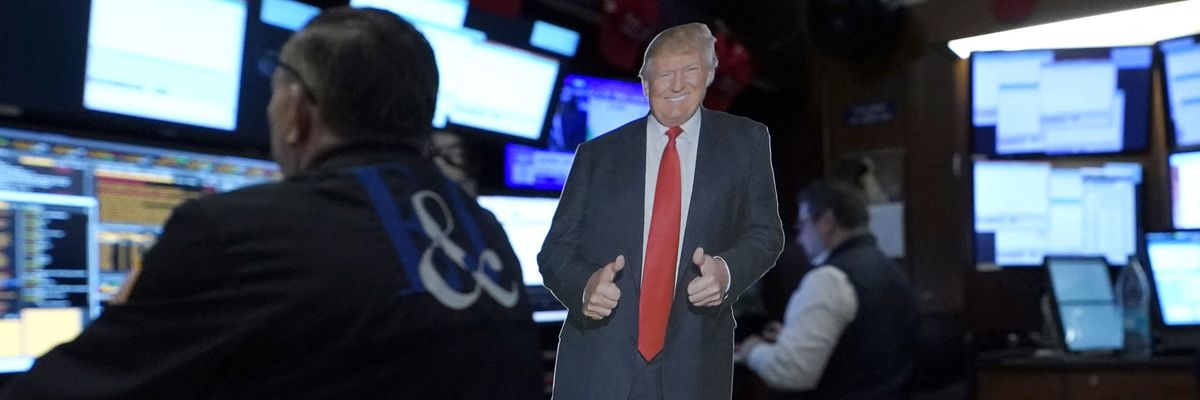
A cutout of then-President-elect Donald Trump is seen as traders and financial professionals work on the floor of the New York Stock Exchange during the first session of the new year on January 2, 2025, in New York City.
(Photo by Timothy A. Clary/AFP via Getty Images)

Robert Reich
Nov 17, 2025
Inequality Media

President Donald Trump claimed last week on social media that “Our economy is BOOMING, and Costs are coming way down,” and that “grocery prices are way down.

Rubbish.
RECOMMENDED...


‘Not a Pretty Picture,’ Expert Says of Trump Economy as Job Growth Grinds to a Halt


Failures of Trumponomics Glaring as Prices, Consumer Anxiety Climb Higher

How do I know he’s lying? Official government statistics haven’t been issued during the shutdown—presumably to Trump’s relief (the White House said Wednesday that the October jobs and Consumer Price Index reports may never come out).

But we can get good estimates of where the economy is now, based on where the economy was heading before the shutdown and recent reports by private data firms.

First, I want to tell you what we know about Trump’s truly sh*tty economy. Then I’ll suggest 10 things that Democrats should pledge to do about it.
1. Prices Continue to Rise as Real Wages Fall

While the cost of living isn’t going up as fast as it did in 2022, consumer prices are still up 27% since the onset of the pandemic. Wages haven’t kept up.

Americans know this. In a recent Harris poll, 62% say the cost of everyday items has climbed over the last month, and nearly half say the increases have been difficult to afford.

Much of this is due to Trump’s tariffs, which are import taxes—paid by American corporations that are now passing many of the costs on to consumers. Even Trump knows this, which is why he’s removing tariffs on coffee, bananas, beef, and other agricultural commodities. But his other tariffs will remain, boosting the costs of everything else.

Every time Trump or his lapdogs in Congress tell Americans that the economy is terrific, they seem more out of touch with reality.

As a result, wages—when adjusted for inflation—have been falling, government and private-sector data show. Since the start of the year, inflation has been rising faster than after-tax pay for lower- and middle-income households, according to the Bank of America Institute.

According to the JPMorganChase Institute, the rate of real income growth has slowed to levels last seen in the early 2010s, when the economy was still recovering from the financial crisis and the unemployment rate was roughly double what it is today.
2. Job Growth Has Stalled

Americans are scared of losing their jobs. In the same recent Harris poll I referred to above, 55% of employed workers say they’re worried they’ll be laid off.

That worry is borne out in the data. Indeed’s job posting index has fallen to its lowest level since February 2021.

The Fed’s Beige Book—which compiles reports from Fed branches all over the country—also shows the job market losing steam.

The latest ADP private-sector data confirms that the labor market continued to weaken in the latter half of October, with more than 11,000 jobs lost per week on average.

Finally, Challenger, Gray & Christmas (a private firm that collects data on workplace reductions) reports that US employers have announced 1.1 million layoffs so far in 2025. That’s the most layoffs since 2020, when the pandemic slammed the economy, and rivals job cuts during the Great Recession of 2008 and 2009.
3. Homeowners Are Underwater, and Foreclosures Are Up

Nearly 900,000 homeowners (about 1.6% of all mortgage holders) are now underwater on their mortgages, the highest share in three years. Many of these buyers purchased in 2022-24 with low down payments in markets that have since cooled.

At the same time, filings for home foreclosures are up about 17% since the third quarter last year (according to ATTOM Data Solutions), suggesting more borrowers in trouble.
4. Corporate Profits Continue to Rise

You might think that with all these stresses on American consumers, corporate profits would dip. But in reality, US corporate profits continue to rise, and the stock market continues to hit new highs (although the stock market is wobbly, as I’ll get to in a moment).

As a result, the investor class—the richest 10% of Americans, who own over 90% of the stock market—are reaping big rewards.

How to square this with all the layoffs and so few job openings? Amazon’s profits are through the roof, but it’s laying off 30,000 people.

First, corporations are reluctant to expand and hire because of so much uncertainty about the future, caused in large part by Trump’s tariffs and his expulsion from the US of many workers critical to the agriculture and construction industries.

Secondly, profits are being led by the six major high tech firms, whose monopolistic hold over their markets has given them the power to raise prices.

Third, many corporations are making use of artificial intelligence. AI is boosting business productivity while reducing the demand for workers. We’re seeing that trend mostly in the technology sector, which continues to substitute AI for jobs. But the trend seems to be spreading to other industries.
5. Inequality Is Widening

Put this all together and you get a two-tier economy whose inequality gap is widening.

America has always had a two-tiered economy, but for the last 80 years, the middle class has been in the upper tier along with the wealthy, while the working class and poor have been in the lower one.

Now, the middle class is joining the lower tier. This new reality has huge implications both for the economy and for American politics.

The richest 10% of households—whom I’ve described as the investor class—now account for nearly half of total US spending, thanks to the stock market surge. (Thirty years ago they were responsible for about a third.)

Meanwhile, middle- and lower-income families are pulling back. They’re facing tightening budgets, higher living costs, declining real wages, and a raft of corporate layoffs.

The consequent divergence in spending—with a smaller group of people keeping the economy going—is fueling concerns that the US economy is becoming more fragile.

With the economy so dependent on the richest 10%—who in turn are highly dependent on the stock market—a stock market downturn would raise risk of a serious recession.
6. What the Democrats Must Pledge to America

The Trump economy is truly sh*tty for most Americans. Every time Trump or his lapdogs in Congress tell Americans that the economy is terrific, they seem more out of touch with reality.

Democrats need to show America that they can be better trusted to bring prices down and real wages up.

This means, in my view, promising the following 10 things. These should constitute the Democrats’ pledge to America:Trump’s across-the-board tariffs are import taxes that are raising the prices of just about everything American consumers buy. Democrats will eliminate them where their costs to consumers are far higher than any potential benefits in the form of new jobs.
Another major source of high prices is monopolies—especially in high tech, healthcare, food, and finance. Democrats will vigorously enforce antitrust (anti-monopoly) laws. Giant corporations will be busted up. Mergers or acquisitions by large firms, barred.
Workers need more bargaining power to get higher wages. Part of the answer is stronger unions. Democrats will make it easier for them to start or join unions.
The national minimum wage will be raised to $20 an hour. No one who works full time should be in poverty.
Housing cost increases will be slowed by stopping private equity firms from buying up large tracts of housing and colluding on prices.
Healthcare costs will be lowered by making Medicare available to everyone.
Working families will get help with childcare and eldercare.
They’ll also get paid family leave.
If adequate-paying jobs are unavailable, workers will also have access to a universal basic income. It won’t make families comfortable, but it will be enough to keep them out of poverty.
Taxes will be raised on the wealthiest to pay for this.


© 2025 Robert Reich


Robert Reich
Robert Reich is professor emeritus of public policy at Berkeley and former US secretary of labor. His latest book is the No. 1 New York Times best-seller, "Coming Up Short."
Full Bio >
Viewership doubles as cartoon becomes 'surprising voice of resistance'

November 08, 2025
ALTERNET

Ratings for Comedy Central’s “South Park” have surged, and its creators probably have political resentment to thank.

New York Times columnist John Koblin reports creators Matt Stone and Trey Parker have a thing for taboos, and they “sensed a fear of speaking out against the administration” as one of the latest taboos to exploit.

“Trey and I are attracted to that like flies to honey,” said Stone. “Oh, that’s where the taboo is? Over there? OK, then we’re over there.”

The results speak for themselves as the latest season delivers “withering attacks against President Trump and his team of advisers,” which has made the show “a surprising voice of the resistance and catapulted the show back into relevance,” said Koblin.

“Viewership over the past four months is more than double [that of] 2023, the last year the show had a new season, according to Nielsen. ‘South Park’ has gotten so popular so quickly that entertainment websites have alerted even minor scheduling changes.

Koblin points out that the show focused its efforts on the White House at a time when creators’ own network has shown remarkable vulnerability and deference to Trump.


The tirade of cartoon attacks “has come immediately after Paramount, Comedy Central’s parent, changed owners in a series of events that appeared to cater to Mr. Trump,” said Koblin. “It has also aired during a few chaotic months in the comedy world. Paramount abruptly announced in July that it would cancel Stephen Colbert’s late-night show after this season, and Disney temporarily pulled Jimmy Kimmel’s competing show off the air in September after pressure from a top Trump administration official.”

At that time of production, Parker and Stone were in the middle of a high-profile contract negotiation with Paramount, and they felt that a new season deal was being delayed because of the looming merger of Paramount and Skydance, a production company run by Trump ally David Ellison. The merger deal required the blessing of the Trump’s administration.

“… We just had to show our independence somehow,” Creaters said.

The first episode debuted just hours after a five-year contract worth $1.25 billion was signed, launching broadsides against Trump and Paramount because of the cancellation of Colbert’s show. The creators initially thought Trump’s obnoxious character could be a one-off, but they felt they had found a “vein of comedy” in the first episode, according to Stone.

Returning to traditional “South Park” drama and abandoning MAGA was a possibility until creators decided “there’s no getting away from this,” according to Parker.

“It’s like the government is just in your face everywhere you look,” he said.


'Isn't this blasphemous?' Chatbots let users talk to 'Jesus' — and even 'Satan'

November 12, 2025
 ALTERNET


As Americans drift from organized religion and congregations consolidate, pastors are turning to artificial intelligence to shoulder parts of their ministry — while some worshippers are turning to AI for something else entirely. Certain AI tools help clergy manage schedules or craft sermons; others invite believers to text directly with “Jesus,” or even “Satan.”

Calling it a “new digital awakening,” Axios reports that “AI is helping some churches stay relevant in the face of shrinking staffs, empty pews and growing online audiences. But the practice raises new questions about who, or what, is guiding the flock.”

“New AI-powered apps allow you to ‘text with Jesus’ or ‘talk to the Bible,’ giving the impression you are communicating with a deity or angel,” according to Axios. “Other apps can create personalized prayers, let you confess your sins or offer religious advice on life’s decisions.”

The apps that “allow” people to “talk” to “Jesus,” “Mary,” the “Bible,” or even “Satan” are reportedly the most popular.


“What could go wrong?” Robert P. Jones, CEO of the nonpartisan Public Religion Research Institute, sarcastically asked, according to Axios.

Text With Jesus bills itself as “a new, interactive way to engage with your faith.” Its website calls it “a revolutionary AI-powered chatbot app, designed for devoted Christians seeking a deeper connection with the Bible’s most iconic figures.”

In the FAQ section of the website, one question asks, “Am I really talking to Jesus? Isn’t this blasphemous?”


“Our app is a tool for exploration, education, and engagement with biblical narratives,” is the response, “and it is not intended to replace or mimic direct communication with divine entities, which is a deeply personal aspect of one’s faith.”

Last month, FOX 32 Chicago reported on criticism of the app.

“Critics call the app blasphemous. In an essay for The PreachersWord, minister Ken Weliever wrote that he would ‘just open my Bible and read it for myself,’ questioning how accurate an AI ‘Jesus’ could ever be. He pointed to answers on same-sex marriage signed with rainbow emojis and called the app’s ‘Satan’ feature chilling.”

“Moody Center President James Spencer wrote in The Christian Post the AI ‘Jesus’ seemed ‘less concerned with fulfilling the Law and the Prophets than providing answers palatable to the itching ears of 21st century users.'”

According to the app’s Mac App Store pages, the company that produces Text With Jesus has additional offerings, including Text With History, Text With Authors, Texts From Bernie Sanders, and Texts From Oscar Wilde.


Why are so many people still looking for Amelia Earhart?


American pilot Amelia Earhart with her navigator, Captain Fred Noonan, in the hangar at Parnamerim airfield, Brazil, on June 11 1937. Topical Press Agency/Getty Images
 Program Director for the Bachelor of Aviation
November 13, 2025 

It has been more than 88 years since the world’s most famous female aviator, Amelia Earhart, and her navigator Fred Noonan, disappeared on the second-last leg of their around-the-world flight odyssey.

According to the United States government’s official report of the 16-day search, Earhart and Noonan ran out of fuel and crashed into the Pacific Ocean, short of their objective of Howland Island, on July 2 1937.

The disappearance, which is often labelled as “mysterious”, continues to captivate the world. With no confirmed wreckage found, millions of dollars have been spent on repeated, fruitless searches. And sensational claims of a possible discovery make splashy headlines with alarming regularity.

Interest in Earhart’s case has also been bolstered by United States President Donald Trump who, in September, said he would order his administration to declassify secret government records related to the disappearance.

A cycle of discovery and disappointment

Many expeditions for Earhart have followed a predictable four-step pattern: a dramatic announcement of a new, startling find; “we found Amelia” stories in the press; the evidence is quietly debunked, or the expedition is postponed; the coverage fades from the media cycle until the next “startling find”. And repeat.

In recent months, we have seen extensive media coverage of yet another such planned expedition. The destination is the so-called “Taraia object”, photographed off Nikumaroro Island, Kiribati – some 644km south-west of Earhart’s destination of Howland Island.

The expedition team includes experts from Purdue University, and the Archaeological Legacy Institute (ALI), headed by ALI’s Executive Director Richard Pettigrew.

It is based on a hypothesis by The International Group for Historic Aircraft Recovery (TIGHAR) that Nikumaroro Island was the final destination of Earhart and Noonan. However, the US government’s initial search (which included Nikumaroro) turned up no evidence of Earhart, Noonan or the aircraft.

Still, the joint ALI and Purdue team seem hopeful. As Pettigrew told Newsweek:
Everything that we see indicates it’s very possible, perhaps even likely, that this is what remains of Amelia Earhart’s aircraft.


The Conversation reached out to TIGHAR founder Ric Gillespie, who said he does not think the Taraia object is the wreck of Earhart’s Lockheed Model 10E Electra aircraft.

Originally scheduled to launch on November 4, the joint ALI and Purdue expedition was postponed last month due to issues with getting permits from the Kiribati government.

ALI continues to publicly fundraise for it, hoping to reach a target of US$900,000 for “Phase 1” (a site visit). Estimated costs for the proposed Phase 2 (the archaeological excavation) and Phase 3 (the “recovery of the aircraft remains”) are yet to be released.

Before ALI, there was TIGHAR

TIGHAR was founded by as a private non-profit in 1985 by Ric Gillespie, and has been searching for aircraft wrecks, including Earhart’s, since 1989. It has mounted at least five expeditions to Nikumaroro since 2010.

Last year, Gillespie said he was “absolutely certain” Earhart crash-landed and lived as a castaway on Nikumaroro Island. But no definitive evidence has been presented.

The organisation has never recovered a complete aircraft of any type, nor a single verified piece of an historic aircraft. For each search project, it raises funds from members, the public, and other interested parties.

Although Gillespie told The Conversation TIGHAR is currently “not fundraising for Earhart research or expeditions”, the organisation’s website contradicts this.

Dorothy Cochrane, a now-retired curator of the Smithsonian National Air and Space Museum, and a long time sceptic of TIGHAR’s work, said in 2016:
He’s (Ric Gillespie) used the same quote unquote evidence over and over again. […] He does this on a routine basis whenever he wants to mount another expedition … It’s his business. It’s his livelihood.

TIGHAR generates income through multiple channels, including various tiers of membership fees, the sale of publications, and general donations. But its website provides little information regarding how funds are allocated to or used within projects.

In response to questions about transparency around how donations are used, Gillespie told The Conversation:
TIGHAR is a recognised educational non-profit foundation. Like any non-profit organisation, we raise money to cover the cost doing our work. All US non-profits are prohibited from “making” money. All money raised is put into the organisation.

Professional heritage and preservation organisations have also raised concerns regarding private bodies searching for, and salvaging, historic wrecks – especially when such organisations only speak of finding and recovery, and not of subsequent preservation or research.

The competing hypotheses

There are several competing views on what happened to Earhart. Some searchers follow the official report’s finding that she crashed and sank close to Howland Island.

In January 2024, much media hype was generated by a sonar image – taken by exploration company Deep Sea Vision – of what some claimed was Earhart’s aircraft. But in November, it was revealed to be a natural rock formation, with far less publicity. Many people will have seen the “discovery”, but not the correction.

The Nauticos Corporation has also been searching for Amelia since 2001, mounting searches in 2002, 2006 and 2017. Each one has come back empty-handed.

Some searchers have also put forward outlandish theories that have all been debunked. These include the claims that Earhart was a spy for then US president Franklin D. Roosevelt, that she crashed in Papua New Guinea, that she was taken prisoner by the Japanese, and that she survived the flight and returned to live anonymously in the US.

Cultural fascination and media myth-making

The global media loves a sensational story: if it bleeds, it leads. But while there’s no fresh blood in the Earhart story, the legacy and modern media have contributed to the proliferation of reports from dubious organisations.

This kind of sensationalism can overshadow critical inquiry, and lead to unsupported claims being remembered long after quiet retractions and scientific rebuttals are published.

At the time of her death, Earhart was among the most famous women in the world. She was a record-breaking pilot, best-selling author, feminist hero and friend of the first lady Eleanor Roosevelt. She disappeared at the peak of her career, and towards the end of the golden age of aerial exploration.

Even people with no interest in historical aviation or aviation archaeology have heard of her, and want to read about the next expedition to find her. But at what cost?

Each high-tech expedition costs millions of dollars. As yet, not one has produced irrefutable evidence of the wreckage. As searches continue, we must ensure they are supported by ethical funding and evidenced-based reporting.

The story of Earhart’s disappearance persists not just because of what we don’t know, but because of how we choose to keep the myth alive. Perhaps one day we can let her rest in peace.

Natasha Heap, Program Director for the Bachelor of Aviation, 
University of Southern Queensland

This article is republished from The Conversation under a Creative Commons license. Read the original article.
The progressive paradox of having a dog

November 17, 2025 


I’ve been a vegetarian for over a decade. It’s not because of my health, or because I dislike the taste of chicken or beef: It’s a lifestyle choice I made because I wanted to reduce my impact on the planet. And yet, twice a day, every day, I lovingly scoop a cup of meat-based kibble into a bowl and set it down for my 50-pound rescue dog, a husky mix named Loki.

This story was originally published by Grist. Sign up for Grist's weekly newsletter here.

Discover more
Raw Story

Until recently, I hadn’t devoted a huge amount of thought to that paradox. Then I read an article in the Associated Press headlined “People often miscalculate climate choices, a study says. One surprise is owning a dog.”

The study, led by environmental psychology researcher Danielle Goldwert and published in the journal PNAS Nexus, examined how people perceive the climate impact of various behaviors — options like “adopt a vegan diet for at least one year,” or “shift from fossil fuel car to renewable public transport.” The team found that participants generally overestimated a number of low-impact actions like recycling and using efficient appliances, and they vastly underestimated the impact of other personal decisions, including the decision to “not purchase or adopt a dog.”

The real objective of the study was to see whether certain types of climate information could help people commit to more effective actions. But mere hours after the AP published its article, its aim had been recast as something else entirely: an attack on people’s furry family members. “Climate change is actually your fault because you have a dog,” one Reddit user wrote. Others in the community chimed in with ire, ridiculing the idea that a pet Chihuahua could be driving the climate crisis and calling on researchers and the media to stop pointing fingers at everyday individuals.


Goldwert and her fellow researchers watched the reactions unfold with dismay. “If I saw a headline that said, ‘Climate scientists want to take your dogs away,’ I would also feel upset,” she said. “They definitely don’t,” she added. “You can quote me on that.”

The study set out to understand how to shift behavior by communicating climate truths. Instead, its media coverage revealed a troubling psychological trade-off: When climate-related messaging strikes a nerve, it may actually turn people off from the work of shifting societal norms.

It’s an instinct I understand on some level. I love Loki, and my knee-jerk reaction is to defend the very personal choice of sharing one’s life with a dog. I also sympathize with redirecting the blame toward the biggest polluters: billionaires and fossil fuel companies (not Bon-Bon, the pet Chihuahua in question). But is it irresponsible to shrug off any conversation about the environmental impact of our pets — something far more within our control than, say, the overthrow of capitalism?

Is there a way to have a frank discussion about the climate impact of our personal lives without it going to the dogs?

Oftentimes, when I’m questioning how a particular climate behavior might fit into my life, I try to imagine how it looks in my vision of a sustainable future. It’s why, for instance, I don’t own a car and am dedicated to riding public transit, even though it isn’t always super convenient. I’m keen to be an early adopter of systems I believe in. But I struggle to imagine a future without companion animals, even knowing about their environmental impact — which is admittedly substantial.

Dogs and cats eat meat-heavy diets, which is where the bulk of their carbon pawprint comes from. A 2017 study from UCLA found that dogs and cats are responsible for about 25 to 30 percent of the environmental impact of meat consumption in the United States. That’s equivalent to a year’s worth of driving by 13.6 million cars. For pets that eat traditional kibble or wet food, that protein may come from meat byproducts — otherwise-wasted animal parts, such as organs and bones, not approved for human consumption. But an increasing number of pet owners are opting to feed their fur babies “human-grade” meat products, which requires additional resources and generates extra emissions.


After they eat, of course, they poop. A lot. At least for dogs, that poop typically gets bagged in plastic and sent to the landfill. And it turns out all the biodegradable poop bags I’ve diligently bought over the years don’t help matters much; they also release greenhouse gases in landfills, and most composting programs don’t accept pet waste.

With more dogs around than ever before — the U.S. dog population has steadily increased from 52.9 million in 1996 to a new peak of 89.7 million in 2024 — their overall climate toll is more than a Chihuahua-sized issue. But pets are also more than just sources of carbon pollution. According to a 2023 Pew Research poll, 97 percent of owners say they consider their pets to be part of their families, with 51 percent of respondents saying they are on the same level as a human family member. So whenever their climate impact crops up in the discourse, as it has periodically, it makes sense that people tend to get defensive.
This don’t-you-dare-take-away-my-dog-you-horrible-environmentalist backlash is certainly not the first time the climate movement has been accused of depriving people of the things they love. Climate policy has long been painted as a force for austerity, coming for your burgers, your gas stoves, your coal-mining jobs. That framing has been politically potent, used by fossil fuel interests and their allies to stoke resentment and delay government action. Big Oil at once wants us to believe that the climate crisis is our fault and that we shouldn’t have to give up anything to fix it.

For some climate advocates, the solution has been to shift messaging away from individual responsibility and focus instead on big, systemic changes like overhauling our electricity and transit systems through governmental investment in clean energy. In her essay “I work in the environmental movement. I don’t care if you recycle,” author and podcaster Mary Annaïse Heglar wrote: “The belief that this enormous, existential problem could have been fixed if all of us had just tweaked our consumptive habits is not only preposterous; it’s dangerous … It’s victim blaming, plain and simple.”


Heglar and others have taken a strong stance against environmental purity — the idea that you can’t care about or advocate for systems-level change if you aren’t first changing your own habits. But not everyone agrees that individual actions should be completely deemphasized in the climate conversation. Kimberly Nicholas, a climate scientist and author of the popular book Under the Sky We Make, has argued that wealthy people living in wealthy countries — and globally, “wealthy” is a lower bar than you might think — do have a responsibility to slash their outsize carbon emissions. And particularly for those of us living in democracies, personal action isn’t just about the choices we make as consumers.

“There’s still an ongoing tension between personal and system change, or individual and collective action,” Nicholas said. “It’s really hard to get that right — to get the right balance there that acknowledges the role and the importance of both, and to talk about and study and describe both in a way that motivates people to take high-impact actions.”

Goldwert saw that tension play out in her maligned climate communications study. In the experiment, participants reviewed 21 individual climate actions (like eating less meat) and five systemic actions (like voting) and rated their commitments to taking each action. Two test groups then received clarifying information about the relative impact of the 21 individual actions — one group was asked to estimate their ranking before learning how they actually ranked, the other group received the information straight-up. But participants didn’t receive any data about the carbon-mitigation potential of the five collective actions, which would be far more difficult to quantify.

What Goldwert’s team found surprised them: The teachings did nudge people toward higher-impact personal actions, but their stated likelihood of engaging in collective ones actually went down — a backfire effect that hints at the perils of focusing too much on personal lifestyle choices.


“It might be kind of like a mental substitution,” Goldwert said. “People feel like, ‘OK, I’ve done my part individually. I kind of checked the box on climate action.’”

Participants were also asked to rate the “plasticity” of each of the actions, or how easy it would be to adopt. And those measurements revealed another nuance in how people view different forms of climate action. For the individual-focused options, participants were more likely to commit to actions they saw as requiring little effort. For the systemic actions, they were more interested in whether it would have an impact — something researchers are still working on quantifying.

“If you think voting or marching is just symbolic or ineffective, you’re not going to engage,” Goldwert said. “We have to show people evidence that their voice or their vote can shift policy, corporate practices, or social norms.”

I, for one, was surprised to see that participants rated the commitment to “not purchase or adopt a dog” as easy. When I asked Goldwert what might be behind that, she noted that dog ownership is a decision people don’t make very often. It also doesn’t require any action at all for people who already don’t own dogs. The results surely would have been different if the listed action was “get rid of your existing dog.” (Which it was not — a point that readers seemed to miss, based on Reddit comments about the study and the “crazy emails” Goldwert said she received.)


Still, for an animal lover like me, the idea of never adopting another dog doesn’t feel easy to commit to at all. It feels like an immense sacrifice. The sadness I feel at the thought of a future without dogs points me to another important factor when it comes to motivation for climate action: joy.

Actions we take to try and mitigate the climate crisis may be partially driven by how easy they are for us or how effective we believe them to be — but any choice we make is also driven by what we find joy in. It’s an essential part of staying committed and resilient in the fight for a better future. In this way, carbon-intensive activities like dog ownership have value beyond their weight in emissions.

“People have an emotional attachment to the people and animals and creatures that we love,” Nicholas said. “And that is actually, I think, very powerful. We’re not only going to solve climate change by lining up all the numbers — we certainly need to do that, but we have to tap into what people really care about and realize all those things are on the line and threatened by the amount of climate change we’re heading for with current policies.”

Would I fight to ensure that dogs, like my beloved Loki, can continue wagging happily on this planet? Heck yes, I would. I’ve always felt that being a pet person goes hand-in-hand with a sense of altruism and responsibility. And if not giving up our pets means fighting climate change by voting, marching, donating, advocating, and consuming like our pets’ lives depend on it, I think we can all get on board.

That might also mean adjusting our pets’ diets. While making my dog a full vegetarian seems challenging (though technically possible), just cutting out beef has a significant impact — shifting to “lower-carbon meats” was even one of the high-impact actions included in Goldwert’s study. That’s one Loki can easily commit to. And we already buy insect-based treats, which leave a pungent odor in my pockets but seem to please his taste buds.

There are also ways that dog ownership intersects with other climate-related behaviors. Anecdotally, I would say I travel less because I have a dog whose care I need to think about. Walking him every day has also made me vastly more connected to my local environment, the goings-on in my neighborhood, and my neighbors themselves — all of which are important aspects of building climate resilience. Some dogs have even been trained to sniff out invasive species and help identify environmental contaminants. (Not Loki, who has never worked a day in his life.)

Though I’d never thought about it quite this way before I read Goldwert’s study, the climate actions I take have a lot to do with the love I feel for Loki. Not because I want to leave a better world for him — I recognize the reality that I will almost certainly outlive him — but because my feelings for him bring me closer to the love I feel for all living things on this planet. This “ice age predator” who shares my home, as the anthropologist and comedian David Ian Howe puts it, is a living reminder of the relationship humans have with other species, going back many thousands of years.

As the saying goes, “Be the person your dog thinks you are.” And next time you get a little worked up about the realities of the climate crisis and your accountability within it, consider taking yourself on a walk.

This article originally appeared in Grist at https://grist.org/culture/the-climate-paradox-of-having-a-dog/.

Grist is a nonprofit, independent media organization dedicated to telling stories of climate solutions and a just future. Learn more at Grist.org
What is Fusarium graminearum — the fungus a Chinese scientist smuggled into the US?


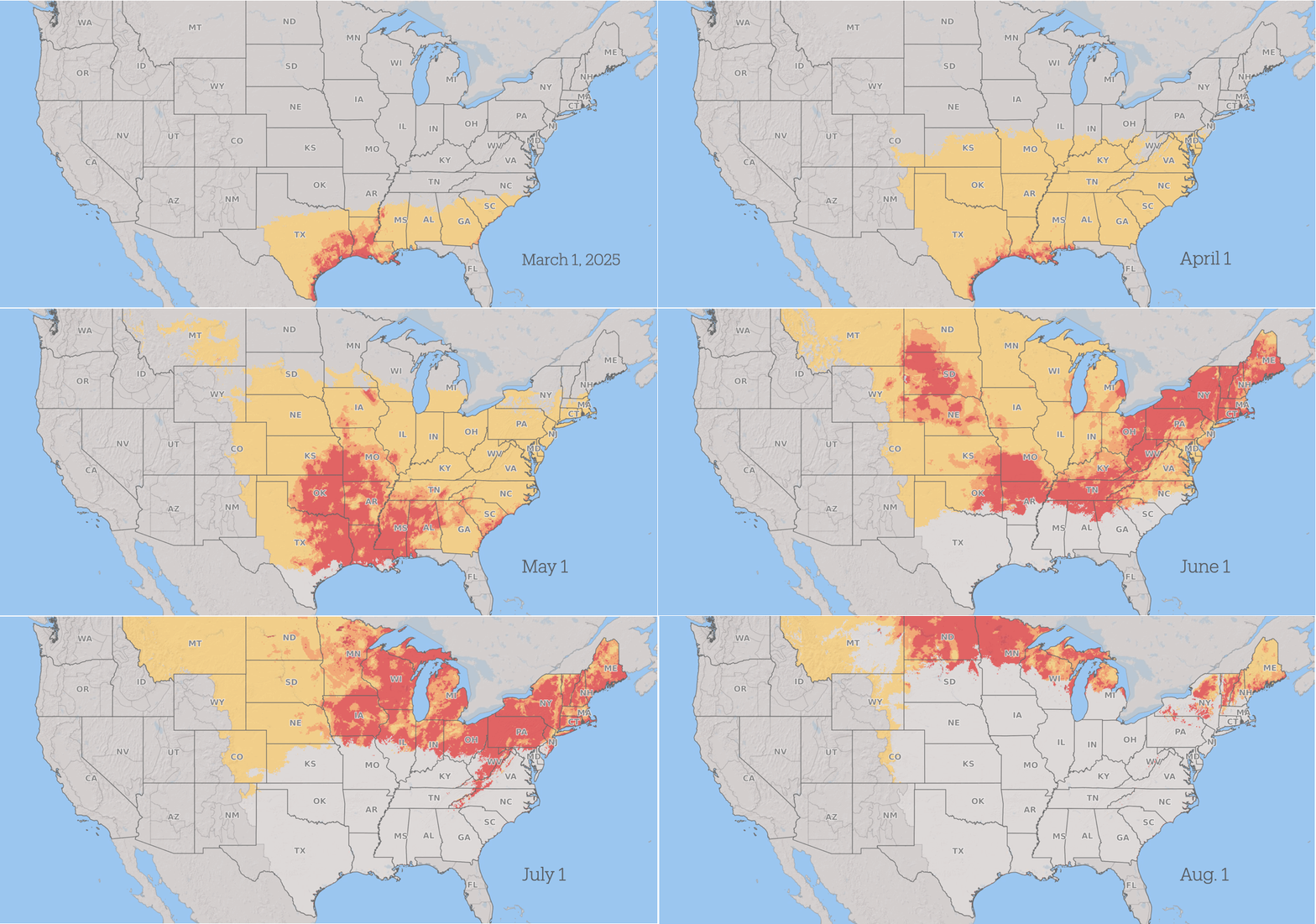
How Fusarium graminearum risk progressed in 2025. Yellow is low risk, orange is medium risk, and red is high risk. Fusarium Risk Tool/Penn State
November 17, 2025 

A Chinese plant scientist at the University of Michigan who drew national attention in June 2025 when she was arrested and accused along with another Chinese scientist of smuggling a crop-damaging fungus into the U.S. pleaded guilty on Nov. 12, 2025, to charges of smuggling and making false statements to the FBI. Under her plea agreement, Yunqing Jian, 33, was sentenced to time served and expected to be deported. She wrote in a statement for the court that she was working on ways to protect crops from disease.

Her arrest put a spotlight on Fusarium graminearum, a harmful pathogen. But while its risk to grains such as wheat, corn and rice can be alarming, Fusarium isn’t new to American farmers. The U.S. Department of Agriculture estimates it costs wheat and barley farmers more than $1 billion a year.

Tom Allen, an extension and research professor of plant pathology at Mississippi State University, explains what Fusarium graminearum is and isn’t.

What is Fusarium graminearum?

Fusarium graminearum is a common fungal plant pathogen that creates problems for farmers across the U.S.

It causes a disease in barley and wheat called Fusarium head blight, or scab. It can also damage rice and rot corn ears and stalks. In severe cases, scab could cut a farm’s yield by 45%.

Scab has been responsible for some of the greatest annual crop losses in the U.S. In 2024, estimates from extension and research plant pathologists suggested scab reduced the U.S. wheat crop by approximately 31 million bushels or roughly 2%.

When compared with other wheat diseases that harm the head and kernels, scab is by far the most concerning because it occurs across wide areas and affects the crop at advanced growth stages.

Why is Fusarium graminearum a concern?

As a plant pathogen, the fungus responsible for scab produces a mycotoxin in grain that can harm humans and livestock. In addition, when wheat grain used for seed is infested with the fungus, the seeds are less likely to germinate and produce new plants in the next growing season.

The mycotoxin is widely categorized as a vomitoxin. It can induce vomiting if ingested in high enough concentrations, but prolonged exposure can also cause gastronintestinal damage, harm the immune system and inflame the central nervous system.

In animals, repeated exposure to the mycotoxin in food can decrease their growth and weight, and livestock can develop an immune response to the toxin that can harm their ability to reproduce.

The U.S. Food and Drug Administration has issued advisory levels, basically limits for the amount of mycotoxin considered a health hazard in grain products.

Since barley and wheat are important as food for humans and livestock, harvested grain is routinely tested when farmers bring their crops to grain elevators for sale. Entire loads of grain may be rejected if they’re found to have mycotoxin concentrations above the FDA limits.

Wheat can be treated to remove scabby kernels. If mycotoxin levels aren’t too high, it could also be used for livestock feed. The advisory threshold for the mycotoxin is higher for adult cattle and chickens, at 10 parts per million, than it is for humans, at 1 ppm.

What does the law say about importing and moving plant pathogens?

These risks are why importing and even moving plant pathogens within the U.S. is regulated by the U.S. Department of Agriculture’s Animal and Plant Health Inspection Service, or USDA-APHIS, through the Plant Protection Act of 2000.

Federal law restricts the movement of plant pathogens, including bacteria, fungi and viruses, even for research purposes, as well as their release into the environment. A scientist who wants to move a plant pathogen, either within the U.S. or from outside the U.S., must go through a permitting process with USDA-APHIS that can take up to six months to complete.

The goal of these rules is to reduce the risk of introducing something new that could be even more destructive for crops.

Even with Fusarium graminearum, which has appeared on every continent but Antarctica, there is potential for introducing new genetic material into the environment that may exist in other countries but not the U.S. and could have harmful consequences for crops.

How do you manage Fusarium graminearum infections?

Fusarium graminearum infections generally occur during the plant’s flowering, rainfall and periods of high humidity during early stages of grain production.

Wheat in the southern U.S. is conducive to infection during the spring. As the season progresses, the risk from scab progresses north through the U.S. and into Canada as the grain crops mature across the region, with continued periods of conducive weather throughout the summer.

Between seasons, Fusarium graminearum survives on barley, wheat and corn plant residues that remain in the field after harvest. It reproduces by producing microscopic spores that can then travel long distances on wind currents, spreading the fungus across large geographic areas each season.

In wheat and barley, farmers can suppress the damage by spraying a fungicide onto developing wheat heads when they’re most susceptible to infection. Applying fungicide can reduce scab and its severity, improve grain weight and reduce mycotoxin contamination.

However, integrated approaches to manage plant diseases are generally ideal, including planting barley or wheat varieties that are resistant to scab and also using a carefully timed fungicide application, rotating crops, and tilling the soil after harvest to reduce residue where Fusarium graminearum can survive the winter.

Even though fungicide applications may be beneficial, fungicides offer only some protection and can’t cure scab. If the environmental conditions are extremely conducive for scab, with ample moisture and humidity during flowering, the disease will still occur albeit at reduced levels.

Plant pathologists are making progress on early warning systems for farmers. A team from Kansas State University, Ohio State University and Pennsylvania State University has been developing a computer model to predict the risk of scab. Their wheat disease predictive model uses historic and current environmental data from weather stations throughout the U.S., along with current conditions, to develop a forecast.

In those areas that are most at risk, plant pathologists and commodity specialists encourage wheat growers to apply a fungicide during periods when the fungus is likely to grow to reduce the chances of damage to crops and the spread of mycotoxin.

Tom W. Allen, Associate Research Professor of Plant Pathology, Mississippi State University

This article is republished from The Conversation under a Creative Commons license. Read the original article.


Bangladesh's Hasina: from PM to crimes against humanity convict

Dhaka (AFP) – Bangladesh's Sheikh Hasina, whose autocratic rule was ended by a mass uprising she tried to crush, had her downfall sealed on Monday when she was sentenced to be hanged for crimes against humanity.


Issued on: 17/11/2025 - FRANCE24

Bangladesh's former prime minister Sheikh Hasina was sentenced in absentia to hang for crimes against humanity over attempts to put down a student-led uprising that ended her rule in August 2024 © Indranil MUKHERJEE / AFP/File

Once praised for overseeing Bangladesh's rapid economic rise, she fled to neighbouring India by helicopter in August 2024 as angry crowds stormed her palace and has remained in hiding ever since.

Critics accused her of jailing political rivals, enacting harsh anti-press laws, and overseeing widespread human rights abuses, including the killing of opposition activists.

The 78-year-old fugitive defied court orders to return to attend her trial on whether she bore command responsibility for the bloody crackdown on the student-led uprising.

Up to 1,400 people were killed between July and August 2024, according to the United Nations.

Corruption charges

The court in Dhaka sentenced her to death after finding her guilty on Monday on three counts of crimes against humanity that included incitement and ordering to kill and inaction to prevent atrocities.

Chief prosecutor Tajul Islam said Hasina was "the nucleus around whom all the crimes (were) committed" during the uprising.

Her trial, which began on June 1, heard months of testimony detailing how Hasina ordered mass killings.

Hasina, who was assigned a state-appointed lawyer, called the trial a "jurisprudential joke".

Witnesses included a man whose face was ripped apart by a gunshot.

The prosecution also played audio tapes -- matched by police with verified recordings of Hasina -- that suggested she directly ordered security forces to "use lethal weapons" against protesters.

Already convicted in July in a contempt of court case and sentenced in absentia to six months in prison, Hasina still faces multiple corruption cases.

Those cases involve several relatives, including her daughter Saima Wazed -- who has served as a senior UN official -- and her niece Tulip Siddiq, a British lawmaker. All deny the accusations.
Rivalry with Zia

The daughter of a revolutionary who led Bangladesh to independence in 1971, Hasina presided over breakneck economic growth in a country once written off by US statesman Henry Kissinger as a "basket case".

Hasina was 27 and abroad when her father, prime minister Sheikh Mujibur Rahman, was killed in a 1975 coup.

She returned after six years in exile and briefly allied with Khaleda Zia's Bangladesh Nationalist Party (BNP) to help oust military dictator Hussain Muhammad Ershad in 1990.

The alliance quickly soured and their rivalry came to define Bangladeshi politics.

Hasina first became prime minister in 1996 but lost to Zia in 2001. Both were imprisoned on corruption charges after a 2007 coup.

Hasina presided over a period of rapid economic expansion, largely driven by Bangladesh's garment export industry, after returning to power in 2008.

Once one of the world's poorest countries, Bangladesh grew more than six percent annually on average since 2009 and surpassed India in per capita income by 2021.

Hasina remained in office until she was overthrown.

"The prospect of Sheikh Hasina mounting a political comeback in Bangladesh now appears very slim," International Crisis Group analyst Thomas Kean said after the verdict.

Her rival Zia is now 80 and will contest elections slated for February 2026 despite suffering from years of house arrest when Hasina was in power.

Her BNP is tipped as the frontrunner to win.

© 2025 AFP

Ex-Bangladeshi PM Sentenced to Death Over Deadly Student Protest Crackdown

Human rights defenders voiced concerns over the fairness of the in-absentia trial and death sentences for Sheikh Hasina and her former home minister.


Then-Bangladeshi Prime Minister Sheikh Hasina speaks during the 25th International Conference on The Future of Asia on May 30, 2019 in Tokyo.
(Photo by Tomohiro Ohsumi/Getty Images)


Brett Wilkins
Nov 17, 2025
COMMON DREAMS

Human rights groups and capital punishment abolitionists expressed alarm Monday after exiled former Bangladeshi Prime Minister Sheikh Hasina and her home minister were sentenced to death by a special tribunal for crimes against humanity for ordering last year’s crackdown on student protests that left thousands of people dead and wounded.

Amnesty International secretary general Agnès Callamard asserted in a statement that “this trial and sentence is neither fair nor just.”

“Victims need justice and accountability, yet the death penalty simply compounds human rights violations,” she said. “It’s the ultimate cruel, degrading, and inhuman punishment and has no place in any justice process.”

According to Callamard:
Justice for survivors and victims demands that fiercely independent and impartial proceedings, which meet international human rights standards are conducted. Instead, this trial has been conducted before a court that Amnesty International has long criticized for its lack of independence and history of unfair proceedings. Further, the unprecedented speed of this trial in absentia and verdict raises significant fair trial concerns for a case of this scale and complexity. Although Sheikh Hasina was represented by a court-appointed lawyer, the time to prepare a defense was manifestly inadequate. Such unfair trial indicators are compounded by reports that defense cross examination of evidence deemed to be contradictory was not allowed.

The International Crimes Tribunal (ICT) sentenced Hasina and former Home Minister Asaduzzaman Khan Kamal to death by hanging over their command responsibility for the killings, torture, and the use of lethal force against participants in what became known as the July Uprising.

Former Inspector General of Police Chowdhury Abdullah Al-Mamun was sentenced to five years in prison after he confessed his guilt and turned government witness against Hasina and Khan, both of whom fled to India in August 2024.

Ironically, the ICT was established by Hasina’s Awami League government to prosecute the perpetrators of crimes against humanity and war crimes committed during the 1971 US-backed genocide committed by Pakistani forces in their unsuccessful bid to prevent what was then East Pakistan from becoming the independent nation of Bangladesh.

Last year’s protests began as opposition to job quota reforms but escalated into a nationwide uprising against government corruption and human rights violations. The demonstrations forced Hasina—who had led Bangladesh for 15 years—to resign and flee the country on August 5, 2024.

According to the United Nations Office for the High Commissioner of Human Rights (OHCHR), members of Hasina’s government and ruling Awami League “systematically engaged in a range of serious human rights violations” during the uprising.

“As many as 1,400 people may have been killed between July 15 and August 5, and thousands were injured, the vast majority of whom were shot by Bangladesh’s security forces,” OHCHR found. “Of these, the report indicates that as many as 12-13% of those killed were children. Bangladesh Police reported that 44 of its officers were killed.”

According to the ICT’s 453-page judgment, Hasina told Sheikh Fazle Noor Taposh, then mayor of Dhaka South, that “police have been ordered to shoot protestors anywhere they can.”

The ICT also found that Hasina incited violence with statements including asking if “Razakars’ grandchildren [will] get jobs rather than the grandchildren of the freedom fighters?”

Razakars were paramilitary fighters—mostly pro-Pakistan Bengalis and Biharis—armed and trained by Pakistan who committed some of the worst atrocities of the 1971 genocide. The “freedom fighters” to whom Hasina referred included members of the Awami League, which led the fight for Bangladeshi independence from Pakistan.

Hasina is the daughter of Awami League co-founder Sheikh Mujibur Rahman, who is considered the “Father of the Nation” for leading the struggle culminating in the 1971 genocide, Indian invasion, and, ultimately, independence for Bangladesh. He was assassinated along with numerous relatives and staff in 1975.

Hasina condemned the verdict and sentence as “biased and politically motivated.”

“We lost control of the situation, but to characterize what happened as a premeditated assault on citizens is simply to misread the facts,” she said in a statement, adding that “I am not afraid to face my accusers in a proper tribunal where evidence can be weighed and tested fairly.”

Both Hasina and ousted and imprisoned former Pakistani Prime Minister Imran Khan have accused the United States of conducting covert operations to topple their respective governments. Former Bangladeshi ministers allege that the US Agency for International Development and the Central Intelligence Agency—both of which have long histories of subversion, torture, and regime change operations—had hands in the July Uprising. The Biden administration denied any involvement in ousting Hasina.

The condemned defendants may now appeal to the Supreme Court.

Muhammad Yunus, the Nobel Peace laureate who leads Bangladesh’s interim government ahead of parliamentary elections expected to be held next February, called the verdicts and death sentences “important, though limited, justice.”

“Today, the courts of Bangladesh have spoken with a clarity that resonates across the nation and beyond,” he said. “The conviction and sentencing affirm a fundamental principle: no one, regardless of power, is above the law.”

UN Human Rights Spokesperson Ravina Shamdasani called the verdicts “an important moment for victims of the grave violations committed during the suppression of protests last year.”

However, Shamdasani added that “we also regret the imposition of the death penalty, which we oppose in all circumstances.”


Human Rights Watch deputy Asia director Meenakshi Ganguly wrote on X that “Bangladesh should ensure a credible justice system” and “abolish capital punishment.”

India’s Ministry of External Affairs declined to say whether it would honor Bangladesh’s request to extradite Hasina and Khan.

“As a close neighbor, India remains committed to the best interests of people of Bangladesh, including in peace, democracy, inclusion, and stability in that country,” the ministry ambiguously stated. “We will always engage constructively with all stakeholders to that end.”

Experts say extradition is highly unlikely.

The days leading up to the verdicts saw widespread protests and unrest, including dozens of arson and crude bomb attacks resulting in the deaths of two people.