On the Road to Nuclear War
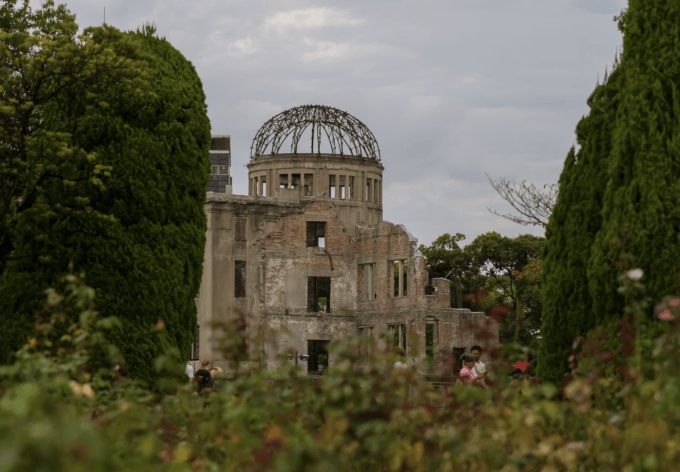
Photo by Thomas Bormans
On January 27, 2026, the editors of the Bulletin of the Atomic Scientists moved the hands of their famous “Doomsday Clock” to 85 seconds to midnight―the closest setting, since the appearance of the clock in 1946, to nuclear annihilation.
This grim appraisal has impressive evidence to support it.
The New Start Treaty, the last of the major nuclear arms control and disarmament treaties between the United States and Russia, expired on February 5, without any serious attempt to replace it. New Start’s demise enables both nations, which possess about 86 percent of the world’s 12,321 nuclear weapons, to move beyond the strict limits set by the treaty on the number of their strategic nuclear weapons (the most powerful, most devastating kind), thus enhancing the ability of their governments to reduce the world to a charred wasteland.
Actually, a nuclear arms race has been gathering steam for years, as nearly all the governments of the nine nuclear powers (which, in addition to Russia and the United States, include China, Britain, France, Israel, India, Pakistan, and North Korea) scramble to upgrade existing weapons systems and add newer versions. China’s nuclear arsenal is the fastest growing among them. “The era of reductions in the number of nuclear weapons in the world . . . is coming to an end,” observed Hans Kristensen, a highly regarded expert on nuclear armament and disarmament. “Instead, we see a clear trend of growing nuclear arsenals, sharpened nuclear rhetoric, and the abandonment of arms control agreements.”
The U.S. government is currently immersed in a $1.7 trillion nuclear “modernization” program that President Donald Trump has championed and repeatedly lauded. As early as February 2018, he boasted that his administration was “creating a brand-new nuclear force. We’re gonna be so far ahead of everybody else in nuclear like you’ve never seen before.” In late October 2025, to facilitate the U.S. nuclear buildup, Trump ordered the Pentagon to prepare to resume U.S. nuclear weapons testing, which had ceased 33 years before. In line with the Comprehensive Test Ban Treaty of 1996, signed by 187 nations (including the United States), no nuclear power (other than the rogue nation of North Korea) has conducted explosive nuclear testing in over 25 years.
Another sign of the escalating nuclear danger is the revival of implicit and explicit threats to initiate nuclear war. Such threats, which declined with the end of the Cold War, have resurfaced in recent years. When angered by the policies of other nations, Donald Trump, Kim Jong Un, and Vladimir Putin have repeatedly and publicly threatened them with nuclear destruction. According to the U.S. government’s Voice of America, the Russian government, in the context of its invasion of Ukraine, issued 135 nuclear threats between February 2022 and December 17, 2024. Although some national security experts have discounted most Russian threats as manipulative rather than serious, in November 2022 Chinese leader Xi Jinping thought the matter serious enough to publicly chide his professed ally, Putin, for threatening to resort to nuclear arms in Ukraine.
Underlying this drift toward nuclear war are the growing conflicts among nations―conflicts that have significantly weakened international cooperation and the United Nations. As the editors of the Bulletin of the Atomic Scientists put it, rather than heed past warnings of catastrophe, “Russia, China, the United States, and other major countries have instead become increasingly aggressive, adversarial, and nationalistic.” Consequently, “hard-won global understandings are collapsing, accelerating a winner-takes-all great power competition and undermining the international cooperation critical to reducing the risks of nuclear war.”
But this is not necessarily the end of the story―or of the world.
After all, much the same situation existed in the second half of the twentieth century, when conflicts among the great powers fueled a dangerous nuclear arms race that, at numerous junctures, threatened to spiral into full-scale nuclear war. And, in response, a massive grassroots campaign emerged to save the world from nuclear annihilation. Although that campaign did not succeed in banning the bomb, it did manage to curb the nuclear arms race, reduce the number of nuclear weapons by more than 80 percent, and prevent a much-feared nuclear catastrophe.
Furthermore, in the early twenty-first century, there have been new and important developments. The worldwide remnants of the nuclear disarmament movement regrouped as the International Campaign to Abolish Nuclear Weapons and, joined by farsighted officials in smaller, non-nuclear nations, drew upon the United Nations to sponsor a series of antinuclear conferences. In 2017, by a vote of 122 to 1 (with 1 abstention), delegates at one of these UN conferences adopted the Treaty on the Prohibition of Nuclear Weapons (TPNW). Although all nine nuclear powers strongly opposed the TPNW―which banned the use, threatened use, development, manufacture, acquisition, possession, stockpiling, stationing, and installation of nuclear weapons―the treaty secured sufficient national backing to enter into force in January 2021. Thus far, it has been signed by 99 countries―a majority of the world’s nations.
In addition to the efficacy of public pressure for nuclear disarmament and the existence of a treaty banning nuclear weapons, at least one other factor points the way toward a non-nuclear future: the self-defeating nature—indeed, the insanity―of nuclear war. With even a single nuclear bomb capable of killing millions of people and leaving the desperate survivors crawling painfully through a burnt-out, radioactive hell, even a nuclear “victory” is a defeat. In the aftermath of a nuclear war, as Soviet leader Nikita Khrushchev is believed to have said, “the survivors would envy the dead.” It’s a lesson that most people around the world have learned, although not perhaps the lunatics.
Lunatics, of course, exist, and some of them, unfortunately, govern modern nations and ignore international law.
Even so, although we are on the road to nuclear war, there is still time to take a deep breath, think about where we are going, and turn around.
MOSCOW BLOG: Nuclear arms race is already underway
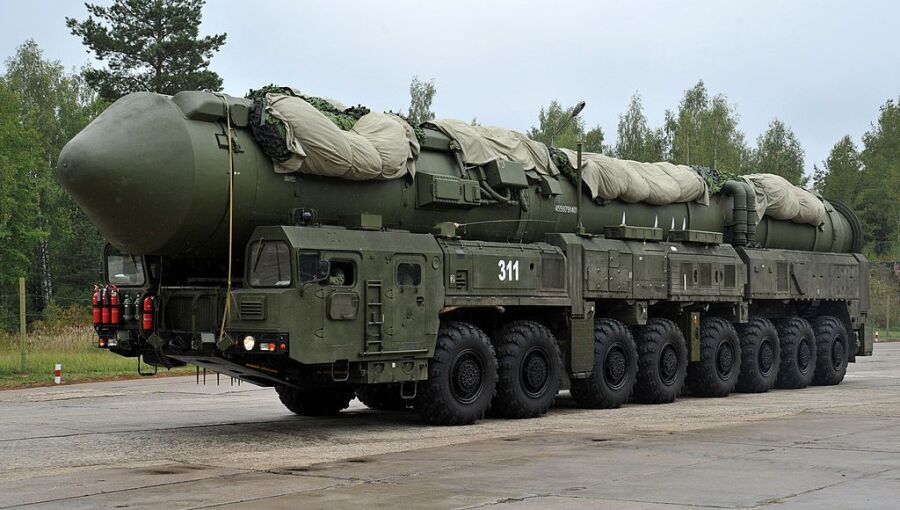
The New START treaty expired last night. It is the last of the Cold War-era missile agreements and marks the death of what security infrastructure was left to prevent the total annihilation of the planet.
There was a reason this infrastructure was put in place. Without it the natural urge is to get into an arms race. The logic of the security infrastructure is that of “mutually assured destruction” (MAD) – i.e. you only need enough missiles to make sure that the other guy will also be completely destroyed if he fires at you first.
Without the infrastructure the temptation is to get a bigger and better missile than the other guy (or just more of them) so that you have an advantage. As both the US and Russia already have over 5,000 missiles each that is already complete overkill in the MAD set up. (China is a relatively new player in this game and has around 600.) You only need 100 missiles to get through the defence to completely collapse a society. And as air defences are not airtight, the military boffins estimate current defences can only stop between 50-70% of inbound missiles. So, we can already blow the world up at least 15-times over.
In other words, slashing the stockpiles will make no practical difference to your ability to destroy the other guy – hence the alphabet soup of missile deals. Why waste all that money and resources on building and maintaining extra missiles if they make no difference to the end result at all? This was the Cold War logic and clearly a very sensible one.
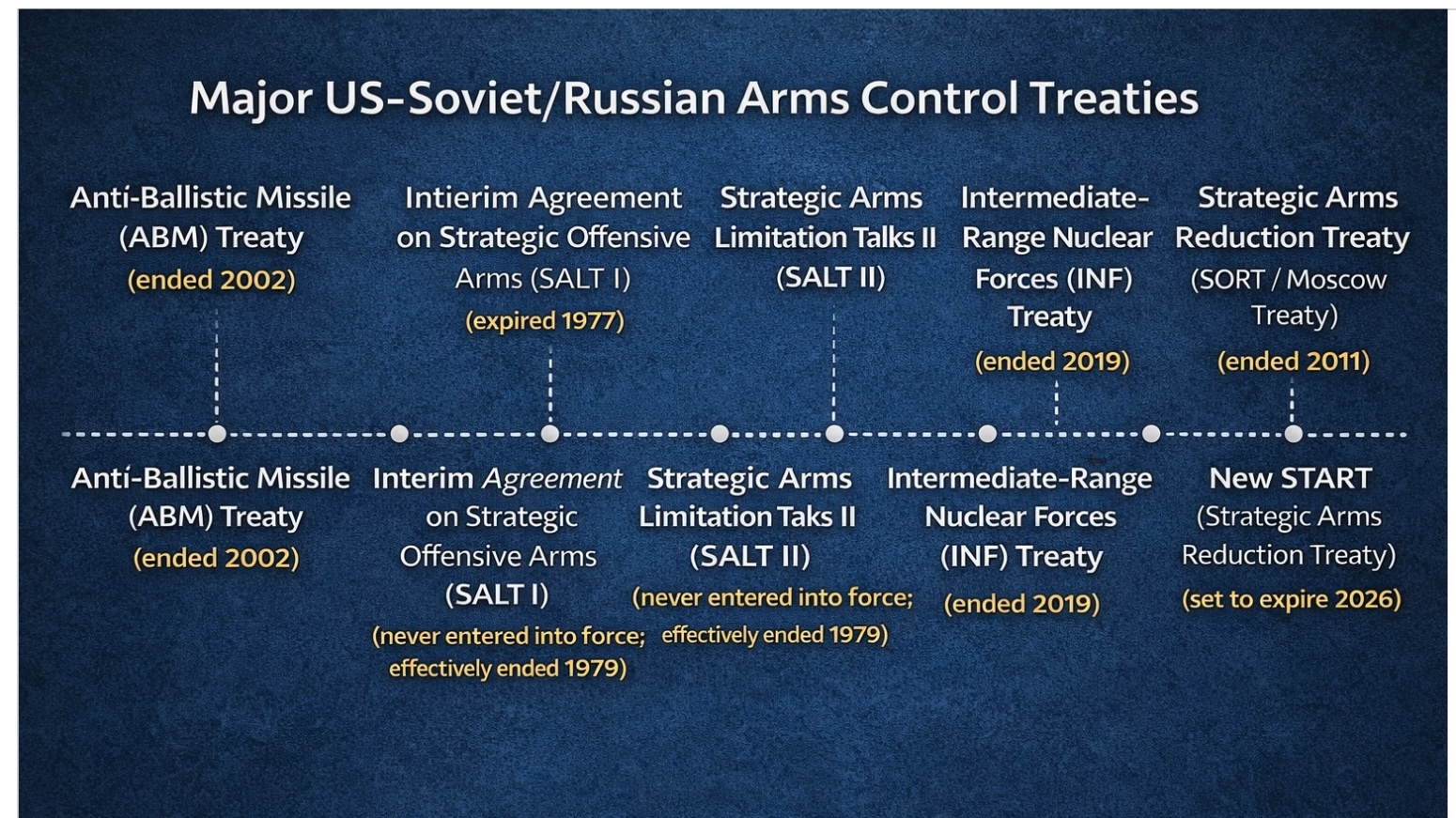
One of the conditions to the New START was to limit stockpiles of missiles to 1,500. If you assume that only 30% of your missiles get through, then that is still 450 missiles – four-times more than you need for MAD to work.
But all this infrastructure has been dismantled now and actually a new arms race is not just a potential problem. A new arms race is already well underway.
This all goes back to 2002 when former President George W Bush unilaterally withdrew from the ABM treaty (Anti-Ballistic Missile Treaty), the granddaddy of missile deals that was signed in 1972 between Richard Nixon and Leonid Brezhnev, starting the whole security thing off.
This was an insane and totally unnecessary decision, and the Kremlin freaked out. (I know some people that were involved in the discussion at the time.) This was only a year after Bush met Russian President Vladimir Putin for the first time in Ljubljana, Slovenia, and “saw his soul” in his eyes.
Withdrawing from the ABM fundamentally and irreversibly destabilised the international balance of power. It sets off a series of events that leads, in my opinion, directly to the war in Ukraine. It’s one of the reasons that Putin is so obsessed with Nato expansion. After the ABM, one by one all the remaining deals were cancelled or allowed to expire. New START is the last one.
Given the writing has been on the wall for more than two decades, it is no wonder that Russia (and now increasingly China) has been investing heavily into weapons tech.
Those biblical words are doubly poignant today. They appeared on the wall of King Belshazzar’s feast: “Mene, Mene, Tekel, Upharsin” which means: “God has numbered the days of your kingdom and brought it to an end. You have been weighed on the scales and found wanting. Your kingdom is divided and given to the Medes and Persians.” Belshazzar was killed the same night.
And having kicked the race off by withdrawing from the ABM, surprisingly the US has been napping ever since. Russian and Chinese missile technology has come on by leaps and bounds since then. Putin showcased new Russian hypersonic missiles during his 2018 state of the nation speech including an ominous video of them flying over the US. More recently Russia released the Oreshnik cruise missile that can hit any city in Europe. The Kinzhal and Zircon, both of which have been used in Ukraine, are too fast to stop (although there are reports of some Kinzhals being brought down by air defence but not the Zircon). The “unstoppable” nuclear powered Poseidon torpedo can circumnavigate the world undetected as it travels so deep. The US doesn’t have anything like this in its arsenal.
It’s the same in critical minerals: there is a very famous Department of Energy report published in 2010 warning that the US had fallen way behind China in the production of critical minerals and rare earth metals (REMs) that China had already, even then, and absolutely nothing was done to address the problem. Ironically, it is one of the (few) things that Trump is doing right, his minerals diplomacy.
The Chinese and Russian are in a race to increase the speeds of their missiles which are already up to a reported Mach 27 (Avangard) in Russia’s case and Mach 25 (DF-41) in China’s case. This is so fast that these missiles can fly from a home base and penetrate the US air defences in under 30mins.
Amazingly, the US doesn’t have any hypersonic missiles at all. It has the “Dark Eagle”, but that is still in development testing and also only has a top speed of Mach 5+. Europe’s hypersonic missiles are still theoretical blueprints.
As our military analyst Patricia Marins recently pointed out the same is true with bells on with the US navy and in naval missiles and Europe is essentially defenceless against a Russian missile attack. Russia has already remilitarised and its entire economy is now on a war footing. China is doing the same thing, and it is knocking out new state of the art high tech weapons every year. China and Russia are developing next-generation combat aircraft. China’s reported J-36 programme appears more advanced than Russia’s Su-57, while the US remains the global leader through its NGAD programme and the troubled F-35 for the moment.
The irony is that despite the US starting this pointless arms race, the Kremlin has made it crystal clear time and time again that it doesn’t want to go there and Putin is desperately keen to restart all these Cold War agreements. He leapt on Biden when the former president offered to renew START in 2021 and the Kremlin immediately offered to open talks on putting the Intermediate-Range Nuclear Forces Treaty (INS Treaty), which Trump nixed in 2019, back in place. Ironically, Biden was also a strong advocate of renewing the Cold War deals and vehemently criticised the decision to nix the ABM treaty, which he warned would be “deeply destabilising” to the international order.
Putin’s desire to renew the missile security infrastructure represents real leverage over the Kremlin in the current peace talks as he would be willing to give up a lot to get these deals done, in my opinion. But the issue has barely been mentioned. In the Russian Ministry of Foreign Affairs statement this morning they threatened a new arms race, but even now at this late stage, held the door open for new arms control talks. However, the MFA also said that they had no response from the White House on their offer to negotiate and that “no message is a message in itself.”
This article originally appeared in Editor’s Picks, a free daily email digest of bne IntelliNews’ best stories from the last 24 hours. Sign up for free here.
https://to989.infusionsoft.com/app/form/editors-picks-subscribers
When major powers abandon restraint in the nuclear field, they send a dangerous message: that international commitments are optional, norms are negotiable, and humanitarian principles can be sidelined.
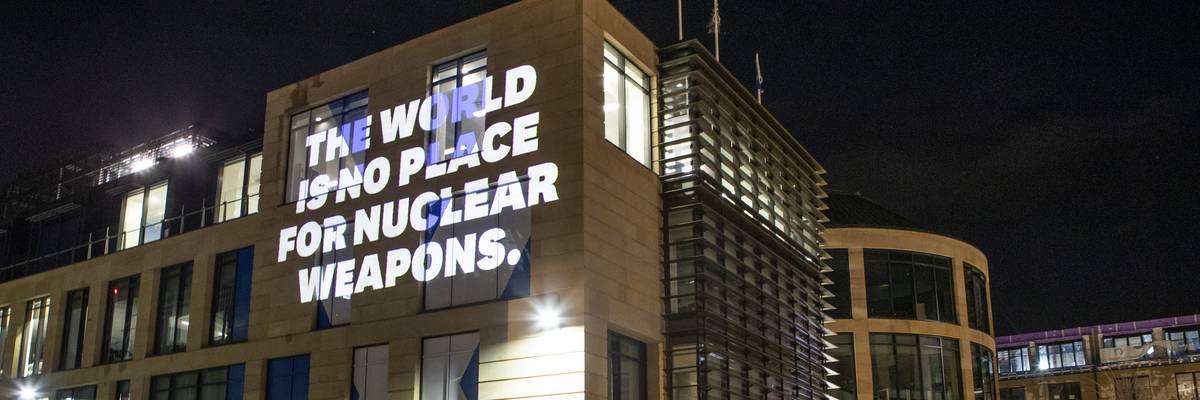
“The World Is No Place For Nuclear Weapons” was projected onto the side of Queen Elizabeth House, the new flagship UK Government Hub, in Edinburgh, to celebrate that the Treaty on the Prohibition of Nuclear Weapons enters into force as international law on January 22, 2021.
(Photo by Jane Barlow/PA Images via Getty Images)
Dr. Ghassan Shahrour
Feb 05, 2026
In January 2026, I published an article warning that the world was approaching the final hours of the New START Treaty. On February 5, 2026, that warning has become reality. For the first time since the early 1970s, no legally binding limits exist on US-Russian strategic nuclear forces. This moment is not only a failure of arms control; it is a profound threat to human security, humanitarian disarmament, and the credibility of multilateral commitments across all fields.
New START was the last surviving pillar of bilateral nuclear restraint. Its expiration removes the ceilings on deployed strategic warheads and delivery systems, eliminates inspections and data exchanges, and forces both sides to operate in an environment of opacity and worst‑case assumptions. In my earlier article, I argued that this collapse would deepen the crisis of credibility facing the Nuclear Non‑Proliferation Treaty (NPT), especially the long‑neglected obligations under Article VI. That analysis stands even more firmly today. A world without New START is a world where the NPT’s disarmament pillar is no longer eroding slowly—it is cracking openly.
But the consequences extend far beyond the nuclear domain. The end of New START is a blow to humanitarian disarmament as a whole. Treaties such as the Mine Ban Treaty (MBT) and the Convention on Cluster Munitions (CMC) were built on the belief that international law can restrain the most harmful weapons and protect civilians. When major powers abandon restraint in the nuclear field, they send a dangerous message: that international commitments are optional, norms are negotiable, and humanitarian principles can be sidelined when politically inconvenient.
This erosion of respect for international commitments is not isolated. It is part of a wider pattern visible in multiple conflicts, where the use of explosive weapons in populated areas, attacks on medical facilities, and disregard for civilian protection have become disturbingly normalized. The collapse of New START reinforces this trend by weakening the broader culture of compliance that humanitarian disarmament depends on.
Strengthening humanitarian disarmament—from nuclear weapons to landmines, cluster munitions, and all weapons that devastate civilian life—is now an urgent moral responsibility.
The humanitarian and medical consequences of this moment cannot be overstated. Nuclear weapons are not abstract strategic tools; they are instruments of mass suffering. Their use—even once—would overwhelm health systems, destroy infrastructure, contaminate environments, and inflict irreversible harm on generations. The expiration of New START increases the likelihood of miscalculation, escalation, and arms racing at a time when global humanitarian systems are already stretched beyond capacity.
This is why the Treaty on the Prohibition of Nuclear Weapons (TPNW) has gained renewed relevance. Its humanitarian logic—grounded in the lived experiences of survivors and the realities of medical response—offers a principled alternative to the paralysis of traditional arms control. As nuclear‑armed states retreat from their obligations, the TPNW stands as a reminder that disarmament is not only a legal duty but a moral imperative.
Today’s moment demands more than observation. It requires action.
Governments must restore restraint and rebuild trust in multilateral commitments.
Civil society must raise its voice with renewed urgency.
Humanitarian and medical organizations must continue to highlight the human cost of nuclear policies.
And the media must stop treating nuclear risks as distant or technical; they are immediate threats to human life and dignity.
The expiration of New START is not the end of arms control—but it is a warning. A warning that the international system is drifting toward a world where the most destructive weapons are unconstrained, humanitarian norms are weakened, and global commitments lose their meaning.
Strengthening humanitarian disarmament—from nuclear weapons to landmines, cluster munitions, and all weapons that devastate civilian life—is now an urgent moral responsibility, more than ever.
Our work is licensed under Creative Commons (CC BY-NC-ND 3.0). Feel free to republish and share widely.
Dr. Ghassan Shahrour
Dr. Ghassan Shahrour, coordinator of Arab Human Security Network, is a medical doctor, prolific writer, and human rights advocate specializing in health, disability, disarmament, and human security. He has contributed to global campaigns for peace, disarmament, and the rights of persons with disabilities.
Full Bio >
“Trump, Putin, and Xi can and must put the world on a safer path by taking commonsense actions to build down the nuclear danger,” said one campaigner.
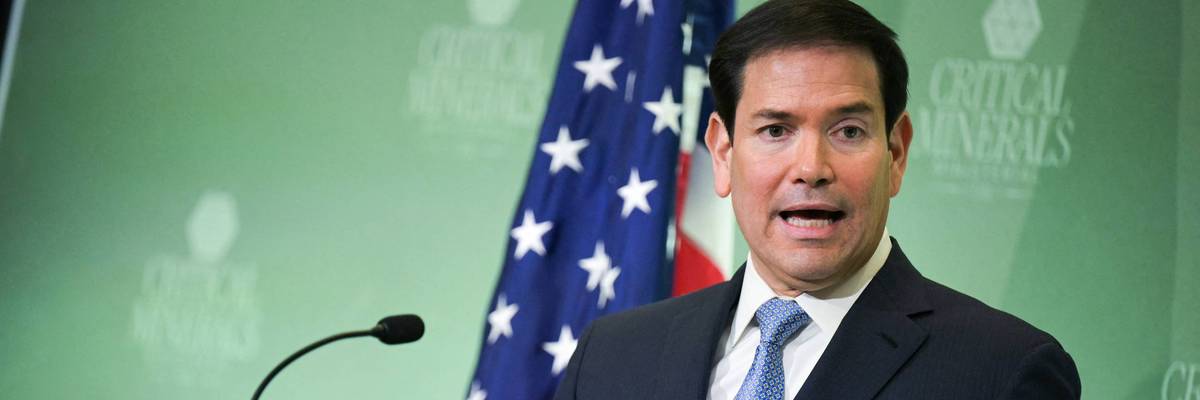
US Secretary of State Marco Rubio speaks during a press conference at the Sate Department in Washington, DC, on February 4, 2026.
(Photo by Oliver Contreras/AFP via Getty Images)
Brett Wilkins
Feb 04, 2026
COMMON DREAMS
Secretary of State Marco Rubio on Wednesday implicitly confirmed that New START—a key arms control treaty between the United States and Russia—will expire Thursday, prompting renewed demands for what one group called “a more coherent approach from the Trump administration” toward nuclear nonproliferation.
Asked about the impending expiration of New START during a Wednesday press conference, Rubio said he didn’t “have any announcement” on the matter, and that President Donald Trump “will opine on it later.”
“Obviously, the president’s been clear in the past that in order to have true arms control in the 21st century, it’s impossible to do something that doesn’t include China because of their vast and rapidly growing stockpile,” Rubio said.
New START, signed in 2010, committed the United States and Russia to halving the number of strategic nuclear missile launchers in their arsenals. While the treaty did not limit the size of the countries’ actual nuclear arsenals, proponents pointed to its robust verification regime and other transparency features as mutually beneficial highlights of the agreement.
“We have known that New START would end for 15 years, but no one has shown the necessary leadership to be prepared for its expiration,” said John Erath, senior policy director at the Center for Arms Control and Non-Proliferation and former longtime State Department official.
“The treaty limited the number of nuclear weapons the United States and Russia could have, but perhaps more importantly, New START also provided each country with unprecedented insights into the other’s arsenal so that Washington and Moscow could make decisions based on real information rather than speculation,” Erath added.
Daryl G. Kimball, executive director of the Arms Control Association, said Wednesday that “the end of New START requires a more coherent approach from the Trump administration.”
“If President Trump and Secretary Rubio are serious, they should make a serious proposal for bilateral (not trilateral) talks with Beijing,” he asserted. “Despite Trump’s talk about involving China in nuclear negotiations, there is no indication that Trump or his team have taken the time to propose risk reduction or arms control talks with China since returning to office in 2025.”
Kimball continued:
Furthermore, there is no reason why the United States and Russia should not and cannot continue, as [Russian President Vladimir] Putin suggested on September 22, to respect the central limits of New START and begin the hard work of negotiating a new framework agreement involving verifiable limits on strategic, intermediate-range, and short-range nuclear weapons, as well as strategic missile defenses.
At the same time, if he is serious about involving China in “denuclearization” talks, he could and should invite [Chinese President Xi Jinping] when they meet later this year, to agree to regular bilateral talks on risk reduction and arms control involving senior Chinese and US officials.
“With the end of New START, Trump, Putin, and Xi can and must put the world on a safer path by taking commonsense actions to build down the nuclear danger,” Kimball added.
Erath lamented that “with New START’s expiration, we have not only lost unprecedented verification measures that our military and decision-makers depended on, but we have ended more than five decades of painstaking diplomacy that successfully avoided nuclear catastrophe.”
“Agreements preceding New START helped reduce the global nuclear arsenal by more than 80% since the height of the Cold War,”
he noted. “Now, both Russia and the United States have no legal obstacle to building their arsenals back up, and we could find ourselves reliving the Cold War.”
Last week, the Bulletin of the Atomic Scientists’ Science and Security Board advanced its symbolic Doomsday Clock to 85 seconds to midnight, the closest it has ever been to global thermonuclear annihilation, citing developments including failure to extend New START, China’s growing arsenal, and Russian weapons tests—to which Trump has vowed to respond in kind.
“The good news is,” said Erath, is that “the end of New START does not have to mean the end of nuclear arms control.”
“While New START can’t be extended beyond today, Presidents Donald Trump and Vladimir Putin could decide to respect the numerical limits the treaty set on nuclear arsenals,” he explained. “They could also resume the treaty’s data exchanges and on-site inspections, in addition to implementing verification measures from other previous arms control treaties.”
“Further, they could instruct their administrations to begin immediate talks on a new treaty to cover existing and novel systems and potentially bring in other nuclear powers, like China,” Erath continued. “Meanwhile, Congress could—and should—fund nonproliferation and global monitoring efforts while refusing to fund dangerous new nuclear weapons systems.”
Last December, US Sens. Ed Markey (D-Mass.) and Jeff Merkley (D-Ore.) and Reps. Don Beyer (D-Va.), John Garamendi (D-Calif.), and Jim McGovern (D-Mass.) reintroduced the bicameral Hastening Arms Limitation Talks (HALT) Act, “legislation outlining a vision for a 21st century freeze on the testing, production, and deployment of nuclear weapons.”
“The Doomsday Clock is at 85 seconds to midnight,” Markey—who co-chairs the congressional Nuclear Weapons and Arms Control Working Group—said Wednesday ahead of a press conference with HALT Act co-sponsors. “We need to replace New START now.”
“The United States and Russia already have enough deployed nuclear weapons to kill tens of millions of people in an hour and devastate the world,” said one expert, warning a lapse will “only make the world less safe.”
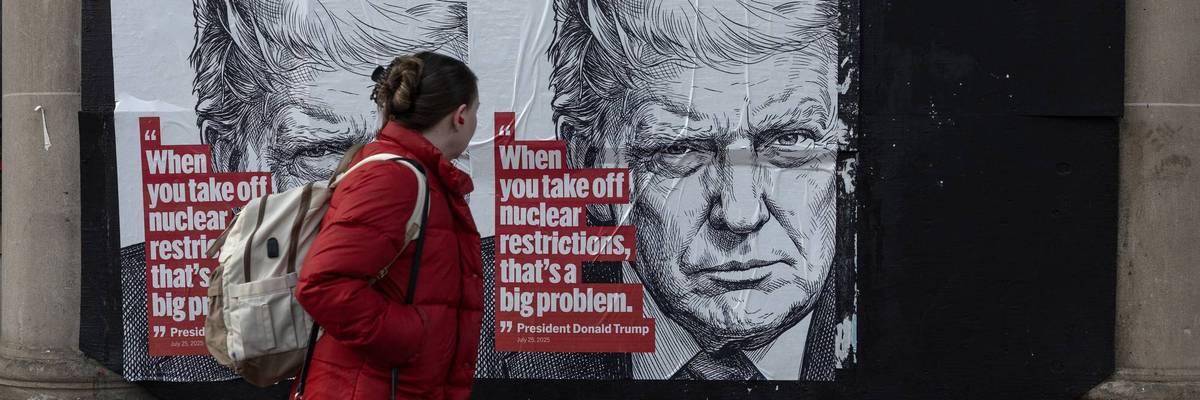
A woman walks past a wall poster that warns of the impending expiration of New START, a US-Russia nuclear arms control treaty, on January 30, 2026 in Washington, DC.
(Photo by Probal Rashid/LightRocket via Getty Images)
Jessica Corbett
Feb 03, 2026
COMMON DREAMS
If New START expires on Thursday, it will be the first time in decades that the United States and Russia don’t have a nuclear arms control treaty, and experts have been sounding the alarm about the arms race that likely lies ahead.
“The expiration of New START would be massively destabilizing and potentially very costly both in terms of economics and security,” said Jennifer Knox, a research and policy analyst at the Union of Concerned Scientists’ (UCS) Global Security Program, in a Tuesday statement.

‘85 Seconds to Midnight’: Doomsday Clock Ticks Down as Trump Drags World Toward New Low
“The United States and Russia already have enough deployed nuclear weapons to kill tens of millions of people in an hour and devastate the world,” Knox pointed out. “Letting New START lapse would erase decades of hard-won progress and only make the world less safe.”
New START was signed in April 2010, under the Obama administration, and entered into force the following February. A decade later, just days into the Biden administration, it was renewed for five years. In 2022, Russia invaded neighboring Ukraine—an ongoing conflict—and the next year, Russian President Vladimir Putin suspended his country’s participation in the treaty, though he has not withdrawn.
“The global security environment facing the United States is very different from when New START was first negotiated, but it remains true that bounding an open-ended, costly arms race will still require some form of agreement between Washington and Moscow,” said Ankit Panda, the Stanton senior fellow in the Carnegie Endowment for International Peace’s Nuclear Policy Program, in a statement.
“The public and lawmakers alike must recognize that we are on the cusp of a fundamentally new nuclear age—one that is more unpredictable, complex, and dangerous than anything we’ve witnessed post-Cold War,” warned Panda, one of the experts participating in a Wednesday briefing about the treaty. “A big risk is that without any quantitative limits or hands-on verification, we’ll end up with compounding worst-case-scenario thinking in both capitals, as during the Cold War.”
While Putin has halted US inspections of Russian nuclear facilities, he has still proposed extending the treaty for a year. Tara Drozdenko, director of the UCS Global Security Program, said that “abiding by New START for another year would be a win-win-win for the United States, Russia, and the rest of the world... The Trump administration should take swift action to publicly acknowledge that the United States will continue to abide by New START in the interim.”
However, US President Donald Trump—who fancies himself as a deal-maker—hasn’t expressed an interest in fighting for the pact, telling the New York Times last month that “if it expires, it expires,” and “I’d rather do a new agreement that’s much better.”
Trump has called for China—which has the most nuclear weapons after Russia and the United States, and is building up its arsenal—to be part of a new deal, but Beijing hasn’t signaled it will do so. Putin has proposed participation from France and the United Kingdom. The other nuclear-armed nations are India, Israel, North Korea, and Pakistan.
Noting Trump’s comments to the Times and aspiration for the Chinese government to join, Jennifer Kavanagh, director of military analysis at the think tank Defense Priorities, declared that “this is wishful thinking–if the administration thinks getting a new ‘better’ treaty after this one lapses will be easy, they are mistaken.”
“New START’s end brings few benefits and lots of risks to the United States, especially as Washington tries to stabilize relations with rivals like Russia and China,” she said, suggesting that Trump “would be better off hanging on to the agreement he has a little longer before trying to get a better one.”
Dmitry Medvedev, a Putin ally who signed the treaty while serving as president and is now deputy chairman of the Russian Security Council, said in a Monday interview with Reuters, TASS, and the WarGonzo project that “our proposal remains on the table, the treaty has not yet expired, and if the Americans want to extend it, that can be done.”
“For almost 60 years, we haven’t had a situation where strategic nuclear potentials weren’t limited in some way. Now such a situation is possible,” he noted. “I spent almost my entire life, starting from 1972, under the umbrella of the Strategic Arms Limitation Treaty.”
“In some ways, even with all the costs, it is still an element of trust,” Medvedev said. “When such a treaty exists, there is trust. When it doesn’t, that trust is exhausted. The fact that we are now in this situation is clear evidence of a crisis in international relations. This is absolutely obvious.”
Considering New START’s potential expiration this week, the Russian leader said that “I don’t want to say that this immediately means a catastrophe and a nuclear war, but it should still alert everyone. The clock that is ticking will, in this case, undoubtedly accelerate again.”
According to Reuters, he was referencing the Doomsday Clock. Last week, the Bulletin of the Atomic Scientists’ Science and Security Board set the symbolic clock at 85 seconds to midnight, the closest it has ever been to global catastrophe, citing various developments, including a failure to extend the treaty, Russian weapons tests, and China’s growing arsenal.
“In 2025, it was almost impossible to identify a nuclear issue that got better,” Jon B. Wolfsthal, a board member and director of global risk at the Federation of American Scientists (FAS), said last week. “More states are relying more intently on nuclear weapons, multiple states are openly talking about using nuclear weapons for not only deterrence but for coercion. Hundreds of billions are being spent to modernize and expand nuclear arsenals all over the world, and more and more non-nuclear states are considering whether they should acquire their own nuclear weapons or are hedging their nuclear bets.”
“Instead of stoking the fires of the nuclear arms competition, nuclear states are reducing their own security and putting the entire planet at risk. Leaders of all states must relearn the lessons of the Cold War—no one wins a nuclear arms race, and the only way to reduce nuclear dangers is through binding agreement to limit the size and shape of their nuclear arsenals,” he argued. “Nuclear states and their partners need to invest now in proven crisis communication and risk reduction tools, recommit to preventing the spread of nuclear weapons, refrain from nuclear threats, and pursue a more predictable and stable global security system.”
Regarding New START specifically, FAS Nuclear Information Project associate director Matt Korda stressed this week that “we are about to enter an era of unconstrained nuclear competition without any guardrails. Not only will there no longer be anything stopping the nuclear superpowers from nearly doubling their deployed nuclear arsenals, but they would now be doing so in an environment of mutual distrust, opacity, and worst-case thinking.”
“While New START was a bilateral agreement between Russia and the United States, its expiration will have far-reaching consequences for the world,” he said. “There are no benefits from a costly arms buildup that brings us right back to where we started, but there would be real advantages in pursuing transparency and predictability in an otherwise unpredictable world.”
Jonathan H. Kantor
Tue, February 3, 2026

A mushroom cloud from a hydrogen bomb test - Alones/Shutterstock
Several military technological innovations have changed the course of history. From the sailing ship to the stirrup, these advances have pushed the world into new directions, and chief among them is nuclear weapons. The first nukes were some of the most notorious weapons developed during World War II, used in the attacks on Hiroshima and Nagasaki, Japan. After the war, nuclear weapons became the tentpole of military and foreign policy, and other nations have followed the U.S. in developing their own arsenals.
As of writing, there are nine countries with nuclear weapons: Russia, China, the United Kingdom, India, North Korea, France, Pakistan, Israel, and the U.S. It should be noted that Israel has never confirmed whether it has nuclear weapons, despite most international agencies believing that it does. Additionally, Israel is not a signatory to the Nuclear Non-Proliferation Treaty. Regardless, there are numerous nations with weapons of all kinds, and together, these account for more than 12,300 warheads, 9,600 of which remain in active military stockpiles.
While that's a lot of nukes, just two countries collectively hold 86.8% of the world's nuclear weapons, with the remaining split between the other seven. Those two nations are the U.S. and Russia, the latter of which has more than the former. These stockpiles represent the legacy of the U.S. policy of Mutually Assured Destruction, which ensured that both the U.S. and the former Soviet Union maintained enough firepower to wipe out the other should either deploy a nuclear weapon in combat.
America's nuclear weapons stockpile

Three nuclear missiles launched over a backdrop of the American Flag. - Dancingman/Getty Images
While the Cold War ended decades ago, the United States still maintains a large stockpile of nuclear weapons. This is in line with the U.S.' nuclear triad, which is a policy requiring three nuclear deployment methods at all times: submarine-launched ballistic missiles, intercontinental ballistic missiles, and aircraft-dropped nuclear weapons. While the stockpile has decreased significantly since the end of the Cold War, the U.S. maintains 5,177 warheads, according to the Federation of Atomic Scientists' 2025 Status of the World's Nuclear Forces report.
The weapons are broken down into three categories. Deployed warheads are those on ballistic missiles and those at bomber bases, and the U.S. has 1,670 of these. It has 1,930 stockpiled warheads, which are available for use when needed. Finally, there are the retired nuclear warheads, accounting for 1,477 of America's total. These are weapons that aren't intended for use, but have yet to be dismantled. This leaves the U.S. with a total of 3,700 usable nuclear warheads.
The U.S. continues to develop nuclear weapons technology, though testing is heavily restricted via numerous treaties. Several defense contractors and government agencies manufacture the nation's nuclear missiles and their warheads, with modernization efforts carried out at multiple facilities in Texas and Tennessee. These ensure that the nation's nuclear capabilities are spread out and maintained in a constant state of readiness should the need arise.
Russia's nuclear arsenal

Missiles preparing to fire over a backdrop of a nuclear detonation, the Russian flag, and a nuclear symbol - Bymuratdeniz/Getty Images
When it comes to nuclear warheads, Russia and the former Soviet Union reign supreme. The Soviet Union developed and tested the largest nuclear weapon ever tested, the Tsar Bomba, which detonated at an estimated 50 megatons. Of course, that's only one of many, and when the U.S.S.R. collapsed, its constituent nations retained some weapons. Ukraine briefly held the third-largest stockpile before denuclearization, and other nations followed suit. These days, Russia has a stockpile of 5,459 total warheads, according to the FAS' 2025 report.
Russia's weapons break down to 1,780 deployed warheads, 2,591 stockpiled, and 1,150 retired, leaving a usable total of 4,309. As a result, Russia maintains 609 nuclear warheads more than the United States, but the difference means little when you're talking about weapons capable of total annihilation of the world in a nuclear war. Like the U.S., Russia maintains its weapons for use in numerous ways, as the nation has nuclear-armed submarines, strategic nuclear bombers, and ICBMs ready to go should the unfortunate need arise.
While Russia and the United States have a lot of nukes, accounting for almost 90% of the total world stockpile, they're nowhere near the numbers of the past: There were an estimated 70,374 nuclear warheads worldwide in 1986. It took a long time to dismantle and draw down from that amount, and treaties continue to push nations to reduce their total number of deployable weapons. Unfortunately, neither the U.S. nor Russia is a signatory to the Treaty on the Prohibition of Nuclear Weapons.
