Thursday, February 12, 2026


Russia to Send Oil to Crisis-Stricken Cuba


Russia plans to send soon oil and oil products to Cuba as part of humanitarian aid, the Russian embassy in Cuba told Russian media on Thursday.

Cuba’s worsening economic and humanitarian situation has gone from bad to worse in recent weeks as the U.S., which now controls Venezuela’s oil sales, is banning shipments to Cuba.      


U.S. President Donald Trump in late January signed an Executive Order declaring a national emergency and establishing a process to impose tariffs on goods from countries that sell or otherwise provide oil to Cuba. This is to protect U.S. national security and foreign policy from the Cuban regime’s malign actions and policies, according to the Executive Order. 

The Executive Order “imposes a new tariff system that allows the United States to impose additional tariffs on imports from any country that directly or indirectly provides oil to Cuba.”  

Russia is unfazed and doesn’t want to cut ties with Cuba, a friendly country according to Moscow’s classification. Venezuela was also among these, until U.S. forces captured Nicolas Maduro in early January and took control over the country’s oil sales.  

“In the near future, it is planned to deliver oil and oil products to Cuba as humanitarian aid,” the Russian embassy in Cuba told Russia’s daily Izvestia.

At the same time, the Russian ministry of economic development has recommended that Russians refrain from traveling to Cuba amid the “fuel emergency” in the Caribbean country.  

Earlier this week, Canadian airlines suspended flights to Cuba as the island nation faces depletion in jet fuel stocks amid the U.S. energy squeeze aimed at prompting regime change.  

Cuba did not receive any oil imports from anywhere in January, Bloomberg has reported citing Kpler data. Cuba’s biggest oil suppliers have traditionally been Venezuela and Mexico, with Venezuela the biggest, but after the effective U.S. takeover of Venezuela’s oil industry those supplies dried up. 

Now, after Trump put pressure on Mexico to stop shipping fuel to the heavily sanctioned island, Cuba has no immediate alternatives although Russia has signaled it planned to continue supplying fuel there.   

By Tsvetana Paraskova for Oilprice.com


Cuba’s Energy Crisis Deepens Amid U.S. Tariffs

  • U.S. tariff threats and sanctions have curtailed oil shipments from Venezuela and Mexico, tightening Cuba’s fuel supply.

  • Rolling blackouts, hospital disruptions, and suspended airline refueling highlight the severity of the island’s energy shortage.

  • The government is rationing fuel, cutting transport and tourism operations, and seeking alternative supply sources to prevent collapse.

Cubans are struggling with blackouts and fuel rationing amid President Trump’s campaign to provoke regime change by choking off the energy supply of the island nation, which is heavily dependent on fuel imports.

Trump last month threatened to impose tariffs on any country that sends oil to Cuba, labelling the island “an unusual and extraordinary threat” to U.S. national security. He noted the Cuban government’s relations with Russia, China, and Iran as evidence of that threat, which, Trump suggested, would present as “migration and violence.”

The island’s biggest oil supplier was out of the picture already, since that was Venezuela, and the United States effectively took control of the country’s oil industry following the ousting of President Nicolas Maduro. 

Cuba’s second-largest oil supplier, Mexico, initially took a tough stance, with President Claudia Scheinbaum saying the country would continue supplying oil to Cuba because “It’s not right. They don’t have fuel for hospitals or schools. The people are suffering.” However, Kpler data shows that no oil cargoes arrived at Cuban ports in January. Indeed, earlier this week, President Scheinbaum said Mexican oil shipments to Cuba were suspended as the country’s government looked for ways to provide fuel for the island without triggering Trump’s wrath and tariffs.

Russia has said it would continue supplying oil to Cuba, but it would take a while for any evidence to emerge of this. Meanwhile, airlines are starting to suspend flights to Cuba because of jet fuel scarcity.

Air Canada was the first to issue a warning about flights to Cuba, followed by two more Canadian airlines. The Cuban Aviation Corporation confirmed the shortage, saying it would suspend refueling services for aircraft for a month. Yet air transport is only one aspect of Cuba’s energy crisis.

Time reported this week that the tight fuel supplies are causing rolling blackouts and affecting hospitals. The publication cited Cuban media as reporting that some medical facilities had had to cancel surgeries and outpatient transfers. Shortages of medical supplies and even antibiotics are also being reported.

France 24, meanwhile, reports that Cubans are turning to charcoal for cooking and to solar panels for electricity generation, even though both are quite expensive for the average Cuban. The Cuban government has responded to the oil blockade by reducing office hours and restricting fuel sales. The government is also closing tourism facilities and reducing transport between provinces, Al-Jazeera reports.

“Fuel will be used to protect essential services for the population and indispensable economic activities,” Deputy Prime Minister Oscar Perez-Oliva said on Cuban state television. “This is an opportunity and a challenge that we have no doubt we will overcome. We are not going to collapse.”

Among the measures that the government is also taking is directing fuel supplies to food-producing regions and considering state support for solar power adoption. Those fuel supplies, however, will run out in less than a month, with Venezuelan and Mexican oil gone. Venezuela accounted for 33% of Cuba’s fuel imports last month, according to data cited by Al-Jazeera, while Mexico was the top supplier, with 44%. Russia supplied 10% of Cuba’s total fuel imports.

Demand for oil on the island, which has been under a total U.S. embargo since 1959, averages around 100,000 barrels daily. Cuba produces some oil, but it is not enough to meet its demand. With Venezuelan and Mexican oil gone, the risk of a total energy collapse in the country becomes a distinct possibility—either that or the government will give in to U.S. demands. For now, officials have not suggested this is an option and have instead called for dialogue.

By Charles Kennedy for Oilprice.com


What the Fall of the Telegraph Says About Fossil Fuels

  • Renewables are positioned as the long-term winner over fossil fuels due to lower lifetime operating costs, faster deployment timelines, improving battery storage, and better demand-side management.

  • Like past technology shifts, consumers ultimately care about affordable and reliable electricity—not the source.

  • Renewables are likely to steadily gain market share as fossil fuel generation faces rising costs and slower innovation.

The global electric power business is changing. The economic hegemony of fossil fuels (and perhaps nuclear as well) is gradually being undermined by the adoption of renewable generating technologies such as solar and wind.  This economic and technological transition resembles warfare or a sporting event with distinct winners and losers. Our argument is based on a stunningly non-controversial premise—namely, that superior, lower-cost technologies producing an identical commodity eventually achieve dominance.

Let’s look at a previous technology transition, from telegraph to telephones, to see if it offers clues about the present power-generating transition.

 Alexander Graham Bell received his telephone patent in the US in 1876. Universal phone service was on its way to being the accepted norm by the early 1900s. During this early period, telephone use was increasing, but so was that of the telegraph system, as the economy grew. Heavy commercial users depended on the information it carried, especially so in financial markets, railroads, newspapers, and the government. The original Wall Street ticker tape was a specialized form of telegraph. (The telegraph system, incidentally,  replaced the Pony Express, which took ten days to deliver messages from St. Joseph, Missouri to California.)

The telephone and telegraph, two competing technologies,  thrived side by side into the early part of the twentieth century,  although the growth in transcontinental phone service began around 1920 to eclipse the demand for telegraphy. The dominant telegraph provider Western Union, founded in 1851, lost ground in the post World War Two years and finalized its demise in the 1980s via unfortunate corporate restructurings and the addition of significant debt. However, the name itself still carried so much prestige and value that it remained in use until 2006 in the money transfer business.  These two competing communications technologies, telephony and telegraphy, existed and operated profitably side by side for decades, although one was gradually lapsing into technological irrelevance.

Renewables, in our view, are the new dominant power-generating technology, analogous to telephones and fossil fuels will gradually fade thing like telegraph.

Renewables will absolutely crush fossil fuels, over the long term, in electric generation because:

1) Renewables will show a lower lifetime cost of operation (no fuel costs). This will be the game changer. (Okay, this is not so evident now. The projected all- in costs of renewables- with storage -and those of low -cost -fossil- fuel generation are close.  But fossil -fuel generation cost  is vulnerable to increases from fuel cost inflation, pollution controls, and environmental lawsuits that should be factored into any realistic long term scenario.) So, consider two power-generating sources, producing the same commodity,  only one of which, fossil fuels, has enormous lifetime (and probably increasing) fuel costs. The other technology has high initial build costs (we call these capital costs) and then produces electricity essentially for free, meaning it has relatively low operating expenses. We don’t think it’s a unique insight to call this an insurmountable competitive advantage. This is the whole game from an economic perspective right here. Everything else after this, as the sage said, is just commentary.

2) Renewables can be deployed more rapidly: two-year new build time versus 5-6 for new gas-fired power generation and 10+ years for new nuclear power stations. Time is money, and the cost of capital tied up for years in a project gets passed on to consumers.

3) Proliferation of batteries increases renewables penetration and begins to address the principal criticism against them, the intermittency of power production. Batteries provide storage capability, enhancing or offsetting the generating limitations of renewables. And in places like California, they are displacing natural gas-fired power generation as well.

4) Demand side management (DSM) techniques are also improving for shifting electrical load and this only helps this transition. One benefit of large commercial electricity customers in a utility’s service area is that they are or can be extremely price sensitive and, as sophisticated customers, can be willing participants in DSM programs with the right incentives.

5) Renewables produce less pollution and environmental degradation. Climate change concerns, however, in our view, have less to do with the emerging dominance of renewables than people realize. In contemporary slang, one might say “It’s all about the Benjamin’s, baby.”

But there is a further analogy between wholesale electricity power production and the transition from the telegraph to the telephone. The essence of the telegraph was short correspondence and data. Today we call those emails and faxes. We still communicate in a fairly similar fashion, but via a completely different conveyance system that’s digital and fiber optic. Similarly, the photo camera industry is mostly a relic, but people still love taking and sharing pictures, just now it’s with their phones. We don’t think electricity is any different in this respect. Electricity consumers of all types simply want affordable and reliable power, and they don’t care all that much about how it's made. Renewables, for the reasons cited, will produce electricity more cheaply (and more reliably) than fossil-fired competitors. For that reason, they will continue to take market share and increasingly displace fossil-fired generation in all power markets where they compete.

In the electricity business, fossil-fired power generation, to remain dominant,  needs superior technology and the ability to undercut competitors on price. Our fossil fuel industry today possesses neither. Its costs will rise more or less at the rate of inflation not counting the increasing volatility of natural gas markets. Renewables, on the other hand, are a technology where costs are declining with new scientific advances in things like battery materials and solar panel efficiency. To us, this type of economic competition is like a war in which only one party emerges victorious. The fossil fuel industry may have already lost.

By Leonard Hyman and William Tilles for Oilprice.com


Morgan Stanley Sees $190 Billion Upside in Tesla’s Solar Ambitions

  • Morgan Stanley says Tesla’s energy business could gain $20–$50 billion in value if Elon Musk succeeds in building 100 GW per year of U.S. solar cell manufacturing capacity.

  • The 100-GW plan—far exceeding current U.S. leader First Solar’s projected 17.7 GW capacity by 2027—would require $30–$70 billion in investment and major vertical integration across the solar supply chain.

  • If fully scaled, a vertically integrated solar and storage business could generate $25 billion in annual revenue.

Tesla’s energy business could become $20 billion to $50 billion more valuable if Elon Musk’s plan to build 100 gigawatts of yearly solar cell manufacturing capacity in the United States pans out, analysts at Morgan Stanley say.

“The solar opportunity is underestimated,” Musk told analysts on Tesla’s Q4 earnings call last month.

“We think the best way to add significant capability to the grid is solar and batteries on Earth and solar in space,” he added.

As Musk sees opportunities in the solar manufacturing business, Tesla will be working “towards getting 100 gigawatts a year of solar cell production integrating across the entire supply chain from raw materials all the way to finished solar panels,” the Tesla CEO said.

Tesla has struggled to move its current “Solar Roof” offering toward mainstream adoption.

Now the company wants to build 100 GW a year of solar manufacturing capacity, which, if achieved, would easily make it the top U.S. solar manufacturer.

First Solar, currently the biggest U.S. solar manufacturer, said in November that it expects 14 GW of American manufacturing capacity in 2026, and 17.7 GW in 2027, thanks to new facilities it is building in Louisiana and South Carolina.

Tesla’s 100-GW ambition will need significant investment of between $30 billion and $70 billion, Morgan Stanley analysts wrote in a note this week, as carried by MarketWatch.

The reward could be significant, too, if Musk’s plan becomes feasible in the next few years and isn’t just another promise on which Tesla’s boss would struggle to deliver within an initially set timeframe.

It is not clear how Tesla would finance the massive push into solar manufacturing.

Its chief financial officer, Vaibhav Taneja, said on the earnings call that “this year is going to be a huge investment year from a capex perspective.”

Tesla expects capex to top $20 billion in 2026, with spending on six factories and building an AI compute infrastructure, and continued investment in existing factories to build more capacity. This capex does not include potential investments in solar cell manufacturing, Taneja noted.

The huge solar manufacturing expansion could boost the equity value of Tesla’s energy business by between $20 billion and $50 billion, according to Morgan Stanley.

Currently, Tesla’s energy business is valued at Morgan Stanley at about $140 billion, or $40 per share—that’s 10% of the bank’s $415 share price target on Tesla.

So a significant ramp-up of Tesla’s solar business could boost the value of its energy business to $190 billion.

Tesla is considering multiple sites across the U.S., with New York, Arizona, and Idaho being evaluated to host its solar manufacturing capacity, sources with knowledge of the plans told Bloomberg News last week.

The company is already hiring for the 100-GW solar manufacturing drive, according to job postings on LinkedIn by senior Tesla executives.

“This is an audacious, ambitious project. We need audacious, ambitious engineers and scientists to help us grow to massive scale,” Seth Winger, senior manager for solar products engineering at Tesla, wrote two weeks ago.

A fully scaled vertically-integrated solar business could generate $25 billion in annual revenues for Tesla, according to Morgan Stanley’s analysts.

“We believe the decision to allocate capital to adding solar capacity may be justified by the value creation and growth opportunities that having a vertically integrated solar [plus] energy-storage business can yield,” Morgan Stanley’s analysts wrote.

Tesla has recently started up the largest and most advanced lithium refinery in the United States. The Corpus Christi, Texas, refinery converts spodumene ore directly into battery-grade lithium hydroxide, in a first-of-its-kind process in North America. It is another step toward the U.S. goal of having domestic refined lithium resources to counter China’s market dominance.

Massive-scale solar manufacturing at Tesla could lessen dependence on Chinese solar products, too, apart from boosting the company’s energy business at a time when its electric vehicle sales are wavering but power demand is soaring with the AI infrastructure boom.

By Charles Kennedy for Oilprice.com

 

The Global Battery Race Heats Up as China Tightens Its Grip

  • China produces more than 80 percent of the world’s battery cells and has poured massive investment into energy storage, positioning itself as the dominant electro-state.

  • Canada’s NEO Battery Materials has unveiled a drone battery with significantly higher capacity and energy density than widely used Chinese models, signaling potential competitive disruption.

  • Despite technological breakthroughs, building globally competitive battery industries outside Asia will require coordinated policy, supply chain development, and large-scale industrial investment.

The global clean energy transition hinges on the continued advancement and integration of energy storage, and especially utility-scale and long-term models. As the world adds renewable energy capacity at a breakneck pace, keeping up with supportive infrastructure additions is integral to maintaining energy security. While solar panels and wind turbines get all the attention, power lines and battery packs are just as critical, if far less glamorous. 

In fact, energy storage is quickly heating up to be “clean energy’s next trillion-dollar business.” Researchers around the world are racing to discover next-gen battery tech that will put them at the vanguard of this massive emerging sector. So far, China is dominating the sector, having surpassed its own ambitious energy storage capacity goals years ahead of schedule. 

China is also leading the pack in terms of battery making in general. In an increasingly electrified world, this gives Beijing a critical geopolitical edge in virtually every corner of the energy and tech sectors. In 2024, more than 8 in 10 battery cells on the planet were made in China. “After decades of quiet growth, firms such as CATL, BYD, Gotion High-Tech, and Envision are now primary suppliers for the world’s EVs and energy grids,” a Wired report writes about China’s leading battery manufacturers.

The World Economic Forum reports that China’s energy storage sector is evolving into a ‘new driving force’ in the country’s otherwise plateaued economy. As of the January 2025 report, the sector had drawn in more than 100 billion yuan (about $13.9 billion) in investment since 2021 alone, “driving further expansion of upstream and downstream industrial chains.”

China has blown the rest of the competition away in terms of overall clean energy spending, not just in terms of energy storage and EVs. In 2023, China alone spent more on clean energy than the next 10 largest spenders combined. As a result of this spending and of a years-long campaign to become the world’s first and overwhelmingly dominant electro-state, China controls the market for many of the most promising energy storage technologies and other next-gen batteries, and is also the cheapest place to produce them. 

But a new battery breakthrough in Canada may just give China a run for its money. Toronto’s NEO Battery Materials has announced that its drone batteries have achieved a game-changing 50 percent capacity improvement, in addition to a 40 percent increase in energy density, making them more powerful than the market standard set by Chinese firms. Critically, the Canadian company achieved this breakthrough without changing the size of the battery. 

According to a press release from NEO, “the newly developed NBM Drone Cell, intended for reconnaissance and surveillance applications, achieves an average discharge capacity of 34.2 amp-hours (Ah) and energy density of approximately 300 watt-hours-per-kilogram (Wh/kg), compared to 22.0 Ah and 214 Wh/kg in widely deployed commercial drone cells manufactured in China.”

As such, the company claims that its breakthrough is key to “addressing critical supply chain concentration and security concerns.” NEO is currently negotiating deals with potential military customers, including the South Korean government, "and is rolling out products for automotive customers, too,” according to a recent report from Semafor.

While the applications of this particular battery type may be narrow, it bodes well for a more diverse and resilient energy storage sector overall. Indeed, localizing battery supply chains is one of the most critical priorities for the future of the battery industry. And governments around the world have made new policies to try to achieve these goals.

“But for globally competitive battery manufacturing industries to emerge outside of Asia over the next ten years, companies will need to do far more than ensure regulatory compliance,” summarizes a January McKinsey & Company report. “Challenges will need to be overcome on multiple fronts spanning supply chains, talent management, operations and technology.”

All of this is to say, while individual breakthroughs like NEO’s battery performance are critical baby steps toward leveling the playing field, they are just that – baby steps. A much greater and more coordinated effort is needed to create a healthier and more sustainable energy and tech economy. 

By Haley Zaremba for Oilprice.com


U.S. Shale Majors Take Fracking Global

  • U.S. shale producers are expanding overseas—from Argentina and Turkey to Australia and the UAE—as domestic shale basins mature and well productivity declines.

  • Companies including Continental Resources, EOG Resources, and investors tied to Tamboran Resources are targeting major unconventional plays such as Vaca Muerta, the Beetaloo Basin, and Middle Eastern shale fields.

  • With top-tier U.S. shale inventory shrinking and oil demand forecasts extending toward 2050, producers are exporting American fracking expertise globally to sustain output and future supply growth.U.S. shale oil and gas producers are buying international assets to maintain supply amid revisions of oil demand outlooks for the long term. From South America to the Middle East, frackers are going global.

Continental Resources is one example. The company of fracking icon Harold Hamm has been expanding in Argentina’s Vaca Muerta shale play, widely considered the second-largest shale oil and gas deposit after the Permian. In the last three months, Continental made two asset acquisition deals in the Vaca Muerta, with its chief executive, Doug Lawler, calling it “one of the most compelling shale plays in the world.”

But Continental is not limiting itself to Argentina. The company also recently sealed two exploration deals in Turkey, one for the Diyarbakir Basin of Southeast Turkey and the Thrace Basin of northwest Turkey. Early evaluations suggest the ultimate recoverable reserves could reach 6 billion barrels of oil and 12-20 trillion cubic feet of gas in the Diyarbakir Basin, and 20-45 trillion cu ft in the Thrace Basin, Continental Resources said.

Meanwhile, the former chief executive of Parsley Energy, Bryan Sheffield, is investing in Australian unconventional energy resources. The Financial Times reported last month that Sheffield—son of Pioneer Natural Resources’ Scott Sheffield—is the biggest shareholder in a company called Tamboran Resources. The company holds the drilling rights to acreage spanning close to 2 million acres in Australia’s Beetaloo basin. The basin is considered to be one of the biggest shale gas deposits globally, with Australia’s Northern Territory government reporting estimated resources of over 500 trillion cu ft in discovered and prospective gas.

EOG Resources, meanwhile, recently started drilling in a shale play in the United Arab Emirates. The UAE is not the first country that comes to mind when talking about unconventional energy resources, but it appears to also be as rich in them as it is in conventional oil and gas. The shale major is also planning to drill for oil in a shale play in Bahrain, with chief executive Ezra Yakob saying at an industry event last year, “We have captured abundant resource in both plays, and we’ve partnered with companies that we have very, very strong stakeholder alignment with.”

According to a recent Wall Street Journal article on U.S. shale drillers’ expansion campaign abroad, the move has been prompted by peaking production at home. The article cited a Wood Mackenzie analyst as saying the global expansion was in fact, long overdue, stumped by the prolific resources of the Permian, which kept everyone’s attention focused on oil and gas resources at home.

“One of the things that killed Global Shale 1.0 was the Permian,” Rob Clarke told the WSJ, adding that now the time has come for Global Shale 2.0, as well productivity in the Permian declines from 65 barrels per lateral foot in 2016 to 46 barrels per lateral foot last year. According to data from Enverus from 2024, well productivity in the Permian, the star shale play in the U.S. unconventional oil and gas industry, had declined by 15% since 2020.

The international expansion is also an expansion in fracking technology. U.S. companies doubtlessly have the most accumulated expertise in how to extract oil and gas from shale rock, and they are happy to apply this expertise in other parts of the world. Liberty Energy, for instance, provided modern stimulation equipment for the successful drilling of Tamboran Resources’ gas wells in the Beetaloo basin. EOG is sharing its own shale drilling expertise with Adnoc in the UAE. In Saudi Arabia, SLB is working on the kingdom’s shale gas fields as Riyadh eyes a substantial increase in gas output.

The global expansion of American shale majors is very likely to continue and intensify in the coming years. According to a senior researcher from Enverus, the big shale players have about 7.5 years of high-quality—meaning low-cost—shale reserves, and smaller players only hold around 2.5 years’ worth of top-notch acreage that can return 10% on investment at WTI below $50 per barrel. With forecasts about oil demand changing radically, from peak demand by 2030 to growth until at least 2050, global expansion is the only way to keep the shale oil flowing.

“We’re approaching the point at which we are going to have to find new sources of production. OPEC spare capacity is starting to shrink, U.S. shale is maturing. If demand keeps growing, where are those barrels going to come from?” Dan Pickering from Pickering Energy Partners told the WSJ.

“The Permian has been a massive wealth creator for America, but we’ve drilled the best prospects and are running out of inventory,” Bryan Sheffield told the Financial Times. “Americans will need to explore outside of America in the next three to five years and use their expertise to develop new shale basins,” the industry executive noted.

By Irina Slav for Oilprice.com


Who Really Owns Syria’s Oil and Gas Comeback?

  • Syria’s central government regained control of most of its oil and gas assets in January 2026, reopening a key revenue stream after output collapsed from 380,000 b/d to about 80,000 b/d before al-Assad’s ouster.

  • As Shell handed over its stake in the al-Omar field to the Syrian Petroleum Company and US majors ConocoPhillips and Chevron expressed their readiness to step in, the investment map shifted sharply.

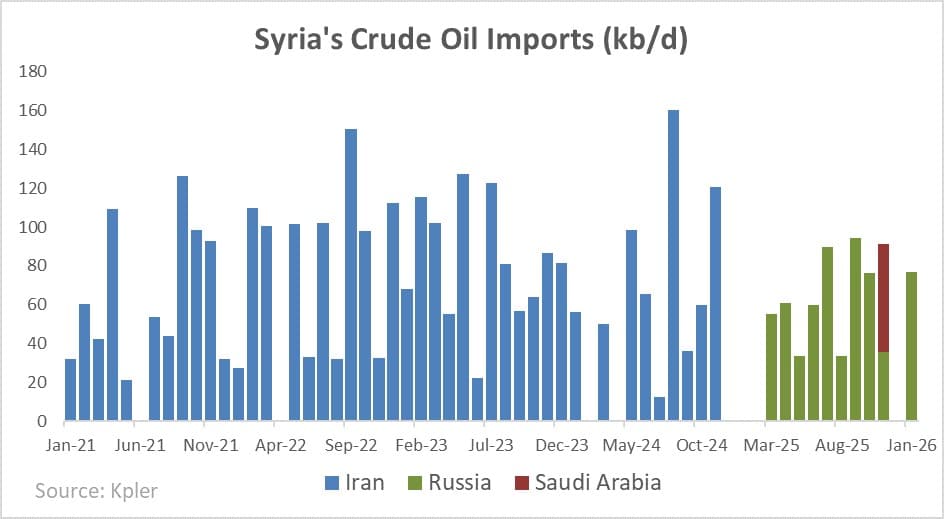
  • With Iran having stopped crude shipments after the fall of the al-Assad regime in late 2024, Russia is now the only major crude and oil products supplier into the country, averaging 115,000 b/d of crude and clean product exports in January 2026.

Syria’s attempt to rebuild its oil and gas sector entered a new phase in January 2026, when forces of the al-Sharaa government pushed into territories long controlled by the Kurdish-led Syrian Democratic Forces (SDF) and forced a new ceasefire. Under the agreement reached on January 18, Damascus assumed administrative and security control over all major oil and gas assets previously held by the SDF in the northeast of the country. For the first time since 2011, the Damascus government regained effective authority over most of the country’s hydrocarbon resources, reopening a vital revenue stream but also exposing the sector to renewed political and commercial risk.

Before the conflict, Syria produced about 380,000 b/d of oil and 25.5 Mcm/d of natural gas. As fighting spread following the onset of Syria’s bloody civil war in 2011, output collapsed. Oil production fell by roughly 80% to around 30,000 b/d in the first years of the conflict, while gas output halved to about 12 Mcm/d. Gas declined less sharply because most major fields are located in the Palmyra basin near Damascus, which remained relatively secure and under government control. Oil, by contrast, is concentrated in northeastern Syria, where fighting was the most intense. These heavy-oil fields were controlled for years by the SDF, the main rivals of the Assad-led central government. As long as these areas remained outside state control, Syria’s energy recovery remained structurally constrained. After the fall of al-Assad’s regime in late 2024, throughout 2025, negotiations between the government and the SDF continued intermittently while clashes persisted. The balance shifted in January 2026, when government forces advanced into SDF-held territory and secured a new ceasefire. Damascus assumed control over Deir ez-Zor and Raqqa governorates and over all major oil and gas assets that were previously held by the SDF, including the Al-Omar and Tanak oilfields and the Conoco gas plant.

Syria’s investment breakthrough also began after the fall of Bashar al-Assad’s regime, when Western governments gradually eased economic restrictions. In June 2025, the US lifted sanctions on the Syrian Petroleum Company (SPC), following similar steps by the EU and the UK. Banking restrictions were relaxed and limited access to SWIFT was restored. However, the first to come back to the country were Gulf partners. Saudi Arabia emerged as a central partner, signing agreements in August 2025 covering gas field development, drilling, processing and solar projects, while the Saudi Electricity Company agreed to cooperate on power generation and grid infrastructure. In November, UAE-based Dana Gas signed a deal to evaluate existing gas fields, and in December Saudi Arabia added four further energy agreements.

Gas, less damaged than oil infrastructure and directly linked to chronic electricity shortages, became the main focus of early reconstruction and investment. The World Bank approved a $146 million four-year programme to stabilise transmission and distribution networks. Syria also resumed gas exploration, launching four wells near Damascus in Al-Tuwani in late 2025, with first output expected in mid-2026. A Qatar-led consortium pledged $7 billion to build new gas-fired power plants, and in August 2025 Syria began importing Azerbaijani gas via Turkey through the Kilis–Aleppo pipeline, targeting volumes of about 1.2 billion cubic metres a year.

Western re-engagement has been cautious and limited in scope so far. Syria’s oil sector remains highly exposed to risks, shaping investor behaviour. In late January 2026, Shell announced it would exit its stake in the Al-Omar field and transfer it to the SPC. The company had lacked access to the asset during years of SDF control and chose not to re-engage after the takeover, consistent with its broader retreat from high-risk jurisdictions, including earlier withdrawals from Iraq’s Majnoon field in 2018 and Nigeria’s onshore assets in 2024.

Although the CEO of the SPC announced plans to award exploration licences to TotalEnergies and Eni, the European majors remain cautious. This way, the most likely new entrants are US companies, which benefit from strong political and security backing. In November 2025, ConocoPhillips signed preliminary agreements with the SPC and Novaterra to develop gas assets and expand exploration. On February 4, Chevron and Qatar-based Power International Holding signed a memorandum of understanding with the SPC for the development of the country’s prospective offshore oil and gas assets, with plans to start first drillings already in summer 2026.

Alongside Western and Gulf re-engagement, Russia remains the most active external player both before and after the war. Russian companies were present even before 2011, when Tatneft began operating in Deir ez-Zor under a PSA with the SPC. Exploration halted after the conflict erupted, but Moscow’s role expanded during the war through security-linked arrangements that granted small Russian firms access to oilfields captured from the Islamic State by Russian-backed private forces. Under al-Assad, Iran became Syria’s main oil supplier, providing most imported crude and fuel under sanctions and keeping refineries operational. That support ended after the regime’s collapse in late 2024, allowing Russia to move quickly into the gap. From early 2025, Moscow began shipping crude and refined products to Syria, starting with ARCO blend cargoes in March – effectively preventing refinery shutdowns – followed by Urals crude and clean products. In January 2026, Russian exports of crude and fuels to Syria reached about 115,000 b/d, according to Kpler data.

The Syrian government began testing crude exports after sanctions were eased in mid-2025, with the SPC probing demand in Mediterranean markets. One crude oil cargo sailed from the Tartous terminal in September 2025 –ultimately bound to Sardinia, home to Vitol’s Saras refinery, one of the region’s most sophisticated facilities. Syrian crude is difficult to market: it is heavy (around 23 degrees API), high in sulphur (about 4%), and, according to Energy Intelligence, with a big water cut. Only complex refiners capable of processing contaminated heavy grades can absorb such barrels. The main attraction, however, is price. SPC cargoes were reportedly offered at around $10 discount to Brent, making them the cheapest sanction-free heavy crude in the Mediterranean region. Refiners willing to take on these operational challenges stand to gain most from Syria’s return to oil markets.

The uneven return of foreign capital to post-Assad Syria reflects intensifying geopolitical competition, as Russian and Western interests increasingly converge on the same energy assets and infrastructure. Moscow is seeking to preserve the privileged economic and political position it built during the war and reinforced through fuel supplies, while Western governments and companies view energy engagement as a channel for stabilisation and political influence. For Damascus, managing this rivalry has become a central political task. Russia remains a key partner, offering geographic proximity, logistical access, and reliable fuel flows, while Western involvement brings capital, technology, and international legitimacy. Security considerations underpin this balance: Washington’s decision to limit support for Kurdish forces and shift backing toward Damascus weakened the SDF, enabling the January 2026 takeover of key oilfields, and making Western military and diplomatic support the main external guarantee of Syria’s territorial consolidation.

Syria’s energy recovery is therefore inseparable from its foreign policy alignment. The government must rely on Russia for immediate stability while signalling loyalty to Western partners to secure long-term investment and security guarantees. Gas-linked power generation is likely to recover first, reflecting its role in economic and social stabilisation. Oil output will recover more slowly, constrained by infrastructure damage, investor caution and political risk. Whether Damascus can navigate this perfect storm of competing interests and convert regained oilfields into sustainable growth, rather than renewed dependency, will determine the durability of its post-war settlement.

By Natalia Katona for Oilprice.com

Pt 

Platinum deficits to persist as EV rollout slows, Valterra says

Stock image.

A slower-than-expected rollout of electric vehicles will help keep platinum-group metals in supply shortfalls over the coming years, according to the chief executive officer of major miner Valterra Platinum Ltd.

The EV boom had long weighed on platinum and sister metal palladium, as a large chunk of production is used in catalytic converters to curb pollution from internal combustion engine vehicles. Still, a slower-than-expected adoption of EVs in some markets has helped boost sentiment around the metals

In December, the European Union in December eased requirements that would have halted sales of new gasoline and diesel-fueled cars starting in 2035.

PGMs “will continue to be in a supply-demand deficit for a number of years,” Valterra CEO Craig Miller said in an interview with Bloomberg TV. The pace of the transition to EVs has not been “as dramatic as some of the forecasts were,” he said.

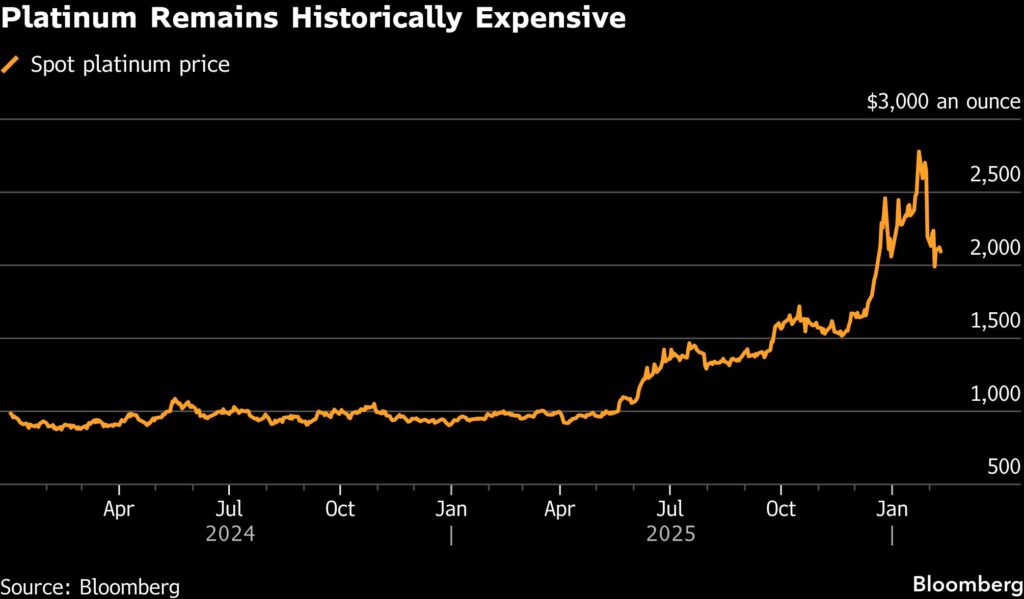
Platinum — which has been in a deficit for the last few years — spiked to a record last month. While prices have since pulled back about 28%, they remain historically high.

Aside from supply-and-demand fundamentals, platinum and palladium have also seen a wave of speculative buying over the past year, rocketing higher alongside gold and silver as investors sought precious metals as a haven.

Valterra in January said its profit likely more than doubled last year as a result of the rally. The former subsidiary of Anglo American Plc became an independent company in the middle of last year – around the time PGM prices began to recover following a lengthy downturn.


(By Jack Ryan and Jennifer Zabasajja)