It’s possible that I shall make an ass of myself. But in that case one can always get out of it with a little dialectic. I have, of course, so worded my proposition as to be right either way (K.Marx, Letter to F.Engels on the Indian Mutiny)
Thursday, February 12, 2026
Trump Disavows Oil Executive’s Role in Venezuela Talks
President Donald Trump on Thursday rejected any suggestion that a private U.S. oil executive is shaping Washington’s approach to Venezuela, stepping into a sensitive debate over who gets influence in the future of the world’s largest stranded crude reserves.
In a post on Truth Social, Trump said Florida fuel trader Harry Sargeant III has no authority to act on behalf of the United States and that only State Department-approved officials conduct diplomacy with Caracas. He described current relations with Venezuela as strong and credited Secretary of State Marco Rubio and other officials managing those contacts.
The statement follows reports that Sargeant had shared ideas with administration figures about how American companies might re-enter Venezuela’s oil sector, which has been crippled by years of sanctions, underinvestment, and economic collapse. Any easing of restrictions could determine whether U.S. operators regain a foothold in a country that holds roughly 300 billion barrels of proven crude reserves.
Sargeant has worked in Venezuela’s oil business since the 1980s through companies tied to heavy crude and asphalt markets, including investments in local oil fields. He built much of his career trading fuel in sanctioned or politically restricted jurisdictions, an experience that placed him close to the intersection of energy commerce and U.S. foreign policy.
People familiar with recent discussions said Sargeant spoke with U.S. officials about rebuilding Venezuela’s oil infrastructure and the conditions required for renewed American investment. He has said he holds no formal advisory position.
In early 2025, Sargeant helped arrange talks between a U.S. envoy and Venezuelan officials covering migration, detained Americans, and the status of licenses allowing limited U.S. oil operations. For oil markets, the message signals that any expansion of U.S. activity in Venezuela will remain tightly controlled and politically managed, which could temper expectations for a rapid reopening of the country’s constrained crude sector.
By Julianne Geiger for Oilprice.com
Venezuela’s Return Won’t Dethrone Latin America’s Oil Leaders
Argentina, Guyana, and Brazil are set to add more than 700,000 bpd in 2026, consolidating their position as Latin America’s oil growth engines.
Venezuela may add short-term supply, but legal risk, heavy crude, and infrastructure decay limit long-term capital reallocation.
Investment is concentrating on shale, pre-salt, and deepwater projects with resilient economics, signaling a fragmented regional oil future.
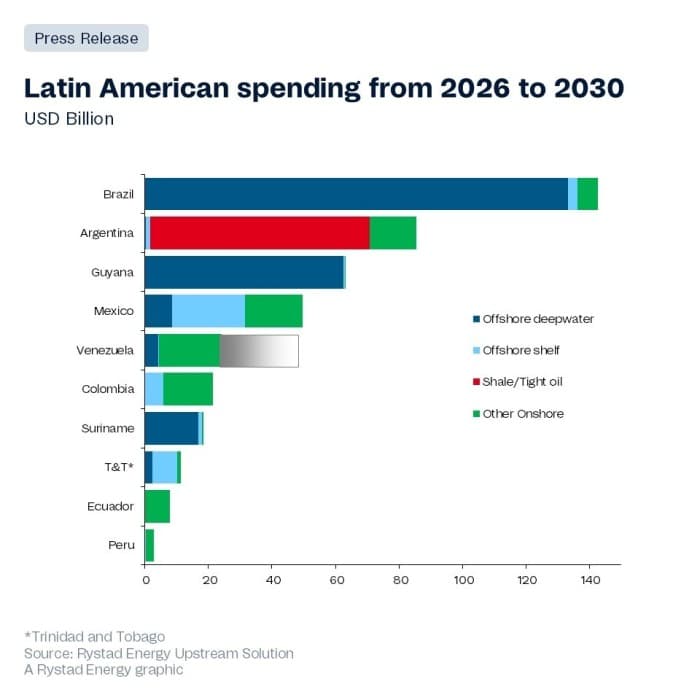
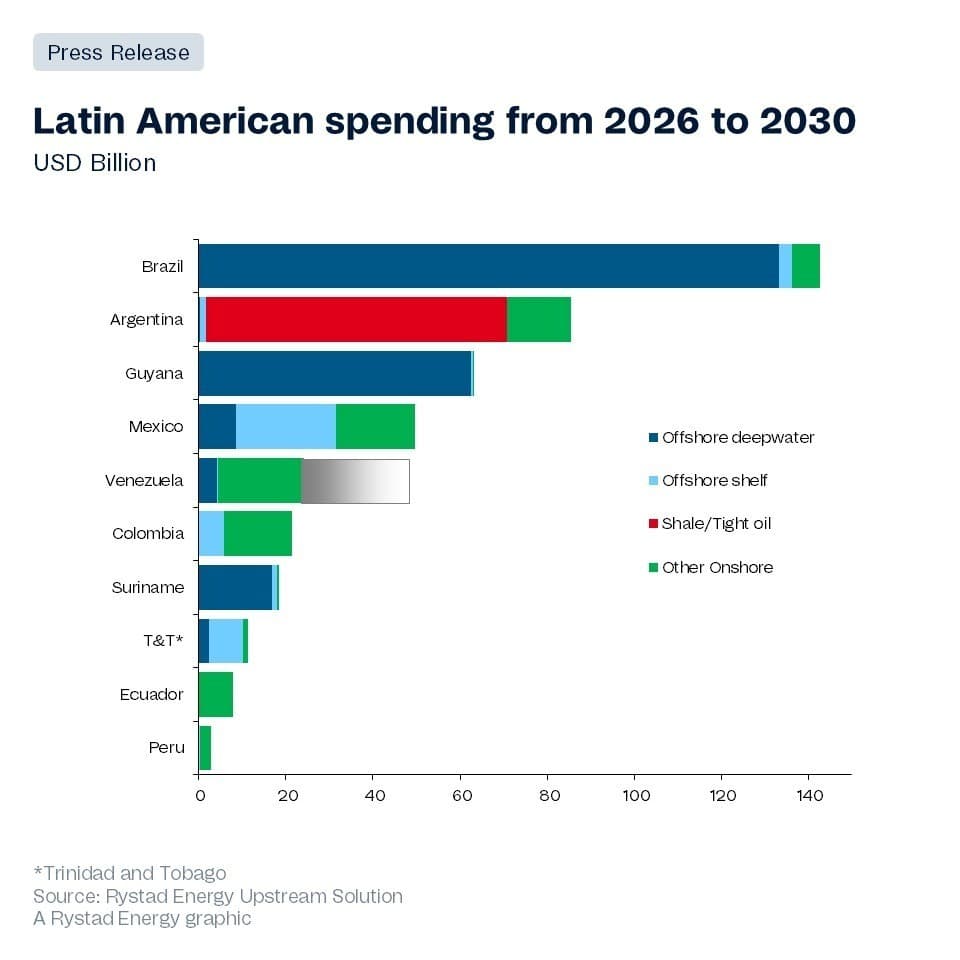
Argentina, Guyana, and Brazil are poised to lead Latin American oil production growth in 2026, even though the possible return of Venezuelan barrels poses questions for the region’s long-term capital expenditure strategy. While the supermajors continue to flag Venezuela as difficult to underwrite on a long-term basis, traders and players like Trafigura and Hillcorp are increasingly drawn to near-term, structured opportunities in the country, signaling a possible rebalancing of portfolios. Although legal uncertainties persist and institutional legitimacy remains thin, recent reforms, such as the lifting of sanctions and the overhaul of Venezuela’s hydrocarbons law, reinforce US efforts to market Venezuelan barrels. Rystad Energy analysis estimates that flagship projects in Argentina, Guyana and Brazil, which are expected to add more than 700,000 barrels per day (bpd) of oil production this year, will continue to outcompete Venezuela through at least 2030. In the short term, 300,000 bpd of Venezuelan supply could be added to the market, but the likelihood of shifting investment from current Latin American powerhouses to beleaguered Venezuelan infrastructure amid an uncertain business environment remains limited.
A Venezuelan oil industry makeover will be costly and lengthy, with the big three in the region – Argentina, Guyana and Brazil – remaining largely indifferent to the estimated, near-term return of Venezuelan crude. Oversupply, whether from Venezuelan or even Iranian barrels, is what is truly testing the financial resilience of operators who would otherwise gain from a revived oil industry in the Bolivarian Republic.
Radhika Bansal, Vice President, Oil & Gas Research, Rystad Energy
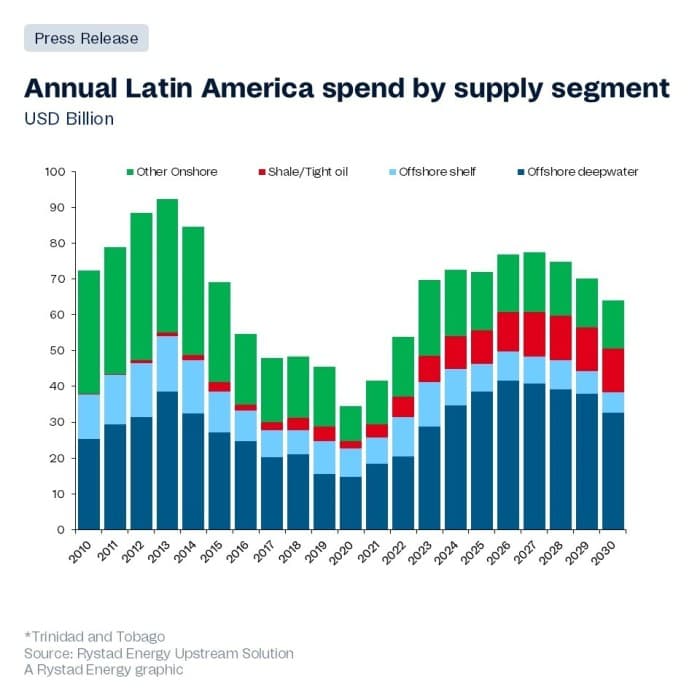
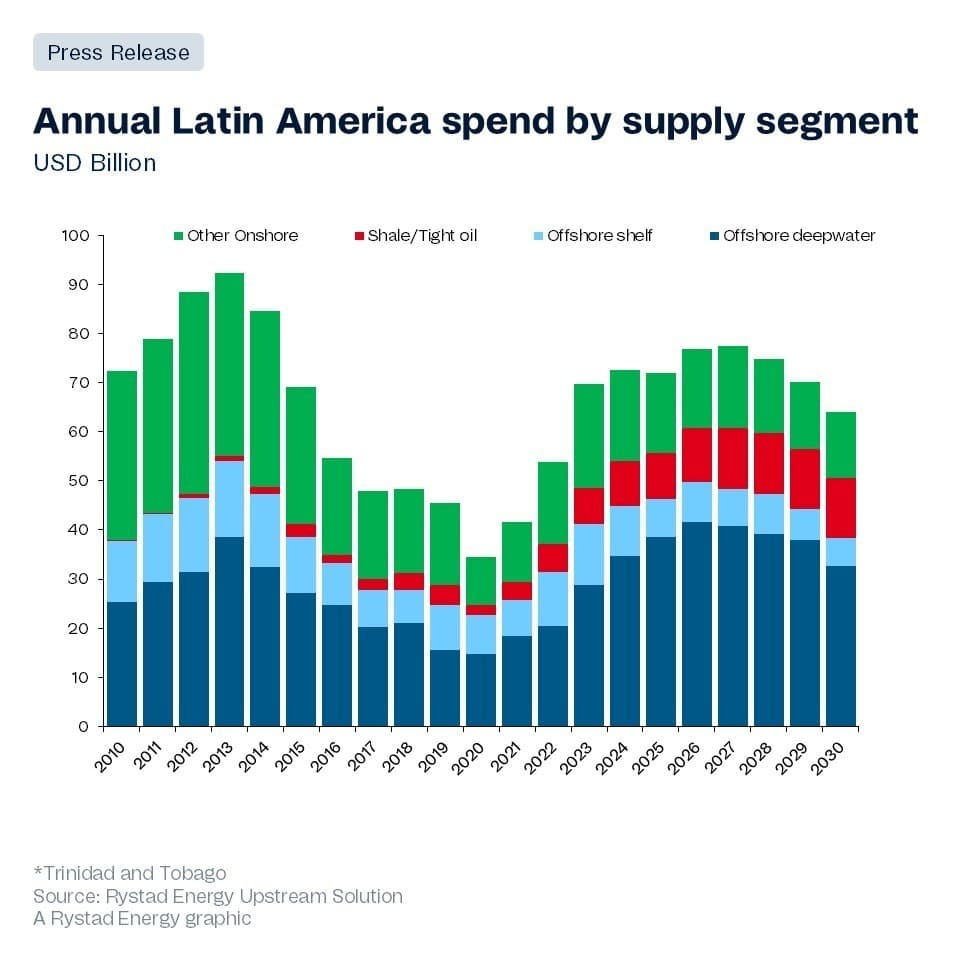
While overall investment in Latin America is expected to increase in 2026, the total volume of conventional reserves put into production will be 45% smaller than last year, signaling a consolidation of investment on projects with nearly guaranteed return on investment (ROI). Final investment decisions (FIDs) were significantly lower in the region last year, and 2026 is expected to be no different. Investment flows will be heavily routed toward greenfield projects in Guyana and Suriname, while Argentina is slated to lead the brownfield investment charge as Vaca Muerta production aggressively ramps up.
Overall, the region’s oil production forecast is expected to exceed 8.8 million bpd this year, driving the majority of non-OPEC+ supply growth and underscoring Latin America no longer moving as a single oil region, with multiple players falling behind as the ‘big three’ dictate its future. Brazil will remain the primary growth engine of 2026, with forecast production exceeding 4.2 million bpd, underpinned by the scale, resilience and cost competitiveness of its pre-salt developments. Brazil’s production growth this year is tied to new floating production, storage and offloading (FPSO) vessel ramp-ups and start-ups.
The true driver of accelerated investment in the region, however, is its shale sector, which is expected to grow from $9.4 billion in 2025 to nearly $11 billion this year, all from Argentina. Additionally, the offshore deepwater sector is expected to drum up $42 billion in investment in 2026, up 7.7% from the previous year. This trajectory has been anchored by strong fundamentals for Vaca Muerta shale and resilient barrels on the pre-salt and on new frontiers in Guyana and Suriname.
As for Venezuela, interest from smaller players is supported by license-enabled access that lowers upfront capital costs, in addition to securing heavy crude feedstock for US Gulf Coast refiners at attractive prices, and the ability for traders to manage the logistics, blending and licensing constraints required to sell Venezuelan barrels. However, projects with long lead times and heavy upfront investments, like offshore Brazil, Guyana and Suriname, remain economically viable in current oil price variations and are anchored by competitive breakeven prices, making these short-term shifts toward Venezuela less consequential. The Vaca Muerta play, although a shorter cycle shale development, has committed to building new infrastructure, so it should also react to Venezuela’s potential comeback with resilience amid declining prices.
Supposing oil demand stays resilient through 2035, and the impact of years-long underinvestment is fully felt, Venezuelan barrels would become far more relevant. If the industry starts making more long term, economically rational choices now, Venezuelan oil production could make sense in a higher oil price environment. However, more attractive barrels will still be at play, with Venezuela’s extra-heavy, emissions-intensive oil posing persistent challenges.
Radhika Bansal, Vice President, Oil & Gas Research
Outside of the big three and in the near term, countries geographically closer to Venezuela may develop a different relationship in an open exploration and production (E&P) market. Trinidad and Tobago, for example, has opportunities to bring Venezuelan offshore gas to supply their liquefied natural gas (LNG) trains. Colombia, on the other hand, could see more competition for capital given the country has little remaining opportunities for oil developments. Colombia could even face labor competition, given the revamp of Venezuela's production would require a specialized workforce available in their neighbor country.
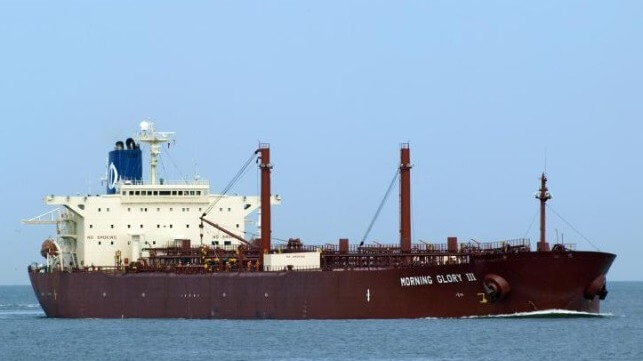
With the resumption of Venezuela's oil trade under U.S. management, shipments from state oil company PDVSA have resumed, including some shipments aboard the same shadow fleet tankers that have carried Venezuelan cargoes for years. Under new orders, some of these vessels are now visiting ports with more stringent PSC inspection regimes, and at least two aging tankers have been detained in Caribbean jurisdictions.
The Caribbean MOU on Port State Control (CMOU) reports that the small tankers Morning Sun and Regina have been detained in Dutch-affiliated jurisdictions, the former in St. Eustatius and the latter in Curacao. NRC, which first reported the development, says that both tankers were involved in delivering Venezuelan oil; Regina had previously carried at least one oil cargo associated with the joint Trafigura-U.S. marketing arrangement, according to the local government.
The detention of Regina could be a setback for Curacao, which wants to become a trading hub for newly-legitimate Venezuelan oil. Curacao prime minister Gilmar Pisas personally welcomed Regina's arrival on the tanker's first visit to the island, reflecting the value that his administration places on the Venezuelan oil trade. But if the jurisdiction's inspectors strictly enforce regulations, many aging shadow fleet vessels will not be able to call at its oil terminal.
Regina's problems extend beyond the usual PSC deficiencies. She arrived falsely flying the flag of East Timor, which does not have an international shipping registry. East Timor has previously asked port states to investigate vessels claiming to fly its flag. An investigation into the circumstances of the vessel's condition and flagging is under way.
Meanwhile, in St. Eustatius, Dutch officials have detained the product tanker Morning Sun for inspection deficiencies. Morning Sun is a 1996-built tanker declaring the flag of Panama; her last PSC inspection outside of Venezuela was in 2018, and the record shows that inspectors found issues with her fire doors, fire pump, and hatchway watertightness, among other items. The officials in St. Eustatius confirmed to NRC that on this inspection, they found too many deficiencies to allow the ship to sail.
Tankers from the "clean," non-shadow fleet have begun calling in Venezuela at scale, arriving on charters for American and European buyers. The experience of Morning Sun and Regina could accelerate Venezuela's transition to the use of tanker tonnage that can pass muster in a Western seaport, rather than aging shadow fleet vessels that make STS transfers in low-enforcement jurisdictions.
TotalEnergies has signed agreements to acquire a 42.5% operated interest in the PEL104 exploration license offshore Namibia from Eight Offshore Investments Holdings and Maravilla Oil & Gas. Once the transaction closes, the French major will take over operatorship of the block, partnering with Petrobras, which will also hold 42.5%, Namibia’s national oil company Namcor with 10%, and Eight retaining a 5% stake.
PEL104 is located in the Lüderitz Basin offshore southern Namibia and covers approximately 11,000 square kilometers. The deal is subject to customary regulatory approvals from Namibian authorities and joint venture partners.
The move builds on TotalEnergies’ aggressive expansion in Namibia following its acquisition in December of a 40% operated interest in the adjacent PEL83 license. Namibia has emerged as one of the most promising new offshore exploration hotspots globally, following a string of major discoveries in recent years, including TotalEnergies’ own Venus find and the Mopane discoveries operated by partners.
By adding PEL104 to its portfolio, TotalEnergies is strengthening its operational control and geological exposure across multiple basins, allowing it to leverage shared infrastructure, subsurface expertise, and exploration synergies. The Lüderitz Basin, while less appraised than the Orange Basin to the north, is considered highly prospective and could offer material upside if exploration success mirrors nearby discoveries.
The partnership with Petrobras also underscores growing international interest in Namibia’s offshore potential, as major oil companies seek to replenish reserves amid declining output from mature basins elsewhere. For Namibia, continued upstream investment supports long-term ambitions to become a meaningful oil-producing nation, with potential spillover benefits for fiscal revenues, employment, and local content development.
TotalEnergies has operated in Namibia for decades and maintains a downstream footprint as one of the country’s largest fuel distributors. The company has also indicated interest in developing low-carbon and multi-energy projects locally, aligning with its broader global strategy while continuing to prioritize high-impact upstream opportunities.
The PEL104 transaction further cements TotalEnergies’ role as a leading operator in Namibia’s offshore exploration drive at a time when the country is attracting sustained global attention from energy investors.
By Charles Kennedy for Oilprice.com
Chevron Reshuffles Top Leadership as Senior Executives Announce Retirements
Chevron Corporation on Thursday announced a series of senior leadership changes that will reshape key parts of its executive team over the next year, reflecting both planned retirements and internal succession following the company’s recent strategic shifts.
The changes include the retirement of several long-serving executives and the promotion of internal candidates into roles overseeing corporate strategy, business development, supply and trading, shale operations, and investor relations.
Among the most senior departures, Frank Mount, President of Corporate Business Development, will retire in November 2026 after 33 years with Chevron. Mount has led the company’s global business development efforts since 2023, a period marked by portfolio optimization and large-scale M&A activity, including the acquisition of Hess.
Jake Spiering, currently Director of Investor Relations, will succeed Mount as President of Corporate Business Development effective August 1, 2026. Spiering joined Chevron in 2008 and has held multiple finance leadership roles across the company’s global asset base.
Investor relations leadership will also change earlier in the year. Jeanine Wai will assume the role of Director of Investor Relations on April 1, 2026. Wai rejoined Chevron in January after prior stints at TotalEnergies, major investment banks, and Bechtel, bringing a mix of operational and capital markets experience.
Chevron’s Supply & Trading organization will see a transition as Patricia Leigh retires in July 2026 after 35 years with the company. Leigh has led the unit since 2024, overseeing supply, logistics, and trading strategy during a volatile period for global energy markets.
Molly Laegeler, currently Chief Strategy Officer, will take over as President of Supply & Trading effective March 1, 2026. Laegeler has previously overseen operations in several assets, including the Permian Basin, and will now be tasked with driving profitability and enterprise value across Chevron’s trading and logistics activities.
Kevin Lyon, who currently serves as Hess Integration Leader, will step into the role of Chief Strategy Officer on the same date. Lyon brings decades of upstream and project leadership experience and will be responsible for guiding Chevron’s long-term strategy, portfolio optimization, and sustainability agenda as the company integrates Hess assets.
Another notable retirement includes Bruce Niemeyer, President of Shale & Tight, who will retire in October 2026 after 26 years with Chevron. Niemeyer has held senior upstream and strategy roles and currently oversees Chevron’s global shale portfolio. He will remain on as Senior Executive Advisor through October.
Gerbert Schoonman, currently Senior Executive Advisor for Hess Integration, will succeed Niemeyer as President of Shale & Tight effective April 1, 2026. Schoonman joined Chevron in mid-2025 following the Hess merger and brings more than 35 years of international upstream experience from Hess and Shell.
The leadership changes come as Chevron continues to integrate Hess, prioritize capital discipline, and balance growth in its core oil and gas business with longer-term energy transition initiatives. The reshuffle underscores Chevron’s reliance on internal succession while drawing on executives with experience in large-scale integrations, trading, and unconventional resource development.
By Charles Kennedy for Oilprice.com
Why the AI Boom May Extend the Reign of Natural Gas
The buildout of AI infrastructure is causing a new wave of power demand, forcing utilities to revise forecasts upward after years of slow load growth.
The continuous, high-density demand from AI workloads makes reliable, dispatchable power sources like natural gas critical because intermittent generation alone cannot meet the firm capacity needs.
While AI increases electrification, if power demand outpaces the buildout of low-carbon capacity, total fossil fuel consumption and emissions may still rise in the near term, making the decarbonization story more complex.
Artificial intelligence is often viewed as a catalyst for electrification and subsequently decarbonization. Yet one of its most immediate effects may be the opposite of what many assume. The rapid buildout of AI infrastructure is increasing demand for reliable power, and that reality could strengthen the role of natural gas and other dispatchable energy sources for many years.
Investors focused on semiconductors and software valuations may be overlooking a key constraint. AI runs on electricity, and those electricity systems operate within physical and economic limits.
AI Is Driving a New Wave of Power Demand
The energy sector has spent much of the past decade grappling with slow load growth. That is now changing, in a way that is reminiscent of the sharp rise in oil demand—and subsequently price—in the early 2000s.
Training large language models and operating advanced AI systems requires enormous computing resources. Hyperscale data centers are expanding rapidly, with developers requesting gigawatt-scale interconnections from utilities. In several regions, electricity demand forecasts have been revised upward after years of flat expectations.
This shift is significant because AI workloads create continuous, high-density demand rather than intermittent usage. Data centers cannot simply power down when the electricity supply becomes constrained. Reliability becomes paramount.
Reliability Requirements Change the Generation Mix
Wind and solar capacity continues to expand, but intermittent generation alone cannot meet the firm capacity needs of AI infrastructure without significant storage or backup generation.
Battery storage is improving, yet long-duration storage remains costly at scale. Nuclear projects face long development timelines and complex permitting hurdles. Transmission expansion also lags demand growth in many regions.
These constraints make dispatchable power sources critical. Natural gas plants can ramp quickly, operate continuously, and be deployed faster than many alternatives. As a result, gas-fired generation is increasingly viewed as a practical solution for supporting AI-driven load growth.
This does not undermine the role of renewables. In many markets, new renewable capacity is paired with gas generation to maintain grid stability. The key point is that AI-driven electrification is likely to increase fossil fuel usage in the near term.
Natural Gas May Be a Big Beneficiary of the AI Boom
Several factors support natural gas as a near-term winner.
Construction timelines favor gas-fired generation when demand rises quickly. Existing pipeline infrastructure reduces barriers to expansion. And for operators of data centers, reliability often outweighs ideological preferences. Downtime is simply too expensive.
Utilities are also revisiting resource plans as load forecasts rise. That shift may drive increased investment in transmission, grid modernization, and flexible generation assets.
If electricity demand outpaces the buildout of low-carbon capacity, fossil generation may still increase in absolute terms even as renewables gain market share. Total emissions could rise, but the carbon intensity of the energy system may trend lower as cleaner sources make up a larger share of supply.
Ultimately, energy systems evolve based on engineering and economics, not just policy goals or market narratives.
What Investors May Be Missing
AI is often discussed as a technology story, but it is equally an infrastructure story.
Rising power demand could benefit utilities investing in transmission and generation capacity. Natural gas producers and midstream companies may see structural demand support from increased power-sector consumption. Equipment suppliers tied to grid reliability and gas turbines could also gain from the shift.
Longer term, advances in nuclear, storage, or efficiency may change the trajectory. For now, the immediate response to surging electricity demand is likely to rely on technologies that can be deployed quickly and reliably.
Artificial intelligence may reshape the economy in profound ways. One of the least appreciated consequences is that it may extend the relevance of natural gas as the world builds the energy backbone required to power the next generation of computing.
Aramco has signed a memorandum of understanding with Microsoft to accelerate the deployment of industrial artificial intelligence and strengthen digital capabilities in Saudi Arabia.
The agreement builds on an existing collaboration between the two companies and centers on deploying AI-driven industrial solutions on Microsoft’s Azure cloud platform. The focus is on moving AI from pilot projects into core operational systems, with the stated goal of improving efficiency, competitiveness, and resilience across Aramco’s global energy operations.
At the heart of the MoU is a push to strengthen digital sovereignty and data governance. The companies will explore a roadmap for cloud deployment that incorporates sovereign controls and supports Saudi Arabia’s data residency requirements. This aligns with Riyadh’s broader push to localize critical digital infrastructure and ensure sensitive industrial data remains under national jurisdiction.
Operational optimization is another pillar of the agreement. Aramco and Microsoft will examine ways to streamline digital frameworks that underpin the oil giant’s upstream, downstream, and chemicals businesses, creating what executives describe as a more seamless and integrated digital backbone.
The MoU also outlines plans to engage Saudi technology integrators and industry partners to widen AI adoption across the Kingdom’s industrial value chain. By fostering a domestic ecosystem of collaborators, Aramco is positioning industrial AI as a lever not just for internal efficiency, but for broader economic diversification under Vision 2030.
A notable element of the partnership is the exploration of co-developing and commercializing industrial AI intellectual property. The companies are assessing the potential creation of a global marketplace for AI-powered operational systems tailored to the energy sector, potentially enabling Saudi-developed solutions to compete internationally.
In parallel, Aramco and Microsoft are discussing expanded workforce development programs focused on AI engineering, cybersecurity, data governance, and product management. These initiatives would build on Microsoft’s existing training footprint in Saudi Arabia, where it has already delivered cloud and AI programs to thousands of learners. The aim is to tie skills development to measurable outcomes, reinforcing the Kingdom’s ambition to cultivate a digitally fluent industrial workforce.
For Aramco, the move underscores a broader strategic shift toward digitalization as a core competency rather than a support function. The company has steadily invested in advanced analytics, automation, and AI across drilling, reservoir management, predictive maintenance, and supply chain optimization. Deepening its partnership with a hyperscale cloud provider like Microsoft signals an intent to standardize and scale those capabilities.
For Microsoft, the agreement strengthens its position in one of the world’s most strategically important energy markets. As energy companies globally race to integrate AI into operations—from predictive maintenance to emissions monitoring—cloud providers are competing to anchor themselves within critical infrastructure environments, particularly where sovereign cloud frameworks are required.
The MoU does not create binding financial commitments but establishes a framework for potential joint projects. If implemented at scale, the collaboration could position Aramco as a reference case for industrial AI deployment in the global energy sector, with implications for both operational performance and Saudi Arabia’s digital industrial policy.
As AI adoption accelerates across heavy industry, partnerships that combine cloud infrastructure, regulatory compliance, and sector-specific expertise are becoming central to the next phase of energy digital transformation.
By Charles Kennedy for Oilprice.com
NATO’s Arctic Sentry Formalizes the Race for the High North
NATO officially launched its Arctic Sentry mission on February 11 to improve its military posture in the Arctic region, following recent tensions between the United States and Denmark over Greenland.
The mission is intended to bring all of NATO's Arctic activities under one command to counter increasing Russian and Chinese activity in the strategically significant area.
Arctic Sentry is confirmed to be a "multidomain" mission, covering air, sea, and land, and will incorporate ongoing exercises like Denmark's Arctic Endurance and the upcoming Cold Response.
NATO officially launched its Arctic Sentry mission on February 11 in a bid to improve the military posture of the alliance in the Arctic region.
The move follows recent tensions between NATO allies Denmark and the United States over the political future of Greenland. When it was first mooted last month, several diplomats told RFE/RL that a potential Arctic mission could be a way out of a growing crisis.
Following a meeting between US President Donald Trump and NATO Secretary-General Mark Rutte last month in Davos, Switzerland, it was agreed that NATO should play a bigger role around Greenland to counter potential Chinese and Russian interference around the island and in the Arctic in general.
Speaking at a press conference in Brussels on February 11, Rutte said that "for the first time we will bring everything we do in Arctic under one command. We will not only leverage all that we are doing, we will also see what gaps there are and we will fill them" adding that "we do this because we have a clear sense that the Russians and the Chinese are becoming more active there.
In a press release announcing the launch, NATO’s supreme allied commander for Europe, Alexus Grynkewich, said that “Arctic Sentry underscores the Alliance’s commitment to safeguard its members and maintain stability in one of the world’s most strategically significant and environmentally challenging areas,” adding that it would "leverage NATO’s strength to protect our territory and ensure the Arctic and High North remains secure.”
No details have emerged so far about how many NATO countries are involved in the mission or troop levels, although the military alliance has confirmed that it is “multidomain,” meaning it will cover air, sea, and land.
NATO has also stated that Denmark’s Arctic Endurance exercise together with 11 other European NATO nations currently going on in and around Greenland and the upcoming Cold Response exercise in northern Norway and Finland involving 25,000 soldiers, including American troops, will form part of Arctic Sentry.
Seven of the eight so-called Arctic countries are NATO members, with Russia being the glaring exception. And while the waters around Greenland aren't full of Russian and Chinese ships right now, that could change as Arctic Sea ice melts and new sea lanes open up.
Arctic Sentry comes after NATO formed similar missions in 2025 that are still underway in the Baltic Sea -- as a response to the alleged Russian sabotage of undersea cables -- and on the alliance’s eastern flank -- after Russian drone incursions into Poland in September.
Libya's state-owned National Oil Corporation (NOC) has announced U.S. Oil & Gas major Chevron (NYSE:CVX) among the winners of its first oil and gas licensing round in nearly two decades, signaling a major push to revive the country's hydrocarbon sector. The bidding round also awarded exploration and production rights to several foreign companies, including Italy’s Eni S.p.A. (NYSE:E), Spain’s Repsol S.A. (OTCQX:REPYY), QatarEnergy and Nigeria’s Aiteo.
Chevron secured an onshore Sirte S4 (also referred to as Contract Area 106) exploration license, reflecting a strategic reentry into Libya's oil sector. Chevron's return aligns with its strategy to focus on high-impact exploration in Africa, following its exit in 2010 following unsuccessful efforts.
Onshore Area 106 in Libya’s Sirte Basin is a high-potential, active exploration zone that recently saw a significant oil and gas discovery in late 2025 by Austria's OMV AG (OTCPK:OMVJF). Located in the heart of Libya's primary hydrocarbon province, this block covers approximately 7,000 square kilometers and is considered a key area for Libya’s goalie to boost production to 2 million barrels per day by 2028.
Eni and QatarEnergy were awarded offshore Area 01 in the Mediterranean's gas-rich Cyrenaica zone, reinforcing a strategic partnership in the region, while Repsol Consortium, led by Spain's Repsol (including Hungary's MOL and Turkey's state-owned TPOC) won Offshore Area 07.
Meanwhile, Nigeria's Aiteo secured the Murzuq M1 license in the southern basin, marking a rare entry for an African independent in the country's upstream sector. Libya holds over 48 billion barrels of oil, often high-quality, light-sweet crude, and significant gas resources.
Western oil majors are making a comeback to Libya thanks to the country’s massive, high-quality hydrocarbon reserves--the largest in Africa--coupled with an improvement in security following the 2020 ceasefire. Driven by the need to secure supplies and counter Russian influence in the Mediterranean, the majors have been flocking to the country as they try to stake their claims despite ongoing instability and dangerous government rivalry.
By Alex Kimani for Oilprice.com
Hungary’s MOL Expands Into Libya With Repsol and TPAO in Offshore Exploration Push
Hungary’s MOL Group is entering Libya’s upstream sector through a joint offshore exploration venture with Repsol and Türkiye Petrolleri A.O., marking its latest move to expand its international footprint.
The consortium won the right to explore Libya’s O7 offshore block as part of the country’s first licensing round in 17 years, reopened by National Oil Corporation in March 2025. Repsol will operate the project with a 40% stake, TPAO will hold 40%, and MOL will take a 20% interest.
The O7 block spans more than 10,300 square kilometers in deepwater areas exceeding 1,500 meters, about 140 kilometers northwest of Benghazi. The deepwater Mediterranean setting plays to the offshore experience of the consortium partners, particularly Repsol and TPAO.
Libya, Africa’s second-largest oil producer after Nigeria, holds Africa’s largest proven crude reserves, but political instability since 2011 has constrained investment and production. The reopening of the licensing round signals Tripoli’s push to revive exploration and boost output, currently fluctuating around 1.2–1.3 million barrels per day.
For MOL, the move strengthens its upstream diversification strategy. The company currently produces oil and gas in eight countries and aims to maintain production above 90,000 barrels of oil equivalent per day over the next five years under its SHAPE TOMORROW strategy. MOL has recently signed cooperation agreements with national oil companies in Kazakhstan, Azerbaijan, Türkiye, and Libya.
CEO Zsolt Hernádi said the Libyan entry represents both geographic expansion and a step toward enhancing supply security for Central Europe.
The deal also deepens energy ties between Libya and Türkiye, which has steadily increased its economic footprint in North Africa, particularly in offshore development and infrastructure.