Wednesday, February 18, 2026

Spotlight on Africa: the race for Africa's critical minerals


SPOTLIGHT ON AFRICA
Issued on: 17/02/2026 
Play - 29:29

In this episode of Spotlight on Africa, we're looking at the race for critical minerals on the continent. In the first week of February, around forty African delegations were invited to Washington DC for a summit dedicated to the issue. The leaders of the Democratic Republic of Congo appear keen to sign deals, but much of the rest of Africa has been calling for better proposals and more robust mechanisms to ensure accountability. So what is happening?

A mining/crushing supervisor at MP Materials displays crushed ore before it is sent to the mill at the MP Materials rare earth mine in Mountain Pass REUTERS - Steve Marcus

The African continent is rich in resources that are critical to the energy transition, as well as to the electronics and high-tech industries. Africa holds vast reserves of coltan, gallium, cobalt, tantalum, lithium, nickel, and many other strategic minerals that sit at the heart of this global competition.

The Trump administration is seeking to counter China's growing dominance over the continent's metals and mining sectors.

DR Congo weighs price of security in minerals deal with US

For the moment, Trump is focused on a US - DRC agreement, which would prioritise American interests in the central African country's supply chain. The DRC sits on vast mineral wealth and is currently engaged in a peace process with Rwanda, brokered by the United States.

DRC takes on Apple: can conflict mineral mining be stopped?

To help us analyse the context of these deals, we are joined today by three guests.

First, Clionadh Raleigh, head of ACLED - the Armed Conflict Location and Event Data Project. We also have Akin Adegoke, Chief Digital Officer at Lotus Bank, who brings experience in driving technology-led, inclusive banking.

And finally, Frédéric Mousseau, Policy Director at the California-based Oakland Institute, who argues that, that under the guise of peace and development, the US–DRC Strategic Partnership Agreement rewrote Congo's laws to favour American mining interests."

Delegates walk through the exhibitors hall at the Cape Town International Convention Center during the 32nd edition of the African Mining Indaba on 10 February , 2026. © AFP - GIANLUIGI GUERCIA

Delegates also gathered at the Cape Town International Convention Centre for the 32nd edition of the African Mining Indaba, the continent's largest conference on the sector.

You'll also hear reactions from people on the ground in the DRC, as well as from leaders in South Africa and Zambia, on what has already been dubbed the new scramble for Africa.

Episode edited by Melissa Chemam and mixed by Erwan Rome.

Spotlight on Africa is produced by Radio France Internationale's English language service.


Japan to invest $36 billion in US projects under Trump deal


Bloomberg News | February 17, 2026 

Stock image.

Japan plans to invest $36 billion in US oil, gas and critical mineral projects, the first tranche of its $550 billion commitment under the trade agreement it struck with President Donald Trump.

“Our MASSIVE Trade Deal with Japan has just launched!” Trump posted Tuesday on social media. “The scale of these projects are so large, and could not be done without one very special word, TARIFFS.”

Japanese Prime Minister Sanae Takaichi said the projects were designed to build resilient supply chains through cooperation in areas crucial for economic security, including critical minerals, energy and artificial intelligence.

“We believe this initiative is fully aligned with its core objectives: promoting mutual benefits between Japan and the United States, ensuring economic security, and fostering economic growth,” she wrote.

The most significant investment is a natural gas facility in Ohio that’s expected to generate 9.2 gigawatts of power, according to a statement from US Commerce Secretary Howard Lutnick, a massive project which Trump described as “the largest in History.”

Japan is expected to invest $33 billion in the gas plant, which will be led by SoftBank Group Corp. subsidiary SB Energy, according a Trump administration official.

If the plant operates at full capacity, it would be the equivalent of nine nuclear reactors or roughly the amount of power consumed by about 7.4 million homes on the largest US grid operated by PJM Interconnection LLC.

The second project is a deepwater crude export facility in the Gulf of Mexico, according to Lutnick. The $2.1 billion investment into the Texas GulfLink export terminal will be operated by Sentinel Midstream and is expected to generate as much as $30 billion in annual US crude exports when operating at full capacity, the administration official said.

Trump’s initial social media post about the project sowed some confusion, describing the investment as a liquefied natural gas facility.

Japan is also expected to invest in a synthetic industrial diamond manufacturing facility, which Trump’s post indicated would be located in Georgia. The diamonds are a “critical input for advanced industrial and technological production,” Lutnick said. The project will receive a $600 million investment and involves Element Six, a subsidiary of De Beers, according to the administration official.

“Both governments will continue to work closely together to fine-tune the details and ensure the speedy start of these projects,” Japanese Chief Cabinet Secretary Minoru Kihara said in a press briefing Wednesday where he confirmed the projects.

The long-awaited announcement marks a step forward for the trade and economic pact that Trump announced with Japan last year. It comes weeks before Takaichi is set to meet with Trump in Washington.

The selection comes after a joint panel first met in December to consider projects, which are ultimately selected by Trump himself based on recommendations from an investment committee he established, along with input from Japanese officials.

The fund is meant to spur a wave of Japanese investment in key US industries and was a central pillar of the tariff deal, under which the US president agreed to set levies at 15% on Japanese products and lower the duty for automobiles, a critical driver for Japan’s economy.

Implementation of the agreement is likely to be a top agenda item during the meeting between Trump and Takaichi in Washington expected to take place March 19.

Lutnick and Japanese Trade Minister Ryosei Akazawa met in Washington last week to hash out the details of the first tranche of investments. Akazawa said he doesn’t expect projects backed by the $550 billion fund to be high-risk, high-return, signaling the Japanese are seeking initiatives with safe returns, rather than less-certain investments.

“Japan is providing the capital. The infrastructure is being built in the United States. The proceeds are structured so Japan earns its return, and America gains strategic assets, expanded industrial capacity, and strengthened energy dominance,” Lutnick said in his Tuesday statement.

The initial investment in a power generation facility is timely. Soaring demand from new data centers, especially to chase the artificial intelligence boom, has raised the cost of ensuring adequate energy supplies.

The two nations identified potential projects ranging from $350 million to as much as $100 billion during Trump’s visit to Japan last year. That framework included energy, artificial intelligence and critical minerals investments involving SoftBank, Westinghouse, Toshiba Corp., among other companies.

The government-owned Japan Bank for International Cooperation and Nippon Export and Investment Insurance are expected to play leading roles in financing the projects. It’s not yet clear how much money will be committed in the form of direct investment. Akazawa said last year that only 1-2% of the $550 billion mechanism would consist of cash investments, with the majority coming from loans and loan guarantees.

After a selection is made, Japan has 45 business days to fund the effort, according to an agreement between the countries.

If Japan elects not to fund a project, the US could claw back certain revenues or reimpose tariffs, according to the agreement. That could risk significantly higher duties on Japanese imports into the US. Trump threatened to raise tariffs to 25%, then scaled that back to 15% after Japan agreed to boost investment in the US through the $550 billion fund.

Trump has grumbled about the pace of implementation of a similar deal with South Korea, a key competitor with Japan on auto manufacturing, and threatened to hike tariffs once again. That saga underscores the link between the investment pledges and the tariff changes that accompanied them.

The announcement follows a historic electoral victory for Takaichi earlier this month and comes as parliament prepares to formally re-elect her as premier later on Wednesday. She has vowed to prioritize strong ties with the US. Trump has praised Takaichi, wishing her “great success” in her “Conservative, Peace Through Strength Agenda.”

William Chou, a senior follow at the Hudson Institute, said that the three projects reflect shared US and Japanese priorities in the energy, AI, and semiconductor sectors and were a good match for Japanese industry’s skillsets and understanding of the US industrial landscape.

“This announcement ensures political momentum ahead of PM Takaichi’s trip to Washington next month, and demonstrates that Japan is an ally that follows through on its promises,” Chou said.

(By Josh Wingrove, Yoshiaki Nohara and Catherine Lucey)


Legal analysis: What Project Vault means for critical minerals regulation

Rare earth minerals in a row. AI-generated stock image by NazeerArt.

The US is accelerating efforts to reshape global critical minerals trade policy, with a growing focus on price floors, coordinated trade mechanisms, and supply-chain security, following the conclusion of a broad Section 232 national security investigation and a high-level ministerial meeting in Washington this month.

The Commerce Department’s Section 232 investigation covered every mineral on the USGS critical minerals list, along with uranium.

 The investigation found the indispensable role of minerals across the US economy, particularly for defense and critical infrastructure, and the price volatility that undermines investment in mining and processing projects in the US and other market economies.

That volatility was cited as a major barrier to developing alternative supply chains outside China.

The administration then announced it plans to launch a $12 billion critical minerals stockpile to reduce reliance on China and guard against supply chain disruptions as geopolitical tensions remain on the rise.

The White House confirmed the start of “Project Vault,” which would combine $1.67 billion in private capital with a $10 billion loan from the US Export-Import Bank to buy and store minerals for automakers, technology companies and other industrial users.

While the investigation concluded that mineral imports threaten US national security, the President opted not to impose tariffs or import restrictions. Instead, the administration directed the Office of the United States Trade Representative (USTR) and the Commerce Department to pursue negotiated solutions with allied countries, including the possible use of price floors and other trade-restrictive mechanisms.

One of the key findings was price volatility and the impact it has on the economic viability of new investments in the US and other market economies, Sahar Hafeez, senior counsel, international trade and national security matters and co-lead of Minerals, Metals, and Materials Supply Chains at Pillsbury Winthrop Shaw Pittman told MINING.COM in an interview.

The firm’s Washington DC office published a client alert shortly after the announcements, led by Hafeez.

“Commerce found that imports threatened national security — but instead of imposing tariffs, the President directed negotiations,” Hafeez said.

“The President directed USTR and Commerce to negotiate with other countries to address these national security threats and to consider price floors and other trade-restricting measures.”

Price floors and trade mechanisms

On the impacts of a border-adjusted price floor, Hafeez pointed out a big question: “What is it based on? What is the reference price?”

“Right now, many of these commodities — particularly where there is significant concentration in China — are priced off Chinese markets. So, what becomes the benchmark?”

“We don’t yet know how this would be implemented — whether it would apply to downstream products, or whether we could see changes to rules of origin in trade agreements,” she said.

The ministerial launched the Forum on Resource Geostrategic Engagement (FORGE), which is positioned as a successor to the Mineral Security Partnership.

Hafeez said one of the big themes was establishing price floors and potentially tying market access to those pricing mechanisms, adding that the US-Mexico action plan is the most concrete articulation of this policy so far.

What comes next?

Looking ahead, the most immediate developments to watch are the implementation of the US-Mexico action plan and the forthcoming US-EU-Japan-related action plan, Hafeez said, adding both of which are expected to provide greater clarity on the path forward with potential price floors or other mechanisms.

Industry response, allied country participation, and potential reactions from China are also expected to shape the next phase of this rapidly evolving strategy.

“Implementation of the US-Mexico action plan and the forthcoming US-EU-Japan action plan are key — those will tell us what this actually may look like in practice,” Hafeez said.

“Which minerals are prioritized, how a price floor is calculated, and who signs on — those are the critical next steps,” she said.

“This is essentially about taking steps to redesign the market architecture for critical minerals.”

ALASKA

Trilogy Metals loss widens on US funding charge


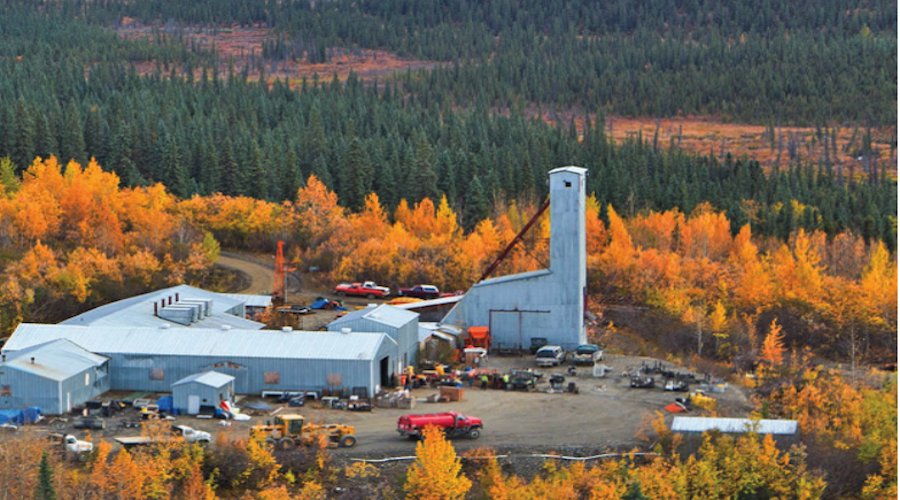
Camp at one of the Upper Kobuk Mineral Projects, in Alaska’s Ambler Mining District. (Image courtesy of Trilogy Metals j.)

Canadian miner Trilogy Metals (TSX, NYSE-A: TMQ) posted a sharply wider fiscal 2025 net loss after booking a non-cash charge tied to a $17.8 million strategic investment from the US government.

The company reported a net loss of $42.2 million, or $0.26 per share for the year ended Nov. 30, 2025, compared with a net loss of $8.6 million, or $0.05 per share, a year earlier. 

Trilogy ended 2025 with $51.6 million in cash, which it said provides flexibility as it advances the Upper Kobuk Mineral Projects (UKMP) in northwestern Alaska through its 50:50 joint venture with South32 (ASX, LON, JSE: S32), Ambler Metals.

The larger loss stemmed mainly from the treatment of the proposed US government’s investment as a derivative financial instrument under US GAAP rules. Trilogy recorded an initial $8.2 million liability and later increased the derivative by $22.6 million to reflect changes in fair value, resulting in a non-cash loss for the year. The accounting impact had no effect on cash and is expected to resolve once the applicable conditions are met.

Chief executive Tony Giardini called fiscal 2025 a landmark year, citing a strengthened balance sheet and closer alignment with US federal and state stakeholders focused on critical mineral supply chains.

He noted the company expanded its senior management and advisory team during the year to support permitting and oversight of Ambler Metals, alongside increased personnel commitments from South32.

Paving the road

Trilogy entered in October into a binding letter of intent with the US Department of War for a conditional $17.8 million investment in exchange for a 10% stake in the company, once construction of the access road to the Ambler project is complete. The Trump administration also received warrants that could raise its stake by a further 7.5%.

The agreement reflects Washington’s push to secure domestic supplies of copper and other critical minerals, including zinc, silver, cobalt and germanium.

The US government restored approvals originally granted in 2020 but revoked under the Biden administration in 2024 and it has also agreed to work with the State of Alaska to help facilitate financing for the road.

Trilogy and South32 approved in December a $35 million budget for Ambler Metals for fiscal 2026, with Trilogy funding $17.5 million. The program will focus on re-staffing, initiating mine permitting for the Arctic copper-silver-zinc-lead-gold deposit and advancing technical work to support long-term development. 

Ambler Metals aims to submit mine permit applications this year and may seek to use the federal FAST-41 framework to streamline the review process, subject to project readiness.

Exploration will centre on the Arctic deposit, including geotechnical and condemnation drilling to support mine design, infrastructure placement and future production planning. 

The joint venture also plans to open the Bornite camp during the 2026 summer field season for geotechnical and exploration drilling and to prepare the site for multi-year use.

Analyst sentiment remains cautious. Trilogy carries an average “hold” rating, with four hold recommendations and no buy or sell ratings, compared with a “buy” consensus for the broader diversified mining peer group. 

Over the past year, the stock has climbed more than 200% in Toronto, trading between C$1.59 and C$15.21 and giving the company a market capitalization of about C$976 million ($714 million).

Billionaire Paulson sells stake in Alaska-focused Trilogy Metals

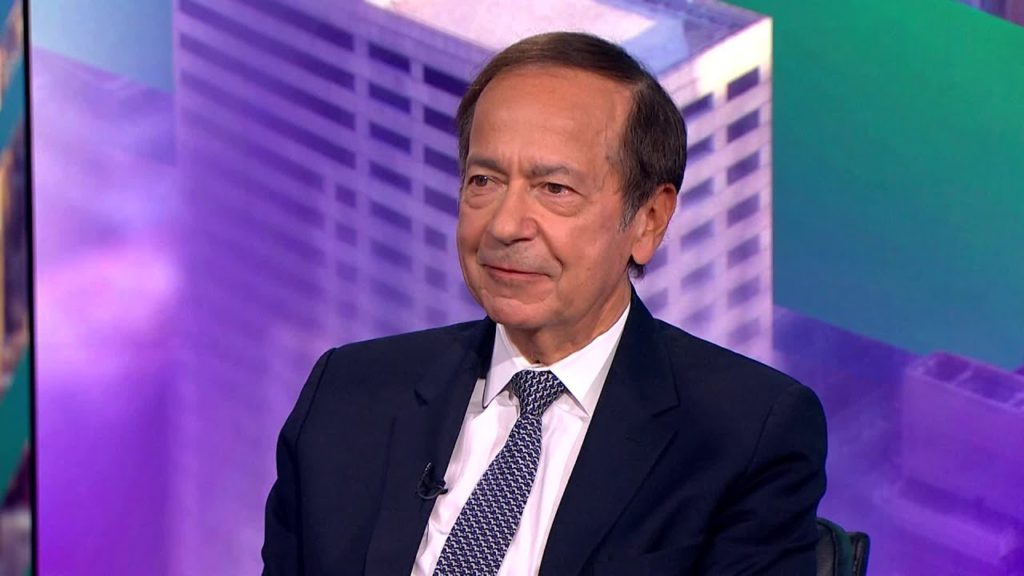
Billionaire John Paulson. Credit: Bloomberg Television via Youtube

Billionaire hedge-fund manager John Paulson has sold his stake in Trilogy Metals Inc. after more than a decade as an investor in the Alaska-focused mining company, which recently secured US government backing.

Paulson, with an 8.7% stake, had been the fourth-largest investor in Trilogy before he sold 14.3 million shares in the fourth quarter of 2025 through his investment firm Paulson & Co., according to filings.

The divestment comes as the White House moves to take a 10% stake in Trilogy, which is based in Vancouver but seeking to build a giant copper and zinc mine in Alaska, in partnership with Australia-based South32 Ltd. The investment plan was announced in October though the deal has yet to be completed.

Paulson, a longtime gold bug, has been a benefactor of Washington’s push to develop mining projects in the US. The investor holds stakes in Perpetua Resources Corp., which was designated a priority project by the administration of President Donald Trump, along with Novagold Resources Inc. in Alaska, where the government is pushing to expand resource extraction.

Paulson & Co. did not respond to a request for comment.

(By Jacob Lorinc)


CU

Column: Copper is pricing scarcity at a time of plenty


Stock image.

Don’t panic. The world hasn’t run out of copper, despite the many warnings of imminent shortfall that have accompanied its rally to all-time highs.

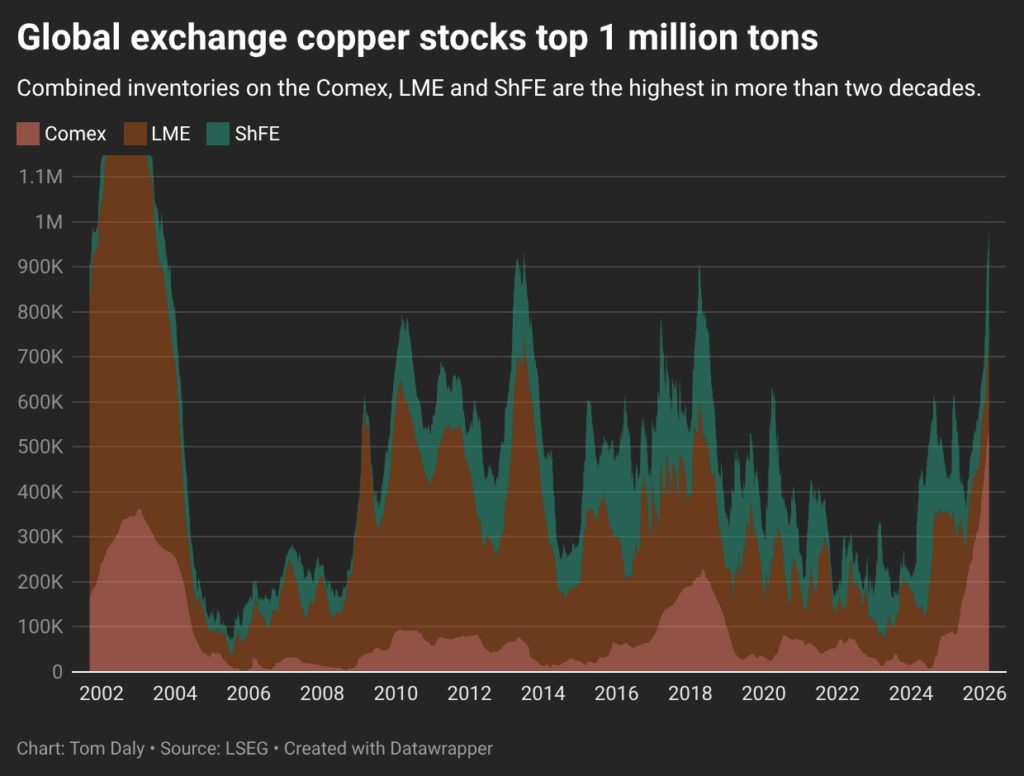
Indeed, the amount of copper held by the world’s big three metal exchanges is above the 1.1 million metric ton mark for the first time since early 2003.

While the tariff trade ensured CME warehouses in the United States accounted for much of the inventory increase last year, both London Metal Exchange and the Shanghai Futures Exchange warehouses are also experiencing accelerated inflows.

Global exchange inventory has surged by 300,000 tons since the start of January, indicating that copper’s super-charged price rally has curbed manufacturing demand.

The gap between speculators’ great expectations and current reality yawns ever wider.

Global exchange inventories of copper

US tariff trade stalls

CME copper stocks registered a net decline on Thursday for the first time since late October in a sign that last year’s relentless build has lost momentum.

The threat of US import tariffs on refined copper, deferred until June, led the CME duty-paid copper price to trade at a wide premium over the LME’s international price at times in 2025.

Traders shipped massive amounts of physical copper to the United States to lock in the easy profits from what was an unprecedented arbitrage opportunity.

US imports of refined copper reached 1.45 million tons in the first eleven months of 2025, a year-on-year increase of over 600,000 tons.

Much of that metal found its way to CME warehouses, lifting exchange stocks from 85,000 tons at the start of 2025 to 536,000 tons today.

The momentum is stalling, however.

The CME premium has evaporated as the market re-assesses the likelihood of US import tariffs. The rationale of US import dependency looks less convincing now the country has so much inventory.

US arrivals continue, but are being redirected to LME warehouses in Baltimore and New Orleans, where registered stocks have risen from zero to 4,950 and 21,075 tons respectively over the last month.

Another 6,450 and 20,665 tons of copper sit in off-warrant LME storage at the two ports.

SHFE copper stocks and SMM Yangshan Premium

Shanghai (pre)seasonal surge

The gravitational pull of the US premium last year sucked in 200,000 tons of copper from China’s bonded warehouse zones but no-one seems to have missed it.

Shanghai Futures Exchange stocks have risen by 127,000 tons to 272,475 tons since the start of January. The Yangshan premium , an indicator of import demand assessed by local data provider Shanghai Metal Market, touched an 18-month low of $22 per ton last month.

Sure, rising inventory and weak import appetite are the norm around China’s lunar new year holiday period.

But the Year of the Horse only starts next week and Shanghai exchange stocks are already higher than last year’s seasonal peak.

Moreover, China seems to have enough surplus metal to help replenish LME stocks.

Spreads signal surplus

Chinese brands of copper accounted for 70% of LME-warranted stocks at the end of January and arrivals are taking place daily at LME warehouses in South Korea and Taiwan.

LME-registered stocks are up by 40% so far this year at 203,875 tons with off-warrant tonnage up by 30% at 90,720 tons.

Time-spreads have loosened accordingly. The benchmark LME cash-to-three-months period was in backwardation as recently as November but is now in a comfortable contango of over $100 per ton.

Forward curves on both the CME and Shanghai copper contracts are also in contango, signaling ample availability.

Price signals…?

Rising stocks and loosening spread structures don’t sit well with an outright price that is within touching distance of last month’s record nominal high of $13,618 per ton.

Doctor Copper has caught a dose of the metals fever that first gripped gold, then moved to silver before spreading to base metals.

Chinese and Western investors alike have been buying up copper both as a bet on the metal’s bright energy transition demand narrative and as a hedge in the broader dollar debasement meme.

But the argument for ever higher prices rests on an assumption that at some stage there will not be enough copper to meet global demand.

That time has yet to come. And every daily rise in global inventory pushes it a little further into the future.

(The opinions expressed here are those of the author, Andy Home, a columnist for Reuters.)

(Editing by Barbara Lewis)

Copper price: Global exchange stocks top 1 million tonnes first time in 21 years

Copper rallied through 2025 and despite some sharp pullbacks along the way ended the year more than 40% higher than at the start.  This year the price is being pulled into different directions.

In holiday thin trade, copper for March delivery fell nearly 1% in New York to $5.76 a pound or $12,700 a tonne on Monday and is now trading 12% below highs hit just at the end of January. 

Copper stocks on the world’s biggest metal exchanges have exceeded 1 million tons for the first time since 2004. Tariff induced stockpiling in the US has been a feature of the market for more than a year and now soft demand in top consumer China is adding to burgeoning global inventories. 

Combined copper stocks on the US Comex exchange, London Metal Exchange and the Shanghai Futures Exchange are at 1.012 million tonnes, after the LME and ShFE recorded further inflows on Friday, Reuters reports.

The news comes on the heels of satellite data showing January copper smelter activity was the lowest on record since tracking began nearly a decade ago in a report released last week. 


Antofagasta profit jumps 52% on record copper prices

Centinela copper mine. (Image courtesy of Minera Centinela.)

Chilean miner Antofagasta posted a 52% jump in annual core profit on Tuesday, as record copper prices offset slightly weaker output, and said its increased capital spending would support production in the medium term.

Earnings before interest, taxes, depreciation and amortization for 2025 leapt to a record $5.2 billion from $3.43 billion a year earlier, in line with analyst expectations as benchmark copper prices surged more than 40% last year.

Antofagasta’s proposed final dividend for 2025 was 48 cents a share, taking its full-year dividend to 64.6 cents a share and representing a pay-out ratio of 50% of underlying earnings. It has kept its policy of returning at least 35% of net earnings to shareholders for more than a decade.

Capital expenditure rose to $3.7 billion last year, exceeding the $3.6 billion forecast as works at its Centinela concentrator peaked. Capex is seen at $3.4 billion in 2026.

Net debt rose to $2.75 billion at the end of 2025, up 69% from a year earlier.

London-listed Antofagasta’s shares sank 3.1% in mid-morning trading, the top loser on London’s FTSE 100 index, which was up 0.4%. The stock has gained almost 11% this year.

Peel Hunt noted that a final 2025 dividend of 48 cents a share was below analysts’ consensus and the brokerage’s estimate of 56.5 cents.

Expanding Centinela

Antofagasta, which operates four mines in Chile, has long pursued expanding Centinela to meet rising copper demand.

“I think that the progress that we’ve completed by the end of last year is about 70% of construction already at the Centinela second concentrator,” CEO Ivan Arriagada said on an earnings call.

He later told analysts construction was set to finish in 2027, with production ramping up in 2028 and the first year at full capacity coming in 2029. The unit has an annual processing capacity of 95,000 tons.

Arriagada said Antofagasta viewed Chile’s change of government positively, noting that President-elect Jose Antonio Kast plans to ease permitting and to lower corporate taxes.

The CEO was upbeat on prospects for Antofagasta’s Twin Metals copper, nickel and platinum group metals (PGM) project in Minnesota, which had been delayed by a mining ban.

“With the changing landscape and policy environment in the US, we do expect that we will be able to make some progress in Twin Metals in the near term,” Arriagada said.

(By Clara Denina and Tom Daly; Editing by Barbara Lewis and Bernadette Baum)


BHP leans on copper growth, not big deals

Escondida, Chile. (Image by BHP).

BHP (ASX: BHP) will prioritize organic copper growth over major acquisitions, as chief executive Mike Henry says the miner already holds the sector’s strongest development pipeline.

Speaking after the company’s half-year results on Tuesday, Henry said he was not surprised that smaller players were pursuing mergers and acquisitions to bolster copper exposure. He said more companies had recognized copper’s appeal over the past five to seven years and were now seeking growth.

“In our case, we’ve got the luxury of starting from a very strong base,” Henry said. “We are now the largest [copper producer], we’ve grown by 30%, and we’ve got multiple large growth options already in the portfolio, so we don’t feel the need.”

BHP walked away late last year from a potential bid for Anglo American (LON: AAL), a move that paved the way for Anglo to merge with Teck Resources (TSX: TECK) in a $53 billion deal. Earlier this month, Rio Tinto (LON: RIO) and Glencore (LON: GLEN) also abandoned merger talks.

Copper takes the lead

Copper overtook iron ore as BHP’s top earnings driver for the first time, with EBITDA of $8 billion, up 59%. The company aims to lift copper equivalent production to 2.5 million tonnes a year by the 2035 financial year, from 1.9–2 million tonnes this year.

BHP expects to produce about 1.4 million tonnes a year from its Escondida and Pampa Norte assets in Chile and an initial 500,000 tonnes a year from its South Australian portfolio, with potential to reach 1 million tonnes.

At the Vicuña project in Argentina, its joint venture with Lundin Mining (TSX: LUN), released on Monday a new technical report for the project. It estimates the Josemaría and Filo deposits contain about 47 million tonnes of copper, 97 million ounces of gold and 1.8 billion ounces of silver. It means that Vicuña could produce 800,000 tonnes a year of copper equivalent at first-quartile cash costs.

The partners plan to spend about $800 million on the project this year and target a final investment decision on the initial stage by year-end. Henry confirmed they had applied under Argentina’s RIGI scheme, which offers incentives for major foreign investments, and said BHP wanted to move quickly given the project’s advanced stage and attractiveness.

Deal capability

As of the end of 2025, BHP’s net debt stood at $14.7 billion, with gearing of 20.9%. The company has identified up to $10 billion in undervalued capital it could unlock, including $6.3 billion already realized through the sale of Pilbara power infrastructure and a silver streaming deal at Antamina with Wheaton Precious Metals (TSX: WPM).

While that financial capacity gives BHP room to pursue acquisitions, Henry said the strategy does not depend on M&A.

“That’s a dangerous place for a company to be, where they can only unlock growth through M&A,” he said.

Henry also said that focusing on productivity gains and advancing existing projects over the next decade would deliver strong returns for shareholders. Although BHP has the balance sheet and capability to execute deals, he said the pool of large, long-life, low-cost assets that meet its criteria remains limited.

“The real focus is on running our existing business even better and unlocking the organic growth that we have in the portfolio,” Henry said. “For the discrete few opportunities that might come along that fit the very strict criteria that we have, we’ve got the wherewithal to pursue them, but we’re not feeling any burning need to.”


BHP’s Vicuna unveils $18 billion copper investment in Argentina

Image: Vicuna

Miner Vicuna Corp, controlled by Australia’s BHP and Canada’s Lundin Mining, announced on Monday an $18 billion multi-year investment plan to develop copper, gold, and silver mining projects in northern Argentina.

The initial investment in its Josemaria and Filo del Sol projects in the province of San Juan will be $7 billion with capital deployment scheduled from 2027 until production begins in 2030, Vicuna said in a statement.

The project is forecast to average 395,000 tons of copper, 711,000 ounces of gold, and 22.2 million ounces of silver annually over its first 25 years.

Output during the first decade is projected at approximately 2.5 million tons of copper, 5.5 million ounces of gold, and 214 million ounces of silver.

Development of the Josemaria and Filo del Sol mining projects will be carried out in three stages. The first stage will be focused on the Josemaria deposit, with the latter two focused on Filo del Sol.


BHP profit beats forecasts as copper tops iron ore earnings on AI-driven demand

BHP’s Newman operations. Credit: BHP

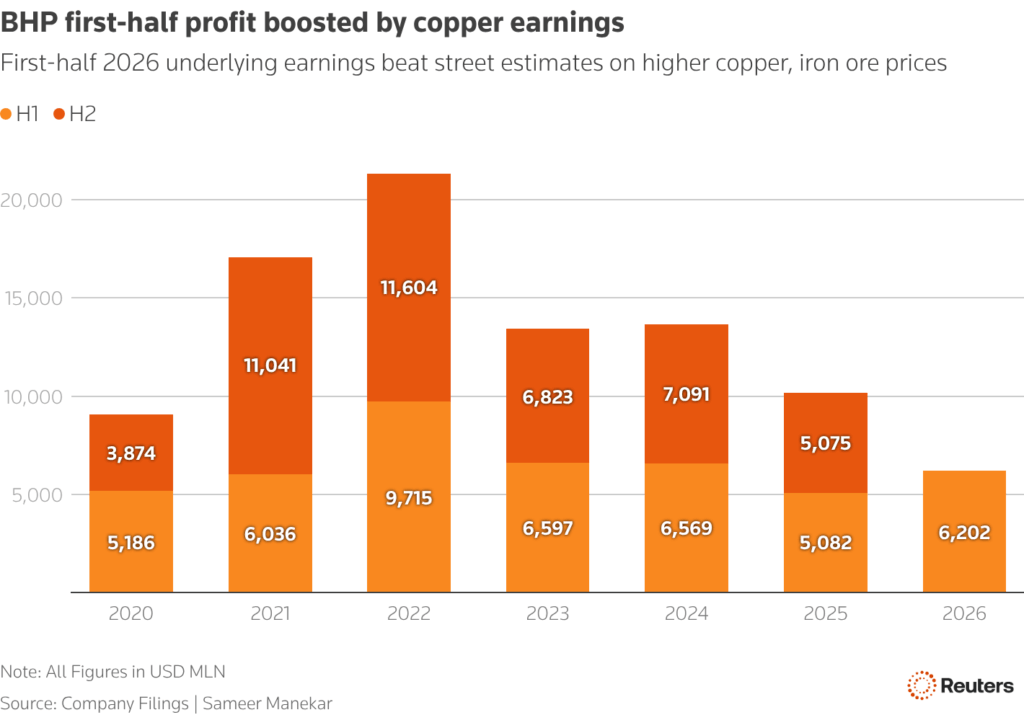
BHP Group reported a stronger-than-expected half-year underlying profit driven by copper, which for the first time surpassed iron ore in the top global miner’s earnings, as prices for the red metal surged on AI-fuelled demand.

BHP’s shares jumped 7% to an all-time high, with investors applauding a much stronger-than-expected dividend and the prospect of sizeable payouts ahead, despite falling iron ore prices.

The strong result comes as demand for copper is soaring driven by rapid growth in power use for artificial intelligence data centres and the shift to cleaner energy, which is spurring competition among mining majors for high‑quality copper assets.

BHP, the world’s top copper producer, highlighted its own copper growth options and played down the need for acquisitions, having walked away last year from an approach to buy Anglo American.

First-half underlying attributable profit rose 22% to $6.20 billion, beating the Visible Alpha consensus of $6.03 billion. BHP declared an interim dividend of 73 cents per share, ahead of market estimates of 63 cents, representing a payout ratio of 60%.

“It was a good result,” said Andy Forster, portfolio manager at Argo Investments, a BHP shareholder. “They smashed everyone’s expectations from a dividend perspective.”

Copper, including byproducts such as gold, contributed $7.95 billion to BHP’s operating earnings in the six months ending December 31, higher than iron ore’s $7.50 billion and making up 51% of the group’s total underlying operating earnings of $15.46 billion.

That was largely driven by a 32% jump in realized prices for copper, along with soaring prices for the precious metals. A record first-half iron ore production alongside higher prices also boosted the miner’s profits.

The push to focus on copper comes amid an expected easing in prices for iron ore as supply grows over the coming years, while inflation is also boosting production costs. Iron ore prices hit a seven-month low this week.

Unit costs for iron ore grew by 7% to $19.41 per metric ton in the half year.

‘No burning need’ for takeovers

BHP chief executive officer Mike Henry said on a media call given its organic growth options, the company did not feel pressure to pursue mergers and acquisitions for copper growth.

“For the discrete few opportunities that might come along that fit the very strict criteria that we have, we’ve got the wherewithal to pursue them, but we’re not feeling any burning need to,” he said.

Rio Tinto, the world’s largest iron ore producer, was in talks to buy Glencore, a deal that would have had major implications for the global copper sector, but walked away earlier this month citing disagreement over valuation.

BHP has been pushing to boost its copper output towards the end of the decade. In January, it lifted the bottom end of its copper production forecast for this year to between 1.9 million and 2 million tons, citing strong operational performance across its copper assets.

On Tuesday it flagged an $18 billion multi-year investment plan to develop copper, gold, and silver mining projects in northern Argentina, at its Vicuna Corp joint venture with Canada’s Lundin Mining. It said the unit has the potential to produce more than 500,000 tons of copper a year at peak production next decade.


Henry said “tough negotiations” with China over iron ore supply continued as the state buyer, CMRG, tries to extract better terms for Chinese steelmakers. He expressed confidence that the issues will be resolved, although it will take time.

BHP flagged it had seen a price impact from CMRG’s ban on its Jimblebar fines product in its quarterly report in January but did not offer further details in its earnings report.

The miner announced a silver streaming agreement with Wheaton Precious Metals for an upfront payment of $4.3 billion at completion, to deliver silver from its share of output at Peru’s Antamina mine.

That payment is part of a targeted $10 billion that BHP aims to raise from existing assets, which could help boost its dividend payout for the full year, Henry said.

(By Sameer Manekar and Rajasik Mukherjee; Editing by Lisa Shumaker and Sonali Paul)


‘We were expecting better from Barrick,’ analyst says after Newmont calls to fix Nevada Gold Mines

ByAnam KhanOpens in new window
 February 10, 2026 

Martin Pradier, materials analyst for Veritas Investment Research, joins BNN Bloomberg to discuss Barrick Mining as production hits the lowest levels in decades

Newmont Corporation has asked Toronto-based Barrick Gold to improve operations at its joint venture before Barrick moves ahead with a planned initial public offering (IPO) later this year.

The world’s largest gold miner released a statement on Monday responding to Barrick’s IPO announcement issued two months ago, which outlined plans to list a new company holding assets including Nevada Gold Mines, Pueblo Viejo and Fourmile.

Newmont said in the release, its primary concern is the operation and management of Nevada Gold Mines, “which has suffered a degradation in performance and subsequent asset value over the past six years.”Barrick Mining evaluating initial public offering of North American gold assets

Barrick and Newmont formed the Nevada Gold Mines joint venture in 2019, pooling their operations and assets in the region. Barrick holds a 61.5 per cent stake and oversees day-to-day operations, while Newmont owns 38.5 per cent and manages broader structural decisions.

Nevada Gold Mines’ fourth-quarter results from last year showed a 23 per cent decline in gold production.


The results were surprising, Martin Pradier, a materials analyst at Veritas Investment Research, told BNN Bloomberg

“The guidance shows increasing cost and lower production from Nevada than what they had previously communicated,” he said.

“There is no doubt that we were expecting better from Barrick,” Pradier said.

He said Newmont holds the right of first refusal, which gives it leverage to push for changes ahead of the IPO.
Newmont’s interest in Nevada assets

Pradier believes Newmont is interested in acquiring Barrick’s entire stake in the Nevada assets. He said listing a portion of the business would establish a public market valuation, potentially allowing Newmont to bid for the remainder.

“I think that Newmont would be interested only in these assets that are in the new company, not in the rest of the assets,” Pradier said.

Less bullish on Barrick’s outlook

Pradier said his research team is now less bullish on Barrick following the company’s latest outlook.

“It was a very big increase in cost, 20 per cent for gold, about 10 per cent for copper, compared to the previous year.”

Barrick has also faced challenges outside Nevada, including a two-year standoff with Mali’s military government involving the Loulo-Gounkoto complex, for which Barrick paid a hefty settlement.

“Barrick has to pay a lot of money, and now the mine is not a low cost producer anymore,” Pradier said.

“It used to be one of the lowest cost producing mines in their portfolio and now is going to be the most expensive, about US$3,000 per ounce in the coming year, according to their estimates.”

Anam Khan

Journalist, BNNBloomberg.ca


Rio Tinto and BHP to lead Australia earnings rebound

Stock image.

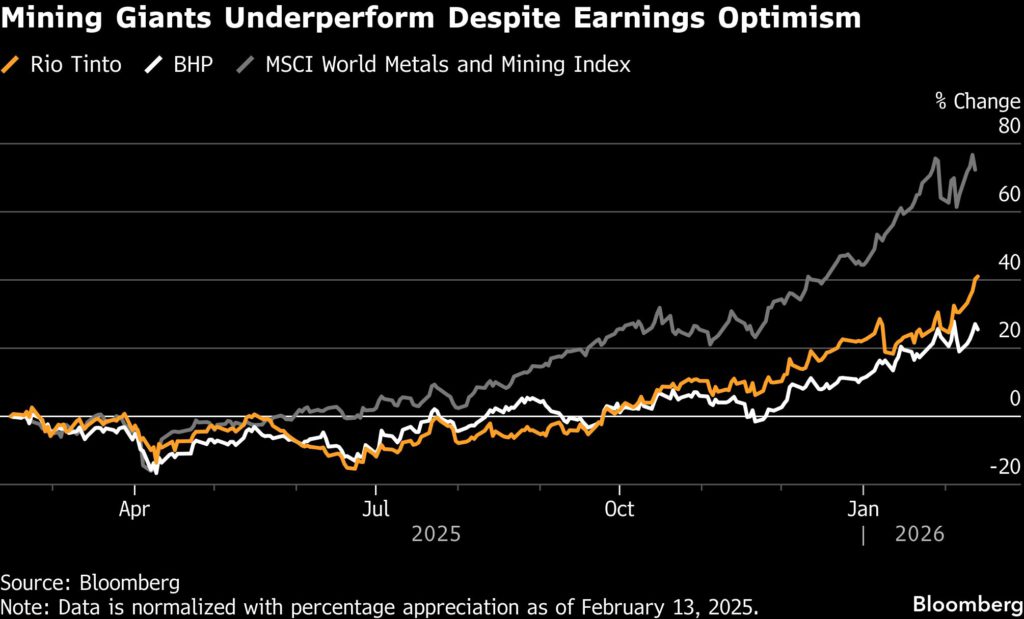
Australia’s reporting season moves into high gear this week with Rio Tinto Ltd. and BHP Group Ltd. seen crucial for the country’s earnings rebound.

Both miners enter 2026 set for earnings outperformance, buoyed by commodity prices that help valuations catch up with broader equity markets, Bloomberg Intelligence analysts Alon Olsha and Grant Sporre wrote in a note.

Wilsons Advisory says investors should also pay attention to growth outside iron ore, Rio’s main source of revenue, especially in copper, which is BHP’s biggest seller.

The results come less than two weeks after Rio Tinto walked away from talks to acquire Glencore Plc, scuttling a mega merger that would have created the world’s largest mining company.

In Australia’s consumer sector, winemaker Treasury Wine Estates Ltd. swung to a first-half net loss and missed revenue estimates amid supply chain difficulties in the US and adverse consumer trends in China.

Retailer Wesfarmers Ltd. will be the next major consumer firm to report after the country’s household spending unexpectedly declined in the final month of 2025. The RBA’s rate hike earlier this month is likely to further restrain demand.

(By Rachel Yeo and Harshita Swaminathan)