Disappearing Bodies: Epstein, ICE, and the Hidden Architecture of Gangster Capitalism
Photograph by Nathaniel St. Clair
Disappearance under neoliberal fascism does not operate through a single institutional or aesthetic form. Alongside the spectacular violence of ICE raids, militarized policing, and the public staging of racialized terror exists a quieter, long-standing mode of disappearance practiced by elites and insulated from democratic scrutiny. The case of Jeffrey Epstein exposes this hidden register with disturbing clarity. What unites these seemingly distinct regimes of disappearance is not only the violence they enact but the way they are consumed. ICE raids circulate as viral footage, cable news spectacle, and partisan theater. Epstein’s crimes reappear endlessly as podcasts, Netflix docuseries, continuous news alerts, and conspiratorial gossip. In both cases, atrocity is converted into content, stripped of historical depth and severed from the economic system that produces it. Gangster capitalism survives not simply by disappearing bodies, but by transforming disappearance into consumable spectacle.
Where contemporary fascist governance increasingly places violence on full display, externalized and dramatized as a public pedagogy of fear, Epstein’s operation depended on secrecy, misogynist terror, and the systematic annihilation of social conscience. This was the hidden violence of gangster capitalism, planned and executed in the exclusive spaces of the ruling class—billionaire townhouses, private islands, elite restaurants, and country clubs—where zombie politics thrives through greed, domination, and an anesthetizing language that renders cruelty banal and power obscene. At the core of this cultural and political cesspool is what Melinda Cooper calls a class of “billionaire patriarchs of the American far-right [who] want to rule an economy of masters and servants.” This anesthetization is crucial. Violence that once provoked moral outrage, if not shock, is now folded into the rhythms of everyday media consumption. Raids become clips. Survivors become case studies. Abuse becomes trivia. Under this regime, suffering is neither denied nor confronted; it is endlessly circulated without consequence, producing familiarity rather than outrage.
Epstein’s victims did not vanish into detention centers or public raids. They disappeared into private aircraft, gated estates, citadels of private wealth, and transnational circuits of wealth and influence, shielded by dense entanglements linking oligarchs, politicians, intelligence services, and global finance. Global sex trafficking operated as a system of pleasure, profit, and risk for a billionaire class convinced that money confers immunity from law, justice, and consequence. This ruling caste of ghouls is sustained by a state that treats the disappearance of migrants, the cold-blooded killing of citizens, and the spread of concentration camps across American soil as legitimate instruments of governance. Within this logic, civic resistance to fascism is rebranded as domestic terrorism, exposing dissenters to surveillance, disappearance, or death. The Epstein case reveals the other side of this machinery: how women are made to vanish into chambers of sexual terror, lured by fraudulent job offers, trapped by lies and manipulation, and, at times, seized outright by force.
In this sense, ICE and Epstein share a final, chilling convergence: both are narrated as aberrations rather than expressions of a corrupt and exploitative system. ICE abuses are framed as policy excesses or rogue enforcement. Epstein is rendered an exceptional monster, detached from the financial, political, and intelligence networks that sustained him. This isolation is ideological. It prevents systemic recognition by recoding structural violence as scandal, misconduct, or spectacle—events to be consumed, debated, and forgotten rather than understood as endemic to gangster capitalism itself.
This is not a departure from the politics of disappearance but its upper register of the workings of gangster capitalism—run by the rich billionaire class. Both ICE enforcement regimes and Epstein’s network were allegedly sites of human trafficking; both enacted extreme cruelty; both were grounded in whitesupremacist, patriarchal, and racialized logics of disposability. The distinction lies not in violence but in visibility: the authoritarian state now stages disappearance as spectacle, while elites have long perfected disappearance under the cover of respectability, secrecy, and impunity.
What is newly unsettling is not simply what these revelations expose, but how easily they are absorbed. Irony functions here as a technology of moral evacuation, dulling judgment and shielding elite brutality from sustained reckoning. Yet the deeper danger lies elsewhere. Epstein does not interrupt this argument; he completes it, exposing gangster capitalism as a toxic system that disappears bodies through both overt terror and hidden privilege, through raids and secrecy alike. When disappearance becomes entertainment, accountability collapses. The public is trained to binge on cruelty rather than trace its causes. This is how gangster capitalism governs affect: by producing endless scenes of horror while foreclosing the possibility of structural understanding.
To confront this machinery requires more than reform, exposure, or moral revulsion. It demands a clear-eyed understanding of how power operates across its visible and concealed dimensions—and a politics willing to name gangster capitalism itself as the enemy. Any viable form of resistance must therefore aim not to humanize this system, but to dismantle and overthrow it before disappearance becomes the final, normalized condition of political life.
*I want to thank Rania Filippakou for helping me think through many of the ideas in this article.
This first appeared on the LA Progressive.
The Cruelty of Aesthetics in the Age of MAGA Politics
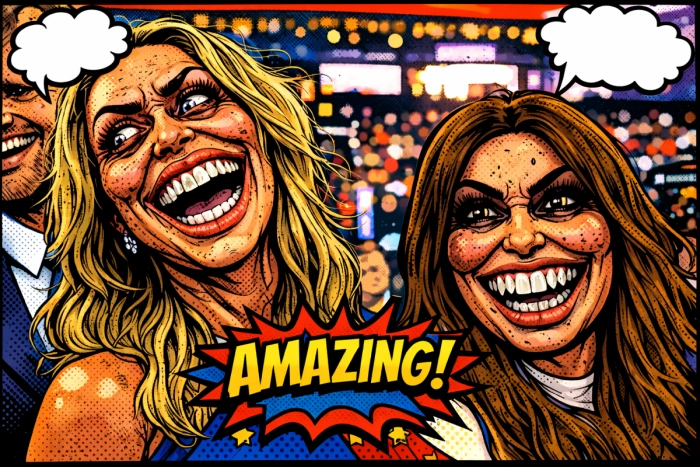
In the MAGA aesthetic, cruelty appears in multiple registers, most visibly in the “Mar-a-Lago face”: plastic smiles, exaggerated cosmetic enhancement, and beauty-pageant nostalgia staged against prisons, detention centers, and armed authority.
The doctrine from which the concentration camps were born was very simple, and for that very reason very dangerous: every foreigner is an enemy, and every enemy must be eliminated; and a foreigner is anyone who is perceived as different, because of their language, religion, appearance, customs, and ideas.
Primo Levi, “Europe of the Concentration Camps (1973).
Cruelty has always been a political weapon, but in the current historical moment it has acquired a distinctive aesthetic form. By MAGA aesthetics, I mean a visual and affective regime in which domination is staged as spectacle, violence is rendered stylish, and exclusion is performed as common sense. It is an aesthetic that does not persuade through argument or policy. It educates through images, bodies, gestures, and scenes of humiliation, training people to feel obedience before they are asked to think critically at all.
This aesthetic did not emerge from nowhere. The aesthetics of cruelty haunt the darkest chapters of modern history, from the genocidal destruction of Indigenous peoples in North America and the enslavement of Africans, to the industrialized torture and extermination carried out by Nazi Germany. In each case, cruelty was not only enacted; it was ritualized, justified, and made culturally legible. Violence became thinkable because it was made visible in ways that erased the humanity of targeted groups.
What is chilling today is how close this logic has moved to home. The march of neo-Nazi groups through Gore Park and downtown Hamilton was not an isolated eruption of extremism. It was a public performance of hate, a rehearsal staged in civic space, designed to intimidate, provoke, and normalize a white nationalist presence. Such spectacles belong to a broader transnational culture in which cruelty is increasingly displayed rather than hidden, and in which reactionary movements borrow freely from U.S. authoritarian aesthetics.
These displays are not disconnected from the legalized terror inflicted elsewhere. In the United States, immigration enforcement agencies such as ICE routinely stage violence against immigrants and people of color as bureaucratic necessity, transforming raids, detentions, and deportations into media-friendly spectacles. Cruelty here is administrative, racialized, and increasingly theatrical. What travels north is not ideology alone but style: the normalization of intimidation, the glorification of force, and the conversion of suffering into political theater. Yet something more is at work than the acceleration of state violence. There is a visible pleasure in cruelty, an enjoyment taken in the suffering of designated enemies, coupled with an ugly aesthetic that turns domination into entertainment. Violence is not only justified; it is consumed.
In the MAGA aesthetic, cruelty appears in multiple registers, most visibly in the “Mar-a-Lago face”: plastic smiles, exaggerated cosmetic enhancement, and beauty-pageant nostalgia staged against prisons, detention centers, and armed authority. Taken as a whole it signals a politics that treats the body as a surface to be engineered, disciplined, and branded, a mask of dominance and emotional vacancy masquerading as strength.
Among MAGA men, a fever dream of authoritarian masculinity proliferates across TikTok, YouTube, X, and other platforms. They stage themselves as strongmen-in-training: squared jaws clenched in hostility, hyper-muscular bodies forged in gym rituals that double as moral theater, and rigid, armored postures where repression hardens into aggression and vulnerability is converted into cruelty. Digital culture intensifies this pedagogy, turning aggression into identity and domination into performance. These are not harmless displays but embodied lessons, teaching that power resides in hardness, compassion is weakness, and democracy itself is a feminized liability.
Canada is not immune to these lessons. When neo-Nazi symbols appear in our parks, bodies draped in white sheets and faces concealed, echoing the Ku Klux Klan and the ICE shock troops occupying U.S. cities, the MAGA aesthetic is no longer imported but enacted. When migrants are cast as threats rather than neighbors, and cruelty is excused as realism or security, the aesthetic logic of MAGA politics has already crossed the border. The danger lies not only in borrowed slogans or flags, but in the slow acclimation to spectacle, fear, and exclusion as ordinary features of public life.
Fascism has always understood that culture is its first battlefield. Long before rights are revoked or institutions dismantled, people are trained to desire authority, admire domination, and mistake cruelty for strength. Aesthetics functions here as pedagogy, shaping affect, memory, and consent.
To confront the cruelty of MAGA aesthetics in Canada is therefore not a matter of taste or decorum. It is a democratic necessity. Making these aesthetics visible disrupts their power, exposing how violence is staged, how hatred is normalized, and how fear is cultivated. Culture can educate for cruelty, but it can also educate for resistance. The choice is neither abstract nor distant. It is already being rehearsed in our streets.

‘Regime Cleavage’: How the ‘Language of Humiliation’ is Engineering a Second American Civil War
February 20, 2026
Image by Andrew Valdivia.
A January 2026 Gallup poll showed that 89 percent of all Americans expect high levels of political conflict this year, as the country heads toward one of its most decisive midterm elections ever.
Gallup, however, was stating the obvious. It is a surprise that not all Americans feel this way, judging by the coarse, often outright racist discourse currently being normalized by top American officials. Some call this new rhetoric the “language of humiliation,” where officials refer to entire social and racial groups as ‘vermin’, ‘garbage’, or ‘invaders’.
The aim of this language is not simply to insult, but to feed the “Rage Bait Cycle” – tellingly, Oxford’s 2025 Word of the Year: a high-ranking official attacks a whole community or ‘the other side’, waits for a response, escalates the attacks, and then presents himself as a protector of traditions, values, and America itself. This does more than simply “hollow out” democracy, as suggested in a Human Rights Watch report last January; it prepares the country for “affective polarization”, where people no longer just disagree on political matters, but actively dislike each other for who they are and what they supposedly represent.
How else can we explain the statements of US President Donald Trump, who declared last December: “Somalia… is barely a country… Their country stinks and we don’t want them in our country… We’re going to go the wrong way if we keep taking in garbage into our country. Ilhan Omar is garbage. She’s garbage. Her friends are garbage.” This is not simply an angry president, but an overreaching political discourse supported by millions of Americans who continue to see Trump as their defender and savior.
This polarization reached a fever pitch at the 2026 Super Bowl, where the halftime selection of Puerto Rican artist Bad Bunny ignited a firestorm over national identity. While millions celebrated the performance, Trump and conservative commentators launched a boycott, labeling the Spanish-language show “not American enough” and inappropriate. The rhetoric escalated further when Homeland Security Secretary Kristi Noem suggested ICE agents would be “all over” the event, effectively ostracizing countless people from their right to belong to a distinct culture within American society.
The weaponization of culture and language was not limited to the stage; it split American viewers into two distinct camps: those who watched the official performance and those who turned to an “All-American” alternative broadcast hosted by Turning Point USA featuring Kid Rock. This ‘countering’ is the very essence of the American conflict, which many have rightly predicted will eventually reach a breaking point akin to civil war.
That conclusion seems inevitable as the culture war couples with three alarming trends: identity dehumanization; partisan mirroring — the view that the other side is an existential threat; and institutional conflict — where federal agencies are perceived as ‘lawless’, sitting congresswomen are labeled “garbage,” and dissenting views are branded as treasonous.
This takes us to the fundamental question of legitimacy. In a healthy democracy, all sides generally recognize the legitimacy of the system itself, regardless of internal squabbles. In the United States, this is no longer the case. We are entering a state of regime cleavage — a political struggle no longer concerned with winning elections, but one where dominant groups fundamentally disagree on the very definition of what constitutes a nation.
The current crisis is not a new phenomenon; it dates back to the historical tension between ‘assimilation’ within an American ‘melting pot’ versus the ‘multiculturalism’ often compared to a ‘salad bowl’. The melting pot principle, frequently promoted as a positive social ideal, effectively pressures immigrant communities and minorities to ‘melt’ into a white-Christian-dominated social structure. In contrast, the salad bowl model allows minorities to feel very much American while maintaining their distinct languages, customs, and social priorities, thus without losing their unique identities.
While this debate persisted for decades as a highly intellectualized academic exercise, it has transformed into a daily, visceral conflict. The 2026 Super Bowl served as a stark manifestation of this deeper cultural friction. Several factors have pushed the United States to this precipice: a struggling economy, rising social inequality, and a rapidly closing demographic gap. Dominant social groups no longer feel ‘safe’. Although the perceived threat to their ‘way of life’ is often framed as a cultural or social grievance, it is, in essence, a struggle over economic privilege and political dominance.
There is also a significant disparity in political focus. While the Right—represented by the MAGA movement and TPUSA—possesses a clarity of ‘vision and relative political cohesion, the ‘other side’ remains shrouded in ambiguity. The Democratic institution, which purports to represent the grievances of all other marginalized groups, lacks the trust of younger Americans, particularly those belonging to Gen Z. According to a recent poll by the Center for Information & Research on Civic Learning and Engagement (CIRCLE), trust in traditional political institutions among voters aged 18–25 has plummeted to historic lows, with over 65% expressing dissatisfaction with both major parties.
As the midterm elections approach, society is stretching its existing polarization to a new extreme. While the Right clings to the hope of a savior making the country ‘great again’, the ‘Left’ is largely governed by the politics of counter-demonization and reactive grievances—hardly a revolutionary approach to governance.
Regardless of the November results, much of the outcome is already predetermined: a wider social conflict in the US is inevitable. The breaking point is fast approaching.