Saturday, March 28, 2026


E-cigarettes rated most effective smoking cessation method by new evidence review


Society for the Study of Addiction


A new overview of the best available evidence worldwide for smoking cessation has found that nicotine‑containing e‑cigarettes appear to be more effective for smoking cessation than other interventions such as nicotine replacement therapy (nicotine patches, gum, lozenges, etc.) e-cigarettes with no nicotine, and behavioural support. 

This ‘overview’ of systematic reviews summarises existing evidence from several systematic reviews and makes the findings more accessible.  The overview pooled the evidence from fourteen systematic reviews of smoking cessation interventions from 2014 to 2023.

Findings from higher-quality reviews consistently showed greater smoking cessation with nicotine-containing e‑cigarettes than other interventions. Lower-quality reviews produced more variable and imprecise estimates. When restricted to higher-quality evidence, results consistently favoured nicotine e‑cigarettes over nicotine replacement therapy, non-nicotine e-cigarettes, and other comparators.

The overview also created an ‘Evidence and Gap Map’ (EGM) to identify gaps in the current evidence that urgently need to be filled.  There are currently no high-quality systematic reviews directly comparing nicotine e-cigarettes with cytisine, bupropion, or nicotine pouches.  Also, direct evidence comparing nicotine e-cigarettes with varenicline is extremely limited, with only a single small trial at high risk of bias.

The EGM also showed that current evidence of serious adverse events associated with e-cigarettes is inconclusive, and that most of the studies collected data from high-income countries.  Future primary research on e-cigarettes for smoking cessation should continue to collect data on serious adverse events and expand its data collection to include low-and middle-income countries.

Lead author DrAngela Difeng Wu, Senior Researcher and Lecturer at the Nuffield Department of Primary Care Health Sciences, University of Oxford, says “We hope this overview and Evidence and Gap Map can lay to rest some claims that evidence is ‘mixed’ regarding the impacts of nicotine e-cigarettes on smoking abstinence.  In fact, the evidence is clear and consistent across all of the meta-analyses we consulted:  e-cigarettes are effective at helping people stop smoking.”

-- Ends –

For editors:

This Open Access paper is available on the Wiley Online Library from the embargo date (https://onlinelibrary.wiley.com/doi/10.1111/add.70388) or you may request an early copy from Jean O’Reilly, Editorial Manager, Addictionjean@addictionjournal.org.

To speak with lead author Dr Angela Difeng Wu, please contact her at the Nuffield Department of Primary Care Health Sciences, University of Oxford by email (angela.wu@phc.ox.ac.uk).

Full citation for article: Wu AD, Conde M, Butler AR, Knight E, Lindson N, Livingstone-Banks J, Hajek P, McRobbie H, Begh R, Theodoulou A, Notley C, Turner T, Zhitnik E, and Hartmann-Boyce J. Electronic Cigarettes for Smoking Cessation: An Overview of Systematic Reviews and Evidence and Gap Map.  Addiction. 2026. DOI: 10.1111/add.70388.

Primary funding:  This research work was funded by Cancer Research UK, Grant Number PRCPJT‐Nov22/100012.

Declaration of interests: Dr Hartmann-Boyce is paid for research consultancy from the Truth Initiative. Dr Lindson is an associate editor for Addiction. Dr. Notley has received an honorarium from Vox Media for filming a 'nicotine explainer' on the role of nicotine in addiction.  All other authors report no known conflicts of interest.

Addiction is a monthly international scientific journal publishing peer-reviewed research reports on alcohol, substances, tobacco, gambling, editorials, and other debate pieces. Owned by the Society for the Study of Addiction, it has been in continuous publication since 1884.

Unravelling active magma by drilling in the heart of volcanoes


Ludwig-Maximilians-Universität München


LMU volcanologists decipher the behavior of magma beneath an active volcano and reveal how it reacts to drilling.

Although volcanic eruptions are spectacular natural events that occur around the world every day, most volcanoes spend the majority of their time not erupting. To accurately forecast volcanic activity, it’s important to characterise the magma before an eruption is imminent. A team lead by LMU volcanologist Dr. Janine Birnbaum has managed to directly reconstruct the prevailing conditions in a magma chamber for the first time and reveal how magma reacts to drilling. The results, which were published in the journal Nature, provide important insights that could improve the monitoring of magma and pave the way for new applications.

Magma slowly moves from deep within the Earth toward the surface. It often temporarily stops in the crust, where it may reside for years, decades, or even millennia. In that time, it cools, crystallizes, ingests the surrounding crustal rocks, and loses or gains dissolved gases – primarily water and carbon dioxide – that power volcanic eruptions. An eruption occurs when the magma system is perturbed through the addition of heat, new magma from depth, or the formation of bubbles – like an overheated can of soda that expands and eventually bursts.

Drilling in Krafla volcanic field in Iceland

To understand how volcanoes behave between and before eruptions, it is important to have detailed information about the temperature, pressure, and gas content of the magma in the Earth’s crust. However, magma often resides deep below the Earth’s surface and is not accessible to direct measurements.

For their new study, the researchers exploited the fact that magma beneath the Krafla volcanic field in the northeast of Iceland comes surprisingly close to the surface. During operations at the Krafla Geothermal Station in 2009, the Iceland Deep Drilling Project 1 (IDDP-1) well unexpectedly intersected a magma body at a depth of just over 2 km. Cold drilling fluids dumped water on the magma, quenching it into tiny chips of glass.

When researchers looked at these chips, they encountered a puzzle: Although the quenched magma had many small bubbles, it held less dissolved gas than the magma was capable of holding at the expected temperature and pressure. To solve this question, the LMU researchers used a new numerical model which showed that the magma reacted to the drilling and lost gas before it fully solidified into glass. Previous measurements had shown that the magma requires several minutes to cool from an initial temperature of about 900 °C to become a glass at around 520 °C. According to the researchers’ hypothesis, this gives the gas enough time to escape from the melt and to cause the observed bubbles to form.

Gas escapes within five minutes

As such, the gas content in the chips of glass does not reflect the original conditions, but is the product of this dynamic process. “It’s like a blurry photo,” explains Birnbaum. “But if we know our exposure time and how fast our system moves, we can unravel where it started.” By simulating how fast the gas escapes, the researchers were able to reconstruct the original gas content. This revealed that the ‘missing’ gas was lost in under five minutes during drilling.

According to the researchers, these findings can help make future endeavors in geothermal fields on active volcanoes safer, while also paving the way for targeted drilling into magma for purposes such as monitoring and green energy extraction.

How do giant caldera volcanoes fill up?


Kobe University
260327-Seama-Reinjection-Caldera 

image: 

We know very little about the processes that lead to a reeruption of supervolcanoes such as the mostly underwater Kikai caldera in Japan (pictured) and are therefore ill-equipped to make predictions.

view more 

Credit: SEAMA Nobukazu


The magma reservoir of the largest volcano eruption of the Holocene is refilling. This Kobe University insight on the Kikai caldera in Japan allows us to understand giant caldera volcanoes like Yellowstone or Toba more generally and gets us closer to predicting their behavior, too.

Some volcanoes erupt so violently, ejecting more magma than could cover all of Central Park 12 km deep, that all that’s left is just a wide and rather shallow crater, a so-called “caldera.” Examples of such supervolcanoes are the Yellowstone caldera, the Toba caldera and the mostly underwater Kikai caldera in Japan, which last erupted 7,300 years ago in what was the largest volcano eruption in the current geological epoch, the Holocene. We know that these volcanoes can and do reerupt but we know very little about the processes that lead up to an eruption and are therefore ill-equipped to make predictions. “We must understand how such large quantities of magma can accumulate to understand how giant caldera eruptions occur,” says Kobe University geophysicist SEAMA Nobukazu.

That the Kikai caldera is mostly underwater is, in fact, an advantage to tackle questions like this. Seama explains, “The underwater location allows us to implement systematic, large-scale surveys.” Thus, the Kobe University researcher teamed up with the Japan Agency for Marine-Earth Science and Technology (JAMSTEC) and used airgun arrays that cause artificial seismic pulses together with ocean bottom seismometers that listen to how that seismic wave propagates through the Earth’s crust to understand its condition.

In the journal Communications Earth & Environment, the team now publishes its findings. They found that there is indeed a region that consists to a large degree of magma directly underneath the volcano that erupted 7,300 years ago and characterized the reservoir’s size and shape. Seama says, “Due to its extent and location it is clear that this is in fact the same magma reservoir as in the previous eruption.”

But this magma is likely not a remnant of that eruption. Researchers had become aware that in the center of the caldera a new lava dome has been forming over the past 3,900 years, and chemical analyses showed that the material produced by this and other recent volcanic activity is of a different composition than what was ejected in the last giant eruption. “This means that the magma that is now present in the magma reservoir under the lava dome is likely newly injected magma,” summarizes Seama. This allows the researchers to propose a general model for how magma reservoirs under caldera volcanoes refill.

“This magma re-injection model is consistent with the existence of large shallow magma reservoirs beneath other giant calderas like Yellowstone and Toba,” says Seama, hoping that his team’s findings may contribute to understanding the magma supply cycles following giant eruptions. He concludes, saying: “We want to refine the methods that have proved to be so useful in this study to more deeply understand the re-injection processes. Our ultimate goal is to become better able to monitor the crucial indicators of future giant eruptions.”

This research was funded by the Ministry of Education, Culture, Sports, Science and Technology (MEXT) (The Third Earthquake and Volcano Hazards Observation and Research Program (Earthquake and Volcano Hazard Reduction Research)) and the Japan Society for the Promotion of Science (grant 20H00199). It was conducted in collaboration with researchers from the Japan Agency for Marine-Earth Science and Technology (JAMSTEC).

Kobe University geophysicist SEAMA Nobukazu and his team found that there is a region that consists to a large degree of magma directly underneath the volcano that erupted 7,300 years ago and characterized the magma reservoir’s size and shape. He says, “Due to its extent and location it is clear that this is in fact the same magma reservoir as in the previous eruption.”

Credit

© A. Nagaya et al. (2026), Communications Earth & Environment (DOI 10.1038/s43247-026-03347-9)

260327-Seama-Reinjection-Model 

The current survey allows the researchers to propose a general model for how magma reservoirs under caldera volcanoes refill. “This magma re-injection model is consistent with the existence of large shallow magma reservoirs beneath other giant calderas like Yellowstone and Toba,” says Kobe University geophysicist SEAMA Nobukazu.

Credit

A. Nagaya et al. (2026), Communications Earth & Environment (DOI 10.1038/s43247-026-03347-9)

The latest world climate report is grim, but it’s not the end of the story
THE CONVERSATION


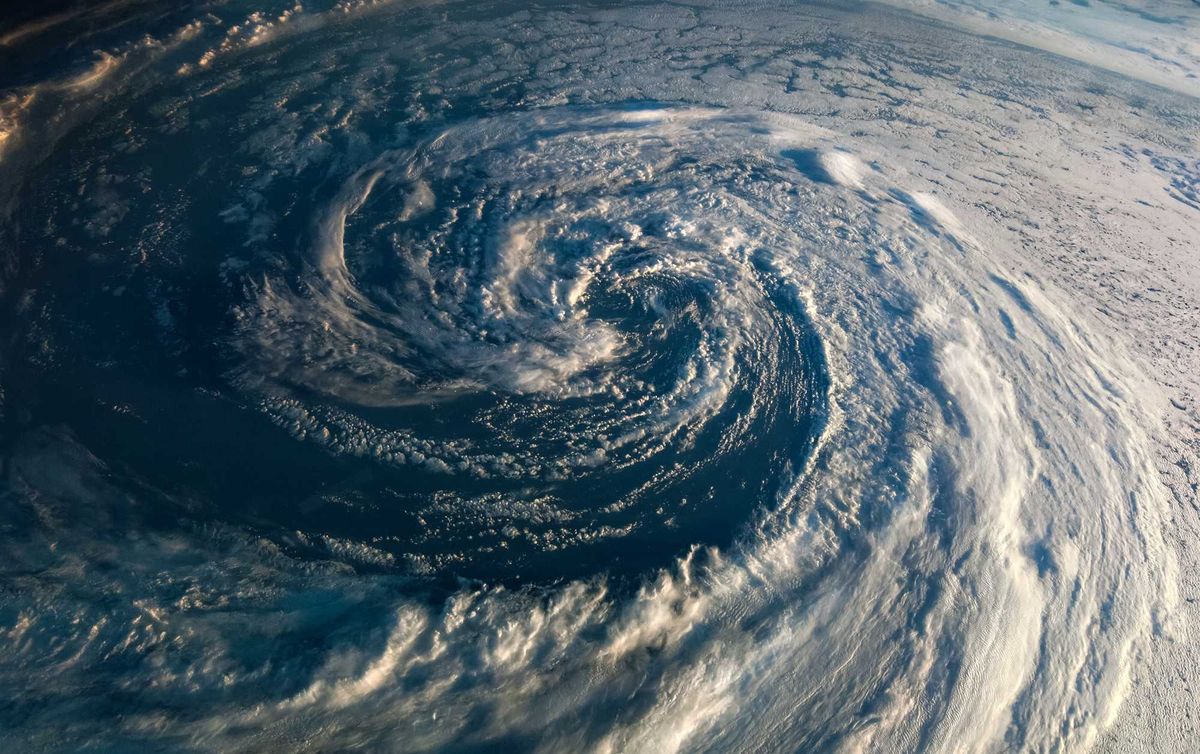
A major storm as seen from space. (Shutterstock)

It’s no secret our planet is heating up.

And here’s the evidence: we’ve just experienced the 11 hottest years on record, with 2025 being the second or third warmest in global history.

The annual State of the Climate report, published today by the World Meteorological Organization, suggests we’re still too reliant on fossil fuels. And that’s pushing us further from our goal to decarbonise.

So what is happening to our climate? And how should we respond?

The climate picture

Unfortunately, the most recent climate data makes for grim reading.

Let’s look back at 2025, through the lens of four climate change indicators.

Carbon dioxide

We now have a record amount of carbon dioxide in the atmosphere, about 50% higher than pre-industrial levels. And we’re still emitting large amounts of carbon dioxide through our use of fossil fuels. In 2025, global emissions reached record high levels. The carbon dioxide we emit can stay in the atmosphere for a long time. So each year we keep emitting large amounts of carbon dioxide, the more concentrated it will be in our atmosphere.

Temperature

In 2025, the world experienced its second or third warmest year on record, depending on which dataset you use. The average temperature was about 1.43°C above the pre-industrial average.

This is particularly unusual given we observed slight La Niña conditions in the Pacific region. La Niña is a type of climate pattern characterised by temperature changes in the Pacific Ocean. It typically creates milder, wetter conditions in Australia and has a cooling effect on the global average temperature. But even with La Niña conditions, the planet stayed exceptionally hot.

And each of the last 11 years were hotter than any of the previous years in the global temperature series. This is true across all the different datasets used in the report. However, this does not mean a new record was set each year.

Oceans and ice

In 2025, the heat held within the world’s oceans reached a record high. And as our oceans continue to warm, sea levels will also rise. Hotter oceans also speed up the process of acidification, where oceans absorb an increased amount of carbon dioxide with potentially devastating consequences for some marine animals.

The amount of Arctic and Antarctic ice is also well below average. This report shows sea ice extent, a measure of how much ocean is covered by at least some sea ice, is at or close to record low levels in the Arctic. Meanwhile, the amount of ice stored in glaciers has also significantly decreased.

Extreme weather

Research shows many of the most devastating extreme weather events of 2025 were exacerbated by human-driven climate change. The heatwaves in Central Asia, wildfires in East Asia and Hurricane Melissa in the Carribean are just three examples. Through attribution analysis, which is how scientists determine the causes of an extreme weather or climate event, this report highlights how our greenhouse gas emissions are making severe weather events more common and intense.
How does Australia stack up?

Compared to most other countries, Australia has a disproportionate impact on the global climate.

This is largely because our per capita carbon dioxide emissions are about three times the global average. That means on average, each of us emits more carbon dioxide than people in all European countries and the US.


Emissions matter because they exacerbate the greenhouse effect. That is the process by which greenhouse gases, such as carbon dioxide and methane, trap heat near Earth’s surface. So by emitting more greenhouse gases, we contribute to global warming. And research suggests Earth is warming twice as fast today, compared to previous decades.

However, Australia is also experiencing first-hand the adverse effects of human-induced climate change.

In 2025, we lived through our fourth-warmest year on record. The annual surface temperatures of the seas around Australia reached historic highs, beating the record temperatures set in 2024. And last March was the hottest March we’ve seen across the continent.

Here in Australia, we are also battling longer and hotter heatwaves and bushfire seasons. And scientists warn these extreme weather events will only become more common.


The Bureau of Meteorology’s annual summary highlights how Australia’s climate is changing.

So what can we do?


The 2025 State of the Climate Report shows how much, and how quickly, we are changing our climate. And it is worryingly similar to previous reports, highlighting the need for urgent action.

The priority should be decreasing our emissions. This would slow down global warming, which will only continue if we keep the status quo. Some countries are already decarbonising rapidly, in part through transitioning to renewable electricity supplies. Others, including Australia, need to move much faster to reduce emissions.

Crucially, we must also meet our net zero targets. In Australia, as in many other countries, we are aiming to reach net zero by 2050. The sooner we reach net zero, the more likely we are to avoid harmful climate change impacts in future. To achieve net zero, we need to significantly reduce our emissions while also increasing how much carbon we remove from the atmosphere.

Even if we meet our net zero targets, climate change will not magically disappear. However, by turning away from fossil fuels and cutting our greenhouse gas emissions now, we may spare future generations from its worst effects. That’s the least we can do.
Trump admin sent chilling message about what's 'next on the chopping block': union head
 States Newsroom
March 27, 2026


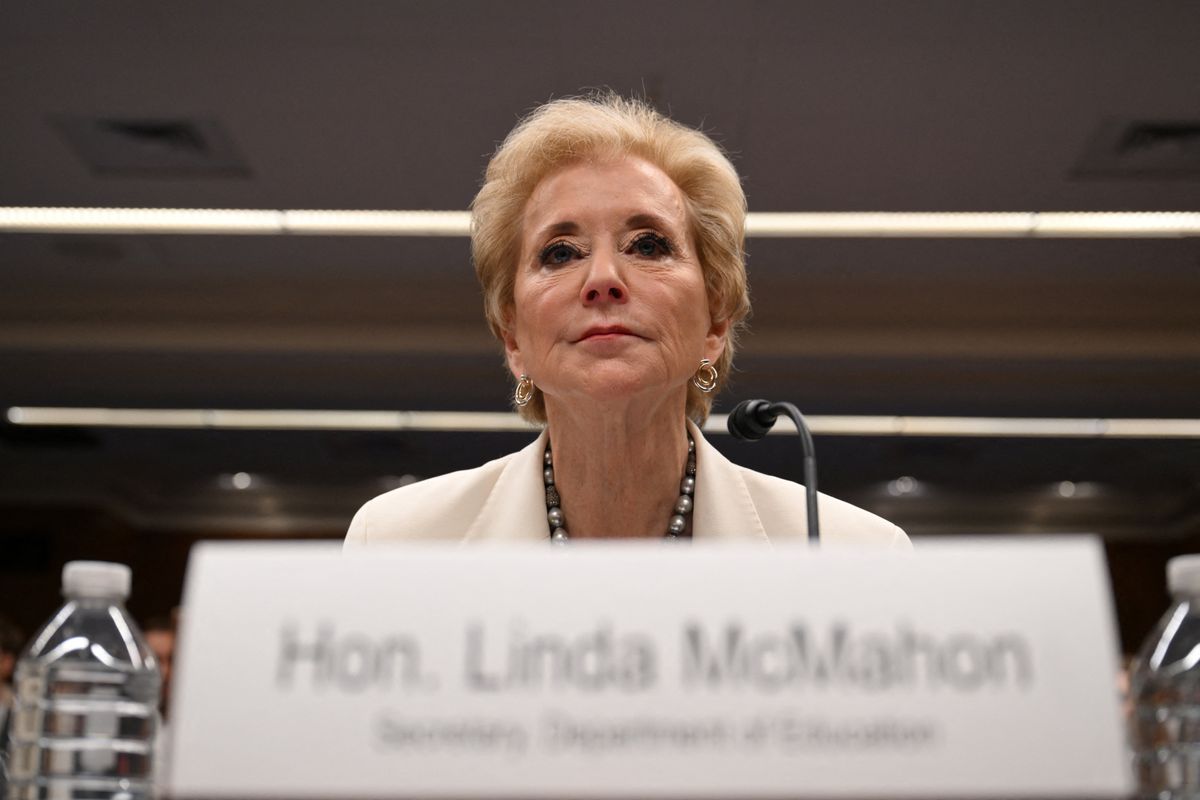
U.S. Secretary of Education Linda McMahon attends to testify before a Senate Appropriations hearing on U.S. President Donald Trump's budget request for the Department of Education, on Capitol Hill in Washington, D.C., U.S., June 3, 2025. REUTERS/Annabelle Gordon

WASHINGTON — The U.S. Department of Education is moving out of its Lyndon B. Johnson headquarters building, the department announced Thursday, in another step toward dismantling the agency.

The Education Department said its “chronically underutilized” building is roughly 70% vacant and estimated the relocation — slated for August — would save taxpayers approximately $4.8 million a year in operating costs.

The move marks the latest action from President Donald Trump’s administration to do away with the 46-year-old department as part of the president’s quest to send education “back to the states.” Much of the oversight and funding of schools already occurs at the state and local levels.

The Education Department will move roughly one block away to a building the U.S. Agency for International Development previously occupied.

The Department of Energy will move out of its James V. Forrestal building nearby and take over Education’s headquarters building.

“Thanks to the hard work of so many, we have made unprecedented progress in reducing the federal education footprint, and now we are pleased to give this building to an agency that will benefit far more from its space than the Department of Education,” Education Secretary Linda McMahon said in a statement.

‘Next on the chopping block’

Rep. Bobby Scott, ranking member of the House Committee on Education and Workforce, rebuked the relocation efforts as “one of the most overt actions by Secretary McMahon to dismantle the Department of Education (ED) and disregard the law, federal courts, and Congress.”

“Leaving the Lyndon B. Johnson headquarters building does not cut bureaucracy — it rearranges it,” the Virginia Democrat added. “This decision to close the Department’s physical building is not just a symbolic move — it reflects a broader effort to reduce the federal government’s role in ensuring people have equal access to a quality education.”

Rachel Gittleman, president of American Federation of Government Employees Local 252, which represents Education Department workers, blasted the announcement in a Thursday statement.

“The message the Secretary’s announcement sends to our staff and the American public is clear — education is next on the chopping block,” Gittleman said.

“But after more than a year of fighting back against this unlawful and unprecedented gutting of a Congressionally created agency, we know that the will of the people, congressional intent, and the law is on our side,” she added.

Interagency agreements

The announcement came just days after the administration said the Treasury Department would take over Education’s responsibility for collecting on defaulted federal student loan debt — the first step in a multiphase process toward Treasury taking on Education’s entire, roughly $1.7 trillion federal student loan portfolio.

Prior to the agreement with Treasury, Education had announced nine other interagency agreements with the departments of Labor, Health and Human Services, Interior and State that transfer several of its responsibilities to those agencies.

Meanwhile, the U.S. Supreme Court in July 2025 temporarily greenlit mass layoffs and a plan to dramatically downsize the Education Department ordered earlier that year.

That plan was outlined in a March 2025 executive order, where Trump called on McMahon to “take all necessary steps to facilitate the closure” of her own department.

Georgia Recorder is part of States Newsroom, a nonprofit news network supported by grants and a coalition of donors as a 501c(3) public charity. Georgia Recorder maintains editorial independence. Contact Editor Jill Nolin for questions: info@georgiarecorder.com.
ICYMI
Melania Trump proposes resurrecting 'Plato' as 'humanoid' robot — to replace teachers

David Edwards
March 25, 2026 
RAW STORY


U.S. first lady Melania Trump walks next to a humanoid robot as she hosts a roundtable event on the second day of the inaugural Fostering the Future Together Global Coalition Summit, at the White House in Washington, D.C., U.S., March 25, 2026. REUTERS/Kylie Cooper TPX IMAGES OF THE DAY

First Lady Melania Trump floated the idea of recreating ancient Greek philosopher Plato as a "humanoid" robot to teach the nation's children.

At an event titled "Melania Trump's Fostering the Future Together Global Coalition Summit at the White House" on Wednesday, the first lady was seen entering the room with an android similar to Elon Musk's Optimus robot.

She spoke at the summit about how the device could be used to replace traditional teachers.

"The future of AI is personified," she explained. "It will be formed in the shape of humans. Very soon, artificial intelligence will move from our mobile phones to humanoids that deliver utility."

"Since our environment is designed for people, humanoids' systems are uniquely suited to navigate and operate within our world. They fit well," she continued. "Imagine a humanoid educator named Plato. Access to the classical studies is now instantaneous."

"Literature, science, art, philosophy, mathematics, and history. History, humanity's entire corpus of information, is available in the comfort of your home."

Trump insisted that Plato would provide "a personalized experience, adaptive to the needs of each student."

"Predictably, our children will develop deep critical thinking and independent reasoning abilities," she insisted.


THE BLACK PRINCE

CPAC gets sobering warning of 'burning American warships' in Iran from Blackwater founder

David Edwards
March 27, 2026 
RAW STORY


Erik Prince, CPAC board member, and Jason Redman, retired Navy SEAL, attend the Conservative Political Action Conference (CPAC) USA 2026 at the Gaylord Texan Resort and Convention Center, in Grapevine, Texas, U.S. March 27, 2026. REUTERS/Callaghan O'Hare

Blackwater founder Erik Prince revealed that he warned President Donald Trump against going to war in Iran.

At the Conservative Political Action Conference, or CPAC, in Texas on Friday, Prince had a sobering message about Operation Epic Fury.

"I counseled as loud as possible against doing this in the first place," he explained. "We face an extremely difficult challenge. The Iranians learned their lesson from what happened to Iraq. Decapitation of the leadership structure of the Iraqi army. The Iranians have done the exact same thing. There's 31 different military districts. All clear direction given to those 31 commanders is to continue to wage war against whoever they can with whatever they can."

"The only person that can countermand that order is the supreme leader," he continued. "And we've killed the supreme leader now, his father, his wife, his sister, other family members in an ancient society — in an ancient society that understands blood oath."

"I don't share the optimism of the administration that there's going to be a peaceful stop to this."

Prince noted that Iran would "burn it down" if the U.S. tried to deploy troops in the country.

"If they try to put boots on the ground, force the Strait of Hormuz, you will see imagery of burning American warships in the next couple of weeks," he advised. "And I don't think people are really prepared for that."

"So I would, look, Iran doesn't have an independence day because they've not really been conquered since Alexander the Great," Prince added. "For all the talk of regime change, there's never been a real preparation of an armed opposition inside the country. And a lot of ways to do that from the periphery that doesn't require U.S. boots."


Emails show Trump official urged beating protesters: ‘No one likes being hit by a stick’

Erik De La Garza
March 27, 2026
RAW STORY


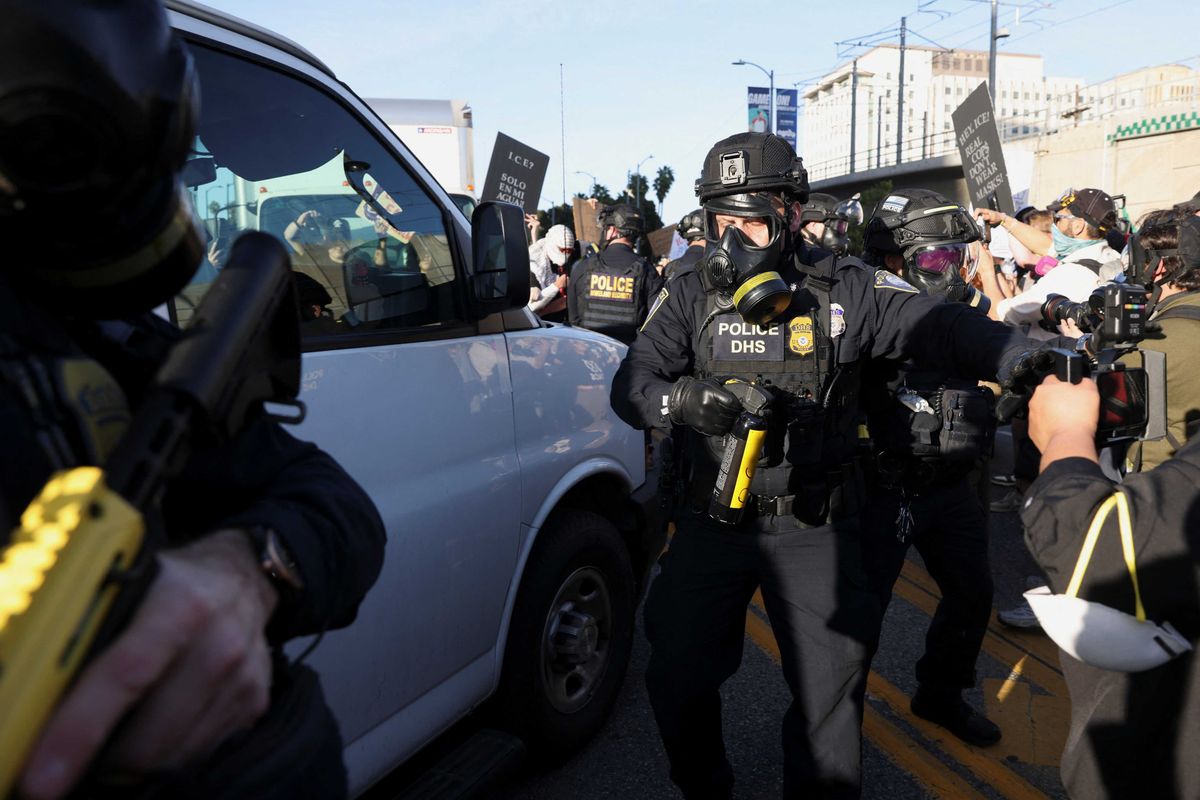
DHS agents operate as people take part in a protest against U.S. Immigration and Customs Enforcement (ICE) and U.S. President Donald Trump's immigration policies outside the Metropolitan Detention Center (MDC) in Los Angeles, California, U.S., January 30, 2026. REUTERS/Jill Connelly

Emails obtained through a public records request show a Trump administration official urged federal agents to use violence against protesters during unrest tied to immigration crackdowns, according to a new report.

The messages, shared with the Los Angeles Times, involve Joseph Mazzara, a State Department employee who previously served as acting general counsel at the Department of Homeland Security.

In a June 11 email, Mazzara wrote that agents confronting demonstrators should have escalated their response, MS NOW reported Friday.

“They should have, when they brought the line in, just started hitting the rioters and arresting everyone that couldn’t get away from them,” Mazzara reportedly wrote in one email. “No one likes being hit by a stick, and people tend to run when that starts happening in earnest.”

The emails were obtained through a Freedom of Information Act request by the watchdog group American Oversight.

MS NOW opinion columnist Ja’han Jones said the messages “speak to the culture of violent intimidation that the president has helped fuel at the Department of Homeland Security, an agency that has become a megaphone for white supremacist propaganda.”

DHS did not immediately respond to requests for comment. Mazzara was later appointed deputy commissioner of U.S. Customs and Border Protection.

“The Trump administration’s deadly anti-immigrant crackdown became so brutal last year that even some popular figures who have supported the president compared it to Nazism,” Jones reminded readers Friday. “That reputation is only bolstered by these revelations of violent bloodlust by a top lawyer formerly tasked with advising the people waging that crackdown.”


The 'strangling angel' could return if RFK Jr. succeeds: report

Erik De La Garza
March 27, 2026 
RAW STORY'


A child after being vaccinated. (Shutterstock)

A new analysis warns that once-controlled childhood diseases could come roaring back if vaccine access declines – including diphtheria, a historic killer known as the “strangling angel.”

Researchers modeled what could happen over 25 years if vaccines for polio, measles, rubella, and diphtheria became unavailable, according to ProPublica. While measles cases are already “teetering on the brink of an explosion,” the report highlights diphtheria as a particularly deadly threat.

The disease earned its nickname because it attacks the respiratory system, forming a thick layer of dead tissue in the throat that can suffocate patients.

“For those who escape suffocation, the toxin can damage the nerves and heart,” ProPublica reported Friday. “Patients who seem better can drop dead weeks later.”

The researchers warned that “we would be playing a game of high-stakes roulette if we lost the vaccine,” and concluded that “there is a chance that the strangling angel could become devastating again.”

While rarer and less contagious than measles, diphtheria is far more deadly, the study found.


“On average, the model predicts 138,000 deaths from diphtheria,” it said. “In the worst-case scenario, though, the model shows that more than a million people could die from diphtheria in 25 years without a vaccine.”

The stark warning comes as Health Secretary Robert F. Kennedy Jr. considers changes that critics say could threaten vaccine availability in the United States.
Trump just got 'the most magnificently savage dismantling' in France's parliament

"A Turkish proverb says, 'When a clown settles in a palace, he does not become king, it is the palace that becomes a circus,"


Travis Gettys
March 27, 2026 
RAW STORY


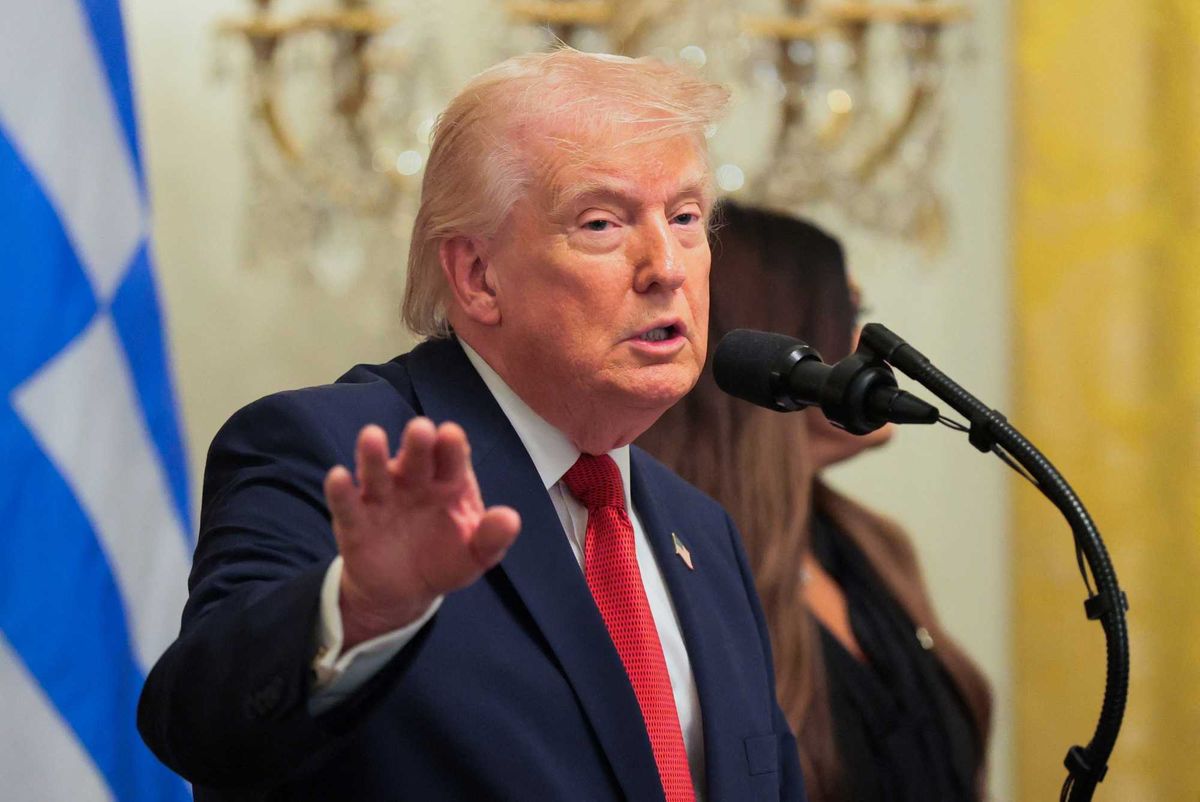
U.S. President Donald Trump delivers remarks at a celebration in honor of Greek Independence Day in the East Room at the White House in Washington, D.C., U.S., March 26, 2026. REUTERS/Kylie Cooper

A French lawmaker torched President Donald Trump and his top officials in a scathing indictment of his second term in the White House.

Senator Claude Malhuret, who was described last year by the New York Times as "Trump's European nemesis," linked the Iran war to the U.S. president's appearance in the Jeffrey Epstein files and shamed American legislators for failing to impeach him for clearly unconstitutional conduct.

"A year ago, here in France, I compared Trump's presidency to Nero's Court," Malhuret began. "I was wrong – it's the miracle court. An anti-vaxxer, former heroin addict as minister of health [Robert F. Kennedy Jr.], a climate skeptic minister of economy [Scott Bessent], an alcoholic TV anchor, minister of the armed forces [Pete Hegseth], an old Qatar agent, minister of justice [Pam Bondi], a groupie of Putin, minister of national security [Tulsi Gabbard]."

"A Turkish proverb says, 'When a clown settles in a palace, he does not become king, it is the palace that becomes a circus," Malhuret continued. "This great team has decided to create a competitor to the UN. Since the creation of the Board of Peace, Trump has triggered more military strikes than Biden during his entire term."

"Every time the Epstein affair resurfaces, bombs explode somewhere in the world and cause a distraction," he added. "Bomb more to win more."

A commenter called Gandalv called it the, "Most magnificently savage dismantling of the Trump administration ever delivered in a language they almost certainly don’t speak."

Malhuret, described by the Times as a right-leaning centrist, then lamented that the U.S. Congress was not willing to remove Trump from office for self-dealing, insider trading and foreign emoluments.

"There isn't a single country where Trump did not take advantage of the situation to get rich without ever forgetting his family," Malhuret said. "A Boeing plane offered by Qatar, investment in all gulf projects or elsewhere, market manipulation that only a few insiders benefit from."

"Any one of these conflicts of interest would have caused an immediate procedure of impeachment here," Malhuret added. "But we are not here. We are in MAGA's America, where public business is conducted in favor of private interests."


'That man is a nut': Trump's bid to slap his name on US currency lights up Congress
RAW STORY


WASHINGTON — House Democrats tore into President Donald Trump on Friday over his push to stamp his name onto official U.S. dollar bills, blasting what they see as his latest self-promotional move.

Rep. Brendan Boyle (D-PA) told Raw Story he tried during the COVID-19 stimulus negotiations to block any president from signing checks, arguing Trump was overly focused on promoting himself while in the White House.

“That’s all he cares about,” Boyle said, adding that Trump ultimately signed the payments sent to millions of Americans with “a big, psychotic looking signature.”

Other Democrats on Capitol Hill were even more blunt.

“Unbelievable,” Rep. Zoe Lofgren (D-CA) said. “That man is a nut. [He] really wants his name on everything.

Lofgren called Republican efforts to name things after the president “embarrassing.”

“I’m embarrassed for them,” she said.

Meanwhile, Rep. Jim McGovern (D-MA) accused Republicans of enabling Trump out of fear.

“They’re afraid of him, and it's really pathetic,” McGovern said. “They're screwing over their own constituents on a daily basis, because they're more afraid of him than they are of the wrath of their constituents.”

The Massachusetts lawmaker didn’t hold back when asked about Trump’s signature push, calling it “so cringey” and “over the top.”

“I mean, like there's something wrong with him,” McGovern concluded.