Saturday, April 11, 2026


SoCal honeybees can fend off deadly mites


Hybrid species exhibits unusual defenses


University of California - Riverside

Wild hive 

image: 

Southern California hybrid honeybee hive hanging from a tree in the wild. 

view more 

Credit: Boris Baer/UCR


Southern California is home to a flying black and yellow treasure. While commercial honeybee hives nationwide are collapsing under attack from deadly parasites, a unique hybrid bee found only in this part of the state has demonstrated the ability to survive.

U.S. beekeepers reported losing up to 62% of their managed honeybee colonies in 2025, which threatens our food supply. The losses are driven by a combination of pesticides, climate pressure, habitat loss, and parasites, with the Varroa mite among the most destructive of these factors.

Varroa mites feed on honeybees’ fat body tissue, which weakens their immune systems, reduces their body weight, and shortens their lives. The fat body is an organ in bees that, if you were comparing it to human biology, performs the functions of the liver, pancreas, and immune system.

The mites also act as vectors for deadly viruses like Deformed Wing Virus and Acute Bee Paralysis Virus, which they transmit directly into a bee’s bloodstream. Beekeepers rely on chemical treatments for suppression that can lose effectiveness over time.

A new study from UC Riverside published in Scientific Reports is the first to show that a locally adapted population of honeybees can naturally and consistently suppress the mites.

“We kept hearing anecdotally that these Californian honeybees were surviving with way fewer treatments. I wanted to test them rigorously and understand the driving force behind what the beekeepers were seeing,” said Genesis Chong-Echavez, a UCR graduate student and lead author of the study.

Alongside entomologists from UCR’s Center for Integrative Bee Research (CIBER), Chong-Echavez monitored 236 honeybee colonies between 2019 and 2022.

The Californian bees were not entirely immune to the mites. However, colonies headed by locally raised Californian hybrid honeybee queens had about 68% fewer mites on average than colonies headed by commercial honeybee queens. They were also more than five times less likely to cross the threshold at which chemical treatments become necessary.

The bees in the study are not a commercial breed. They come from a genetically mixed population of honeybees established in Southern California, often from feral colonies living in trees. Recent research shows they are a hybrid population with ancestry from at least four honeybee lineages, including African, Eastern European, Middle Eastern, and Western European bees.

To more fully understand the bees’ resistance to the mites, the researchers also ran laboratory experiments with developing honeybee larvae. Varroa mites must enter brood cells to reproduce, so the team tested whether mites were equally drawn to larvae from commercial and Californian hybrid honeybee colonies.

They were not.

Mites were less attracted to the Californian hybrid honeybee larvae, especially at seven days old, the stage when mites are normally most likely to invade. The finding suggests the bees’ secret to fending off mites lies in early development, before any adult worker behaviors might come into play.

“What surprised me most was the differences showed up even at the larval stage,” Chong-Echavez said. “This suggests the resistance mechanism may go deeper than some kind of behavior and may be genetically built into the bees themselves.”

The findings could have implications beyond Southern California. Honeybees pollinate crops worth billions of dollars and are under growing pressure from multiple environmental stressors. The research suggests that part of the answer to improving honeybee health may lie in the biology of these bees.

Boris Baer, UCR entomology professor and co-author of the study, said the study also highlights the value of listening to working beekeepers.

“This question did not start in the lab. It started in conversations with beekeepers,” Baer said. “They were not just observers; they helped shape the questions behind this research.”

The researchers caution that the Californian hybrid honeybees are not entirely mite-free, and they do not suggest abandoning current management practices. Instead, they hope to learn which traits help these honeybees keep mite levels lower, and whether those traits could support future breeding programs or reduce dependence on chemicals.

Next, the team plans to investigate the genetic, behavioral, and chemical signals that may make the larvae less attractive to mites.

“At a time when pollinators are facing global decline, this work offers a hopeful message: solutions may already be emerging in the field, and we just need to understand them,” Chong-Echavez said.


A Varroa mite on a developing honeybee larva inside a brood cell. 

Researchers inspecting honeybee colonies as part of long-term monitoring of Varroa mite infestations. 

Credit

Genesis Chong-Echavez/UCR

The Local Universe’s Expansion Rate Is Clearer Than Ever, But Still Doesn’t Add Up


Artist’s interpretation of the cosmic distance ladder — a succession of overlapping methods used to measure distances across the Universe, where each rung of the ladder provides information that can be used to determine the distances at the next higher rung. Methods include observations of pulsating Cepheid variable stars, red giant stars that shine with a known brightness, Type Ia supernovae, and certain types of galaxies. In this illustration, the distance ladder begins at the Coma Cluster, which is the nearest extremely rich galaxy cluster to us. The distance to the Coma Cluster can be measured directly using observations of Type Ia supernovae within the cluster. Type Ia supernovae have a predictable luminosity that makes them reliable objects for distance calculations. 
CREDIT: CTIO/NOIRLab/DOE/NSF/AURA/J. Pollard Image Processing: D. de Martin & M. Zamani (NSF NOIRLab)

April 11, 2026
By Eurasia Review


An international collaboration of astronomers has produced one of the most precise measurements yet of how fast the local Universe is expanding. The result deepens one of the most significant challenges in modern cosmology. John Blakeslee, astronomer at NSF NOIRLab, funded by the U.S. National Science Foundation, is a member of the collaboration, and telescopes across two NSF NOIRLab Programs contributed data.

Astronomers have sought to measure the expansion rate of the Universe using two fundamentally different approaches. One method relies on measuring distances to stars and galaxies in the nearby Universe. The other uses measurements of the cosmic microwave background to predict what the expansion rate would be today under the standard model of cosmology.

These two approaches are expected to yield the same result, but they don’t. Measurements based on the nearby Universe consistently indicate a higher expansion rate — around 73 kilometers per second per megaparsec — while predictions derived from the early Universe yield a lower value, closer to 67 or 68. Although the numerical difference is modest, it is far larger than can be explained by statistical uncertainty. This persistent disagreement, known as the Hubble tension, has now been observed across multiple independent studies and techniques.

By bringing together decades of independent observations into a single, unified framework, an international collaboration of astronomers has achieved the most precise direct measurement to date of the expansion rate of the nearby Universe. In a paper published in Astronomy & Astrophysics, the H0 Distance Network (H0DN) Collaboration reports a value of the Hubble constant of 73.50 ± 0.81 kilometers per second per megaparsec, corresponding to a precision of just over 1%.

The study, “The Local Distance Network: a community consensus report on the measurement of the Hubble constant at ∼1% precision,” is the outcome of a broad community effort launched at the International Space Science Institute (ISSI) Breakthrough Workshop, “What’s under the H0od?”, held at ISSI in Bern, Switzerland, in March 2025.

“This isn’t just a new value of the Hubble constant,” the collaboration notes, “it’s a community-built framework that brings decades of independent distance measurements together, transparently and accessibly.”

NSF NOIRLab contributed both expertise and observational data to this effort. John Blakeslee, astronomer and Director of Research and Science Services at NSF NOIRLab, is a member of the collaboration. The study includes data from telescopes at NSF Cerro Tololo Inter-American Observatory (CTIO) in Chile and NSF Kitt Peak National Observatory (KPNO) in Arizona, both Programs of NSF NOIRLab. Those data were incorporated into a broader, collaborative framework spanning both ground and space-based observatories, helping to strengthen the overall result.

Rather than relying on a single method, the team constructed a “distance network” that links many overlapping techniques for measuring distances across the local Universe. These include observations of pulsating Cepheid variable stars, red giant stars that shine with a known brightness, Type Ia supernovae, and certain types of galaxies. This approach enables multiple independent paths to the same final result, and allows for a critical test: is the discrepancy caused by an error within a single method? The results indicate that this is unlikely. Even when individual techniques are removed from the analysis, the overall result changes only minimally. Independent measurements remain consistent with one another, reinforcing the robustness of the locally measured expansion rate.

“This work effectively rules out explanations of the Hubble tension that rely on a single overlooked error in local distance measurements,” the authors conclude. “If the tension is real, as the growing body of evidence suggests, it may point to new physics beyond the standard cosmological model.”

The implications are significant. The lower expansion rate inferred from the early Universe depends on the standard model of cosmology, which describes how the Universe has evolved since the Big Bang. If that model is incomplete — for example, if it does not fully account for the behavior of dark energy, new particles, or modifications to gravity — its predictions for the present-day expansion rate would be affected.

In that case, the Hubble tension may not be the result of measurement error, but rather evidence that the current model of the Universe is missing a key component. The local distance network also establishes a framework for future investigations. By making its methods and data openly available, the collaboration has created a foundation that can be expanded with new observations. With next-generation observatories expected to provide even more precise measurements, astronomers aim to determine whether this discrepancy will ultimately be resolved or continue to point toward new physics.


The local universe’s expansion rate is clearer than ever, but still doesn’t add up


A new synthesis of astronomical measurements confirms a persistent mismatch that could point to physics beyond current models


Association of Universities for Research in Astronomy (AURA)

Artist’s interpretation of the cosmic distance ladder 

image: 

Artist’s interpretation of the cosmic distance ladder — a succession of overlapping methods used to measure distances across the Universe, where each rung of the ladder provides information that can be used to determine the distances at the next higher rung. Methods include observations of pulsating Cepheid variable starsred giant stars that shine with a known brightness, Type Ia supernovae, and certain types of galaxies.

In this illustration, the distance ladder begins at the Coma Cluster, which is the nearest extremely rich galaxy cluster to us. The distance to the Coma Cluster can be measured directly using observations of Type Ia supernovae within the cluster. Type Ia supernovae have a predictable luminosity that makes them reliable objects for distance calculations.

view more 

Credit: CTIO/NOIRLab/DOE/NSF/AURA/J. Pollard Image Processing: D. de Martin & M. Zamani (NSF NOIRLab)


An international collaboration of astronomers has produced one of the most precise measurements yet of how fast the local Universe is expanding. The result deepens one of the most significant challenges in modern cosmology. John Blakeslee, astronomer at NSF NOIRLab, funded by the U.S. National Science Foundation, is a member of the collaboration, and telescopes across two NSF NOIRLab Programs contributed data.

Astronomers have sought to measure the expansion rate of the Universe using two fundamentally different approaches. One method relies on measuring distances to stars and galaxies in the nearby Universe. The other uses measurements of the cosmic microwave background to predict what the expansion rate would be today under the standard model of cosmology.

These two approaches are expected to yield the same result, but they don’t. Measurements based on the nearby Universe consistently indicate a higher expansion rate — around 73 kilometers per second per megaparsec — while predictions derived from the early Universe yield a lower value, closer to 67 or 68. Although the numerical difference is modest, it is far larger than can be explained by statistical uncertainty. This persistent disagreement, known as the Hubble tension, has now been observed across multiple independent studies and techniques.

By bringing together decades of independent observations into a single, unified framework, an international collaboration of astronomers has achieved the most precise direct measurement to date of the expansion rate of the nearby Universe. In a paper published on 10 April in Astronomy & Astrophysics, the H0 Distance Network (H0DN) Collaboration reports a value of the Hubble constant of 73.50 ± 0.81 kilometers per second per megaparsec, corresponding to a precision of just over 1%.

The study, “The Local Distance Network: a community consensus report on the measurement of the Hubble constant at ∼1% precision,” is the outcome of a broad community effort launched at the International Space Science Institute (ISSI) Breakthrough Workshop, “What’s under the H0od?”, held at ISSI in Bern, Switzerland, in March 2025.

“This isn’t just a new value of the Hubble constant,” the collaboration notes, “it’s a community-built framework that brings decades of independent distance measurements together, transparently and accessibly.”

NSF NOIRLab contributed both expertise and observational data to this effort. John Blakeslee, astronomer and Director of Research and Science Services at NSF NOIRLab, is a member of the collaboration. The study includes data from telescopes at NSF Cerro Tololo Inter-American Observatory (CTIO) in Chile and NSF Kitt Peak National Observatory (KPNO) in Arizona, both Programs of NSF NOIRLab. Those data were incorporated into a broader, collaborative framework spanning both ground and space-based observatories, helping to strengthen the overall result.

Rather than relying on a single method, the team constructed a “distance network” that links many overlapping techniques for measuring distances across the local Universe. These include observations of pulsating Cepheid variable starsred giant stars that shine with a known brightness, Type Ia supernovae, and certain types of galaxies. This approach enables multiple independent paths to the same final result, and allows for a critical test: is the discrepancy caused by an error within a single method? The results indicate that this is unlikely. Even when individual techniques are removed from the analysis, the overall result changes only minimally. Independent measurements remain consistent with one another, reinforcing the robustness of the locally measured expansion rate.

“This work effectively rules out explanations of the Hubble tension that rely on a single overlooked error in local distance measurements,” the authors conclude. “If the tension is real, as the growing body of evidence suggests, it may point to new physics beyond the standard cosmological model.”

The implications are significant. The lower expansion rate inferred from the early Universe depends on the standard model of cosmology, which describes how the Universe has evolved since the Big Bang. If that model is incomplete — for example, if it does not fully account for the behavior of dark energy, new particles, or modifications to gravity — its predictions for the present-day expansion rate would be affected.

In that case, the Hubble tension may not be the result of measurement error, but rather evidence that the current model of the Universe is missing a key component. The local distance network also establishes a framework for future investigations. By making its methods and data openly available, the collaboration has created a foundation that can be expanded with new observations. With next-generation observatories expected to provide even more precise measurements, astronomers aim to determine whether this discrepancy will ultimately be resolved or continue to point toward new physics.

More information

This research is presented in a paper titled “The Local Distance Network: A community consensus report on the measurement of the Hubble constant at ∼1% precision” to appear in Astronomy & Astrophysics. DOI: 10.1051/0004-6361/202557993

The results are presented by the H0DN Collaboration.

NSF NOIRLab, the U.S. National Science Foundation center for ground-based optical-infrared astronomy, operates the International Gemini Observatory (a facility of NSFNRC–CanadaANID–ChileMCTIC–BrazilMINCyT–Argentina, and KASI–Republic of Korea), NSF Kitt Peak National Observatory (KPNO), NSF Cerro Tololo Inter-American Observatory (CTIO), the Community Science and Data Center (CSDC), and NSF–DOE Vera C. Rubin Observatory (in cooperation with DOE’s SLAC National Accelerator Laboratory). It is managed by the Association of Universities for Research in Astronomy (AURA) under a cooperative agreement with NSF and is headquartered in Tucson, Arizona. 

The scientific community is honored to have the opportunity to conduct astronomical research on I’oligam Du’ag (Kitt Peak) in Arizona, on Maunakea in Hawai‘i, and on Cerro Tololo and Cerro Pachón in Chile. We recognize and acknowledge the very significant cultural role and reverence of I’oligam Du’ag to the Tohono O’odham Nation, and Maunakea to the Kanaka Maoli (Native Hawaiians) community.

The International Space Science Institute (ISSI) is an Institute of Advanced Studies, where scientists from all over the world meet in a neutral, welcoming, and multi-disciplinary setting to discuss and publish about relevant and compelling topics related to four Disciplines: Astrophysics, Heliophysics, Planetary Science and Earth Science. ISSI’s mission is to advance science by facilitating scientific community interactions, meetings, discussions, and publications aimed at a deeper understanding of results from different space missions, ground-based observations, and theory. This is achieved through a broad portfolio of scientific opportunities that include: International Teams, Workshops, Working Groups, Fora, or visits of individual Visiting Scientists. For additional information related to ISSI and to the opportunities it offers, see: www.issibern.ch.

Links


Bill Nye blasts Trump's NASA plan as ‘illogical’: ‘We cannot allow this’

Erik De La Garza
April 10, 2026 
RAW STORY


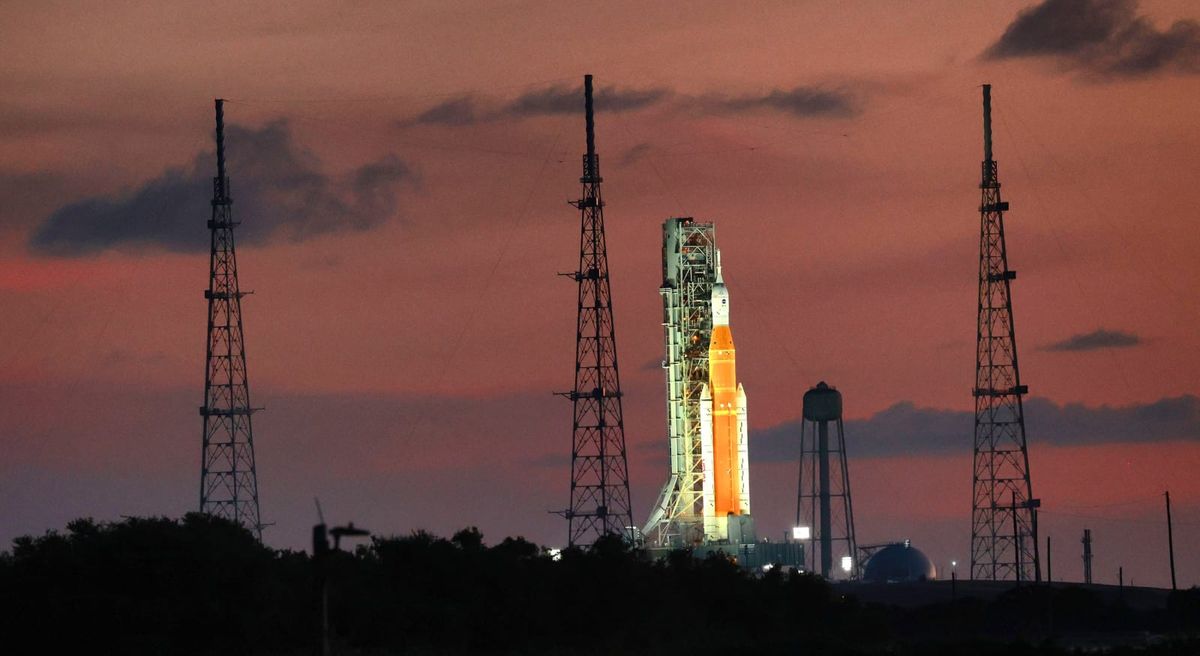
The sun rises behind Artemis I, NASA's heavy-lift lunar rocket system, as it sits temporarily grounded at pad 39- B at Kennedy Space Center, Florida, on Sept. 6, 2022. - Joe Burbank/Orlando Sentinel/TNS

Science educator Bill Nye came out swinging at President Donald Trump on Friday, blasting his administration’s proposed cuts to NASA as “surprising, illogical and very troubling” in a scathing new opinion piece.

Writing for MSNOW in the wake of the historic return of the Artemis II crew – the first mission to the moon since 1972 – Nye argued the moment of celebration is being overshadowed by Trump’s plans to slash funding for space science.

“The proposed cuts would terminate 53 NASA Science missions, throwing away more than $13 billion in taxpayer investment and halting the development of nearly every future NASA Science mission,” according to Nye, best known for hosting the hit educational show “Bill Nye the Science Guy.” He added that such reductions would be “an insult to our astronauts and entire NASA workforce.”

Nye also took aim at proposed cuts to STEM education, calling efforts to eliminate NASA’s outreach programs “quite personal” and warning they would damage the nation’s long-term scientific leadership.

“We cannot allow this,” Nye declared, urging Americans to push back against the MAGA administration’s “draconian cuts.” He pointed to a growing global competition in space, particularly with China, and questioned why the U.S. would “cede the lead” at such a pivotal moment.

“NASA is the best brand our nation has,” Nye told readers Friday. He argued that space exploration reflects America “at its best” – and warned that abandoning scientific investment “would be an unworthy choice.”

“If Artemis II has showed us anything, it’s that the public, across the political spectrum, strongly supports space exploration, scientific discovery and a deeper understanding of the universe and our place within it,” he concluded.

Trump, for his part, on Friday congratulated the Artemis crew in a Truth Social post, praising their trip as "spectacular," and the landing as "perfect."

"I could not be more proud!" Trump wrote.

The president who once said space wasn't important now wants to remake it in his image


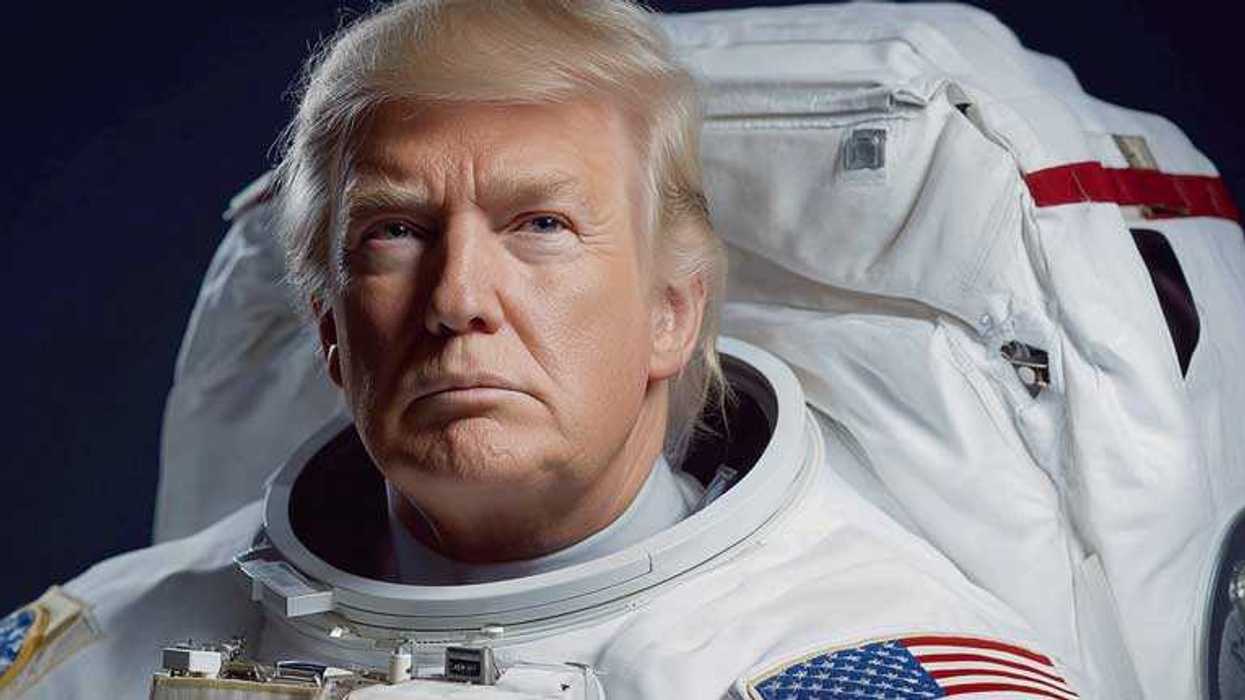
Illustration of Donald Trump as an astronaut (Roxanne Cooper/MidJourney)

March 31, 2026
ALTERNET

President Trump is positioning the upcoming Artemis II moon mission as a potential centerpiece of his second-term legacy, according to a New York Times report by Peter Baker. The mission, scheduled to launch this week, will send four astronauts farther from Earth than any humans have traveled since the Apollo program ended more than 50 years ago.

Trump's enthusiasm for space exploration marks a dramatic reversal from his 2015 campaign stance. When asked about space during a New Hampshire campaign stop, Trump dismissed the subject, saying: "Right now, we have bigger problems — you understand that? We've got to fix our potholes." By the time he entered office, however, he had embraced space exploration as integral to American greatness, and no president since Kennedy and Johnson has pushed NASA as aggressively.

Trump's ambitions extend well beyond Artemis II. Shortly after Jared Isaacman became NASA administrator in January, Trump called to ask about Mars missions and nuclear rockets, inquiring: "Are we doing something in the 2028 window for Mars? What do you think about the nuclear rocket?" Isaacman indicated that Trump envisions sustained lunar presence and infrastructure rather than brief visits. Trump emphasized: "We better be doing more than getting rocks this time."

Trump's public attention to the Artemis II launch has been notably limited. Though the four astronauts were seated in the gallery during his February State of the Union address, Trump did not acknowledge them or mention the mission. He has said little about it in recent days despite the launch's imminence.

Trump's space agenda faces fiscal constraints. The Trump administration proposed cutting NASA funding by 24 percent last year, a reduction that would have terminated more than 40 missions. Though Congress protected the Artemis program through budget legislation, nearly 4,000 NASA employees are departing through federal workforce reductions.

Questions remain about Trump's sustained commitment to the long-term program. Retired astronaut Cady Coleman expressed concerns about losing experienced personnel, while Apollo 17 moon walker Harrison H. Schmitt stressed the importance of presidential leadership. Schmitt noted: "You have to have the White House and the president acting as the spokesman for it. There's just no question about that."


Wildlife trade increases pathogen transmission


University of Lausanne


A study conducted at the Department of Ecology and Evolution of the University of Lausanne (Unil) quantifies the impact of wildlife trade on the exchange of germs and parasites between animals and humans. It was published on 9 April 2026 in the journal Science.

Hedgehogs, elephants, pangolins, bears or fennec foxes: many wild species are sold as pets, hunting trophies, for traditional medicine, biomedical research, or for their meat or fur. These practices, whether legal or illegal, concern one quarter of all mammal species.

The team led by Cleo Bertelsmeier, Associate Professor at the Department of Ecology and Evolution (DEE) of the Faculty of Biology and Medicine at Unil, assessed the role of international wildlife trade in the transmission of pathogens between animals and humans. While this link has seemed obvious since Covid-19 – reminding that the sale of animals at the Wuhan market was singled out – “no precise quantification had been carried out until now,” explains Jérôme Gippet, first author of the study published on 9 April 2026 in Science.

Forty years of trade data analysed

The team combined forty years of legal and illegal wildlife import-export data with compilations of host–pathogen relationships. Their analyses, conducted in collaboration with U.S. researchers (Yale University, University of Maryland and University of Idaho), led to the following result: wild mammals that are traded are 1.5 times more likely to share infectious agents with humans than those that are not involved in trade. “In other words, these species have a 50% higher probability of sharing at least one virus, bacterium, fungus or parasite with us.” And that is not all: the risk is even higher when species are traded illegally or alive (for example as exotic pets).

The most striking finding according to the research team is that “the length of time an animal has been present in trade plays a key role: on average, a species shares one additional pathogen with humans for every ten-year period spent on the market,” emphasizes Jérôme Gippet, former postdoctoral researcher at the DEE, now at the University of Fribourg.

Wildlife in all its forms

The work focuses on wild mammals, meaning species that have not been domesticated and on which humans have therefore not exerted selective pressure, unlike cats, dogs, cattle or camels. These may be individuals captured from the wild or bred in captivity, for example for fur production. This category also includes new exotic pets – fennec foxes, otters, African pygmy hedgehogs, leopard cats or sugar gliders, to name but a few – whose buying and selling are fuelled by their popularity on social media. The data analysed cover both the trade in live specimens and in animal-derived products (fur, skins, scales, horns, etc.).

“It is important to understand that the probability of being infected by playing a piano with ivory keys or wearing fur is almost nonexistent. The problem lies at the beginning of the chain: someone had to hunt the animal, skin it, transport it…,” explains Jérôme Gippet. “Thus, even if the danger is not immediate, our consumption choices indirectly fuel the transmission of pathogens to humans. This calls our purchasing practices into question,” adds Cleo Bertelsmeier, who led the study.

At the intersection of ecology and public health

The team led by Cleo Bertelsmeier initially became interested in wildlife trade because it is a source of biological invasions (see related news in French). Individuals can escape or be released into the wild and cause harm to local ecosystems. But this activity can also have two other consequences: first, the risk of species extinction due to overexploitation of natural populations; second, the risk of pathogen exchange with humans, which is the focus of this latest Science publication, a phenomenon that can lead to epidemics or even pandemics. Covid-19 is only one example among others: in 2003, the United States notably faced an outbreak of monkeypox transmitted by prairie dogs sold as pets.

Strengthening biosurveillance

The results of the study highlight the need to improve biosurveillance of animals and animal-derived products in order to detect infectious agents and assess their potential for transmission to humans. Currently, the main multilateral agreement governing international trade in wild species, CITES, focuses exclusively on preventing extinction.

“Our finding that wild mammals share, on average, one additional pathogen with humans for every decade of presence on the global market highlights that the number of contacts plays a decisive role. To reduce disease emergence, these opportunities for encounters must be limited, and therefore the overall volume of trade,” states Jérôme Gippet.

“In my view, our work clearly shows how fundamental research can shed light on public health issues. It provides key elements to better understand host–pathogen dynamics and prevent future epidemics,” concludes Cleo Bertelsmeier.


World's largest known chimpanzee community demonstrates rare instance of division and deadly violence


University of Texas at Austin


The largest group of wild chimpanzees known to scientists has permanently split in two. In a study published in Science, researchers from The University of Texas at Austin and other institutions report the first clearly documented permanent fission in wild chimpanzees and the sustained intergroup violence that followed. The findings draw on three decades of field observations of the Ngogo chimpanzees of Kibale National Park, Uganda, a population featured in the Netflix documentary series Chimp Empire.

The community was cohesive for the first two decades of research. Individual chimpanzees moved between flexible subgroups, or "clusters," and maintained social ties across the community — a fission-fusion dynamic typical of the species, in which individuals temporarily separate and reunite. In 2015, however, the team witnessed signs of polarization, with the Western and Central clusters increasingly avoiding each other. This shift coincided with a change in the male dominance hierarchy and came one year after the deaths of several adult males who may have functioned as bridges holding the larger community together.

By 2018, the fission was complete. The chimpanzees now belonged to two distinct groups — Western and Central — with separate territories. What followed was a series of lethal attacks by the Western group on members of the Central group. Between 2018 and 2024, researchers observed or inferred with high confidence seven attacks on adult males and 17 on infants.

"What's especially striking is that the chimpanzees are killing former group members," says Aaron Sandel, associate professor of anthropology at UT Austin and the study's lead author. "The new group identities are overriding cooperative relationships that had existed for years."

In many primate species, large groups regularly split into smaller ones, often reducing competition for resources. But in chimpanzees, permanent fissions are extraordinarily rare. Genetic evidence suggests they occur roughly once every 500 years. The only previously reported case took place in the 1970s at Gombe, Tanzania, during Jane Goodall's long-term study. But that case has remained a subject of debate in part because the chimpanzees there were provisioned with food by researchers. At Ngogo, the chimpanzees were never provisioned, and the picture is more complete, thanks to nearly three decades of study by John Mitani, emeritus professor of anthropology at the University of Michigan, and a large team of researchers and Ugandan field staff.

"I would caution against anyone calling this a civil war," says Sandel. "But the polarization and collective violence that we have observed with these chimpanzees may give us insight into our own species."

The authors describe their findings as a challenge to the hypothesis that human warfare, including civil war, is driven primarily by cultural markers of group identity such as ethnic or religious differences.

"If relational dynamics alone can drive polarization and lethal conflict in chimps without language, ethnicity, or ideology, then in humans, those cultural markers might be secondary to something more basic," says Sandel. "If that's true, then we may have the potential to reduce societal conflicts in our personal lives, and that gives me hope. As our paper concludes, it may be in the small, daily acts of reconciliation and reunion between individuals that we find opportunities for peace."