Thursday, April 16, 2026


Three-Tier Dollar Zone Structure And Pathways For Breakthroughs In Yuan Internationalization – Analysis


April 16, 2026
 Anbound
By Zhang Yi

Recently, a series of moves by the United States may appear fragmented and isolated on the surface, but in reality they could very well be a systematic strategy during Donald Trump’s second term to reshape the global landscape of resources and supply chains, while reinforcing the dominance of the U.S. dollar in international settlement and finance. By strengthening its military presence in the Persian Gulf, the U.S. is enhancing its influence over critical regional maritime routes.

In South America, it is leveraging global commodity pricing conventions and its regional influence to sustain the use of the U.S. dollar in lithium and copper trade in countries such as Argentina and Chile. In the Asia-Pacific, the U.S. is deepening alliance coordination with Japan and South Korea and upgrading its security commitments. Both of the East Asian countries have pledged a combined USD 900 billion in strategic investments in the U.S., covering areas including critical minerals. Meanwhile, through the already signed USD 8.5 billion U.S.–Australia critical minerals agreement, Australia’s supply chains for lithium, rare earths, and other resources are being more tightly integrated into the U.S. dollar system.

These measures are closely tied to the U.S. domestic fiscal and debt situation. According to U.S. Treasury data released in March, total federal debt has reached USD 39 trillion, and net interest payments on that debt are projected to exceed USD 1 trillion this fiscal year. The combination of elevated debt levels and rising interest burdens has become an internal driver behind efforts to reinforce the dominance of the dollar. ANBOUND’s founder Kung Chan noted that as the global geopolitical landscape shifts, the underlying logic of the international monetary system is also undergoing adjustment. The dependence of European and Japanese currencies on the dollar has increased significantly, and the euro’s original ambition to rival the dollar has largely fallen short. The U.S. is now seeking to advance a three-tiered structure for the “dollar zone”: the Americas as the core dollar area, the Asia-Pacific and the Middle East as regions under dollar control, and Europe and Africa as areas within the dollar’s sphere of influence. The evolution of this framework warrants close attention.

The three-tier “dollar zone” structure is a strategic concept developed by the U.S. based on five key dimensions: geographic proximity, holdings of U.S. Treasury securities, the level of military alliance, dependence on dollar-based settlement, and the degree of strategic resource integration. Each tier has clearly defined geographic boundaries, capital characteristics, and functional roles. The “core zone” encompasses the U.S. mainland, Canada, Mexico, as well as all of Central and South America. It is guided in an integrated manner by the U.S. National Security Strategy and relies on regional trade agreements and cross-border financial cooperation frameworks to promote the coordinated integration of capital, resources, and industries within the region. This, in turn, is to build the credit foundation and internal circulation base of the dollar system.


According to the latest data from the U.S. Treasury and the Federal Reserve, domestic U.S. entities hold more than 70% of total U.S. Treasury debt, making them the most stable holders, while other economies in the Americas account for roughly 15% of foreign-held Treasuries, serving as key overseas holders. The Americas possess approximately 30% of the world’s arable land and renewable freshwater resources, and concentrate around 47% of globally economically recoverable lithium reserves, 41% of copper reserves, and 31% of proven oil reserves. In the context of AI computing power and energy infrastructure development, copper functions as the “vascular system” of data centers and next-generation power grids, while lithium serves as the “lifeblood” of energy storage systems. Control over the supply of these two minerals effectively secures upstream influence over global power infrastructure and computing capacity. Such strategic resources provide a solid foundation of tangible assets underpinning the dollar. With respect to food, energy, and critical minerals within the region, the U.S. is leveraging industrial investment and trade rules to guide the entire resource value chain toward reinforcing the role of dollar-based settlement, thereby consolidating a closed-loop internal cycle of “dollar–resources–commodities”.


The “control zone” spans the Asia-Pacific and the Middle East, encompassing countries such as Japan, South Korea, Singapore, the Philippines, and Australia, as well as Saudi Arabia, the United Arab Emirates, Kuwait, and Qatar, serving as a critical hub for global dollar liquidity. As U.S. treaty allies, Japan, South Korea, and Australia have long ranked among the top ten foreign holders of U.S. Treasuries, collectively accounting for roughly 15% of overseas holdings and forming a core group of major buyers. Japanese and South Korean firms are deeply embedded in upstream semiconductor materials, essential equipment, and midstream advanced wafer fabrication, providing essential support for the global supply of high-end chips.

The U.S., together with Japan, South Korea, and Australia, has signed the Pax Silica Declaration, promoting joint investment and R&D in artificial intelligence and semiconductors, thereby strengthening the foundational computing infrastructure of the AI era. Through the Minerals Security Partnership (MSP), the U.S. has also deepened resource cooperation with Australia, developing critical minerals such as rare earths and gallium needed for the semiconductor and AI industries, and securing control over key upstream raw material supplies. In the Middle East, the region is closely integrated with the U.S. through the petrodollar system, with strong linkages in energy trade, security cooperation, and dollar-based settlement. The region accounts for approximately 35% – 40% of global crude oil exports. By leveraging the control zone, the U.S. is constructing a cross-border cycle of “dollar–minerals–energy–technology”, thereby reinforcing the dollar’s global dominance.

The “influence zone” includes regions such as Europe, Africa, ASEAN, and India, forming the outer buffer layer of the U.S. dollar’s global financial architecture. Through interest rate policy, the Federal Reserve generates cyclical “dollar tides,” capturing cross-border returns while reinforcing the dollar’s dominant position. During easing cycles, the U.S. expands the issuance of Treasury securities and injects dollar liquidity, much of which flows into the influence zone. This inflow tends to push up local currencies, weakening export competitiveness. In response, local authorities often passively increase domestic currency supply to counter exchange rate pressures, which in turn drives up regional prices and asset valuations.


Conversely, during tightening cycles, dollar liquidity flows back to the U.S., leading to currency depreciation and asset price corrections in the influence zone, while sharply increasing the cost of servicing dollar-denominated debt. In some cases, high-quality leveraged assets are sold at discounted prices due to liquidity shortages, enabling U.S. investors to acquire them at lower valuations and subsequently strengthen domestic capital through dividends and capital gains, thereby alleviating debt pressures. Although Europe operates within the NATO alliance framework, the euro maintains an independent monetary status and seeks a role in cross-border settlement. Meanwhile, economies in Africa, ASEAN, and India generally hold relatively low levels of U.S. Treasuries and, in most cases, lack high-level military alliances with the United States. These factors constitute the core rationale behind Washington’s classification of these regions as a risk-buffering periphery.

The dollar system during the administrations of Bill Clinton and Barack Obama shared the same fundamental objectives as this three-tier “dollar zone”, i.e., to consolidate the dollar’s role as the world’s primary currency for settlement and reserves, to drive global capital circulation through dollar liquidity cycles, and to anchor energy trade in the Middle East as a foundation for dollar circulation. However, there are significant structural differences in their underlying material bases and geographic configurations. During the Clinton and Obama years, the dollar system relied on oil trade as a single anchor. It was built upon the 1974 U.S.–Saudi petrodollar agreement, which established global pricing and settlement norms for energy, and was reinforced by dollar-denominated mechanisms within institutions such as the International Monetary Fund (IMF) and the World Bank. Policy focus was centered on monetary policy management and the maintenance of cross-border financial order, without incorporating key real-economy supply chains, such as critical minerals, semiconductors, or artificial intelligence, into its structural support. As a result, dollar circulation operated within a relatively singular closed loop of “oil + finance”.

By contrast, the current three-tier dollar zone is attempting to shift from a single energy anchor to a more diversified foundation spanning energy, minerals, and technology. At the same time, while both earlier administrations pursued an open, globalized approach, which was engaging in broad, non-discriminatory financial cooperation worldwide without exclusive barriers, the present framework is moving toward a more alliance-based, tiered configuration. Functional regions are delineated according to technological controls, resource security, and settlement systems, with the U.S., Latin America, Japan, South Korea, and Australia forming the core of an exclusive industrial and resource network. For non-allied countries, clear boundaries on cooperation are being established, marking a shift from broad multilateral coordination to more narrowly defined, alliance-centered alignment.

As for Donald Trump’s two terms, there has been a clear adjustment in dollar strategy. During his first term, he sought to restore U.S. economic competitiveness through tax cuts and trade protectionism, but encountered structural contradictions in balancing domestic interest groups with global capital flows, indirectly weakening the foundations of the dollar system. His protectionist trade policies pushed up inflation and harmed exports. Meanwhile, the fiscal stimulus heightened deficit risks, and monetary policy interventions unsettled markets. At the same time, troop withdrawals and reductions in overseas deployments affected the interests of the military-industrial complex, provoking resistance from Congress and defense contractors. Furthermore, promises of manufacturing reshoring were not fulfilled, rising prices increased the burden on households, and criticism of Wall Street, along with pressure on the Fed, undermined capital market confidence in policy continuity. Having learned the lessons from his first term, Trump, in his second term, is attempting to reconcile competing interests and advance the three-tier “dollar zone” through targeted geopolitical measures.


In the “core zone” of the Americas, efforts are focused on reshaping governance dynamics in Venezuela and encouraging South American resource alliances to align more closely with the dollar system. This is done simultaneously with balancing domestic capital arbitrage, military-geopolitical control, and energy price stability. In the Middle Eastern “control zone”, the strategy emphasizes intensifying strategic competition with Iran, sustaining the petrodollar system, repairing alliances with Japan, South Korea, and Australia to stabilize demand for U.S. Treasuries, and advancing cooperation in critical minerals and semiconductors. In the outer “influence zone”, the U.S. is increasing its resource engagement in Africa and leveraging Europe’s energy challenges to weaken the euro’s competitive position, while recalibrating the balance of interests among capital, the military, and the public. Overall, this approach aligns closely with the underlying logic of the three-tier dollar zone framework.

It is important to pay attention to the issue of the internationalization of the Chinese currency amid the accelerated strategic expansion of the U.S. dollar. While the internationalization of the yuan or renminbi has been discussed for decades, first advanced as a major policy proposal by ANBOUND in the late 1990s (Kung Chan and Zhong Wei, 1998), the context today is fundamentally different. Yuan’s internationalization is now unfolding within the framework of a G2 relationship between major powers (Kung Chan, 2025).

The escalation of conflict in the Middle East is disrupting the advancement of the three-tier “dollar zone” and increasing the risks surrounding its evolution. Following the outbreak of hostilities, Iran has accelerated efforts to de-dollarize its oil trade. At the same time, Saudi Arabia and the United Arab Emirates have expanded the use of the yuan settlement in trade with China, with the conflict acting as a catalyst for this trend. Data show that in March this year, the share of yuan settlement in Saudi Arabia’s oil trade with China exceeded 40%, a marked increase from previous levels. Meanwhile, First Abu Dhabi Bank (FAB) has formally connected to the Cross-Border Interbank Payment System (CIPS), further improving the efficiency of yuan clearing in the Middle East.

At the same time, driven by geopolitical uncertainty and the need for diversified asset allocation, Middle Eastern countries have been reducing their holdings of U.S. Treasuries. In January this year, Kuwait, Saudi Arabia, and the United Arab Emirates collectively held approximately USD 313 billion in U.S. government debt, but the subsequent escalation of regional conflict has led to continued reductions. U.S. defense spending has surpassed USD 900 billion this year, and orders for Lockheed Martin Corporation have surged. However, Vanguard, a key stakeholder in the military-industrial complex, is simultaneously heavily invested in defense stocks while issuing warnings about systemic risks involving global market interconnectedness and mounting debt. This structural contradiction between “defense dividends” and “capital market stability” reflects the complex and multifaceted position of American capital groups”.

Geopolitical shifts in the Middle East are introducing new uncertainties into the advancement of the three-tier “dollar zone”, while also creating a strategic window of opportunity for yuan’s internationalization. Advancing the international role of the Chinese currency will require coordinated efforts among China’s central state-owned enterprises (SOEs), private enterprises, and the state, with a focus on key regions such as Europe, Africa, the Middle East, and Southeast Asia. Under the coordination of the country’s State-owned Assets Supervision and Administration Commission (SASAC) and its overseas asset management framework, central SOEs can promote yuan settlement in Middle Eastern oil and African mineral trade, using a “resource cooperation + associated equity” model to secure long-term supply stability. Private enterprises, supported by policy incentives and cross-border financial services, can expand yuan settlement scenarios in sectors such as e-commerce logistics in Southeast Asia and commercial services in the Middle East and Africa.


At the national level, efforts should accelerate the development of institutional infrastructure, including the establishment of cross-border payment risk protection mechanisms and geopolitical risk compensation funds. Promoting the use of digital currency bridge platforms can enable low-cost, multi-currency clearing, while leveraging the Regional Comprehensive Economic Partnership (RCEP) to expand the Chinese currency’s usage in cross-border trade. At the same time, increasing the scale and application of local currency swap arrangements will help build a coordinated framework in which “central SOEs expand use cases, private firms enhance services, and the state provides strong guarantees”, encouraging partners to adopt yuan settlement based on tangible economic benefits and thereby steadily advancing its internationalization.
Final analysis conclusion:

ANBOUND notes that the three-tier “dollar zone” is the United States’ current effort to implement a hierarchical dollar-based framework, with the Americas as the core zone, the Asia-Pacific and the Middle East as the control zone, and Europe and Africa as the influence zone. Compared with the dollar system during the Clinton and Obama eras, this strategy marks a shift from reliance on a single petrodollar anchor to a more diversified foundation spanning energy, minerals, and technology, as well as a transition from a globally open approach to a more alliance-based, tiered configuration. While the Middle East conflict introduces uncertainties into the advancement of this framework, it also creates a window of opportunity for yuan internationalization. Progress in this area will require coordinated efforts among central state-owned enterprises, private enterprises, and the state, with a focus on deepening yuan settlement and local currency cooperation in key regions, thereby steadily advancing the internationalization of the Chinese currency.


Anbound

Anbound Consulting (Anbound) is an independent Think Tank with the headquarter based in Beijing. Established in 1993, Anbound specializes in public policy research, and enjoys a professional reputation in the areas of strategic forecasting, policy solutions and risk analysis. Anbound's research findings are widely recognized and create a deep interest within public media, academics and experts who are also providing consulting service to the State Council of China.
There Is Nothing New About Trump’s Economic Populism – OpEd


Trump’s policies are not guided by a coherent philosophy; they form a transactional strategy that draws on tactics employed by earlier Republican leaders. All this makes clear that such interventionism is a legacy of the GOP itself—rather than an aberration within the American right—as many analysts wrongly claim.


April 16, 2026 
By MISES
By Lorenzo Cianti


The Supreme Court’s 6–3 decision invalidating Donald Trump’s emergency tariffs, followed almost immediately by the President’s response reinstating and increasing them, reminds us once again how rapidly American politics evolves. Yet, in some cases, it pays to recognize that certain underlying threads in government policy remain constant, regardless of the period or the leaders in charge.

Too often, so-called “experts” weigh in on current events without any real command of economic history. Consider the outrage among prominent Republicans over Trump’s bombastic campaign promises and what his detractors see as troubling moves after returning to office.

In a December 2025 op-ed for The New York Times, former presidential candidate Mitt Romney contended that tariffs “burden lower- and middle-income families,” pointing to analyses showing they act as a regressive tax that hits the poorest Americans hardest. Still, in the same piece, he echoed progressive rhetoric by calling for higher taxes on the rich, himself included. We have no intention of defending Trump here, but one neglected aspect deserves attention.

For decades, a persistent myth has held that the Reagan-era GOP heralded an age of unfettered laissez-faire capitalism, nudging the entire ideological spectrum toward pro-free trade, business-friendly positions. It thus became natural to portray Trump as an outlier in the Republican fold—an irritating, heterodox chapter in the story of a party that, on the surface at least, has long championed individual liberty and small government. The truth, however, is far more nuanced than the dominant narrative would have us believe.

To debunk this simplistic notion, we must dissect the most salient aspects of Trump’s platform and compare them with the GOP’s historical record.

Protectionism


Protectionism stands as the policy Trump touts most proudly, so much so that he has proclaimed himself “Tariff Man.” He went further still, calling “tariff” the most beautiful word in the English language.

Contrary to conventional wisdom, the Republican Party emerged in the mid-1850s by inheriting Henry Clay’s “American System,” which formed the cornerstone of the Whigs’ agenda: leveraging the federal government to stabilize finance, protect and foster domestic industry, and build national infrastructure.

Whigs and early Republicans both favored higher tariffs not only to generate federal revenue, but also to safeguard and promote US manufacturers, with the goal of developing a more diversified, industrializing economy. As Lew Rockwell aptly noted in the introduction to Murray Rothbard’s For a New Liberty: The Libertarian Manifesto:


The Civil War, in addition to its unprecedented bloodshed and devastation, was used by the triumphal and virtually one–party Republican regime to drive through its statist, formerly Whig, program: national governmental power, protective tariff, subsidies to big business, inflationary paper money, resumed control of the federal government over banking, large–scale internal improvements, high excise taxes, and, during the war, conscription and an income tax.

The US House of Representatives passed the Morrill Tariff on the eve of Lincoln’s presidency. The measure sharply raised tariff rates on dutiable imports and widened the protectionist scope of federal policy. A subsequent adjustment soon pushed rates even higher.

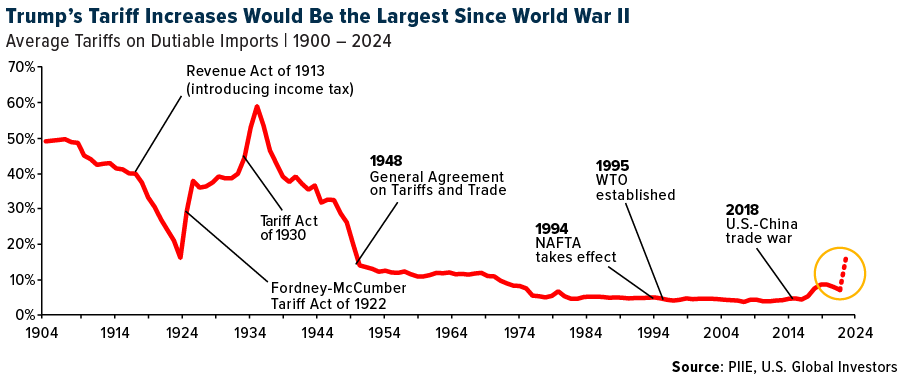
The 1890 McKinley Tariff, named after then-Representative William McKinley, established the highest average tariff level in US history up to that time, with some rates surpassing 100 percent. The Fordney-McCumber Tariff of 1922, enacted under Warren Harding, produced substantial increases in a decade defined by isolationism and protectionist sentiment.

Yet it was the Smoot–Hawley Tariff Act of 1930, signed into law by Herbert Hoover, that delivered the most dramatic escalation of duties in American history to that point. This infamous measure lifted average tariff rates to approximately 60 percent—up from the Fordney-McCumber level of 38 percent—in an effort to shield domestic employment. The result was a cascade of retaliatory tariffs from trading partners around the world.


The Smoot-Hawley Act was a classic example of beggar–thy–neighbor policy, in which one country pursues its own national advantage at the direct expense of others. This zero-sum logic parallels the rationale behind Trump’s tariffs, as the following chart illustrates:


Price Controls

On December 19, 2025, Trump announced nine new agreements with major pharmaceutical companies to lower prescription drug prices for American patients, bringing them in line with the lowest prices paid in other developed countries (known as most-favored-nation, or MFN, pricing). These voluntary deals lower costs for Medicaid programs and certain direct–to–consumer sales, building on earlier MFN efforts from his administration.

The best-known historical precedent came on August 15, 1971, when Richard Nixon declared a 90-day freeze on wages and prices as part of his New Economic Policy. That move aimed to combat runaway inflation and avert a currency crisis amid the collapse of the Bretton Woods system.

It was the first peacetime imposition of mandatory wage and price controls in US history, initially winning broad public support but then proving disastrous. Driven by stagflation and fears of a gold drain after the dollar’s convertibility ended, the inflation rate had climbed above 12 percent by 1974.

The program evolved through multiple phases, including the establishment of the Pay Board and Price Commission to oversee allowable increases. Artificially-suppressed prices quickly led to widespread shortages, most notably in gasoline and steel, with long lines at pumps and rationing conditions. Businesses, unable to cover costs, reduced output, cut quality, or were forced to shut down.

The controls disrupted market signals, prevented economic calculation, and failed to curb long–term inflation, contributing to distortions that lingered for years. Why should we believe similar interventions today would produce different results?


Tax Cuts

Through the 2017 Tax Cuts and Jobs Act (TCJA), Trump’s first term delivered the most significant federal tax overhaul since the 1980s.

This mirrors Ronald Reagan’s 1981 Economic Recovery Tax Act—which phased in a 25 percent across-the-board cut in individual rates (top marginal from 70 percent to 50 percent), accelerated depreciation, and inflation indexing—and the 1986 Tax Reform Act, which simplified brackets and dropped the top rate to 28 percent, but left overall revenue roughly intact due to offsets.

As Rothbard asserted in his critique of Reaganomics, these cuts were illusory and temporary in practice, offset by bracket creep, rising payroll taxes, stealth increases, and massive spending growth that ballooned the federal deficit without structural restraint. Although any tax cut should be welcome, in both cases, these were easily reversible measures that drove deficits higher because they were not accompanied by cuts to public spending and government departments.

Government Spending


The Republican embrace of expansive government spending under the banner of “compassionate conservatism” reached new heights during George W. Bush’s presidency.

In 2003, Bush signed Medicare Part D—a massive new entitlement program providing prescription drug benefits to seniors—with initial costs estimated at $400 billion over ten years, later revised upward to $534 billion. The voluntary benefit, administered through private insurers, represented a major expansion of federal involvement in healthcare, adding trillions to long-term liabilities without corresponding offsets.

Similarly, in October 2008, Bush enacted the Troubled Asset Relief Program (TARP) as part of the Emergency Economic Stabilization Act, authorizing $700 billion (then capped at $475 billion) to bail out financial institutions by purchasing troubled assets, ultimately disbursing $443 billion with a net cost of $31 billion after recoveries.

These interventions underscored the GOP’s willingness to deploy federal resources during crises and foreshadow Trump’s own big-spending tendencies. Bush’s 2008 Economic Stimulus Act also provided $152 billion in rebate checks to over 130 million households, aimed at boosting spending amid the financial crisis.

That approach finds a counterpart in Trump’s 2020 CARES Act—a $2 trillion package that included $1,200 direct payments per adult as part of broader relief, though on a vastly larger scale (12 percent of GDP in 2020 versus 1 percent in 2008). Both initiatives sought rapid economic stimulus but prioritized short-term aid over fiscal restraint.

Conclusion

Trump’s policies are not guided by a coherent philosophy; they form a transactional strategy that draws on tactics employed by earlier Republican leaders. They are best understood as a somewhat disorganized, contradictory blend of neo-mercantilism, national populism, and old-school protectionism, rooted in the Whig program and traditional Republicanism.

Trumpism combines higher tariffs abroad with “fewer regulations” at home, folding in Nixon’s price controls, Reagan’s tax cuts, and Bush’s expansionary policies. All this makes clear that such interventionism is a legacy of the GOP itself—rather than an aberration within the American right—as many analysts wrongly claim.


About the author:
 Lorenzo Cianti is a student of Political Science and International Relations at Roma Tre University. Passionate about Austrian Economics and political philosophy, he is a regular contributor to L’Opinione delle Libertà—Italy’s oldest continuously published newspaper—and to the online magazine Atlantico Quotidiano. He was a finalist in the 2026 Kenneth Garschina Undergraduate Student Essay Contest for the essay “The Chainsaw Revolution: Javier Milei’s Rothbardian Assault on Argentine Collectivism.”


Source: This article was published by the Mises Institute

The Mises Institute, founded in 1982, teaches the scholarship of Austrian economics, freedom, and peace. The liberal intellectual tradition of Ludwig von Mises (1881-1973) and Murray N. Rothbard (1926-1995) guides us. Accordingly, the Mises Institute seeks a profound and radical shift in the intellectual climate: away from statism and toward a private property order. The Mises Institute encourages critical historical research, and stands against political correctness.

SPACE/COSMOS

Planets Need More Water To Support Life Than Scientists Previously Thought


By 

Unfortunately for science fiction fans, desert worlds outside our solar system are unlikely to host life, according to new research from University of Washington. Scientists show that an Earth-sized planet needs at least 20 to 50% of the water in Earth’s oceans to maintain a critical natural cycle that keeps water on the surface.

Scientists believe that there are billions of planets outside our solar system. More than 6,000 of these exoplanets are confirmed, but only some of them are candidates for life. The search for life has focused on planets in the “habitable zone,” a sweet spot that is neither too close nor too far from a central star. Planets in this zone are considered viable because they can maintain liquid surface water.

“When you are searching for life in the broad landscape of the universe with limited resources, you have to filter out some planets,” said lead author Haskelle White-Gianella, a UW doctoral student of Earth and space sciences.

Water, although essential, does not guarantee the existence of life. With this study, researchers worked to further narrow the search by investigating planets with just a small amount of water.

“We were interested in arid planets with very limited surface water inventory — far less than one Earth ocean. Many of these planets are in the habitable zone of their star, but we weren’t sure if they could actually be habitable,” White-Gianella said.

The team’s results, published in Planetary Science Journal, show that habitability hinges on the geologic carbon cycle — a water-driven process that exchanges carbon between the atmosphere and interior over millions of years, stabilizing surface temperatures.

Carbon dioxide, which comes from volcanoes in a natural system, accumulates in the atmosphere before falling back to Earth dissolved in rainwater. Rain erodes and chemically reacts with rocks on the Earth’s surface and runoff transports carbon to the ocean, where it sinks to the seafloor. Plate tectonics drives carbon-rich oceanic plates below continental land. Millions of years later, carbon resurfaces as mountains form.

If water levels drop too low for rainfall, carbon removal — from weathering — can’t keep up with emissions from volcanic eruptions and carbon dioxide levels in the atmosphere spike, trapping water. Rising temperatures evaporate the remaining surface water, initiating runaway warming that makes the planet too hot to support life.

“So that unfortunately makes these arid planets within habitable zones unlikely to be good candidates for life,” White-Gianella said.

Although scientists have instruments that can measure surface water, rocky exoplanets are difficult to observe directly. In this study, the researchers ran a series of complex simulations to better understand how water might behave in these desert worlds.

Previous efforts to model the carbon cycle focused on cooler, perhaps wetter planets. The models factored in evaporation from sunlight, but didn’t include other drivers, such as wind. White-Gianella adapted existing models to drier planets by refining evaporation and precipitation estimates.

“These sophisticated, mechanistic models of the carbon cycle have emerged from people trying to understand how Earth’s thermostat has worked — or hasn’t — to regulate temperature through time,” said senior author Joshua Krissanen-Totton, a UW assistant professor of Earth and space sciences.

However, the function of the geologic carbon cycle on arid planets was largely unexplored. The results show that even planets that form with surface water could lose it, transitioning from potentially habitable to uninhabitable due to carbon cycle disruption.

One such planet exists far closer to home: Venus. The planet of love is roughly the same size as Earth, likely formed around the same time and may have started with a similar amount of water.

Yet today, the surface of Venus rivals the temperature of a wood-fired pizza oven. Standing on the surface would feel like being crushed by 10 blue whales, White-Gianella said.

Many theories attempt to explain why Earth and Venus are so different. White-Gianella and Krissanen-Totton propose that Venus, being closer to the sun, may have formed with slightly less water than Earth, which imbalanced the geologic carbon cycle. As surface temperatures rose with atmospheric carbon dioxide levels, Venus lost its water — and any life it may have hosted.

Upcoming missions to Venus will attempt to understand what happened to the planet and whether it ever hosted life. The findings could also offer insight into planets much farther away.

“It’s very unlikely that we will land something on the surface of an exoplanet in our lifetime, but Venus — our nextdoor neighbor — is arguably the best exoplanet analog,” White-Gianella said.

The researchers hope that results from future missions will help validate the results of their modeling.

“This has implications for a lot of the potentially habitable real estate out there,” Krissanen-Totton said.

NASA Selects Voyager For Seventh Private Mission To Space Station

By 

NASA and Voyager Technologies have signed an order for the seventh private astronaut mission to the International Space Station, targeted to launch no earlier than 2028 from Florida.

This is the company’s first selection for a private astronaut mission to the orbiting laboratory, underscoring NASA’s ongoing investment in fostering a commercial space economy and expanding opportunities for private industry in low Earth orbit. 

“Private astronaut missions are accelerating the growth of new ideas, industries, and technologies that strengthen America’s presence in low Earth orbit and pave the way for what comes next,” said NASA Administrator Jared Isaacman. “With three providers now selected for private missions, NASA is doing everything we can to send more astronauts to space and ignite the orbital economy. Each new partner brings fresh capabilities that move us closer to a future with multiple commercially operated space stations and a vibrant, sustainable marketplace in low Earth orbit.”

The mission, named VOYG-1, is expected to spend as many as 14 days aboard the space station. A specific launch date will depend on overall spacecraft traffic at the orbital outpost and other planning considerations.

Voyager will submit four proposed crew members to NASA and its international partners for review. Once approved and confirmed, they will train with NASA, international partners, and the launch provider for their flight. 

“This award reflects decades of partnership with NASA and validates our belief that the infrastructure being built in low Earth orbit today is the launchpad for humanity’s future in deep space,” said Dylan Taylor, chairman and CEO, Voyager. “From the International Space Station’s first commercial airlock to the seventh private astronaut mission, Voyager is committed to making American human spaceflight stronger, more capable, and more sustainable at every step of the journey.”

The company will purchase mission services from NASA, including crew consumables, cargo delivery, storage, and other in-orbit resources for daily use. NASA will purchase the capability to return scientific samples that must remain cold during transit back to Earth.

Sustainability In An Age Of Strategic Disorder – Analysis


April 16, 2026 
Observer Research Foundation
By Soumya Bhowmick

For much of the last decade, sustainability was framed through targets, metrics, and transition pathways, under the assumption that ambitious government commitments, market adjustments to climate risk, and sustained multilateral momentum would gradually move the world towards a greener and more resilient future. That assumption now appears increasingly inadequate. Sustainability is pursued in a global environment shaped by conflict, debt stress, trade restrictions, and geopolitical mistrust, raising a broader question: can the international system still protect long-term public goods while responding to immediate strategic pressures?

The tension is evident in current trends. Only 35 percent of SDG targets are on track or making moderate progress, while nearly half are advancing too slowly, and 18 percent have regressed; at the same time, global military expenditure rose to US$2.718 trillion in 2024, the sharpest annual increase in decades. The issue, then, is not simply one of inaction. States are acting, but much of that effort is being directed towards deterrence, industrial competition, sanctions management, and short-term crisis response rather than adaptation, social resilience, or developmental recovery.

At the centre of this challenge lies a reality that today’s sustainability crisis is also a financing crisis. Developing countries are being asked to decarbonise, adapt to climate change, generate employment, strengthen social protection, and modernise infrastructure even as their fiscal room narrows. The adaptation finance gap for developing countries remains between US$187 billion and US$359 billion per year, despite the gradual increase in public adaptation flows.

At the same time, debt burdens have become more restrictive with rising interest payments reducing the share of government revenue available for other public spending in 99 developing countries between 2018 and 2024, while official development assistance fell by 7.3 percent in 2024 even as financing needs increased. Sustainability is therefore not faltering because developing countries fail to recognise its significance, but because too many states are being asked to meet ambitious developmental and climate responsibilities under tightening financial conditions and limited access to affordable capital.

This is also where the foreign-policy dimension of sustainability becomes especially important. Wars and geopolitical confrontations no longer remain confined to their immediate theatres; their effects now travel through shipping routes, commodity prices, energy markets, insurance costs, inflation expectations, and capital flows. The sustainability debate still often treats strategic and developmental concerns as separate domains, but that distinction is increasingly difficult to sustain. In fact, in a world shaped by repeated supply disruptions, weaponised interdependence, and crisis-driven policy responses, inclusive green transitions are harder to achieve, especially for economies that remain energy-import-dependent, capital-constrained, and exposed to external volatility.

The present moment is better understood as one of reconfiguration rather than deglobalisation. India’s Economic Survey 2024–25 notes that more than 24,000 new trade and investment restrictions were introduced globally between 2020 and 2024, while the World Trade Organisation describes the current phase as one of “reglobalization”—not a retreat from integration, but its restructuring around resilience, technological capability, and climate-related adjustment. This shift matters because it reveals a broader change in the sustainability debate, where the green transition is no longer only developmental or environmental but also geopolitical, with clean technologies, critical minerals, subsidies, and standards becoming instruments of strategic positioning.

India, Global South, and the Terms of Transition

This shift has major implications for the Global South. If the transition is driven less by developmental need than by bloc politics, subsidy strength, and technological advantage, sustainability may remain universal in principle but uneven in practice. Late industrialisers may be pushed to move faster under financial and regulatory conditions they did little to shape, even as advanced economies shield domestic industries through subsidies and stricter standards. The issue, then, is not whether the transition will occur, but on what terms and at whose cost.

For India, this changing landscape presents both constraints and opportunities. India remains exposed to volatility in imported energy, shifts in global financial conditions, and the wider turbulence of an international economy being reshaped by strategic rivalry. At the same time, this context allows India to articulate a more grounded position on sustainability, one that treats it not as an argument for restraint alone, but as a question of development-compatible resilience. The International Energy Agency notes that 83 percent of India’s power-sector investment in 2024 went to clean energy, indicating that growth, energy access, and transition need not be treated as competing objectives.

Yet India’s experience also underscores that ambition alone is not enough. India must also manage the transition under tighter external and domestic constraints. The share of CBAM-covered exports in India’s exports to the EU rose from 6.3 percent in 2014 to 10.5 percent in 2023, especially in iron and steel, suggesting that carbon-linked trade measures could raise compliance costs and affect competitiveness in key sectors. At the same time, India’s cost of capital for grid-scale renewables remains 80 percent higher than in advanced economies, while distribution companies owed more than US$9 billion in unpaid dues as of March 2025, highlighting the extent to which financing and off-taker risks continue to constrain the pace of the transition. The cost, availability, and architecture of finance remain decisive, which gives India a credible basis from which to argue for a different global compact: one in which late industrialisers are not effectively penalised for later starting points, and in which climate responsibility is matched by affordable capital, technological openness, and policy space.


Finally, sustainability can no longer be treated as a specialised agenda separate from the wider structure of world order. Its future will be shaped as much by debt, trade, technology, and strategic stability as by climate negotiations alone. More broadly, if development finance weakens, trade becomes more exclusionary, and geopolitical rivalry continues to crowd out cooperation, the problem will not be a lack of knowledge but a failure of priorities. The central question is whether resilience can be secured as a broader public good, rather than becoming concentrated among those with greater strategic and financial insulation.


This article is based on the author’s intervention as a panellist at the Indian Institute of Foreign Trade (IIFT) Annual Economics Conclave 2026 in Kolkata, India, on the theme “Divided World, Shared Crisis: The Future of Sustainability.”

 About the author: Soumya Bhowmick is a Fellow and Lead, World Economies and Sustainability at the Centre for New Economic Diplomacy (CNED) at the Observer Research Foundation.

Source: This article was published by the Observer Research Foundation.

ORF was established on 5 September 1990 as a private, not for profit, ’think tank’ to influence public policy formulation. The Foundation brought together, for the first time, leading Indian economists and policymakers to present An Agenda for Economic Reforms in India. The idea was to help develop a consensus in favour of economic reforms.

What’s In Your Gasoline? Understanding U.S. Motor Gasoline Formulations – Analysis

April 16, 2026 

By EIA

Motor gasoline in the United States is a blend of hydrocarbons and chemicals, with specific formulas varying by region and season. To meet federal air quality standards, the U.S. Environmental Protection Agency (EPA) and state regulators require different formulations, depending on air quality and location, which affect performance, cost, and emissions. In addition, warmer summer months require a different gasoline formulation than cooler winter months. Key differences between formulations include octane rating, volatility—commonly measured as Reid vapor pressure (RVP)—and emissions. This year, the EPA will relax federal enforcement of summer RVP standards to help reduce gasoline prices.


What are the main types of gasoline formulations in the United States?


There are two main types of gasoline: Conventional gasoline is the standard gasoline blend used in areas of the United States that meet federal air-quality standards. Conventional blend gasoline meets basic federal limits on emissions and volatility. Most of the United States uses this formulation.
Reformulated gasoline (RFG) is required by the Clean Air Act in areas with high smog. RFG burns cleaner than conventional gasoline but is typically more expensive to produce. Approximately 25% of U.S. gasoline sales are RFG, according to the EPA.

Both types of gasoline are available in different octane ratings (regular, midgrade, premium) and are usually blended with ethanol. In addition to conventional and reformulated gasoline, refiners adjust gasoline blends for summer and winter.


Why do gasoline formulations change seasonally?

The EPA uses RVP to regulate gasoline volatility: the lower the RVP, the less volatile the gasoline and the less evaporative the emissions. To reduce smog-forming emissions, the EPA mandates that summer grade gasoline has a lower RVP (less volatility) to control evaporation, which would normally increase in warm weather. In cold weather, higher volatility helps engines start more easily.

How do RVP limits change across regions?

During the summer season, EPA limits gasoline in the continental United States to an RVP of no more than 9.0 pounds per square inch (psi). However, regulators apply stricter limits in areas with air quality issues, including:Gasoline with a RVP no higher than 7.8 psi in areas requiring federally mandated gasoline

RFG program gasoline with RVP no higher than 7.4 psi in federally designated areas
Gasoline made to specification for State Implementation Plans (SIP) that are more stringent than federal requirements

How does the RVP limit change through the year?

The summer season for retailers and wholesale purchasers runs from June 1 to September 15. For refiners and bulk terminals, it starts earlier, running from May 1 to September 15, to allow time for supplies of summer-grade gasoline to get from producers to retailers. Some areas require longer periods for summer-grade gasoline use to further control emissions. Although not mandated, switching back to winter-grade gasoline in the fall is common because of its lower production cost.

Why is gasoline with lower RVP more expensive?


Gasoline with lower RVP is more expensive to produce because it requires pricier components for blending. For example, butane, a low-cost octane booster, has high RVP that limits its use in summer or RFG blends. Instead, lower RVP gasoline uses more expensive components such as alkylate to maintain octane while reducing RVP, contributing to higher retail prices.

Do all states follow the same rules?

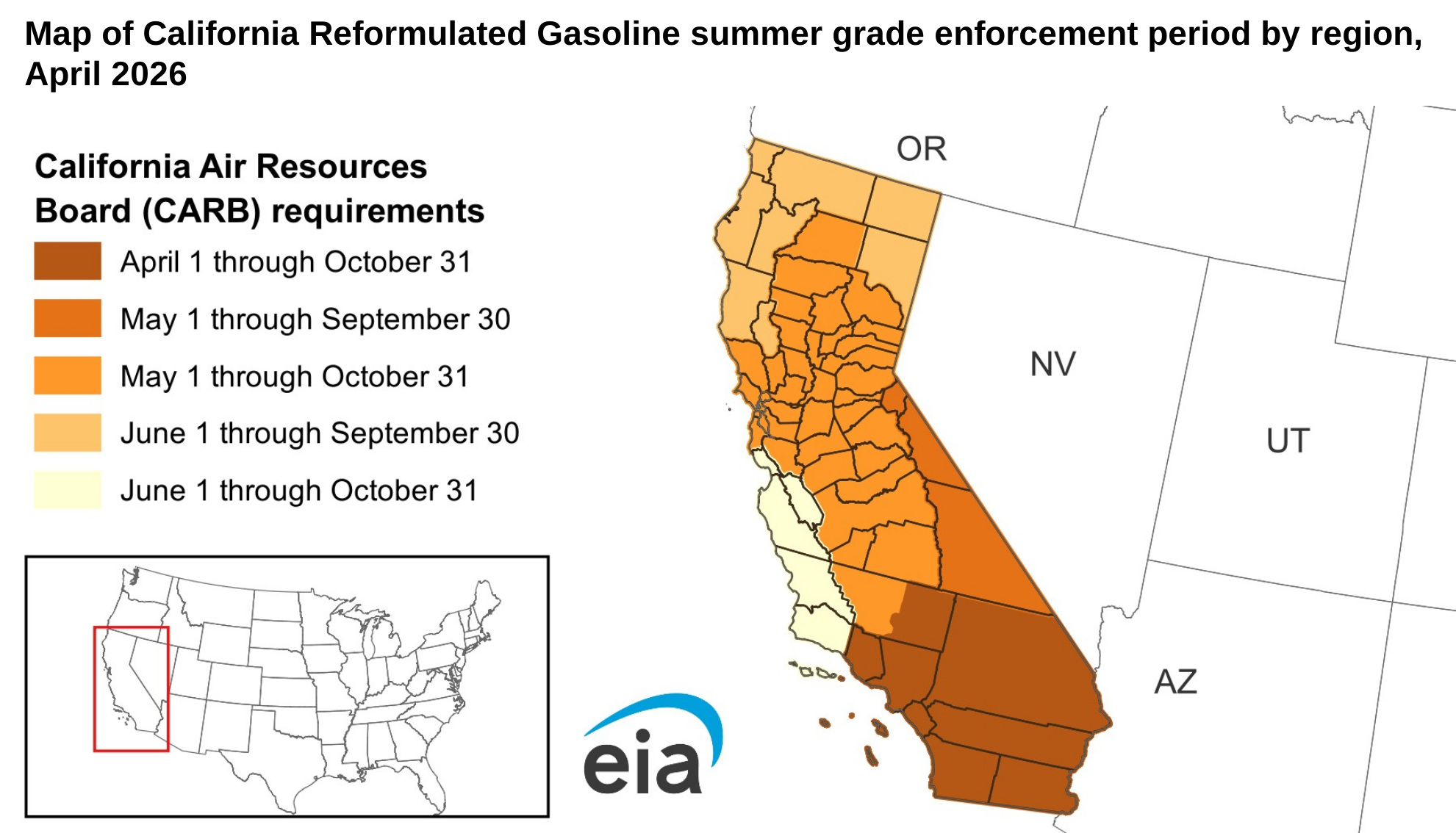
Not exactly. The EPA sets federal standards but allows states or regions to set stricter gasoline specifications. Arizona, for example, requires the use of Cleaner Burning Gasoline (CBG) in parts of the state. California has stricter requirements than the federal government.

Data source: California Air Resources Board

The California Air Resources Board (CARB) requires gasoline RVP has no more than 7.0 psi during the summer season. In addition, CARB requires longer periods for summer-grade gasoline. These requirements contribute to consistently higher gasoline prices in California.


Principal contributor: Alex de Keyserling

Source: This article was published by the EIA

The U.S. Energy Information Administration (EIA) collects, analyzes, and disseminates independent and impartial energy information to promote sound policymaking, efficient markets, and public understanding of energy and its interaction with the economy and the environment.

Ocean Eddies Are Amplifying Climate Extremes In Coastal Seas


Ocean currents on Feb 11, 2018 from OSCAR v2.0, distributed by NASA JPL, generated by Earth and Space Research, and visualized by earth.nullschool.net.

By 

Lisa Beal, a professor of ocean sciences at the University of Miami Rosenstiel School of Marine, Atmospheric, and Earth Science, collaborated with South African researchers to study the Agulhas Current, a fast and narrow western boundary current flowing poleward along the southeast coast of Africa. Over a two-year period, they gathered high-resolution mooring data, recording hourly measurements of velocity, temperature, and salinity throughout the entire depth and width of the current.

The dataset launched more than a decade of research, with foundational work led at the Rosenstiel School and now advanced through sustained collaboration with Kathryn Gunn at the University of Southampton in the United Kingdom. Gunn and Beal use this dataset to show that increasing eddy activity is reshaping the Agulhas Current and intensifying adjacent coastal temperature extremes. Their findings, published in a new study in the journal Nature Climate Change, identify small frontal instabilities, about 10 kilometers across, along with larger, iconic meanders of the current, that transfer heat, salt, and nutrients between the open ocean and coastal environments.

“More eddy activity is accelerating surface warming in the Agulhas, while simultaneously enhancing hidden upwelling that cools deeper waters,” said Beal, the study’s senior author. “This combination—along with the onshore encroachment also driven by eddies—will create more extreme conditions in shelf seas in the future, potentially placing significant strain on coastal ecosystems.”

Both frontal eddies and meanders pump deep, cold, nutrient-rich water up onto the shelf, potentially enhancing productivity there, while farther offshore meanders trap heat and salt closer to the surface. The result is rapidly warming surface waters above cooler waters at depth.

Decades of satellite data have shown that surface waters in the Agulhas Current are warming at three or four times the global ocean average. At the same time, this new study shows that eddies have kept deeper waters comparatively cool. This layered structure helps explain how rapid surface warming—leading to increased rainfall in South Africa—has occurred alongside a reported decline in the current’s total heat transfer to higher latitudes.

These major changes are happening even as the overall strength (volume transport) of the Agulhas Current remains stable.

The implications extend far beyond southern Africa. The researchers suggest that intensifying eddies may provide a unifying explanation for observed changes in major ocean currents worldwide, including the Gulf Stream along the U.S. East Coast.

“Our findings suggest that eddies are fundamental in shaping how the ocean responds to climate change,” said Beal.