Sunday, June 22, 2025

Support the Russian-Ukrainian resistance against accelerating fascism worldwide

Sunday 22 June 2025, by Gin Vola, Elias Vola


Already in bad shape after 22 years of Putin’s repression, ranging from the criminalization of any critical action by the government to the imprisonment and assassination of opponents, the Russian opposition has had to face increased violence since the invasion of Ukraine.


As precarious and weak as this resistance is, it does not mean it is impotent and even less that the rejection of Putin is not a reality working underground in the Russian population.

The effects of the war are weighing on broad sections of the population, and our internationalist responsibility is to support all those who seek to shape an alternative to Russian neo-fascism.

A conscription that does not say its name

Desertion, prison or exile are the only ways to avoid a conscription that does not say its name. While participation in the war now allows Russian soldiers to obtain salaries that are on average 8 times higher than the average in the country, the risk to their lives remains enormous. With estimates of 30,000 deaths per month on the frontline, fighting for Putin’s war means taking a serious option for the cemetery.

This tension can be seen in the contractual conditions of the soldiers: it is impossible to leave the army or to terminate your contract; you never know where you will be posted; soldiers’ identity documents are confiscated on arrival in order to prevent them from leaving the country.

Soldiers are recruited at the time of military service (at 18 years of age). The young men are offered a contract to go to the front. If they refuse, they are sent to the most critical areas of the occupied territories (Zaporizhzhia, Kherson) that the government considers to be Russian territories.

In practice, this amounts to compulsory conscription, aimed primarily at the most precarious young people in small towns, attracted by high salaries and unable to obtain an exemption. The conditions in which soldiers work are particularly harsh, subject to a command that did not hesitate to massively sacrifice their lives and to exercise physical and psychological torture in the event of disobedience.

Desertion and political opposition


The figures for the desertion of soldiers are an explicit sign of this tension: between 30,000 and 40,000 in 2023 alone, according to Yuri Fedorov. A counter-propaganda site, “A Farewell to Arms” has been created by young exiled deserters, broadcasting content via Telegram and Youtube channels to encourage Russian soldiers to desert.

Recently, three Russian opposition figures in exile were able to speak in the European Parliament. Yulia Navalnaya (Alexander Navalny’s widow), Vladimir Kara-Murza and Ilya Yashin (both close to Boris Nemtsov, assassinated in 2015), sentenced to long prison terms for criticizing Putin’s war in Ukraine, made strong speeches. They insisted on the existence of a broad opposition to Putin in Russia, but which does not find space to express itself. Being engaged in propaganda work in Russia, they said the best thing to do to help the Russian opposition was to support the Ukrainians.

Fighting Putin’s far-right


The alignment of the United States with Russia only makes the matter more urgent, with the danger posed by the pro-Putin European far-right forces. These are on the rise across the continent and are fully aligned with Putin’s and Trump’s strategies. This internal destabilization is the most serious threat to the peoples of Europe. From this point of view, it is particularly worrying to see currents of the European left claiming to be fighting the far right, while aligning themselves with the latter’s discourse when it comes to Putin.

12 June 2025

Translated by International Viewpoint from l’Anticapitaliste.https://lanticapitaliste.org/actualite/international/soutenir-la-resistance-russo-ukrainienne-contre-la-fascisation-acceleree-du

P.S.


If you like this article or have found it useful, please consider donating towards the work of International Viewpoint. Simply follow this link: Donate then enter an amount of your choice. One-off donations are very welcome. But regular donations by standing order are also vital to our continuing functioning. See the last paragraph of this article for our bank account details and take out a standing order. Thanks.

Attached documentssupport-the-russian-ukrainian-resistance-against_a9062.pdf (PDF - 906.7 KiB)
Extraction PDF [->article9062]

Russia
‘No one has strengthened the Ukrainian far-right more than Putin’
“Ukraine’s Fate Raises the Issue of the Rights and Sovereignty of Small States”
No to the Russian-US plan to annex Ukraine!
“The crisis of liberal hegemony is the reason why so many Europeans are turning to the extreme right”
“For the Neofascists, the Law of the Jungle is the Only One That Makes Sense”


The Horror and the Shame


Yes, it’s deja vu all over again.

As the U.S. moves huge amounts of military assets within striking distance of Iran, preparing to create another conflagration and initiate World War III, let’s contemplate the slaughterfest which resulted from World War II. Look at this chart.

Like so many of the recent military conflicts, most of them instigated by the U.S. in its pursuit of world domination, the coming war on Iran is unnecessary, illegal, and totally unjustified.

Anyone who is paying attention knows where all this is going. The drums of war beat out a very simple rhythm that even a child can understand.

Anyone who is paying attention also knows why this is taking place.

Anyone who is paying attention knows that yet again, we citizens are the helpless pawns of pointless power games, and will be required to make the ultimate sacrifice of our precious lives, in the name of imperial plunder and greater riches for the corporate plutocrats.

The problem is very few are paying attention.

No, there’s not much time to worry about all that stuff happening over there, or sufficient calm to think clearly and consider productive alternative plans, with all the hysterical cries of the warmongers relentlessly poisoning the airwaves and opeds, shouting down the few voices of sanity who attempt a balanced, coherent analysis and constructive conversation.

I still have to wonder …

In terms of the few isolated individuals who might actually be paying attention, yet still go along with this march to madness, and the neocon psychopaths themselves who can’t wait to chase their self-sabotaging and bankrupt delusions of world conquest and American imperial rule, what are they thinking?

Didn’t we learn anything from Vietnam?

Didn’t we learn anything from Afghanistan?

Didn’t we learn anything from Iraq?

Aren’t we learning from our humiliation in Ukraine?

I never hear a timidly tendered, “Oops.”

Not a chagrin-tinged, “Sorry about that.”

Not even a mildly rueful, “Hmm.”

Evidently reflection and apologies are for girly-boys or the zombies of the liberal class.

Many of our most respected think tanks now appear to be staffed with students of history equipped with no memory and no conscience.

Jingoistic cheer leading driven by testosterone-fueled delusions of empire spews simplistic black-hat/white-hat bumper stickers. The public swoons in Orwellian silence.

Russia bad … America good … Russia bad …

China bad … America good … China bad …

Iran bad … America good … Iran bad …

What’s another 87,000,000 bodies?

How about a 1,000,000,000 bodies?

Or if this thing goes nuclear … 8,000,000,000 bodies?

YEAH! Now we’re talking

Actually it’s kind of the perfect ending.

With horror on this scale, there is no one left to feel any shame.

John Rachel has a B.A. in Philosophy, has traveled extensively, is a songwriter, music producer, neo-Marxist, and a bipolar humanist. He has written eight novels and three political non-fiction books. His most recent polemic is The Peace Dividend: The Most Controversial Proposal in the History of the World. His political articles have appeared at many alternative media outlets. He is now somewhat rooted in a small traditional farming village in Japan near Osaka, where he proudly tends his small but promising vegetable garden. Scribo ergo sumRead other articles by John, or visit John's website.
Trump administration quietly continues to admit unknown number of white Afrikaner refugees

In fact, the State Department declined to say how many Afrikaners it has admitted to date.

REVERSE DEI
 STEPHEN MILLER'S RE-WHITEING AMERIKA 


(RNS) — Americans are still celebrating World Refugee Day, but there are far fewer of them since President Trump shut down refugee resettlement for all but white South African Afrikaners.


FILE - White South Africans demonstrate in support of U.S. President Donald Trump in front of the U.S. embassy in Pretoria, South Africa, Saturday, Feb. 15, 2025. 
(AP Photo/Jerome Delay, File)

Yonat Shimron
June 20, 2025

(RNS) — When a group of 59 Afrikaners arrived at Dulles International Airport under the humanitarian designation of “refugee” last month, Deputy Secretary of State Christopher Landau met them at the airport. There were flags and balloons and a press conference.

Since then another group of Afrikaners claiming refugee status arrived at Hartsfield-Jackson Atlanta International Airport on May 30 — to much less fanfare.

In fact, the State Department declined to say how many Afrikaners it has admitted to date.

“Refugees continue to depart South Africa on commercial flights as part of the Department’s successful efforts to resettle Afrikaners seeking safe haven in the United States,” a spokesperson informed RNS via email. “As a matter of general policy, we are unable to comment on individual cases or internal operations of refugee processing.”

The Refugee Processing Center is not updating its database, either. Its recordkeeping ended in late December.

But news outlets abroad have reported that nine additional Afrikaners arrived in the U.S. on May 30 — and more are coming.

On Friday (June 20), World Refugee Day, faith-based resettlement agencies that work with the government are acknowledging this will be a record-low year for refugees.

Last year, under the Biden administration, around 100,000 refugees from around the world were resettled across the U.S. On his first day in office, President Trump paused the refugee program.

The one group the Trump administration has allowed in are Afrikaners, the white ethnic minority that created and led South Africa’s brutal segregationist policies known as apartheid. Their admission to the U.S. as “refugees” escaping persecution has been widely denounced as a fabrication. The Episcopal Migration Ministries ended its partnership with the government rather than resettle the refugees.

“In light of our church’s steadfast commitment to racial justice and reconciliation and our historic ties with the Anglican Church of Southern Africa, we are not able to take this step,” the Most Rev. Sean W. Rowe — the presiding bishop of the Episcopal Church — said.

Other faith-based refugee agencies have reluctantly agreed to resettle Afrikaners because they hope a court injunction will compel the government to resettle at least 128,000 refugees who had already been approved before Trump’s Jan. 20 suspension of all refugee admissions.

Three faith-based refugee agencies sued the Trump administration to resume refugee admissions. In April, a U.S. district judge ruled that the government must continue providing refugee resettlement. The government filed a motion this week saying the court’s injunctions represent “excessive overreach.”


A furnished apartment by Welcome Home for an Afrikaner family in Raleigh. Photo courtesy Marc Wyatt

Many refugee agencies laid off hundreds of employees because of the Trump administration’s indefinite pause of the refugee program. Another faith-based refugee resettlement group run by U.S. Conference of Catholic Bishops also ended its government-supported program.

Ten Afrikaners are being resettled in North Carolina, a N.C. Department of Health and Human Services spokesperson said. The first three arrived in the U.S. on May 12; another seven on May 30.

Most settled into apartments in Raleigh, the state capital, furnished with help from Welcome House, a program of the Cooperative Baptist Fellowship of North Carolina.

North Carolina Gov. Josh Stein has declared June 20-26 “North Carolina Refugees Welcome Week,” in keeping with the annual June 20th celebration established by the United Nations to honor refugees.

Adam Clark, executive director of World Relief Durham, a faith-based agency, said at least 10 people on his staff have been let go. But the office remains open and is serving refugees that arrived just before Trump’s pause. It has not yet been asked to resettle Afrikaners.

“We’ll move forward for now just to make sure that the door can stay open for people from the world’s greatest crisis areas and for the current thousands of clients that will be penalized (if we close),” Clark said.

In the meantime, Clark said World Relief will celebrate refugees at Durham Central Park on Saturday (June 21) as part of Durham Refugee Day, a community-wide event that celebrates the contributions and cultures of our refugee and immigrant neighbors.


Singapore Responds to Fire Aboard Tanker in Anchorage

tanker fire
Fireboat conducting boundary cooling (SCDF)

Published Jun 20, 2025 2:01 PM by The Maritime Executive


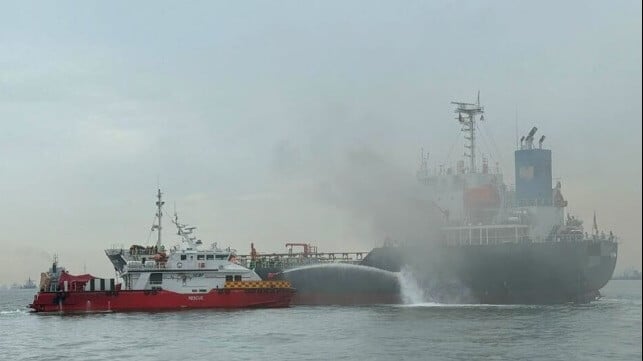
[Brief]  The Singapore Civil Defense Force is reporting teams from two of its stations responded to reports of a fire aboard a smaller tanker in the eastern anchorage of the port. The fire was quickly controlled with no reports of injuries.

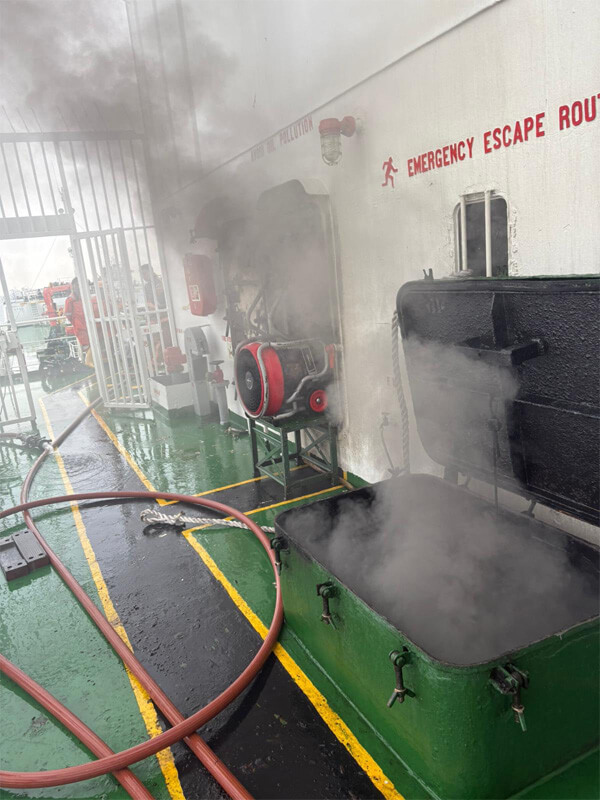
According to the report the fire teams were alerted to the fire at 8:10 a.m. local time. A large-scale response was mounted with 40 marine firefighting specialists from the two stations and three SCDF marine rescue vessels. When they reached the unidentified tanker smoke was billowing out from an area in the deck house which was later identified as a storeroom.


The fireboats began a boundary cooling effort and fire teams boarded the vessel. The SCFD reports the teams were able to locate the seat of the fire and used a water jet to extinguish the blaze before it could spread to more areas of the vessel. The fire team was also using specialized equipment to ventilate the vessel.

The crew of the tanker has been accounted for and they were uninjured. The cause of the fire is still under investigation.

 UPDATED

Video: Bayesian Superyacht Lifted to Surface in Ongoing Operation

Bayesian sailing yacht
Bayesian (file image courtesy Perini Navi)

Published Jun 20, 2025 3:07 PM by The Maritime Executive


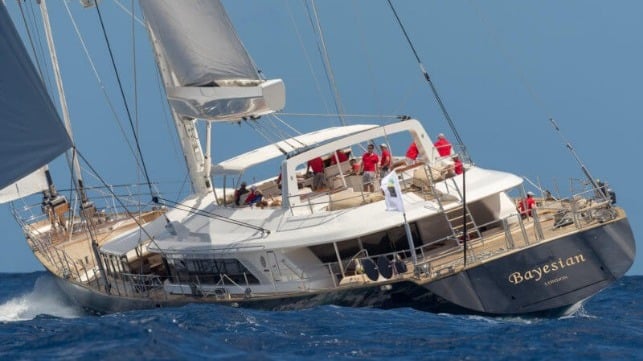
The sailing yacht Bayesian reached the surface on Friday afternoon, June 20, ten months after it was lost claiming the lives of seven passengers including billionaire tech entrepreneur Mike Lynch and his 18-year-old daughter. It was the first phase of a complex salvage operation that will resume on Saturday and is expected to be completed by Monday when the salvage team will hand the vessel over to investigators.

The salvage company TMC described the complex operation which has been ongoing all week using sophisticated remote vehicles and two of the heaviest lifting capacity cranes in Europe. They were working on the yacht which was upright but at an angle approximately 50 meters (165 feet) below the surface near the fishing port of Porticello, Italy. The yacht had anchored for the night of August 19, 2024, with a forecast of thunderstorms in the region.

TMC reports a specialized remote-controlled, diamond-wire precision-cutting tool was used earlier this week to remove the vessel’s mast. It stood 72 meters (236 feet) from the waterline and would have made it impossible to bring the hull up on an even keel. The mast was lowered to the seafloor for later recovery. 


Eight steel lifting straps were strung below the hull which measures 56 meters (184 feet) with four near the bow and four near the stern. They are using a combination of straps, a sling, and a harness to recover the vessel. TMC reports the lifting process began three days ago. Two heavy lift cranes, Hebo Lift 10 and Hebo Lift 2, were positioned on each side of the wreck.

Around 1 p.m. local time the upper portion of the accommodations came out of the water. The lifting was paused at this point. The Italian Navy and Coast Guard were on hand observing and ensuring that no onlookers approached the site. TMC explains they were inspecting the hull, and it must reinforce and increase the harnesses before the next phase of the operation. In addition to the yacht which is reported to weigh about 550 tons, there are still 18,000 liters of fuel aboard as well as the weight of the water inside the hull.


The next phase is scheduled to start at dawn on Saturday and weather permitting the vessel will be fully lifted and transferred to Hebo Lift 10. The crane barge is scheduled to depart on Sunday and arrive on Monday in the port of Termini Imerese, Sicily. On Monday, they plan to lift the hull into a specially built steel cradle that has been prepared on the dock in Sicily. 

Investigators are anxious to begin reviewing key points that are believed to have contributed to the sinking. They will be trying to determine the position of access doors and others that could have hastened the sinking if they had been left open. They are also looking to determine the position of the sailing yacht’s retractable keel. Investigators want to know if it was raised or lowered as it would have also affected stability and the ability to withstand the sudden winds which are believed to have caused the vessel to roll onto its side. They want to know why the yacht rolled and why it did not recover.

The prosecutors in the Palermo suburb are investigating the captain, engineering officer, and watchman. They have been charged with multiple counts of manslaughter for the seven deaths as well as negligence contributing to the shipwreck.

A second investigation is underway for the death of a diver working at the site in May. Three people from the salvage company SMIT are being investigated on allegations that workplace safety rules were violated.

After completing the removal of the Bayesian, teams will return to the site to recover the mast and other debris on the seafloor.


Poland Succeeds After Eight Years to Dispose of Abandoned Russian Tanker

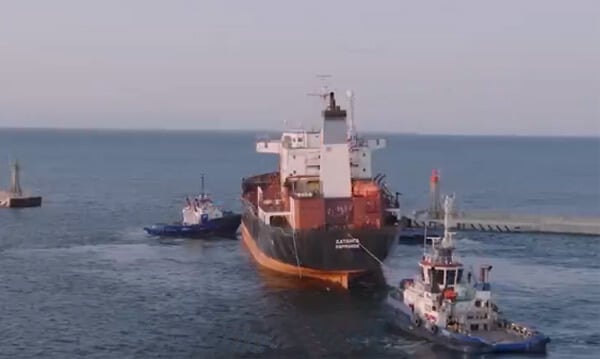
Russian tanker towed from Poland
After eight years in port Khatanga was prepared for departure (Arkadiusz Marchewka)

Published Jun 20, 2025 6:05 PM by The Maritime Executive


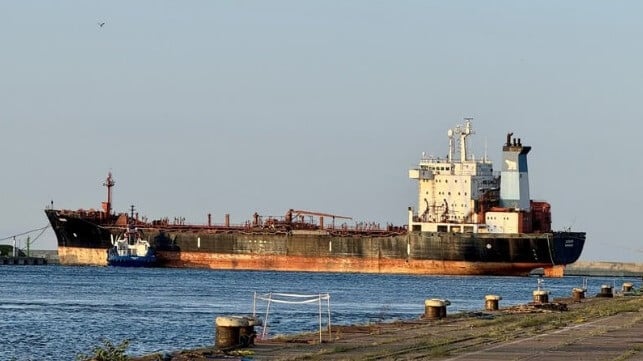
Polish officials were on hand to witness a Russian-registered product tanker towed from the Port of Gdynia after languishing for eight years and becoming a political liability. After months of efforts, the tanker Khatanga was towed away on Thursday, June 19, with Poland’s Deputy Minister of Infrastructure Arkadiusz Marchewka on hand to highlight the occasion announcing the vessel would be “cut into razor blades.”

The product tanker Khatanga (23,000 dwt) became a fixture in the Port of Gdynia after it was detained in October 2017 after a failed Port State inspection. Structural issues were identified during the inspection along with questions regarding the training and competence of the crew. The owner of the vessel, Murmansk Shipping Company, promised repairs but ended up filing for bankruptcy in 2020. Control of the vessel passed to a trustee who showed little interest in the ship.


This year the ship drew renewed attention with speculation in the media even suggesting the Russians were using it to spy on NATO’s activity in the port. Port officials however simply said it was a navigation hazard, but they lacked the legal authority to expel the ship or seize the Khatanga. It highlighted the growing danger confirming reports that the vessel had twice broken away from its moorings and began to drift in the port.

The government authorized the sale of the vessel and by May the Port Authority was reporting it was finally ready to depart. However, because the European Union has classified the vessel as waste, and because it is incapable of navigation, they require documentation before the ship can be towed from the port. Technical work had to be undertaken to prepare the ship including reports in the media that its tanks had not been properly vented in years creating a risk of an explosion.


With Poland in the midst of a contentious presidential election that is yet to be resolved, Marchewka used the departure of the ship as a political issue. He accused the predecessor government of not doing anything. He created a video on the dock with the ship as a backdrop and posted it on X.

Port officials announced that the ship had been sold to a qualified scrapyard in Denmark licensed for the required remediation and dismantling of the vessel. Secured with tugs, the vessel was finally hauled away from the dock and began its journey to the recycling yard.


Austal USA Launches First Steel Ship Marking Expansion from Aluminum

Navy tug launch
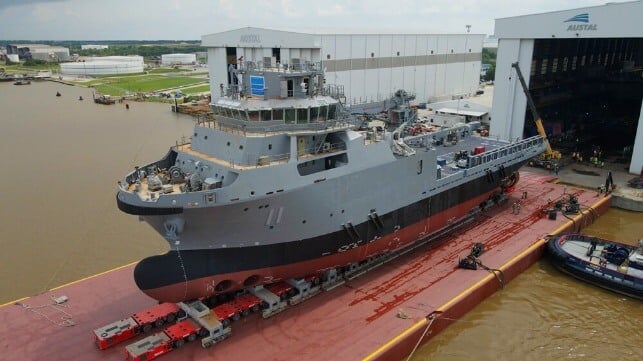
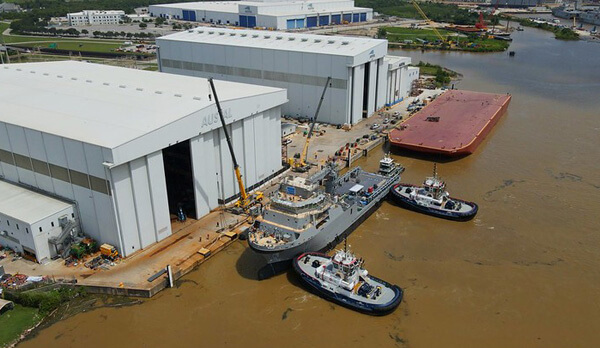
The Navy's towing and salvage tug was also the first steel construction for the Mobile shipyard (Austal USA)

Published Jun 20, 2025 8:31 PM by The Maritime Executive


Austal USA marked a key milestone in its shipbuilding operation recently with the rollout and launch of its first steel ship, the future USNS Billy Frank Jr. (T-ATS 11). The company is best known for its large aluminum vessels and the Independence-class Littoral Combat Ship, started the transition into steel five years ago responding to the U.S. Navy’s concerns over the durability of lighter-weight aluminum vessels.

USNS Billy Frank Jr. is seen as a kickstart for the shipyard to develop its skills in steel construction and its newly developed automated steel panel line. The Navy in 2019 began planning its return to all steel construction and the Department of Defense supported Austal in its efforts to develop the capabilities. This included a $50 million matching grant toward the construction of the steel line and the development of additional capacity for steel naval vessel construction at its Mobile shipyard.

Work began in July 2022 for the first-ever steel cutting at the Mobile facility and kicking off the Navy Towing, Salvage, and Rescue Ship program. Austal USA won a contract for three of the hulls as its first steel job. The rollout of the first vessel took place on June 14 in Mobile.

“It was amazing to see the flawless rollout of our first steel ship,” said Harley Combs, vice president of surface ship programs. “The completion of this milestone is the result of the hard work and dedication of our talented workforce.” 

At 3,100 metric tons, T-ATS 11 is also the heaviest ship Austal USA has launched to date. The launch was executed using the process used to launch most of the 32 Navy ships the company has built and delivered over the last 15 years. The multi-step method involves rolling the ship onto a moored deck barge and then transferring the ship from the barge to a floating dry dock.  The dry dock is submerged enabling the ship to float for the first time and then removed from the dry dock and moored pier side.


Future USNS Billy Frank Jr. afloat and positioned to the fitting out berth (Austal USA)


The ship was over 85 percent complete at the time of launch. Austal reports the future USNS Billy Frank Jr. will now prepare for her next major milestone, the engine light off, as she gets ready for sea trials and delivery.

T-ATS will provide ocean-going towing, salvage, and rescue capabilities to support fleet operations. It will have a multi-mission common hull platform capable of towing U.S. Navy ships and will have 6,000 square feet of deck space for embarked systems. The large, unobstructed deck allows for the embarkation of a variety of stand-alone and interchangeable systems. 

The class was designed to combine the capabilities of the retiring Rescue and Salvage Ship (T-ARS 50) and Fleet Ocean Tug (T-ATF 166) platforms. It will be able to support current missions including towing, salvage, rescue, oil spill response, humanitarian assistance, and wide-area search and surveillance. The platform also enables future rapid capability initiatives such as supporting modular payloads with hotel services and appropriate interfaces.

While it is the first steel construction for Austal, the prize was a $3 billion contract for seven ocean surveillance ships for the U.S. Navy awarded in 2023. In addition, after committing to its steel capability, Austal also received a contract for the Navy’s Auxiliary Floating Drydock Medium (AFDM) and in a contested decision, Austal beat out Eastern Shipbuilding to secure follow-on hulls for the U.S. Coast Guard Offshore Patrol Cutter (OPC) program.

The addition of the steel capability is critical for the yard as it works to complete the delivery of its final Independence-class Littoral Combat Ship. The future USS Pierre (LCS-38) was launched in August 2024 as the final ship of the series for Austal. The company highlights that it is closing more than a decade of work as this series winds down. The yard was established in 1999 focusing on aluminum and the demand for more capacity to meet the needs of the U.S. Navy.


World’s Largest Sail Yacht Cruise Ship Floated Out in France

sail yacht cruise ship
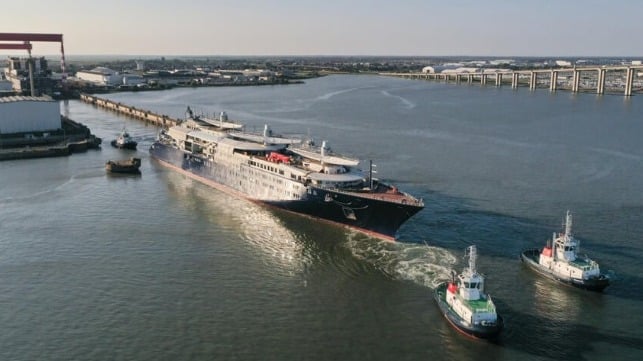
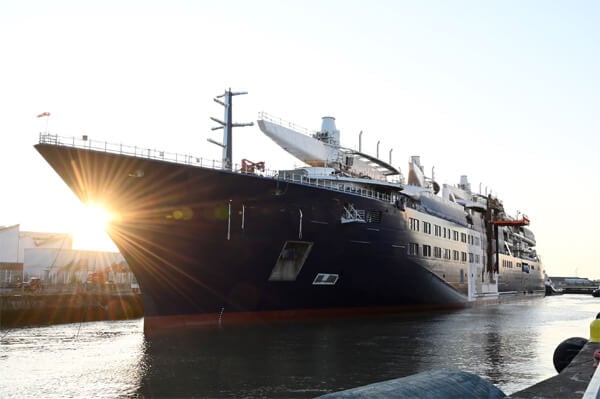
Sail yacht cruise ship floated out in France (Courtesy of Accor)

Published Jun 20, 2025 7:13 PM by The Maritime Executive


What promises to be one of the unique entrants into the growing luxury segment of the cruise market, Orient Express Corinthian (26,200 gross tons) was floated out this week. At 727 feet (220 meters) in length and accommodations for 110 passengers, it will be the world’s largest sail yacht and the launch of the famed Orient Express and French Accor group into the cruise market.

The float out took place on June 16 at the Chantiers de l’Atlantique shipyard in Saint-Nazaire, France. First steel for the vessel was cut in March 2024 and assembly began at the beginning of this year. It was moved from the dry dock to the fitting out berth with its maiden voyage scheduled for June 2026.

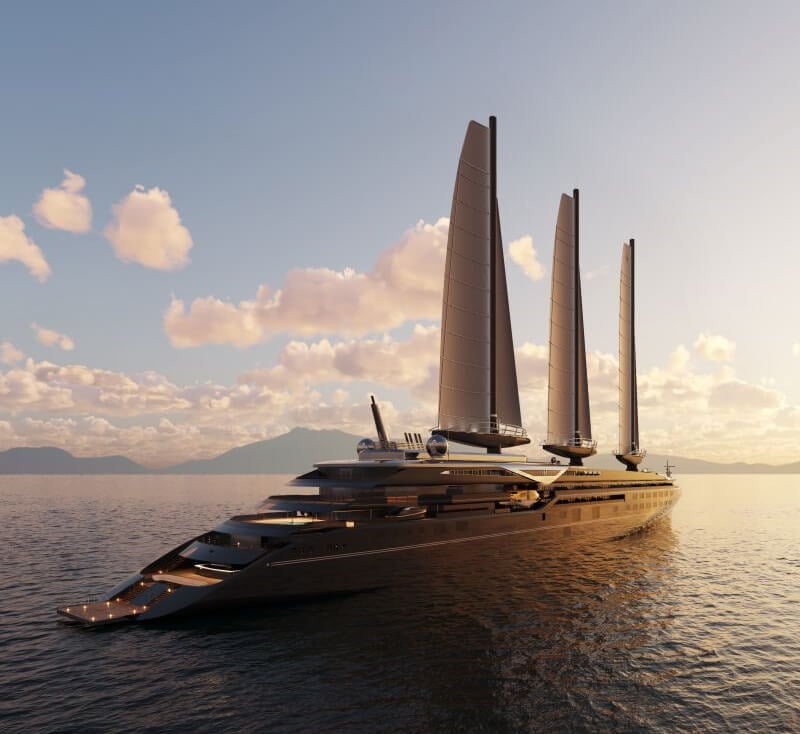
The hull was built from 14 structural blocks and the vessel features three balestron rigs that are a unique base for the masts and sails. The bases pivot and tilt to increase the performance of the three rigid sails. Each mast will stand 100 meters (328 feet) supporting 16,146 square feet of rigid sails. The sails will also fold down when not in use. The unique sail concept was developed by Chantiers de l’Atlantique and this is the first commercial installation after years of testing.

The propulsion system will be unique for a cruise ship of this size able to sail 100 percent under renewable power in the right conditions. Backing up the sails when required is a hybrid propulsion system powered by liquified natural gas (LNG).


Sail yacht afloat for the first time (Accor)


The shipyard and Orient Express highlight other state-of-the-art technology aboard the vessel and her sister ship Orient Express Olympian due to enter service in the summer of 2027. Each ship will be outfitted with an AI-driven floating object detection system which aims to minimize the risk of marine mammal collisions. They will also have dynamic positioning technology which eliminates the need for anchoring, preserving delicate seabeds. BIO-UV Group is also supplying a BIO-SEA ballast water treatment. It is a chemical-free UV-based system to treat water aboard the vessels.

Accor, which is one of the world’s largest hotel companies with more than 5,600 locations and 850,000 hotel rooms, acquired in 2022 the legendary Orient Express brand famous for the luxury train of the same name. The group is launching its first Orient Express branded hotels in 2025 and last year Accor and LVMH entered into a strategic partnership to accelerate the development of Orient Express.

The launch of the cruise ships leverages the brand name while introducing a new element to the luxury segment. It follows the entry of Ritz-Carlton and Four Seasons into the luxury cruise market.


Rendering of the ship as it will look with its masts and sails (Orient Express)


Orient Express Corinthian will feature 54 luxury suites ranging between 485 and 2,476 square feet. The ship will also have five restaurants and private dining spaces, all overseen by multi-Michelin starred chef Yannick Alléno who also oversees dining on the train. The company promises to capture the same grandeur of the famed train onboard with a luxury interior design.

Beginning service in June 2026, the ship, which will be registered in France, will depart on its maiden voyage from Marseille and cruise in the Mediterranean and Adriatic. It will cross the Atlantic to spend the winter in the Caribbean. 

As Kremlin Promotes Ties With S. Africa, FESCO Launches New Durban Service

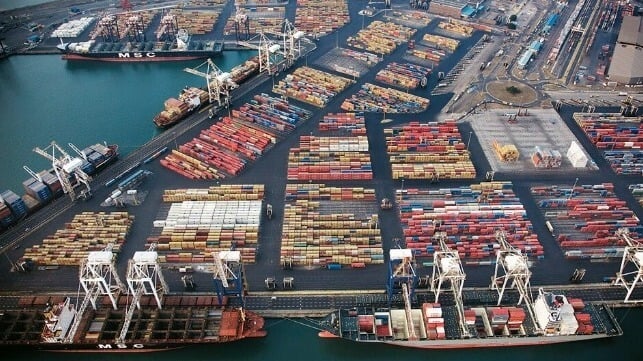
Port of Durban (Media Club / CC BY SA 3.0)
Port of Durban (Media Club / CC BY SA 2.0)

Published Jun 22, 2025 6:50 PM by The Maritime Executive


As part of its global expansion drive, Russia’s top container line FESCO has launched a new service linking key ports with Durban, South Africa. The launch of the service was revealed last week by German Maslov, FESCO’s Vice President for the Liner and Logistics Division.

For South African exports, FESCO will utilize its regular service from Novorossiysk and St. Petersburg to India’s Nhava Sheva. The cargo will then be transshipped by feeder vessels bound for South Africa. As for the imports from South Africa to Novorossiysk, FESCO will transship the cargo via Nhava Sheva or Jebel Ali (UAE) ports. The containers heading to St. Petersburg will be routed through India’s Mundra port.

Since the launch of FESCO’s Indian line in 2023, the service has grown by almost 10 times, becoming one of the best routes for the small shipping company. The service mainly operates to India’s western ports of Nhava Sheva and Mundra.

Currently, the FESCO Indian Line West (FIL-W) marine service is operated by two containerships with a total cargo capacity of around 2,100 TEU. The vessels provide a regular service every 18 days, with transit time of about 17 days from Novorossiysk to western India. Last year, FESCO shipped more than 16,000 TEU through its Indian Line service, which is 7 times higher than in 2023.

Overall, FESCO operates a fleet of 30 vessels and a container capacity of more than 200,000 TEU. The company has a strong Intra-Asia service with regular schedules to Malaysia and Vietnam.

FESCO’s launch of a South African service comes at a time Russia wants to boost its trade turnover with the country, with which it enjoys warm and well-established political ties. Last week, South African Vice President Paul Mashatile made a state visit to Russia, where he met President Vladimir Putin and other senior government officials.

The two sides emphasized bilateral cooperation, specifically in agriculture, energy and logistics. “The volume of trade between Russia and South Africa is about $1.3 billion. We would like to triple this amount in the next 4-5 years,” said Mashatile.

However, a major barrier to trade between Russia and South Africa has been distance and unreliable logistics services. The launch of FESCO’s direct sea route will help solve this challenge.

Top image: Port of Durban (Media Club / CC BY SA 2.0)


Study: Life At Sea is the Most Dangerous Way to Earn a Living

NOT BEING A COP OR FIREFIGHTER

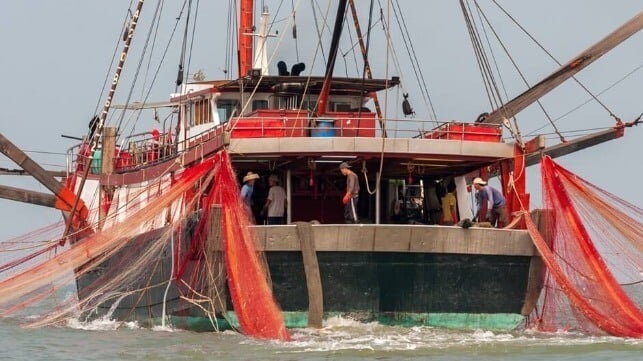
Trawler at work off China (iStock / Winhorse)

Published Jun 22, 2025 9:20 PM by The Maritime Executive


Working on or near the sea is the most dangerous way to make a living, according to new survey results from the Lloyd's Register Foundation and Gallup. People that the survey categorized as "ocean workers" - a broad group containing "those who work on or near the water" - reported higher rates of injury than any shoreside industry grouping.  

According to the poll, fully 25 percent of all "ocean workers" reported experiencing harm on the job within the past two years. This was seven points higher than the global average, and more than twice the rate of reported injuries in the safest sector, the utility industry. 

Workers in this broad category reported lower rates of safety training than workers in shoreside industries. 32 percent said that they had received occupational safety and health training at some point in the past, compared to 38 percent of workers in all other industries. They were also much less likely to tell anyone about it if they got hurt, reflecting a cultural preference for toughness. Only 41 percent of workers who reported that they got hurt at sea said that they reported the incident, 10 points less than the average in other industries. 

Lloyd's Register Foundation also found that - as could be expected from the seagoing life - "ocean workers" were more exposed to risk from weather than any other group. 33 percent reported serious personal harm from severe weather within the last two years, compared to just 20 percent of other workers. 

However, the results may not be representative of risks faced by seafarers in commercial maritime commerce: the poll's "ocean worker" statistics include injury rates in the fishing industry, which has a higher risk profile than that found in commercial shipping. In the United States, the workplace fatality rate in the fishing industry is 28 times higher than the national average for all industries. Worldwide, the Pew Charitable Trusts estimates that about 100,000 people die in the fishing industry each year, with many deaths unreported due to the informal, exploitative practices of IUU fishing operators.