China’s Data Center Boom Could Double Power Demand by 2030
- China’s data center capacity is expected to nearly double by 2030, driving power consumption to 289 TWh and 2.3% of total demand.
- AI and high-performance computing are significantly increasing energy intensity, with demand growing at a 19% annual rate through 2030.
- Operators are rapidly integrating renewables and storage to meet strict efficiency and sustainability targets while ensuring reliable power supply.
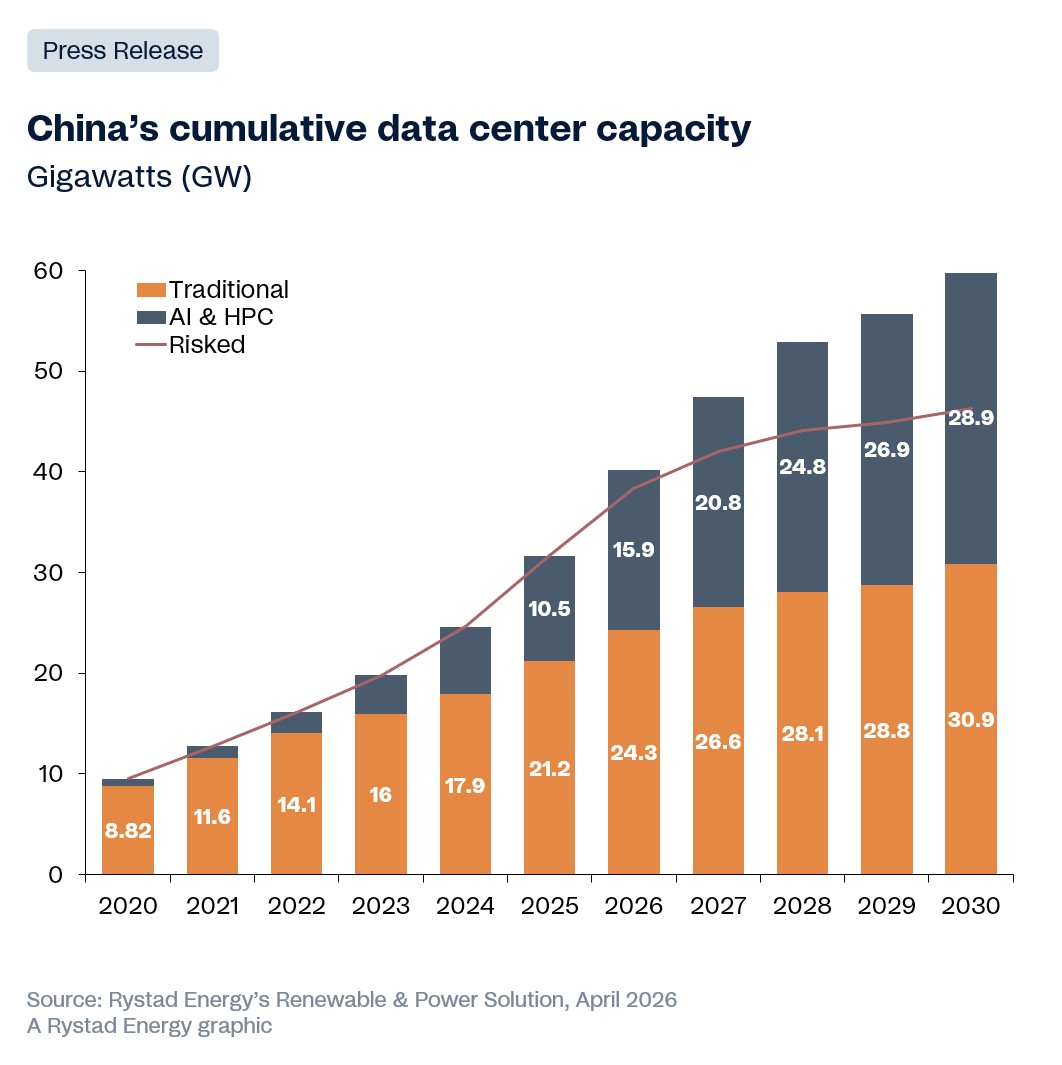
China is on course to nearly double its data center capacity within five years, with 28 gigawatts (GW) of new projects expected to come online by 2030, adding to the 32 GW already installed as of the end of last year, according to new analysis from Rystad Energy. Based on currently announced projects, with additional capacity likely to follow, this expansion is expected to lift data center power consumption to 289 terawatt-hours (TWh) by 2030. That is more than double levels seen last year and would account for around 2.3% of China’s total electricity demand. Data centers are also set to be the fastest-growing source of power demand in the country, with consumption rising at an annual rate of 19% between 2025 and 2030, driven by rapid growth in artificial intelligence (AI) and high-performance computing (HPC).
Installed capacity is projected to reach 40 GW by the end of this year, up from 32 GW at the end of 2025, reflecting the speed of buildout across the sector. AI and HPC facilities are playing a growing role, accounting for 39% of installed capacity this year and expected to rise to 48% by 2030. Unlike traditional data centers built for general-purpose computing, these facilities are significantly more energy-intensive, reshaping both the scale and geographic distribution of China’s digital infrastructure. The shift has been reinforced by the ‘East Data West Computing’ strategy launched in 2022, which established eight major computing hubs to ease pressure on land and energy in the east, with clusters emerging in regions such as Ulanqab in Inner Mongolia, where companies including 21Vianet, Huawei and ByteDance have secured around 10 GW of projects.
China's data center sector is no longer a peripheral part of the country's power system. It is becoming a structural driver of demand in its own right. What sets this buildout apart is the speed of the AI-driven shift, which is compressing timelines for both infrastructure deployment and energy procurement. Operators are not waiting for policy incentives or mandates to integrate renewables. They are increasingly combining different power sources, such as wind, solar and battery storage because reliable electricity and lower-carbon supply have become business priorities. This is most visible in western computing hubs, where abundant renewable resources can support growing AI demand,
Simeng Deng, Senior Analyst, Renewables & Power Research at Rystad Energy
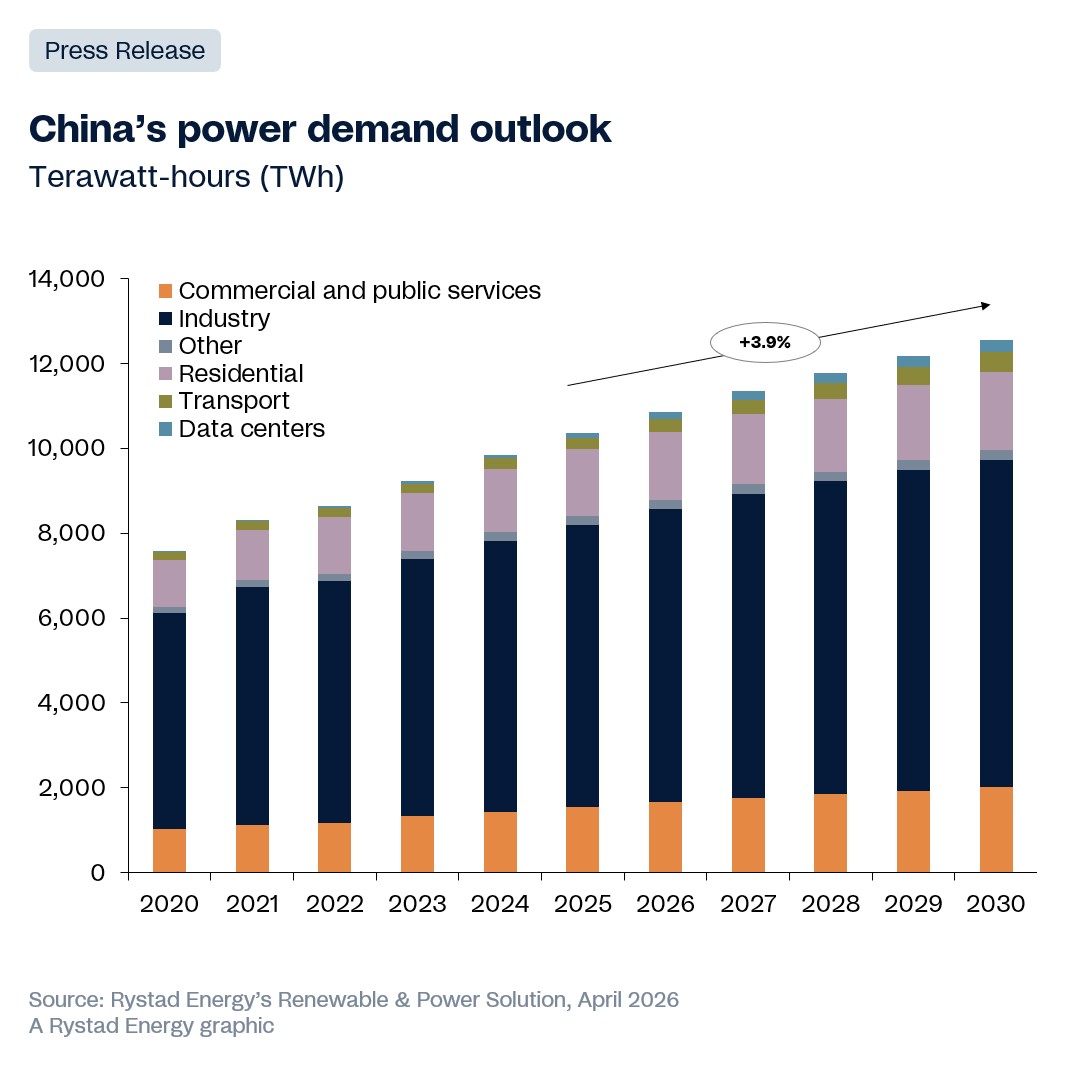
Rystad Energy expects China’s power demand to grow at a compound annual growth rate (CAGR) of 3.9% through 2030 as efficiency improves and the demand mix shifts, down from 6.5% during the 14th Five-Year Plan, when consumption exceeded 10,000 TWh last year. Within that slowing aggregate, the contrast between sectors is stark. Industrial demand growth is projected to decelerate from a 5.4% CAGR between 2021 and 2025 to 3% between this year and 2030. On the other hand, data centers, which accounted for just 1.2% of total power demand last year, posted a 38% CAGR over the past five years and are forecast to maintain a 19% CAGR through 2030, lifting their share of national consumption to 2.3% by the end of the decade.
Furthermore, China has made data center development a strategic priority in its 2026 to 2030 15th Five-Year Plan, with a dual focus on efficiency and renewable integration. A key metric is power usage effectiveness (PUE), which measures how efficiently a data center uses power. Targets introduced in 2024 call for at least 60% data center capacity utilization nationwide and an average PUE below 1.5 by the end of last year, with a world-leading average targeted by 2030. New large and mega data centers must already achieve a PUE of 1.25 or lower, while projects in national computing hubs face a stricter 1.2 threshold. For context, top global facilities have achieved PUE levels as low as 1.04 to 1.07 under favorable climate conditions.
Chinese operators mainly rely on grid power to support uninterrupted operations, due to China’s reliable power system, with sufficient baseload from coal and resilient grid networks to accommodate surging data center loads. The scale of China's data center buildout also offers the chance to boost the country's renewable energy consumption. All new data center projects within the eight national computing hubs are required to source at least 80% of their power from renewable energy under the 2025 action plan for green data centers, and operators are responding with diversified procurement strategies to enhance their renewable power consumption. Green electricity certificate (GEC) procurement remains the most widely used method, offering flexibility without requiring physical access to renewable infrastructure, but green power trading, direct connection to offsite wind or solar farms, and onsite generation are all in active use, with many operators layering multiple approaches to meet both renewable targets and reliability requirements.
The integration of wind, solar and battery energy storage is emerging as a key model for the sector’s next phase besides grid connection. Several projects reflect this approach, including Zhongjin’s Ulanqab computing base, which is connected to 200 MW of wind, 100 MW of solar and 45 MW/180 megawatt-hours (MWh) of battery storage, making it one of China’s first zero-carbon computing projects. China Mobile’s Qaidam Green microgrid operates with 122 MW-peak of rooftop solar and 75 MW/300 MWh of on-site battery storage. Tencent has also combined rooftop solar, GEC procurement and green power trading at its Qingyuan cloud computing center.

No comments:
Post a Comment