SPACE/COSMOS
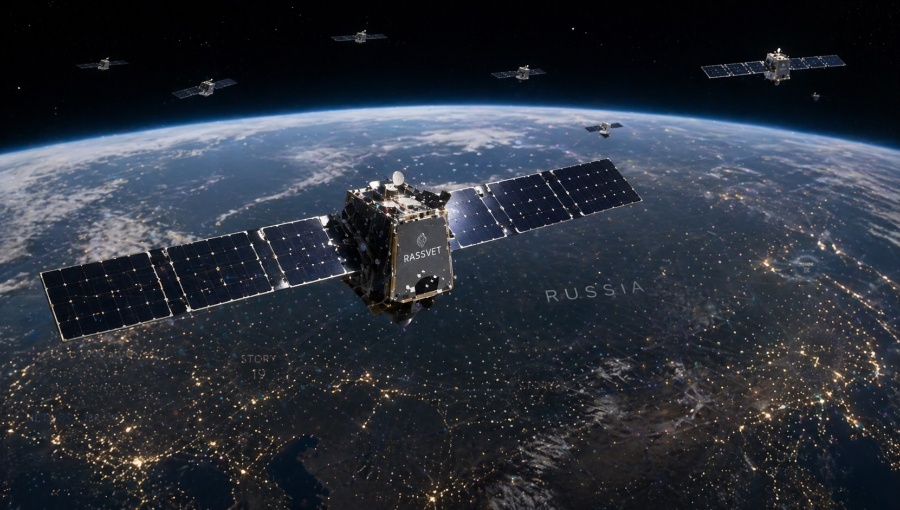
Russia launched its first operational batch of low-Earth orbit internet satellites in March, marking the beginning of what the Kremlin has boasted is the country's path to digital sovereignty — a homegrown alternative to SpaceX's (NASDAQ: SPACEX) Starlink that would free Russia from dependence on Western communications infrastructure.
Whether it can ever deliver on that ambition is a different question.
On March 23, 2026, a Soyuz-2.1b rocket lifted off from the military Plesetsk Cosmodrome in northern Russia and placed 16 satellites of the Rassvet constellation — the name means "dawn" in Russian — into low Earth orbit.
The satellites, built by the private aerospace company Bureau 1440 and developed under the Rassvet-3 programme, successfully separated from the launch vehicle and were transferred to the company's flight control centre, where they are undergoing system checks before moving into their target operational orbits.
"Launch of the first spacecraft of the target constellation marks the transition from experiments to building a communications service," Bureau 1440 said in a statement. "Dozens more launches and hundreds of satellites will be required to achieve global coverage."
The launch was originally scheduled for the fourth quarter of 2025 but was delayed by approximately three months due to satellite production difficulties. Russia has some world class technology in things like aviation and missiles, but it has a long standing problem with civil technology. While its great at software too (Tetris was a Russian invention) it struggle especially in telecoms and semiconductor tech.
The technology
The Rassvet-3 satellites, each weighing approximately 370 kilograms, are equipped with a communications system based on the 5G NTN (non-terrestrial network) standard, an upgraded power supply system, next-generation inter-satellite laser communication terminals and plasma engines. The constellation is designed to operate at an altitude of around 800 kilometres — higher than typical Starlink satellites but below the orbital range of OneWeb.
The laser inter-satellite links are among the most technically significant features. Bureau 1440 previously conducted 14 laser communication experiments over distances of 30 to 220 kilometres during prototype testing, transmitting a total of 1.5 terabytes of data, with 450 gigabytes transferred in a single session without loss.
The design specification targets 1 Gbps speeds and low latency — performance that would, if achieved at scale, represent a genuine competitive capability.
"On July 1, 2023, we conducted our first communication session with the first three satellites developed by Bureau 1440 for the Rassvet-1 mission and saw our 'space internet,'" Bureau 1440 said. "The data transfer rate to the device at that time was 10 Mbps, and the latency was 41 ms." The gap between that 2023 test figure and the 1 Gbps target illustrates the distance still to be travelled.
The scale problem
The scale of what Russia is attempting — and how far it has to go — is illustrated with brutal clarity by a single comparison. SpaceX's Starlink network has deployed more than 10,000 satellites in low Earth orbit since its first operational launches in 2019. Russia is starting with 16.
Roscosmos chief Dmitry Bakanov has previously stated that more than 900 low-orbit satellites are scheduled to go into space by 2035. Commercial operations involving over 250 satellites are expected to begin sometime in 2027.
That timetable requires approximately 15 additional Soyuz launches in the near term, each carrying 16 satellites — a demanding manifest for a launch infrastructure that is simultaneously supporting military operations and commercial commitments.
The Russian government has earmarked RUB102.8bn ($1.36bn) for the development of Rassvet as part of the national Data Economy Initiative. Bureau 1440 plans to invest an additional RUB329bn, equivalent to around $4.36bn, of its own funds through 2030.
Total committed investment of approximately $5.7bn compares with SpaceX's cumulative investment in Starlink, which analysts estimate at over $10bn and rising.
Space analyst Vitaly Egorov noted that while the project was initially conceived for civilian use — providing connectivity for airlines and rail networks — its strategic value has shifted significantly. Replacing Starlink for military purposes, he said, would require significantly more launches as well as the development and mass production of affordable ground terminals.
"The economic challenge posed by a state constellation of 900 satellites — if indeed it reaches that number — that has only begun launching in 2026, is likely out of the question" as genuine competition for Starlink, according to one industry analysis.
The military dimension
The launch has attracted close scrutiny from Ukrainian military analysts — and not because of its civilian internet ambitions. Analysis published by Militarnyi tracked three fully operational prototype satellites and observed them passing directly over Ukrainian territory two to three times per day, with each pass creating a communication window lasting approximately 15 to 20 minutes. Even with just 16 operational satellites, analysts estimated the constellation could provide communication windows totalling several hours per day.
"This underscores the need for immediate countermeasures without waiting for full deployment, as initial use cases may begin well before the system is fully operational," the analysis concluded.
The system operates in the Ka and Ku frequency bands, which are more resistant to electronic warfare interference and more difficult to detect with standard electronic intelligence systems. Experts noted that elements of the system's design may draw on technologies associated with OneWeb satellites that remained in Russia following the start of the full-scale invasion in 2022.
The military relevance is not hypothetical. Russian forces previously relied heavily on Starlink terminals — obtained through third-party supply chains — for battlefield communications and drone operations. Following technical restrictions implemented by SpaceX in coordination with Ukraine, which disabled a significant portion of those terminals by limiting access to registered users, the pressure on Moscow to develop a domestic alternative became acute. Ukraine's Defence Ministry adviser Serhiy Beskrestnov described the original Starlink restrictions as creating a "catastrophe" for Russian forces.
The context: digital sovereignty under pressure
The Rassvet launch is unfolding against a backdrop of deepening tensions around Russia's domestic internet infrastructure. Throughout March, mobile internet went completely dark every day in parts of central Moscow, St Petersburg and other major cities as the Kremlin pursued an intensifying crackdown on VPNs, Telegram and other communication tools ahead of September's parliamentary elections.
The internet outages have contributed to a significant fall in Putin's approval ratings, with VTsIOM data showing a seven-week consecutive decline to 65.6% — the lowest level since the invasion of Ukraine.
The irony of launching a digital sovereignty satellite constellation while simultaneously throttling domestic internet access has not been lost on Russian commentators. Roscosmos chief Bakanov stated that Rassvet was intended to equip Russia — and eventually its allies — with alternatives to Western satellite networks.
The military and geopolitical logic is clear. Whether the industrial capacity exists to execute it at the required scale, against a competitor that launched its 10,000th satellite while Russia was still preparing its first 16, is the question the coming years will answer.
Better volcano eruption predictions on Earth--and Venus--thanks to Mauna Loa study
University of Pittsburgh
image:
(a) NERZ channelized lava flow front evolution obtained through Planet SuperDoves (PS), Landsat 8 (LS), and Sentinel 2 (S2) scenes (Table 1). The base map is a pre-eruption greyscale hillshade image from 3DEP (Table 1). (b) NERZ channelized lava flow front distance from the vent and calculated flow front areal coverage rate in km2/day.
view moreCredit: Courtesy of Ian Flynn/University of Pittsburgh
When Mauna Loa erupted in 2022, the largest lava flow headed on a path headed directly toward Daniel K. Inouye State Highway 200, also known as Saddle Road, a critical route that carries many residents from their homes on one side to their jobs on the other.
No one could accurately predict whether the lava would continue to flow and eventually block the highway, or stop short, sparing the road.
However, when the volcano next erupts scientists will be better able to monitor the eruption in real-time and make more accurate predictions about where the lava will flow and when the volcano might erupt. These advances are thanks to the availability of satellite data from public and private sources as well as machine learning algorithms developed at Pitt with help from a colleague in Italy, as highlighted in a recent publication in the Journal of Volcanology and Geothermal Research.
During the 13-day Mauna Loa eruption, Ian Flynn, research assistant professor in the Department of Geology and Environmental Science in Pitt’s Kenneth P. Dietrich School of Arts and Sciences, wasworking in the lab of Professor Michael Ramsey.
At the time, more data from privately launched satellites was becoming available to researchers. Ramsey wondered if those new sources could be combined with traditional government satellites to make better predictions. “He asked if I could map the lava flow in real time and actually see the flow-front advancing toward the only road that cuts across the island,” Flynn said.
He could. He was able to watch as the lava made its way toward the Saddle Road. “The concern was that lava was making a beeline toward the road,” Flynn said. “It stopped about 1.5 miles from the road.”
The best way to keep people safe in the event of an eruption, however, is to know as soon as possible before lava begins running down hillsides.
Every volcano has its own personality
Researchers already knew that increased heat and seismic activity are indicators of an upcoming eruption, but how hot? How much activity? How early? These questions are difficult to answer in general.
Working with a colleague, Dr. Claudia Corradino, from the Italian National Institute of Geophysics and Volcanology (INGV) the team was able to use a machine learning algorithm to identify a thermal increase one month before the start of the eruption. While this signal that an eruption was coming was identified after the eruption ended, any new insights into how a volcano behaves prior to erupting adds to scientists’ ability to predict when they’ll occur for the next eruption.
“Every volcano has its own personality,” Flynn said. “Yes, it’s cheesy, but it’s the truth. They’re all different.” His research has been focused on Mauna Loa for years, trying to decode how those changes relate to its eruptions.
Combining public and private data did just that. But Flynn thought there might be more useful information to extract. Particularly, the thickness of the lava flow. He reached out to Dr. Shashank Bhushan, a colleague working at NASA’s Goddard Space Flight Center.
Bhushan had done similar work with glaciers. “I reached out and asked, ‘can we use this methodology that you apply to glaciers and adapt it lava flows?’ He said, ‘I don’t know. Let’s try.’” It did work, and it gave Flynn and collaborators another tool to understand the eruption.
“Getting visible data helped us understand where it’s going,” Flynn said, but that data is two dimensional. “Now we can also generate flow thickness and understand how much material is coming out.” That information is key to understanding if an eruption has just begun or if it’s waning. It can also be analyzed in terms of the thermal trends to understand how the lava is cooling over time.
“One, if it’s still hot, it’s still a hazard. You don’t want someone walking along something that’s still degassing dangerous chemicals,” he said. And knowing when the lava cooled can help researchers more accurately analyze the lava’s composition.
And then there’s Venus
When we search for active lava flows on other planets, knowing how long it takes for lava to cool on Earth will help us to better understand what’s happening if we see a hot flow on Venus,” he said. Depending on the environmental conditions, rates of cooling should be different. “Knowing how lava cools enables scientists to better constrain our models when we find active volcanoes on other planets.”
As more data becomes available, not only do Flynn and his colleagues continue to learn more about the Mauna Loa eruption, they learn more about the kinds of information they’ll need to know about other volcanoes. There won’t likely be a one-size-fits-all solution to predicting eruptions for all volcanoes, but there may be a way to find a unique solution for predicting eruptions at individual sites.
Mauna Loa may be the most active volcano in the world, but others can be just as—if not more—threatening to people living nearby. Each has its own personality, and each may need its own, tailor-made monitoring system.
Journal
Journal of Volcanology and Geothermal Research
Method of Research
Computational simulation/modeling
Subject of Research
Not applicable
Article Title
Satellite data synergy for volcano monitoring: The 2022 Mauna Loa eruption
Why stars spin down, or up, before they die
Magnetic fields in the convection zone drives the rotation evolution of massive stars
Kyoto University
image:
Illustration of the inner regions of a massive star during its final oxygen (green) and silicon (teal) shell burning phase, before the collapse of the iron core (indigo). The strength and geometry of the magnetic field, combined with the properties of convection in the oxygen region can cause the rotation rate to speed up or slow down.
view moreCredit: KyotoU / Lucy McNeill
Kyoto, Japan -- From birth to death, stars generally slow by 100 to 1000 times their initial rotation rates; in other words, they spin down. The Sun's total angular momentum has declined as material is gradually blown off at the surface as solar wind. By observing this, astronomers have theorized the interaction between magnetic fields and plasma flow to be the most efficient way to spin down stars.
Why and how this happens has long interested astronomers, and recently an observational technique called astroseismology, which measures a star's natural oscillation frequencies, has made it possible to measure the internal rotation rates and magnetic fields of other stars in our galaxy. From this huge population, a picture of how stellar rotation decreases with stellar age has emerged, one that suggests that current theory is insufficient to explain the dramatic decrease in rotation.
Fascinated by astroseismology and by other researchers' 3D simulations of the solar convective zone, a team of researchers at Kyoto University was inspired to investigate how magnetic fields affect rotation inside massive stars..
"Our coauthors in Australia and the UK have already performed 3D magnetohydrodynamic simulations for massive stars before core-collapse. We suspected that the flow inside the massive star’s convective zone may evolve analogously with the solar convective zone," says team leader Ryota Shimada.
With a 3D simulation of a massive star, the researchers were able to directly investigate the complex interplay between violent convection, rotation, and magnetic fields. They confirmed that the internal rotation and magnetic field coevolve akin to the solar dynamo: the energy process that sustains our Sun's magnetic field. With these equations in hand, the team was able to mathematically predict the evolution of the star's internal rotation in time.
Their simulation reveals that the speed and direction of convective motions were influenced by rotation and magnetic fields over short timescales, which in turn changes the rotation, causing it to spin down or -- in some cases -- up. The team was able to formulate the interaction between convection, rotation, and magnetic fields as a model for radial transport of angular momentum outwards and inwards, showing that this transport in later burning phases is directly related to the geometry of the magnetic field.
"We were surprised to discover that some configurations of the magnetic fields actually spin the core up, suggesting that the final spin rate will be unique to the star's properties," says co-author Lucy McNeill. "Slow rotation might even be forbidden in some classes of massive stars."
Their discovery of magnetic angular momentum transport during advanced burning phases suggests that the theory developed to describe rotation in solar-type stars may be universal. Next, the team plans to create stellar evolution simulations depicting the whole lifetimes of various low to high mass stars to predict their rotation rates during various evolutionary stages.
###
The paper "Angular momentum transport in the convection zone of a 3D MHD simulation of a rapidly rotating core-collapse progenitor" appeared on 27 April 2026 in The Astrophysical Journal, with doi: 10.3847/1538-4357/ae53da
About Kyoto University
Kyoto University is one of Japan and Asia's premier research institutions, founded in 1897 and responsible for producing numerous Nobel laureates and winners of other prestigious international prizes. A broad curriculum across the arts and sciences at undergraduate and graduate levels complements several research centers, facilities, and offices around Japan and the world. For more information, please see: http://www.kyoto-u.ac.jp/en
Journal
The Astrophysical Journal
Method of Research
Computational simulation/modeling
Subject of Research
Not applicable
Article Title
Angular momentum transport in the convection zone of a 3D MHD simulation of a rapidly rotating core-collapse progenitor
Article Publication Date
27-Apr-2026
Origin of the stellar Fe Kα line revealed!
Tandem superflare observations uncover the mechanism behind an astronomical mystery
Kyoto University
image:
How the researchers uncovered the origin of the stellar Fe Kα line.
view moreCredit: KyotoU / Shun Inoue
Kyoto, Japan -- The Fe Kα line, or iron Kα line, is often used in astronomical research to understand the physical composition of astronomical objects. This line is produced when a K-shell electron of an iron ion in the photosphere -- the gas on the stellar surface -- is ejected by an external process, and has been detected in X-ray spectra of solar and stellar flares. Yet the dominant mechanism behind this ionization process has remained an open question for many years.
Astronomers have proposed two possible mechanisms: photoionization by X-ray photons emitting from hot flare plasma, or collisional ionization by high-energy electrons accelerating at the onset of the flare. With these two possibilities in mind, a team of researchers at Kyoto University set out to uncover the truth behind the iron Kα line.
The team focused on the triple star system UX Arietis, conducting several days of simultaneous ultraviolet and X-ray observations using NICER, NASA's X-ray telescope aboard the International Space Station, and Hisaki, JAXA's ultraviolet space telescope. While Hisaki was developed primarily for observations of planets in the Solar System, the researchers demonstrated that it can also be used to study distant stars.
When the team detected a superflare, they discovered that the ultraviolet emission peaked about 1.4 hours earlier than the X-ray emission. They also observed that the iron Kα line peak coincided with the peak of the thermal X-ray continuum emitted by the hot fire plasma, and not with the ultraviolet emission, which is associated with high-energy electrons.
This is very clear evidence of photoionization as the dominant emission mechanism of the iron Kα line during a stellar flare. Specifically, the researchers found that hot plasma generated in the stellar flare loop emits X-ray photons, causing the ionization of iron atoms at the stellar surface and producing the iron Kα line.
"We are intrigued that a long-standing, unresolved problem in solar and stellar flare research was solved through coordinated observations with Hisaki and NICER, even though Hisaki was not originally designed to study the Sun or stars," says first author Shun Inoue.
This study represents the first instance in which time-resolved observations led to the clear demonstration of this mechanism in a stellar flare. As a result of the team's efforts, other astronomers can now use the iron Kα line as a diagnostic tool to infer where stellar flares occur on the surfaces of stars.
In the near future the team plans to use XRISM, a telescope with a high energy resolution and the ability to more accurately measure the iron Kα line, which will enable them to investigate the flare structure and location in greater detail. They hope that their findings will contribute to future research on stellar flares and exoplanets.
###
The paper "Origin of the Stellar Fe Kα Line Clarified with Far-ultraviolet and X-Ray Observations of a Superflare on the RS Canum Venaticorum–type Star UX Arietis" appeared on 27 April 2026 in The Astrophysical Journal, with doi: 10.3847/1538-4357/ae2be0
About Kyoto University
Kyoto University is one of Japan and Asia's premier research institutions, founded in 1897 and responsible for producing numerous Nobel laureates and winners of other prestigious international prizes. A broad curriculum across the arts and sciences at undergraduate and graduate levels complements several research centers, facilities, and offices around Japan and the world. For more information, please see: http://www.kyoto-u.ac.jp/en
Journal
The Astrophysical Journal
Method of Research
Observational study
Subject of Research
Not applicable
Article Title
Origin of the Stellar Fe Kα Line Clarified with Far-ultraviolet and X-Ray Observations of a Superflare on the RS Canum Venaticorum–type Star UX Arietis
Article Publication Date
27-Apr-2026
The NICER and Hisaki telescopes
Credit
NASA, JAXA
Local dwarf galaxies may preserve a record of the infant Universe
Stockholm University
image:
(A) Dark matter distribution in our neighborhood in the Universe, the so-called Local Group of galaxies. The two large dark matter halos correspond to those of the Milky Way and Andromeda galaxy; (B) zoom-in on the dark matter in and around a small halo ~700 million years after the Big Bang; (C-1 and C-2) stars and gaseous material in the simulated ultra faint dwarf galaxy, hosted in the centre of the small dark matter halo in panel B, in two different models for the conditions of the early Universe. We can see how the ultra-faint dwarf galaxy changes its properties depending on the model. The scale on each image is in units of light years. (Image credit: J Sureda/A Fattahi/S Brown/S Avraham)
view moreCredit: J Sureda/A Fattahi/S Brown/S Avraham
Ultra-faint dwarf galaxies, tiny satellite galaxies orbiting the Milky Way, have long been seen as cosmic fossils. Now, a new study by researchers at the Oskar Klein Centre and the LYRA collaboration uses an unprecedented set of simulations to show just how powerfully these faint systems can reflect the conditions of the early Universe and tell us why some galaxies grew and others did not.
Azadeh Fattahi is Associate Professor at the Oskar Klein Centre (OKC) and heading the research group which led this work, now published in Monthly Notices of the Royal Astronomical Society (MNRAS), together with collaborators from Durham University and University of Hawaii. She explains the scale of the project:
“In this work we presented a brand-new suite of cosmological simulations focused on the faintest galaxies in the Universe, with an unprecedented resolution. These are by far the largest sample of such galaxies ever simulated at these resolutions.”
Dwarf galaxies are often described as small cousins of the Milky Way. They form in small dark matter halos which are predicted by the standard model of cosmology. The faintest examples of such systems are extreme in both size and fragility, and lie on the boundary of our knowledge about galaxy formation and dark matter.
“The smallest galaxies are called ultra-faint dwarf galaxies, which are a million times less massive than the Milky Way or even smaller,” Fattahi says. “Due to their small size these galaxies have proven very difficult to model and simulate.”
This new simulation suite represents a major step forward, enabling a systematic view of how these galaxies form and evolve.
A down-to-earth analogy
“A useful analogy is to plants and crops and how the way they grow is sensitive to the weather conditions”, says Shaun Brown who led the study while working at OKC and Durham University. “In the same way that the yield of a crop in summer can indirectly tell you a lot about what the weather in spring must have been like, the properties of faint dwarf galaxies today can tell us a lot about the conditions, or weather, of the Universe at a much earlier time.”
What makes the results especially timely is that the simulations do more than reproduce faint dwarf galaxies – they suggest that these local objects can act as a probe of the Universe’s earliest “climate”. The team explored how different assumptions about the early radiation environment influence which small dark matter haloes manage to form stars at all.
“In the paper we studied two different assumptions about the properties of the early Universe when it was less than 500 million years old, to understand the effect on the properties of these small galaxies today when the Universe is 13 billion years old,” Brown explains.
The outcome was striking:
“We found that these small ultra-faint galaxies are very sensitive to these changes, while more massive galaxies, like our Milky Way, don’t really care,” he adds, “For the smallest galaxies, early conditions can decide whether they become visible galaxies – or remain starless dark matter halos.”
Future research
That sensitivity opens a clear path to testing early-Universe physics with upcoming observations.
“Excitingly, in the near future we will have data from the Vera C. Rubin Observatory which will be able to find many more of these ultra-faint dwarfs around the Milky Way,” says Fattahi.
Many astronomers hope the Vera C. Rubin Observatory can deliver a near-complete census of Milky Way satellite galaxies – and these simulations suggest that census may carry information far beyond our local neighbourhood.
“Our work suggests that these upcoming observations of the very local Universe will be able to constrain what the Universe at its infancy looked like, something we currently cannot directly access with other observations.”
The result is particularly relevant in light of recent discoveries of galaxies in the early Universe, by the James Webb Space Telescope (JWST), which is finding many surprises, in particular unexpectedly massive and bright galaxies in the early universe,” Fattahi notes.
If the early Universe is producing surprises at large distances, then local relics from the same epoch, ultra-faint dwarfs, may provide an additional route to understanding what happened.
Reaching this regime came with major practical challenges. “Running these simulations is challenging, and extremely expensive in both time and computational resources,” Fattahi says.
In total it took more than six months to run all of the simulations. The scale of the data was also substantial: “The simulation also produces very large amounts of data (in total approximately 300 TB). This meant many of the old algorithms designed for smaller amounts of data needed updating and improving to effectively handle this new large amount of data.”
Work carried out on the COSMA 8 supercomputer
Most of the work was carried out on the COSMA 8 supercomputer, which is designed for simulation-driven research. Durham University’s Institute for Computational Cosmology hosts COSMA 8 on behalf of the UK’s DiRAC High Performance Computing Facility.
Looking ahead, Fattahi’s team plans to use the new suite to tackle questions that are still open in modern galaxy and structure formation, such as where we can find the very first generation of stars formed in the Universe or what do the properties of ultra-faint dwarf galaxies tell us about the nature of dark matter?
Read article in Monthly Notices of the Royal Astronomical Society (MNRAS)
Contact:
Azadeh Fattahi, Associate Professor at the Oskar Klein Centre and the Department of Physics, Stockholm University
E mail: azadeh.fattahi@fysik.su.se Phone: ++46855378717
Azadeh Fattahi is a Wallenberg Academy Fellow at the Oskar Klein Centre and the Department of Physics at Stockholm University. Read more about her research
Journal
Monthly Notices of the Royal Astronomical Society
Article Title
LYRA ultra-faints: The emergence of faint dwarf galaxies in the presence of an early Lyman-Werner background'
Article Publication Date
24-Apr-2026

No comments:
Post a Comment