Inflation, Tariffs and War
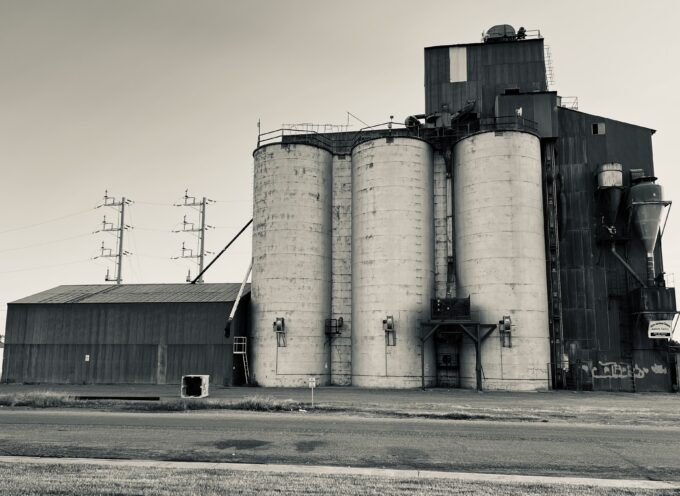
Grain silos in California’s Central Valley. Photo: Jeffrey St. Clair.
Inflation, a general rise in prices, increased in April due to higher costs for energy primarily (40 percent), food and shelter. “The Consumer Price Index for All Urban Consumers (CPI-U) increased 0.6 percent on a seasonally adjusted basis in April, after rising 0.9 percent in March, the U.S. Bureau of Labor Statistics reported. Over the last 12 months, the all items index increased 3.8 percent before seasonal adjustment.”
Energy prices are up in no small way due to the unprovoked U.S.-Israel war against Iran begun on February 28, 2026. That violation of international law has caused 3,468 deaths and over 26,500 injuries in Iran, according to Iranian authorities, and closed the Strait of Hormuz.
An estimated 20 percent of the world’s petroleum passes through this route, which was open for business before the war began. Moreover, that closure is evidence of a U.S. defeat, writes Robert Kagan, a leading neoconservative and Iraq War hawk who co-founded the Project for the New American Century, in the Atlantic magazine recently.
There’s another factor driving inflation, according to Dan Anthony, head of We Pay The Tariffs, a grassroots coalition of nearly 1,200 small U.S. businesses that advocates against tariffs. “Tariffs raise prices,” he said in a statement. Basically, the tariffs are part of a trade war spurring inflation.
Recall that President Trump imposed tariffs, or taxes on imports from U.S. global trading partners, on March 4, 2025. The tariff rates have increased and decreased since then. To say the impacts of the Trump tariffs on aluminum, steel and other commodities from abroad has been chaotic understates the case.
Recent research at the Federal Reserve Bank of Dallas agrees with Anthony’s assessment of tariffs and inflation. The Fed researchers found that import-dependent businesses passing along the cost of tariffs on imports have added a full percentage point to the inflation of consumer prices. What can be done?
“There aren’t many levers the government can pull to lower prices,” according to Anthony, “but permanently eliminating tariffs is one of them.” That is accurate and also unlikely at least in the short term. Further, a brief look back reveals another presidential lever available, and a precedent for it, one that coincides with a past U.S. military defeat and its role in triggering inflation.
On August 15, 1971, President Richard Nixon, the Republican born a Quaker who later became an anti-communist crusader, subsequently dubbed “Tricky Dick” in the White House, imposed wage and price controls for 90 days. That lever froze wages and prices to fight inflation, an outcome of U.S. deficit spending to wage war in Vietnam. The point that I am making is that presidents have battled inflation in more than one way.
In the meantime and on a related note, President Donald J. Trump might have delayed the signing of executive orders to temporarily reduce tariffs on beef imports, and back policies to increase the domestic cattle herd. The two policy aims of these proposed executive orders seem contradictory. Are they at odds with each other? What’s really going on here?
Sarah Carden is the research and policy director at Food Action. “The administration appears to be presenting this move as a way to lower beef prices for consumers while supporting domestic cattle ranchers,” she said in a statement, “but we’ve already seen this approach fail. Previous import expansions from Argentina did not meaningfully reduce beef prices because the real problem is a highly consolidated meatpacking sector controlled by just a handful of dominant corporations.”
Consider this. Four major meatpackers control roughly 85 percent of the U.S. beef industry, according to Farm Action. This is the definition of market consolidation.
Such consolidation can and does spur higher prices. Fewer producers in the marketplace means that they can and do avoid price competition. Why should monopoly companies with consolidated market power reduce prices if competitors do not offer lower-priced products to consumers? Why cut prices except to counter competitors’ threats to grab market share and profits?
In a for-profit economic system, such a move to decrease prices absent competitive pressures to do so makes no business sense. Meanwhile, at the end of the day, domestic cattle producers, some of whom make up the base of MAGA, are feeling the pain, along with U.S. consumers and import-dependent businesses generally, coping with the impacts of inflation, tariffs and war.

No comments:
Post a Comment