‘The power Of Organizing’: How Indigenous Organizers Defeated A Mining Company At Pe’ Sla
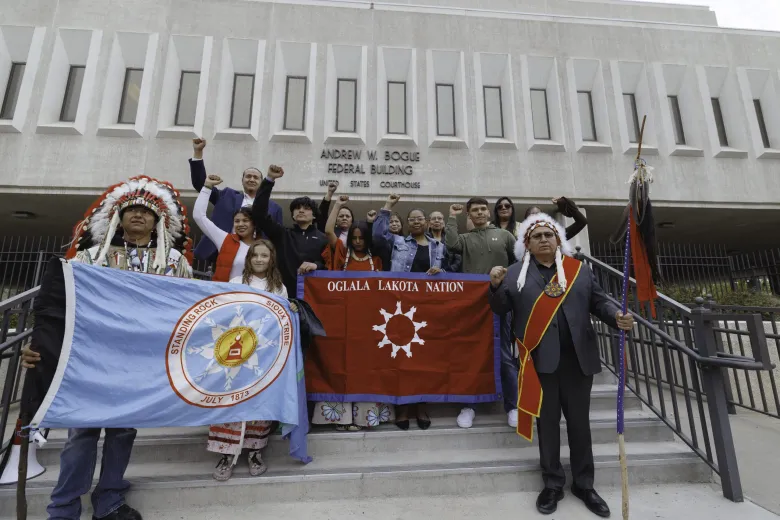
Indigenous organizers and environmental groups are celebrating a rare and hard-fought victory after a South Dakota mining company withdrew its plan to drill for graphite near Pe’ Sla, a sacred site in the Black Hills. The withdrawal followed a monthslong coordinated campaign that combined prayer, direct action, and legal pressure—tactics that could offer lessons for future land defense fights, organizers say.
Pete Lien & Sons informed the U.S. Forest Service on May 7 that it was withdrawing its plan of operations for the Rochford Mineral Exploratory Drilling Project and did not intend to submit another drilling plan for the site, according to a letter shared by project opponents. The decision came days after a federal judge on May 4 temporarily halted drilling amid sustained opposition to the project from Native nations and local water protectors.
“I think it shows the power of organizing, the power of community coming together to say no through direct action,” said Wizipan Garriott, president of NDN Collective, which was one of the plaintiffs in a lawsuit to halt the drilling. “It also shows the power of being able to bring things to the court. And then it also shows the power of tribes being able to organize and to take action.”
South Dakota-based nonprofit Black Hills Clean Water Alliance, another plaintiff in the case, wrote in a statement published to Instagram that organizers will stay on alert if the mining company decides to reapply with another plan.
“This is a testament to the people, organizations, and tribal governments who showed unified action, determination, and courage in the face of what seemed to be overwhelming odds. It is unusual for a mining company to be slapped down decisively. Pe’ Sla is safe!” the group wrote.
Pe’ Sla, also known as Reynolds Prairie, is a high mountain meadow in the central Black Hills that holds deep spiritual significance for Lakota, Dakota, and Nakota people. Tribal nations use the land for prayer and cultural activities; buffalo also graze there. The exploratory drilling plan would have allowed Pete Lien & Sons to search for graphite 0.6 miles north of Pe’ Sla, including at sites within a two-mile protective buffer zone established in 2016 through an agreement between the Forest Service and tribes.
The Forest Service approved the project on Feb. 27 using a categorical exclusion, a streamlined review process that allowed the agency to avoid a full environmental assessment. Opponents argued that the project’s proximity to Pe’ Sla required more rigorous review and tribal consultation.
Two legal challenges followed. On April 2, NDN Collective, Black Hills Clean Water Alliance, and Earthworks sued the Forest Service, alleging violations of the National Environmental Policy Act and religious freedom protections. On April 30, nine Native nations filed a separate lawsuit accusing the Forest Service and the U.S. Department of Agriculture of violating federal historic preservation and environmental laws by approving drilling near Pe’ Sla without adequate consultation or review.
But according to Garriott, legal action alone did not stop the project. He said they learned drilling had begun without meaningful public notice. Garriott said access roads had been plowed and equipment was staged before opponents were fully aware that operations were underway. Once that information traveled among organizers, attorneys and tribal leaders sought an emergency restraining order to halt the work.
“That communication is necessary for … being able to coordinate our political and legal strategy and PR strategy around this,” Garriott said.
As litigation intensified, Pete Lien & Sons accelerated drilling, Garriott said. He said the company went from one drill operating a 12-hour shift each day to three drills operating two 12-hour shifts per day, effectively running around the clock in what he alleged was an effort to complete as much drilling as possible before a court hearing.
Pete Lien & Sons did not respond to Prism’s request for comment.
In response, Indigenous land defenders occupied two active drill pads on April 30 and held a ceremony at the site. NDN Collective said at least 10 drill pads were located within the two-mile buffer zone around Pe’ Sla. The group described the actions as part of a campaign to stop what it called illegal drilling near sacred land.
“It was only through direct action that we were able to stop some of those holes from being drilled,” Garriott said, “and it was the holes that were closest and adjacent to the tribal lands themselves.”
The company’s withdrawal is a significant victory for Pe’ Sla protectors, but Garriott cautioned that the work is not finished. He said tribes should be granted access to any core samples collected during drilling to understand what the company was seeking, and cultural monitors should be allowed to assess damage already done to the land.
“There needs to be monitoring of the reclamation process to ensure that that is done right and correctly and adequately,” Garriott said. “They tore things up really bad up there.”
The victory at Pe’ Sla also arrives amid growing concern over other proposed extractive projects in the Black Hills, including uranium exploratory drilling near Craven Canyon, an area known for Indigenous petroglyphs.
“What happens here is happening or is going to happen in other parts of the country,” Garriott said.
The Pe’ Sla fight also exposes a deeper conflict over how the green energy transition is pursued. Graphite is a key mineral used in electric vehicle batteries and other technologies, and mining companies increasingly frame extraction as necessary to meet the demand for clean energy.
“From the very beginning, it’s always been about extraction of resources at the expense of Indigenous peoples, at the expense of Indigenous cultures, and at the expense of Indigenous-owned resources,” Garriott said. “There are ways to advance clean energy while not exploiting and damaging our environment.”
For Garriott, the campaign against drilling at Pe’ Sla was also inseparable from treaty rights and the long history of the Black Hills. Under the 1868 Fort Laramie Treaty, the Black Hills were guaranteed to the Great Sioux Nation, though the U.S. later seized the land after gold was discovered there. The U.S. Supreme Court ruled in 1980 that the taking of land without just compensation was illegal. The Sioux rejected the decision and its accompanying monetary compensation, but the land itself was never returned.
“We would never go into somebody’s church and begin drilling,” Garriott said. “Yet that is what they’re doing here.”
He said the issue is also ecological, arguing that drilling near Pe’ Sla could contaminate water sources in the Rapid Creek watershed and threaten drinking water in surrounding communities.
“We all need clean water,” Garriott said. “We all have a duty to protect clean water, and we all have a human right to clean drinking water.”
For now, Pe’ Sla protectors are celebrating a win they say is proof of what becomes possible when Native nations, grassroots groups, attorneys, students, and community members act in concert.
During the court hearing, more than 100 high school students walked out of class and gathered at the courthouse in Rapid City, South Dakota, in opposition to the drilling, Garriott said.
“It shows what can happen,” he said, “and the power of people coming together.”

No comments:
Post a Comment