Saturday, August 26, 2023


Wind Power Could Bring Seaborne Transportation Full Circle

  • A dry bulk ship outfitted with special sails has set out on its first voyage.

  • Scientists are studying how the use of wind power can reduce emissions at sea.

  • Two years ago, the World Bank issued a recommendation to avoid LNG bunkering, saying hydrogen and ammonia offer the best long-term solutions as the shipping industry.

A dry bulk ship chartered by agricultural and bioindustrial specialist Cargill Plc has set out on its first voyage after being fitted with special sails aimed at studying how harnessing wind power can lower emissions in the shipping sector. Marine transport is one of the biggest consumers of oil, accounting for ~7% of oil consumption worldwide and 3% of global CO2 emissions.

"It is risk taking. There is no guarantee ... that the economics are going to work. But it is up to us to show the industry what is possible and hopefully get some more people confident around this technology," Jan Dieleman, president of Cargill's ocean transportation division, has told Reuters, adding that they plan to scale the operation if they get positive results. The five-year old Pyxis Ocean has been retrofitted with large wing sails measuring nearly 40 meters in height known as WindWings, with Cargill hoping to recoup the costs through fuel savings. Wind power is likely to be a far cheaper source of energy than another clean energy solution proposed by the World Bank: hydrogen.

Two years ago, the World Bank issued a recommendation to avoid LNG bunkering, saying hydrogen and ammonia offer the best long-term solutions as the shipping industry continues to adopt increasingly stringent measures to decarbonize.

Unfortunately, the economics of green hydrogen--the type favored by most governments--are not in its favor. Green hydrogen--i.e. Hydrogen made through the electrolysis of water using renewable energy--costs about $5 per kilogram compared to $1.50 per kilogram for gray hydrogen, which is created from natural gas, or methane, using steam methane reformation(SMR). Currently, 99% of U.S. hydrogen production is sourced from fossil fuels, with 95% from natural gas by SMR. Although the DOE is sponsoring a “moonshot” project to reach $1 per kilogram within a decade, it would require a huge scale-up of renewable electricity for green hydrogen costs to fall to such levels. For instance, meeting the EU green hydrogen target would require ~1,000 terawatt-hours of new solar and wind installations, nearly double the bloc’s installed capacity.ank recommendation has faced plenty of backlash from industry representatives who say the industry cannot afford to wait for a perfect solution to address climate change. Instead, the shipping industry favors the adoption of technologies that can boost LNG’s carbon credentials.

Cheapest marine fuel

In its report, the World Bank presents an overview for policymakers regarding its perspective for the industry, saying that the industry needs to abandon fossil-based bunker fuels and turn toward zero-carbon bunker fuels in order to lower and ultimately eliminate its climate impact.

In addition to its overview of the issues, the World Bank presented a report entitled “The Role of LNG in the Transition Toward Low- and Zero-Carbon Shipping.” The report says LNG is likely to play only a limited role in the decarbonization of the shipping sector even in the short-term, and recommends that countries should avoid adopting public policies that support LNG as a bunker fuel due to the risk of methane emissions and other highly damaging GCG emissions. In a twin report, entitled “The Potential of Zero-Carbon Bunker Fuels in Developing Countries”, the World Bank identifies ammonia and hydrogen as the most promising zero-carbon bunker fuels for the shipping industry.

However, panelists at the opening of Singapore Maritime Week representing owners, charterers and shipbuilders have opposed that idea and instead see switching to LNG as one plausible, interim solution to a low-carbon transition that can happen sooner rather than later.

BHP CEO Vandita Pant has counter-argued that the maritime industry risks becoming “a laggard” if it fails to use LNG at least as a stop-gap measure and instead waits for “a perfect solution to come”.

But truth be told, the biggest reason why shipping magnates are not so keen on ditching LNG is simply due to the fact that it’s the cheapest fuel available.

According to data by international accredited registrar and classification society, DNV, over the past several years, Henry Hub natural gas has consistently ranked at or near the bottom of marine fuel prices when ranked by heating value. Henry Hub natural gas is selling for $2.56/MMbtu, the lowest among the six fuels ranked. Adding a $4/MMBtu liquefaction cost means it still remains considerably cheaper than low-sulfur Marine gasoil (MGO).

On the investment side of things, commodity shipping stocks have pulled off from their February/March highs but several remain solidly in the green. Teekay Tankers (NYSE: TNK) and Tsakos Energy Navigation (NYSE: TNP) are leading with gains of 55.5% and 37.0% in the year-to-date, respectively.

By Alex Kimani for Oilprice.com


Biden Tightens Offshore Rig Safety Rules Rolled Back By Trump

  • The Biden Administration is tightening safety rules for offshore oil and gas rigs that were rolled back under the former president.

  • The final well control rule strengthens testing and performance requirements for blowout preventers and other well control equipment.

  • The rules were originally imposed by President Obama after the Deepwater Horizon disaster but were then rolled back by President Trump.

The Biden Administration is toughening the rules on well integrity and blowout prevention at offshore oil and gas rigs that were loosened under former president Donald Trump.  

The Department of the Interior’s Bureau of Safety and Environmental Enforcement (BSEE) published on Tuesday the final well control rule, which strengthens testing and performance requirements for blowout preventers and other well control equipment, BSEE said in a statement.

The rules, imposing new technical regulations on drilling and drilling equipment, were initially introduced in 2016 by President Obama in the aftermath of the Deepwater Horizon disaster in 2010 that killed 11 people and resulted in the worst U.S. offshore oil spill.  

But in 2019, the Trump Administration rolled back some offshore oil drilling requirements imposed after the Deepwater Horizon disaster, after complaints from the oil industry that some of the regulations were burdensome without necessarily improving safety.

While the oil industry and its organizations argued at the time that the easing of some requirements was good for the offshore industry and technological development, opponents said that relaxing rules would endanger oil workers and the environment.

The Biden Administration is now reinstating some provisions but is not completely reversing the eased Trump-era rules.

“These improvements are necessary to ensure offshore operations, especially those related to well integrity and blowout prevention, are based on the best available, sound science,” Secretary of the Interior Deb Haaland said.

BSEE Director Kevin Sligh commented,

“This rule strengthens testing and performance requirements for blowout preventers and other well control equipment, provides for timely and robust analyses and investigations into failures, and clarifies reporting requirements to ensure we have appropriate visibility over information and data critical to maintaining well integrity.” 

The new final rule “incorporates key lessons learned from operator experience, incident data regarding blowout preventers, and well integrity since the publication of the 2016 rule and revises or rescinds certain modifications that were made in the 2019 rule,” BSEE said.

Excluding trans women in women’s chess makes you a pawn of the patriarchy


The world’s top chess federation is banning trans women from competing until a review is made – and the defenses are sexist assumptions and shaky science


THE GUARDIAN
Sat 19 Aug 2023 

Trans women banned from high-level women’s chess events

As anyone who has ever played the game knows, chess pieces are deceptively heavy. Enormous hand strength and lung capacity are required to move even a tiny pawn across a board. Shifting a rook or a queen? That can exhaust a delicate lady’s fingers for weeks on end. And don’t get me started on the spatial intelligence and mental acuity required for chess. Even thinking about the game makes my poor little woman brain hurt.

Obviously, this is all nonsense. And yet men have long been keen to push the idea that they’re somehow innately better at chess than women. “[Women] are terrible chess players,” Bobby Fischer proclaimed in 1963. “I guess they’re just not so smart … I don’t think they should mess into intellectual affairs, they should keep strictly to the home.”

As recently as 2015 Nigel Short, then vice-president of the world chess federation Fide, claimed that “men are hardwired to be better chess players than women”, adding: “You have to gracefully accept that.” The English grandmaster went on to explain it was clear men and women’s brains are different because he helps his wife get the car out of the garage and she has more emotional intelligence than him.

Fide still seems to believe that cis women are born lacking some sort of chess gene. How else does one explain their recent decision that transgender women cannot compete in its official events for females until a review of the situation – which may take up to two years – is made by its officials. Certainly, Fide hasn’t made it clear what sort of innate advantage they think trans women may have.

There have, of course, already been several defenses of Fide’s decision. But rather than being based on any firm evidence, they seem to be constructed out of sexist assumption and shaky science. Debbie Hayton, a trans woman who writes frequently for conservative outlets, wrote in UnHerd: “It’s possible that evolution has left men with an innate advantage in chess.” Hayton backed that up with a quote from a (female) Harvard biologist about males having a large advantage over females in spatial ability. But that’s not entirely true. While you can certainly cherrypick lots of studies that show men’s spatial abilities are superior, there are also lots of recent studies that refute this. A 2020 study in Nature Scientific Reports, for example, found no difference between male and female spatial abilities. Any differences previously found, a lot of research suggests, may be down to testing methodologies.

It is true, of course, that men dominate the upper echelons of chess. But why do you think that is? Do you really think it’s because men are brainier? Do you really think it’s because men and women’s brains are hardwired differently? Or do you think it’s because structural sexism stops a lot of young girls from getting into chess? Sexist assumptions seep into us from a very young age: a disturbing 2017 study found that girls as young as six believe that brilliance is a male trait. This social conditioning affects everything from career choices to hobbies.

Forget trans women for a moment, should there be separate women and men’s categories at all in chess? That’s a little tricky. Because far fewer women go into chess than men there’s certainly a strong case for keeping some separate men and women’s categories for the moment. But the idea that you wouldn’t ever see women win if the categories were mixed-sex is misguided. Nigel Short has certainly been beaten by a woman: Judit Polgar, who was ranked as high as No 8 in the world, has a winning record against him.

Perhaps men like Short are so keen on a separation of the sexes because they’re worried about their own performance. Look at air rifle shooting, for example, a sport where men and women are evenly matched. “Shooting wasn’t always split by gender,” air rifle coach Heinz Reinkemeier told ESPN in a 2021 article. “In the 1976 Olympics, the American Margaret Murdock won a silver medal in the free shooting event … after that the men decided to split shooting up into men and women because they didn’t like to be overtaken by the girls.”

Again, I think the question of whether men and women should play in separate categories in high-level chess is tricky. However, I can’t see any case for stopping trans women from competing in the women’s category. Ultimately women’s chess isn’t helped by gatekeeping definitions of women. It’s not helped by excluding trans women; it’s helped by encouraging more women to get into chess and dismantling gender stereotypes. If your argument for excluding trans women is that women have inferior brains than men then you are no feminist, you are a pawn of the patriarchy.

Magnus Carlsen “completes” chess as he bags World Cup title
by Carlos Alberto Colodro
8/24/2023

 – Magnus Carlsen has won it all. The world number one beat Praggnanandhaa Rameshbabu in tiebreaks to win the FIDE World Cup for the first time in his career. After his victory, the Norwegian noted that he will not attempt to recover the World Championship title unless there is a major change in the format, especially regarding the shortening of time controls. Meanwhile, third seed Fabiano Caruana beat Nijat Abasov in the match for third place to secure a spot in the 2024 Candidates Tournament. | Photo: FIDE / Stev Bonhage


A clash of generations

There is no hiding the fact that a new generation of elite chess players is slowly taking over the sport. In the final of the FIDE World Cup, Magnus Carlsen, who was born in 1990 and obtained his GM title in 2004, defeated a player born in 2005 — the talented and ever-humble Praggnanandhaa Rameshbabu.

Also known as Pragg, the youngster from Chennai had a remarkable showing in Baku, as he knocked out both Hikaru Nakamura and Fabiano Caruana (seeded second and third respectively) before reaching the final against Carlsen. For his efforts, the prodigy gained 20.2 rating points in classical chess, thus climbing to the 20th spot in the live ratings list.

In this Fritztrainer: “Attack like a Super GM” with Gukesh we touch upon all aspects of his play, with special emphasis on how you can become a better attacking player.

Pragg also climbed to the 3rd spot among the juniors (under-20 players), as he now stands only behind Alireza Firouzja and Dommaraju Gukesh. The top-3 are joined by yet three more prodigies who have already crossed the 2700 rating barrier. Or as Carlsen put it in an interview conducted by the chess24 commentary team:

I think this generation of players born 1990-94 really have dominated for a long time, and finally now with these youngsters born 2003 and after, we have a generation that’s worthy of succeeding us when the time comes — the time could be fairly soon!

It will certainly be exciting for chess fans to see this story unfolding as time goes by. Will it be Firouzja who goes on to dominate? Or will it be one of the three Indians — Gukesh, Pragg and Arjun Erigaisi? Perhaps Nodirbek Abdusattorov, or the steady climber Vincent Keymer...

For now, however, the likes of Carlsen, Caruana, Nakamura and world champion Ding Liren are still going strong!


Praggnanandhaa signing autographs for even younger fans! |
 Photo: FIDE / Anna Shtourman

As for Carlsen’s accolades, there is little that can be said besides the list of trophies shared by Norwegian journalist Tarjei J. Svensen on X.


The 32-year-old has won it all, as the World Cup was the one big trophy missing in his cabinet. Besides beating formidable opponents in five World Championship matches, Carlsen won the Rapid and Blitz Championships multiple times and has accumulated no fewer than eight triumphs at the traditional Tata Steel Masters in Wjik aan Zee.

Carlsen later shared the following GIF on his X account — chess, completed

Of course, what most fans were wondering after this victory was whether Carlsen is planning to fight to regain the World Championship title by playing the Candidates. In line with previous comments on the subject, the Norwegian asserted:

The one non-negotiable point for me, if I ever were to play the World Championship again, is that there would have to be more games and shorter time controls. [...] With the classical time control, I think there is just no way.

If that is the case, Nijat Abasov will get an invitation to the 2024 Candidates Tournament, which already has Ian Nepomniachtchi, Praggnanandhaa and Caruana in the list of participants. The remaining contenders will be decided by rating, according to the FIDE Circuit ranking and in the FIDE Grand Swiss.


A man of strong opinions — Magnus Carlsen | Photo: FIDE / Stev Bonhage

In Thursday’s tiebreaks, Carlsen kicked off with a win. He had the black pieces and outplayed his young opponent in a queenless endgame.

Praggnanandhaa vs. Carlsen - Rapid game #1
Black has an edge thanks to his more active pieces. More importantly, Carlsen had been putting pressure on Pragg for a while now, and the Indian had less than 20 seconds on the clock at this point — no wonder he erred with 42.a6 here.

There followed 42...bxa6 43.Ba4 Rc3 44.Na5

Going for the c6-pawn only distracted White’s pieces from defending his king. Carlsen played 44...Ng5 and 44...Ngh3+ on the next two moves, creating mating threats that Pragg could not counter without giving up a lot of material. Resignation came on move 4


The podium | Photo: FIDE / Stev Bonhage


Chess: sickly Carlsen wins World Cup in Baku by beating Praggnanandhaa


Norway’s world No 1 beat the 18-year-old 2.5-1.5 after playing cautiously in the first two games due to food poisoning


Leonard Barden
Fri 25 Aug 2023 08.00 BST

Magnus Carlsen has finally won the biennial World Cup, the only major individual honour to have eluded him. Norway’s World No 1 defeated India’s 18-year-old Rameshbabu Praggnanandhaa 2.5-1.5 in the final. Carlsen’s first prize was $110,000 and Praggnanandhaa’s $80,000.

Carlsen contracted food poisoning after his semi-final win last weekend and he was still recovering during the first two days of the final, where he played in an untypically cautious style, aiming for draws.


“I’ve been in pretty rough shape the last couple of days,” Carlsen said. “I got some food poisoning after the game against Abasov. I haven’t been able to eat for the last two days. This also meant that I was really calm because I had no energy to be nervous.”

In their second game, playing White, he even opened with an ancient version of the Four Knights 1 e4 e5 2 Nf3 Nc6 3 Nc3 Nf6 4 Bb5 Nd4 known to be highly drawish for over 100 years, to minimise risk. It was an obvious match strategy in the circumstances for Carlsen to aim for Thursday’s rapid and blitz tiebreaks, a genre where he is still the world champion and has vast experience.

The third game of the match, a 25-minute game with 10 seconds per move increment, virtually settled it. Praggnanandhaa had a small edge but burned up too much clock time and cracked at moves 42-44, after which he lost a bishop and resigned. Needing only half a point in game four, Carlsen swiftly simplified to a dead equal position.

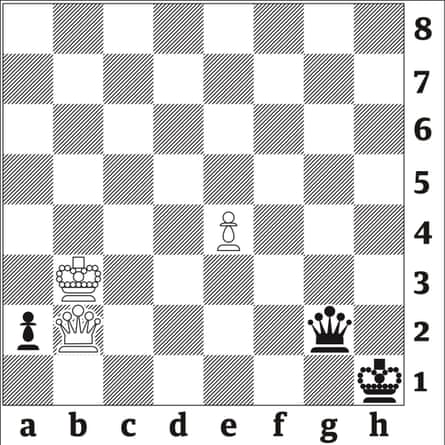
3882: Wang Hao v Boris Gelfand, Beijing 2013. Black to move and win. In the actual game, Gelfand overlooked the winning sequence and drew tamely by 1...Qxe4 2 Qxa2.

For Praggnanandhaa, this World Cup has still been a major success. He now qualifies for the 2024 Candidates, the eight-player tournament to decide the challenger to China’s Ding Liren. He is the third youngest Candidate ever, behind only Carlsen and Bobby Fischer. In the race among the rising young generation, he has gained ground against his rivals Alireza Firouzja, Dommaraju Gukesh and Nodirbek Abdusattorov.

The third place playoff was a triumph for the US champion and world No 2, Fabiano Caruana, who had been upset by Praggnanandhaa in the semi-finals. Caruana was still in shock in his first game against the hometown hero Nijat Abasov when 23...f5! would have been fine. Three moves later, he resigned in the face of 26...exf5 27 Nf6+! gxf6 28 Qxh6+! Kxh6 29 Rh3 mate.

Then Caruana fought back strongly, grinding out a difficult endgame win in game two, and winning the final two games by fine attacking for a 3-1 scoreline. Both players qualify for the 2024 Candidates.

The Women’s World Cup went to Russia’s No 2 seed, Alexandra Goryachkina, who defeated the surprise finalist, Nurgyul Salimova, by 1.5-0.5, after the Bulgarian failed to spot an easy drawing chance late in their marathon 105-move second game. Goryachkina narrowly missed the world crown in 2020 when she lost a title match to China’s Ju Wenjun by 7.5-8.5 after being ahead at one stage. For the future in women’s chess, there could be greater Western interest as two rising stars are Eline Roebers, 17, from the Netherlands and America’s Alice Lee, 13.

The Northumberland Masters, the premier chess event in the north, takes place at Newcastle this weekend, with opportunities for Fide title norms and a £600 bonus pool donated by Mark Jordan, a former English Chess Federation publicity manager. GMs Keith Arkell and Danny Gormally are among the top seeds. Play can be followed live and free on chess24.com.


Several English players have been campaigning for GM norms and titles this summer. Three norms and a 2500 rating are needed, which is proving a stiff task for Harry Grieve, 22, and Peter Roberson, 34 (two norms each), Matthew Wadsworth, 23, and Shreyas Royal, 14, (one each) and Jonah Willow, 20 (no norms yet but some near misses). Of these, Wadsworth and Willow are competing at Newcastle.

England’s likely next GM, however, is Ameet Ghasi. The 36-year-old, whose family is from Kashmir and whose twin brother, Sumeet, is also a strong player, was a youthful prodigy who won the British Rapidplay at only 13, still an age record. Then he decided to give priority to his studies, abandoned chess for a decade, took a biochemistry degree at Birmingham, and qualified as an accountant. Returning in 2011, he swiftly gained his IM title and has since further improved his rating, mainly via games in the national 4NCL league, to its current 2506. He already has two GM norms from Southend 2023 and Wood Green 2023, so just needs a third for the title.

Ghasi’s playing style used to be patient grinds from closed openings, perhaps influenced by Mir Sultan Khan, who came to the UK from what is now Pakistan in the late 1920s, reached the world top 10 and beat José Capablanca in a marathon at Hastings. Sultan also preferred slow openings from which he could outplay opponents in strategical middle games.

Ghasi has gradually evolved to a more universal style, and won this incisive attacking game at his latest tournament, the King Mohamed VI Open in Casablanca, Morocco, the venue for the chess scene in Humphrey Bogart’s famous film.

At halfway in Casablanca last week Ghasi had an unbeaten 3.5/5, including a fighting draw against Alexey Shirov, the former world title challenger, and was on course for his third GM norm, before fading to 5/9 against the uniformly high-class opposition. A near miss, and his time should soon come.

The 22-year-old British woman champion, Lan Yao, who at Leicester achieved her WGM title and missed an IM norm by only half a point, tries again on 2 September at First Saturday Budapest, the city where she scored her first WGM norm in 2017.

3882: 1...Qg8+! 2 Kc2 (if 2 Kb4 Qb8+ 3 Kc3 Qh8+ and 4...a1=Q+) Qc4+ 3 Kd2 Qf1! 4 Qh8+ (if 4 Qxa2 Qf2+ and Qxa2) Kg1! wins after 5 Qg7+ Qg2+ or 5 Qd4+ Qf2+.

"Blue supermoon" will be the biggest and brightest of 2023

On the night of August 30, 2023, the biggest and brightest full moon of the year – the “blue supermoon” – will make its glorious appearance in the night sky. The term “blue supermoon” is not just a poetic label; it captures a rare convergence of three distinct lunar phenomena. 

As explained by Gordon Johnston from NASA’s Solar System Exploration, the upcoming full moon is a merger of a supermoon and a blue moon that is in alignment with the Hindu festival Rakhi Purnima.

Saturn will dance with the supermoon

On August 30th, as the Earth-based longitude shows the moon in perfect opposition to the Sun, it will light up the night at 9:36 PM EDT. 

The ringed planet Saturn, a few days from its brightest stance for the year, will gracefully accompany our rare blue supermoon. 

Observers can look for Saturn five degrees to the upper right of the Moon as evening twilight ceases at 8:42 PM. The duo will then appear to dance, with Saturn swinging clockwise around the Moon throughout the evening, according to NASA.

What makes this blue moon super?

But why is this moon termed “super”? The supermoon phenomenon refers to the moon’s closeness to Earth during its full phase, making it appear more substantial and brighter. 

Various publications have different criteria for designating a moon as “super,” but both of August 2023’s full moons meet these requirements.

Second full moon of the month

Diving into the “blue” of the blue supermoon, it’s not about the color. Instead, it references this being the second full moon of August. 

This terminology can be traced back to a 1946 Sky & Telescope magazine definition. Intriguingly, the more aged definition from the 1500s designated the third full moon of a four-moon season as the Blue Moon. 

By that criteria, the blue status would belong to the full moon of August 2024. For those curious about witnessing a truly blue-tinted moon, history did record such a spectacle, which can be discovered in-depth on NASA’s site.

Rakhi Purnima

Synced with this lunar event is Rakhi Purnima or Raksha Bandhan, a Hindu festival celebrating the unbreakable bond between siblings. The ritual involves sisters tying a rakhi (a cotton bracelet) around their brothers’ wrists and receiving gifts in return. This act symbolizes the enduring bond and mutual protection between them.

For those who follow traditional solar and lunar calendars, this full moon signifies various important timings. In the Chinese calendar, it marks the middle of the seventh month, while in the Islamic calendar, it’s Safar. 

Jewish observers will note this full moon during Elul, a significant time of introspection and preparation for the forthcoming High Holy Days of Rosh Hashanah and Yom Kippur.

While celestial attire is recommended for full moon viewing, it’s also a great time to cherish family ties, release resentments, and wish for a prosperous year ahead.

Upcoming lunar events

Looking forward as summer transitions into fall, the periods of daylight will decrease rapidly, reaching a turning point at the autumn equinox. 

No significant meteor showers are anticipated in this lunar cycle, but there will be other starry sights. The evening sky of August 30 will showcase Vega, a luminary of the Summer Triangle and one of the brightest in our sky, shining from a distance of 25 light-years away.

August’s second full moon stands out among 2023’s lunar events. It’s not only the third supermoon of the year but also the closest. At a mere 222,043 miles (357,344 kilometers) from Earth, it trumps even the August 1 full moon by a slim margin of 115 miles.

On September 29, be on the lookout for the Harvest Moon, which will be the final supermoon of 2023.

More about the Harvest Moon

Next month’s Harvest Moon holds special significance in various cultures due to its association with the harvest season. Here are some pieces of folklore and traditions surrounding the Harvest Moon:

Bright nights

The Harvest Moon rises at roughly the same time for several nights in a row, which means that there is no prolonged darkness between sunset and moonrise. 

This phenomenon provided farmers with extended periods of light, allowing them to work late into the evening to harvest their crops.

Symbol of abundance

In many cultures, the Harvest Moon is seen as a symbol of abundance, prosperity, and completion. It’s a time to celebrate the bounty of the earth and to give thanks for the food that will sustain people through the winter.

Festivals

Many cultures hold festivals or celebrations during the time of the Harvest Moon. For instance, in East Asia, the Mid-Autumn Festival (or Moon Festival) is celebrated with mooncakes, lanterns, and family gatherings.

Romance

The bright and large appearance of the Harvest Moon has also given it romantic connotations. In literature and popular culture, it’s often depicted as a perfect backdrop for lovers, symbolizing warmth and hope.

The unexplained

Full moons have often been linked in folklore to strange or unexplained behavior, both in humans and animals. Some believe that full moons can lead to more erratic behavior, though scientific evidence is limited.

National Dog Day: Celebrating all the ways that dogs make life better

National Dog Day is celebrated on August 26th every year in the United States. It is a day to celebrate all breeds of dogs and to recognize the irreplaceable roles they play in our lives. 

It is a day to show appreciation for working dogs that protect us and provide invaluable services, such as guide dogs, therapy dogs, search and rescue dogs, and police dogs.

It’s also a day to raise awareness about the number of dogs that need to be rescued and adopted. Many people celebrate by spending extra time with their dogs, posting pictures on social media, or even adopting a new pet.

History 

National Dog Day was founded in 2004 by animal welfare advocate and pet lifestyle expert, Colleen Paige. 

The date of August 26th was chosen because it’s the date that Paige’s family adopted her first dog “Sheltie” from the local animal shelter when she was 10 years old.

How dogs help humans

Dogs are known for their loyalty and faithfulness and have been companions to humans for centuries. They play many roles in our society as helpers, protectors, and companions.

Dogs offer unconditional love and can improve mental well-being. Additionally, they encourage physical activity through walks and play. Some breeds assist in tasks like hunting, herding, or policing, while service dogs can help individuals with disabilities. 

Companionship

Dogs are loyal and loving companions, providing emotional support and reducing feelings of loneliness.

Physical activity

Taking care of a dog involves regular walks and playtime, which helps in keeping the owners physically active.

Mental health

Spending time with dogs has been shown to reduce stress, anxiety, and depression.

Security

Dogs are often protective of their owners and can provide a sense of security.

Assistance

Some dogs are trained to assist people with disabilities, such as guide dogs for the visually impaired or service dogs for people with other physical or mental challenges.

Work

Dogs are used in various professional capacities, such as search and rescue, police work, and herding animals.

Bond between humans and dogs

The bond between humans and dogs is one of the most mutually beneficial relationships in the animal kingdom. It is thought to have existed for thousands of years, dating back to when humans first domesticated wolves. Over time, this relationship has evolved and strengthened, leading to the domestic dog species we know today.

Emotional Bond

Dogs are known for their loyalty and affection. They often form strong emotional bonds with their human owners, providing companionship and reducing feelings of loneliness. Humans often view dogs as members of their family. 

Communication

Both humans and dogs have developed ways to communicate with each other, both verbally and non-verbally. Dogs have learned to understand human gestures, facial expressions, and tone of voice, while humans have learned to interpret a dog’s barks, growls, and body language.

Mutual benefits

The relationship between humans and dogs is mutually beneficial. Dogs provide companionship, emotional support, and security, while humans provide food, shelter, and care. 

Trust and dependence

Over time, a sense of trust and dependence develops between a dog and its owner. Dogs often look to their owners for guidance and support, while owners often rely on their dogs for companionship and protection.

Ways to celebrate:

  • Adopt a dog: Many people choose this day to adopt a new furry friend from a shelter.
  • Volunteer: Some people spend their day volunteering at a local animal shelter.
  • Pamper your dog: Many dog owners pamper their pets with special treats, new toys, or a long walk in the park.
  • Social media: Share photos and stories of your dog on social media using the hashtag #NationalDogDay.

National Dog Day is not only a day to celebrate and appreciate the love and joy that dogs bring into our lives, but also a day to raise awareness about the thousands of dogs that are in shelters waiting for a loving home.

It is a time to celebrate and honor the various ways dogs make our lives better, and to encourage responsible dog ownership and care.

—-

Check us out on EarthSnap, a free app brought to you by Eric Ralls and Earth.com.

Animal diversity can be monitored by collecting DNA from leaves

Since global biodiversity loss is currently accelerating at an unprecedented rate, tracking changes in wildlife is crucial for informing adaptive management strategies and conserving biodiversity. 

Moreover, since the majority of emerging infectious diseases have their origins in wild animal populations, understanding which animal species are where is needed for estimating and potentially reducing the risk of disease spillover into human populations.

Collecting animal DNA 

In a new study published in the journal Current Biology, an international team of scientists has employed a simple yet innovative method of monitoring species compositions in specific regions: sampling DNA from leaves, a technique inspired by recent findings that animal DNA can be sampled from air.

“If animal DNA is in the air all around us, perhaps it settles and gets stuck to sticky surfaces like leaves,” said senior author Jan Gogarten, an expert in the ecology and evolution of infectious diseases at the University of Greifswald

“The rainforest and its plants are often called ‘the lungs of the planet.’ Could the lungs of the planet represent the ideal place to sample settling DNA from air?”

How the research was conducted 

The researchers tested this idea in the Kibale National Park in Uganda, which is well known for its rich biodiversity and has attracted biologists for decades. 

Armed with 24 cotton buds, the scientists started swabbing leaves for three minutes with each of them, aiming to collect samples from as many leaves as possible within the timeframe.

“To be honest, we did not expect great results,” said lead author Christina Lynggaard, a molecular ecologist at the University of Copenhagen. “The rainforest is hot and humid and these are conditions that cause DNA to quickly degrade.”

What the researchers discovered 

However, when the results came back from the DNA sequencer, the researchers were amazed. “We found DNA from an absolutely staggering diversity of animals in those 24 cotton buds – over 50 species of mammals and birds and a frog. And all from just a total of 72 minutes of swabbing leaves,” Gogarten reported.

The analysis detected an average of nearly eight animal species in each of the cotton buds, spanning a wide diversity of mammals and birds from the massive African elephant to a tiny species of songbird. 

Some of the animals that were detected included the hammer-headed fruit bat, an amazing creature with a wingspan of nearly a meter, various species of monkeys such as the elusive L’Hoest’s monkey and the endangered ashy red colobus, as well as a diversity of rodents such as the forest giant squirrel, and birds like the great blue turaco and the endangered grey parrot.

Wildlife management strategies 

“This diversity of detected animals and the high animal detection rate per swab showcase that animal DNA can be readily sampled from leaves,” Gogarten said. “The high detection rate and the ease of sampling can make swabbing a new tool with which to inform wildlife management strategies.”

Currently, animals worldwide are facing significant threats from human activities, leading to severe biodiversity loss, particularly in tropical regions. This worrisome trend has far-reaching consequences for the essential services and functions these ecosystems provide, such as seed dispersal or pollination. 

Thus, careful monitoring of animal populations is crucial for understanding the scale of recent ecosystem changes and for guiding the development of effective management strategies.

Moreover, knowing the location of various animal species is crucial for assessing the risk of spillover in areas where wildlife can get into contact with humans.

Study implications 

“With numerous factors rapidly changing on our planet, understanding how they influence wild animal populations is a complex yet critical task, and we anticipate that DNA detected with leaf swabs can provide us valuable insights,” Gogarten said. 

“We know that many animals live in these dense rainforests, but we rarely see them, and their changing distributions are really difficult to map. This remarkably straightforward sampling method gives us an efficient tool to make the unseeable seeable.”

“Leaf swabbing itself does not require fancy and expensive equipment or lengthy training to carry out, and so it can easily be carried out by citizen science programs. During the COVID-19 pandemic, testing required automated extraction of nucleic acids from millions of swabs per day, and the analytical devices were spread to every corner of the planet. What if these instruments could be repurposed for using swabs to monitor animals on a massive scale?” Lynggaard concluded.


The indiscriminate devastation of Canada's raging wildfires

  • Published

    Joanna Kelly is a barrister in the Kelowna law courts - this week she's been given permission to appear in legal cases by video-link partly because she has very few formal clothes to wear. They, and most of her other possessions, went up in flames last week.

    On her mobile phone, Joanna watches a grainy video of what used to be her house with Duncan Vickers - her friend and neighbour for decades. They're now evacuees in Canada's worst ever wildfire season.

    Joanna says they had never seen anything like the inferno that tore through their Okanagan valley community, in the western province of British Columbia, destroying almost everything in its path, including their homes.

    "It was blindingly bright and then it would get into a house," says Joanna, as she describes watching the wall of fire from a vantage point on the other side of the lake. "There was a raging fire going through a skeleton-like building and it went from one to the next until there were dozens of destroyed structures."

    Her next-door neighbour Duncan, who emigrated to Canada in the 1970s, lost most of what he had built and owned - including his father's World War Two medals. But, says Duncan, showing some of his native Yorkshire stoicism, his family is safe and everything else has to be put into perspective.

    "I got my cars out, which is important," he says. "It's terrible, but you've got to be philosophical about these things."

    It's still too dangerous and risky for Duncan, Joanna and other residents who lost their homes to return and pick up the pieces. But, from the vantage point of a boat on the lake, the devastation is clear to see.

    Image caption,
    Duncan Vickers and Joanna Kelly both lost their homes in the recent blazes

    What's apparent is the indiscriminate nature of the wildfires. In parts of the waterfront communities, where houses back onto the forests, several homes have been completely destroyed by fire. House after house has been gutted. But then, all of a sudden, you come across buildings only yards away that have been barely touched by the blaze and are completely habitable.

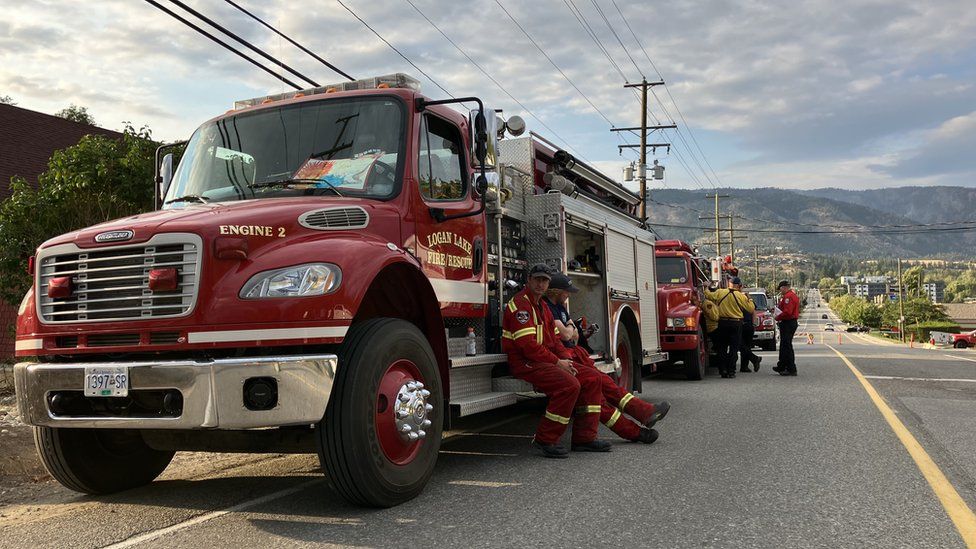
    Via security cameras, streamed to devices or phones in safe locations, some residents could watch and listen, helplessly in real time, as their houses burned. It's a testament to local rescue services that no lives were lost. Jason Brolund is the local fire chief and was on the frontline with his crews in often perilous situations.

    "There were times when our staff were surrounded on all sides by fire," says the chief. "They would not say they were 'trapped' but there's no question it's been dangerous. We saw dramatic fire behaviour, with winds ripping up trees by their roots and laying them down like toothpicks."

    Most alarmingly, Chief Brolund wonders about how his relatively small department can cope with an ever-expanding fire season. Normally the team would be dealing with a relatively small number of blazes in July and August. Now, he says, they can be fighting wildfires from March to November.

    He and many others with years of experience in this field are in no doubt that the increasing impact of human activity on the environment must bear much of the blame.

    Image caption,
    Fire chief Jason Brolund says he's concerned at the increasing intensity of Canada's wildfire season

    There have been more than 1,000 wildfires across Canada in the last week - a record number. As he toured a local evacuation centre I asked the province's premier, David Eby, if he thought that climate change might be partly responsible for the spike in such incidents.

    "Without a doubt," said Mr Eby. "The ferocity of the fires and the extent of the burning, not just here in British Columbia, are clearly linked to human-caused climate change. We're in the fourth year of drought here and that's making the fires so much worse."

    The biggest fires may have been tamed, but there is still a significant threat as new seats of fire start up at various places in the tinder-dry forest. I watched as a small team of helicopters swooped over a local lake, scooping up water in huge buckets to try and douse a big fire on the other side of the valley that was clearly of concern to the authorities.

    The helicopters flew and dropped water virtually from dawn till dusk and were back again the next day.

    This crisis has undoubtedly strengthened the bond between the fire crews and a grateful public, who gather at fire houses in Kelowna to cheer home the firemen and firewomen after another exhausting day in the forest.

    But most people here are under no illusion that the number and frequency of wildfires will become more common in the future.