Saturday, August 26, 2023

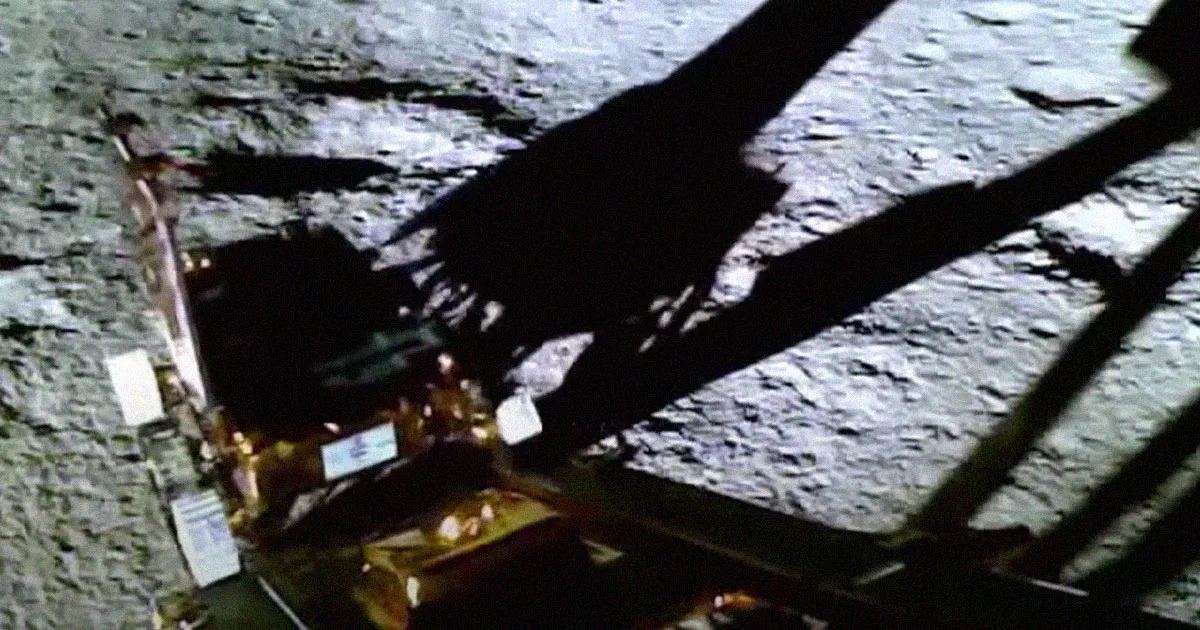
Amazing Footage Shows Indian Rover Ramping Down to the Lunar Surface

Victor Tangermann
Fri, August 25, 2023 

Polar Express

Earlier this week, India became just the fourth country to ever land on the Moon, a historic moment in space exploration.

The Indian Space Research Organization's (ISRO) Vikram lander also became the first spacecraft to ever land near the Moon's south pole, a tantalizing opportunity to examine a region believed to be rich in water ice. Tantalizingly, that makes it a key site for future efforts to establish a permanent presence on the lunar surface.

And now, we get to watch the landing in a fascinating pair of videos released by the ISRO.

The first shows Vikram releasing a 57-pound, six-wheeled rover called Pragyaan — Sanskrit for "wisdom" — down to the lunar surface, where it's designed to explore the area for evidence of ice. The second shows Vikram already rolling across the crater-dotted surface.

It's an incredible feat that signals a new era for international space exploration. As many failed attempts have shown, softly landing a spacecraft on the lunar surface is anything but easy — and India just stuck the landing.

Space Race 2.0

Case in point, the news comes after Russia's efforts to land its Luna-25 spacecraft on the Moon ended in disaster over the weekend. The spacecraft crashed into the Moon due to an "emergency situation," foiling the country's efforts to follow up on the Soviet Union's Luna missions, which date back to the 1970s.

Moving forward, India's mission could prove once and for all what scientists have long suspected: that the Moon's craggy polar regions could hold vast stores of water, particularly in shadowed corners of its massive craters.

While it's not the first time we've seen a rover set off on the surface of the Moon, Vikram's landing could signal the beginning of a new stage of the ongoing space race. With the US and China's plans to explore the Moon well underway, India just became a big part of our future efforts to establish a permanent presence on the Moon as well, shifting the international balance of power on our planet's natural satellite.

And more countries could soon follow. Japan's space agency JAXA is already lining up an attempt to land on the Moon with its Smart Lander for Investigating Moon (SLIM), which is scheduled to launch tomorrow.

More on the landing: India Just Became the Fourth Ever Country to Land on the Moon

Julian Assange supporters to protest his extradition in the metaverse

Jeremy Corbyn among 'avatar' speakers at virtual event


Brian McGleenon
Fri, 25 August 2023 

Supporters of WikiLeaks founder Julian Assange have organised a political rally in the metaverse to protest against his extradition.

A pre-recorded virtual avatar version of Assange will address attendees at the protest on Saturday. Also giving speeches via their own virtual avatars, will be Julian's wife Stella, WikiLeaks co-founder Kristinn Hrafnasson and Labour MP Jeremy Corbyn.

The event, organised by the Don’t Extradite Assange Campaign, will take place within the Wistaverse, located in the Sandbox metaverse, on the Polygon (MATIC-USD) blockchain.

John Rees from the Don't Extradite Assange campaign said the benefit of holding a metaverse mass protest is that, "no matter where you are in the world, you can virtually join this event.”

He told Yahoo Finance UK's The Crypto Mile that this "first of its kind" event would not replace physical protests on the streets of major cities, but would complement the ongoing campaign.

"We have had the metaverse environment designed as a replica of the real Royal Courts of Justice, so that people attending this event will get the idea it would be a good thing to turn up outside the real court on the day that Julian appears," he said.

Rees said he is hopeful they will get thousands of people to virtually attend from across the globe.

"This is a pioneering form of political action, and if it works I'm sure we will not be the only ones to repeat it," he added.

John Rees from the Don't Extradite Assange campaign said the metaverse event would not replace physical protests on the streets of major cities, but would complement the ongoing campaign to free Julian Assange. Photo: Adam Berry/Getty
Assange faces extradition to the US

The rally is part of the effort to prevent the founder of WikiLeaks from being extradited to the US where he could face a 175 year jail sentence for revealing information about the Iraq and Afghan wars through his platform WikiLeaks.

WikiLeaks and Assange became the subject of global interest in 2010, when a series of leaks provided by US army intelligence analyst Chelsea Manning were published on the platform.

The leaks contained 75,000 documents related to the war in Afghanistan, and roughly 390,000 army field reports concerning the war in Iraq.

Assange has now served four years in the UK's Belmarsh prison.
UK
Arm staff to enjoy $2.5bn windfall from flotation


James Titcomb
Fri, 25 August 2023 

Arm's chief executive, Rene Haas, is expected to received a $20m cash award and a further $20m as a result of the listing
 - David Paul Morris/Bloomberg

Employees at the British semiconductor giant Arm are braced for a $2.5bn (£2bn) windfall from the company’s New York flotation as lucrative share awards are unlocked.

Staff have millions of restricted share units – compensation that converts to shares over time – according to company documents.

It translates to an average reward of more than $400,000 for Arm’s 5,963 employees, although the figures include executives who are each likely to secure millions as well as former workers.

Arm, the Cambridge-based company whose microchip designs feature in 99pc of the world’s smartphones as well as countless other devices, filed for a Nasdaq flotation last week.

At a rumoured $70bn valuation it is likely to be the biggest float in two years and is being seen as a catalyst for a moribund tech market.

Arm’s listing document outlines 38.7m in restricted stock units (RSUs) under various employee schemes, which the company says it expects to settle in shares.

This represents between 3pc and 4pc of Arm’s existing shares, or around $2.5bn at a $70bn valuation. Many of the shares will be subject to a 180-day lock-up period, preventing staff from selling until months after the flotation.

Arm paid staff around $298m in cash this year related to earlier share awards.

Staff were expected to receive $1.5bn under a $40bn takeover from the Silicon Valley microchip company Nvidia announced in 2020.

The company abandoned the deal last year under pressure from regulators, leading Arm to pursue a floatation.

Almost half of Arm’s 5,963 employees are based in the UK. Numbers have fallen after the company made 436 staff redundant last year.

Staff who lost their jobs were offered the chance to keep hold of their shares or take a cash payment at a valuation likely to be significantly lower than the company’s floatation price.

Rene Haas, Arm’s chief executive, is receiving a $20m cash award and a further $20m in shares as a result of the flotation, while two other executives will receive a combined $35m.

Last week, Arm’s Japanese owner SoftBank bought the 25pc stake in Arm it did not already own from the separate SoftBank Vision Fund at a price that gives Arm a valuation of $64bn.

Bankers are expected to embark on an investor roadshow in the next few weeks with the flotation’s value confirmed next month.

Elliott Management paid UK staff average of £1.3m each in 2022

Kalyeena Makortoff Banking correspondent
Thu, 24 August 2023 

Photograph: Mike Blake/Reuters

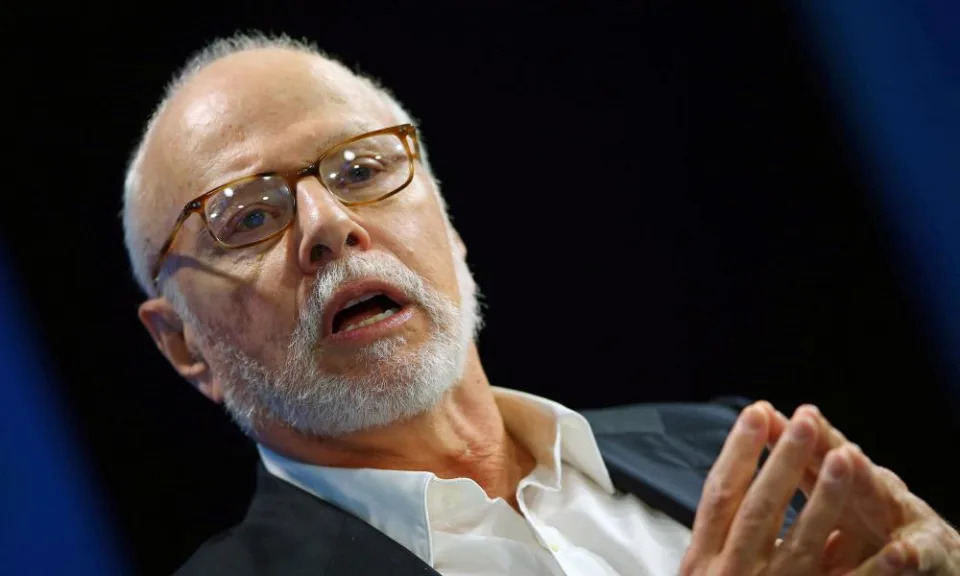
The US hedge fund and notorious activist investor Elliott Management paid its 124 UK staff a combined £160m last year, after a 10% rise in annual profits.

The pay pot is higher than the £137m shared by employees the previous year, and comes after its UK operation, Elliott Advisors UK, reported pre-tax profits up by a tenth to £10m. Turnover for the firm, which made headlines after throwing its hat into the ring to buy Manchester United earlier this year, rose 16% to £225m.

Elliott, which is the world’s largest activist hedge fund and is led by the billionaire Republican party donor Paul Singer, is best known for its aggressive corporate and political battles, famously chasing the Argentinian government for debts for more than decade.

Over the past 18 months, the group not only entered into talks to buy a Premier League team, but also took a multibillion-dollar stake in Salesforce, the owner of the Slack messenger platform. It also launched a lawsuit against the London Metal Exchange (LME) over its its controversial decision to cancel nickel trades after a rise in prices linked to the invasion of Ukraine.

Elliott has alleged that the decision may have violated its human rights. The LME previously said it believed Elliott’s claim was without merit and would “contest it vigorously”.

Filings at Companies House show the average payout per UK staff member held steady at £1.3m in 2022, after the firm increased its headcount from 106 to 124 last year.

Elliott’s three top directors shared a smaller pot last year, worth around £10.4m, compared with £12.8m in 2021. One of the unnamed trio took the bulk of the payout, earning around £8.9m. That was lower than the top payout of £11.5m in 2021.

Elliott declined to comment.
UK
Union tells KP Snacks before walkout: If you pay peanuts, expect strike action


Alan Jones, PA Industrial Correspondent
Thu, 24 August 2023 


Workers at a factory making KP Nuts will stage a week-long strike in a row over pay.

Members of Unite at the KP Snacks site in Rotherham will walk out on September 5 after voting by 83% in favour of industrial action.

The union said strikes will escalate if an 8% pay offer is not improved.


General secretary Sharon Graham said: “Unite’s message to KP Snacks is if you pay your workers peanuts, expect strike action.

Unite union general secretary Sharon Graham said the firm’s profits have soared while workers’ real-terms pay has fallen (PA)

“The company has increased its profits by an astonishing 275% since 2018 but the workers’ pay has fallen 14% in real terms over the same period.

“That’s why workers are refusing to accept anything less than a pay deal which keeps up with the cost of living.”

Mark Duffy, manufacturing director at KP Snacks, said: I can confirm that following further wage negotiations with colleagues and their representatives at our Hellaby site, our latest pay offer has been rejected and we have been advised by Unite that they will be taking strike action from September 5-12.

“We believe that the offer of 8% with no strings backdated to April 2023 is fair, equitable and ahead of most pay deals this year within the industry.

“We are extremely disappointed to have reached this situation, which is unprecedented for KP, and had hoped to avoid the announced strike and resultant impact on colleagues.

“In the meantime the factory team continue to develop robust contingency plans to minimise the impact on customers and consumers.”
SCOTLAND
Essential school staff to go on strike unless pay deal agreed, says union


Sarah Ward, PA Scotland
Fri, 25 August 2023 


Essential school staff will go on strike across Scotland in the autumn unless a pay deal can be struck, a union has warned.

Workers including cleaners, janitors and support workers represented by Unison have voted to strike in 24 out of the country’s 32 council areas.

It is the largest ever vote for strike action by school staff in Scotland, and the union said there was an “overwhelming vote in favour of strike action in every council” but a 50% turnout had to be met.

Unison balloted school staff working for every council in Scotland over the 5% pay offer from employer body Cosla, and described the response as “unprecedented”.


Workers were due a pay rise in April and have also been offered an additional increase dependent on salary from January 2024 for all local government workers.

Non-teaching school staff who are members of GMB Scotland also balloted to strike last week and have announced strike dates of September 13 and 14 across Aberdeen, Clackmannanshire, Comhairle Nan Eilean Siar, Dundee, East Dunbartonshire, Falkirk, Glasgow, Orkney, Renfrewshire and South Ayrshire.

The 24 councils where Unison strikes are threatened are: Aberdeen City, Aberdeenshire, Angus, City of Edinburgh, Clackmannanshire, Comhairle nan Eilean Siar, Dumfries & Galloway, Dundee City, and East Dunbartonshire.

Also impacted were: East Renfrewshire, Fife, Glasgow City, Highland, Inverclyde, Moray, North Ayrshire, Orkney Islands, Perth & Kinross, Renfrewshire, Shetland Islands, South Ayrshire, South Lanarkshire, Stirling, and West Dunbartonshire.

Unison Scotland’s local government committee will meet next week to take the next steps to prepare for industrial action, which is likely to take place in early autumn.

The union’s secretary in Scotland, Lilian Macer, said: “This is Unison’s strongest ever strike mandate in local government, which shows the level of anger felt by staff.

“The union will do everything possible to get back around the table with Cosla to resolve this dispute.

“School staff would prefer to be in school working with children, not on picket lines and closing dozens of schools.

“But the Scottish Government and Cosla should be in no doubt about the determination of school staff and they’ll do what it takes to get an improved pay deal for all local government workers.”

Unison Scotland local government committee chair, Mark Ferguson, said: “School staff across Scottish local government have voted to strike in unprecedented numbers.

“Cosla must address the union’s calls for improved fair pay that recognises and rewards them for the vital work they do in their communities.

“Cosla leaders are meeting today and, if they fail to address the reasonable demands on the back of such a significant mandate, schools across Scotland will close and nobody wants that.

“Unison remains committed to dialogue and hopes a satisfactory resolution can be found before staff are forced to take industrial action.”

Katie Hagmann, Cosla’s resources spokesperson, said: “We had a good positive meeting of council leaders earlier today at which they once again reiterated how much they value the whole of the local government workforce.

“In relation to this year’s pay negotiations for the SJC (Scottish Joint Council) workforce, we discussed options for concluding these negotiations as soon as the outcome of current ballots are known, and to this end, there was agreement to hold a special meeting of leaders as soon as we possibly can.”

The Scottish Government has been contacted for comment.
Are big cats prowling the UK? What science tells us

Egil Droge, Researcher of Conservation, University of Oxford
Fri, 25 August 2023 
THE CONVERSATION

Exploring the British countryside? Unlikely, says big cat expert. Karel Bartik/Shutterstock

Rumours that there are big cats in Britain stubbornly keep cropping up. The thought of a large predator lurking in the rural landscapes of Britain is an exciting one.

The most recent widely published claim of a big black cat in the UK does actually show a photo of a big cat species, which can be identified by the small ears relative to the size of the head. But this image turns out to have been photoshopped. The original image can be found on Getty Images, using the search term “big black cat sitting in grass”.

Dragonfly Films, the documentary makers who unearthed the photo, did not respond to a request for comment.

Often the story goes that big cats, once held in captivity, were set free to roam the British countryside when it became illegal for people to keep them as pets in 1976.

But the scientific evidence flies in the face of these tales.

First, it didn’t become illegal to keep big cats as pets. It just became a lot harder to keep them legally. In 2022 a survey of local council data found nearly 2,500 dangerous wild animals are kept by private collectors in England, including a cheetah, mountain lion and snow leopard living in Cornwall. You need to get an annual licence from your local authority, the premises have to be inspected and you must get third party liability insurance.

I’ve always been sceptical about these claims that big cats live in the British countryside.

Large cats leave their traces


I’ve worked with large carnivores in Africa since 2007 and it’s obvious if big cats are around. You would regularly come across prints of their paws along roads. The rasping sound of a leopard’s roar can be heard from several kilometres. Livestock, mostly cattle, goats and sheep, would be attacked. Often leopards kill more than one animal in an attack. In Africa, where there are scavengers such as vultures and hyenas who move quickly, leftovers are quickly cleaned up, but you can still regularly find some remains of kills.

Wild prey, such as our large deer populations, wouldn’t completely protect livestock from big cats. There are many studies and reports of livestock being killed by large cats in areas where there also is a lot of wild prey.

Technology is also making it easier for biologists to detect wild animals.

Jaguars, leopards, tigers, snow leopards, both species of clouded leopards, and even lions are now routinely studied with camera traps. A camera trap is automatically triggered by movement within its view, like that from an animal or a human being. These camera traps can reveal information about big cats’ presence, absence, habitat use and preference, activity patterns and even diet.

DNA advancements have made it easier than ever to reveal which species is in an area. A saliva swab from a kill, hairs found on or near a carcass and faeces can show which species, and often which individual animal, left it. Environmental DNA, which is collected from water, soil or even the air, can also be used these days. For example, DNA found in soil in tracks made by animals can confirm the species that left the prints.

Cats often mark their territory using faeces, so they put it in places where they think other animals will notice it, which also makes it easier to find for researchers.

When I was studying wildcats in Zambia, my team often saw female cheetahs and their cubs but rarely encountered males.

With trained detection dogs we surveyed the area and collected faeces the dogs indicated was from cheetahs. DNA analysis revealed the scats came from seven male, and 12 female cheetahs. Without the DNA analysis we wouldn’t have realised so many males were in the area. The DNA analysis also detected more females than we had seen in previous years. In Germany, The Netherlands and Belgium DNA samples taken from faeces, and carcasses of livestock, are routinely taken to see if wolves were responsible for attacks.

However, proof like this can be falsified. You can take photos of a toy. DNA samples like hair can be planted.

The big giveaway

Let’s assume there are big cats roaming free in UK. Large cats like leopards and jaguars have home ranges of several dozen to several hundred square kilometres. There is no reason to believe they would have smaller ranges here. In the UK, there are no uninhabited areas of this size. They would encounter roads, they would cross paths where their paw prints would be noticed by walkers.

If there truly was a big cat on the prowl, the tell-tale sign would be repeated attacks on sheep. As anyone who ever kept a cat would know, cats chase things which move away from them. Big cats are no different and if sheep run away when seeing a big cat, they would chase them, and grab them.

There is no native population of big cats living in the UK. So any such big cats would have been born in captivity and with no hunting experience. Sheep in confined fields would be an irresistible target. Farmers would be quick to sound the alarm, and rightly so.

In July 2023, German authorities launched a full-scale sweep of Berlin and the surrounding woods after a video snippet of a lioness circulated online. No zoos reported a missing animal, yet the report was taken seriously. Shortly afterwards, authorities gave the all-clear. Similarly, in the UK, authorities responded quickly when a young lynx escaped a Welsh zoo in 2017 and killed it upon recapture.

There are sometimes vague photos or videos of big cats, but never clear photos or videos – or clear photos of paw prints, which would be easy to obtain because prints don’t move. But it’s the absence of attacks on sheep in such cases that is remarkable, and a tell-tale sign there isn’t a big cat out there roaming the UK countryside.

This article is republished from The Conversation under a Creative Commons license. Read the original article.


Egil Droge works at the Wildlife Conservation Research Unit, a research group within the Department of Biology at the University of Oxford.


REST IN POWER

Isabel Crook, Maoist English teacher who spent her life in China supporting the regime – obituary

Telegraph Obituaries
Isabel Crook
Canadian anthropologist and educator

Fri, 25 August 2023 

Isabel Crook with Xi Jinping in the Great Hall of the People in Beijing in 2019 after being awarded the Friendship Medal - Wang Ye/Xinhua/Alamy

Isabel Crook, who has died aged 107, was born in China to Canadian missionaries but became an ardent Maoist; she devoted most of her life to the country, working as an English teacher at Peking First Foreign Languages Institute (now the Beijing Foreign Studies University, or BFSU) and collaborating with her husband David Crook, an English communist, on studies of land reform and revolution in rural China.

In 2019 China’s president Xi Jinping presented her with the country’s Medal of Friendship, a prize “reserved for foreigners who have made contributions to China’s socialist modernisation and promoted co-operation with other countries”. The Medal, according to the Canadian Globe and Mail, had only been awarded eight times, recipients including Vladimir Putin, Raúl Castro, former president of Cuba, and Nursultan Nazarbayev, authoritarian president of Kazakhstan.

Politics aside, Isabel Crook and her husband did much good in their adopted country, where they were credited with laying the foundation for foreign-language education, including devising a curriculum and compiling textbooks for English teaching – and helping to equip diplomats of the “New China” with English-language skills. But at the same time they stood accused of wilful blindness to the crimes of the Communist regime.

On October 1 1949 Isabel Crook had been one of the few foreigners invited to see Mao Zedong declare the founding of the People’s Republic, arriving in Tiananmen Square in the back of a Communist army truck. She kept the faith over the next half-century as tens of millions died of starvation or were massacred as a result of such policies as the Great Leap Forward (1958-62) and the Cultural Revolution (1966-76).


Isabel Crook in her younger days

By some estimates between 60 million to 80 million people may have perished due to Mao’s policies, making him responsible for more deaths than Adolf Hitler and Josef Stalin combined. Her husband, Isabel Crook explained, had persuaded her early on that violent revolution was necessary: “He convinced me by saying if you had a very serious acute illness, that could be cured with an operation, would you not have an operation rather than go on suffering?”

The Crooks were imprisoned as suspected spies during the Cultural Revolution. But nothing could shake their faith. There would, David Crook wrote to an American friend from Qincheng prison, be “painful experiences” during a revolution: “But the gains are the overwhelming aspect, not the losses.” Isabel, who was arrested in 1968, recalled writing to their friends abroad after her husband’s arrest the previous year, that “David has gone to the countryside to teach the peasants. I wasn’t going to give anyone the satisfaction of gloating over China’s difficulties.”

Recalling her own incarceration in a 2019 interview with Nicholas Shakespeare in The Spectator, Isabel Crook said, “When I was locked up, I read Volumes I-IV of Mao’s complete works three and a half times... I loved his rare shafts of humour.”

Isabel Brown was born on December 15 1915 in Chengdu, the capital city of south-west China’s Sichuan Province, to Homer Brown, dean of education at West China Union University, and his wife Muriel, née Hockey, who ran kindergartens and schools for disabled children. At the time of Isabel’s birth China’s last emperor, Puyi, was still living in the Forbidden City after abdicating three years earlier.


The Crooks' 1979 book

As a child, Isabel became interested in China’s many ethnic minorities and, she wrote later, “sharply critical of the lifestyle most of the missionaries led, with their large houses, many servants and imported comforts which contrasted with the far lower standard of living of their Chinese fellow Christians”.

After graduating in sociology and anthropology at Toronto University, in 1938 she returned to China, where she carried out anthropological fieldwork in villages in south-west China. “It was then I first came to realise revolution was needed for the poor farmers,” she recalled.

It was in the summer of 1940 that she met David Crook, a committed member of the British Communist Party who had fought as a volunteer in Spain, been recruited to Stalin’s NKVD and sent to China during the Second Sino-Japanese War. “I wanted to find something to do, a cause,” Isabel recalled. “I wrote to my mother and I said: ‘Please send me some of those religious books so I could get a cause.’ I read them. I didn’t get any cause. And it was just at that time that I met David Crook, and he was a communist. And when he talked... I liked passion. I decided that my cause would be communism.”

They married in London in 1942. David then joined the RAF and served during the war in India, Ceylon and Burma while Isabel joined the British Communist Party and served as a nurse in the Canadian Women’s Army Corps.


Prosperity's Predicament revisited research Isabel Crook had undertaken decades earlier

At the end of the war, inspired by Edgar Snow’s book Red Star Over China (1938), they returned to the country, then in the throes of civil war between the Chinese communists and nationalist Kuomintang, and in 1947 evaded a nationalist blockade to cross into a Communist-controlled area in northern China. After presenting a letter of introduction from the British Communist Party the couple was able to settle in Shilidian (“Ten Mile Inn”) – a village in Hebei province where, as Isabel recalled, they “first experienced the salutary practice of criticism and self-criticism”.

“We ate millet and sweet potatoes, wore suits of homespun cloth, lived in peasant homes and slept on kangs, heatable brick beds... We were witness to the land reform which soon spread across China in a movement which changed history,” she recalled in an autobiographical piece. Based on their study, the couple wrote a book entitled Revolution in a Chinese Village: Ten Mile Inn, published in London in 1959.

The book was praised by the Communist Party of Great Britain as a “seminal work, which has been bringing the achievements and challenges of the Chinese agrarian revolution to life for English-speaking readers”. In fact during the land reform period, landlords were subjected to mass killing by the CCP and former tenants, with the estimated death toll ranging from hundreds of thousands to millions. Mao himself estimated that as many as 2-3 million were killed.

The Crooks returned to Shilidian several times, reporting on progress in The First Years of Yangyi Commune (1966) and Ten Mile Inn: Mass Movement in a Chinese Village (1979), studies which, Beverley Hooper observed in Foreigners under Mao (2016), were regarded by non-leftist reviewers as “as much reflections of the authors’ revolutionary romanticism as scholarly analysis”.

In 1948 they were planning to return to Britain to write up their research but were asked by the Central Committee of the Chinese Communist Party to stay to teach English to future diplomats at a new foreign affairs school in Beijing. From the outset, they insisted on being “regular members” of the teaching staff, so that they could become, in Isabel’s words, “participants in the Chinese revolution at the grassroots level”.

In 1958, during the Great Leap Forward, the Crooks were sent for three weeks of agricultural labour to a remote village, David describing the work as “a kind of redemption... poetic justice for Britain’s pillage of China”.


Isabel Crook, then aged 103, is carried into the Great Hall of the People in Beijing in 2019 to receive her Friendship Medal from Xi Jinping -
Liu Bin/Xinhua/Alamy

He was clearly aware of the subsequent terrible famine when an estimated 30 million people died of starvation, but placed most of the blame on adverse natural conditions, admitting that he felt “bound more than ever to be loyal and unquestioning”. Thereafter, apart from the period in which they were locked up during the Cultural Revolution, they remained at the school from its inception to their retirement in the 1980s.

They struck a rare note of dissent in 1989 when they visited student hunger-strikers in Tiananmen Square with bottled water and plastic sheets, and wrote to the communist People’s Daily hoping “that no attempt will be made by China’s leaders to settle the present crisis by force”.

After David’s death in 2000, Isabel, who continued to live in a modest apartment on the BFSU campus, revisited the research she had begun before they met and in 2013 published Prosperity’s Predicament: Identity, Reform, and Resistance in Rural Wartime China (1940-1941), with Christina Gilmartin and Yu Xiji.

In 2019 a new Chinese ambassador to Canada held Isabel Crook up as an example of good bilateral ties between the two countries, a year after two Canadians – a former diplomat and a businessman – had been incarcerated by Beijing on allegations of espionage. But David Mulroney, a former Canadian ambassador to China, was withering: “Not only is the example of Isabel Crook unlikely to inspire much more than compassion for her suffering on behalf of such an unworthy cause, but... we are also reminded that the Communist Party of China has a long history of capriciously locking up foreigners.

“Isabel Crook fits the classic description of what China’s Communist Party calls an ‘old friend’... Such individuals tend to maintain an unwavering devotion to China, despite the fact that another feature common to ‘old friends’ is a long spell in one of Mao’s brutal, Cultural Revolution-era prisons.”

Isabel Crook is survived by three sons.

Isabel Crook, born December 15 1915, died August 20 2023
UK
The natural party of government? After five PMs in seven years, the Conservatives seem all at sea

Geoffrey Wheatcroft
Thu, 24 August 2023 


Late one night in 1867, Benjamin Disraeli, chancellor of the exchequer in Lord Derby’s Tory government, cunningly thwarted a Liberal wrecking amendment in the Commons to his second reform bill. Having written to Queen Victoria at 2am, he went to the Carlton Club, where he was cheered and toasted as “the man who rode the race, who took the time, who kept the time, and who did the trick”. The following year he became prime minister.

Much the same words may have been used in the small hours of 13 December 2019, when Boris Johnson pranced about Conservative central office in London, pumping his fists in the air as his adoring staff and colleagues embraced him. In the less than five months he had been Tory leader and prime minister, Johnson had purged his parliamentary party of some of its best and most honourable people, had precipitated a general election by dubious and possibly unlawful means, had then fought the election on a promise to “Get Brexit done” – and had won the Tories’ largest parliamentary majority for more than 30 years. Here was another leader who had ridden the race and done the trick.

And there the comparison ends. After defeat by William Gladstone and the Liberals at the 1868 election, the Tories returned with a crushing victory in 1874. Disraeli spent six more years at No 10, ending his days as the Earl of Beaconsfield and Knight of the Garter, adored by Victoria, ruefully admired by Bismarck, and with the Primrose League founded in his memory.

Within three months of his own election triumph, Johnson was faced with the pandemic crisis – which he was totally unequipped to deal with – and by the summer of 2022 he had been ejected by his own party, to be replaced by Liz Truss, in an even more absurd and even shorter-lived tenure. In Randolph Churchill’s phrase, Disraeli’s career saw “failure, failure, failure, partial success, renewed failure, ultimate and complete triumph”. Johnson has known enough ups and downs himself, but today, less than four years after his victorious election, his career has ended in ultimate and complete failure, for himself – and maybe for the Tories.

If the fall of Thatcher, or the way it was done, poisoned the party for years, the recent poison was inflicted by the cynicism behind the rise of Johnson. As Dominic Lawson, an intelligent Brexiter, has said, “Boris Johnson was never in favour of Brexit, until he found it necessary to further his ambition to become Conservative leader.” Since the Tories knew that, their relationship with him was always transactional. He was useful for a time, but he was dumped as soon as he became more liability than asset. And yet the Tories are suffering from “long Boris”, a grievous affliction that could still prove terminal.

If Rishi Sunak was meant to offer calm and efficiency after mountebankery and pandemonium, it hasn’t worked. A technocrat isn’t what is needed at present, and the skills Sunak presumably showed while making money as a banker are different from those a political leader requires. He looks more and more “in office but not in power”, unable to cope with everything from the small boats crisis to inflation and low productivity. And one effect of the Tories’ destructive civil wars has been to leave Sunak with one of the most unimpressive cabinets in living memory.

After a torrent of scandals and a string of byelection defeats, this August finds polls in which the Tories are looking at a wipeout in next year’s election. Eighteen years ago I published a book called The Strange Death of Tory England, and was later mocked in the rightwing press when the Tories staged a revival. But maybe that title was only premature.

Modern European political history has seen few things more remarkable than the Conservative party. There has been something called a Tory party in England for 350 years. Its name originally came (with a certain historical irony) from the Irish Gaelic tóraí for an outlaw, thence a Royalist rebel against Cromwell’s murderous oppression, thence again a supporter of the Stuart crown and the Church of England. After the “glorious revolution” had deposed James II in 1688 and the Hanoverians arrived in 1714, the Tories went into internal exile. As AJP Taylor asked, “What sense had ‘church and king’ in an age of latitudinarian bishops and German princes?”

But the Tories had begun to show their remarkable capacity for shapeshifting and chameleon adaptation. By the second half of the 18th century they were in power, by the early decades of the 19th century they were for a time a party of reaction. And yet they soon began to illustrate Bismarck’s dictum about English politics: that progressive administrations take office to pass reactionary measures and reactionary administrations take power to pass progressive measures, notably in the Tory case Catholic emancipation in 1829 and the Second Reform Act in 1867.

Related: Powerless in the face of Britain’s crises, Rishi Sunak has now entered his self-pitying era | Nesrine Malik

A vein of sheer obscurantism could always be found, from Lord Eldon, early in the 19th century, saying that all change was change for the worse, including change for the better, to Lord Salisbury later in the century with his maxim: “Whatever happens will be for the worse, and therefore it is in our interest that as little should happen as possible.”

And yet the Tories refashioned themselves over and again, as a party of patriotism and public welfare, particularly in the 1920s, when Neville Chamberlain laid the foundations for so much of that social security we now take for granted. In the 1950s Rab Butler said that “the Conservatives have never believed in laissez-faire”, and in the 1980s Margaret Thatcher did her best to contradict him. In all, by continually adapting themselves to changing times, the Tories have held office alone or in one form of coalition or another for 90 out of the last 150 years, always displaying a ruthless hunger for power.

Now something has gone wrong, or gone missing. In 2002 Theresa May told the party conference they were in danger of becoming “the nasty party”, but this was a misunderstanding. They have always been that, and as Lee “fuck off back to France” Anderson shows, they still are. But nobody ever voted for the Tories because they were “nice”. Their success was founded not on amiability but on competence, and that’s what has been destroyed by the farcical recent turbulence, with five prime ministers in the past seven years.

For a century and a half the Tories had a plausible claim to be “the natural party of government”. Today, they barely look capable of governing at all. Forty years ago Thatcher brimmed with ideas, some of them right and some of them demonstrably wrong, but the Tories now have no idea at all. They have run out of time, run out of excuses – and maybe run out of purpose.

Geoffrey Wheatcroft is a journalist and the author of The Strange Death of Tory England. He is writing a further book about the Tories’ recent turmoil and implosion
UK
Public expects Starmer will become prime minister, poll finds

Christopher McKeon, PA Political Reporter
Fri, 25 August 2023 

A majority of the public expects Sir Keir Starmer to become prime minister, a new poll has found.

Some 56% of people told pollster Ipsos UK they thought it was “likely” the Labour leader would succeed Rishi Sunak, with only 28% saying they thought it was unlikely.

That figure equals the previous high point for Sir Keir recorded in October 2022, amid chaos on the bond market and the collapse of Liz Truss’s government.

The poll of 1,038 British adults, conducted between August 11 and 13, painted an almost universally positive picture for Labour – and a bleak one for the Conservatives.

As well as public expectation that he will become Prime Minister, Sir Keir continued to lead Mr Sunak on favourability by 30 points to 27, and outpolled his opponent on all but three of 12 key traits Ipsos asked about.

These included whether the two leaders understood the problems facing Britain, with 47% saying Sir Keir did against 32% saying the same of the Prime Minister.

Some 37% said Sir Keir was in touch with ordinary people, against just 17% saying Mr Sunak was, while the Labour leader enjoyed a six-point lead on whether he would make the country a better place.


A majority of the public said it was clear what Rishi Sunak stands for, but the Prime Minister trailed his opponent on most questions in the Ipsos poll. (Yui Mok/PA)

The two men were tied on 37% as to whether they pay attention to detail, while Mr Sunak led by one point on whether they had “a lot of personality” and by five points on being good in a crisis.

Mr Sunak began his premiership with relatively good favourability ratings, especially compared with his wider party, and some suggested he would therefore be able to improve the Conservatives’ ratings.

However, the Ipsos poll suggests that that has not been the case so far, with Labour the only party to enjoy a net positive favourability rating and 53% of people saying they had an unfavourable image of the Conservative Party.

With just 23% of people saying they had a positive image of the Tories, only Reform UK recorded a worse net favourability rating.

One brighter spot for Mr Sunak is that voters seem much clearer about what he stands for than they do about Sir Keir, with 52% to 46%.

Keiran Pedley, Ipsos director of politics, said: “As it stands, the British public expect Keir Starmer to be Prime Minister. A majority are unfavourable towards the Conservative Party and Starmer leads Rishi Sunak on several key leadership traits.

“However, with many still unsure what Starmer himself stands for, the Labour leader will hope he can set out a compelling vision for the country in the coming months to seal the deal with the electorate.”

'Likely to cause offence': Anti-monarchy billboards blocked by media giant, Alba say


Xander Elliards
Fri, 25 August 2023 

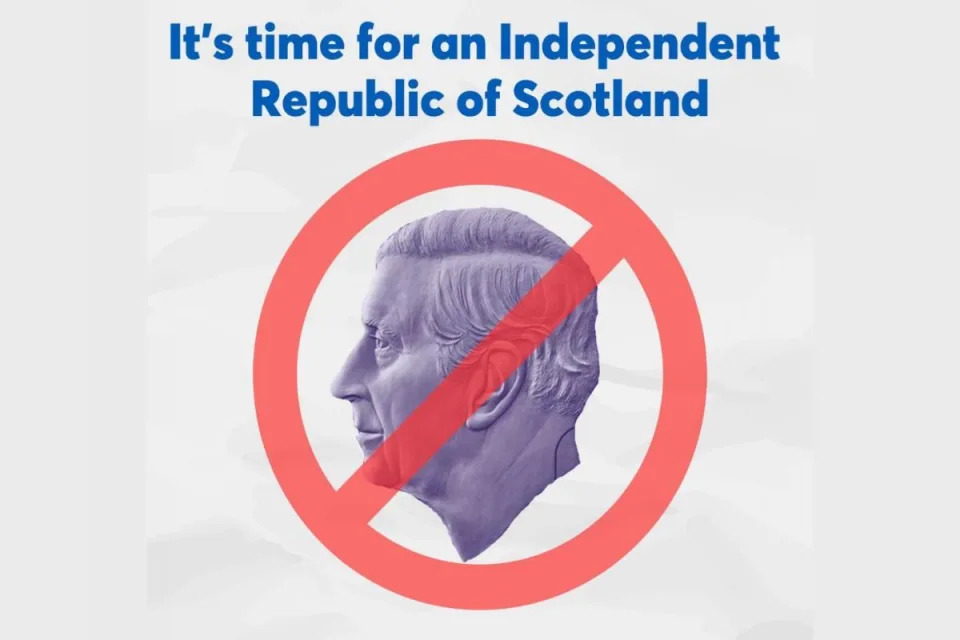
Alba had looked to place anti-monarchy billboards with the media giant Global
 (Image: Alba)

A MEDIA giant has rejected an anti-monarchy billboard from Alba, saying it may cause offence.

Global, which runs radio stations LBC and Heart as well as a large outdoor advertising arm, said it would not carry the adverts from Alex Salmond’s party.

It comes after the same firm refused to display an Alba advert which depicted Rishi Sunak as a vampire because it “slandered” the Prime Minister, according to an email seen by the BBC.

In a new email seen by STV, Global has rejected a billboard showing a profile of King Charles III, a banned symbol, and the words: “It’s time for an independent republic of Scotland.”

READ MORE: Complaint submitted to Ofcom amid row over Alba's Rishi Sunak vampire advert

Global said in an email to Alba that if the image was “deemed to be politically persuasive with the use of something that is likely to cause offence, likely to get complaints and likely to have to be removed/replaced then we’re told that we can’t carry it”.

Alba said they had offered to redesign the advert to instead include a crown, but Global said this would still be a direct reference to the royals.

Chris McEleny, the party’s general secretary, said: “The Alba Party have already had our campaign in the Rutherglen and Hamilton West by-election interfered with by the blocking of our messaging that aimed to highlight Westminster seizing Scotland’s vast oil resources but with Global having such a huge billboard footprint in Scotland the issue of political censorship is now a growing concern.

READ MORE: Outrage after 'excrement' smeared on Alba Party anti-monarchy billboard

“We have a potential General Election next year and the current situation is that media giants will get to decide which messages the public get to see and which messages they don’t.

“Therefore if you wanted to campaign for an independent Scotland with an elected head of state you wouldn’t be allowed to display an image of King Charles on the advert in fear that it would ‘upset the royals’.

“This is a ridiculous situation to be in – we must not allow interference in our democratic right to campaign in elections.”

Global has been approached for comment.

On Tuesday, The National reported how a complaint had been submitted to Ofcom over Global's radio stations' alleged failure to cover the news that the firm had rejected the Sunak vampire advert.