Sunday, August 27, 2023

WAR ON HUMAN RIGHTS
In Iowa and elsewhere, bans on LGBTQ+ ‘conversion therapy’ become a conservative target


HANNAH FINGERHUT
Fri, August 25, 2023 


Archer Trip tells the Waterloo City Council on Aug. 21, 2023, about their experiences of undergoing conversion therapy as a child, in Waterloo, Iowa. 
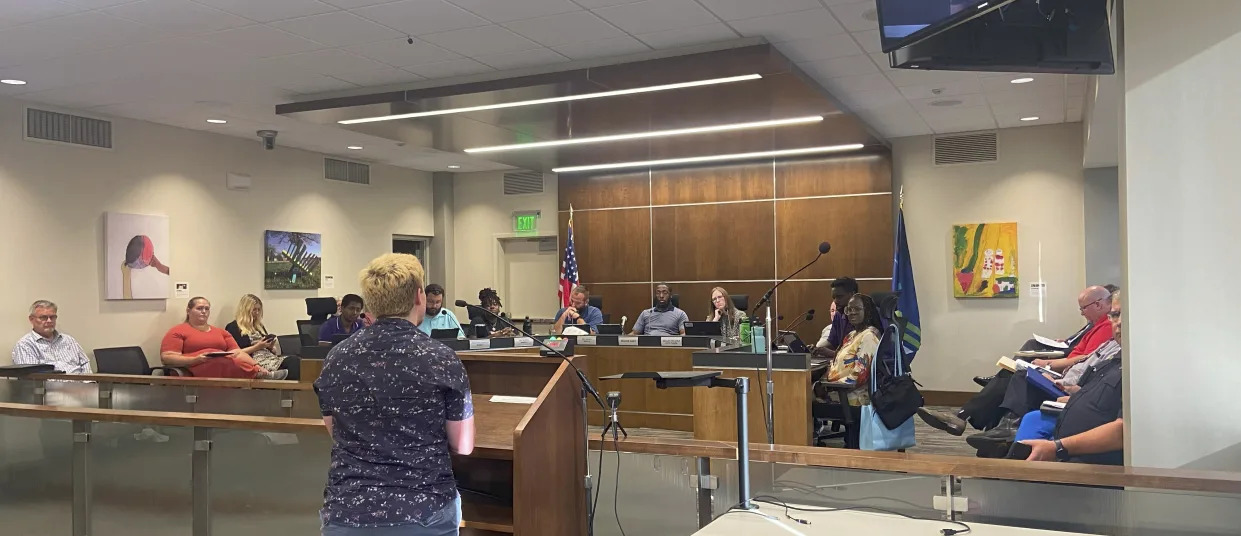
(Maria Kuiper/The Courier via AP) 


DES MOINES, Iowa (AP) — One of Iowa's largest cities repealed its ban on “conversion therapy” — the discredited practice of trying to change a person’s sexual orientation or gender identity through counseling — after a Christian organization threatened legal action, part of a deepening national movement to challenge protections for LGBTQ+ kids.

The city council in Waterloo voted this week to remove its restrictions after Liberty Counsel warned in a letter June 30 that it would “take further action” if the city did not repeal the ordinance by August 1. It was enacted in May.

The organization, which is based in Orlando, Florida, argued the ordinance infringes on the constitutional right to free speech and acted on behalf of a therapist in Waterloo “who was concerned about the implications of this on the practice of counseling," Mat Staver, Liberty Counsel founder and chair, said in an interview in which he promised further litigation targeting states.

In Iowa and across the country, efforts are spreading to curb the rights of LGBTQ+ kids and adopt restrictions on gender and sexuality in classroomsyouth sports and medicine. In recent years, local bans on conversion therapy in Florida also fell with the help of Liberty Counsel, which describes itself as a Christian ministry that is “restoring the culture by advancing religious freedom, the sanctity of human life and the family.”

Such therapy has been discredited and is opposed by, among others, the American Medical Association and the American Psychiatric Association, citing research that shows it leads to increased risk of suicide and depression.

“The mental health mainstream believes that one, that these practices don’t really work, and two, that they may cause harm,” said Dr. Jack Drescher, a Columbia University psychiatry professor and editor of the chapter on gender dysphoria in the psychiatric association's diagnostic manual. “There’s no science on the side of people who believe in conversion therapy. There’s just faith and belief.”

Laws prohibiting mental health professionals from attempting to change a minor’s sexual orientation or gender identity are on the books in 22 states and Washington, D.C., according to the Movement Advancement Project, an LGBTQ+ rights think tank. In 13 states, including Iowa, some municipalities have adopted their own provisions.

The issue has the potential to come to a head in the next year if the U.S. Supreme Court decides early this fall to hear the appeal of a Washington state therapist, Brian Tingley, whose lawsuit was dismissed.

While early lawsuits similar to Tingley’s failed, a Supreme Court ruling in 2018 prompted a new round of cases, said Christy Mallory, legal director at the UCLA School of Law's Williams Institute, which researches sexual orientation and gender identity. That ruling invoked free speech protections to block a California law that required anti-abortion centers to provide information about abortion.

In 2020, a panel of three federal judges in Florida relied in part on that 2018 ruling and became the first federal appeals court to block ordinances in Boca Raton and Palm Beach County that banned conversion therapy. Liberty Counsel represents the two therapists who won that case.

The diverging federal rulings in the Washington and Florida cases may be a reason for the U.S. Supreme Court to weigh in this term, bringing another high-profile LGBTQ+ issue to the docket.

Staver is confident the Supreme Court will strike down bans in the near future. And Liberty Counsel has imminent plans to sue over statewide bans, he said.

“I think it is a losing proposition for any state or local government to have one of these laws, and they would be wise to repeal them before they also are sued,” Staver said.

In Iowa, Senate Democrats and a Republican in the House introduced bills for conversion therapy bans that didn’t make it out of subcommittees in 2020. That was the last time there was a concerted effort for a ban in the state, said Damian Thompson, public policy director at Iowa Safe Schools, an organization that advocates for LGBTQ+ children.

Meanwhile, in Iowa and elsewhere, laws have since been passed to prohibit teachers from raising gender identity and sexual orientation issues with students through grade six, to restrict the restrooms transgender students can use, and to ban treatments like puberty blockers and hormone therapy for trans minors. Many are facing challenges in court.

Republican lawmakers say the laws are designed to affirm parents’ rights and protect children. The issues have become flashpoints in the race for the 2024 Republican presidential nomination.

But many parents and advocates worry about the deterioration of the rights and safety of LGBTQ+ kids.

In Waterloo, a city of over 65,000, Councilor Jonathan Grieder said he had heard concerns about conversion therapy happening in the area. He worked with Thompson at Iowa Safe Schools to draft an ordinance after watching statewide efforts stall but a ban pass in another Iowa city, Davenport, and in Linn County.

The Waterloo council approved it 6-1 in May, but overturned it 4-3 on Monday amid the prospect of costly litigation.

Archer Trip, of neighboring Cedar Falls, addressed the council before the repeal vote as a “survivor of conversion therapy" who had been placed there in high school.

“It does not work. Now, I am a proud queer man, but I am also here to protect everyone else,” Trip said. "We should protect our children.”

Archer's twin sister, Nic Trip, who was also put in conversion therapy, testified: “Unfortunately, not all parents always make the safest decision for their children. What is the line of what is OK to do to our children?”

Mayor Quentin Hart said, not mentioning the Liberty Counsel, that there was “threat of impending litigation moving forward,” which put the members in a “tough situation.”

“I don’t believe that the Waterloo City Council are cowards," Hart said. "I believe that they do have a decision to make tonight.”

The decision disappointed Thompson, who said Iowa Safe Schools will continue to advocate for local bans despite far-right groups’ success in turning a “common sense” issue into a “wedge culture war” one.

“Which is a shame,” Thompson said, “because in the meantime it only results in more kids being victimized and more kids, ultimately, receiving lifelong trauma.”


Transgender woman in New York reaches landmark settlement with county jail after great discrimination

Emily Barnes, Binghamton Press & Sun Bulletin
Fri, August 25, 2023 at 9:37 PM MDT·5 min read

A transgender woman in New York has achieved a significant settlement with Broome County after experiencing violence, discrimination and the denial of medical care while in custody at Broome County Jail.

Broome County will adopt new policies affirming the rights of transgender people in the jail after a woman said she was discriminated against while in custody at the jail.

Makyyla Holland, a 25-year-old Black transgender woman, reached a settlement with the county Thursday after filing a lawsuit in 2022 saying she was the victim of multiple forms of harassment, including physical abuse, misgendering and refusal of access to medication and commissary items during her time in at the jail in 2021.

As part of the settlement, the county will pay Holland $160,000 for the harms she suffered, according to the New York Civil Liberties Union (NYCLU) and Transgender Legal Defense & Education Fund (TLDEF).


"No one should ever have to go through what I went through at the Broome County Jail and I am so grateful that with this new policy, hopefully, no one else ever will," Holland said in a written statement. "This policy and policies like it can impact a lot of my community and I will continue to fight to ensure that no other trans person in New York or anywhere has to endure what I did."
What the new policies entail

Makyyla Holland's 2022 lawsuit against Broome County for how she was treated in the jail's custody in 2021 has incited policy changes.

Under the settlement, the county is changing its policies to comply with federal and state laws, according to a statement from the NYCLU and TLDEF. Specifically, the county will:

House people consistent with their gender identity or within the unit consistent with the sex designation the person in custody believes is safest for them.


Conduct searches consistent with the person in custody’s own view of what gender officer would be safest to perform the search.


Ensure that staff at the jail respect a person’s gender identity in all other contexts, including name and pronoun use.


Ensure access to clothing and toiletry items consistent with a person’s gender identity, and facilitate access to gender-affirming items such as binders, wigs, and gaffs.


Ensure access to medical care free from discrimination on the basis of sex, gender identity, gender expression, or sexual orientation, including access to medical care for treatment of gender dysphoria.

This policy isn't the first to be enacted in the Southern Tier. In August 2020, the NYCLU and TLDEF reached a settlement with Steuben County, which adopted similar policies.

"Today we celebrate the stunning, transgender rights victory of courageous Makyyla Holland and the NYCLU in their lawsuit against Broome County, the Sheriff, Undersheriff, officers, and medical staff," Justice and Unity in the Southern Tier (JUST) said in a written statement Thursday. "This is a wonderful outcome, and we look forward to observing its implementation at the County jail and other facilities."

Anti-trans legislation: Is all the anger, fury really about transgender rights? Maybe not.

Broome County did not comment on the matter but referred to the jail administration.

"While this settlement stems from an incident and subsequent lawsuit that occurred before I was elected Sheriff, I’m pleased we were able to amicably reach a resolution that establishes clear LGBTI Guidelines, which were previously nonexistent, to address the rights of LGBTI inmates while maintaining the safety and security of individuals both housed and working at the Broome County Correctional Facility," Broome County Sheriff Fred Akshar said.

"It’s another important step forward in pragmatically and safely modernizing policies to meet the needs of those we serve and protect as we work to build a better, safer community for everyone in Broome County.”
What the lawsuit says

Broome County is adopting a new policy which will affirm the rights of transgender people while they are in the Broome County jail.

During Holland's first period of incarceration between January and February 2021, the lawsuit states Holland faced several injustices, including:

Being physically attacked during the intake process, suffering multiple bruises, cuts, a broken tooth and a painful lump on her head that caused her severe migraines.


Never seen by a dentist or offered any treatment for her broken tooth, the pain in the back of her head and the migraine headaches she endured as a result, other than ibuprofen.


Assigned to the men's unit inside the Broome County jail and placed in an isolated cell by herself with glass walls on all sides, visible to men in the unit at all times, despite informing correctional officers several times about her transgender status.


Denied access to a shower and the ability to leave the cell during periods when men she detained with were allowed out.

Between June and July 2021, the lawsuit claims Holland’s second period of incarceration in the Broome County jail saw similar injustices, such as:

Strip searched by several men, forced to peel off her acrylic nails without the appropriate tools and placed exclusively within men’s housing units, despite disclosing her transgender status multiple times.

Her wig, which was glued to her head, was ordered to be removed.

Medical providers denied her hormone replacement therapy medications for four weeks, never provided her with her prescribed testosterone blockers or antidepressants and only provided her with a single estrogen injection after she had been in the jail for 28 days.

Transgender rights: How abortion helped revive Alabama's ban on gender affirming care

These denials caused horrible withdrawal symptoms, according to the documents, and she had to postpone her gender-affirming surgery.

Throughout Holland’s stay in the Broome County jail, the lawsuit states she was harassed and misgendered repeatedly and was forced to shower in full view of the male staff and the men in custody.

Holland was denied access to undergarments, hygiene products and commissary items routinely afforded to women in the Broome County jail, according to the documents.

The lawsuit also states Holland reported some instances to one of the correctional officers, as well as submitted several grievance slips, which Holland’s lawsuit claims she never received any responses to.

Emily Barnes is the New York State Team Consumer Advocate Reporter for the USA Today Network. Contact Emily at ebarnes@gannett.com or on Twitter @byemilybarnes. To get unlimited access to the latest news, please subscribe or activate your digital account today.

This article originally appeared on Binghamton Press & Sun-Bulletin: Transgender woman in New York reaches landmark settlement with county jail

Saturday, August 26, 2023

Thousands converge on National Mall to mark the March on Washington’s 60th anniversary
AARON MORRISON and AYANNA ALEXANDER
Updated Sat, August 26, 2023 

A person holds an image of the Rev. Martin Luther King Jr. as they listen to speakers during the 60th Anniversary of the March on Washington at the Lincoln Memorial in Washington, Saturday, Aug. 26, 2023. (AP Photo/Andrew Harnik)


2 / 16


WASHINGTON (AP) — Thousands converged Saturday on the National Mall for the 60th anniversary of Rev. Martin Luther King Jr.'s March on Washington, saying a country that remains riven by racial inequality has yet to fulfill his dream.

“We have made progress, over the last 60 years, since Dr. King led the March on Washington," said Alphonso David, president and CEO of the Global Black Economic Forum. “Have we reached the mountaintop? Not by a long shot."

The event was convened by the Kings’ Drum Major Institute and the Rev. Al Sharpton 's National Action Network. A host of Black civil rights leaders and a multiracial, interfaith coalition of allies rallied attendees on the same spot where as many as 250,000 gathered in 1963 for what is still considered one of the greatest and most consequential racial justice and equality demonstrations in U.S. history.

Inevitably, Saturday's event was shot through with contrasts to the initial, historic demonstration. Speakers and banners talked about the importance of LGBTQ and Asian American rights. Many who addressed the crowd were women after only one was given the microphone in 1963.

Pamela Mays McDonald of Philadelphia attended the initial march as a child. “I was 8 years old at the original March and only one woman was allowed to speak — she was from Arkansas where I’m from — now look at how many women are on the podium today,” she said.

For some, the contrasts between the size of the original demonstration and the more modest turnout Saturday were bittersweet. “I often look back and look over to the reflection pool and the Washington Monument and I see a quarter of a million people 60 years ago and just a trickling now," said Marsha Dean Phelts of Amelia Island, Florida. “It was more fired up then. But the things we were asking for and needing, we still need them today.”

As speakers delivered messages, they were overshadowed by the sounds of passenger planes taking off from Ronald Reagan National Airport. Rugby games were underway along the Mall in close proximity to the Lincoln Memorial while joggers and bikers went about their routines.

Yolanda King, the 15-year-old granddaughter of the Rev. Martin Luther King, Jr., roused marchers with remarks delivered from the same spot her grandfather gave the “I Have A Dream” speech sixty years ago.

“If I could speak to my grandfather today, I would say I’m sorry we still have to be here to rededicate ourselves to finishing your work and ultimately realizing your dream,” she said. “Today, racism is still with us. Poverty is still with us. And now, gun violence has come for places of worship, our schools and our shopping centers.”

From the podium, Sharpton promised more demonstrations to push back against injustices, new and old.

“Sixty years ago Martin Luther King talked about a dream. Sixty years later we’re the dreamers. The problem is we’re facing the schemers,” Sharpton said. “The dreamers are fighting for voting rights. The schemers are changing voter regulations in states. The dreamers are standing up for women’s right to choose. The schemers are arguing whether they are going to make you stop at six weeks or 15 weeks."

After the speeches, the crowd marched to the Martin Luther King Jr. Memorial.

Several leaders from groups organizing the march met Friday with Attorney General Merrick Garland and Assistant Attorney General Kristen Clarke of the civil rights division, to discuss a range of issues, including voting rights, policing and redlining.

Saturday's gathering was a precursor to the actual anniversary of the Aug. 28, 1963 March on Washington. President Joe Biden and Vice President Kamala Harris will observe the march anniversary on Monday by meeting with organizers of the 1963 gathering. All of King’s children have been invited to meet with Biden, White House officials said.

Martin Luther King Jr.'s Washington remarks have resounded through decades of push and pull toward progress in civil and human rights. But dark moments followed his speech, too.

Two weeks later in 1963, four Black girls were killed in the 16th Street Baptist Church bombing in Birmingham, Alabama, followed by the kidnapping and murder of three civil rights workers in Neshoba County, Mississippi the following year. The tragedies spurred passage of the Civil Rights Act of 1964.

The voting rights marches from Montgomery to Selma, Alabama, in which marchers were brutally beaten while crossing the Edmund Pettus Bridge in what became known as “Bloody Sunday,” forced Congress to adopt the Voting Rights Act of 1965.

Speakers warned that King's unfinished dream was in danger of being further whittled away. “I’m very concerned about the direction our country is going in," Martin Luther King III said. "And it is because instead of moving forward, it feels as if we’re moving back. The question is, what are we going to do?”

Rosetta Manns-Baugh knew the answer: Keep fighting.

“I think we have accomplished a lot, but I also think we lost." said Manns-Baugh, who was a Trailways bus counter worker in 1963 when she left her seven children and husband at home in Virginia to come to D.C. Now she's so disillusioned she's stopped singing “We Shall Overcome,” the anthem of the civil rights movement.

But even at age 92, she returned to Washington for the 60th anniversary, bringing three generations of her family, all the way down to her 18-month-old grandchild. “I think that’s why we all are here because we do expect the world to get better," Manns-Baugh said. "We can’t stop working at it that’s for sure.”

___

Associated Press journalists Gary Fields, Jacquelyn Martin, Julie Walker and Nicholas Riccardi in Denver contributed to this report.

___

The Associated Press receives support from several private foundations to enhance its explanatory coverage of elections and democracy. See more about AP’s democracy initiative here. The AP is solely responsible for all content.

Ethiopia's Amhara crisis: Abiy's political failures threaten a return to war

Yohannes Gedamu, Senior Lecturer of Political Science, Georgia Gwinnett College
Thu, August 24, 2023
THE CONVERSATION


The federal government of Ethiopia declared a state of emergency in Amhara region on 4 August 2023. A special session of parliament endorsed this decision, placing the administration of the country’s second largest region under the military. This followed clashes between federal troops and Amhara forces resisting a government order to disarm and demobilise regional special forces.


Amhara region is the second most populous region in Ethiopia. Its northern neighbour is the Tigray region, which was the epicentre less than a year ago of the most destructive civil war in the history of modern Ethiopia. Combined with a political climate that is dominated by ethnic narratives, ethnic parties and regional militias, the current crisis in Amhara has sparked fears of another civil war.

Political tensions with ethnic undertones have been high in Ethiopia. However, forced displacements and massacres targeting ethnic Amharas have continued under Prime Minister Abiy Ahmed’s watch since 2018.

In 2019 Ethiopia was ranked first in the world for the number of internally displaced people. This was more than those displaced by wars in Syria, Yemen and Afghanistan.

With ethnic polarisation higher than ever, pan-Ethiopian unity forces and political parties lost their appeal long ago. Ethnic grievances are now the main organising principles in Ethiopia, which shows why Amharas who were mostly known for supporting national political movements are now organising just as Amharas.

In the last two years alone, ethnic Amharas were displaced from suburbs surrounding Addis Ababa, the capital. Amharas also continue to face harassment by Oromia’s security forces when travelling to Addis Ababa, which is a self administrating city but geographically an enclave of Oromia region.

Then there’s the government’s reliance on ethnic-based militias, such as Amhara Fano fighters whenever it deemed necessary to ensure its survival. During the federal government’s war on Tigray, for example, the overstretched Ethiopia National Defence Force mobilised Amhara youth to fight. Following the war, the Fano emerged well-armed and much stronger with somewhat obscure but seemingly centralised command. This unsettled Abiy and led directly to the present crisis.

For the Amhara Fano fighters, however, main causes for their struggle are the continued massacres targeting their group, displacements, and discriminatory treatments that Amharas face across Ethiopia. For example, they mention that the recent mass arrest of Amharas in Addis Ababa by the federal police are examples of Abiy’s continued mistreatment of their group. To make matters worse, families who are demanding to know about the whereabouts of their imprisoned children are facing harassment.

I am a political science scholar with a focus on the Horn of Africa countries. I have also authored a book on ethnic federalism and authoritarian survival in Ethiopia. Nine months into Abiy’s rise to power in Ethiopia, I warned that the persecution of ethnic Amharas could derail his then highly touted political reforms. At the time, he vowed to deal with political violence that targeted any ethnic group and impeded freedom of movement of citizens. Sadly, he failed to deliver.

Today, many in Ethiopia and especially citizens in the Amhara region believe that the incumbent Prosperity Party has lost both the credibility and the administrative capacity to lead the region. It’s my view that Abiy’s use of the military to address such a critical challenge will prove a failure. A military approach could result in more bloodshed.

Ethiopia’s increasing challenges

Once considered the lone hope to resolve Ethiopia’s problems, Abiy eluded scrutiny because of his unifying political rhetoric. But the political challenges continued to intensify. It was not long before political dissent was met with violence by his security forces.

By 2021, the media reported that 5.1 million people had been displaced internally. People from all of Ethiopia’s regional states had experienced forced displacement, mainly due to their ethnic identity. A disproportionate number of these were Amharas targeted in five regions.

The Tigray war was to follow. Two years of fighting, mainly between federal forces and the Tigray People’s Liberation Front, intensified the destruction in the country. Hundreds of thousands of Ethiopians have died and the country needs at least US billion for post conflict reconstruction.

Read more: Persecution of ethnic Amharas will harm Ethiopia’s reform agenda

A peace agreement was eventually signed in Pretoria, South Africa, in November 2022. The political settlement brought relief in the country’s north. But Abiy’s regime did not attempt to find political solutions for all the country’s other challenges. For example, once peace in Tigray is achieved, the government did not also attempt to address the grievances of Amharas related to massacres, displacements and harassment they persistently had to endure. Even during the Tigray war, regions such as Afar and Amhara equally suffered from the destruction the war had caused. But the government seems to have ignored the suffering of Afar and Amhara Ethiopians.

As a result, the Amhara region is the centre of conflict with federal forces that has parallels with the Tigray war. The deployment of military drones – an important tool against Tigray – is responsible for the deaths of least 26 civilians in the Amhara city of Finote Selam.

Interestingly, now that the government’s peace deal with Tigray forces is holding, Abiy’s Oromo prosperity party officials are now openly inviting Tigrayans to also arm against the Amhara, which shows that the government is only steadfast to respond to violence by way of more violence.

Amhara region’s case

Amhara’s popular president and top leadership were assassinated months after they came to power in 2019. Since then, the region has not witnessed any semblance of normalcy. Successive Amhara leaders from incumbent Prosperity Party have also become failures.

Into this void stepped Amhara youth groups organised as impromptu militia units tasked with protecting and securing their localities. Over time these morphed into an Amhara popular resistance. A considerable number of disgruntled former Amhara special force members are now part of this fano led resistance after rejecting an offer to integrate with the federal defence force.

Read more: Ethiopia's political crisis plays out in the regions. Why it's a federal problem

This rise in the strength of the Fano forces was cited by Ethiopia’s spy chief to be behind the federal government’s decision to dissolve regional special forces.

The order applies to all regions, but the Amhara view it as a ploy that only targets Amhara’s strong special forces while leaving others intact. They also believe that such a move could expose their region to possible attacks from Oromia and Tigray regions. These regions have claims over Amhara territory that have stoked longstanding tensions.

Amhara also see the move to disarm them as a betrayal, after they made sacrifices during the Tigray war to secure the prime minister’s survival.

What happens next?

Fears of another war that could match or even eclipse what happened in Tigray are not misplaced if a solution is not found. The international community must press all groups, especially Ethiopia’s federal government, to start political dialogue immediately and agree a ceasefire. Federal Authorities in Ethiopia must also learn that only dialogue and direct engagement with the public could help with conflict resolution.

It’s also time for Abiy to prove that Ethiopia can be at peace under his leadership. The impact of another civil war in the Horn of Africa, at the same time as Sudan’s, would be catastrophic.

This article is republished from The Conversation, a nonprofit news site dedicated to sharing ideas from academic experts. 

It was written by: Yohannes GedamuGeorgia Gwinnett College.

Read more:


Scottish Government delays plans to fund more statues of women ACTIVISTS

Andrew Learmonth
Fri, 25 August 2023 

Scottish Government promise to fund more statues of women paused

The Scottish Government has blamed the "financial restrictions of devolution” after ministers delayed plans to build more statues of women.

In the party’s manifesto ahead of the 2021 Holyrood election, the SNP promised to "create a new £2 million fund for public artwork which broadens the range of representation in public spaces of Scotland’s history and culture, in particular the contribution of women and minority ethnic communities."

However, Angus Robertson, the Cabinet Secretary for Culture recently admitted that two years on from the vote, ministers still did “not have a confirmed timeframe at this time for when the fund will be actively in place.”

READ MORE: Scotland 'on the cliff-edge of a cultural recession'

There have long been calls for more public artwork to celebrate women and people of colour who have made an impact on Scotland.

It's thought there are just over 20 statues of women across Scotland.

Four of those are symbolic rather than dedicated to a historic figure, while five are of Queen Victoria.

In Edinburgh, there are just two statues of women, Queen Victoria and Helen Crummy, who founded the Craigmillar Festival Society.

There are, however, five statues of dogs in the capital.

In Perth, there are more statues of fish, than there are of women.

Conservative MSP Sharon Dowey wrote to Mr Robertson over the summer to ask for an update on the manifesto commitment.

In reply, the minister said: “The Scottish Government values the importance of culture and the arts in nurturing creativity and wellbeing and towards the cultural, social and economic life in communities across Scotland.

“However, due to the effects of the pandemic and the current cost crisis facing the culture sector along with the challenging outlook for public expenditure, the Scottish Government does not have a confirmed timeframe at this time for when the fund will be actively in place.”

READ MORE: More than 500 arts organisations apply for multi-year funding

Ms Dowey said she was disappointed with the minister’s reply.

She told The Herald: “The £2 million public artwork fund that the SNP promised in their 2021 manifesto is yet another promise they have failed to deliver on.

“This isn’t the first time the SNP have turned their back on the arts, and I’m disappointed to see yet another commitment has been kicked into the long grass.”

A Scottish Government spokesperson said: “The Scottish Government values the importance of culture and the arts in nurturing creativity and wellbeing and their contribution towards the cultural, social and economic life in communities across Scotland.

“We are committed to broadening the range of people represented in Scotland’s public places, in particular the contribution of women and ethnic minorities.

“It is our aim to bring this policy forward within this parliament. However, due to the cost crisis the Scottish Government has had to make difficult choices to live within our largely fixed budgets.

"Our ability to respond to the cost crisis is limited by the inactivity of the UK Government and the financial restrictions of devolution.”

There has been some progress in recent years. In 2018, a statue of Mary Barbour, a key figure in the 1915 Rent Strikes, was unveiled in Govan.

Plans to honour Dr Elsie Inglis, one of Edinburgh’s most famous feminists with a statue on the Royal Mile have been put on pause after a scandal last year over the choice of sculptor.

The charity behind the push for the statue suspended an open competition to find an artist and appointed the royal sculptor Alexander Stoddart instead, sparking uproar from artists on social med
UK
HMV owner in last-ditch bid to rescue Wilko

Daniel Woolfson
Thu, 24 August 2023 

HMV owner Doug Putman has initiated talks with administrators at PwC about acquiring around 200 Wilko shops
- Fabio De Paola/PA Wire

The Canadian businessman who brought HMV back from the brink of oblivion has emerged as a potential last-minute buyer for collapsed chain Wilko.

Doug Putman, who is credited with reversing the fortunes of HMV after buying it out of administration in 2019, has initiated talks with Wilko’s administrators at PwC about acquiring around half of Wilko’s 400 shops – although it is understood no formal bid has been tabled.

Around 10 other parties are understood to be interested in acquiring stores, including a small number that have expressed an interest in potentially buying more than 50 stores.

News of Mr Putman’s interest, first reported by The Times, raises the prospect that thousands of jobs could be saved at the fallen high street chain, which collapsed into administration earlier this month after struggling to recover from the pandemic and failing to secure a buyer.

Mr Putman would, reportedly, continue to run a number of shops under the Wilko brand if he were to acquire them. It is expected a further announcement on the future of Wilko will be made over the coming week.

It comes one day after PwC warned it was likely many of Wilko’s stores would close and jobs would be lost.

“While discussions continue with those interested in buying parts of the business, it’s clear that the nature of this interest is not focused on the whole Group,” it said on Wednesday.

A PwC spokesman added on Thursday evening: “As administrators we’re intent on achieving the best outcome for everyone involved while preserving as many jobs as possible and adhering to our statutory duty to act in the best interests of the creditors as a whole.

“It would be inappropriate to comment on individual bidders or interested parties at this stage in the process.”

Brothers Simon and Bobby Arora are reportedly interested in buying some of Wilko's stores to add to B&M’s portfolio

Rival discount retailers including B&M, which is run by the Arora brothers, are also reportedly interested in acquiring some of Wilko’s stores.

Wilko has struggled with the legacy of supply issues during the pandemic and overexposure to Britain’s ailing high streets.

But sales and share price of B&M – which focuses more on retail parks and locations with higher footfall – have surged in recent months.

Mr Putman, who owns Canadian retailer Sunrise Records, turned around HMV by refocusing it around vinyl and merchandise instead of the CDs and DVDs it had become known for over the last decades.

Sales at HMV’s UK parent company Sunshine Records and Entertainment, which also owns smaller chain Fopp, jumped from £90m to £150m in the 12 months to May 2022, and HMV is poised to return to the former site of its Oxford Street flagship later this year, four years after shutting the doors of the shop.

Mr Putman declined to comment.
CAVET EMPTOR
UK
More than 80% of online marketplace products fail in Government safety checks


Josie Clarke, PA Consumer Affairs Correspondent
Fri, 25 August 2023 

More than 80% of items bought from online marketplaces for a Government testing programme have failed safety checks, leading to concerns the UK has become a “dumping ground” for unsafe products.

The Government’s Office for Product Safety and Standards (OPSS) tested 2,260 products sold via online marketplaces between October 2021 and September 2022, finding that 1,832 (81%) failed to meet safety standards.

The product category with the highest rate of non-compliance was toys, closely followed by small mains powered electricals.

The toys failed product safety testing on areas such as strangulation hazards to children under 36 months, while electrical items failed testing against UK safety standards for electrical goods, which could pose a risk of electric shocks or electrical fires.

The OPSS said it targeted products, also including cosmetics and products containing button batteries, that routinely appeared in recalls and alerts, had poor reviews or appeared to be of low quality in the listing photos, and so warned that the findings were not representative of all products sold by online marketplaces.

However, the Chartered Trading Standards Institute (CTSI) said it was concerned about the “overwhelmingly high” rate of non-compliance, “demonstrating that online marketplaces are still flooding the UK with unsafe goods and posing serious risks to UK consumers”.

CTSI chief executive John Herriman said: “We welcome the OPSS investigation into the safety of products being sold on online marketplaces. However, the sheer volume and proportion of goods that aren’t meeting basic safety checks is appalling – we have standards for a reason – including to protect the public’s health and safety.

“It is concerning to see this level of products failing safety testing, particularly when the highest category of non-compliance is toys.

“We would urge the Government to take action to stop unsafe products entering our supply chains and online marketplaces – this includes ensuring enough checks are taking place at ports and borders. We also call on online marketplaces to be more rigorous in undertaking checks across their platforms.”

Jerry Burnie, head of compliance at the British Toy and Hobby Association, said: “The BTHA have tested over 550 products in the last six years and have been pushing for a change in the law to ensure that the online marketplaces are jointly and severally liable for products sold by third-parties via their platforms, which otherwise would not have access to the UK market.

“This is a situation that has not improved over those six years. We are pleased that OPSS’ own figures have now confirmed our findings and hope that sufficient action will be taken to ensure consumers are protected from these dangerous and unsafe products.”


The findings have prompted concerns over safety standards (Adam Peck/PA)

Lesley Rudd, chief executive of safety charity Electrical Safety First, said: “The evidence is overwhelming, online marketplaces are a hot bed for dangerous and non-compliant goods.

“These new figures from the Government show that online shopping is a minefield, with consumers unknowingly exposed to thousands of unsafe goods, many of which can be in their homes the very next day.

“Decisive action has never been so urgent, online marketplaces cannot be relied upon to self-regulate the issue of illegal and harmful goods on their platforms. The Government must act without delay to finally force them to take steps to ensure that these goods sold via their sites, from which they profit, are safe.”

Marathon to Shut Third-Largest US Oil Refinery After Storage Tank Fire
Barbara Powell and Robert Tuttle
Fri, August 25, 2023 at 2:03 PM MDT·1 min read


(Bloomberg) -- Diesel futures surged to a seven-month high in New York after Marathon Petroleum Corp. said it was shutting the third largest US oil refinery following a blaze at a storage tank.

The fire at the Garyville refinery in south Louisiana was contained but ongoing late Friday afternoon, according to Marathon spokespeople. It’s the third blaze to strike the plant in less than a year. Parish officials have ordered residents within a two-mile radius to evacuate.

Diesel rose 5% while gasoline futures jumped about 4%. The outage threatens to deplete already below-average distillates stockpiles at a time when US demand for the fuel is set to rise going into the harvest and heating seasons.

Garyville, located on the Mississippi River between New Orleans and Baton Rouge, produces about 265,000 barrels a day of gasoline, or about 3% total US consumption. It also makes about 230,000 barrels per day of diesel, according to Andy Lipow, president of Lipow Oil Associates in Houston. The refinery has a crude processing capacity of 596,000 barrels a day.

The Louisiana Department of Environmental Quality “is conducting monitoring in the community adjacent to the site and all readings are nondetect,” according to spokesperson Gregory Langley.

The Environmental Protection Agency said it has deployed a federal coordinator to the site to oversee the response and provide technical support, including emergency response air monitoring in downwind communities. A firefighter is being evaluated for heat stress and two storage tanks have been damaged, according to Marathon spokesperson.

--With assistance from Jennifer A. Dlouhy, Chunzi Xu and Joe Aboussleman.

Earth Tilted 31.5 Inches in Less Than 20 Years. Here’s What That Really Means for Us

Caroline Delbert
Wed, August 23, 2023 

Earth Has Tilted 31.5 Inches—But Should We Care?Getty Images

Earth’s tilt recently made headlines when scientists revealed it had deviated 31.5 inches. That data came from a June study, published in the journal Geophysical Research Letters, that found human groundwater pumping is primarily to blame for the jaunty new tilt. And in that study, the increase in tilt was linked with a 0.24-inch rise in global sea level. That’s already a lot to take in. How does the change in tilt affect global sea level? Why does groundwater pumping affect the tilt in the first place? And is a 31.5-inch difference in Earth’s tilt really that big of a deal?

But the truth about Earth’s tilt is far more complex than that, and it involves an unsettling amount of wiggle room across many variables, which affect almost every condition on Earth’s surface. Here’s what you need to know about Earth’s tilt, and why it matters that it keeps shifting.

Earth’s tilt is iconic. It’s why we have the specific range of seasons that we do, and why the North and South Poles each have times with no sunlight at all or no darkness at all. If you think about it, it’s easy to understand why. If Earth’s tilt was perpendicular to its orbit around the sun, then the one hemisphere exposed to the sun would remain the same at all times of year. That hemisphere would always include the very edges of both the North and South Poles—it’s like the Tilt-o-Whirl ride before it, you know, tilts. But with Earth’s tilt, just like on the ride, you are sometimes much closer (and sometimes much farther) from the sun or the ground.

Getty Images

Where most of us live, Earth feels very solid, which can be a bit deceptive. The crust, or the outermost layer made primarily of solid rock, is around 25 miles deep in many places. Just one square foot of rock that’s 25 miles deep weighs nearly 11,000 tons on average; that’s the same weight as the entire retractable roof of Toronto’s Rogers Centre where the Blue Jays play. It was enough to right the Costa Concordia, a 114,000-ton cruise ship that hit land and sank onto its side ten years ago.

But 25 miles thick is only about one-third of one percent of Earth’s diameter, and 11,000 tons is a negligible, far-out decimal of its total mass of 13,170 billion trillion pounds—it’s the paper-thin M&M candy shell on the solar system’s densest planet. On top of the crust are the oceans, and underneath its surface are vast subterranean freshwater areas. Below that, the mantle has a small amount of liquid molten rock, and below that, the outer core is liquid. (Earth’s inner core is believed to be solid.)

Water flows from an underground well to irrigate an orchard on Tuesday, October 12, 2021 in Visalia, California.Getty Images

The recent paper on groundwater explores a specific phenomenon. When people seeking fresh water punch holes into the water reserves below or inside Earth’s crust, they affect how the entire planet is balanced in the simplest way: suddenly, one area of Earth’s outer shell weighs a great deal less than it did before. (What if you hollowed out one part of the outside of a bowling ball or a spinning top? It might still be fine, but it wouldn’t spin the same as it did before.) And because Earth has so much water and molten metal, any new spin reverberates through these other liquids, and can reflect back in a way that makes the new spin even more different.

Earth’s tilt, which is scientifically known as obliquity, is known to vary between 22.1 and 24.5 degrees on a cycle that lasts about 41,000 years. Each degree of Earth’s circumference is about 69 miles, which means 31.5 inches is truly an amount so tiny that it almost doesn’t matter. But this is a specific paper about one isolated factor, and how much it is believed to be affecting Earth’s tilt. And more importantly, this is a human-caused factor, not part of the natural fluctuation of Earth’s tilt. Humans existed 41,000 years ago, but they weren’t drilling into Earth’s crust to drain the groundwater.

 What Is Groundwater Pumping?

According to the U.S. Geological Survey (USGS), there is over 1,000 times more water in aquifers below Earth’s surface than in all of the world’s rivers and lakes. (An aquifer is a body of rock or sediment that holds groundwater). This groundwater can be found virtually everywhere on Earth, even in deserts, but it’s often inaccessible or requires treatment for human use. The water may be near the surface, where it’s just a few hours old, or at great depths, where it may be several thousands of years old.

We’ve become reliant on groundwater pumping as fresh water in lakes and rivers has dried up and disappeared; we use that groundwater for a myriad of purposes, from drinking water to irrigation to mining, according to Issues in Science and Technology, a quarterly journal from the National Academies of Sciences, Engineering, and Medicine and Arizona State University. But that comes with consequences. Excessive groundwater pumping wreaks havoc on our natural bodies of water and wetlands, drying them up; leads to ground collapses; and disrupts, and even kills off, wildlife, fish, and trees. And now, apparently, groundwater pumping has even affected Earth’s tilt.

Earth doesn’t need to be almost perfectly balanced like a top or a bowling ball. In fact, scientists believe a giant impact from a celestial body, called Theia, created Earth’s tilted spin in the first place. This knocked an entire chunk out of Earth’s mass, which scientists believe, in turn, became the moon. The rest of Earth left behind, with a big Swiss cheese crater knocked out of one side, just spun differently. Thankfully, for the living things on Earth, nothing has happened to knock it back into a truer orbit.

And because of the way Earth and other planets spin, they end up smoothing their own shapes over time into something closer to spheres, a concept called hydrostatic equilibrium. In fact, being nearly spherical is a criterion for planethood in the first place, which means the chunky post-Theia Earth might not have qualified until it got its rotational act back together. Earth’s tilt has not affected its ability to maintain a spherical shape, because hydrostatic equilibrium is a phenomenon of each planet’s individual rotation regardless of its pitch.

In 2018, NASA shared news that it had isolated three major causes of the changes to Earth’s tilt in the 20th century. These causes are the melting of Greenland, land “bouncing back” after glaciers move or melt, and mantle convection. In mantle convection, the portions of liquefied rock beneath Earth’s crust are constantly roiling upward and being pushed back down. The density of these different temperatures of rock are different, and throw off the center of mass.

Scientists have known that Earth’s tilt varies based on a huge number of factors, but the ability to study them one at a time is pretty new. “As the Earth undergoes continuous changes at a large variety of time scales, from its inner to outer components, all of those dynamical parameters do not have steady values, but vary with time. Their variations are so small compared to the constant reference values that they could not be observed until recent years,” scientists wrote in a 2020 paper.

That means we’re likely to see more news of more drift of Earth’s tilt attributed to specific things in the years to come.