Friday, December 27, 2024

Carbon footprint: Putting a ‘steak’ into the heart of the UK’s favourite meals


By Dr. Tim Sandle
DIGITAL JOURNAL
December 27, 2024


Steak, fries, and a cocktail. Image (C) Tim Sandle.

With 55 percent of vegans citing climate concerns as the main reason for adopting a plant-based diet, the environmental impact of food choices is an important consideration for many. Meal production and cooking alone can contribute up to 30 percent of a household’s carbon footprint.

Which common British dishes are the biggest environmental offenders?

With a 170 percent spike in searches for “how to reduce your carbon footprint” over the past months, interest in greener habits has surged, according to the firm Confused.com Energy. The company has uncovered which dishes leave the largest environmental mark by analysing their ingredients’ emissions, appliances used in the recipe, as well as the cooking time.

In sourcing the data, recipes and cooking times of each meal were collected through BBC Good Food, the serving size and ingredients were taken from the original recipe and inputted into a free food carbon footprint calculator, My Emissions. The values of the carbon footprint results are based on estimates of the emissions used from farm to store, including packaging and transport. This does not measure the emissions during storing, cooking or disposal of food.

Steak, fries, and a cocktail. Image (C) Tim Sandle.

With 55 percent of vegans citing climate concerns as the main reason for adopting a plant-based diet, the environmental impact of food choices is an important consideration for many. Meal production and cooking alone can contribute up to 30 percent of a household’s carbon footprint.

Which common British dishes are the biggest environmental offenders?

With a 170 percent spike in searches for “how to reduce your carbon footprint” over the past months, interest in greener habits has surged, according to the firm Confused.com Energy. The company has uncovered which dishes leave the largest environmental mark by analysing their ingredients’ emissions, appliances used in the recipe, as well as the cooking time.

In sourcing the data, recipes and cooking times of each meal were collected through BBC Good Food, the serving size and ingredients were taken from the original recipe and inputted into a free food carbon footprint calculator, My Emissions. The values of the carbon footprint results are based on estimates of the emissions used from farm to store, including packaging and transport. This does not measure the emissions during storing, cooking or disposal of food.

Top 10 British meals with high carbon emissions:

RankPopular MealsEnergy kWhCarbon RatingCarbon Footprint of recipe (gCO2e per serving)kWh converted to CO2Total Carbon footprint (gCO2)
1Steak & Chips0.9E10,13114210,273
2Fettuccine Alfredo0.3C8,421418,462
3Lasagna3.3E5,7695406,309
4Chilli Con Carne1.5E5,9252436,168
5Burritos0.8E5,9241226,046
6Spaghetti & Meatballs0.8E4,9361225,058
7Scampi & Chips1.3E2,1622132,375
8Toad in the Hole1.5D1,9142432,157
9Bangers & Mash1.5C1,5982361,834
10Vegetable Lasagna2.5B1,3904051,795


From the above table and the full dataset, a meal of steak and chips has the highest carbon emissions during the cooking process, with a carbon footprint of 10,273g carbon dioxide per serving. The majority of emissions come from the recipe’s ingredients, as it releases only 142gCO2 during the cooking process.

In second, fettuccine alfredo releases 8,462 grams of carbon dioxide – the same as driving 60.5 kilometres. This dish is in the top 10 for lowest energy usage, at 0.3kWh, taking just 10 minutes in total to cook.

Lasagna is a popular meal despite it needing the most energy of all the meals (3.3kWh) to cook. The Italian dish has a carbon footprint of 6,309g carbon dioxide.

Chilli con carne emits an average carbon footprint of 6,168g carbon dioxide. With a total cooking time of an hour, it uses a total of 1.5kWh of energy costing a total of 9.2 pence per serving.

Another Mexican delicacy, the burrito has an average carbon footprint of 6,046g carbon dioxide which spans to 43.2 kilometres of driving.


Top 5 most energy-efficient meals of Britain:

RankPopular MealsEnergy kWhCarbon RatingCarbon Footprint of recipe (gCO2e per serving)kWh converted to CO2Total Carbon footprint (gCO2)
1Chicken Casserole0.625B431101532
2Pasta Fagioli0.875A399142541
3Penne all’Arrabbiata0.3B49549544
4Tomato Soup1.125A386182568
5Beans on Toast0.3917B59164655


In contrast, there are some dishes with a lower carbon footprint. The meat-base fare may not match the success of vegan and vegetarian fare, but they are substantially lower than others. Chicken casserole ranks as the most energy-efficient of the more popular meals, causing just 532 grams of carbon emissions and using only 0.625kWh of energy.

Pasta fagioli falls second with a carbon footprint of 541g carbon dioxide, three less than penne all’arrabbiata at 544g carbon dioxide.

Membership of UK’s anti-immigration Reform party surpasses Conservatives


By AFP
December 26, 2024


Reform UK leader Nigel Farage hailed a 'historic moment' in British politics - Copyright AL-MASIRAH TV/AFP -

Membership of Britain’s upstart anti-immigration Reform UK party has overtaken that of the centre-right Conservative Party for the first time, the party said Thursday, as Tories disputed the numbers.

Party leader and Brexit figurehead Nigel Farage hailed the figure as a “historic moment”.

Immigration was a major issue at the ballot box at the UK’s July general election which saw the Conservatives ousted after 14 years in power.

The digital counter on the Reform website showed a membership tally ticking past the 131,680 figure declared by the main opposition Conservatives during its leadership election earlier this year.

“The youngest political party in British politics has just overtaken the oldest political party in the world,” wrote Farage on X.

“Reform UK are now the real opposition.”

Party chairman Zia Yusuf said the milestone showed the long “stranglehold on the centre-right of British politics by the Tories has finally been broken”.

The last declared Conservative Party tally was the lowest on record and a drop on 2022, when there were around 172,000 members.

New Conservative Party leader Kemi Badenoch, however, questioned the figures, accusing Farage of “fakery”.

She said Reform’s counter was “coded to tick up automatically”.

Farage responded by saying he would “gladly invite” a firm to “audit our membership numbers” if the Tories did the same.

– Splitting the right –

Reform won five seats in the 650-seat UK parliament in July, though it received roughly 14 percent of total votes cast.

Reform maximised the damage to the Conservatives by splitting the right-wing vote and picking up former Tory supporters in key constituencies.

The Labour Party won by a landslide although Prime Minister Keir Starmer has had a bumpy first five months in power.

An Ipsos opinion poll this month found that 53 percent of Britons said they were “disappointed” in what the Labour government had achieved so far.

British politics has been dominated by the two main parties — Labour and the Conservatives — for decades but commentators have warned that major parties have seen irreversible downturns in their popularity in the past.

In the years after World War I, a divided Liberal Party found itself supplanted by the Labour Party as the main opposition.

The party of 19th-century political giant William Gladstone and World War I leader David Lloyd George never again regained its status as a party of government.

Farage, a supporter of US President-elect Donald Trump, said earlier this month that he was in talks with tech billionaire Elon Musk about donating to his hard-right party.


RIP

Manmohan Singh: technocrat who became India’s accidental PM


By AFP
December 26, 2024


Former Indian prime minister Manmohan Singh, who has died at the age of 92, oversaw far-reaching economic reforms - Copyright AFP/File -

Manmohan Singh’s father may have believed his bookworm son would one day lead India, but the understated technocrat with the trademark blue turban, who died Thursday at the age of 92, never dreamed it would actually happen.

Singh was pitchforked into leading the world’s largest democracy in 2004 by the shock decision of Congress leader Sonia Gandhi to turn down the role after leading the party to an upset win over the ruling Hindu nationalists.

He oversaw an economic boom in Asia’s fourth-largest economy in his first term, although slowing growth in later years marred his second stint.

Known as “Mr Clean”, Singh nonetheless saw his image tarnished during his decade-long tenure when a series of corruption cases became public.

As finance minister in the early 1990s, he was hailed at home and abroad for initiating big-bang reforms that opened India’s inward-looking economy to the world.

Known as a loyalist to the Gandhi political dynasty, Singh studied economics to find a way to eradicate poverty in the vast nation and never held elected office before becoming PM.

But he deftly managed the rough and tumble of Indian politics — even though many said Sonia Gandhi, the Italian-born widow of the assassinated Rajiv Gandhi, was the power behind the throne.


– Streetlight studying –


Born in 1932 in the mud-house village of Gah in what is now Pakistan, Singh moved to the holy Sikh city of Amritsar as a teenager around the time the subcontinent was split at the end of British rule into mainly Hindu India and Muslim Pakistan.

His father was a dry-fruit seller in Amritsar, and he had nine brothers and sisters.

He was so determined to get an education he would study at night under streetlights because it was too noisy at home, his brother Surjit Singh told AFP in 2004.

“Our father always used to say Manmohan will be the prime minister of India since he stuck out among the 10 children,” said Singh. “He always had his nose in a book.”

Singh won scholarships to attend both Cambridge, where he obtained a first in economics, and Oxford, where he completed his PhD.

He worked in a string of senior civil posts, served as a central bank governor and also held various jobs with global agencies such as the United Nations.

Singh was tapped in 1991 by then Congress prime minister P.V. Narasimha Rao to reel India back from the worst financial crisis in its modern history — currency reserves had sunk so low the country was on the brink of defaulting on foreign loans.

Singh unleashed sweeping change that broke sharply with India’s Soviet-style state-directed economy.


– ‘History will be kinder’ –


In his first term he steered the economy through a period of nine-percent growth, lending the country the international clout it had long sought.

He also sealed a landmark nuclear deal with the US that he said would help India meet its growing energy needs.

But by 2008 there was growing disquiet among the ruling alliance’s left-leaning parties about the pact, while high inflation — notably food and fuel prices — hit India’s poor hard.

Still, voters remained drawn to his calm, pragmatic persona, and in 2009 Congress steered its alliance to a second term.

Singh vowed to step up financial reforms to drive economic growth, but he came under increasing fire from critics who said he had done nothing to stop a string of corruption scandals on his watch.

Several months before the 2014 elections, Singh said he would retire after the polls, with Sonia Gandhi’s son Rahul earmarked to take his place if Congress won.

But Congress crashed to its worst-ever result at that time as the Hindu-nationalist Bharatiya Janata Party, led by Narendra Modi, won a landslide.

More recently, an unflattering book by a former aide titled “The Accidental Prime Minister” portrayed him as timid and controlled by Sonia Gandhi.

Singh — who said historians would be kinder to him than contemporary detractors — became a vocal critic of Modi’s economic policies, and more recently warned about the risks that rising communal tensions posed to India’s democracy.

Panama president rules out talks with Trump over canal threat

By AFP
December 26, 2024

A cargo ship passes through the Miraflores locks on the Panama Canal - Copyright AFP/File MARTIN BERNETTI
Juan Jose Rodriguez

Panamanian President Jose Raul Mulino on Thursday ruled out negotiations with US President-elect Donald Trump over control of the Panama Canal, denying that China was interfering in its operation.

Mulino also rejected the possibility of reducing tolls for US vessels in response to Trump’s threat to demand control of the vital waterway connecting the Atlantic and Pacific oceans be returned to Washington.

“There’s nothing to talk about,” Mulino told a press conference.

“The canal is Panamanian and belongs to Panamanians. There’s no possibility of opening any kind of conversation around this reality, which has cost the country blood, sweat and tears,” he added.

The canal, inaugurated in 1914, was built by the United States but handed to Panama on December 31, 1999, under treaties signed some two decades earlier by then-US president Jimmy Carter and Panamanian nationalist leader Omar Torrijos.

Trump on Saturday slammed what he called “ridiculous” fees for US ships passing through the canal and hinted at China’s growing influence.

“It was solely for Panama to manage, not China, or anyone else,” Trump said in a post on his Truth Social platform. “We would and will NEVER let it fall into the wrong hands!”

If Panama could not ensure “the secure, efficient and reliable operation” of the channel, “then we will demand that the Panama Canal be returned to us, in full, and without question,” he said.


– ‘No Chinese interference’ –


An estimated five percent of global maritime traffic passes through the Panama Canal, which allows ships traveling between Asia and the US East Coast to avoid the long, hazardous route around the southern tip of South America.

The United States is its main user, accounting for 74 percent of cargo, followed by China with 21 percent.

Mulino said the canal’s usage fees were “not set at the whim of the president or the administrator” of the interoceanic waterway, but under a long-established “public and open process.”

“There is absolutely no Chinese interference or participation in anything to do with the Panama Canal,” Mulino said.

On Wednesday, Trump wrote on Truth Social alleged, without evidence, that Chinese soldiers were “lovingly, but illegally, operating the Panama Canal.”

Mulino denied that allegation, too.

“There are no Chinese soldiers in the canal, for the love of God,” he added.

Panama established diplomatic relations with China in 2017, after breaking off ties with Taiwan — a decision criticized by Trump’s first administration.

On Tuesday, dozens of demonstrators gathered outside the US embassy in Panama City chanting “Trump, animal, leave the canal alone” and burning an image of the incoming US president.

'That is very different': CNN host fact-checks conservative's Panama claims


Travis Gettys
December 26, 2024 
RAW STORY

CNN

CNN's Sara Sidner fact-checked a conservative panelist's claims about China and the Panama Canal.


Donald Trump threatened to reassert U.S. control over the canal, claiming that China had too much influence over the critical waterway, and conservative commentator Shermichael Singleton argued that Trump was right.

"I don't think it's a sideshow," Singelton said. "There are five principal zone ports in Panama [and] China controls two, the United States doesn't control any. We controlled the Panama Canal completely up until '77. We entered into a mutual agreement with the Panamanian government in 1999, we handed over complete control to them and fast forward to 2023, 2024. Now China controls two of those zones. Trump is mad about it and, in my opinion, Sara, he is right to be mad. The Chinese government, they're not playing checkers here, they're playing 4-D chess to dominate the global stage, and, in my opinion, they're moving in what I would argue is an area and a pace that should concern U.S. leaders, and this idea of the U.S. trying to at least somewhat usurp China's complete dominance in the region isn't necessarily new."

"Members of Congress have been concerned about this," he added. "In the past, there have just been debates about what is the right course of action to sort of minimize China's growing influence in the Panama Canal, and I think it's important for Trump to really put a spotlight on this."

Sidner interjected to set Singleton straight, saying the Chinese government did not have direct control over any Panamanian ports.

"We should talk about the fact that it is a subsidiary of a Hong Kong company [CK Hutchison Holdings] that is in control of, or not in control of, that is administering a couple of ports, but there is an autonomous government agency that controls the canal," Sidner said. "So it doesn't mean that China is in full control."

Singleton conceded that she was correct on the administration of those ports, but he said Trump was right to raise the issue.

"You're right, Sara, to point out that it is a Hong Kong-based company that runs these two ports," he said. "But what if they have one company from China that manages one port and a U.S.-based company that manages another port? I don't think that's necessarily a bad argument for the president-elect to make. It's a very pivotal port for U.S. trade, and so I think, again, to pinpoint this and say, wait a minute, this appears to be unbalanced – I don't think he's necessarily wrong in that regard."

Sidner then lectured her guest and asked why Trump had made public threats before even returning to office instead of engaging in diplomacy.

"He's saying he's going to take back the Panama Canal," Sidner said. "That is very different than why not have these negotiations with the country, with the president, who he has completely pissed off, for lack of a better word, with just throwing this out there that he's going to take over. I mean, it's one of those things that you wonder is, was there not a negotiation that could have happened when he is in the seat of the presidency?"

Watch below or click here
-

- YouTubeyoutu.be


Fox News pundit slams Trump buying Greenland as 'ramblings' for 'media attention'

David Edwards
December 26, 2024
RAW STORY

Republican presidential nominee and former U.S. President Donald Trump holds a campaign rally in Reno, Nevada, U.S. October 11, 2024. REUTERS/Fred Greaves

Fox News pundit Jonathan Kott argued that President-elect Donald Trump's push to take over Greenland, Canada, and the Panama Canal were just "ramblings" of "things he's seen online."

During a Thursday panel on Fox News, Kott responded to an anonymous lobbyist who claimed Democrats were ready for Biden to leave office.

"I don't think on the Democratic side there's anybody excited for the Biden presidency to be over and the Trump presidency to start," Kott, a Democratic strategist, insisted. "I'd also point out that the void that Trump is filling is just the media void. He and Biden have very different styles. Biden likes to work behind the scenes very quietly."

Kott also addressed Trump's recent expansionist musings.

"I'd also point out Donald Trump has spent the last few days talking about buying Greenland and invading Panama and making Canada a 51st state," the Fox News guest said. "I don't think those are actually like powerful things that a president-elect is doing. That's just like ramblings of things he's seen online or things he wants to do at three in the morning."

"So the void he's filling is just the media attention that we need because we live in a 24-hour news cycle that we always need something," he added. "No Democrat is excited to see the Biden presidency end."


Move over Mercedes: Chinese cars grab Mexican market share


By AFP
December 27, 2024


A Chinese-made Haval H6 SUV is seen on Reforma Avenue in Mexico City 
- Copyright AFP ALFREDO ESTRELLA

Yussel GONZALEZ

The growing popularity of Chinese sport utility vehicles and pickup trucks has shaken up Mexico’s luxury car market, hitting sales of traditionally dominant brands such as Mercedes-Benz and BMW.

According to industry experts, Mexicans are increasingly switching from traditionally dominant sedans to Chinese vehicles due to a combination of comfort, technology and price.

It is no small feat in a country home to factories of foreign brands such as Audi and BMW, and where until a few years ago imported Chinese cars were stigmatized, as in other parts of the world.

According to the Mexican Association of Automotive Distributors (AMDA), the high-end segment of the market registered a sales drop of 8.1 percent from January to November.

Audi’s sales slumped by 21.9 percent, while BMW, which includes the Mini brand, saw no growth in Latin America’s second-largest economy, home to 129 million people.

Mercedes-Benz suffered a 9.8 percent decline, according to the state-run statistics institute INEGI.

In contrast, Motornation, which sells the BAIC, JMC and Changan brands in Mexico, saw an 8.8 percent increase in sales in the first 11 months of this year, while those of Jetour rose 131 percent, it said.

Chinese firms now control 9.3 percent of the Mexican market, according to the AMDA.

They have brought stiff competition to the pickup truck segment, with many of the features of high-end models offered by premium brands, the association’s president Guillermo Rosales told AFP.

Traditionally, the premium segment included sedan-type vehicles with luxury engines and top-of-the-range features.

However, over the past decade consumer preferences have shifted toward utility vehicles such as pickup trucks, minivans and SUVs.

Asian brands also benefited from an exemption from import tariffs on electric vehicles that was in effect in Mexico from 2020 until October 1.


– ‘Simple arithmetic’ –


As in other Latin American countries, Mexicans are becoming more used to seeing Chinese brands on the streets that were unknown to them until about five years ago.

Miguel Reyes, a 71-year-old retiree, said that choosing a Chinese car over others was “simple arithmetic.”

“I needed a car that had the necessary technology, such as steering assist, to make driving safer,” Reyes said.

As well as the design and comfort, the “competitive” price was another factor, said Reyes, who paid around 550,000 pesos — roughly $27,000 dollars.

A similar model from a traditional brand would have cost him between $40,000 and $50,000, he said.

According to Gerardo Gomez, an expert at the data and analytics company J.D. Power, there are around 30 Chinese brands in Mexico, with vehicles ranging from compacts to luxury cars.

“They can offer you anything at any point in the range.”

BYD offers an electric pickup truck for more than a million pesos ($50,000) but also a compact car for $17,000.

Zeekr, a premium electric brand, sells luxury models for around $40,000.


– Trump tensions –

Chinese cars’ growing presence in Mexico, which is itself a major exporter of vehicles, comes at a time when China is a source of contention between the United States, Mexico and Canada, partners in a regional free trade agreement.

During his campaign, US President-elect Donald Trump suggested that China was building car factories in Mexico to sell vehicles in the United States.

Canadian officials have accused Mexico of being a springboard for Chinese products in the region — a claim denied by Mexican authorities.

Trump has also threatened to impose 25 percent tariffs on both Mexico and Canada unless they stop flows of migrants and drugs.

According to Mexican President Claudia Sheinbaum, only seven percent of the components of cars manufactured in the Latin American country are Chinese.

“There’s no evidence from anywhere that proves that Mexico is being used as a springboard” for Chinese products, said Diego Marroquin, a trade policy specialist at the Wilson Center in the United States.

“It’s a political narrative that comes from the United States and now from Canada.”

Sheinbaum said last month that she would propose to the United States and Canada a Chinese import substitution plan, noting that in the case of Mexico alone, the trade deficit with the Asian giant amounted to $80 billion.


Brazil views labor violations at BYD site as human ‘trafficking’

EV SLAVERY


By AFP
December 27, 2024


Chinese auto giant BYD says it has broken its contract with the company employing some of the workers to build its factory - Copyright AFP/File Ina FASSBENDER

Authorities in Brazil said Friday they are probing Chinese auto giant BYD and one of its contractors for suspected “trafficking” of Chinese workers building a factory in the South American country.

Federal prosecutors in Brazil are weighing possible criminal action after labor inspectors found 163 Chinese workers “in slave-like conditions” at the construction site in the northeast state of Bahia, a government statement said.

The workers, employed by BYD contractor Jinjiang Open Engineering, were viewed as “victims of international trafficking for the purpose of labor exploitation,” said the statement.

A Chinese foreign ministry spokeswoman in Beijing, Mao Ning, said: “We have noted the relevant reports… and are currently verifying the situation.”

She added that Beijing “attaches great importance to protecting laborers’ legitimate rights and interests, and has always required Chinese enterprises to operate in line with the law and regulations.”

On Thursday, BYD and Jinjiang were quizzed by Brazilian government ministries, which said “the companies committed to collaborate in protecting the rescued workers.”

– Allegations denied –

Brazilian officials on Monday said it had found the labor violations at the site, which is being built to be BYD’s largest electric car plant outside of Asia.

Bahia’s regional ministry for works (MPT) ordered construction be suspended at part of the site.

Inspections carried out since November found “degrading working conditions” at the site, including beds in workers’ accommodation lacking mattresses, and one bathroom per 31 workers, an MPT statement said.

The workers, who spent long hours under Brazil’s sun, had “visible signs of skin damage,” the statement said.

The MPT added that it suspected “forced labor,” with workers’ passports confiscated and their employer “retaining 60 percent of their salary.”

After the allegations were made public, BYD’s Brazilian subsidiary said it had broken its contract with the Jinjiang subsidiary responsible for work on the site. It added that it had sent the 163 workers to stay in hotels.

Jinjiang on Thursday — in a statement issued before the online hearing with Brazilian authorities — denied the slavery allegation.

The company said the accusations “seriously damaged the dignity of Chinese people” and claimed it “made our staff feel seriously insulted and that their human rights have been violated.”

A Jinjiang representative told AFP on Friday that the company would hold a press conference in Brazil.

ECOCIDE

Oil leak in Peru tourist zone triggers ‘environmental emergency’


By AFP
December 26, 2024


A picture released by the NGO Coast 2 Coast Movement shows workers cleaning up Peru's Las Capullanas beach after an oil spill - Copyright Coast to Coast Movement/AFP Emi KOCH

Peru has declared an “environmental emergency” after an oil spill that triggered a clean-up operation on a stretch of northern coastline popular with tourists.

According to state-owned energy company Petroperu, the cleaning of half a dozen beaches in Talara province has almost finished and work was planned to mitigate the impact on birds, fauna and commerce in the area, whose population relies on fishing and tourism.

The emergency measure will be in effect for 90 days, during which time the authorities must carry out recovery and remediation work, according to an environment ministry resolution cited late Wednesday by state news agency Andina.

The leak was detected last Friday on Las Capullanas beach when the crude oil was about to be loaded onto a tanker, the company said at the weekend without specifying the cause or amount of oil spilled.

The government’s Environmental Assessment and Oversight Agency said the leaked oil extended over an area of 47 to 229 hectares (116 to 566 acres).

The public prosecutor’s office launched an investigation Sunday against Petroperu for the alleged crime of environmental contamination that it said had affected the sea and shore along the South American nation’s Pacific coastline.

“Birds and marine fauna were also found to be seriously affected,” it said.


UN official denies Israeli claim Yemen airport was military target


By AFP 
December 27, 2024


Thge control tower of Sanaa international airport was damaged by the strikes on December 26 - Copyright AFP Mohammed HUWAIS

The top UN official for humanitarian aid in Yemen, who narrowly dodged an aerial bombing raid by Israel on Sanaa’s airport, denied Friday that the facility had any military purpose.

Israel said that it was targeting “military infrastructure” in Thursday’s raids and that targets around the country were used by Huthis to “smuggle Iranian weapons” and bring in senior Iranian officials.

UN humanitarian coordinator Julien Harneis said the airport “is a civilian location that is used by the United Nations.”

“It’s used by the International Committee of the Red Cross, it is used for civilian flights –- that is its purpose,” he told reporters by video link from Yemen.

“Parties to the conflict have an obligation to ensure that they are not striking civilian targets,” he added. “The obligation is on them, not on us. We don’t need to prove we’re civilians.”

Harneis described how he, World Health Organization chief Tedros Adhanom Ghebreyesus, and 18 other UN staff, were caught up in the attack, which he said also took place as a packed airliner was touching down nearby.

One UN staffer was seriously wounded in the strikes, which destroyed the air traffic control facility, Harneis said. The rest of the team was bundled into armored vehicles for safety.

“There was one air strike approximately 300 meters (985 feet) to the south of us and another air strike approximately 300 meters to the north of us,” he said.

“What was most frightening about that air strike wasn’t the effect on us -– it’s that the air strikes took place… as a civilian airliner from Yemenia Air, carrying hundreds of Yemenis, was about to land,” he said.

“In fact, that airliner from Yemenia Air was landing, taxiing in, when the air traffic control was destroyed.”

Although the plane “was able to land safely… it could have been far, far worse.”

The Israeli attack, he said came with “zero indication of any potential air strikes.”

Harneis said the airport is “absolutely vital” to continued humanitarian aid for Yemen. “If that airport is disabled, it will paralyze humanitarian operations.”

The United Nations has labeled Yemen “the largest humanitarian crisis in the world,” with 24.1 million people in need of humanitarian aid and protection.

Public institutions that provide healthcare, water, sanitation and education have collapsed in the wake of years of war.

The Huthis control large parts of Yemen after seizing Sanaa and ousting the internationally recognized government in September 2014.

Israel’s strikes come as the group has stepped up its own long-range attacks on Israel in the wake of a ceasefire between Israel and another Iran-backed group, Lebanon’s Hezbollah.

WHO Chief OK But Others Killed in Israeli Strike on Yemen Airport


State media reports at least four people were killed and 21 others injured.


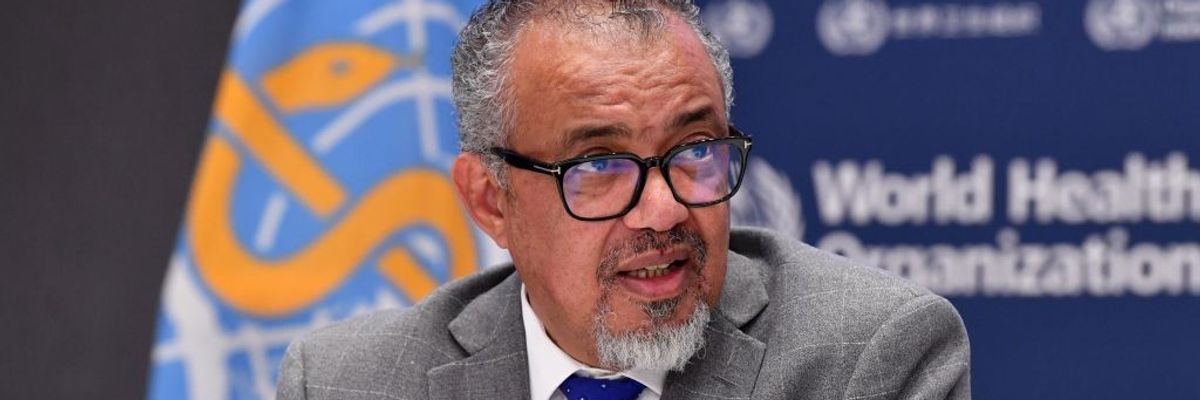
World Health Organization Director-General Tedros Adhanom Ghebreyesus speaks during a press briefing at the WHO headquarters in Geneva, Switzerland, on December 10, 2024.
(Photo: Lian Yi/Xinhua via Getty Images)

Jessica Corbett
Dec 26, 2024
COMMON DREAMS

As part of Israel's assault on various countries across the Middle East, Israeli fighter jets on Thursday bombed multiple sites in Yemen, including Sanaa International Airport, killing multiple people and threatening the life of a leading United Nations official.

World Health Organization (WHO) Director-General Tedros Adhanom Ghebreyesus and colleagues were at the airport, wrapping up a trip "to negotiate the release of U.N. staff detainees and to assess the health and humanitarian situation in Yemen," when the attack occurred, the agency leader said on social media. "We continue to call for the detainees' immediate release."

"As we were about to board our flight from Sanaa, about two hours ago, the airport came under aerial bombardment. One of our plane's crew members was injured," Tedros explained, noting the reported deaths. "The air traffic control tower, the departure lounge—just a few meters from where we were—and the runway were damaged. We will need to wait for the damage to the airport to be repaired before we can leave. My U.N. and WHO colleagues and I are safe. Our heartfelt condolences to the families whose loved ones lost their lives in the attack."

According toThe New York Times: "At least four people were killed and 21 others injured in the attack on Thursday after Israel struck the international airport in Sana and the city of al Hodeida, the Saba state news agency said, citing Yemen's Health Ministry. The report could not be independently verified."

A spokesperson for the Israel Defense Forces (IDF), Lt. Col. Nadav Shoshani, told the Times that Israel had no prior knowledge that the WHO leader would be at the airport during the attack. "We didn't know," he said. "We wish him well."


The IDF said in a statement posted on social media that "fighter jets conducted intelligence-based strikes" with approval from Chief of the General Staff Herzi Halevi, Defense Minister Israel Katz, and Prime Minister Benjamin Netanyahu.

"The targets that were struck by the IDF include military infrastructure used by the Houthi terrorist regime for its military activities in both the Sanaa International Airport and the Hezyaz and Ras Kanatib power stations," the military continued. "In addition, the IDF struck military infrastructure in the al Hodeida, Salif, and Ras Kanatib ports on the western coast. These military targets were used by the Houthi terrorist regime to smuggle Iranian weapons into the region and for the entry of senior Iranian officials."

Since the October 7, 2023 Hamas-led attack on Israel, the U.S.-armed IDF has not only decimated the Gaza Strip and killed over 45,000 Palestinians there but also ramped up strikes on other groups tied to Iran, including the Houthis in Yemen and Hezbollah in Lebanon. Additionally, Israel has exploited the recent collapse of Syrian former President Bashar al-Assad's government, seizing more territory in that country.

"The targeting of Sanaa International Airport and other civilian infrastructure is a Zionist crime against the entire Yemeni people," a Houthi spokesperson, Mohammed Abdulsalam, said in a statement. "If the Zionist enemy thinks that its crimes will deter Yemen from supporting Gaza, it is delusional."

The strikes on Yemen came a day after Netanyahu said that "the Houthis, too, will learn what Hamas, Hezbollah, the Assad regime, and others have learned, and even if it takes time, this lesson will be understood across the Middle East."

Israel's ongoing destruction of Gaza has led to a genocide case at the International Court of Justice and International Criminal Court arrest warrants for Netanyahu and his former defense minister, Yoav Gallant, as well as a Hamas leader.

Huthis claim new attacks on Israel after strikes hit Yemen airport

By AFP
December 27, 2024


An image grab from a handout video provided by Yemen's Huthi rebels' Al-Masirah TV shows burning buildings following Israeli strikes on the Ras Kutaib power station in Hodeida - Copyright GETTY IMAGES NORTH AMERICA/AFP/File MARIO TAMA

Yemeni rebels claimed a strike against the airport in Israel’s commercial hub of Tel Aviv on Friday, after Israeli air strikes hit rebel-held Sanaa’s international airport and other targets in Yemen.

The Israeli strikes on Thursday landed as the head of the UN’s World Health Organization said he and his team were preparing to fly out from Yemen’s Huthi rebel-held capital.

Hours later on Friday, the Huthis said they fired a missile at Ben Gurion airport and launched drones at Tel Aviv as well as a ship in the Arabian Sea.

No other details were immediately available.

Yemen’s civil aviation authority said the airport planned to reopen on Friday after the strikes that it said occurred while the UN aircraft “was getting ready for its scheduled flight”.

The Israeli military did not immediately respond to a request for comment on whether they knew at the time that WHO chief Tedros Adhanom Ghebreyesus was there. Israel’s attack came a day after the Iran-backed Huthi rebels claimed the firing of a missile and two drones at Israel.

Yemen’s Huthis have stepped up their attacks against Israel since late November when a ceasefire took effect between Israel and another Iran-backed group, Lebanon’s Hezbollah.

The Huthis Al-Masirah TV said the Israeli strikes killed six people, after earlier Huthi statements said two people died at the rebel-held capital’s airport, and another at Ras Issa port.

The strikes targeting the airport, military facilities and power stations in rebel areas marked the second time since December 19 that Israel has hit targets in Yemen after rebel missile fire towards Israel.

In his latest warning to the rebels, Prime Minister Benjamin Netanyahu said Israel would “continue until the job is done”.

“We are determined to cut this branch of terrorism from the Iranian axis of evil,” he said in a video statement.


– Yemenis depend on aid –


UN Secretary-General Antonio Guterres denounced the “escalation” in hostilities between Israel and the Huthis and called the Sanaa airport strikes “especially alarming”.

He said bombing transportation infrastructure posed a threat to humanitarian operations in Yemen, where 80 percent of the population is dependent on aid.

Tedros was in Yemen to seek the release of UN staff detained for months by the Huthis, and to assess the humanitarian situation.

He said he and other UN staff were about to board their flight when “the airport came under aerial bombardment”.

“The air traffic control tower, the departure lounge — just a few meters from where we were — and the runway were damaged,” Tedros said on X, adding that he and United Nations staff were safe.

A witness told AFP that “more than six” attacks struck the rebel-held capital’s airport, with raids also targeting the adjacent Al-Dailami air base.

A series of strikes also targeted a power station in Hodeida, on the rebel-held coast, a witness and Al-Masirah TV said.

Following rebel attacks against Israel, Israeli strikes had already twice this year hit Hodeida, a major entry point for humanitarian aid to impoverished Yemen, which has been ravaged for years by its own war.

On December 19, after the rebels fired a missile towards Israel and badly damaged a school, Israel for the first time struck targets in Sanaa. It said the strikes were against ports and energy infrastructure that “effectively contributed to” Huthi military actions.

Huthi media said those strikes killed nine people.

In the latest attacks, the Israeli military said its “fighter jets conducted intelligence-based strikes on military targets belonging to the Huthi terrorist regime”.


– ‘Iranian weapons’ –


The targets included “military infrastructure” at the airport and power stations in Sanaa and Hodeida, as well as other facilities at Hodeida, Salif and Ras Kanatib ports, an Israeli statement said.

The targets were used by Huthis “to smuggle Iranian weapons into the region and for the entry of senior Iranian officials,” the statement said.

Iran’s foreign ministry condemned Israel’s strikes as a “clear violation of international peace and security and an undeniable crime against the heroic and noble people of Yemen”.

Palestinian militant group Hamas, whose top leaders Israel has killed during the war in the Gaza Strip, condemned the attack as an “aggression” against its “brothers from Yemen”.

Almost a week ago, on December 21, Israel’s military and emergency services said a projectile fired from Yemen wounded 16 people in Israel’s commercial centre, Tel Aviv.

The Huthis have repeatedly fired missiles and drones at Israel since the Gaza war began in October last year, claiming solidarity with the Palestinians.

They have similarly attacked commercial shipping in the Red Sea and Gulf of Aden, waters vital to world trade.

Scores of drone and missile attacks on cargo ships have prompted reprisal strikes against Huthi targets by US and sometimes British forces.

In July, a Huthi drone attack on Tel Aviv killed an Israeli civilian, prompting the first Israeli retaliation on Hodeida.

The Huthis control large parts of Yemen after seizing the capital and ousting the internationally recognised government in September 2014.

A Saudi-led coalition in March 2015 began a military campaign to dislodge them that was unsuccessful, despite what the Yemen Data Project, an independent tracker, said were more than 25,000 coalition air raids.

strs-th-it/dcp