FREE KURDISH LEADER OCALAN
Karasu: The conditions of Öcalan must be improved, words are not enough
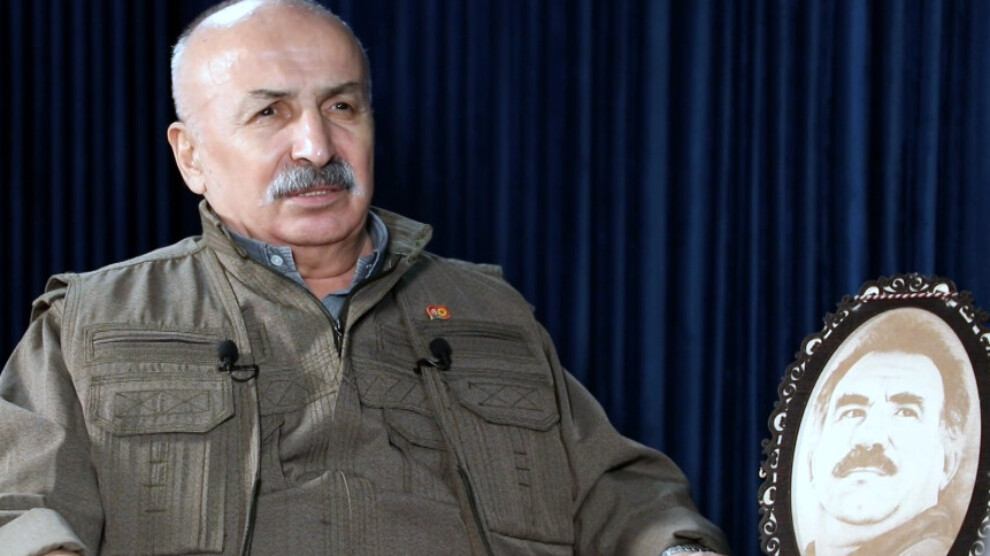
Musafa Karasu said that "isolation in Imrali continues. The working and living conditions of President Öcalan must be improved. If the government's intentions are good, if they really want to do something, then why has nothing happened so far?"
ANF
NEWS DESK
Thursday, 9 January 2025, 07:50
In the second part of this in-depth interview, Mustafa Karasu, member of the KCK Executive Council, questioned the lack of progress in the government's circles and spoke about the situation in Syria.
The first part of this interview can be read here.
People's leader Abdullah Öcalan is trying to involve the parliament; to what end? What are the different intentions of the ruling parties? And what do you say about the Imrali delegation that is currently holding talks with all parties? And what does that mean for the struggle that is being developed within the framework of the global freedom campaign?
Rêber Apo [Abdullah Öcalan] wants to include not only the parliament but all democratic forces in Turkey in this. But so far, nothing has happened. There are only some individuals stating that this would happen on January 15 and that it would happen on February 14. Why did Rêber Apo point to the parliament? The parliament has not yet discussed the matter or even put it on the agenda. What should the parliament be? An expression of the will of the people. What is its task? The creation of laws. What other responsibility does the parliament have? If the parliament fulfills its responsibility, what will happen? Laws will be drafted, and, if necessary, the constitution will be amended. When people talk about amending the constitution, some talk about Erdoğan’s election or other things. What does that have to do with it? For the Kurds, for the freedom of the Kurds, the solution to the Kurdish question, and the democratization of Turkey, a constitutional amendment is needed. Instead of talking about this kind of constitutional reform, they are talking about how Erdoğan’s position can be secured there. How can such a thing be possible? Such talks are absurd. If the Kurds are going to show an approach, it will be about the solution of the Kurdish question.
The AKP and MHP may have different intentions. The Kurdish people are skeptical, and so are we. We need to see them taking steps. At the same time, one must look at the opposition forces. Their duty is to push for a solution to the Kurdish question, and if there are different intentions within the government and the state, to expose them. If they want to instrumentalize the Kurdish question and instrumentalize Rêber Apo, they have to expose this and put forward their own approach to the solution to the Kurdish question.
The problem is not one of optimism or pessimism. The process must be handled correctly. It is not a question of words. All kinds of words can be said and talks take place. Within this framework, what needs to be discussed in parliament? The DEM party is going, and meeting with the parties and parliament must be the next step. If it is a serious discussion, if the parties and the parliament come to this, drafts of new laws and a changed constitution must be discussed. Or will they all just be empty words? It is important to focus on which laws need to be discussed and what changes are necessary.
Rêber Apo used to say, “I neither deceive nor am I deceived”. This is one of the most fundamental principles of Rêber Apo’s struggle. ‘Neither deceive nor be deceived’. Rêber Apo is waging a political struggle and wants to lift any blockage on the way to a solution.
It must be said that the isolation still continues; it has not been broken. The working and living conditions of Rêber Apo must be improved. If their intentions are good, if they really want to do something, then why aren’t the conditions of Rêber Apo changing? In order to test this in the first process, Rêber Apo said, “Let my secretary come, let me meet with some people, and let other comrades come. Let me meet with a variety of groups”. Rêber Apo lifts a historical responsibility. He is responsible for the freedom of the Kurdish people. Therefore, this isolation must be broken, and for this a struggle is necessary.
It is the global struggle that has brought the AKP and MHP to this point. After 2015, the AKP-MHP made a so-called ‘collapse plan’. Through its implementation, they wanted the freedom struggle to collapse, but it didn’t work. Because at the same time, a global struggle developed that put massive pressure on them. The Kurdish people’s struggle for freedom is challenging. Now they have put a new policy into action. This is what we are all seeing right now. What kind of process will this be? Will they start a process of democratic transformation? Thousands of people are imprisoned. A trustee was appointed instead of the elected Ahmet Turk for three terms under the pretext of terrorism. Including him in the delegation is the most reasonable, because it clearly reveals what the state’s trustee policy is. It is clear that the appointing of the trustees is to break the will of the people. They are making up some fake pretexts for their practice, but it is obvious what is going on. The reason for all those appointments of trustees has been revealed again with Ahmet Turk’s inclusion in this delegation. People must see these facts. Everyone must see the true face of the AKP.
The current delegation has had previous meetings with Rêber Apo. Sirri Sureyya Onder, Pervin Buldan and Ahmet Turk have been to Imrali before. They can continue to participate. But the thing is, Devlet Bahceli made a call. He said that the DEM party should go to Imrali. So why aren’t the co-chairs of the party involved? If they are going as a delegation of the DEM party, the DEM leadership must also be involved. As far as I am informed, Sirri Sureyya Onder is currently not part of this leadership, Pervin Buldan is the co-chair of the HDP and Ahmet Turk is a co-mayor. However, the call was addressed to the DEM party. It should go to Imrali. So why weren’t the co-chairs of the DEM party also there? At least one of them must be part of the delegation.
I would like to point out that even though we evaluate it as positive and good, there is laxity. If a democratic step is wanted to be taken to solve the Kurdish question, everyone must support it. Of course, we will support it. We support all the statements and steps of Rêber Apo. But one must never forget the true face of the Turkish state. We say this for historical reasons and by looking at its practices. This is not just a suspicion or a delusion; there is a reality in front of everybody’s eyes. When it comes to the true face of the Turkish state, one must always be cautious. Rêber Apo conducts this process and is very cautious in doing so. No one should approach this lightly or negligently. It is a historical responsibility. It is necessary to make efforts for the solution of the Kurdish question, for the democratization of Turkey, and to encourage this process. It can be encouraged. Everyone can be encouraged to get involved in this process. This is not wrong, but it is important to be cautious.
In essence, the struggle should not stop. The struggle must continue since there is still no practical result. There is nothing that would justify loosening the struggle now. Our people should continue the global campaign for the freedom of Rêber Apo in every field without slackening their struggle.
Let us now turn to the situation in Syria. The HTS has gained control over large parts of the country and now has to take care of building a new system. How did it get to this point in the first place? What was Turkey’s role in this, and what is now important for those who build the new system to take into consideration?
How HTS captured Damascus has been evaluated. In fact, it is not the success of HTS, but the fall of Damascus. Many forces came into play, and Damascus fell. It was already weakened before and unable to produce solutions by itself. A political movement, party, or state collapses when it is unable to bring forward solutions to upcoming problems and issues. And Damascus had reached such a point. There weren’t any answers anymore that it could give to the refugee issue, to the opposition, and the situation in North and East Syria. When it lost the ability to answer these, it was certainly just a question of time when it would fall.
Turkey has a decisive role in bringing Syria to this point. Turkey wanted Syria to fall immediately and come under the control of the Muslim Brotherhood and itself. That is why it has been so provocative. It wanted to accelerate the overthrow of the Syrian government and prevent Kurds from benefiting. That is why they constantly intervene in the situation in Syria. It provoked the civil war, and deliberately took 4-5 million refugees (according to them). It attracted the refugees consciously and made policy by using them as bargaining chips. This can be clearly understood today. Just as Turkey played an essential role in bringing Syria to this point, Turkey also played a role in the emergence of HTS. HTS only existed in the area dominated by Turkey. It was in Afrin and Idlib, where Turkey was dominant. And HTS could not have stayed there without Turkey. In fact, it could not have stayed without the support of the coalition. Because at one point, Russia and Syria were going to enter the region, but the US intervened and didn’t let them attack. While Turkey was supporting them logistically.
Now the Assad regime has fallen. Britain and the coalition are behind this, and they used Turkey for their plan. According to their plan, the Assad regime was overthrown for Israel’s security. Actually, there were certain compromising attitudes, but in the end, the government in Syria was overthrown because it was not trusted. And so HTS took Damascus in its hands. For a Syria based on Israel’s security, Damascus was overthrown and HTS entered Damascus. Now, Turkey can use as much anti-Israel rhetoric as it wants, but it is clear that it played its role in the destruction of a Syria based on Israel’s security. The same accounts for the HTS. In this course, Trump called Erdoğan a smart man. Also, many trolls made such Erdoğan propaganda. Not long ago, they acted as if they were agitating against imperialism; they were calling the US many names, and now? And now they are telling everyone that the American president has praised Erdoğan and is literally flying. They are truly inconceivable.
It reminds one of Celal Bucak and his men. If he swore at them or slapped them, they would say, “Oh, he slapped me. He called me a jackass”. It is a similar state of mind. Because now, when Trump called Erdoğan that he was smart, he in fact said, “Be smart. We are conducting a policy for Israel’s security in the Middle East. We are waging a war. Don’t get in the way of that.” Erdoğan never had the attitude of being an obstacle to Israel’s security. That’s why he told Erdoğan that he was smart. “You are smart if you won’t make mistakes and won’t be an obstacle to our policies.” The AKP members also praised him to the skies. What Trump expressed was that they were aware of Turkey’s influence on Syria, but that they would not accept a Syria that could in any way challenge Israel’s position, role, or security. Therefore, they had given Turkey a role and Erdoğan a responsibility. The fact that they are bragging so much about this one sentence shows how much they need it. However, the American president’s statement is clear: ‘Erdoğan, be smart. Do as we say and don’t break out of the system that we create’.
So, what will the new Syria look like? Firstly, it will not be a Syria that jeopardizes Israel’s security. Jolani stated, “I am not a threat to anyone.” He is doing anything to make himself accepted. The fact that he wears a tie is an expression of what he has become in order to make himself accepted. Now they are telling al-Jolani to “be smart and obey the system.” Turkey is giving him the same advice. First Ibrahim Kalin came, then the interior minister, and then Kalin’s deputy went to Damascus for talks. All of them are advising Damascus like this. They always want to discuss the question of how they will approach North and East Syria, of how they will neutralize and liquidate it. The axis of all their policies is to crush the Kurdish struggle for freedom. They are constantly coming and holding talks, so that this will be the basis of Syria’s policy. Turkey is telling Jolani to form a centralized state like the Turkish one and not to give any rights to anyone, any group, or any community. But of course, such a Syria cannot be formed. If Syria is not democratized, if all the different communities – Kurds, Alawites, Druze, and so on – do not have community rights, there will be no stability in Syria. The nation state is disintegrating; in fact, it has already disintegrated. The Assad regime disintegrated because it could not overcome this. Saddam disintegrated for the very same reason. They tell Jolani that if he gives community rights, it will divide Syria.
Now Germany is coming, the British are coming, the Arabs are coming, and all the others are now coming to Damascus. Like the Turks had been coming and going, now everyone else is now coming too, giving ‘advice’ and wanting to work on a Syria shaped according to their interests.
Al-jolani cannot create a Syria on his own; even if he wanted to do so, he could not. The only way out is to be smart and not listen to Turkey, to recognize the rights of Kurds, Alawites, Druze, and the other people as a community, as a people, as a different faith. That is how Syria will unite. The opposite of it will lead to war. It means fighting with the Kurds, fighting with the Alawites, and fighting with the Druze.
Now we hear that they want to form a people’s congress. Some form of a people’s congress or a constituent assembly. They themselves want to form it. How is that supposed to be possible? How is it supposed to work if there are no representatives of the peoples, particularly of the Kurds, Alevis, and Druze, and above all the representatives of women? It is crucial that women must find a place in this system. One must primarily be concerned and suspicious because of the dominant and male-dominated mentality. That concern is almost above all other concerns. It is impossible that there will be no representatives of the women, Kurds, Alevis, and Druze in such a congress.
If Syria shows an approach that takes into account the realities of Syria, Syria can be fine. Otherwise, there will be no stability in the country. Our assessment is as follows. Kurds built an autonomous system in North and East Syria. It was the most stable region during the whole war. It is not possible to establish a new Syria without the Damascus government reaching an agreement with them. Let me emphasize again, why was the Assad regime overthrown? Why did it fall apart? Why was it unable to rule? They should ask themselves this question and act based on the answers they’ll find.
While there are currently many discussions in Damascus, the situation in northern Syria is different. The Turkish state is sending the SNA against the Democratic Autonomous Administration of North and East Syria. There has been an intense war and resistance by the peoples there for weeks. How do you assess the situation there?
One must analyze what the so-called SNA is. It is a paramilitary gang, consisting of mercenaries, that is based on money and has nothing to do with the Arabic people. It is a group of mercenaries that was formed by the Turkish state. The main issue of the Turkish state is enmity against the Kurds and the strangling of the Kurdish people’s struggle for freedom. And these gangs are currently attacking the Kurds because of the Turkish state’s policy. The Turkish state does not want the Kurds to gain freedom anywhere; it does not want them to gain status; that is why it attacks.
The SNA is a mixed group of mercenaries, with a significant part of them coming from Chechnya and others from here and there, and someone from Turkey was sent and became the general of the HTS. On the other side, in North and East Syria, it is the peoples, the locals, the people of Manbij, the people of Kobane, and the people of Raqqa that are fighting. That is why these gangs are attacking every day under the protection of the Turkish state’s UAVs and UCAVs. It is the Turkish state that is fighting; there is no such thing as SNA. If those UCAVs and planes wouldn’t come only for one day, all the mercenaries of the SNA would run away. Not a single one of them would stay there. One should name it what it is; it is a war of the Turkish state.
The people of Rojava, North and East Syria, will preserve their democratic system. It was the most peaceful region during the civil war. There may have been problems, but it was also peaceful on an economic level. Everywhere else there had been massive problems. Now, of course, the Kurds, Arabs, and Assyrian people will defend that system because it is a democratic system. The Arabs govern themselves in their own regions. They have schools, live according to their culture, and administer their own social lives. These ongoing attacks will be repelled. They are already being repelled. All the people of North and East Syria are involved in this war, and they will, without any doubt, frustrate the policy of the Turkish state. This war will reveal the true face of the Turkish state even more. Now it is seen even more openly that it is the Turkish state that destabilizes Syria and continues the war. There is no war anywhere else at the moment. There would be no war in Syria if the Turkish state did not make its gangs attack. Therefore, what is left for me to say in this regard is that I commemorate all the martyrs of that resistance with respect and gratitude. I wish success to all freedom fighters.
While the war continues, the people are also mobilizing in other parts of Kurdistan and even beyond. Many actions and impressive marches have taken place, and there is currently a lot to see, especially in the northern Kurdish cities of Suruc and Nusaybin, which border Rojava. What do you want to say in this regard?
The protests in solidarity with Rojava have a tradition. In the struggle against ISIS, in the Kobane resistance, all the Kurdish people, the peoples of Turkey, the democratic forces of Turkey, and all kinds of democratic organizations, pioneered by women, came and supported the Kobane resistance in Pirsus (tr. Suruc). Support came from all over the world. And with this morale, with this support, that resistance was successful. The support played a very crucial role in winning the battle of Kobane and defeating ISIS.
Now that tradition has developed again. Both in Nisebin (tr. Nusaybin) and Pirsus, the people are showing their support in the form of vigils. There were very good marches. I salute all these marches and other expressions of solidarity. They should spread even more. All democratic organizations, institutions, trade unions, and all democratic organizations in Turkey, pioneered by women and the youth, should come and support those who are standing guard in Pirsus and Nisebin. They must oppose this policy of the Turkish state, because it is the Turkish state that is waging this war. The stance that is being shown in Pirsus and Nisebin, is of great value. This must be continued and strengthened. People must participate in these actions from everywhere, and it must not be interrupted until the war there stops, until there is assurance that the people of North and East Syria will face no further attack. Based on this, I send my greetings to all those who show their support and resist.
Regarding the situation in northern Kurdistan and Turkey, currently there are again many reports about mistreatment and state violence in prisons, but instead of reporting about it, Turkish media only headlines about the prisons in Syria. What is happening in Turkish prisons?
There is no need to explain what kind of state the Turkish state is when it comes to prisons. In the Turkish state media, they talk about all the evils that the Baath regime has done to those imprisoned, but they should look at what their own state is doing first. Turkey is a country of oppression, and this is reflected above all in its prisons. There are deaths of imprisoned people every day. Perhaps Turkey has the highest rate of female political prisoners in the world according to its population. It is a misogynist system. The reality of Turkey lies open in front of everyone’s eyes. Currently, it is pointing the finger at the Baathist regime, but the world knows what is happening in their prisons.
There is still torture in police stations in Turkey. In the past years, especially after 2015, young people who were arrested have been raped in police stations. Many cases are known, although many prefer to keep quiet about what was done to them. It was Suleyman Soylu who had given instructions to do all kinds of these things.
The Turkish state’s statements that Assad has committed such and such atrocities are purely to cover up its own reality. We don’t want to say that the Assad regime did not commit atrocities, persecution, and torture. It surely is also responsible for terrible things. But for the Turkish state it is all about propaganda. It’s about pointing the finger at them and saying “but they’re worse”.
Recently, out of nowhere, several institutions in Sulaymaniyah were closed by the state with the pretext that they were affiliated with the Kurdish freedom movement. Do you know about this, and if so, what can you tell us?
The Iraqi government really doesn’t know what they are doing. The Turks got into their heads. They were deceived because they did not recognize the true face of the Turkish state. Maybe as some kind of excuse, some say that some people in the Iraqi government took bribes. But that is not the point. How can you tolerate the existence of the Turkish state on your soil? Previous governments asked Turkey to leave Bashiqa and Turkey refused. Now they have made it even more active, and they are going to train there. They are in a blunder. They do not know what Turkey will do to them tomorrow. They already have good relations with ISIS members, have relations with some Sunni groups, and they have relations with the KDP. It is not clear what they will bring to Iraq. Iraq does not realize what it is doing. It has become unable to think for itself.
We have no understanding of the closure of women’s institutions in Sulaymaniyah. Autonomous women’s organization is a democratic right. It was not right to close them and we had already criticized their decision. We don’t think that the PUK or the administration and people in Sulaymaniyah will make any further wrong decisions in this regard. We are still trying to understand why and how it happened.
Is there anything else you would like to express at the end of our conversation?
2024 was a year of great and also difficult struggle for us. We gave many martyrs, and many comrades were wounded. I commemorate all martyrs with gratitude and respect by commemorating comrades Asya Ali and Rojger Helin. It was a great year of struggle. It was also a year of great struggle in terms of embracing Rêber Apo. The guerrillas waged a great resistance both in northern Kurdistan and in the Medya Defense Areas. The Turkish state was locked in all the places it entered. This will and determination shown in 2024 will further develop our struggle in 2025.
Everyone should know that the struggle of Rêber Apo and the PKK grows and increases with every new year it enters. The Kurdish people have become a people who struggle for their freedom. There is now such a people, such an organization, such an ideological line, and such a political struggle. This will of course further develop. The year 2025 will be a year of even greater achievements. Based on this, I once again congratulate everyone on 2025 and wish success to all the forces of struggle.
Karasu: A meeting with Leader Öcalan doesn't mean isolation was lifted
The anniversary of the dastardly attack on Sara, Rojbin, and Ronahi is just a few days ahead of us. January itself is a month characterized by many such targeted assassinations, especially of political and revolutionary women. What would you like to share
ANF
BEHDINAN
Wednesday, 8 January 2025, 07:50
In the first part of this in-depth interview, Mustafa Karasu, member of the KCK Executive Council, spoke about the anniversary, on 9 January, of the First Paris Massacre, as well as the first meeting by the DEM party with Abdullah Öcalan.
The anniversary of the dastardly attack on Sara, Rojbin, and Ronahi is just a few days ahead of us. January itself is a month characterized by many such targeted assassinations, especially of political and revolutionary women. What would you like to share with us on the occasion of the twelfth anniversary of the First Paris Massacre?
Before I start, I would like to congratulate everyone on the new year and hope that it is going to be a year of peace and tranquility for everyone.
January is indeed a month in which many dear comrades were martyred. Just to name some of them, on January 4, 2016, Pakize Nayir, Fatma Uyar, and Seve Demir were murdered. On January 6, 2017, Rubar, Halil, and Murat were martyred. On January 9, 2013, Sara, Rojbin, and Ronahi were assassinated. And on December 23rd, 2022, comrades Evin, Abdurrahman Kizil, and Mir Perwer were massacred. I remember all the martyrs that gave their lives in January with great respect and gratitude.
These martyrs have great historical meaning to us. I stayed together with comrade Sara, who was among those who founded the party, in the prison for years. Then again, comrades Rubar and Halil were two comrades that took crucial roles in our struggle. And comrade Evin, who had been a member of the Executive Council. What I want to highlight is that very valuable comrades were martyred this month.
Comrade Sara is very well known due to the fact that she was involved in the founding of the party, but she is also very important beyond that. Especially in the struggle for the freedom of Kurdistan, the pioneering role of a woman at such a level, who has ensured so much development in the freedom struggle, is the expression of an important renewal and innovation. Comrade Sara was not only among the founders of the party but was also one of the pioneers of the prison resistance. She had a decisive influence on the strong resistance in the prison and the formation of the moral values of the resistance. Most importantly, as Rêber Apo [Abdullah Öcalan] put it, Sara’s life, from a historical aspect, represents not only the history of women’s struggle for freedom in Kurdistan, but the struggle and history for women’s liberation in general.
This foundation stone of the struggle for women’s liberation, that was laid by comrade Sara and that was strengthened by thousands of women that gave their lives for it, is today being built on by thousands, tens of thousands of women that are participating in this great struggle. Comrade Sara has a crucial role in the women’s liberation struggle and in the democratic change of Kurdish society. The women’s liberation struggle means the deepening of the struggle for freedom in Kurdistan and the deepening of democratization. Women’s liberation has such a great value to add to the Kurdish people’s struggle for freedom. And in this struggle, comrade Sara’s contribution was massive.
Rêber Apo labeled the assassination of comrade Sara the ‘Second Dersim Massacre’. Indeed, in a way, it was an attack to destroy Dersim (tr. Tunceli), which was rising up again and resisting. The assassination was planned by the Turkish national intelligence and directly targeted her. It was an assassination planned and approved by Hakan Fidan, who is the current foreign minister of the Turkish state. And that in itself shows the true face of the Turkish state quite well. On the one hand, Hakan Fidan came to talk with us in Oslo, as if he would play a role in the solution to the Kurdish question. And on the other hand, he had carried out an assassination, a massacre, which signified the Kurdish genocide. One should never forget this. The reality of the Turkish state needs to be seen in all its colors.
The struggle initiated by comrade Sara is developing greatly right now. It is developing all over the world. The theoretical and historical grounding of the women’s liberation struggle by Rêber Apo has given a great impetus to it. Today, comrade Sara has become the symbol of women’s liberation not only in Kurdistan, not only in the Middle East, but also all over the world. All our martyrs are comrades who have created great values.
Comrade Evin was also among those who were martyred in the second Paris Massacre. She was a comrade who was born and raised in the heart of the region of Botan, who embodied the values of Kurdishness, the values of Botan, and became a leader in the freedom struggle. Botan is the heart where our struggle for freedom was ignited, and in terms of women’s liberation, thousands of women from Botan, like comrade Evin Goyi, poured into our ranks, played, and continue to play a historical role in social change in Kurdistan.
Our comrades Rubar, Halil, and Murat, who were martyred on January 6, 2017, have lived in the struggle for many years. Personally, I have known comrade Rubar since 1976 in Antep. At that time, he had not been part of the group that laid the foundation for the freedom struggle in Kurdistan yet. He was a construction worker. He was very young back then and joined later on. He devoted his whole life to this struggle. And his family joined the struggle. Both his sisters were martyred as well. And one of his brothers spent more than 15 years in prison. And his mother is still one of the moral values of our struggle.
Seve Demir, Pakize Nayir, and Fatma Uyar gave their lives during the self-administration resistance. They were also female comrades from the bosom of Botan. I met Seve Demir when she came to the mountains once. She was a very enthusiastic, excited, sympathetic, and sociable comrade. I commemorate all these comrades once again on this occasion, with respect and gratitude.
On December 28, a delegation of the DEM party, consisting of Pervin Buldan and Sirri Sureyya Önder, went to Imrali and held a meeting with the peoples leader Abdullah Öcalan. Why is the meeting only taking place now? What significance does it have, and what will follow from it?
On October 23, 2024, there was a family meeting in Imrali. Rêber Apo talked to his nephew, Ömer Öcalan, and through him, he made it clear that the isolation continues. Rêber Apo said that “they did everything in order to turn this place for me into hell”. In the meeting, Rêber Apo elaborated on how the state approaches him and what approach he himself has. Another long time has passed since this meeting now took place. Actually, it would have happened sooner. But when the Assad regime collapsed and political uncertainty emerged in Syria, they didn’t let them meet at first, thinking that the impact of the messages Rêber Apo would convey might be negative for them.
The first point that needs to be emphasized and underlined is that the isolation continues. One cannot say that there were one or two meetings with Rêber Apo, and so the isolation was lifted. He is not allowed to meet with his lawyers. He is not allowed to meet with his family. Why? If the isolation is lifted, why is he not allowed to meet? And there is also a comrade in the prison with Rêber Apo, who has been imprisoned for more than 30 years. According to the law, his time in prison is over; he must be released, but they don’t release him. Why? That is also part of the isolation. They don’t let him out for this reason. Rêber Apo is talking to him, meeting with him, and sharing his thoughts. If he comes out, he will be able to express what Rêber Apo thinks, how he evaluates issues, etc., and will be able to convey these thoughts to society. That is why they are not letting this comrade go.
One should not forget these facts when saying, 'The delegation went and met with Rêber Apo.' As the saying goes, ‘There is no spring with only one flower’. An approach such as “the isolation was lifted with one meeting, everything is going well, everything is getting better” would be wrong. Especially when it comes to the reality of the Turkish state, of course, one must be cautious. The policies of this state are clear. Its policies against the Kurds are clear. The 26-year persecution of Rêber Apo is clear.
Devlet Bahceli had said, 'Let the DEM party go, and let Imrali come here and speak under the name of the DEM party,' but one must look at what was said to DEM yesterday. “Crush it, finish it, shut it down!” They were almost calling to cut off their head, and they refused to acknowledge their right to live. So what has suddenly happened? When it comes to the Turkish state, especially when it comes to the Kurdish question, it is necessary to approach state policies with caution. This is not a matter of optimism or pessimism. This is an expression of historical fact and responsibility when it comes to this serious issue.
Of course, it is good to have a meeting with our leader. It is good to learn about his health. It is important to have a meeting with the leader and to convey his thoughts. Regardless of the Turkish state’s intentions, regardless of its approach, from this point of view, we, of course, value and give meaning to such a meeting. It is very important that Rêber Apo meets with a delegation and expresses his thoughts.
Why is Rêber Apo allowed to meet, particularly now? They are talking about a process, but they are not giving it a name. Everyone knows what this is about. The people know it, the political forces know it, the world knows it. Why is there a meeting with Rêber Apo now? Rêber Apo is not just any ordinary prisoner. He is the representative and leader of a people. He was thrown into prison for raising the consciousness of a people, organizing, and struggling, and for this, such heavy isolation is being applied. All forms of isolation are implemented against Rêber Apo because he raised up a people who wanted to be annihilated and subjected to genocide. Now, such a meeting is related to the Kurdish question, but how is it related? This is what needs to be evaluated. We will learn more details about this in time. We will learn which view of the Kurdish question this meeting is the result of and why such a meeting was held. But what is clear is that Rêber Apo has certainly fought all his struggles for the freedom of the Kurdish people and has made great efforts for this struggle to result in a democratic solution.
There is an interview with Rêber Apo conducted by Mehmet Ali Birand in 1988. It was published as a book and can be read by everybody. The approach Rêber Apo formulates in the interview is the same as he has today. Rêber Apo is trying to solve the Kurdish question within a reasonable framework, within a democratic framework, on the basis of the brotherhood of the peoples of Turkey. He has devoted his whole life to this. As comrade Cemil Bayik pointed out, Rêber Apo would never do anything to the detriment of the peoples. Whatever is in the interest of the peoples, whatever is right, whatever is right at this time, in this place, he will approach in that direction. This is Rêber Apo’s approach. Rêber Apo evaluates the historical process, evaluates the political developments of today, and, accordingly, he puts forward whatever is the right approach. Rêber Apo always has an approach to the solution of this question, for a solution on the right basis, for a solution on the basis of the brotherhood of peoples. He has a consistent line. Of course, the struggle, line, and politics may take different forms depending on the time and place, especially according to developments.
This meeting of Rêber Apo was important. And, of course, right now everyone evaluates it from their own perspective. What is Rêber Apo expressing? He says that a paradigm has been established and that he joins and supports it. But what is Rêber Apo trying to say? It is the intention of this paradigm to work out a solution without violence and war. This is not the first time he has expressed this; he has been saying it for forty years and has reiterated it in his prison writings, as well as in all the talks that have ever taken place in Imrali. He says that this issue must be resolved without violence and war. Rêber Apo has always pointed out that this is the only way. Without war, he wanted to approach the issue democratically and through dialog. What Rêber Apo is saying today is exactly the same. That is the intention expressed in the new paradigm. He wants to solve this issue beyond war on a democratic basis.
Seven main points were highlighted from the meeting with Rêber Apo. The most important of them is the ‘democratic transformation’. I think that this is the key point. Rêber Apo says that the aim of all the discourses and steps to be taken is to ensure democratic transformation, to ensure democratic transformation in Turkey. Rêber Apo had this approach in 2015 as well. This was the basis of the Dolmabahce Agreement. There are some people who say that the PKK broke that process or that they wanted too many things; that this would be why it broke down. That is far from being true. There was a process. It was a process to drag the AKP government into a solution process. It was entering that process with the Dolmabahce agreement, but then it left. That is the truth. What happened after that? The June 7 elections took place. And right before that, there was the massacre committed by ISIS, and on July 24, dozens of planes dropped bombs on us. Back then, Davutoglu said, 'We prepared for this a year in advance.'
Now Rêber Apo is handling this process in a way that will lead to a democratic transformation. This is the essence. It is democratic transformation. And democratic transformation means democratization of the country. What is needed for this? The Kurdish question needs to be solved. Can there be democratic transformation without a solution to the Kurdish question? Why is there no democracy in Turkey anyway? Why is it so anti-democracy? Why were the AKP, the MHP, and the state opposing democracy? Because they were not ready. They were saying that if there is democratization, Kurds will benefit. If there is democratization, the Kurdish question will be solved. Acceptance of language, identity, and culture would emerge. That’s what they were afraid of, and that’s why they opposed democracy.
Now we, of course, question whether AKP-MHP, which used to oppose democracy because it would benefit the Kurds, has now come to a mindset of democratic transformation that will benefit the Kurds. For that, we will look at their practice. It is not the multiplicity of demands of the freedom movement that puts obstacles to the solution of the Kurdish question. It is not the abundance of demands but their lack of the necessary mentality. Their mentality is not democratic; it is not in favor of solving the Kurdish question. That is why no solution has been developed so far. It has nothing to do with the multiplicity of demands. Rêber Apo shows the most reasonable approach, and so does our movement. But their mentality did not change; denialism continued.
Now Ahmet Turk says, 'We are not negotiating'. Because there are things that cannot be negotiated. We used to organize resistance in prison; we used to meet with the administration; we even had meetings with the ministry at that time as a result of the prison resistance. We always asked them, 'Are human rights to be negotiated?'. Human rights cannot be negotiated. We said that we were going to meet with our family and asked them, 'Is that something that needs to be negotiated?'. We said that there will be no torture anymore and asked them, “Is that something that needs to be negotiated?”. Kurds have human rights too. Democracy also accounts for Kurds. There can be no negotiation about the question of whether Kurds have education in the mother tongue, whether they are allowed to teach themselves, or whether they exist or not. These are the natural rights of the Kurds.
One needs to look at this from the perspective of democratization. That is the approach of Rêber Apo. Already before 2015, he held talks, and in all these talks, all his efforts were to pave the way for democratization in Turkey. It was to enable the democratic forces to breathe, to strengthen them. It was to bring together the democratic forces in Turkey. It was for the Turkish left and democratic forces to come together. The whole effort of Rêber Apo in those processes was to develop the process of creating an atmosphere of democratization in Turkey. Because Rêber Apo also sees that without democratization and democratic transformation in Turkey, the Kurdish question cannot be solved. Democratic transformation and the fundamental rights of the Kurdish question are intertwined and cannot be separated from each other.
We fully support the efforts of our leader. Because he will always strive for the good and benefit of the peoples. Rêber Apo will carry out this work for the democratization of Turkey and the solution to the Kurdish question. He said that if they have a serious intention of solving the Kurdish question, he is ready to play his role. But Rêber Apo clearly pointed out the necessity of their serious intention.
Musafa Karasu said that "isolation in Imrali continues. The working and living conditions of President Öcalan must be improved. If the government's intentions are good, if they really want to do something, then why has nothing happened so far?"
ANF
NEWS DESK
Thursday, 9 January 2025, 07:50
In the second part of this in-depth interview, Mustafa Karasu, member of the KCK Executive Council, questioned the lack of progress in the government's circles and spoke about the situation in Syria.
The first part of this interview can be read here.
People's leader Abdullah Öcalan is trying to involve the parliament; to what end? What are the different intentions of the ruling parties? And what do you say about the Imrali delegation that is currently holding talks with all parties? And what does that mean for the struggle that is being developed within the framework of the global freedom campaign?
Rêber Apo [Abdullah Öcalan] wants to include not only the parliament but all democratic forces in Turkey in this. But so far, nothing has happened. There are only some individuals stating that this would happen on January 15 and that it would happen on February 14. Why did Rêber Apo point to the parliament? The parliament has not yet discussed the matter or even put it on the agenda. What should the parliament be? An expression of the will of the people. What is its task? The creation of laws. What other responsibility does the parliament have? If the parliament fulfills its responsibility, what will happen? Laws will be drafted, and, if necessary, the constitution will be amended. When people talk about amending the constitution, some talk about Erdoğan’s election or other things. What does that have to do with it? For the Kurds, for the freedom of the Kurds, the solution to the Kurdish question, and the democratization of Turkey, a constitutional amendment is needed. Instead of talking about this kind of constitutional reform, they are talking about how Erdoğan’s position can be secured there. How can such a thing be possible? Such talks are absurd. If the Kurds are going to show an approach, it will be about the solution of the Kurdish question.
The AKP and MHP may have different intentions. The Kurdish people are skeptical, and so are we. We need to see them taking steps. At the same time, one must look at the opposition forces. Their duty is to push for a solution to the Kurdish question, and if there are different intentions within the government and the state, to expose them. If they want to instrumentalize the Kurdish question and instrumentalize Rêber Apo, they have to expose this and put forward their own approach to the solution to the Kurdish question.
The problem is not one of optimism or pessimism. The process must be handled correctly. It is not a question of words. All kinds of words can be said and talks take place. Within this framework, what needs to be discussed in parliament? The DEM party is going, and meeting with the parties and parliament must be the next step. If it is a serious discussion, if the parties and the parliament come to this, drafts of new laws and a changed constitution must be discussed. Or will they all just be empty words? It is important to focus on which laws need to be discussed and what changes are necessary.
Rêber Apo used to say, “I neither deceive nor am I deceived”. This is one of the most fundamental principles of Rêber Apo’s struggle. ‘Neither deceive nor be deceived’. Rêber Apo is waging a political struggle and wants to lift any blockage on the way to a solution.
It must be said that the isolation still continues; it has not been broken. The working and living conditions of Rêber Apo must be improved. If their intentions are good, if they really want to do something, then why aren’t the conditions of Rêber Apo changing? In order to test this in the first process, Rêber Apo said, “Let my secretary come, let me meet with some people, and let other comrades come. Let me meet with a variety of groups”. Rêber Apo lifts a historical responsibility. He is responsible for the freedom of the Kurdish people. Therefore, this isolation must be broken, and for this a struggle is necessary.
It is the global struggle that has brought the AKP and MHP to this point. After 2015, the AKP-MHP made a so-called ‘collapse plan’. Through its implementation, they wanted the freedom struggle to collapse, but it didn’t work. Because at the same time, a global struggle developed that put massive pressure on them. The Kurdish people’s struggle for freedom is challenging. Now they have put a new policy into action. This is what we are all seeing right now. What kind of process will this be? Will they start a process of democratic transformation? Thousands of people are imprisoned. A trustee was appointed instead of the elected Ahmet Turk for three terms under the pretext of terrorism. Including him in the delegation is the most reasonable, because it clearly reveals what the state’s trustee policy is. It is clear that the appointing of the trustees is to break the will of the people. They are making up some fake pretexts for their practice, but it is obvious what is going on. The reason for all those appointments of trustees has been revealed again with Ahmet Turk’s inclusion in this delegation. People must see these facts. Everyone must see the true face of the AKP.
The current delegation has had previous meetings with Rêber Apo. Sirri Sureyya Onder, Pervin Buldan and Ahmet Turk have been to Imrali before. They can continue to participate. But the thing is, Devlet Bahceli made a call. He said that the DEM party should go to Imrali. So why aren’t the co-chairs of the party involved? If they are going as a delegation of the DEM party, the DEM leadership must also be involved. As far as I am informed, Sirri Sureyya Onder is currently not part of this leadership, Pervin Buldan is the co-chair of the HDP and Ahmet Turk is a co-mayor. However, the call was addressed to the DEM party. It should go to Imrali. So why weren’t the co-chairs of the DEM party also there? At least one of them must be part of the delegation.
I would like to point out that even though we evaluate it as positive and good, there is laxity. If a democratic step is wanted to be taken to solve the Kurdish question, everyone must support it. Of course, we will support it. We support all the statements and steps of Rêber Apo. But one must never forget the true face of the Turkish state. We say this for historical reasons and by looking at its practices. This is not just a suspicion or a delusion; there is a reality in front of everybody’s eyes. When it comes to the true face of the Turkish state, one must always be cautious. Rêber Apo conducts this process and is very cautious in doing so. No one should approach this lightly or negligently. It is a historical responsibility. It is necessary to make efforts for the solution of the Kurdish question, for the democratization of Turkey, and to encourage this process. It can be encouraged. Everyone can be encouraged to get involved in this process. This is not wrong, but it is important to be cautious.
In essence, the struggle should not stop. The struggle must continue since there is still no practical result. There is nothing that would justify loosening the struggle now. Our people should continue the global campaign for the freedom of Rêber Apo in every field without slackening their struggle.
Let us now turn to the situation in Syria. The HTS has gained control over large parts of the country and now has to take care of building a new system. How did it get to this point in the first place? What was Turkey’s role in this, and what is now important for those who build the new system to take into consideration?
How HTS captured Damascus has been evaluated. In fact, it is not the success of HTS, but the fall of Damascus. Many forces came into play, and Damascus fell. It was already weakened before and unable to produce solutions by itself. A political movement, party, or state collapses when it is unable to bring forward solutions to upcoming problems and issues. And Damascus had reached such a point. There weren’t any answers anymore that it could give to the refugee issue, to the opposition, and the situation in North and East Syria. When it lost the ability to answer these, it was certainly just a question of time when it would fall.
Turkey has a decisive role in bringing Syria to this point. Turkey wanted Syria to fall immediately and come under the control of the Muslim Brotherhood and itself. That is why it has been so provocative. It wanted to accelerate the overthrow of the Syrian government and prevent Kurds from benefiting. That is why they constantly intervene in the situation in Syria. It provoked the civil war, and deliberately took 4-5 million refugees (according to them). It attracted the refugees consciously and made policy by using them as bargaining chips. This can be clearly understood today. Just as Turkey played an essential role in bringing Syria to this point, Turkey also played a role in the emergence of HTS. HTS only existed in the area dominated by Turkey. It was in Afrin and Idlib, where Turkey was dominant. And HTS could not have stayed there without Turkey. In fact, it could not have stayed without the support of the coalition. Because at one point, Russia and Syria were going to enter the region, but the US intervened and didn’t let them attack. While Turkey was supporting them logistically.
Now the Assad regime has fallen. Britain and the coalition are behind this, and they used Turkey for their plan. According to their plan, the Assad regime was overthrown for Israel’s security. Actually, there were certain compromising attitudes, but in the end, the government in Syria was overthrown because it was not trusted. And so HTS took Damascus in its hands. For a Syria based on Israel’s security, Damascus was overthrown and HTS entered Damascus. Now, Turkey can use as much anti-Israel rhetoric as it wants, but it is clear that it played its role in the destruction of a Syria based on Israel’s security. The same accounts for the HTS. In this course, Trump called Erdoğan a smart man. Also, many trolls made such Erdoğan propaganda. Not long ago, they acted as if they were agitating against imperialism; they were calling the US many names, and now? And now they are telling everyone that the American president has praised Erdoğan and is literally flying. They are truly inconceivable.
It reminds one of Celal Bucak and his men. If he swore at them or slapped them, they would say, “Oh, he slapped me. He called me a jackass”. It is a similar state of mind. Because now, when Trump called Erdoğan that he was smart, he in fact said, “Be smart. We are conducting a policy for Israel’s security in the Middle East. We are waging a war. Don’t get in the way of that.” Erdoğan never had the attitude of being an obstacle to Israel’s security. That’s why he told Erdoğan that he was smart. “You are smart if you won’t make mistakes and won’t be an obstacle to our policies.” The AKP members also praised him to the skies. What Trump expressed was that they were aware of Turkey’s influence on Syria, but that they would not accept a Syria that could in any way challenge Israel’s position, role, or security. Therefore, they had given Turkey a role and Erdoğan a responsibility. The fact that they are bragging so much about this one sentence shows how much they need it. However, the American president’s statement is clear: ‘Erdoğan, be smart. Do as we say and don’t break out of the system that we create’.
So, what will the new Syria look like? Firstly, it will not be a Syria that jeopardizes Israel’s security. Jolani stated, “I am not a threat to anyone.” He is doing anything to make himself accepted. The fact that he wears a tie is an expression of what he has become in order to make himself accepted. Now they are telling al-Jolani to “be smart and obey the system.” Turkey is giving him the same advice. First Ibrahim Kalin came, then the interior minister, and then Kalin’s deputy went to Damascus for talks. All of them are advising Damascus like this. They always want to discuss the question of how they will approach North and East Syria, of how they will neutralize and liquidate it. The axis of all their policies is to crush the Kurdish struggle for freedom. They are constantly coming and holding talks, so that this will be the basis of Syria’s policy. Turkey is telling Jolani to form a centralized state like the Turkish one and not to give any rights to anyone, any group, or any community. But of course, such a Syria cannot be formed. If Syria is not democratized, if all the different communities – Kurds, Alawites, Druze, and so on – do not have community rights, there will be no stability in Syria. The nation state is disintegrating; in fact, it has already disintegrated. The Assad regime disintegrated because it could not overcome this. Saddam disintegrated for the very same reason. They tell Jolani that if he gives community rights, it will divide Syria.
Now Germany is coming, the British are coming, the Arabs are coming, and all the others are now coming to Damascus. Like the Turks had been coming and going, now everyone else is now coming too, giving ‘advice’ and wanting to work on a Syria shaped according to their interests.
Al-jolani cannot create a Syria on his own; even if he wanted to do so, he could not. The only way out is to be smart and not listen to Turkey, to recognize the rights of Kurds, Alawites, Druze, and the other people as a community, as a people, as a different faith. That is how Syria will unite. The opposite of it will lead to war. It means fighting with the Kurds, fighting with the Alawites, and fighting with the Druze.
Now we hear that they want to form a people’s congress. Some form of a people’s congress or a constituent assembly. They themselves want to form it. How is that supposed to be possible? How is it supposed to work if there are no representatives of the peoples, particularly of the Kurds, Alevis, and Druze, and above all the representatives of women? It is crucial that women must find a place in this system. One must primarily be concerned and suspicious because of the dominant and male-dominated mentality. That concern is almost above all other concerns. It is impossible that there will be no representatives of the women, Kurds, Alevis, and Druze in such a congress.
If Syria shows an approach that takes into account the realities of Syria, Syria can be fine. Otherwise, there will be no stability in the country. Our assessment is as follows. Kurds built an autonomous system in North and East Syria. It was the most stable region during the whole war. It is not possible to establish a new Syria without the Damascus government reaching an agreement with them. Let me emphasize again, why was the Assad regime overthrown? Why did it fall apart? Why was it unable to rule? They should ask themselves this question and act based on the answers they’ll find.
While there are currently many discussions in Damascus, the situation in northern Syria is different. The Turkish state is sending the SNA against the Democratic Autonomous Administration of North and East Syria. There has been an intense war and resistance by the peoples there for weeks. How do you assess the situation there?
One must analyze what the so-called SNA is. It is a paramilitary gang, consisting of mercenaries, that is based on money and has nothing to do with the Arabic people. It is a group of mercenaries that was formed by the Turkish state. The main issue of the Turkish state is enmity against the Kurds and the strangling of the Kurdish people’s struggle for freedom. And these gangs are currently attacking the Kurds because of the Turkish state’s policy. The Turkish state does not want the Kurds to gain freedom anywhere; it does not want them to gain status; that is why it attacks.
The SNA is a mixed group of mercenaries, with a significant part of them coming from Chechnya and others from here and there, and someone from Turkey was sent and became the general of the HTS. On the other side, in North and East Syria, it is the peoples, the locals, the people of Manbij, the people of Kobane, and the people of Raqqa that are fighting. That is why these gangs are attacking every day under the protection of the Turkish state’s UAVs and UCAVs. It is the Turkish state that is fighting; there is no such thing as SNA. If those UCAVs and planes wouldn’t come only for one day, all the mercenaries of the SNA would run away. Not a single one of them would stay there. One should name it what it is; it is a war of the Turkish state.
The people of Rojava, North and East Syria, will preserve their democratic system. It was the most peaceful region during the civil war. There may have been problems, but it was also peaceful on an economic level. Everywhere else there had been massive problems. Now, of course, the Kurds, Arabs, and Assyrian people will defend that system because it is a democratic system. The Arabs govern themselves in their own regions. They have schools, live according to their culture, and administer their own social lives. These ongoing attacks will be repelled. They are already being repelled. All the people of North and East Syria are involved in this war, and they will, without any doubt, frustrate the policy of the Turkish state. This war will reveal the true face of the Turkish state even more. Now it is seen even more openly that it is the Turkish state that destabilizes Syria and continues the war. There is no war anywhere else at the moment. There would be no war in Syria if the Turkish state did not make its gangs attack. Therefore, what is left for me to say in this regard is that I commemorate all the martyrs of that resistance with respect and gratitude. I wish success to all freedom fighters.
While the war continues, the people are also mobilizing in other parts of Kurdistan and even beyond. Many actions and impressive marches have taken place, and there is currently a lot to see, especially in the northern Kurdish cities of Suruc and Nusaybin, which border Rojava. What do you want to say in this regard?
The protests in solidarity with Rojava have a tradition. In the struggle against ISIS, in the Kobane resistance, all the Kurdish people, the peoples of Turkey, the democratic forces of Turkey, and all kinds of democratic organizations, pioneered by women, came and supported the Kobane resistance in Pirsus (tr. Suruc). Support came from all over the world. And with this morale, with this support, that resistance was successful. The support played a very crucial role in winning the battle of Kobane and defeating ISIS.
Now that tradition has developed again. Both in Nisebin (tr. Nusaybin) and Pirsus, the people are showing their support in the form of vigils. There were very good marches. I salute all these marches and other expressions of solidarity. They should spread even more. All democratic organizations, institutions, trade unions, and all democratic organizations in Turkey, pioneered by women and the youth, should come and support those who are standing guard in Pirsus and Nisebin. They must oppose this policy of the Turkish state, because it is the Turkish state that is waging this war. The stance that is being shown in Pirsus and Nisebin, is of great value. This must be continued and strengthened. People must participate in these actions from everywhere, and it must not be interrupted until the war there stops, until there is assurance that the people of North and East Syria will face no further attack. Based on this, I send my greetings to all those who show their support and resist.
Regarding the situation in northern Kurdistan and Turkey, currently there are again many reports about mistreatment and state violence in prisons, but instead of reporting about it, Turkish media only headlines about the prisons in Syria. What is happening in Turkish prisons?
There is no need to explain what kind of state the Turkish state is when it comes to prisons. In the Turkish state media, they talk about all the evils that the Baath regime has done to those imprisoned, but they should look at what their own state is doing first. Turkey is a country of oppression, and this is reflected above all in its prisons. There are deaths of imprisoned people every day. Perhaps Turkey has the highest rate of female political prisoners in the world according to its population. It is a misogynist system. The reality of Turkey lies open in front of everyone’s eyes. Currently, it is pointing the finger at the Baathist regime, but the world knows what is happening in their prisons.
There is still torture in police stations in Turkey. In the past years, especially after 2015, young people who were arrested have been raped in police stations. Many cases are known, although many prefer to keep quiet about what was done to them. It was Suleyman Soylu who had given instructions to do all kinds of these things.
The Turkish state’s statements that Assad has committed such and such atrocities are purely to cover up its own reality. We don’t want to say that the Assad regime did not commit atrocities, persecution, and torture. It surely is also responsible for terrible things. But for the Turkish state it is all about propaganda. It’s about pointing the finger at them and saying “but they’re worse”.
Recently, out of nowhere, several institutions in Sulaymaniyah were closed by the state with the pretext that they were affiliated with the Kurdish freedom movement. Do you know about this, and if so, what can you tell us?
The Iraqi government really doesn’t know what they are doing. The Turks got into their heads. They were deceived because they did not recognize the true face of the Turkish state. Maybe as some kind of excuse, some say that some people in the Iraqi government took bribes. But that is not the point. How can you tolerate the existence of the Turkish state on your soil? Previous governments asked Turkey to leave Bashiqa and Turkey refused. Now they have made it even more active, and they are going to train there. They are in a blunder. They do not know what Turkey will do to them tomorrow. They already have good relations with ISIS members, have relations with some Sunni groups, and they have relations with the KDP. It is not clear what they will bring to Iraq. Iraq does not realize what it is doing. It has become unable to think for itself.
We have no understanding of the closure of women’s institutions in Sulaymaniyah. Autonomous women’s organization is a democratic right. It was not right to close them and we had already criticized their decision. We don’t think that the PUK or the administration and people in Sulaymaniyah will make any further wrong decisions in this regard. We are still trying to understand why and how it happened.
Is there anything else you would like to express at the end of our conversation?
2024 was a year of great and also difficult struggle for us. We gave many martyrs, and many comrades were wounded. I commemorate all martyrs with gratitude and respect by commemorating comrades Asya Ali and Rojger Helin. It was a great year of struggle. It was also a year of great struggle in terms of embracing Rêber Apo. The guerrillas waged a great resistance both in northern Kurdistan and in the Medya Defense Areas. The Turkish state was locked in all the places it entered. This will and determination shown in 2024 will further develop our struggle in 2025.
Everyone should know that the struggle of Rêber Apo and the PKK grows and increases with every new year it enters. The Kurdish people have become a people who struggle for their freedom. There is now such a people, such an organization, such an ideological line, and such a political struggle. This will of course further develop. The year 2025 will be a year of even greater achievements. Based on this, I once again congratulate everyone on 2025 and wish success to all the forces of struggle.
Karasu: A meeting with Leader Öcalan doesn't mean isolation was lifted
The anniversary of the dastardly attack on Sara, Rojbin, and Ronahi is just a few days ahead of us. January itself is a month characterized by many such targeted assassinations, especially of political and revolutionary women. What would you like to share
ANF
BEHDINAN
Wednesday, 8 January 2025, 07:50
In the first part of this in-depth interview, Mustafa Karasu, member of the KCK Executive Council, spoke about the anniversary, on 9 January, of the First Paris Massacre, as well as the first meeting by the DEM party with Abdullah Öcalan.
The anniversary of the dastardly attack on Sara, Rojbin, and Ronahi is just a few days ahead of us. January itself is a month characterized by many such targeted assassinations, especially of political and revolutionary women. What would you like to share with us on the occasion of the twelfth anniversary of the First Paris Massacre?
Before I start, I would like to congratulate everyone on the new year and hope that it is going to be a year of peace and tranquility for everyone.
January is indeed a month in which many dear comrades were martyred. Just to name some of them, on January 4, 2016, Pakize Nayir, Fatma Uyar, and Seve Demir were murdered. On January 6, 2017, Rubar, Halil, and Murat were martyred. On January 9, 2013, Sara, Rojbin, and Ronahi were assassinated. And on December 23rd, 2022, comrades Evin, Abdurrahman Kizil, and Mir Perwer were massacred. I remember all the martyrs that gave their lives in January with great respect and gratitude.
These martyrs have great historical meaning to us. I stayed together with comrade Sara, who was among those who founded the party, in the prison for years. Then again, comrades Rubar and Halil were two comrades that took crucial roles in our struggle. And comrade Evin, who had been a member of the Executive Council. What I want to highlight is that very valuable comrades were martyred this month.
Comrade Sara is very well known due to the fact that she was involved in the founding of the party, but she is also very important beyond that. Especially in the struggle for the freedom of Kurdistan, the pioneering role of a woman at such a level, who has ensured so much development in the freedom struggle, is the expression of an important renewal and innovation. Comrade Sara was not only among the founders of the party but was also one of the pioneers of the prison resistance. She had a decisive influence on the strong resistance in the prison and the formation of the moral values of the resistance. Most importantly, as Rêber Apo [Abdullah Öcalan] put it, Sara’s life, from a historical aspect, represents not only the history of women’s struggle for freedom in Kurdistan, but the struggle and history for women’s liberation in general.
This foundation stone of the struggle for women’s liberation, that was laid by comrade Sara and that was strengthened by thousands of women that gave their lives for it, is today being built on by thousands, tens of thousands of women that are participating in this great struggle. Comrade Sara has a crucial role in the women’s liberation struggle and in the democratic change of Kurdish society. The women’s liberation struggle means the deepening of the struggle for freedom in Kurdistan and the deepening of democratization. Women’s liberation has such a great value to add to the Kurdish people’s struggle for freedom. And in this struggle, comrade Sara’s contribution was massive.
Rêber Apo labeled the assassination of comrade Sara the ‘Second Dersim Massacre’. Indeed, in a way, it was an attack to destroy Dersim (tr. Tunceli), which was rising up again and resisting. The assassination was planned by the Turkish national intelligence and directly targeted her. It was an assassination planned and approved by Hakan Fidan, who is the current foreign minister of the Turkish state. And that in itself shows the true face of the Turkish state quite well. On the one hand, Hakan Fidan came to talk with us in Oslo, as if he would play a role in the solution to the Kurdish question. And on the other hand, he had carried out an assassination, a massacre, which signified the Kurdish genocide. One should never forget this. The reality of the Turkish state needs to be seen in all its colors.
The struggle initiated by comrade Sara is developing greatly right now. It is developing all over the world. The theoretical and historical grounding of the women’s liberation struggle by Rêber Apo has given a great impetus to it. Today, comrade Sara has become the symbol of women’s liberation not only in Kurdistan, not only in the Middle East, but also all over the world. All our martyrs are comrades who have created great values.
Comrade Evin was also among those who were martyred in the second Paris Massacre. She was a comrade who was born and raised in the heart of the region of Botan, who embodied the values of Kurdishness, the values of Botan, and became a leader in the freedom struggle. Botan is the heart where our struggle for freedom was ignited, and in terms of women’s liberation, thousands of women from Botan, like comrade Evin Goyi, poured into our ranks, played, and continue to play a historical role in social change in Kurdistan.
Our comrades Rubar, Halil, and Murat, who were martyred on January 6, 2017, have lived in the struggle for many years. Personally, I have known comrade Rubar since 1976 in Antep. At that time, he had not been part of the group that laid the foundation for the freedom struggle in Kurdistan yet. He was a construction worker. He was very young back then and joined later on. He devoted his whole life to this struggle. And his family joined the struggle. Both his sisters were martyred as well. And one of his brothers spent more than 15 years in prison. And his mother is still one of the moral values of our struggle.
Seve Demir, Pakize Nayir, and Fatma Uyar gave their lives during the self-administration resistance. They were also female comrades from the bosom of Botan. I met Seve Demir when she came to the mountains once. She was a very enthusiastic, excited, sympathetic, and sociable comrade. I commemorate all these comrades once again on this occasion, with respect and gratitude.
On December 28, a delegation of the DEM party, consisting of Pervin Buldan and Sirri Sureyya Önder, went to Imrali and held a meeting with the peoples leader Abdullah Öcalan. Why is the meeting only taking place now? What significance does it have, and what will follow from it?
On October 23, 2024, there was a family meeting in Imrali. Rêber Apo talked to his nephew, Ömer Öcalan, and through him, he made it clear that the isolation continues. Rêber Apo said that “they did everything in order to turn this place for me into hell”. In the meeting, Rêber Apo elaborated on how the state approaches him and what approach he himself has. Another long time has passed since this meeting now took place. Actually, it would have happened sooner. But when the Assad regime collapsed and political uncertainty emerged in Syria, they didn’t let them meet at first, thinking that the impact of the messages Rêber Apo would convey might be negative for them.
The first point that needs to be emphasized and underlined is that the isolation continues. One cannot say that there were one or two meetings with Rêber Apo, and so the isolation was lifted. He is not allowed to meet with his lawyers. He is not allowed to meet with his family. Why? If the isolation is lifted, why is he not allowed to meet? And there is also a comrade in the prison with Rêber Apo, who has been imprisoned for more than 30 years. According to the law, his time in prison is over; he must be released, but they don’t release him. Why? That is also part of the isolation. They don’t let him out for this reason. Rêber Apo is talking to him, meeting with him, and sharing his thoughts. If he comes out, he will be able to express what Rêber Apo thinks, how he evaluates issues, etc., and will be able to convey these thoughts to society. That is why they are not letting this comrade go.
One should not forget these facts when saying, 'The delegation went and met with Rêber Apo.' As the saying goes, ‘There is no spring with only one flower’. An approach such as “the isolation was lifted with one meeting, everything is going well, everything is getting better” would be wrong. Especially when it comes to the reality of the Turkish state, of course, one must be cautious. The policies of this state are clear. Its policies against the Kurds are clear. The 26-year persecution of Rêber Apo is clear.
Devlet Bahceli had said, 'Let the DEM party go, and let Imrali come here and speak under the name of the DEM party,' but one must look at what was said to DEM yesterday. “Crush it, finish it, shut it down!” They were almost calling to cut off their head, and they refused to acknowledge their right to live. So what has suddenly happened? When it comes to the Turkish state, especially when it comes to the Kurdish question, it is necessary to approach state policies with caution. This is not a matter of optimism or pessimism. This is an expression of historical fact and responsibility when it comes to this serious issue.
Of course, it is good to have a meeting with our leader. It is good to learn about his health. It is important to have a meeting with the leader and to convey his thoughts. Regardless of the Turkish state’s intentions, regardless of its approach, from this point of view, we, of course, value and give meaning to such a meeting. It is very important that Rêber Apo meets with a delegation and expresses his thoughts.
Why is Rêber Apo allowed to meet, particularly now? They are talking about a process, but they are not giving it a name. Everyone knows what this is about. The people know it, the political forces know it, the world knows it. Why is there a meeting with Rêber Apo now? Rêber Apo is not just any ordinary prisoner. He is the representative and leader of a people. He was thrown into prison for raising the consciousness of a people, organizing, and struggling, and for this, such heavy isolation is being applied. All forms of isolation are implemented against Rêber Apo because he raised up a people who wanted to be annihilated and subjected to genocide. Now, such a meeting is related to the Kurdish question, but how is it related? This is what needs to be evaluated. We will learn more details about this in time. We will learn which view of the Kurdish question this meeting is the result of and why such a meeting was held. But what is clear is that Rêber Apo has certainly fought all his struggles for the freedom of the Kurdish people and has made great efforts for this struggle to result in a democratic solution.
There is an interview with Rêber Apo conducted by Mehmet Ali Birand in 1988. It was published as a book and can be read by everybody. The approach Rêber Apo formulates in the interview is the same as he has today. Rêber Apo is trying to solve the Kurdish question within a reasonable framework, within a democratic framework, on the basis of the brotherhood of the peoples of Turkey. He has devoted his whole life to this. As comrade Cemil Bayik pointed out, Rêber Apo would never do anything to the detriment of the peoples. Whatever is in the interest of the peoples, whatever is right, whatever is right at this time, in this place, he will approach in that direction. This is Rêber Apo’s approach. Rêber Apo evaluates the historical process, evaluates the political developments of today, and, accordingly, he puts forward whatever is the right approach. Rêber Apo always has an approach to the solution of this question, for a solution on the right basis, for a solution on the basis of the brotherhood of peoples. He has a consistent line. Of course, the struggle, line, and politics may take different forms depending on the time and place, especially according to developments.
This meeting of Rêber Apo was important. And, of course, right now everyone evaluates it from their own perspective. What is Rêber Apo expressing? He says that a paradigm has been established and that he joins and supports it. But what is Rêber Apo trying to say? It is the intention of this paradigm to work out a solution without violence and war. This is not the first time he has expressed this; he has been saying it for forty years and has reiterated it in his prison writings, as well as in all the talks that have ever taken place in Imrali. He says that this issue must be resolved without violence and war. Rêber Apo has always pointed out that this is the only way. Without war, he wanted to approach the issue democratically and through dialog. What Rêber Apo is saying today is exactly the same. That is the intention expressed in the new paradigm. He wants to solve this issue beyond war on a democratic basis.
Seven main points were highlighted from the meeting with Rêber Apo. The most important of them is the ‘democratic transformation’. I think that this is the key point. Rêber Apo says that the aim of all the discourses and steps to be taken is to ensure democratic transformation, to ensure democratic transformation in Turkey. Rêber Apo had this approach in 2015 as well. This was the basis of the Dolmabahce Agreement. There are some people who say that the PKK broke that process or that they wanted too many things; that this would be why it broke down. That is far from being true. There was a process. It was a process to drag the AKP government into a solution process. It was entering that process with the Dolmabahce agreement, but then it left. That is the truth. What happened after that? The June 7 elections took place. And right before that, there was the massacre committed by ISIS, and on July 24, dozens of planes dropped bombs on us. Back then, Davutoglu said, 'We prepared for this a year in advance.'
Now Rêber Apo is handling this process in a way that will lead to a democratic transformation. This is the essence. It is democratic transformation. And democratic transformation means democratization of the country. What is needed for this? The Kurdish question needs to be solved. Can there be democratic transformation without a solution to the Kurdish question? Why is there no democracy in Turkey anyway? Why is it so anti-democracy? Why were the AKP, the MHP, and the state opposing democracy? Because they were not ready. They were saying that if there is democratization, Kurds will benefit. If there is democratization, the Kurdish question will be solved. Acceptance of language, identity, and culture would emerge. That’s what they were afraid of, and that’s why they opposed democracy.
Now we, of course, question whether AKP-MHP, which used to oppose democracy because it would benefit the Kurds, has now come to a mindset of democratic transformation that will benefit the Kurds. For that, we will look at their practice. It is not the multiplicity of demands of the freedom movement that puts obstacles to the solution of the Kurdish question. It is not the abundance of demands but their lack of the necessary mentality. Their mentality is not democratic; it is not in favor of solving the Kurdish question. That is why no solution has been developed so far. It has nothing to do with the multiplicity of demands. Rêber Apo shows the most reasonable approach, and so does our movement. But their mentality did not change; denialism continued.
Now Ahmet Turk says, 'We are not negotiating'. Because there are things that cannot be negotiated. We used to organize resistance in prison; we used to meet with the administration; we even had meetings with the ministry at that time as a result of the prison resistance. We always asked them, 'Are human rights to be negotiated?'. Human rights cannot be negotiated. We said that we were going to meet with our family and asked them, 'Is that something that needs to be negotiated?'. We said that there will be no torture anymore and asked them, “Is that something that needs to be negotiated?”. Kurds have human rights too. Democracy also accounts for Kurds. There can be no negotiation about the question of whether Kurds have education in the mother tongue, whether they are allowed to teach themselves, or whether they exist or not. These are the natural rights of the Kurds.
One needs to look at this from the perspective of democratization. That is the approach of Rêber Apo. Already before 2015, he held talks, and in all these talks, all his efforts were to pave the way for democratization in Turkey. It was to enable the democratic forces to breathe, to strengthen them. It was to bring together the democratic forces in Turkey. It was for the Turkish left and democratic forces to come together. The whole effort of Rêber Apo in those processes was to develop the process of creating an atmosphere of democratization in Turkey. Because Rêber Apo also sees that without democratization and democratic transformation in Turkey, the Kurdish question cannot be solved. Democratic transformation and the fundamental rights of the Kurdish question are intertwined and cannot be separated from each other.
We fully support the efforts of our leader. Because he will always strive for the good and benefit of the peoples. Rêber Apo will carry out this work for the democratization of Turkey and the solution to the Kurdish question. He said that if they have a serious intention of solving the Kurdish question, he is ready to play his role. But Rêber Apo clearly pointed out the necessity of their serious intention.


