Monday, May 19, 2025

Bruce Springsteen Lambastes “Treasonous” Trump During Start of European Tour

And Trump Responds

bruce-springsteen-en-concert-en-allemagne-en-juillet-photo-sipa-ap-georg-wendt-1694060256.jpg
Speaking at a concert in Manchester, the American singer-songwriter said his country was “in the hands of a corrupt, incompetent and treasonous administration.”

Musicians protesting against political leaders and government policies have a long and distinguished history in the United States. Bruce Springsteen, 75, one of the country’s most beloved singer-songwriters, lambasted President Donald Trump this week at a concert in Manchester, England, during the first leg of his “Land of Hope and Dreams” tour.

Here is a transcript of Springsteen’s remarks:

Introduction to Land of Hope and Dreams

Good Evening!

It’s great to be in Manchester and back in the U.K. Welcome to the Land of Hope & Dreams Tour! The mighty E Street Band is here tonight to call upon the righteous power of art, of music, of rock ‘n’ roll in dangerous times.

In my home, the America I love, the America I’ve written about, that has been a beacon of hope and liberty for 250 years, is currently in the hands of a corrupt, incompetent and treasonous administration.

Tonight, we ask all who believe in democracy and the best of our American experiment to rise with us, raise your voices against authoritarianism and let freedom ring!

Introduction to House of a Thousand Guitars

The last check, the last check on power after the checks and balances of government have failed are the people, you and me. It’s in the union of people around a common set of values now that’s all that stands between a democracy and authoritarianism. At the end of the day, all we’ve got is each other.

Introduction to My City of Ruins

There’s some very weird, strange and dangerous shit going on out there right now. In America, they are persecuting people for using their right to free speech and voicing their dissent. This is happening now.

In America, the richest men are taking satisfaction in abandoning the world’s poorest children to sickness and death. This is happening now.

In my country, they’re taking sadistic pleasure in the pain they inflict on loyal American workers.

They’re rolling back historic civil rights legislation that has led to a more just and plural society.

They are abandoning our great allies and siding with dictators against those struggling for their freedom. They are defunding American universities that won’t bow down to their ideological demands.

They are removing residents off American streets and, without due process of law, are deporting them to foreign detention centers and prisons. This is all happening now.

A majority of our elected representatives have failed to protect the American people from the abuses of an unfit president and a rogue government. They have no concern or idea for what it means to be deeply American.

The America l’ve sung to you about for 50 years is real and regardless of its faults is a great country with a great people. So we’ll survive this moment. Now, I have hope, because I believe in the truth of what the great American writer James Baldwin said. He said, ‘In this world, there isn’t as much humanity as one would like, but there’s enough.’ Let’s pray.

In a statement, the White House lashed out at Springsteen saying that “the 77 million Americans that elected President Trump disagree with elitist and out-of-touch celebrities like Bruce Springsteen. Bruce is welcome to stay overseas while hardworking Americans enjoy a secure border and cooling inflation thanks to President Trump.”

On Friday, Mr. Trump responded on his social media platformsaying that the rocker is “just a pushy, obnoxious JERK, who fervently supported Crooked Joe Biden, a mentally incompetent FOOL, and our WORST EVER President, who came close to destroying our Country.”

He added: “Springsteen is ‘dumb as a rock,’ and couldn’t see what was going on, or could he (which is even worse!)? This dried out ‘prune’ of a rocker (his skin is all atrophied!) ought to KEEP HIS MOUTH SHUT until he gets back into the Country, that’s just ‘standard fare.’ Then we’ll all see how it goes for him!”

Dating back to pre-Revolutionary War times, protest music has always had its day. “Yankee Doodle” was ordered played by the Marquis de Lafayette after the British surrender at Yorktown. The music of the abolition movement celebrated African musical traditions.

During the Great Depression Woody Guthrie sang about refugees forced of their land and migrating across the country. Billie Holiday singing Abel Meeropol’s 1939 anti-lynching song “Strange Fruit” was a catalyst for the civil rights movement. Paul Robeson sang about mistreated workers. Pete Seeger, Bob Dylan, Joan Baez, Marvin Gaye and others crafted songs protesting, racism, social injustice, and the foolhardiness of the Viet Nam War.

In 2003, at a concert in London, The Chicks (then known as The Dixie Chicks) spoke out against George W. Bush and the Iraq War, triggering a backlash that had an enormous effect on its career. At the time, The Dixie Chicks were one of the most popular American country acts. After the statement was reported it triggered a backlash from American country listeners. The group was blacklisted by many country radio stations, received death threats and was criticized by other country musicians.

In addition to his tour, later this summer, Springsteen will release a new album collection that will include dozens of “never-before-heard” songs from previously unreleased records.

Bill Berkowitz is a longtime observer of the conservative movement. Read other articles by Bill.


The Nakba Never Ended


May 15 marked 77 years since the Nakba, which refers to the expulsion, destruction, and ethnic cleansing of Palestinians associated with the creation of Israel in 1948. While we advocate for the colonization of Palestine to be recognized by our leaders and institutions in Canada as an injustice, we are also witnessing the Nakba continue — and even accelerate — in Israel’s genocide in the occupied Gaza Strip and West Bank.

In Canada, even acknowledging the existence of the 1948 Nakba continues to be rejected. Nakba denial is a form of genocide denial and a mechanism for denying the Palestinian right of return. It is also a key element of anti-Palestinian racism, something that is consistently perpetuated by the Canadian media. In 2023, the Canadian government even boycotted the first ever event held by the United Nations to commemorate the Nakba, sending a message to Palestinians that their ongoing suffering is uniquely undeserving of recognition.

What makes Nakba denial especially absurd in 2025 is that Israel is currently causing a greater scale of dispossession in Gaza than in 1948, with at least 1.9 million Palestinians forcibly displaced from their homes. This cruelty is not an accident, but by design, as one step in a deliberate plan by Israel to permanently expel Palestinians from Gaza.

When Donald Trump announced his plan for the United States to take over Gaza and permanently expel the population, Israel’s Prime Minister Netanyahu praised it — and told lawmakers that forcing Palestinians out of Gaza was the “inevitable outcome” of his military strategy. They are blocking aid from entering Gaza, deliberately using starvation as a weapon of war — a practice strictly prohibited under international law and codified as a war crime — with the genocidal intent of ensuring that Palestinians die, if not by bomb, then by hunger. This is a way of coercing those who survive to leave Palestine.

In a chilling message to world leaders, UN experts recently warned that we are at a “moral crossroads” in Gaza, and that states “must act now to end the violence or bear witness to the annihilation of the Palestinian population in Gaza.” Similarly, this week the UN Relief Chief challenged states: “what more evidence do you need? Will you act now – decisively – to prevent genocide in Gaza and to ensure respect for international humanitarian law?”

How will Canada respond to this call? Prime Minister Carney has said that “President Trump’s proposed forced displacement of Palestinians from Gaza is deeply disturbing,” but he has taken no concrete steps to address it. No sanctions, no pressure, nothing that could ever hope to stop the genocide that is being openly plotted by US and Israeli leaders.

Last year, CJPME submitted policy recommendations outlining how Canada can acknowledge and rectify the historical tragedy of the Nakba. Some of our recommendations included:

  1. Canada must officially recognize the Nakba and our role in the partition of the Mandate of Palestine.
  2. Canada must recognize Nakba denial as a form of anti-Palestinian racism and as having a direct impact on Canadians’ right to free speech and academic freedom.
  3. The Nakba is ongoing and Canada must play a role in halting it and reversing its consequences. To halt it, Canada must pressure Israel to change course by implementing boycotts, divestments, and sanctions.
  4. Canada must insist upon the right to return, restitution, and compensation for Palestine refugees, consistent with UNGA Resolution 194 and general principles of international human rights law and refugee law, and acknowledge that these rights are distinct, they are not mutually exclusive and must not be pitted against one another.
  5. Canada must play a role in demanding accountability and reparations for the Nakba (past and ongoing) by calling on the international community to set up an International Criminal Tribunal for Palestine, and by providing support to the International Criminal Court’s open investigation into war crimes committed in the Occupied Palestinian Territories.

Acknowledging the Nakba is not just about the past, it is about the present and the future — and addressing Canada’s complicity in an ongoing genocide. As Israel advances the Nakba in Gaza while annexing the West Bank, what will Canada’s legacy be?

CJPME’s mission is to enable Canadians of all backgrounds to promote justice, development and peace in the Middle East, and here at home in Canada. Read other articles by Canadians for Justice and Peace in the Middle East, or visit Canadians for Justice and Peace in the Middle East's website.

Tens of thousands protest in The Hague to demand Dutch government action on Gaza war


Copyright Niels van der Pas via AP
By 
Emma De Ruiter
Published on 19/05/2025 

Human rights groups and aid agencies — including Amnesty International, Save the Children and Doctors Without Borders — estimated the peaceful crowd at more than 100,000 people.

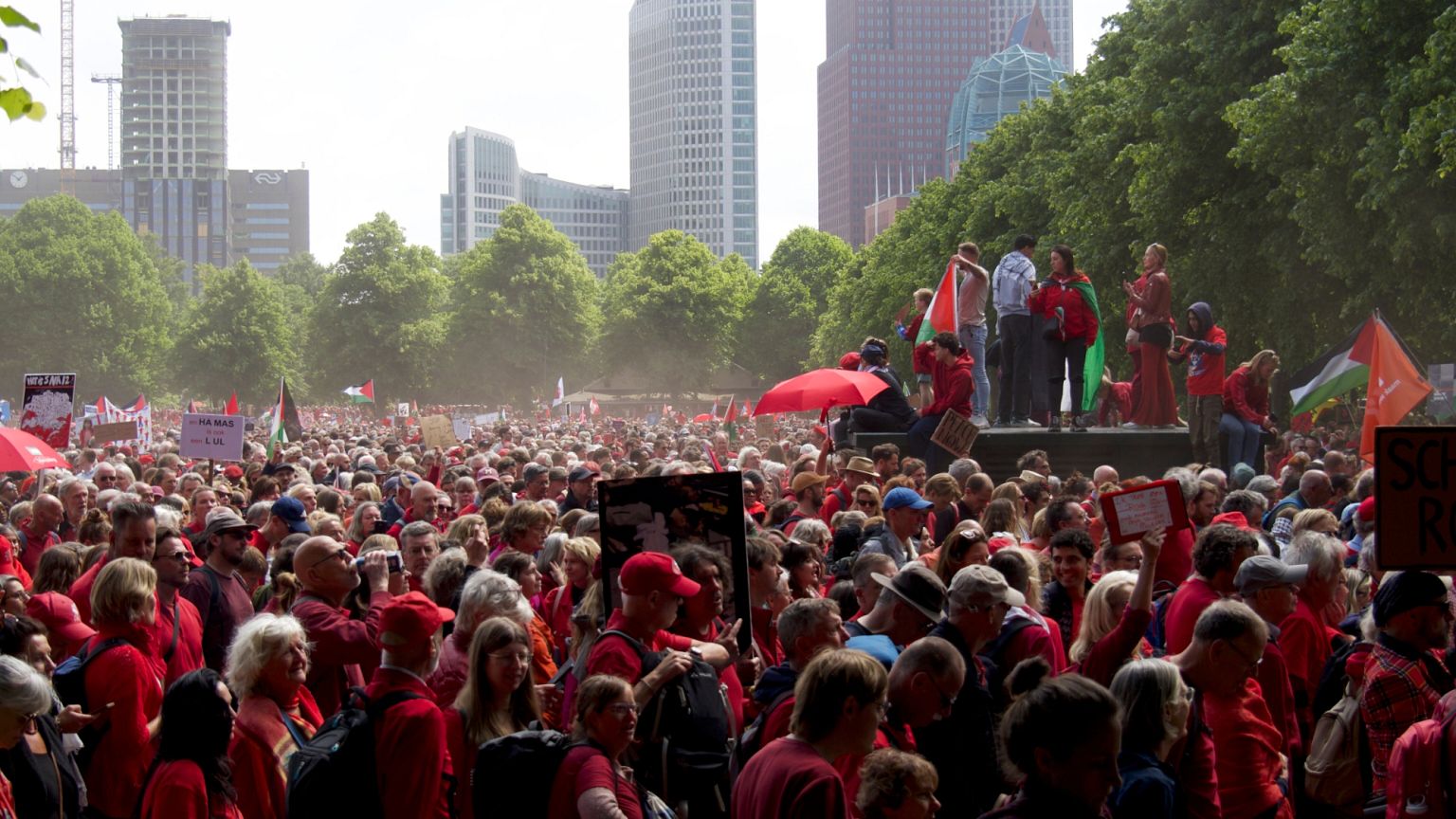
Tens of thousands of red-clad protesters marched through The Hague on Sunday to demand government action to seek a halt to Israel's campaign in Gaza.

Organisers called it the country's biggest demonstration in two decades, with human rights groups and aid agencies — including Amnesty International, Save the Children and Doctors Without Borders — estimating the peaceful crowd at more than 100,000 people.

The streets of the Dutch political capital were packed with the old, young and even some babies on their first protest.

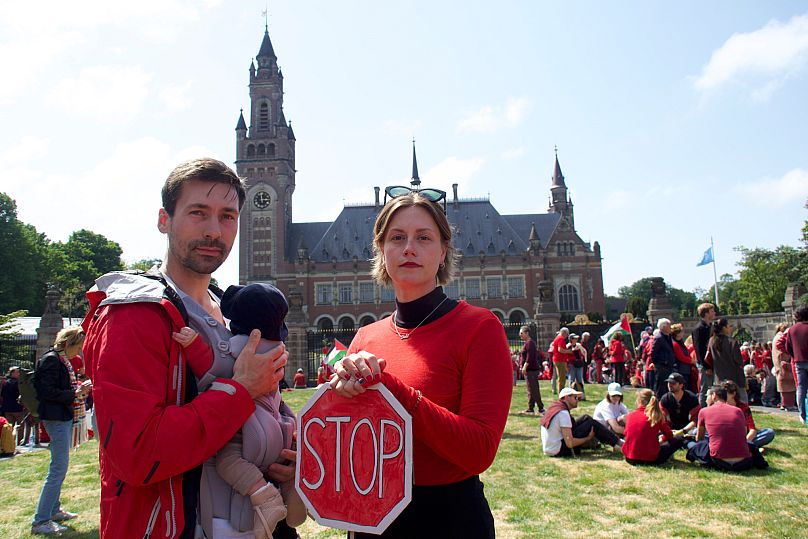
Roos Lingbeek, right, husband Stijn Joosten and daughter Dido stand in front of the Peace Palace during the Red Line protest in The Hague, Netherlands on Sunday, May 18, 2025.Niels van der Pas via AP

“We hope this is a wake-up call for the government,” said teacher Roos Lingbeek, attending the march with her husband and their 12-week-old daughter, Dido, who slept in a carrier as her parents brandished a sign simply reading: “STOP.”

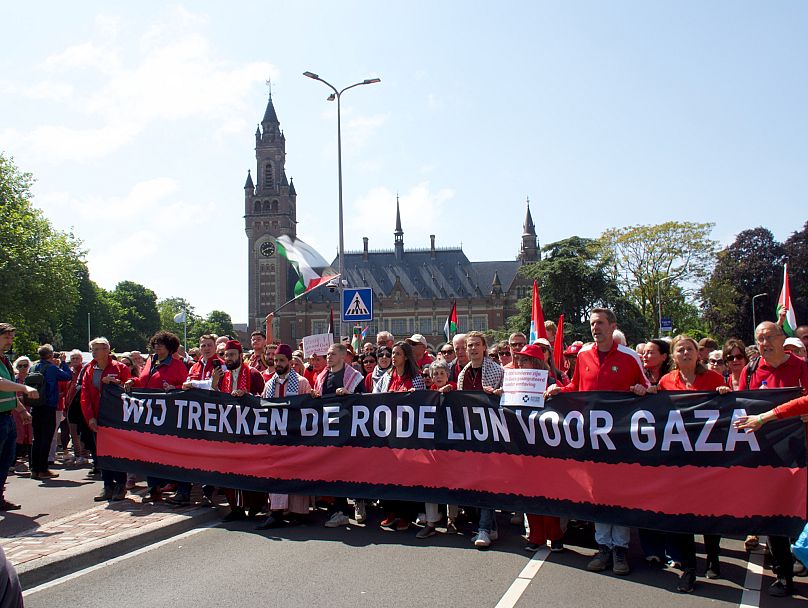
The march went past the Peace Palace, headquarters of the United Nations’ International Court of Justice, where last year judges ordered Israel to do all it can to prevent death, destruction and any acts of genocide in Gaza.

Protesters walked a 5-kilometre loop around the city centre of The Hague, to symbolically create the red line they say the government has failed to set.

Protesters carry a banner that reads We trekken een rode lijn voor Gaza (We draw a red line for Gaza) during the Red Line protest in The Hague, Netherlands on 18 May, 2025.Niels van der Pas via AP

“We are calling on the Dutch government: stop political, economic and military support to Israel as long as it blocks access to aid supplies and while it is guilty of genocide, war crimes and structural human rights violations in Gaza and the Occupied Palestinian Territories,” Marjon Rozema of Amnesty International said.

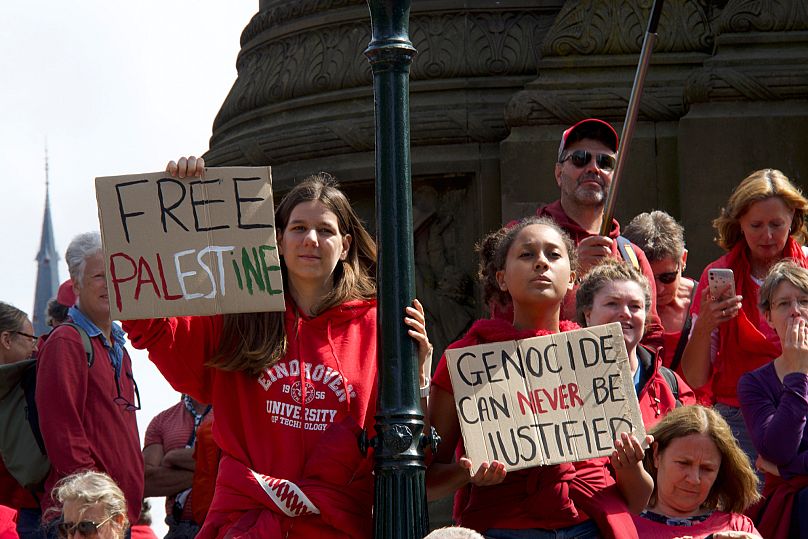
Demonstrators attend the Red Line protest in The Hague, Netherlands on Sunday, May 18, 2025.Niels van der Pas via AP

Dutch policy toward Israel is just one of many issues causing splits in the Netherlands’ fragile coalition government. Hard-right leader Geert Wilders is staunchly pro-Israel and his anti-immigrant Party for Freedom holds the largest number of seats in the country’s parliament.

In a post on X, Wilders accused the protesters of supporting Hamas, calling them "confused."

Last week, however, foreign affairs minister Caspar Veldkamp of the minority centre-right VVD party urged the European Union to review a trade agreement with Israel, arguing that its blockade of humanitarian aid violated international law. Wilders hit back, denouncing the call as an “affront to cabinet policy.”

Spectacular find: Monumental images of gods discovered at Nineveh in Iraq

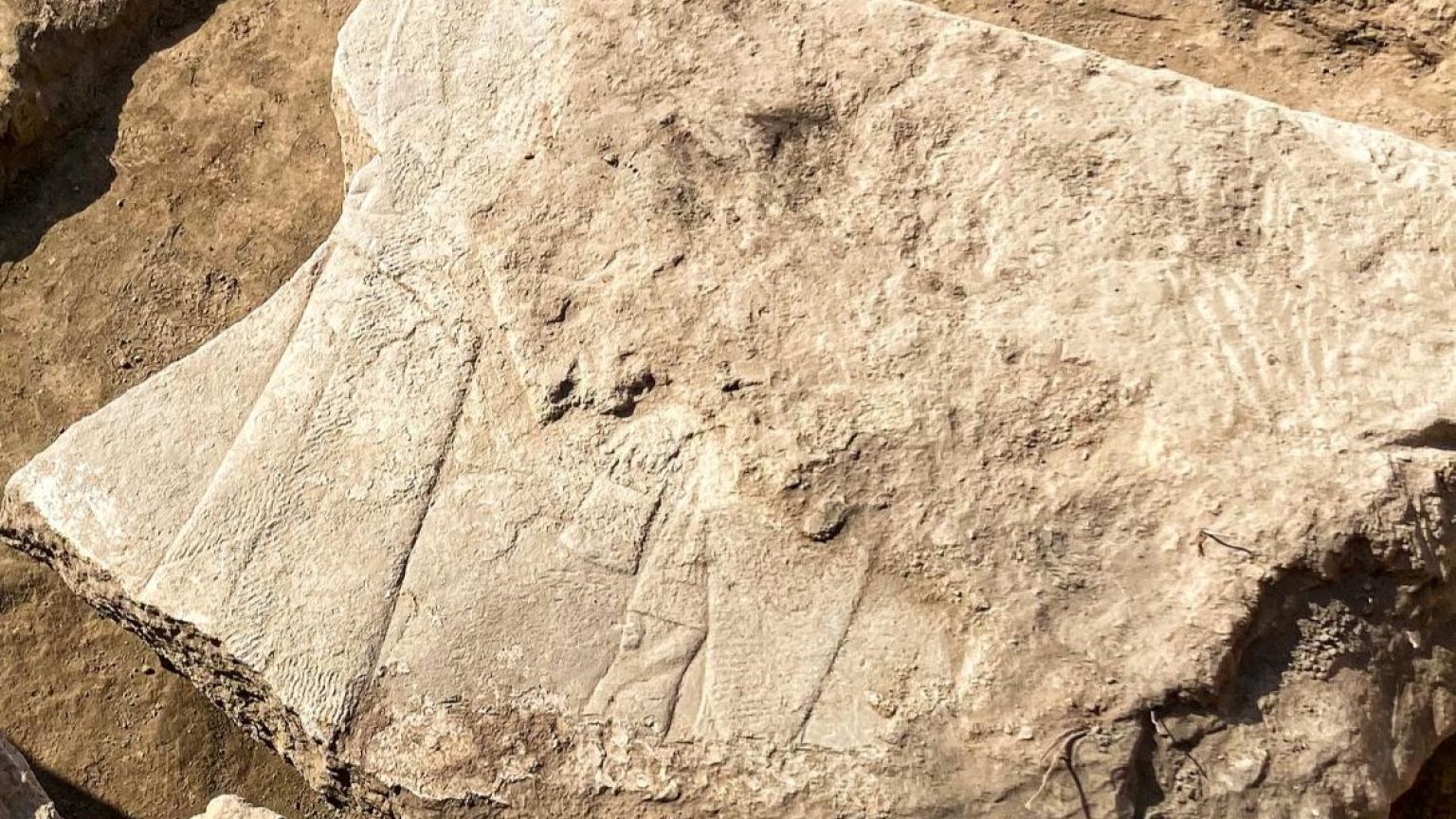
Fragment of the discovered relief
Copyright Aaron Schmidt

By Christoph Debets
Published on 

2,700 years ago, Nineveh was the capital of the Assyrian empire. Researchers from the University of Heidelberg have made a spectacular discovery in the palace of King Assurbanipal. During excavations, they came across the first large-format depictions of two important Assyrian deities.

German archaeologists have made a spectacular discovery in Iraq. During excavations in the ancient metropolis of Nineveh, a team from Heidelberg University came across large parts of a monumental relief. It shows King Assurbanipal (668 to 627 BC), the last ruler of the Assyrian Empire, accompanied by two important deities and other figures.

The relief was unearthed in the throne room of the North Palace. It was carved on a massive stone slab measuring just over five metres in length and three metres in height and weighs around 12 tonnes.

The find is extraordinary for the scientists not only because of its size, but also in terms of what the relief shows: "Among the numerous relief depictions of Assyrian palaces known to us, there is no depiction of the great deities," emphasises Prof. Dr Aaron Schmitt from the Institute of Prehistory and Early History and Near Eastern Archaeology. Schmitt is in charge of the excavations in the North Palace.


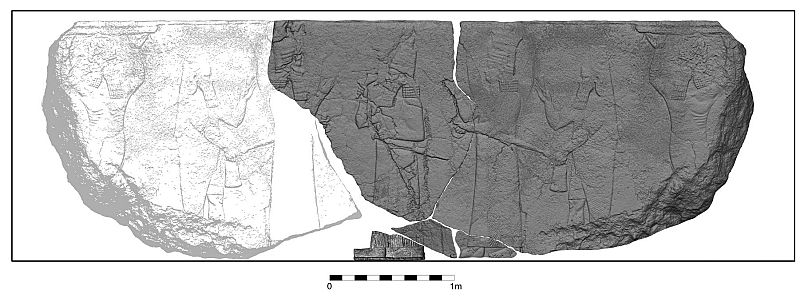
3D model of the relief: The finds are marked in dark grey, the light grey part is a reconstruction. In the centre is King Assurbanipal, flanked by Assur and Ištar.Michael Rummel / Ruprecht-Karls-Universität Heidelberg

King Assurbanipal is at the centre of the relief that has now been discovered. He is flanked by two high deities: the god Assur and the city goddess of Nineveh named Ištar. These are followed by a fish genius, who bestows salvation and life on the gods and the ruler, as well as a supporting figure with raised arms; presumably a scorpion man.

"These figures suggest that a giant winged sun disc was originally placed above the relief," explains Schmitt. Based on the data collected on site, the scientists will analyse the finds in the coming months and publish the results in a scientific journal.

The relief originally stood in a wall niche opposite the main entrance to the throne room, i.e. in the most important place in the palace, according to Schmitt. The Heidelberg researchers discovered the fragments of the relief in a pit filled with earth. It was probably created in Hellenistic times in the third or second century BC.

"The fact that the fragments were buried is certainly one of the reasons why the British archaeologists did not find them more than a hundred years ago," surmises Schmitt.

At the end of the 19th century, British researchers had already examined the northern palace of ancient Nineveh for the first time and discovered large reliefs, which are now on display in the British Museum in London.

It is unclear why the relief was buried. Schmitt points out that there is a lack of information about the Hellenistic settlement in Nineveh: "We don't know whether they had a negative attitude towards the Assyrian king and the Assyrian gods," he told the science portal "Live Science". "I hope that our future excavations will give us a clearer picture."

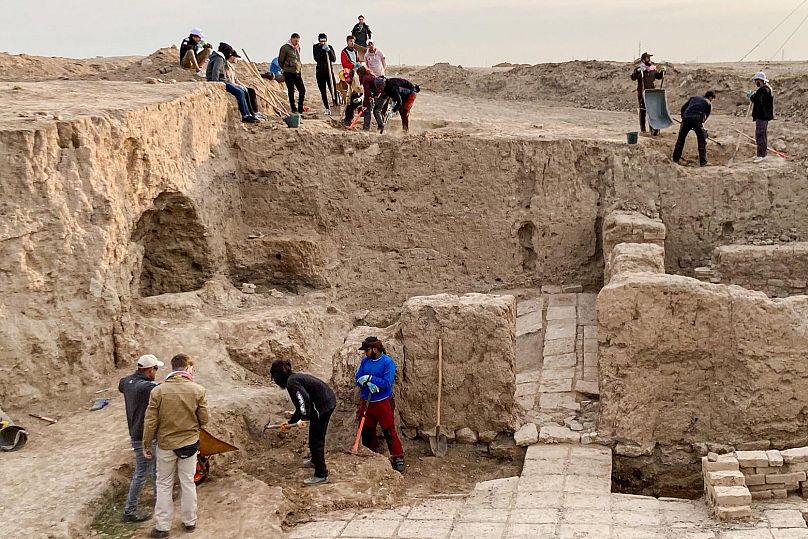
Excavation work in ancient Nineveh.Aaron Schmitt / Ruprecht-Karls-Universität Heidelberg

Ancient Nineveh is considered one of the most important cities in northern Mesopotamia and developed into the capital of the Assyrian empire in the late eighth century BC under King Sanherib (705 to 680 BC). It was located on the left bank of the Tigris, at the mouth of a small tributary within the modern city of Mosul.

Aaron Schmitt and his team have been conducting research on Kuyunjik Hill in the core area of the northern palace built by King Assurbanipal since 2022. The excavations are part of the Heidelberg Nineveh Project launched in 2018 under the direction of Professor Stefan Maul from the Department of Near Eastern Languages and Cultures at Heidelberg University.

In consultation with the State Board of Antiquities of Iraq (SBAH), the plan is to return the relief to its original location in the medium term and make it accessible to the public.

EURO ELECTIONS

Portugal general election: Ruling AD coalition wins while Chega and Socialist Party tie for seats

 AP Photo/Armando Franca

By Euronews
Updated 

The final results showed the AD coalition won with 32% of the vote, followed by the Socialist Party at 23%. The far-right Chega party comes in third with 22.56%.

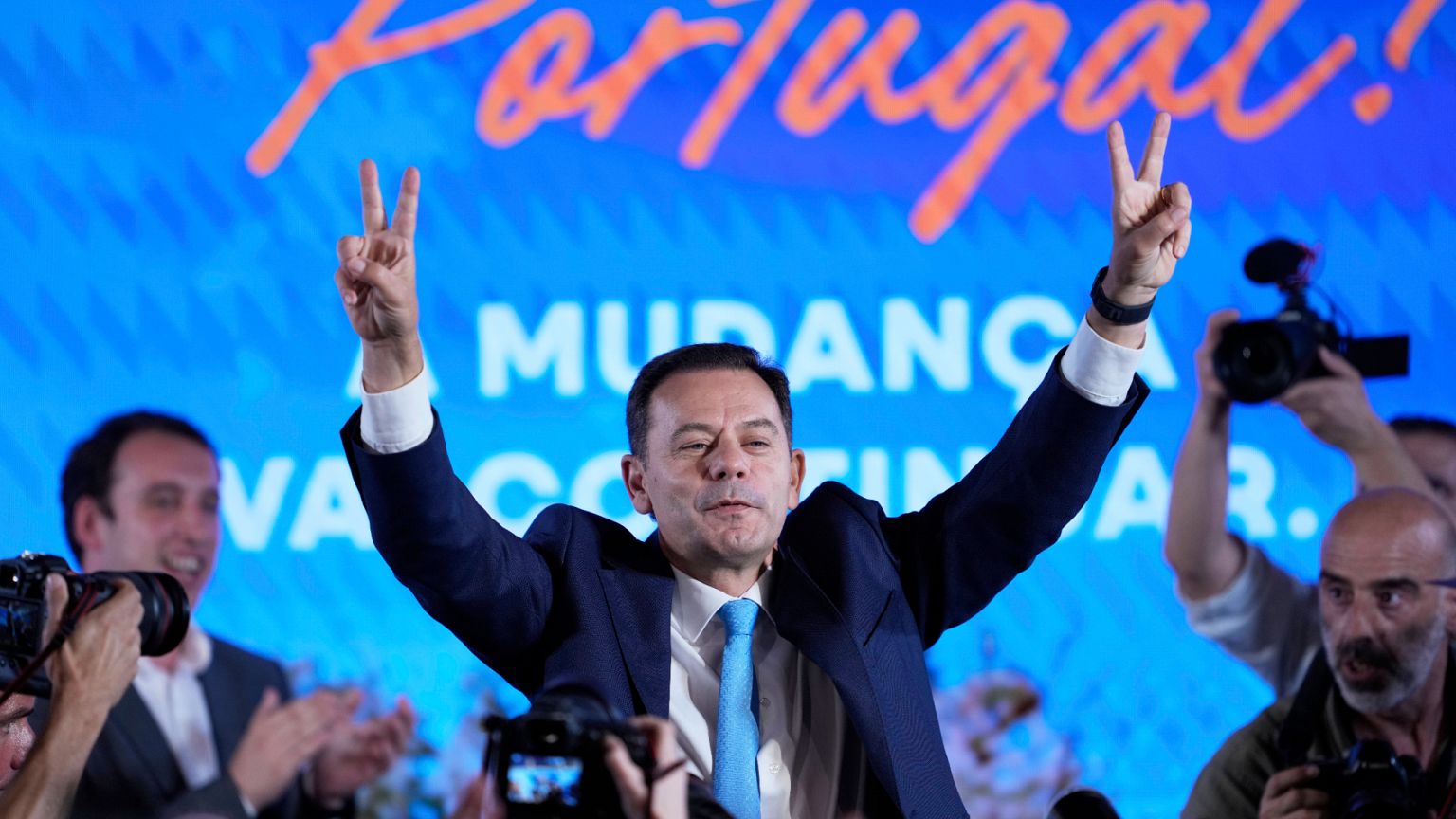
The ruling centre-right coalition Democratic Alliance (AD/PSD-CDS) remained the strongest political force in Portugal, with 32% of votes won in the Sunday general election.

With 99% of the vote counted, far-right party Chega, which earned 22,56%, has managed to nearly become the second-strongest party in the country, nearing the Socialist Party (PS) which won 23,38% of the vote. Both parties will have the same number of seats in the new parliament, 58.

Without a majority of seats the Democratic Alliance, led by the Social Democratic Party, can try to recruit support from smaller parties, currently seen as unlikely, or take office as a minority government as it did during its last term. That leaves it at the mercy of opposition parties combining to bring it down, as happened two months ago.

The election on Sunday was triggered by the Portuguese parliament's vote of confidence, ordering the resignation of the PSD/CDS-PP minority executive a year and a day after the victory of the AD/PSD-CDS coalition in the early legislative elections of March 2024.

The vote took place after two motions of censure, which Prime Minister Luís Montenegro survived, were requested by Chega and the PCP following the controversy involving Montenegro and the family company Spinumviva.

The case raised doubts about compliance with the regime of incompatibilities and impediments for holders of public and political positions.

Political instability

The ballot deepens political uncertainty just as Portugal is considering investing more than €22 billion of EU development funds.

Voter discontent with a return to the polls could benefit the far-right Chega (Enough), which has fed off frustration with the two mainstream parties.

Portugal has been caught up in the rising European tide of populism, with Chega surging into third place in last year’s election.

The government, led by the Social Democrats in an alliance with a smaller party, fell amid a controversy centred on potential conflicts of interest in the business dealings of Montenegro’s family law firm.

Montenegro, who is standing for re-election, has denied any wrongdoing.

He said he left control of the firm to his wife and children when he became PSD's leader in 2022 and has not been involved in its running.

The Socialists demanded a parliamentary inquiry into Montenegro’s conduct.

The Social Democrats are hoping that economic growth estimated at 1.9% last year, compared with the EU’s 0.8% average, and a jobless rate of 6.4%, roughly the EU average, will hold their support steady.

The Portuguese president has urged voters to participate actively in the country’s third general election in three years, saying the continent faces stiff challenges to its security and economy that require political stability.


Only 3.3 per cent of foreigners in Portugal can vote. Will the deportation policy have an impact?

Of the more than one million foreigners living in Portugal in 2023, only 34,165 were registered
Copyright Armando Franca/Copyright 2024 The AP. All rights reserved

By Joana Mourão Carvalho
Published on 

Immigrants have little participation in political life in Portugal. A study points out that this favours populist speeches and compromises integration.

Despite already representing around 15 per cent of the resident population, foreigners accounted for just 0.3 per cent of registered voters in Portugal at the end of 2024, according to data from the Voter Portal of the General Secretariat of the Ministry of Internal Administration (SGMAI).

study by the Office of Economic, Business and Public Policy Studies (G3E2P) of the Faculty of Economics of the University of Porto (FEP) reveals that immigrants in Portugal have a low level of political participation, which is compromising their social integration and favouring populist anti-immigration discourse.

Of the 1.6 million foreign residents in Portugal, only 34,165 were registered (3.3 per cent). Of these, 16,985 had acquired Portuguese nationality, which guarantees them automatic registration. For the other foreigners, registration is voluntary.

Of the total number of people registered, 15,613 were voters from European Community countries resident in Portugal and 18,552 were voters from other foreign countries. In terms of nationality, the majority were Brazilians (25.03%) and Cape Verdeans (16.89%).

Immigrant membership of Portuguese political parties is marginal or non-existent, as is the case in the rest of Europe, the EFF study also points out. If parties actively recruited immigrants to represent foreign residents, the country's diverse population would be better reflected in Parliament, the researchers say.

Recalling that all foreign residents can naturalise after five years in the country, acquiring broad political rights, the FEP's G3E2P analysis also highlights that the low level of voter registration and participation prevents immigrants' political potential from translating into effective representation.

Illegal immigration marks election campaign in Portugal

Immigration has once again become a hot topic during Portugal's election campaign. More than 10.9 million voters living abroad are expected to go to the polls this Sunday.

Days before the start of the election campaign, the surprise deportation announcement by Luís Montenegro's government, via Presidency Minister António Leitão Amaro, was a "bucket of cold water" for many immigrants.

"Over the next few weeks, we're facing around 18,000 notifications to leave national territory. I should also point out that this is the first set of decisions. We still have another 110,000 cases, most of which will probably be granted, but of those 110,000 still to be decided, we will probably also have more rejections and more notices to leave national territory," the executive spokesperson announced.

One of the flagships of the AD programme, led by Montenegro, is the control of migratory flows and the implementation of a regulated immigration policy.

The AD has been criticised from left to right, with opposition parties accusing Luís Montenegro of "electioneering" and "propaganda" in a dispute over Chega voters. André Ventura's party has insisted on a more populist discourse, claiming that immigrants are a factor of insecurity for the country.

Will deportations weigh on foreign voters?

Elaine Miranda is a hairdresser and came to Portugal 16 years ago from São Luís do Maranhão, in the north-east of Brazil. When she arrived in Lisbon in 2009, she didn't intend to stay, but ended up settling here because she identified with the Portuguese capital due to its similarities to her hometown.

After a week, she soon received job offers and ended up becoming a naturalised citizen, even though the process took a long time. She will be exercising his right to vote on the 18th for the first time. Elaine expects the next government to provide a balanced solution to the problem of unregulated immigration.

"I'm an immigrant and I'm in favour of immigration, but we have to have conditions, there has to be control at all times, and people have to integrate into the community," Elaine told Euronews, rejecting the idea that the announcement of the deportations will influence her vote on Sunday.

Ounísia Santos, a PhD student in Environmental Engineering, has a different view. She came to Portugal from Cape Verde 12 years ago to continue her studies in higher education and became a naturalised citizen in 2021.

When she heard the news about the immigrants being expelled, her first reaction was concern. "It feels like they're coming after you, like a persecution. Portugal has always seemed to me to be a welcoming and receptive country, so I was shocked to learn that a country that has welcomed me so well is not receptive to everyone," she told Euronews.

As an immigrant, she says she understands the importance of foreign labour for the country, but she is also critical of uncontrolled immigration. "There needs to be proper management, otherwise scenarios like the one we're seeing now in Portugal happen, such as pressure on public services, schools and housing," she admits.

Ounísia voted in the two previous elections, in 2022 and 2024, and intends to vote again this Sunday. She hopes that the next government will at least provide the conditions for immigrants who are already here to integrate.

Portugal: Young men five times more likely to vote for the far-right than women

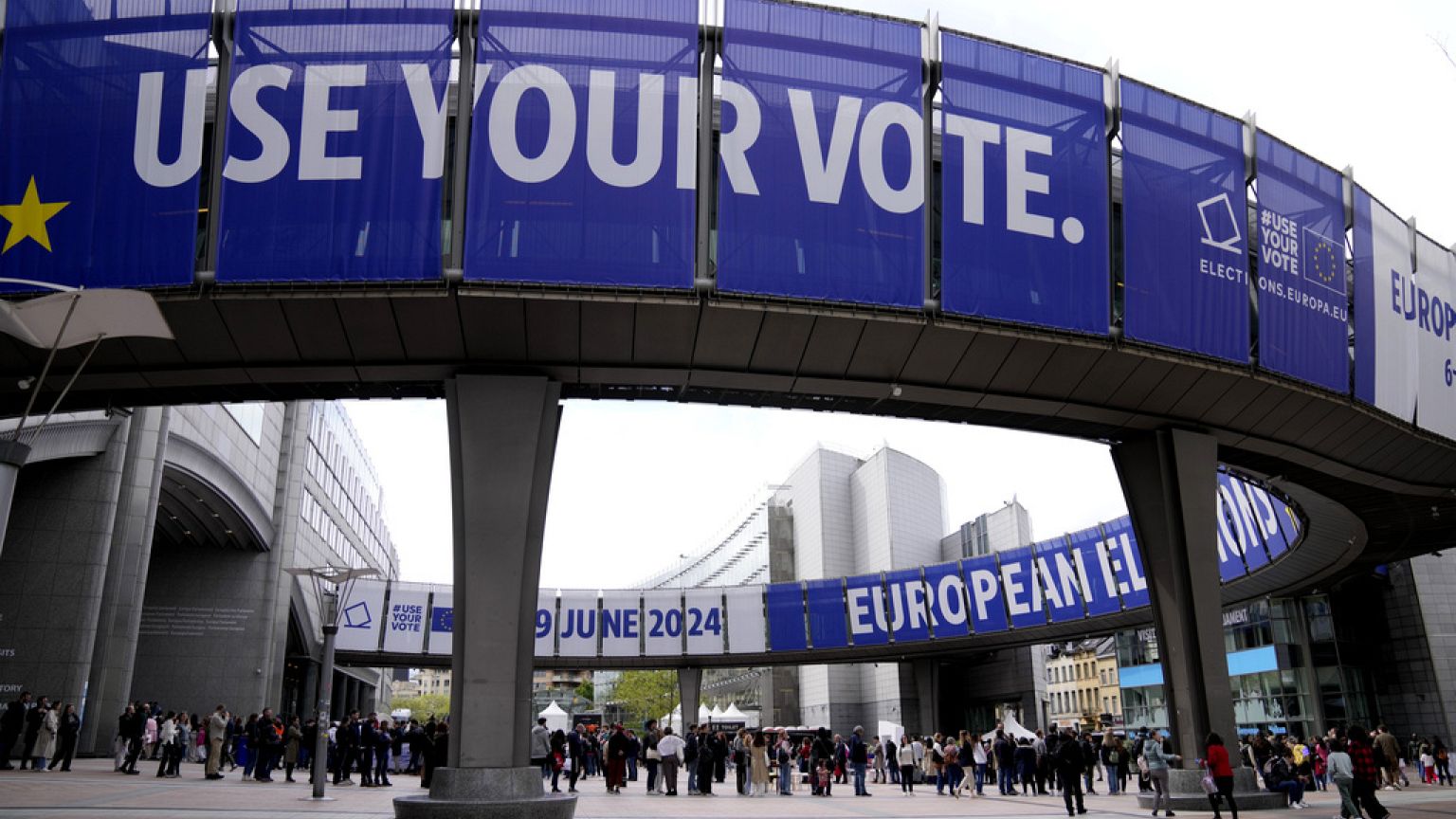
People wait in line to visit the European Parliament during the Europe Day celebrations in Brussels on 4 May 2024.
Copyright Virginia Mayo/Copyright 2024 The AP. All rights reserved.

By Euronews
Published on 

The author of the report, who is an analyst at the European Policy Centre, explains that far-right movements have been able to take advantage of the frustration of young men under 25 over the 'loss of a stable job and financial independence', which are 'traditional markers of masculinity'.

Young Portuguese men vote five times more for the far right than girls. The conclusion, presented in a report by the European Policy Centre, reflects a growing trend that marks a gender divide among European youth when it comes to politics - men are oriented towards far-right ideals, while women lean towards progressive movements.

In Portugal, in the youth population, every female vote for a far-right party is matched by 4.9 male votes. This is the second highest figure in the European Union, behind only Croatia (6.0), and ahead of countries like Spain (4.6), Denmark (4.4) and Finland (4.2). The pattern was found in the votes for the last European elections in 2024.

The cause of this gender disparity in young people's voting behaviour may lie in the economy.

"The rise in anti-feminism among young men is not just a reaction to feminism, but also the result of growing precariousness - especially among working men who don't have a university degree," notes Javier Carbonell, author of the study, emphasising that younger men have less access to employment.

Job opportunities, he stresses, "have been increasing among women under 24 for decades, while they have been decreasing for men".

Due to the decline "in terms of income, wealth, employment, purchasing power, educational attainment and mental health", European men under 25 are being attracted to the "traditional vision of masculinity" advocated by far-right parties, which "have successfully capitalised on the frustration associated with the loss of a stable job and financial independence - traditional markers of masculinity", explains Carbonell.

The study warns that "this gender gap threatens not only gender equality, but also the foundations of democratic support itself, since radicalised young men often show a weaker commitment to democratic norms".


Polish presidential election: Trzaskowski and Nawrocki advance to second round

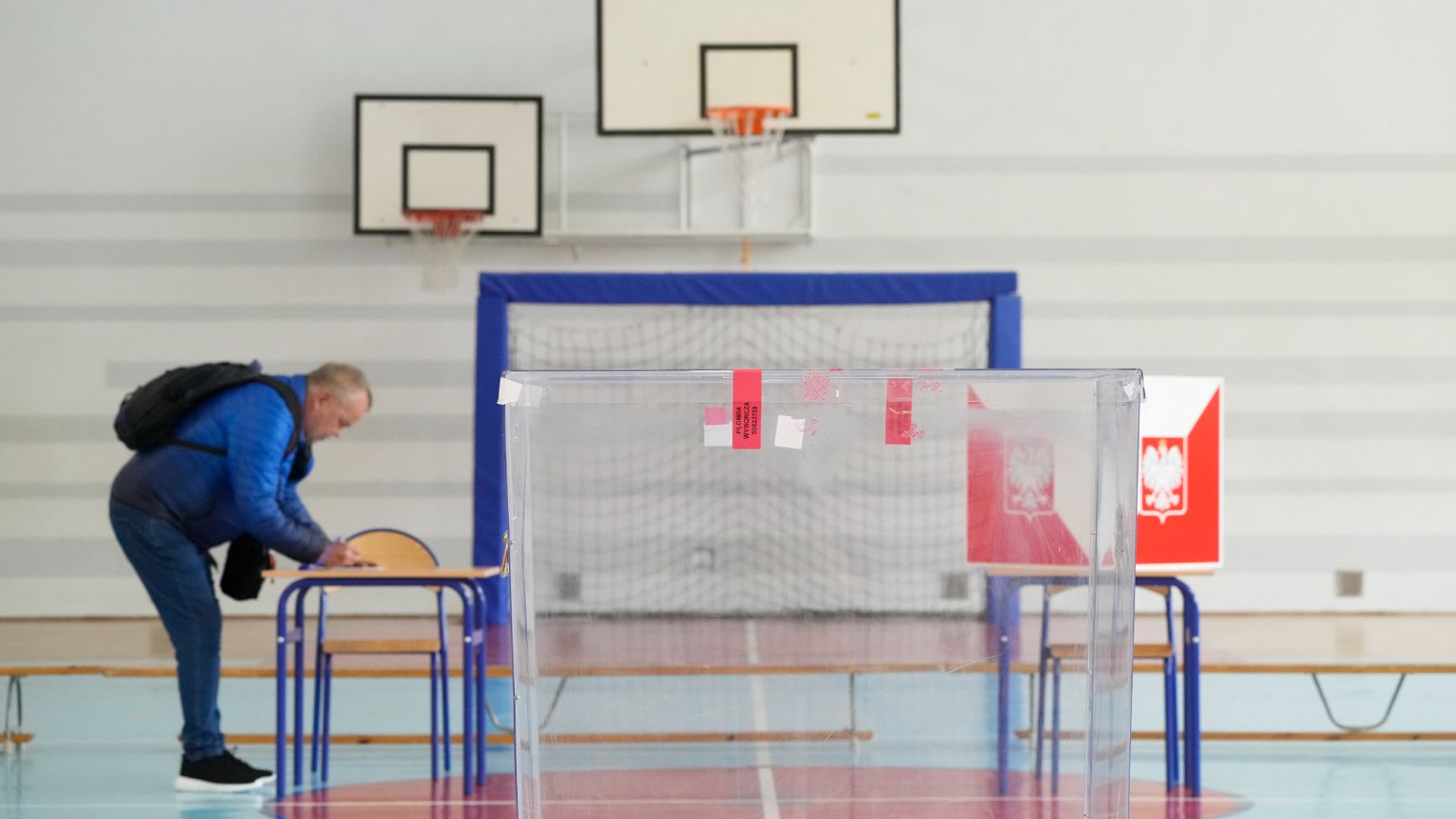
Presidential elections in Poland 2025: First round
Copyright Copyright 2025 The Associated Press. All rights reserved


By Katarzyna-Maria Skiba
Published on 

Two main candidates have progressed to the second round of the Polish presidential election, with Trzaskowski at 31.2% and Nawrocki at 29.7% of the vote.

Warsaw Mayor Rafal Trzaskowski and PiS-backed independent Karol Nawrocki have advanced to the runoff of the Polish presidential election, after a closely fought race on Sunday, latest exit polls show.

According to the last-minute Ipsos poll, which came as 90% of the votes were counted, Trzaskowski has won 31.2% of the vote, while Nawrocki is right behind him with 29.7%.

Third and fourth place went to far-right candidates Slawomir Mentzen and Grzegorz Braun, who won 14.5% and 6.3% of the vote, respectively.

According to experts, their electorate may decide the outcome of the second round.

According to exit polls, Rafal Trzaskowski won in 10 provinces and Nawrocki in six. The electoral maps have shown a repeat trend of a split between western Poland, which mostly voted for Trzaskowski, and the eastern part of the country, where Nawrocki won the bulk of the vote.

The two candidates will now move on to the second round, which will take place on 1 June. According to the latest Opinia24 poll published by TVN24, the race will be close, with little difference between the candidates.