It’s possible that I shall make an ass of myself. But in that case one can always get out of it with a little dialectic. I have, of course, so worded my proposition as to be right either way (K.Marx, Letter to F.Engels on the Indian Mutiny)
Friday, September 26, 2025
Iraq Expects Kurdistan Oil Exports to Restart This Week
Iraq expects crude oil exports from the semi-autonomous region of Kurdistan via pipeline to Turkey to resume this week, Iraqi Foreign Minister Fuad Hussein has told Bloomberg in an interview.
Oil exports from Kurdistan have been halted for two and a half years, after they were shut in in March 2023 due to a dispute over who should authorize the Kurdish exports. Despite some breakthroughs in negotiations in recent months, the disagreements have continued.
The restart of exports to the Turkish Mediterranean port of Ceyhan will take place “most likely this week,” following a breakthrough in discussions for an agreement between the federal government, the Kurdistan Regional Government (KRG), and the oil companies operating in Kurdistan, the official said.
Initially, about 230,000 barrels per day (bpd) from Kurdistan will be exported, and this volume to rise up to 500,000 bpd with new investments to increase production, the Iraqi minister told Bloomberg.
Eight oil companies operating fields in Kurdistan have reached an agreement with the Iraqi central government and the Kurdistan Regional Government that would enable the restart of exports from the region.
“This framework, once signed and implemented, should allow exports to restart in the coming days, while providing a path toward longer-term arrangements,” the association of oil producers in Kurdistan said. The companies involved in the agreement represent 90% of oil production in the northern Iraqi region, the New Arab reported, noting two companies have not signed off on the deal yet.
Norwegian DNO ASA and British Genel Energy have refused to sign a deal until the Kurdistan Regional Government provides guarantees that they will receive the money it owes them.
The suspension of oil flows in 2023 has cost Iraq and Kurdistan some $26 billion in lost oil income, the KRG’s head of foreign relations told media earlier this month.
Additional supply from Kurdistan is set to hit the oil market at a time when analysts, forecasters, and traders expect oversupply to start building with the end of the peak summer demand season.
Zelenskyy told Axios that Trump approved Ukraine striking Russian energy facilities in response to Moscow’s attacks.
Ukrainian drones hit Russia’s Salavat petrochemical complex and other refineries, worsening fuel shortages.
Kyiv is pressing Washington for more offensive weapons to pressure Putin, while Moscow admits to economic strains.
Ukrainian President Volodymyr Zelenskyy says US President Donald Trump told him Kyiv could respond to Russia's attacks on its energy infrastructure with tit-for-tat strikes, as Ukraine continues to pound Russian refining operations.
He added that Trump had also green-lit retaliatory strikes on Russia's military factories. However, he suggested they might be harder to reach due to the high level of defense of such facilities.
Zelenskyy's comments came a couple days after he talked with Trump on the sidelines of the UN General Assembly in New York on September 23.
The meeting was followed by Trump's sudden rhetorical shift in which he said Ukraine could restore control over its borders with "time, patience, and the financial support of Europe and, in particular, NATO."
"[Russian President Vladimir] Putin and Russia are in BIG economic trouble," Trump wrote on his Truth Social page, suggesting the country’s money problems were one of the main reasons for his newly voiced confidence in Ukraine's capabilities.
The Kremlin denied the claim on September 24, though it admitted that "yes, Russia is experiencing certain tensions and problem areas in various sectors of the economy."
As Zelenskyy said he told Trump Ukraine has drones that can reach deep into Russian territory, Kyiv has continued to attack Russian oil refining infrastructure, critical to its war efforts.
The day after the US and Ukrainian leaders met in New York, the Salavat petrochemical complex, one of Russia's largest, which is located in the Bashkortostan region, was attacked by Ukrainian drones.
Salavat, located about 1,500 kilometers from the front lines in Ukraine, produces 150 types of products, including automotive gasoline, diesel fuel, fuel oil, bitumen, and polyethylene.
Amid the wave of attacks by Ukraine, which were also reported on Russian oil distribution facilities in the Bryansk and Samara regions, Russia has seen growing shortages of some fuel grades due to reduced refining capacity.
RFE/RL's Crimea.Realities reported that gas stations in Crimea, which Russia illegally annexed from Ukraine in 2014, were almost completely out of fuel supplies.
In the interview, Zelenskyy further said he asked Trump for additional weapons systems he thinks would pose "additional pressure on Putin to sit and speak."
Volodymyr Fesenko, a Ukrainian political scientist, told Current Time he sees the sale of offensive US weapons to Ukraine as a strong alternative to possible European and US sanctions on Russia.
"It won't be free of charge... But it's a tool that could put pressure on Putin," Fesenko added.
French LNG terminals operator Elengy has issued force majeure notices to customers that its three import facilities in France will not be receiving cargoes until October 2 due to a prolonged strike, a company spokesperson told Reuters on Friday.
France is gripped by a nationwide strike over pay and salary negotiations in the energy sector, which has resulted in lower electricity output at French nuclear power plants and other energy facilities in recent days.
The strike has been affecting LNG terminals, too.
Elengy operates the Fos Tonkin and Fos Cavaou LNG terminals on France’s Mediterranean coast and the Montoir-de-Bretagne facility on the Atlantic coast.
All these, plus the Dunkirk terminal, have seen impact from the strikes in recent days. Disruptions at Dunkirk have been minimal.
But the three LNG terminals operated by Elengy will not receive LNG cargoes until at least October 2.
Fos Tonkin and Fos Cavaou LNG terminals were blocked from sending out natural gas on the network to the neighboring countries, which rely on the French imports for part of their gas use. The Montoir-de-Bretagne LNG terminal has seen reduced flows to the neighboring gas network systems, the spokesperson for Elengy told Reuters.
The strike has also blocked loading at the Fos Cavaou terminal, they added.
The reduced LNG arrivals in France kept the Dutch TTF Natural Gas Futures, the benchmark for Europe’s gas trading, stable on Friday morning in Amsterdam, despite the rise in Norwegian pipeline gas flows as facilities wind down planned maintenance.
Europe is filling inventories ahead of the winter, but the rate of filling is lagging behind last year’s levels after a cold winter sapped more volumes from reserves.
This summer, LNG demand in Asia has been tepid, allowing Europe to draw a lot of U.S. LNG cargoes. The weakness in Asian LNG demand has been welcome news for Europe as the EU scrambles to fill up inventories going into the winter.
Dubbo project. Credit: Australian Strategic Materials
Some of Australia’s most advanced critical minerals producers are moving forward on plans to build processing facilities in the United States, despite Australia’s strategic push to build up its own domestic industry.
An Australian delegation of critical minerals companies visited Washington and New York last week to meet senior administration officials and investors. ASX-listed firms including Australian Strategic Materials, Ionic Rare Earths, and International Graphite are looking to expand in the US, company executives told Reuters.
The scale of the US customer base is a major attraction, they said, given its rapidly developing electric vehicle, defence, and advanced manufacturing industries, as well as cheap energy and the hefty subsidies it is set to deploy.
“We’ve identified six states as ones that we’re looking at seriously,” said chief legal officer Annaliese Eames of ASM, which is seeking to expand beyond its rare earths metallization plant in Korea.
Of those states, ASM, an $85 million firm, is conducting detailed due diligence, including reviewing sites, in Oklahoma and South Carolina.
What drew ASM to the US was more than strong federal and state support and incentives. “It’s the commitment that they’re making to grow the entire ecosystem,” she said.
Some critical minerals firms that supply to customers in defence need to locate nearby for reasons of national security and the series of complex steps in turning raw materials into magnets used in everything from wind power to missiles.
That is the case for Ionic Rare Earths, which is planning to replicate the magnet recycling technology it has developed in Belfast in several US states, including Tennessee, where it is in advanced discussions, managing director Tim Harrison said.
“There are a number of other states that can provide very low cost of power… They also have a lower labour cost base and they have both federal and state governments that are willing to deploy immense funding,” he told Reuters.
International Graphite, which is building an advanced processing plant in Western Australia, is also looking at options to build in the US and Europe, to be more closely aligned to the specific requirements of its customers, CEO Andrew Worland said.
China’s restrictions on rare earths exports in April galvanized the US to supercharge its rare earths industry, and higher Western world prices that have emerged are attracting investors and greasing the wheels of project finance.
Even so, access to US funding is expected to be highly competitive. Australia’s Lynas Rare Earths, the biggest supplier outside China, warned last month that its heavy rare earths processing plant in Texas may not go ahead after the Trump administration provided multibillion dollar funding to its US rival.
Policy challenges
The trend highlights critical policy challenges in Australia that are impeding the government’s ambition to develop new export markets beyond its mainstay fossil fuels. That opportunity was worth A$170 billion ($112 billion) to its economy by 2040, according to a PwC report as recently as 2023.
“Australia has been struggling to set up the critical minerals industry beyond primary extraction,” PwC Australia chief economist Amy Lomas said.
Australia’s high power and labour costs, and a cumbersome approvals process, are dragging on growth and diminishing the country’s international competitiveness, major miners regularly complain. Meanwhile, advanced manufacturing is still a small sector, its development clipped by the closure of Australia’s car industry in the 2010s.
“For an Australian company to look at building it in Australia, where do we sell our materials? Where is the metals, alloys, magnet capacity being built? It’s not being built in Australia because our cost base is too expensive and we have minimal advanced manufacturing industry,” Ionic’s Harrison said.
Still, Australia passed a A$17 billion production tax credit in February that will provide a 10% offset for critical minerals processors from 2027. It is also building critical minerals partnerships with allies including Japan, India and Britain that could deepen its customer base, PwC’s Lomas added.
“Then that starts to set the foundations for Australia to be able to run a lot harder typically for midstream processing, and then ideally downstream processing,” she said.
($1 = 1.5177 Australian dollars)
(By Melanie Burton; Editing by Stephen Coates)
G7 mulls rare earth price floors, other measures to counter China
The Group of Seven (G7) nations and the European Union are said to be discussing the idea of imposing price floors on rare earths to counter China’s dominance in the supply chain, Reuters reported on Wednesday.
A price floor, if imposed, would provide greater incentives for producers of rare earths and related products in those regions, which for decades have relied on Chinese supply. Rare earths, which are difficult to extract and expensive to process, are key to many high-tech products, including cell phones, EVs and defense applications.
China currently dominates the global mine supply of rare earths and controls over 90% of their total processing capacity. This forces the G7 nations, with the exception of Japan, to their supply rare earths and related products such as permanent magnets, which are used in wind turbines and electric vehicles, exclusively from China.
According to Reuters, G7 leaders recently met in Chicago to address their over-reliance on Chinese supply. “The heart of the conversation was whether to raise the bar on regulation of foreign investment in critical materials in order to avoid companies going to China,” said one of its sources.
Another option would be to introduce geographical restrictions that limit sourcing from select countries like China, though not all G7 leaders were convinced, the source added.
During these talks, the idea of a price floor backed by government subsidies, which the US introduced in late July, was brought up. One of its sources said Canada responded “positively” to this approach. Australia, too, is separately considering setting a price floor.
Sources said the group also discussed a type of carbon tax or tariff on Chinese exports of rare earths based on the percentage of non-renewable energy used in their production.
The discussion comes months after China leveraged its near-monopoly status at the height of the global trade war by imposing export controls on rare earths and related magnets. While exports have since surged as trade tensions subsided, Western nations remain concerned over the security of supply, and many end-users in the EU have been choked off and face the risk of shutdown.
China rare earths issue remains unresolved, US lawmaker says
The US-China dispute over Beijing’s control of rare earth supplies has yet to be resolved, the head of a visiting US congressional delegation said after meeting Chinese officials, signaling a key irritant persists in bilateral relations.
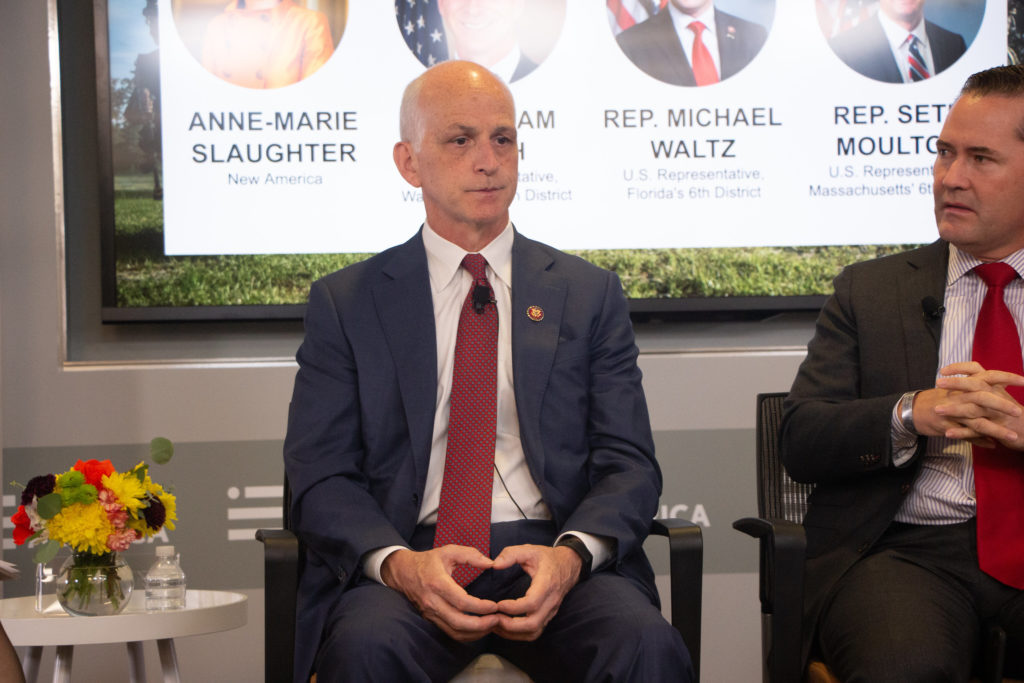
Representative Adam Smith described continuing challenges on the matter in a press briefing on Tuesday in the Chinese capital, where he’s leading the first official visit by US House lawmakers since 2019 as relations steady before a potential meeting between the countries’ presidents.
“I don’t think we resolved the rare earth question,” Smith said, without specifying what the sticking points are. “I think that that still needs to be worked on.”
China dominates the global supply and processing of the minerals, which are vital for everything from electric vehicles to advanced weaponry. Beijing has used its position as a strategic lever as trade tensions with the Trump administration escalated earlier this year.
The two governments reached a framework agreement in June that includes a Chinese commitment to review applications for shipping rare earth magnets, although few details of the deal have been disclosed. US Trade Representative Jamieson Greer last week said supplies to his country had “bounced back up significantly,” although European companies have complained about shortages that threaten to halt production.
Smith also struck a note of caution in response to a reporter’s question about whether Beijing-based ByteDance Ltd. will have any role in maintaining the app’s algorithm in the US. Citing privacy and security concerns, he said the matter has “not been 100% resolved,” while adding that he wasn’t privy to the negotiations.
The US and China are nearing an agreement to hive off the US operations of social media platform TikTok to a consortium that includes software giant Oracle Corp. Under the spin-off arrangement being discussed, TikTok will be majority-owned and controlled by Americans, according to White House Press Secretary Karoline Leavitt. Many of the finer details of the agreement have yet to be made public.
Joined by US Ambassador to China David Perdue, the delegation’s visit may build more goodwill ahead of a possible sitdown between US President Donald Trump and Chinese President Xi Jinping next month in South Korea. Throughout the trip, both sides expressed support for more engagements, with Beijing Mayor Yin Yong calling for more sub-national exchanges in a Wednesday meeting.
The world’s two largest economies are in the final stages of negotiations for a “huge” Boeing Co. aircraft order, Perdue said at the Tuesday briefing. Such a deal, which has been years in the making, would be the centerpiece of a trade agreement between the two nations but has been contingent on an easing in tensions.
On the security front, Smith, the top Democrat on the House Armed Services Committee, urged Beijing to engage in talks over its “rapidly growing nuclear arsenal” to prevent miscalculation.
“When you’re getting up into the hundreds, close to 1,000 on nuclear weapons, it’s time to start having a conversation about it to make sure that we understand each other,” Smith said. He stressed the need for better military-to-military dialogue, a message he delivered in meetings with Chinese officials including Premier Li Qiang since the delegation arrived on Sunday.
During the trip, the US delegation has also discussed the flow of fentanyl and called for fair access to China’s market for US firms.
The group met with National People’s Congress Chairman Zhao Leji and Foreign Minister Wang Yi later on Tuesday.
Wang praised the exchanges between the two heads of state for steadying relations and called on both sides to uphold them.
“Their conversations have set the tone and chartered the course for the bilateral relationship. In the recent period, this relationship has stabilized,” Wang said in his opening remarks. “This is not easy. We need to preserve this.”
CU
Hudbay Minerals temporarily shuts down Peru mill amid unrest
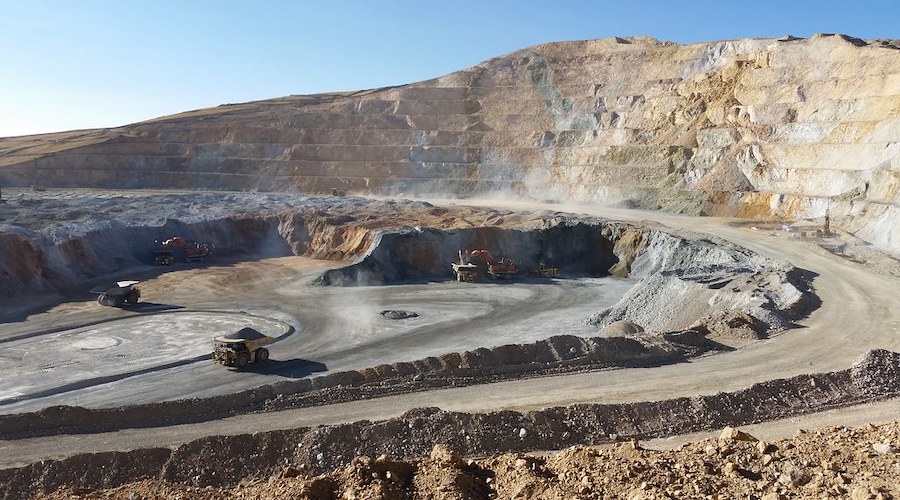
Canadian miner Hudbay Minerals said on Tuesday that its Constancia mill in Peru has been temporarily shut down and non-essential workforce has been demobilized due to riots in Lima and several protests across the country.
Peru’s informal miners have staged protests over stricter permit rules over the past few months, blocking key copper transport routes and disrupting operations.
Along with others in the southern mining corridor, Hudbay’s mine has been impacted by local protests and blockades.
The company added that it will continue to collaborate with government and legal authorities to engage with the protesters to achieve a resolution that will allow operations to return to normal as soon as possible.
Hudbay said these temporary disruptions will be resolved and will not impact its ability to meet its 2025 production and cost guidance range.
(By Katha Kalia; Editing by Alan Barona)
Goldman lowers copper supply forecast on Grasberg disruption, sees deficit in 2025
Goldman Sachs has lowered its global copper supply forecast for both 2025 and 2026, citing recent disruptions at the world’s second-largest copper mine.
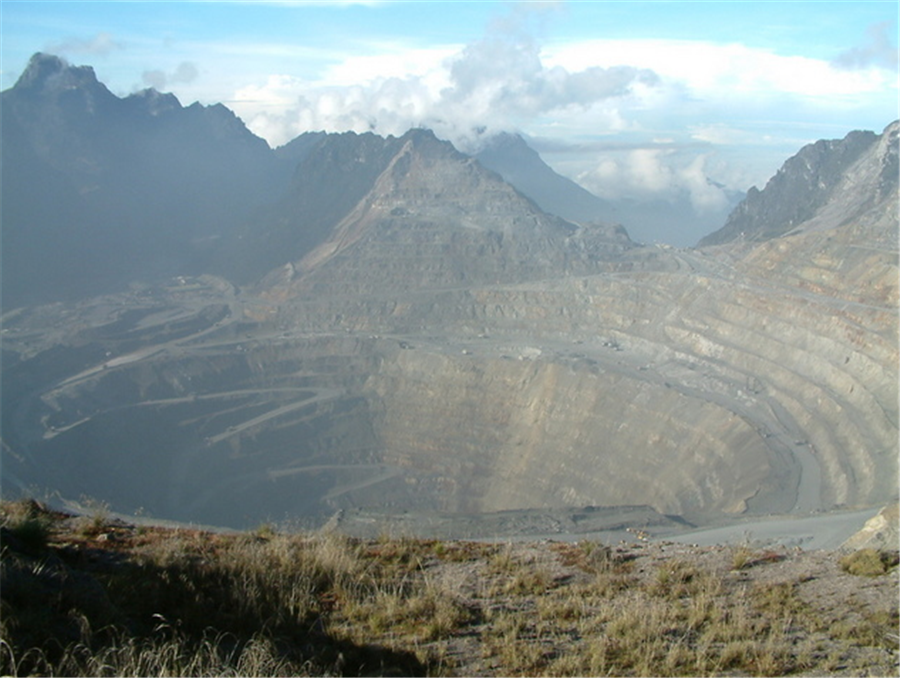
Production at the Grasberg mine in Indonesia has been under suspension since Sept. 8 after a landslide unleashed 800,000 tonnes of mud into the Block Cave area, trapping seven workers and causing severe damage across the mine’s infrastructure.
US-based Freeport McMoRan (NYSE: FCX), the mine’s operator, immediately halted mining activities to prioritize the rescue of the mine workers, and to date has recovered two bodies. As the search continues, the company has declared force majeure and is investigating the incident.
This disruption, Goldman estimates, could lead to as much as 525,000 metric tons of lost copper mine supply. As a result, the bank dropped its supply forecast for the second half of 2025 by 160,000 tons and its 2026 forecast by 200,000 tons.
Grasberg output hit
Production at Grasberg, consisting of the Block Cave as well as the Big Gossan and Deep MLZ mines, is now expected to fall by 250,000 to 260,000 tons in 2025 and by 270,000 tons in 2026, the bank added. Data from S&P Global shows that the mine had produced over 160,000 tons during the first half of 2025.
When it declared force majeure earlier this week, Freeport said it expects Grasberg’s fourth quarter production “to be very low,” as the unaffected areas (Big Gossan and Deep MLZ) of the mine could only restart in the middle of the quarter.
As for the rest of the mine, Freeport’s management said operations could restart sometime next year, though its 2026 copper output would be significantly lower — as much as 35% — than its previous forecast as it gradually ramps up production. A full recovery is anticipated in 2027, it said.
Shift to deficit
The setback has dealt a crucial blow to Freeport, as Grasberg accounts for half of its proven and probable reserves and 70% of its projected copper and gold output through 2029. Shares of the Phoenix, Arizona-based miner have fallen by more than 21% since its update, and are now trading at levels last seen during the April market turmoil.
Grasberg’s suspension also represents a turning point for the global copper market. Goldman says the disruption has shifted its 2025 global copper balance from a projected surplus of 105,000 tons to a deficit of 55,500 tons, though 2026 is expected to remain in a small surplus.
The projected production loss, Goldman says, exceeded its typical allowances for global supply disruptions. This has led the bank to revise its estimates for global mine production growth for 2025 to 0.2%, down from a previous forecast of 0.8%, and 1.9% the year after, down from 2.2%.
The supply risks further support Goldman’s bullish outlook on the price of copper, with the bank reaffirming its target of $10,750 a ton by 2027.
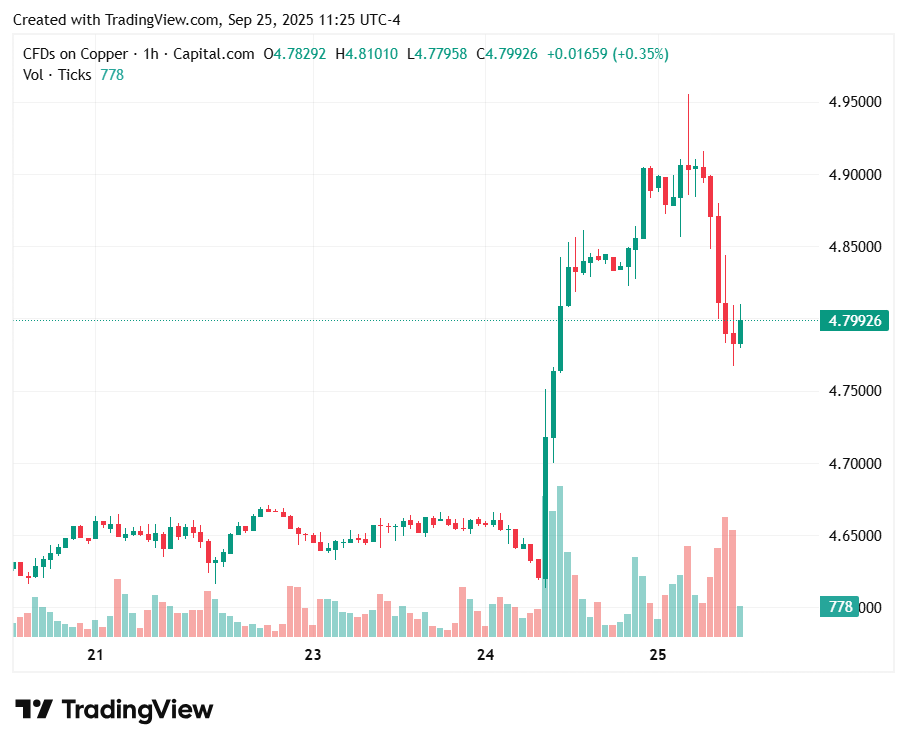
In the near term, Goldman sees upside risks to the December 2025 LME price forecast of $9,700 a ton, with possibilities of the $10,200-$10,500 range. Those contracts are currently priced at $10,336 a ton, up 3% on the day.