Strangers in a Strange Land: Dennis Walder and His Secret Jewish Mother
The Algerian-born French novelist, Albert Camus, a pied-noir, began his existentialist classic, The Stranger, with the now memorable words, “Mother died today. Or maybe yesterday, I don’t know. I received a telegram from the old people’s home: ‘Mother deceased.’” Camus would add, “In our society, any man who doesn’t cry at his mother’s funeral is liable to be condemned to death.”
Dennis Walder, channeling Camus, wrote colloquially in the opening paragraph of his newly published memoir, Amid the Alien Corn, “Mom died yesterday.” It’s not easy to compete with Camus, but Walder tries his level best. “Mom” works better for him than Camus’ “mother.”
The title for Walder’s book comes from John Keats’ “Ode to a Nightingale,” in which the poet valorizes the Biblical Ruth, a Moabite who marries an Israelite. She is “sick for home” and stands “in tears among the alien corn.” (The Biblical Ruth became the great-great-grandmother of King David.) Walder’s elusive, secretive mother is a kind of Wandering Jew without a real home who lives and dies largely a stranger to herself and her son.
The strange land in which mother and son exist as aliens is South Africa, a place of spectacular beauty in which a small white minority controls much of the destiny of the Black majority that acquiesce under the heel of a tyrannical regime and also rebel against it. Walder is an eyewitness to the traumatizing and liberating events of contemporary history in Europe as well as in Africa; empires collapse, fascism rises and falls, workers cry for their rights and ideas and philosophies like existentialism and Marxism come and go. Walder carried on. Colonized South Africa was not unlike colonized Algeria and so the nod to Camus seems apt.
The narrator doesn’t participate directly in the flux of events, but rather remains on the sidelines, observing and recording what he sees and hears. Nelson Mandela, Steve Biko, F. W. De Klerk, Margaret Thatcher, Gorbachev and others flicker across these pages and bring newspaper headlines to life.
Not long ago, I met Walder at a conference in Leeds, England and discovered that we shared a 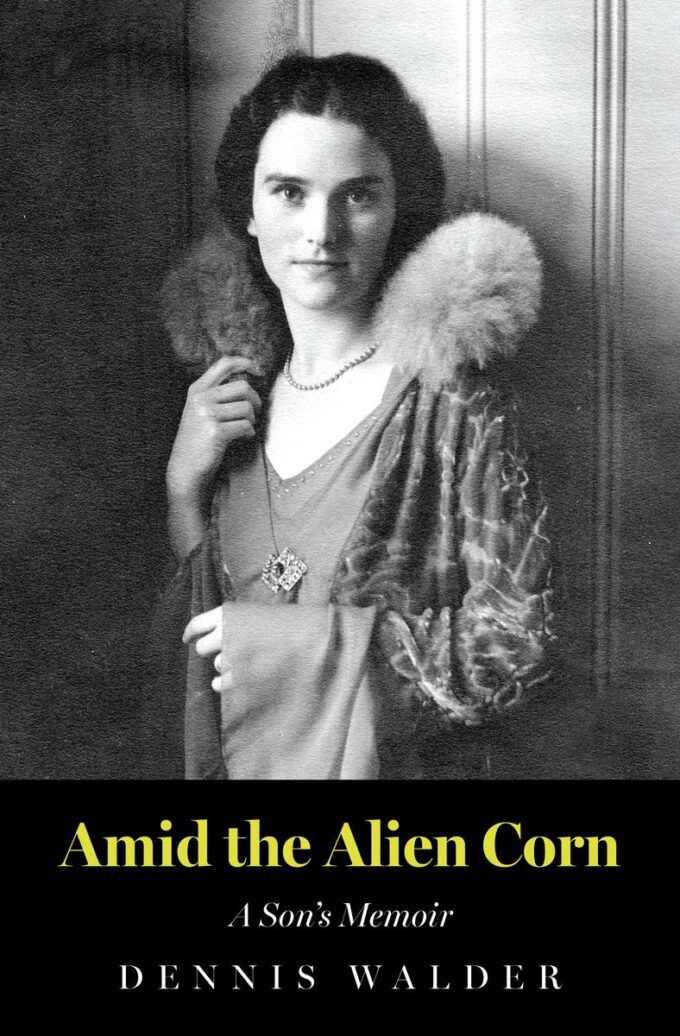 fascination with postcolonial fiction and the work of Doris Lessing, the Nobel Prize-winning author who was born in what was then Persia and who was raised in Southern Rhodesia before she settled in London in the late 1940s. The other day, Walder sent me a signed copy of Amid the Alien Corn. He included a note in which he said he’d been reading from his book to a “large Jewish community” in North London, where it was praised as a “fine example of life writing.”
I read the 377-page book in several sittings, and appreciated his disclosure in the acknowledgements that a cousin named Margot Merlin made him “realize the importance of remembering those lost in the Holocaust.” One would have thought that that realization had guided him all along. Apparently not.
In his opening chapter, Walder explains that when his sister told him of their mother’s death and the funeral, he “burst into tears, which dried quickly, making me wonder if there was something wrong with me.” Without a nurturing mother, Walder went through much of his life not knowing where he belonged, and even if he belonged anywhere. Still, he had suspicions.
An uncle called him a “fat Greek Jew,” but never explained what he meant. And when he dated a Jewish woman, she ended the relationship, she said, because he wasn’t Jewish. Too bad for him.
Dennis and his mother lived apart from the time he was a teenager and until her death in 1992. “So perhaps I should not have expected more from myself,” he explains apropos his all-too brief tears.
Ruth Walder, nee Liebenstein, lived most of her life in South Africa, but she didn’t consider herself a South African. She came from a well-off German Jewish family, though she didn’t know that she was Jewish. Hush hush, big secret. Not surprisingly, she felt an alien and unmoored. Her son Dennis grew up not knowing that he had Jewish ancestors.
Not until he embarked, as an adult, on a journey of self-discovery that took him year-after-year across Europe and Africa, and to the United States, where he met assimilated Jewish relatives who had changed the family name from Liebenstein to Livingston.
At Ellis Island officials changed my maternal grandparents from the Kvitkows to the Quitkins and the Quitkins it has remained to this day.
In Auschwitz, near the end of his wanderings, Walder learned that his great aunts, Rosalie and Meta Liebenstein, were murdered by the Nazis on 11 July 1942. It’s a somber moment in a somber life and it gives Walder pause. “I write this down,” he explains. “Proof that they once existed.” He had to write things down to remember them.
The lesson Walder learns from his search for his mother’s elusive past is not that “Every Man Dies Alone,” to borrow the title from Hans Fallada’s 1947 anti-fascist novel, but that, “if you allow people to live together, whatever their ethnicity or background, they may come to accept, perhaps even respect each other.”
Wishful thinking one might say. Tell that to South Africans, Black and white, the Irish, both Catholic and Protestant and to Israelis and Palestinians. Dennis Walder could be a utopian, though he often avoided romanticism and embraced the dark side. He echoes Camus, who said “at the heart of Beauty lies something inhuman.”
Ruth Walder— her son discovered when he took on the role of family detective—was baptized in 1913 on her second birthday and grew up believing that she was a “Lutheran Christian.” Her funeral took place, not in a synagogue but in an Anglican church.
Ruth shared with her son not an iota of family history and no information about her parents or grandparents, though as an adult Dennis learned that his ancestors, “the Liebensteins thought of themselves as German first, Jewish second and that the Nazis made them see themselves as Jewish first.” I have always felt quintessentially Jewish among anti-Semites.
Narratives about Jews and Nazis have been told repeatedly with variations by European authors, most recently by Edmund de Waal in his riveting best-selling memoir, The Hare with the Amber Eyes in which he recounts the harrowing story about his own wealthy, assimilated Jewish ancestors who were robbed by the Nazis of the art they collected, all their worldly possessions, their identities and their lives. Money didn’t protect them. Nothing did.
Walder assumed that the reason for his mother’s “silence” about her “family background was local antisemitism.” Local antisemitism? Wasn’t anti-semitism a global menace and wasn’t there little if any escape from it anywhere on the planet, though there were pockets of tolerance and mutual respect.
Walder lived most of his life feeling “alone in the world,” and occasionally was “glad to be an outsider.” He writes, “Secrecy is something our family trades in, our past like the scene of a crime.” No wonder he felt guilty that he belonged to an undefined conspiracy.
Of course, all families have secrets. My family kept the secret about my Aunt Sarah who committed suicide by throwing herself from the roof of a Brooklyn apartment building. Because a lover jilted her and because of the Depression of the 1930s, when she was unemployed. There’s more than one story to explain the secret of Sarah’s suicide
My own mother wasn’t maternal, but her sisters more than made up for Mildred Raskin’s emotional distance. Lily read the Old Testament to me when I was a boy and took me to the opera. Ada introduced me to the work of Isaac Bashevis Singer, and Lenore, who kept a kosher household, fed me on Friday nights when I was a college student.
Beginning in my own boyhood, I knew that I was Jewish, and knew, too, that my family on both my father’s and mother’s sides was also Jewish. That felt in part like a burden but it also felt like a mitzvah. My brother Adam went to Ukraine to search for ancestors and learned that they were killed by the Nazis in World War II.
Walder gave birth to his own myth. Instead of feeling proud about his past, he nurtured a sense of shame that was partially alleviated by immersion in the world of books that brought with them a sense of belonging. Teaching also filled a void.
Reading and writing became a kind of religion for Walder as it did for many American Jewish authors, thinkers and literary critics: Philip Roth, the author of The Plot Against America; Alfred Kazin, celebrated for his memoir New York Jew; Lionel Trilling, who passed for a gentile; and Bernard Malamud, who wrote the all-American baseball novel, The Natural.
The death of Ruth Walder provided no sense of closure for her son, but rather prompted him to “wonder who really, she was,” and “who I was to her?” About his mother’s silence, he asked, “Was she trying to protect us from knowing about her father’s family and their history as persecuted Jews?” That question triggered more questions and no hard-and-fast answers.
Raised in apartheid South Africa, and educated there and in the United Kingdom, Walder taught for decades at the Open University in London, which attracted older students from diverse backgrounds and provided a sense of community. He had a father and then a stepfather when his mother remarried, but neither provided emotional support.
Walder married twice, raised a family, and made friends with the English literati at the Times Literary Supplement (TLS), but often kept to himself and conducted research for books, articles and lectures. Perhaps his wounds generated creativity.
From his own experience, he knew what Wright Morris meant when he titled one of his books, The Loneliness of the Long Distance Writer. For most of his life, Walder avoided direct participation in the anti-apartheid movement, though he was sympathetic to its goals and he rejoiced when Nelson Mandela was released from prison.
Occasionally, he attended Communist Party meetings and admired Communist Party members and CP intellectuals like Arnold Kettle and E. J. Hobsbawm, but he never joined any Communist Party whether in Africa or Britain, and when urged by a “shabby” (his word) lefty organizer to join a protest for dock workers he asked himself “who was I, not only middle class but a foreign student to tell dock workers to strike?”
Still, he realized that much of the major international help toward ending apartheid in South Africa came from the communist world. Unlike me, Walder didn’t belong to any of the countercultural tribes that flourished in the Sixties and took away the sense of alienation and loneliness I harbored growing up in the Cold War 1950s.
When the Soviet Union collapsed and the Berlin Wall came down, Walder concluded that no “Marxist analysis of the inexorable forces of social change could have anticipated what has happened.” He joined the British Labour Party, but only as a lukewarm supporter.
Curiously, by his own admission, Walder was an odd and ambivalent sort of family detective. Indeed, he avoided “finding things out yet [felt] increasingly impelled to continue.” In that sense, he was a procrastinator. The journey to locate the truth seemed to mean more to him than a destination and a sense of certainty.
Still, I think I know how he felt when he allowed that he was “blissfully unaware of reality.” My aunt Ada called me a “liftmensch”: a man who lived on air and didn’t attend to life’s quotidian practicalities. In a world of trauma, living on air seemed like a way to protect me from harm.
I wouldn’t want to blame Walder’s troubles on his mother; Jewish mothers and the archetypal “Jewish mother” have taken the rap for things for which they were not responsible. Still, reading Amid the Alien Corn strongly suggests that if Ruth had been candid with her son about her past, and about her parents, he might have been less of a stranger to himself and to the world. He might even have been a happy person. I’m glad that while promoting his memoir, he connected to London Jews, a community I once knew well.